6843
Illuminating School Administrators‘ Solicitude On
Dual-Language Programme
Ashairi Suliman, Mohamed Yusoff Mohd Nor, Melor Md Yunus , Azlin Norhaini Mansor
Abstract: Dual Language Programme (DLP) is becoming more acceptable in the global education system. Many countries have started to employ this practice in their schooling system due to the benefits harvested from the programme. Prior to this, the Dual-Language Programme (DLP) in the Malaysian education system has commenced since the year of 2016. Resembling the previous controversial educational policy PPSMI, this programme highlights the use of English as a means of instruction in the teaching and learning of Science and Mathematics. To accentuate, the programme requires four main criteria for it to commence. School readiness has been one of the concerns in implementing DLP. Hence, this study divulges into the school administrators‘ lenses focusing on their understanding of the programme objectives and acceptance towards the programme. Given survey research design, this study employed questionnaire embedded with open-ended questions to gather the data. The study roped into a sample of 80 DLP school administrators nationwide. The results have disclosed positive outcomes from the respondents pertaining to the two constructs studied. The open-ended responses have also unearthed some significant and essential issues concerning the implementation of DLP. To recapitulate, the implementation of DLP needs to be taken into serious consideration by everyone involved. The availability of resources and facilities, human resource development as well as DLP students‘ welfare are some of the crucial elements that may progress its implementation should they are given utmost priority.
Key Words: Dual-Language Programme (DLP), education, English as second language, programme acceptance, school administrators, Science and Mathematics
————————————————————
1.
INTRODUCTION
Dual Language Programme (DLP) entitles for the teaching and learning of content subjects using the national language and target language. It allows for the development of academic learning besides nurturing literacy in which the target language is utilised half of the time (Watzinger-Tharp, Rubia & Tharp, 2018; Freire & Valdez, 2017). This means half of the instructional time will be conducted using the national language whereas the target language will accommodate the remaining time. The target language chosen depends on the context of the schooling system. In the global view, Mandarin, Korean and Spanish are among the languages commonly partnered with English in the context of United States DLP (Chen, Yang & Chen, 2017; Lindholm-Leary, 2016; Palmer & Henderson, 2016; Lee & Jeong, 2013). Besides the aforementioned languages, there is a growing pressure in utilising other languages in DLP. As elucidated by Christian (2016), Russian, Arabic and Vietnamese are among the languages commencing to be introduced in DLP but facing such obstacles in terms of scarcity of resources and experience. With that growing proliferation, the spread of DLP is also affecting the Malaysian education system. In the global context, DLP is very prominent and prevalent in the context of United States education system. As defined by the US Department of Education (2015),
dual language education is a bilingual education programme for which literacy and academic content are taught in two languages, English and a partner language. In addition, dual language immersion schools have demonstrated a rapid growth in the United states and become very essential all over America (Steele et al., 2017; Tran et al., 2015). On another note, Japan has also begun to implement this programme which is a means to promote the International Baccalaureate diploma programme in Japan secondary schools (Yamamoto, 2016). Indubitably, in discussing the implementation of DLP, it is imperative to understand the situation faced other countries enforcing the teaching of science and mathematics in English particularly for countries in which English is not the first language. Many countries have also introduced English as the main instructional medium in the teaching of these two subjects. This replicates Education First (2016) whereby English proficiency tends to be on a high level in regions which have language history to English. This includes South Africa (Mthiyane, 2016), Hong Kong (Pun & Macaro, 2019), Vietnam (Nguyen & Thi Kieu, 2015), Phillipines (Racca & Lasaten, 2016) and Malta (Mifsud & Farrugia, 2016). These studies have disclosed the experience undergone in the teaching of these subjects using English. Before DLP commences in the Malaysian education system, there was a policy resembled the context of this programme regulated earlier. The policy of Teaching Science and Mathematics in English or commonly known as PPSMI was introduced in 2002. Aiming at maximising the human capital and reaching the standard of a developed nation (Suliman, Nor & Yunus, 2017), the policy regulated the teaching of all science and mathematics subjects using English as the instructional medium. This somehow in agreement with Dearden (2014), English serves as the instructional language used in the content subjects especially for countries in which English is not the first language. The PPSMI policy was conducted in all levels of education, since primary school up to the tertiary level. Prior to this, the policy was also introduced as the government intended to acknowledge the decline in the English mastery among Malaysians and accelerate the interest in science and mathematics fields (Azman, 2016; Yunus & Sukri, 2017). Furthermore, Samah (2008) proposed that in order to visualise Vision 2020, it requires the mastery of English language _______________________________
• Ashairi Suliman, PhD Scholar, Department of Education Leadership and Policy, Faculty of Education, Universiti Kebangsaan Malaysia E-mail: [email protected]
• Mohamed Yusoff Mohd Nor, Deputy Dean of Community Partnership and International, Faculty of Education, Universiti Kebangsaan Malaysia E-mail: [email protected] • Melor Md Yunus, Deputy Dean of Research and Innovation,
Faculty of Education, Universiti Kebangsaan Malaysia E-mail: [email protected]
besides excellence in the domains of science, mathematics and information technology. Holding to these notions, PPSMI was executed. Conversely, the policy was not able to cater to everyone‘s needs. After going through debates and refutes for a period of a decade, the policy was fully abolished in 2014. The PPSMI implementation is perceived to a be a decade of failure from the macro, meso and micro levels of context (Ha, Kho & Chng, 2013; Mohandhas, 2015). Prior to this, Sumintono (2015) contended that the decline in the TIMSS result was clearly an evidence of the impact brought by the PPSMI policy. The post-PPSMI era has witnessed that dissatisfaction was still prevalent among parents who disagreed with English not being used as the instructional medium in science and mathematics as revealed by Habuan (2018). This implies that some groups still prefer for these two subjects to be taught in English. Hence, to cater to that needs, the government introduced an educational programme which has resemblance to the PPSMI policy, named as Dual Language Programme (DLP). The Malaysian Dual Language Programme (DLP) was introduced in the year of 2016. With 300 schools involved in the pilot project, the number has doubled up over the years. Though it is commonly perceived as the rebirth of PPSMI, it is different in terms of the implementation aspect (Suliman, Nor & Yunus, 2017). Two major aspects resemble PPSMI would be the subjects involved in the programme and the target language utilised in carrying out the teaching and learning process. Malaysian DLP advocates the use of either Malay or English as the language used in the teaching and learning of science and mathematics subjects (Suliman, Nor & Yunus, 2017; Shamsudin, Abdullah & Noh, 2018; Bullah & Yunus, 2019). The programme opens the opportunities for the interest group (schools, teachers, parents and students) to opt to their preferred language of instruction in the learning of science and mathematics. One prevalent thing is that both PPSMI and DLP espouse on the use of English as the means to disseminate science and mathematics knowledge and information. Adhering to four main rules, the programme works on a voluntary basis unlike PPSMI which was a compulsory educational policy. Few studies have been conducted since the inception of Dual Language Programme in the Malaysian setting. These studies unravel the implementation from the lenses of teachers and students involved with the programme. As unearthed by Bullah and Yunus (2019), the urban DLP teachers displayed positivism towards the implementation but disclosed their worries regarding the lack of facilities and resources which may dampen the programme. This somehow reiterates Unting and Yamat (2017) which suggested for more support and guidance to be given to the DLP teachers. Shamsudin, Abdullah and Noh (2018) on the other hand claimed that teachers were moderately ready with their skills, knowledge and interest. Suliman, Nor & Yunus (2017) in their preliminary study revealed that language mastery influenced the DLP students‘ moderate level of readiness and confidence. Two years after the preliminary study, Suliman, Nor & Yunus (2019) found positivity among DLP students but language mastery and ineptitude of understanding still persist as the main hindrance confronting them. This opposed Suliman, Nor & Yunus (2018) in their study involving non-DLP students who displayed positivity in their language capabilities and attitudes to learn using English. As more past researches zoomed into the lenses of students and teachers and little is known pertaining to the school administrators‘ views. More studies
also contextualised into the leadership practice employed by DLP administrators such as Mashur and Wahab (2019); Ghozali and Wahab (2019); Shah and Nor (2018). Hence, this study aims to unravel the administrators‘ perceptions who plays a fundamental role in the implementation of DLP in their respective schools. The following are the research questions aimed to be elucidated via this study.
i. What are the administrators‘ understanding and acceptance towards the programme?
ii. Why do the school decide to take part in the programme?
iii. What are the challenges encountered by the school in the programme?
iv. What are the suggestions to improve the programme?
2.
LITERATURE REVIEW
6845 as being proficient in the English language when they
participated in the DL programme rather than enrolled in the mainstream programmes. Thus, DL is regarded as a promising tool that would indirectly assist and nurture the language proficiency level of an individual.
3.
METHODOLOGY
This study employed mixed-method approach. Questionnaires and open-ended questions were executed to gather the data. To begin with, questionnaires were distributed to the respondents to understand their perceptions of the programme. To further consolidate the findings, open-ended questions would unearth the challenges faced by the school in the implementation of the programme.
3.1 Research Instrument
The survey questionnaire is a four-point Likert-scale questionnaire. The questionnaire was developed by the researcher based on the Malaysian DLP guidelines and with reference to Besar (2007). It consisted of three sections; the demographic profile of the respondents, understanding of the programme objectives and acceptance towards the programme. The total number of items in the questionnaire was 14. To further validate the instrument, it was sent to three experts of different fields such as language, psychometric and content. After amendments were made based on the experts‘ recommendations, the instrument was piloted with a sample of twenty respondents. Reliability test was generated and the Cronbach alpha value was 0.838. This indicates the reliability of the instrument. As for the open-ended questions, respondents were inquired three questions regarding (i) the reasons of school participation in the programme, (ii) the challenges faced by the school in the implementation of DLP and (iii) suggestions for the programme improvement. These were designed to unravel respondents‘ unheard voices and support the findings from the questionnaire. Furthermore, it is meant to gather more information pertaining to the implementation of the programme in the DLP schools.
3.2 Sample
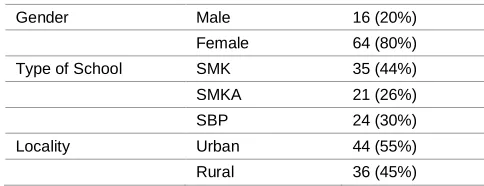
This study involved the administrators from the DLP schools. Hence, eighty administrators participated in the data collection process based on the purposive sampling technique. Initially, ninety-two respondents received the questionnaire but due to certain unexpected circumstances, the final valid responses were only eighty. They represented eighty secondary schools all over Malaysia involved with DLP. This includes national secondary schools (SMK), national religious secondary schools (SMKA) and fully residential schools (SBP). The following table describes the details of the respondents.
TABLE 1
PROFILE OF THE RESPONDENTS
Gender Male 16 (20%)
Female 64 (80%)
Type of School SMK 35 (44%)
SMKA 21 (26%)
SBP 24 (30%)
Locality Urban 44 (55%)
Rural 36 (45%)
3.3 Data Collection and Analysis
The questionnaires were distributed to the respondents and clarifications were made to enlighten them. The data collection took almost three months as the distribution of the samples varied from one state to another. The researcher also sought help from some friends who were teaching in the DLP schools to gather the respondents‘ participation. The findings from the questionnaire were analysed using a statistical software, SPSS Version 20. As this is a survey research design study, descriptive statistics involving frequency, percentage and mean were employed. There was no inferential statistical test conducted in this study. The mean score for each item was interpreted based on four levels (very negative, negative, positive and very positive). On top of that, responses from the open-ended section were analysed by using content analysis approach. Then, the researcher extracted the codes and categories that would provide meaningful data to the study. In the end, few themes were identified to answer the second, third and fourth research question.
4.
FINDINGS AND DISCUSSION
4.1 Administrators’ Understanding and Acceptance towards Dual Language Programme
The administrators‘ perspectives were scrutinised via two aspects: understanding of the programme objectives and acceptance towards the programme. Results will be displayed in terms of the mean score and interpretation of the score. The following table describes the respondents‘ understanding of the programme objectives.
TABLE 2
RESPONDENTS’ UNDERSTANDING OF THE PROGRAMME OBJECTIVES
No. Item Mean Interpretation
1 DLP increases the learning
interest in Science 2.88 Positive
2 DLP increases the learning
interest in Mathematics 2.77 Positive
3
DLP increases the exposure to the English language in the classroom
3.40 Very Positive
4 DLP strengthens English mastery 3.35 Very Positive
5
DLP eases students in getting Science and Mathematics exposure at the international level
3.39 Very Positive
6
DLP broadens students‘ marketability in the employment sector
3.23 Positive
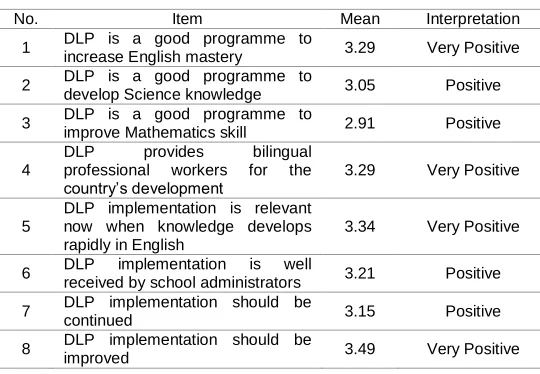
TABLE 3
RESPONDENTS’ ACCEPTANCE TOWARDS DLP
No. Item Mean Interpretation
1 DLP is a good programme to
increase English mastery 3.29 Very Positive
2 DLP is a good programme to
develop Science knowledge 3.05 Positive
3 DLP is a good programme to
improve Mathematics skill 2.91 Positive
4
DLP provides bilingual professional workers for the
country‘s development 3.29 Very Positive
5
DLP implementation is relevant now when knowledge develops rapidly in English
3.34 Very Positive
6 DLP implementation is well
received by school administrators 3.21 Positive
7 DLP implementation should be
continued 3.15 Positive
8 DLP implementation should be
improved 3.49 Very Positive
Based on the above table, the respondents have disclosed positive acceptance towards DLP. In spite of their positivity, it is interesting to note that the highest scoring item was ‗DLP should be improved‘. This implies that DLP is not a perfect programme and requires for improvements from various aspects. Resembling the finding from the previous section, the respondents‘ acceptance towards the programme is also associated to the needs of enhancing language mastery as indicated by item (1), (4) and (5). The respondents affirmed that DLP would assist the development of English among the students as well as teachers indirectly. Even though the respondents contended that DLP should be improved, they still believed that it should be continued as it is well-received by the administrators. As revealed earlier, respondents‘ acceptance towards DLP as a means to develop science and mathematics recorded the lowest mean score. Hence, it can be ascertained that DLP would improve English skills more than science and mathematics skill.
4.2 Reasons to Take Part in the Programme
The qualitative part of the study intends to discover the reasons leading to the school‘s decision to take part in DLP. Irrefutably, the school has to adhere to the four regulations before they could commence DLP. However, it is imperative to fathom what underlies the school to implement the programme. From the open-ended responses, it can be concluded that developing English language as the main reason leading to the schools deciding to take part in DLP. Majority of the respondents affirmed the needs to improve English among the students as well as the teachers have indirectly affected the choice. To further illustrate this, respondents claimed that ―Teachers and students are exposed more to the use of English language and given the chance to explore beyond the subjects like math, science and English‖, ―We see this as an effort to improve English proficiency‖, ―The English result improved as DLP programme implemented‖, ―Teachers could enhance their English skills via the courses provided by the Ministry‖ and ―Students gained more confidence in communicating in English‖. These excerpts have indicated that improving the proficiency in English language has somehow led to the school‘s decision to enrol in DLP. As reinforced by Aziz and Nair (2015), mastering English is an essential prerequisite for Malaysia to move towards becoming
a developed nation as English is the country‘s second language. Hence, it is not surprising to reckon the influence of English language in the education system that leads to the DLP participation by the schools.
4.3 Challenges Faced in the Programme
6847 English. Some would appoint overseas graduate teachers
believing they are competent in English although they had graduated for more than a decade. Despite the fact that some were previously teaching under PPSMI policy, the competency might be questioned as it was in the history. To curb this issue, some schools would send their DLP teachers to courses aiming to develop their language competency. Similarly, the English panel teachers would be lending their help to the science and mathematics teachers in setting the exam questions or on any random occasion.
4.4 Suggestions to Improve the Programme
As for the final research question, two major suggestions have been collated. They ascertained that the programme would be better if the teachers‘ proficiency is developed in line to the supposed standard. When the teachers are given and equipped with the courses and trainings to enhance their language mastery, they would be able to deliver the lessons better and more effective. Lacking of confidence would somehow lower down their confidence and self-esteem in the class. Initially, the respondents also alluded that by attending language classes the teachers would be able to enrich their vocabulary and other language skills necessary to teach the lessons in the target language. Among the excerpts garnered from the responses include ‗teachers should be properly trained when they were in universities or IPG‘, ‗teachers must be provided with opportunities to improve their English‘, ‗ongoing training for teachers as they are supposed to master well in English‘, ‗teachers teaching science and mathematics need to increase their English proficiency with the help of English teachers‘ and ‗give more English workshops for the teachers to develop their skills‘. In addition, respondents also believed that resources and materials need to be improved as they serve as the main learning texts for the teaching and learning process. The provision of the resources and materials to the schools needs to be improved in terms of its time. Respondents affirmed that the supply should be available before the semester commences to ease the distribution to both teachers and students. Similarly, they suggested for variety of resources and materials available in the bookstores to assist the teaching and learning process better. This is highlighted via ‗a module to be prepared to aid teachers such as workbooks or teaching aids that will help a lot‘, ‗prepare more reference books and materials‘, ‗provide more science and mathematics references in the English language‘, ‗prepare bank questions for the students‘, ‗books, resources and materials for the ease of teachers to be provided‘ and ‗more additional materials that may assist teachers and students‘. Administrators believed that the supply and provision of these materials would ease teachers‘ burden in preparing for the lessons.
5.
CONCLUSION
The study has revealed that the school administrators were found display their positivism in regards to the implementation of DLP. They believed that DLP should be continued, yet improvements are inevitable. Prior to that, the school perceives DLP as a means to develop and improve English language mastery among the students in particular as well as the teachers indirectly. However, without doubt, both teachers and students‘ competency and proficiency may pose a great challenge in the implementation of this programme. Therefore, more actions and provisions are needed to render to solidify
the current situation. More efforts would be deemed in enhancing the language mastery among the teachers and students. School administrators would need to organise more courses and trainings that may assist the teachers besides boosting their confidence to teach in English. Similarly, schools need to promote more English language usage among the students via outdoor activities to engage them more with the language. Otherwise, the issue of language mastery will never be rectified. Besides, issues on materials and references need to be solved to ensure the smoothness of the teaching and learning process. It is imperative that this study has its own limitations. Relying only on eighty respondents whereby there are more than a thousand Malaysian secondary schools involved in DLP might not suffice to really understand the existing situation. In addition, focusing on administrators‘ views solely may not address other issues that confront the school. Hence, it is suggested for future research to engage with more administrators of DLP schools. Furthermore, it is also recommended to investigate the administrators‘ perceptions on more administrative part such as the school facilities, resources, exam matters besides parents‘ responses towards DLP. That would somehow triangulate the data in a more comprehensive and detailed overview. Last but not least, interview sessions with teachers and students of the same school with the administrators may help to triangulate the data provided by the respondents. In encapsulation, Dual Language Programme will be a successful programme should more considerations and remedies are given to solidify its implementation. As this is the fourth year of its implementation, DLP has a long way to go to prove that it can be a sustainable educational programme. With the history of PPSMI policy, we should not repeat the same mistake. Improving the implementation of the programme will eventually assist the programme to be a better one benefitting the nation. The goal of the programme is very straight-forward, aiming to develop the interest in science and mathematics while at the same time enhance the English language. Hence, it takes everyone in the education system to work hand in hand to ensure the success of the programme.
ACKNOWLEDGEMENT
The authors would like to thank the Faculty of Education, Universiti Kebangsaan Malaysia for the funding provided under GG-2019-032.
REFERENCES
[1]. Aziz, R. M. R. A. & Nair, R. 2015. Globalisation and the evolution of English language education in Malaysian secondary schools. In Spolsky, B. & Sung, K. (Ed.), Secondary School English Education in Asia. New York: Routledge.
[2]. Azman, H. 2016. Implementation and Challenges of English Language Education Reform in Malaysian Primary Schools. 3L: The Southeast Asian Journal of English Language Studies 22(3): 65 – 78.
[3]. Besar, J. A. 2007. Polisi pengajaran dan pembelajaran Sains dan Matematik dalam Bahasa Inggeris: Kajian impak di Selangor dan Terengganu. Masters Dissertation, Universiti Kebangsaan Malaysia.
Programme (DLP) in Urban Schools. Asian Social Science 15: 24–31.
[5]. Chen, Y., Yang, T., & Chen, H. L. 2017. Challenges Encountered in a Chinese Immersion Programme in the United States. The Asia-Pacific Education Researcher 26: 163–170.
[6]. Christian, D. (2016). Dual Language Education: Current Research Perspectives. International Multilingual Research Journal, 10, 1–5.
[7]. Dearden, J. 2014. English as a medium of instruction- a growing global phenomenon. https://www.britishcouncil.org/sites/.../e484_emi_- _cover_option_3_final_web.pdf
[8]. Education First. 2016. EF English Proficiency Index. Retrieved from www.ef.com/epi.
[9]. Freire, J. A., & Valdez, V. E. 2017. Dual language teachers‘ stated barriers to implementation of culturally relevant pedagogy. Bilingual Research Journal 40: 55–69.
[10]. Ghozali, M. F. & Wahab, J. A. 2019. Konsep Kepimpinan Lestari dalam Kesediaan Pengetua/Guru Besar Melaksanakan Dual Language Programme Di Sekolah. National Research Seminar Proceeding, pp: 8-16.
[11]. Ha, P. L., Khoo, J., & Chng, B. 2013. Nation Building, English as an International Language, Medium of Instruction, and Language Debate: Malaysia and Possible Ways Forward. Journal of International and Comparative Education 2(2): 58-71.
[12]. Habuan, D. A. A. 2018. Using Spolsky‘ Model in Examining Malaysia‘s National Language Policy. ELS Journal on Interdisciplinary Studies in Humanities 1(3): 321-327.
[13]. Lee, J. S., & Jeong, E. 2013. Korean-English dual language immersion: perspectives of students, parents and teachers. Language, Culture and Curriculum 26: 89–107.
[14]. Lindholm-Leary, K. 2012. Success and challenges in dual language education. Theory into Practice 51: 252–262.
[15]. Lindholm-Leary, K. 2016. Students‘ Perceptions of Bilingualism in Spanish and Mandarin Dual Language Programs. International Multilingual Research Journal 10: 59–70.
[16]. Lindholm-Leary, K., & Howard, E. 2008. Language and academic achievement in two-way-immersion programs. In T. Fortune & D. Tedick (Eds.). Path-ways to bilingualism: Evolving Perspectives on Immersion Education. England: Multilingual Matters. [17]. Mashur, M. & Wahab, J. A. 2019. Principal
Instructional Leadership and Its Influence on Teachers‘ Readiness on Teaching and Learning Process of DLP in Secondary School Melaka Central. 2nd International Conference on Business, Humanities and Education Conference, pp: 174 – 191.
[18]. Mifsud, J., & Farrugia, J. 2016. Language choice for science education: policy and practice. The Curriculum Journal 28: 83–104.
[19]. Mohandhas, P. 2015. A policy analysis of the delivery of primary and secondary school
mathematics and science in English. Education Research and Perspectives 42: 246 – 285.
[20]. Mthiyane, N. 2016. Pre-service teachers‘ beliefs and experiences surrounding the use of language in science classrooms: A South African case study. Nordic Journal of African Studies 25: 111–129. [21]. Nguyen, N. D. & Thi Kieu, O. P. 2015. Enhancing
The Effectiveness of Teaching Mathematics in English at Universities of Education. Paper presented at National Conference for Young Lecturers in the Universities of Education.
[22]. Palmer, D. K., & Henderson, K. I. 2016. Dual Language Bilingual Education Placement Practices: Educator Discourses about Emergent Bilingual Students in Two Program Types. International Multilingual Research Journal 10: 17–30.
[23]. Pun, J., & Macaro, E. 2018. The effect of first and second language use on question types in English medium instruction science classrooms in Hong Kong. International Journal of Bilingual Education and Bilingualism 22: 64–77.
[24]. Racca, R. M. A. B. & Lasaten, R. C. S. 2016. English Language Proficiency and Academic Performance of Philippines Science High School Students. International Journal of Languages, Literature and Linguistics 2(2): 44 – 49.
[25]. Samah, A. A. 2008. The Development of English Language Policy in Malaysia: The New Policy on Science and Mathematics in The Medium of English. Doctorate Dissertation, University of Sussex. [26]. Shah, A. I. M. & Nor, M. Y. M. 2018. Kesediaan
Guru, Sekolah dan Murid dalam Pelaksanaan Dual Language Programme (DLP). IPGKPI Educational Research National Seminar Proceeding, pp: 418-429.
[27]. Shamsudin, N., Abdullah, N. & Noh, N. M. 2018. The Primary School Science Teachers‘ Readiness towards The Implementation of Dual Language Programme (DLP). Jurnal Pendidikan Sains dan Matematik Malaysia 8: 34–45.
[28]. Steele, J. L., Slater, R. O., Zamarro, G.,Miller, T., Li, J., Burkhauser, S. & Bacon, M. 2017. Effects of Dual-Language Immersion Programs on Student Achievement: Evidence from Lottery Data, American Educational Research Journal 54(1): 282 – 306. [29]. Suliman, A., Nor, M. Y. M. & Yunus, M. M. 2017.
Dual language programme in Malaysian secondary schools: glancing through the students‘ readiness and unravelling the unheard voices. GEMA Online Journal of Language Studies 17: 128–145.
[30]. Suliman, A., Nor, M. Y. M. & Yunus, M. M. 2018. Gleaning into Students‘ Perspectives in Learning Science and Mathematics Using the English Language. The Journal of Social Sciences Research 2: 445–456.
[31]. Suliman, A., Nor, M. Y. M. & Yunus, M. M. 2019. Sustaining the implementation of Dual-Language Programmes (DLP) in Malaysian secondary schools. Global Journal of Business and Social Science Review 7(1): 91 – 97.
6849 (ISSE). Universitas Negeri Yogyakarta. Indonesia,
October.
[33]. Tran, N. A., Behseta, S., Ellis, M., Martinez-Cruz, A. & Contreras, J. 2015. The Effects of Spanish English Dual Language Immersion on Student Achievement in Science and Mathematics. E-Journal of Education Policy 2015 Special Issue.
[34]. Unting, J. G. & Yamat, H. 2017. Dual Language Programme: Teachers‘ Voice. 73 ISERD International Conference, pp. 20–24.
[35]. US Department of Education. 2015. Dual Language Education Programme: Current State Policies and Practices. Washington DC: American Institutes for Research.
[36]. Watzinger-Tharp, J., Rubio, F., & Tharp, D. S. 2018. Linguistic performance of dual language immersion students. Foreign Language Annals 52: 199–201. [37]. Yahaya, M. F., Noor, M. A. M., Mokhtar, A. A.,
Rawian, R. M., Othman, M. & Jusoff, K. 2009. Teaching of Mathematics and Science in English: The Teachers‘ Voices. English Language Teaching 2(2): 141 - 147.
[38]. Yamamoto, B. A., Saito, T., Shibuya, M., Ishikura, Y., Gyenes, A., Kim, V., Mawer, K., Kitano, C. 2016. Final Report on Implementation and Impact of the Dual Language IB DP Programme in Japanese Secondary Schools.