IJSRR, 7(4) Oct. – Dec., 2018 Page 1125
Research article
Available online www.ijsrr.org ISSN: 2279–0543
International Journal of Scientific Research and Reviews
Population Growth, Urbanisation and Overcrowding cities: An
Analysis of Changing Scenario in India
YesurajanM.
Department of Economics (PG & Research), The American College, Madurai, Tamil Nadu
ABSTRACT
Urbanization in India and in a large portion of the underdeveloped nations is yet at a low dimension however the urban areas are as of now demonstrating uncontrolled hyper-urbanization depicting the similar trend of the developed world. Since the start of the last century, the urban space of India is quickly extending. A noteworthy piece of urban development is credited to the specific movement to bigger towns and urban communities, predominantly the capitals and region head quarters having the best alluring power. This truly brings outcomes consistently developing disparities and basic irregular characteristics inside the distinctive classes of urban settlements and districts of the nation and state. Generally, urbanization in India is at its essential dimension with 285 million urban populaces, which is 27.78 per cent of the aggregate populace, according to the 2001 evaluation. There are nine states and six association domains recording urbanization over the national average. The study is an endeavour to analyse the pattern of urbanization in India.
Keywords: Urbanisation, population growth, migration, urban crisis,present scenario.
*Corresponding author
M. Yesurajan
Assistant Professor,
IJSRR, 7(4) Oct. – Dec., 2018 Page 1126
INTRODUCTION
In India, an expanding pattern towards urbanization has been recorded from the earliest starting point of this present century. A fascinating part of the 2011 Census was that for the first time since India's achievement of freedom, the outright increment in overviewed populace was observed to be more in urban zones than in rustic regions. The Level of Urbanization in India, which is likewise viewed as a record of financial improvement, expanded from 27.81 per cent in 2001 to 31.16 per cent in the 2011 Census. Statistics of India 2011 uncovered that there is an aggregate of 7,935 towns in the nation. It is fascinating to take note of that the quantity of towns has expanded by 2,774 since the last Census (of 2011). What is considering all the more intriguing to note is the way that out of the aggregate 7,936 towns, 6,166 are a piece of the urban casing of the nation by being bunched together as urban agglomerations of variable sizes. Just 1,770 towns in India are autonomous of any urban bunching. The aggregate number of towns/urban communities in India with populace over 1,00,000 (One Lakh or 0.1 million) is 468. These are otherwise called Class I Cities/Towns.
The developing convergence of population in urban territories has been making numerous issues and irritating the urban condition. India is confronting a house deficiency in urban regions right now and all the more lodging would be required with the end goal to take care of future demand. This interest originates from the financially weaker segment because of the absence of lodging arrangements. There is a substantial dependence on private transport that has prompted the blockage of streets and expanding driving time and contamination. Street organizes subsequently need to expand in light of the deluge of these vehicles in the urban territories. Extend periods of time of congested driving conditions are normal in numerous metropolitan urban communities. Water lack is another extreme issue in urban territories. The water supply in India faces a few issues and the water and wastewater administration in the nation should be moved forward. Expanding urbanization has prompted expanding request in vitality utilization. India enormously needs to expand their capacity creating limit and grow better approaches for producing power. The higher centralization of vagrant work in the urban zones prompts stuffing. The impact of urbanization in India has not been exceptionally amiable as alongside the quick spread of urbanization there has likewise been the productive development of tremendous ghettos and shanty towns where individuals have been keeping up a hopeless life. Moreover, high centralization of the populace in class I and class II towns have offered ascend to a lot of issues.
IJSRR, 7(4) Oct. – Dec., 2018 Page 1127
deal with this urban development in a practical way while a synchronous need exists for improving the urban biological communities. Our urban communities should be beneficial, brilliant and atmosphere flexible and our urban approach needs to center around comprehensive development. Urban focuses in India will keep on developing in any event till the center of this century and our strategies will decide whether we move development in a couple of urban focuses or make savvy, liveable urban communities in all parts of India. The last is by all accounts the diagram of feasible urban improvement.
OBJECTIVES OF THE STUDY
The present study aims to deal and analyse various aspects of urbanisation in India with the following objectives: -
1. To understand the growth and distribution pattern of urban population in India.
2. To understand the demographic characteristics of urban population and urban centres.
METHODOLOGY
The study is analytical in nature. The study makes the use of secondary data pertaining to the urban centres and population. The entire data of urban population have been collected through secondary sources published by Census of India, General population tables. Some of the recent data are also collected from the web site of census of India and from various other web sites and publications. The study covers the census data from 1901 to 2011. Inaddition the study obtained data from World Urbanization Prospects, 2014 published by United Nations for analysing world urbanisation trend.
TREND OF URBANISATION IN INDIA
IJSRR, 7(4) Oct. – Dec., 2018 Page 1128
percent in 1971 registration and after that imperceptibly rose to 23.7 percent in 1981. Again in 2001, the aggregate size of urban populace in India expanded to 285 million when contrasted with that of 217 million out of 1991. This demonstrates the extent of urban populace to add up to populace of India has expanded from 25.8 percent in 1991 to 27.8 percent in 2001. The temporary figure of aggregate urban populace of India in 2011 is evaluated at 377 million which is assessed at 31.16 percent of the aggregate populace of the nation. In addition, the aggregate number of towns in India which was just 1627, step by step rose to 3060 out of 1951, 3126 out of 1971, 4029 of every 1981 and after that to 5166 of every 2001.
Urbanization in India started to quicken after independence, because of the nation's selection of a blended economy, which offered ascend to the advancement of the private part. Urbanization is occurring at a quicker rate in India. Populace living in urban zones in India, as indicated by 1901 enumeration, was 11.4%. This tally expanded to 28.53% as indicated by 2001 enumeration, and intersection 30% according to 2011 evaluation, remaining at 31.16%. As indicated by an overview by UN State of the World Population report in 2007, by 2030, 40.76% of nation's populace is relied upon to live in urban territories. According to World Bank, India, alongside China, Indonesia, Nigeria, and the United States, will lead the world's urban populace flood by 2050.
Quick ascent in urban populace, in India, is prompting numerous issues like expanding slums, diminish in way of life in urban regions, likewise causing ecological harm. India's urban development rate is 2.07% which is by all accounts critical contrasted with Rwanda with 7.6%. India has around 300 million individuals living in metropolitan zones. This has incredibly caused ghetto issues, with such a significant number of individuals stuffing urban areas and driving individuals to live in hazardous conditions which additionally incorporates unlawful structures. Water lines, streets and power are deficient with regards to which is causing fall of expectations for everyday comforts. It is likewise adding to the issue of a wide range of contamination.
Table 1: Degree of Urbanization in India Year Urban Population
(%)[U/P]*100
Rural Population (%) [R/P]*100
Rural-Urban Ratio (%) [U/R]*100
1901 10.8 89.2 12.11
1911 10.3 89.7 11.48
1921 11.2 88.8 12.61
1931 12 88 13.64
1941 13.9 86.1 16.14
1951 17.3 82.7 20.92
1961 17.97 82.03 21.91
1971 19.91 80.09 24.86
1981 23.34 76.66 30.45
1991 25.72 74.28 34.63
2001 27.86 72.14 38.62
IJSRR, 7(4) Oct. – Dec., 2018 Page 1129
Source: Census of India, 1901-2011.
Table 1shows that the annual exponential growth rate of urban population has increased from 10.8 per cent in 1901 to 12 per cent in 1931. The share of urban population in the total increased from 19.91 per cent in 1961 to 31.16 per cent in 2011. This indicates that an increasing trend of India’s urbanization over the decades.
According to the census numbers, India's populace remained at 1.21 billion in 2011. The share of India's populace living in urban territories expanded from 27.81 percent to 31.16 percent in the intercensal period 2001-2011. Examination over the two time frames 1991-2001 and 2001-2011, shows that the rate of development of populace of India has backed off. Over the intercensal period 1991-2001, the populace expanded by 21.5 percent (18.1 percent in rustic and 31.5 percent in urban). In the intercensal period 2001-11, India's populace expanded by 17.6 percent (12.2 percent in rustic and 31.8 percent in urban). The decrease in general development of populace can be ascribed to the decrease in the development rate of populace in rustic zones. As far as total numbers the populace expanded from 1.029 billion to 1.21 billion. A fascinating measurement is that, out of the blue since India's autonomy in 1947, the outright increment in urban populace over the intercensal period 2001-11 is bigger than the expansion in provincial territories.
Independence in 1947 brought political and also financial auxiliary change. Monstrous open part interest in chosen pockets, particularly amid the Second and Third Five Year Plans (1955– 65), helped in rebuilding the urban chain of command. Notwithstanding, local differences held on, in spite of people in general part assuming a noteworthy job in coordinating concentrated speculations towards "in reverse" zones. This is on the grounds that the peak focuses did not make a suitable arrangement of urban settlements – as in many created entrepreneur economies – and left their hinterland for all intents and purposes immaculate. The suspicion of permeation and dispersion of development motivations from the middle to the fringe – normal for the Anglo-Saxon local improvement speculations – turned out to be invalid as the multiplier impacts got appropriated inside the expansive agglomerations. The change of vast urban communities from pilgrim to national capitals implied just an expanding centralization of low beneficial assembling and administration exercises that could discover an a dependable balance all the more effortlessly because of the changed political economy. The pace of urban development was fast amid the initial three decades after Independence; however that prompted more noteworthy in formalisation of the urban economy and to developing hardship as far as essential administrations (Amitabh Kundu, 2011).
IJSRR, 7(4) Oct. – Dec., 2018 Page 1130
IJSRR, 7(4) Oct. – Dec., 2018 Page 1131
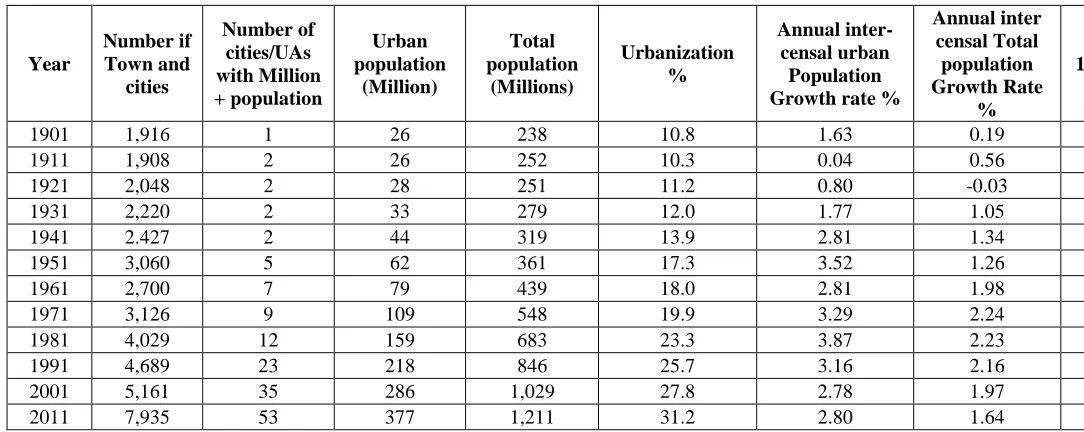
Table 2: Urbanization and urban Growth in India 1901-2011
Source: Census of India, 1901-2011.
Year Number if Town and cities Number of cities/UAs with Million + population Urban population (Million) Total population (Millions) Urbanization % Annual inter- censal urban Population Growth rate %
Annual inter censal Total population Growth Rate % Share of major 10cities as of
urban population
Share of Major 10 cities as of
total population Urban sex ratio Total sex ratio
1901 1,916 1 26 238 10.8 1.63 0.19 17.3 1.9 910 972
1911 1,908 2 26 252 10.3 0.04 0.56 19.4 2.0 872 964
1921 2,048 2 28 251 11.2 0.80 -0.03 19.8 2.2 846 955
1931 2,220 2 33 279 12.0 1.77 1.05 19.0 2.3 838 950
1941 2.427 2 44 319 13.9 2.81 1.34 22.0 3.0 831 945
1951 3,060 5 62 361 17.3 3.52 1.26 24.4 4.2 860 946
1961 2,700 7 79 439 18.0 2.81 1.98 26.0 4.7 845 941
1971 3,126 9 109 548 19.9 3.29 2.24 26.5 5.3 858 930
1981 4,029 12 159 683 23.3 3.87 2.23 25.7 6.0 880 934
1991 4,689 23 218 846 25.7 3.16 2.16 25.4 6.5 894 926
2001 5,161 35 286 1,029 27.8 2.78 1.97 26.0 7.2 900 933
IJSRR, 7(4) Oct. – Dec., 2018 Page 1132
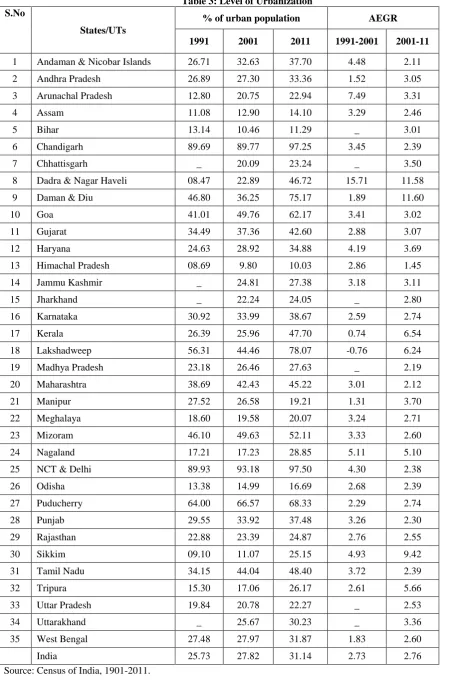
Table 3: Level of Urbanization S.No
States/UTs
% of urban population AEGR
1991 2001 2011 1991-2001 2001-11
1 Andaman & Nicobar Islands 26.71 32.63 37.70 4.48 2.11
2 Andhra Pradesh 26.89 27.30 33.36 1.52 3.05
3 Arunachal Pradesh 12.80 20.75 22.94 7.49 3.31
4 Assam 11.08 12.90 14.10 3.29 2.46
5 Bihar 13.14 10.46 11.29 _ 3.01
6 Chandigarh 89.69 89.77 97.25 3.45 2.39
7 Chhattisgarh _ 20.09 23.24 _ 3.50
8 Dadra & Nagar Haveli 08.47 22.89 46.72 15.71 11.58
9 Daman & Diu 46.80 36.25 75.17 1.89 11.60
10 Goa 41.01 49.76 62.17 3.41 3.02
11 Gujarat 34.49 37.36 42.60 2.88 3.07
12 Haryana 24.63 28.92 34.88 4.19 3.69
13 Himachal Pradesh 08.69 9.80 10.03 2.86 1.45
14 Jammu Kashmir _ 24.81 27.38 3.18 3.11
15 Jharkhand _ 22.24 24.05 _ 2.80
16 Karnataka 30.92 33.99 38.67 2.59 2.74
17 Kerala 26.39 25.96 47.70 0.74 6.54
18 Lakshadweep 56.31 44.46 78.07 -0.76 6.24
19 Madhya Pradesh 23.18 26.46 27.63 _ 2.19
20 Maharashtra 38.69 42.43 45.22 3.01 2.12
21 Manipur 27.52 26.58 19.21 1.31 3.70
22 Meghalaya 18.60 19.58 20.07 3.24 2.71
23 Mizoram 46.10 49.63 52.11 3.33 2.60
24 Nagaland 17.21 17.23 28.85 5.11 5.10
25 NCT & Delhi 89.93 93.18 97.50 4.30 2.38
26 Odisha 13.38 14.99 16.69 2.68 2.39
27 Puducherry 64.00 66.57 68.33 2.29 2.74
28 Punjab 29.55 33.92 37.48 3.26 2.30
29 Rajasthan 22.88 23.39 24.87 2.76 2.55
30 Sikkim 09.10 11.07 25.15 4.93 9.42
31 Tamil Nadu 34.15 44.04 48.40 3.72 2.39
32 Tripura 15.30 17.06 26.17 2.61 5.66
33 Uttar Pradesh 19.84 20.78 22.27 _ 2.53
34 Uttarakhand _ 25.67 30.23 _ 3.36
35 West Bengal 27.48 27.97 31.87 1.83 2.60
India 25.73 27.82 31.14 2.73 2.76
IJSRR, 7(4) Oct. – Dec., 2018 Page 1133
Table 2 demonstrates the state insightful urban population in India amid 2001-11. Madhya Pradesh positions first among the states in India with 14.4 per cent urban populace in 2001 which has declined to 13.5 per cent in 2011, however, the state stay on the principal position. Uttar Pradesh (11.8%), Tamil Nadu (9.26%), West Bengal (7.71%) and Andhra Pradesh (7.48%) are the other driving urbanized states in India. The moderate pace of urbanization found in Sikkim. The level of the population living in urban zones of Sikkim has expanded from 0.02 per cent in 2001 to 0.04 per cent in 2011. Arunachal Pradesh (0.05%), Nagaland (0.15%), Mizoram (0.15%), Meghalaya (0.16%) and Himachal Pradesh (0.18%) has encountered low rate of urbanization. It is uncovered that the greater part of the North-Eastern states is encountering low rate of urbanization throughout the years. Table 3 uncovers the dimension of urbanization crosswise over Indian states and Union Territories. It is dissected a wide variety has happened as amid the achievement of urbanization among 28 states (barring Telangana) under the investigation the littlest state is Himachal Pradesh which accomplish 10 percent of urban populace. It is the most minimal among all states. Though Delhi achieved 97.5 percent of urban populace has the most noteworthy extent of urban individuals amid 2011. Among association regions, prior Dadar Nagar Haveli had stayed as littlest and biggest extent of urban populace. Be that as it may, in 2011 registration Among UT's Andaman and Nicobar islands have enlisted most reduced level of urban populace enrolled about 35.67 rates, while Chandigarh recorded at the largest amount 97.25 rate. At the point when contrasted with 2001 enumeration the circumstance is vastly improved in 2011 where West Bengal , Andhra Pradesh , Haryana, Punjab, Karnataka ,Gujarat Maharashtra, Kerala, Tamil Nadu and UT's of Andaman and Nicobar, Pondicherry, Daman and Diu had enrolled urban populace much over the national normal 31.16 rate. Yet, if there should be an occurrence of numerous retrogressive states like Manipur, Nagaland, Tripura, Sikkim, Rajasthan, Orissa and Most of the recently framed states have less extent of urban populace and underneath the national normal.
RECOMMENDATION AND CONCLUDING REMARKS
IJSRR, 7(4) Oct. – Dec., 2018 Page 1134
Quick industrialization and urbanization have just demonstrated their belongings as issues like blockage, over-populace and absence of room in numerous nations. Other social issues, for example, wrongdoing, misconduct liquor abuse, prostitution and dehumanization are available, as it were, in the nation. Congestion, ghettos, quick rhythm of life, break of essential connections and change in customary living, occupations, values and so forth are genuinely obvious in Indian scene. Mass movement from the provincial territories to urban areas and towns is making irregular characteristics in the economy. Urban conveniences and the arrangements of fundamental supply are progressively confronting the issue of deficiency and shortage. Lodging, sanitation, transport and medicinal offices are not adapting to the expanding request. Town-and urban arranging has in this way turned into a need of the time. Organizers, executives and social reformers are looked with troublesome issues. Consequently, the examination recommends the need of the viable arrangements for urban populace administration in India. With the end goal to confront the difficulties of urbanization, foundations should be progressed. Shockingly, fast populace development and an absence of satisfactory venture is making urban framework development moderate. Subsequently, the government should give consideration on the improvement of framework through public private participation.
REFERENCES
1. Atkinson, R. D. Technological Change and Cities. Cityscape: A Journal of Policy
Development and Research.1998;3(3):129–170. Retrieved from
https://pdfs.semanticscholar.org/316e/bd0f2eba8df9f7a67915b0bb3fb22b44403a.pdf
2. Eqbal, A. Trends of urbanization in India : a comparative analysis of 1981_91. 1999.Retrieved from http://shodhganga.inflibnet.ac.in/handle/10603/51785
3. Gollin Remi Jedwab Dietrich Vollrath, D., Jedwab, R., Vollrath, D., Campante, F., Davis, D., Duranton, G.,Yi, K.-M. Urbanization with and without Industrialization.2013; Retrieved from https://www2.gwu.edu/~iiep/assets/docs/papers/Jedwab_IIEPWP_2014-1.pdf
4. Harris, N. Urbanization, Economic Development and Policy in Developing Countries. 1990;Retrievedfromhttps://www.ucl.ac.uk/bartlett/development/sites/bartlett/files/migratedfil es/WP19_0.pdf
5. Kalamkar, S. S. Urbanisation and Agricultural Growth in India. Indian Journal Of
Agricultural Economics.2009;64(3):442–461. Retrieved from
http://ageconsearch.umn.edu/record/204644/files/13-Kalamkar.pdf
IJSRR, 7(4) Oct. – Dec., 2018 Page 1135
Review of Literature.2017;4(12):1–4. Retrieved from
http://oldrol.lbp.world/UploadArticle/349.pdf
7. Rees, P., Bell, M., Kupiszewski, M., Kupiszewska, D., Ueffing, P., Bernard, A., … Stillwell, J. The Impact of Internal Migration on Population Redistribution: an International Comparison. Population, Space and Place.2017;23(6):1–22. https://doi.org/10.1002/psp.2036 8. United Nations. 2014 Revision of World Urbanization Prospects.2014; Retrieved from
https://esa.un.org/unpd/wup/publications/files/wup2014-highlights.pdf
9. Bank, A. D.. Asia 2050: Realizing the Asian Century: Executive Summary.2011; Retrieved from https://www.adb.org/sites/default/files/publication/28608/asia2050-executive-summary.pdf
10.Kundu, A. Trends and processes of urbanisation in India Human Settlements Group, IIED Population and Development Branch, UNFPA Urbanization and Emerging Population
2011;6.Retrieved from
https://pdfs.semanticscholar.org/0410/50627c7b9ea7db53ad59f23ac05f70fe7295.pdf
11.United Nations. World Urbanization Prospects: The 2009 Revision.2010; Retrieved fromhttp://wedocs.unep.org/bitstream/handle/20.500.11822/18401/World_Urbanization_pros pects_2009_Revision.pdf?sequence=1&isAllowed=y