Licensed under Creative Common Page 746
http://ijecm.co.uk/
ISSN 2348 0386
ENHANCING SALES PERFORMANCE THROUGH
CUSTOMER KNOWLEDGE MANAGEMENT
FarhadMohammadzadeh
Master of Business Administration, Allameh Tabataba'i University, Tehran, Iran [email protected]
Ehsan Torbati
Master of Business Administration, University of Tehran, Tehran, Iran [email protected]
Reza Asadi
Master of Business Administration, Allameh Tabataba'i University, Tehran, Iran [email protected]
KouroshRazavi
Master of Business Administration, Islamic Azad University, Abhar Branch, Abhar, Iran [email protected]
Abstract
In the competitive environments of service businesses, the leading organizations attempt to
utilize their intangible capital in order to improve their sale performance. Among different
determinants of sale performance, this paper is to investigate the effects of customer knowledge
management. For this purpose, the simultaneous effects of three dimensions of customer
knowledge (knowledge for, about and from customer) on the criteria of sale performance have
been investigated. The research method is descriptive and correlational. The population of the
research consists of 875 managers and employees of a private bank in Iran. A sample of 270
subjects was selected using random sampling. Data collection tool is a standard questionnaire
that was used for the survey. Data analysis has been done through path analysis. The results
Licensed under Creative Common Page 747
sale performance of the bank. This shows the importance of customer knowledge management
in banking industry. Finally, according to research findings, some suggestions are presented to
enhance sale performance of distribution corporations.
Keywords: Sale performance, Customer knowledge management, Knowledge for the customer,
Knowledge from the customer, Knowledge about the customer
INTRODUCTION
By increasing the global competition, the leading banks turn to improve the business performance continuously and gain sustainable competitive advantage, particularly through innovation. Today, individuals and the leading banks worldwide seek to benefit from the innovation and entrepreneurial activities as their priorities in order to gain competitive advantage (Gundy, Luzov, Kilic and Alpkan, 2011). In fact, the rapidly changing needs and demands of customers, short life cycle of products / services, in stability of competitive advantage and any new global competition are among main reasons that led to increasing importance of answer to the question among leading organizations that "how we innovate and how we achieve the resources of sustainable competitive advantage? "(Johannessen and Olsen, 2010). Many organizations have found answers to these questions in innovation. Innovation bodes efforts of organizations to find new opportunities and new solutions to gain competitive advantage through new products, new services or improve processes (Dess and Lumpink, 2005). Thus, understanding and enhancing the determinants of innovation and how to use it in order to improve organizational performance are among fundamental issues these organizations are facing.
On the other hand, with the development of knowledge-based economy, focusing on intangible assets and their effective utilization is the priority of the leading organization (Raaswami, Rivastava & Bhargava, 2009). Among these capitals, knowledge has a special place as a basis for achieving core and strategic competencies for superior performance and gaining competitive advantage, and knowledge management has also become a key task for these organizations (Nonaka, Toyama and Konno, 2002). An important part of the organization's knowledge resources is knowledge about the customer and management and its effective utilization can also bring valuable achievements.
Licensed under Creative Common Page 748 sources of knowledge outside the organization that can be utilized by organizations to develop their competitive capabilities or create new capabilities (Rollins and Halinen, 2005); in other words, customer knowledge management leads to achieve new marketing opportunities with applying knowledge in connection with customers, that ultimately would achieve a higher level of performance and mutual value creation (Lin, Su and Chien, 2006). Knowledge creation can result in providing better products and services jointly by customers and organizations for the mutual value addition (Gebert et al , 2003). During the identification of customer knowledge as a key element for the ability to innovate, an organization can increase its innovative capabilities (Gebert et al., 2003).
When talking about customer knowledge management, the knowledge about the customers is considered as a valuable resource and can serve as a stimulus for innovation and organizational performance (Ismail Pour et al., 2016). It is also crucial for organizations active in the banking industry. Competition, dynamism and radical transformation in the environment that the banks face and the emergence of new competitors in this industry every day, highlight the use of customer knowledge and its effective utilization as a sustainable competitive advantage and improving their sales performance more.
Despite the importance of customer knowledge flows in organizational performance, studies regarding its use in order to improve organizational performance, particularly in private banks were not rich enough. Present research aimed to help in the reduction of this shortage, and studied the role of customer knowledge management in improving sales performance of the bank. The results of this study can be used to gain a more complete understanding of the nature and effect of every aspect of customer knowledge on determinants of bank sales performance and strategies to promote their performances will be offered.
RESEARCH BACKGROUND
Sale performance
The first model of sale performance was known as WCF. The model was developed from theory of expectation motivation (Vroom, 1964) and it revealed a direct relationship between purchase behavior, performance and variables related to personal, organizational and environmental factors (Weitz, 1981). The sale effectiveness is defined by four types of sale behaviors that are a) acceptance by customers; b) the possibility of influencing them; c) using effectiveness skills; d) controlling sale interactions (Plank and David, 1994).
Licensed under Creative Common Page 749 to each other. In order to establish more effective relationship, seller must be same as his customer. The successful sellers are those who adjust their communication styles to have better interactions with their customers. So having the more effective relationships, sellers should understand the motivation and attitudes of customers whose messages are received by sellers (Davis Dyreen, 2008). Studies indicate that success is the interactive process that depends on the interpersonal trust between seller and customer. The effectiveness of sale interactions includes the ability of seller to develop and understand customer ideas, the ability to discover and find the impact of effective strategies and adjust customer with these strategies, product performance and abilities of seller to choose strategies influencing customer. Accordingly, seller performance is a function of motivation level; competency, capacity and talent of selling; the realization of how to play these roles (Davis Dyreen, 2008). The evaluation based on reflections of customer make the judgment in sale procedure easy so it can be noted that adjustment is one of the main aspects of sale procedure ( Weitz. B, 1981)
Customer knowledge management
Knowledge management and customer relationship management both rely on one thing and it is to find the resources to support the business processes of a firm. Therefore, the combination of both theories of knowledge management and customer relationship management which is called customer knowledge management is recognized as the appropriate way to acquire knowledge from the customer and provide appropriate knowledge to him. Customer knowledge management means the use of tools and techniques of KM to support the exchange of knowledge between organizations and their customers and enable the firm to make appropriate commercial decisions (Paquette, 2006, Murillo and Annabi, 2002). Customer knowledge management has been also defined as the use of knowledge for, from and about customer in order to increase capabilities for customers by the organization (Rowley, 2002).
In fact, customer knowledge management uses knowledge management as a supporting
Licensed under Creative Common Page 750 satisfaction, increasing sales, improving customer retention, and making familiar the organization with customer-specific orientation knowledge.
Three types of knowledge flows that play a vital role in the interaction between companies and customers, include: knowledge "for", "from" and "about" customer. In the first stage, in order to support customers in their purchasing process the flow of knowledge is required which is directed from the firm towards customers (i.e. knowledge for the customer). Such knowledge will influence customer perceptions of service quality (Rollins 2005). Accordingly, the "customer knowledge" can be used to innovate, generate ideas and continuously improve the products and services.
Acquiring knowledge from the customer and involving customers in the innovation process can be done in different ways. For example, customer knowledge about products, suppliers and market trends can be used with the help of appropriate reflection mechanism to improve systematically and have innovative products. Collection and analysis of "knowledge about the customer," is one of the earliest forms of knowledge management activities in the field of customer relationship management. In addition to demographic information and past transactions, 'knowledge about the customers’ encompasses current needs of customers, their
future demands, communication, shopping activities and financial capability (Shami Zanjani and Najaflou, 2011).
Knowledge about the customer
The type of knowledge that helps organizations to know its customers know and target them effectively. There are three types of knowledge about the customer: demographic, psychological, and behavioral (Bose 2003). From the perspective of Shami Zanjani and colleagues (2008) knowledge about the customer, is the type of knowledge (as well as data or information that can be analyzed, interpreted, and eventually become knowledge) that the firm acquired to better understand its targeted customers. They believe types of "knowledge about the customer," as follow:
- Knowledge and information about current customer
Knowledge and historical data for existing customers
Knowledge and information about the needs of current customers
- Knowledge and information about potential customers
Knowledge and personal information of potential customers.
Knowledge and information about interests and preferences of potential
Licensed under Creative Common Page 751
Knowledge for the customer
Knowledge for the customer is a type of knowledge in order to raise the awareness and experiences of customers about products and services. The growth of E-commerce has made transferring tangible experience vital for the user. From Shami Zanjani and colleagues (2008) points of view, knowledge for the customer is a type of knowledge that our targeted customers have acquired to know us better. Data, information or knowledge for the customer can be acquired from various sources like other customers, competitors, institutions or consultancy companies to provide information required by the customer (Rowley, 2002). Knowledge for the customer is normally a one-way relationship from the firm to the customer that provides the customer- needed information about the organization for them so they will be able to better understand and know more about the products and services of organization (Day G.S, 2000 ) . From Shami Zanjani and others’ points of view (2008), types of "customer knowledge" include:
Knowledge and Information of products and services: knowledge and information
requirements of current customers and potential customers
Knowledge and public information of the organization: information of the recommender
,knowledge products of firm.
Environmental information and knowledge of firm: knowledge and market information,
information about products and services and competitors (Rowley , 2002).
Knowledge from the customer
Knowledge from the customer includes the ideas, views and information that the organization receives from its customers. These views can be about current products and services, customer trends and their future needs and ideas for innovation in the firm. Those ideas that are offered for successful product innovations are often received from the end customer, not from the organization. Hence, organizations must actively seek to acquire it. In doing so, customers should be helped to be creative in relation to the products and make them customized according to their specific needs and preferences (Bose, Sugumaran, 2003).
Licensed under Creative Common Page 752
Empirical Background
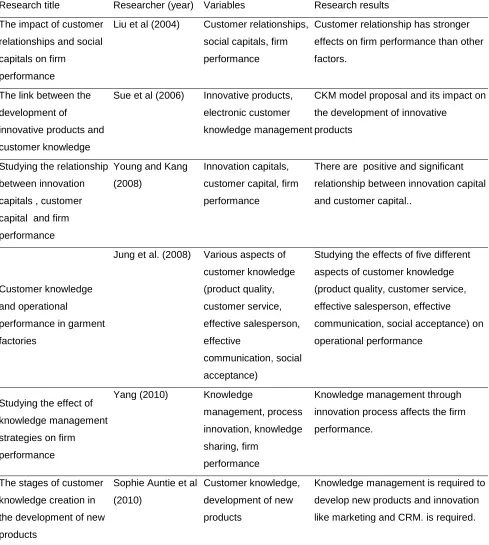
Some of the most important research questions in relation to the objectives of this study are summarized in the following table:
Table 1. History of empirical research
Research title Researcher (year) Variables Research results The impact of customer
relationships and social capitals on firm
performance
Liu et al (2004) Customer relationships, social capitals, firm performance
Customer relationship has stronger effects on firm performance than other factors.
The link between the development of
innovative products and customer knowledge
Sue et al (2006) Innovative products, electronic customer knowledge management
CKM model proposal and its impact on the development of innovative
products
Studying the relationship between innovation capitals , customer capital and firm performance
Young and Kang (2008)
Innovation capitals, customer capital, firm performance
There are positive and significant relationship between innovation capital and customer capital..
Customer knowledge and operational
performance in garment factories
Jung et al. (2008) Various aspects of customer knowledge (product quality, customer service, effective salesperson, effective communication, social acceptance)
Studying the effects of five different aspects of customer knowledge (product quality, customer service, effective salesperson, effective communication, social acceptance) on operational performance
Studying the effect of knowledge management strategies on firm performance
Yang (2010) Knowledge
management, process innovation, knowledge sharing, firm
performance
Knowledge management through innovation process affects the firm performance.
The stages of customer knowledge creation in the development of new products
Sophie Auntie et al (2010)
Customer knowledge, development of new products
Licensed under Creative Common Page 753
Customer knowledge management
The existing empirical literature review on the topic of research shows that knowledge management and customer knowledge play decisive roles in enhancing innovation and organizational performance. However, the role that can be played by customer knowledge management in enhancing sales performance of private banks is less considered. This study is intended to reduce this gap and promote the awareness in the field of sales performance antecedents of these organizations.
Conceptual Model
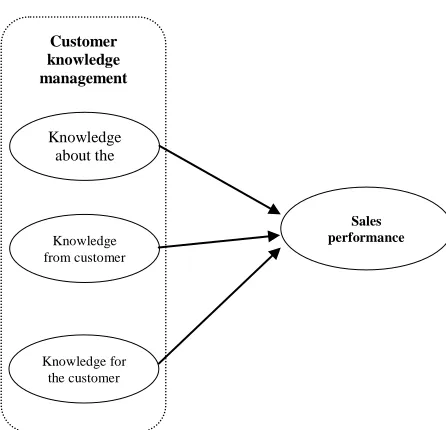
Based on the literature expressed in this research, The dimensions of customer knowledge management are considered as independent variables and sales performance as the dependent variable.
Three dimensions of customer knowledge management are adapted from Rollins and Halinen (2005), include three types of knowledge: knowledge from the customer, knowledge for the customer and knowledge about the customer. The effects of customer knowledge management on sales performance are also hypothesized based on the findings of Yang (2010) that show knowledge management is an important factor affecting organizational performance enhancement. For customer knowledge assessment, standardized questionnaire by Shami Zanjani and Najaflou (2011) was used. Accordingly, this conceptual model can be presented as figure1.
Figure 1. Conceptual model of research
Knowledge about the customer
Knowledge from customer
Knowledge for the customer
Licensed under Creative Common Page 754 Due to issues in the theoretical background and conceptual model developed, the mentioned hypotheses of this study are:
1. Knowledge about the customer has a positive effect on enhancing sales performance. 2. Knowledge from the customer has a positive effect on enhancing sales performance. 3. Knowledge for the customer has a positive effect on enhancing sales performance.
RESEARCH METHODOLOGY
This study is practical in terms of objectives; because its findings are used to solve specific problems within the organization. From the perspective of how to collect data, it is considered descriptive-correlational study; because the required information from the status quo of the statistical sample is obtained using a questionnaire. This study is also considered cross-sectional in terms of time procedure and quantitative in terms of data types.
Population examined in this study, consists of 870 managers and employees of a private bank in Tehran. The random sampling method is used. The sample size on the basis of sampling formula from a limited population is 270 subjects.
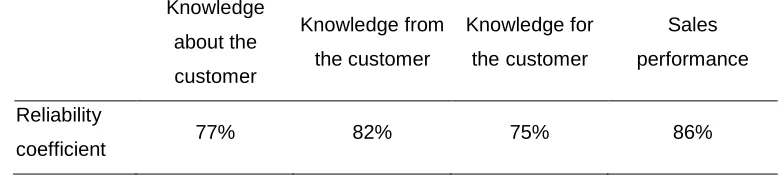
In order to collect primary field data, a 16-item questionnaire with five-level Likert scale was used. To test the reliability of the questionnaire, a prototype contains 30 questionnaire was pre-tested and then using the data and SPSS, reliability coefficient was calculated .83 using Cronbach's alpha. The reliability of the questions related to any of the variables are provided in table 2.
Table 2. Reliability of the questionnaire and each of the variables and their dimensions
Knowledge about the customer
Knowledge from the customer
Knowledge for the customer
Sales performance
Reliability
coefficient 77% 82% 75% 86%
ANALYSIS AND FINDINGS
Licensed under Creative Common Page 755 than .08 and p-value that must be less than .05 and AGFI that must be greater than .9. To determine the significance of customer knowledge management influence on sales performance and to assess the quality and extent of this effect, the significant models and standard models were used. About the significance of the obtained numbers, it can be said that since the hypothesis test is at confidence level of .95, significant numbers will not be between 1.96 and -1.96; This means that if a number is between 1.96 and -1.96, it will not be significant.
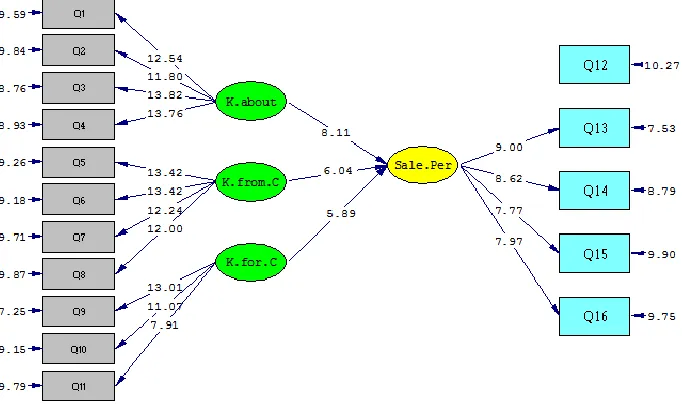
In order to examine the relationships mentioned in hypotheses, significance model of each anticipated relationship were examined and then the quality and extent of their effects are evaluated using standard model. Based on the indexes of table 3, we can judge about goodness of fit for the effect model of customer knowledge management on sales performance. The results of the assessment of the significance of relationships have been shown in figure 2.
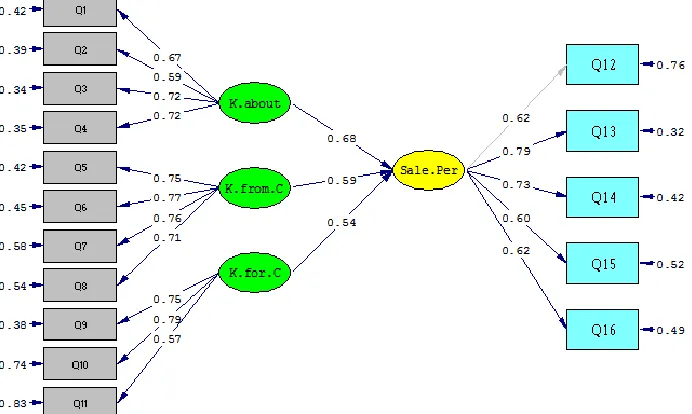
Figure 2. The effect model CKM on sales performance in significance mode
GFI shows appropriateness of measuring model of related variables; because the ratio of chi square to degrees of freedom equals to 1.77 and less than 3, RMSEA (i.e. .056) is less than .08 and greater than .05. Based on this model, the effect of the anticipated relationships are significant in all hypotheses; because their values for all hypothesis is greater than 1.96.
Table 3. GFI of the effect model of empowerment on sales performance
X2 / df AGFI GFI RMSEA
Licensed under Creative Common Page 756 Using the standard model, we can examine the effect of the relationships that their significance has been confirmed in this model.
Figure 3. The effect model CKM on sales performance in standard mode
Model in standard mode shows the positive effects of customer knowledge management on sales performance is verifiable. In this way, based on results obtained from the significant and standard models, we can summarize the hypotheses in table 4.
Table 4. The results of the study
Hypothesis Path: positive and significant effect of ....
Standard factor
Significant
numbers Result
1 Knowledge about the customer, on
sales performance .68 8.11 Confirmed
2 Knowledge from the customer's on
sales performance .59 6.04 Confirmed
3 Knowledge for the customer on sales
performance .54 5.89 Confirmed
Licensed under Creative Common Page 757 have significant and positive effect on sales performance of the private banks. Accordingly, knowledge about customers have had the most influential effect on the sale performance.
These findings are consistent with the results of earlier studies conducted in this area; for example, Nikraftar and colleagues (2014) found that organizational innovation in small and medium industries is related directly with marketing innovation. Ismail Pour et al (2016) also found that knowledge has a significant positive effect on the speed and quality of innovation as well as operational and financial performance of banks. This effect on the knowledge about the customer and for the customer has been positive but different. In addition, Yang (2010) also found that knowledge management has effects on organizational performance through the innovation process.
CONCLUSION
The present study investigates the effects of CKM on improving sales performance of his private bank. The severe competition among banks and the need for their effective and stable interaction they have with their customers make understanding and the effective exploitation of any types of customer knowledge play a crucial role in the promotion of the sales performance of the banks. The results of evaluating the effect of customer knowledge management on the sales performance of this bank represent significant and positive effects of all three types of customer knowledge in this field. Based on these results, it can be said that those banks that are willing to have higher performance in selling products and more customer loyalty, should take into account he effective CKM as a critical responsibility.
The vital importance of customer knowledge management for the bank is for this reason that today; enhancing awareness of people has been increasingly growing due to factors such as increasing development of information technology and social network. Changing needs and expectations of customers have occurred every day as a result of such trends. In addition, creating new competitive environment made it inevitable to pay special attention to the demands, needs and expectations of customers. In this competitive environment, using customer knowledge and managing it in a true way in innovation processes and performance of organization can help banks and financial institutions in achieving sustainable competitive advantage and enhancing sales performance as final objective. Improving product quality and service delivery to customers, enhancing customer satisfaction, better maintenance and retention of customers and ultimately increasing sales are among important achievements of implementing CKM optimally.
Licensed under Creative Common Page 758 customer knowledge on the sales performance of this private bank has been consistent with the findings of the study by Li and colleagues (2011).
The findings of this study indicate the significant and positive effects of knowledge from the customer on sales performance of the studied bank. This shows the importance of knowledge from the customer in banking industry. The banks can know about knowledge and products of competitors and attitudes of customers about these products and can add new products and services to their cart by modeling them. They can become aware of ideas from outside the organization quickly and as a result, they can innovate more quickly than competitors. In addition, the knowledge from the customer leads to improve products quality and services of the bank innovatively with providing new ideas. Furthermore, applying knowledge from the customer and operationalizing ideas derived from it ensure customers that their views have been taken into account by the organization and this can be a valuable incentive for participation of customers in the organization.
Based on the findings of research, knowledge about the customer also can help to enhance the sales performance of the banks. Identifying expectations, becoming aware of purchase behaviors and the preferences of current customers of the organization can provide appropriate opportunity to modify services and products delivery to customers and these can help to reinforce positive attitude of customer towards products and services of the bank and the desire to continue interacting with it. Understanding the motivations and expectations of potential customers also provide potential areas to actualize these customers and this enhances the sales performance of the bank.
The findings of this study suggest that “knowledge for the customer" has also a positive
effect on sales performance of this bank. Recognizing the knowledge and information needs of the current and potential customers of this bank and providing enough information about this bank and its products to the customer can make a positive -thinking among customers about this bank and it is likely to increase he preference for readmission to the bank. This creates the customer confidence and as a result, the customers are more willing to share their knowledge with the bank.
SUGGESTIONS
Licensed under Creative Common Page 759 customers. Accordingly, by enabling customers to create value jointly turns the customer from a passive recipient of the product to active partners in creating value.
To acquire knowledge from the customer, identifying sources of customer knowledge is essential to use it. Some of these proposed sources and methods to acquire knowledge from them include:
1. Interactions with customers: The banks are able to acquire valuable knowledge to enhance their performance by interacting effectively with their customers about their customer satisfaction of products, expectations of the customers and decision –making processes of customer knowledge.
2. Customer club: The banks are proposed to set up and have ongoing activities of the customer club about their ideas for new products and other usages of current products in order to acquire valuable knowledge and provide the context for the creation of multilateral value. 3. Analysis of customer transactions: The banks are proposed to acquire valuable knowledge from his source about the complementary products, consumer trends and seasonal usages and inventory control and use it in decision -making processes.
In order to identify knowledge about the customers, the banks are suggested to define their required knowledge about the customer first and then identify tools and sources of knowledge acquirement by recognizing the knowledge gap and develop their knowledge about the customer with their help.
To promote the success of the banks in acquiring knowledge from the customer, the three following ways are suggested:
1. Monitoring of customers: observing and monitoring the behavior of their customers and get their reflection about the products and services
2. Cooperation with loyal customers of this bank to gain their experiences in the use of intended services
3. Establishing and developing informal communication with customers in order to get their ideas and views on innovation in the new products
RESEARCH LIMITATIONS
There might be unwanted factors in any research that make limitations to the research; hence, some of the unwanted variables are not under researcher`s control. These factors must be determined and the researcher must show his knowledge about the influence of these factors on the research results. In the present study, there were some limitations such as:
Licensed under Creative Common Page 760 by which the understandings and attitude of any person is investigated; whereas, the reality might be different with respondent`s answers.
2) There are two issues must be considered regarding the nature and generalization of the research: firstly, there might be some practical behaviors like other survey researches that are mostly dependent on environmental conditions. Furthermore, intervening variables might affect the supposed relations among variables that are considered in this study.
3) Some other important limitations to this research include: reluctancy of some of the respondents to answer the questionnaires, not enough carefulness of some of the respondents in answering the questions, the possibility of bias in answering the questions by some of the respondents.
REFERENCES
Bose R., V. Sugumaran Application of Knowledge Management Technology in Customer Relationship Management. Knowledge and Process Management 2003; 10 (1): 3-17.
Davis Dyreen D (2008). The Influence of Salesperson leadership as a Customer Interaction Behavior on Sales Performance, Ph.D. Dissertation, Nova Southestern University.
Dess, GG & Lumpink, GT (2005). The role of entrepreneurial orientation in effective corporate stimulating entrepreneurship. Academy of executive management , 19 (1): 147-156.
Day GS Managing Market Relationships. Journal of the Academy of Marketing Science 2000; 2891): 24-30 .
Feng T., J. Tian Customer Knowledge Management and Condition Analysis of Successful CKM Implementation. Proceedings of the Fourth International Conference on Machine Learning and Cybernetics. Guanghou , two thousand and five; August 18-21.
Hagedoorn , J. & Cloodt, M. (2003). Measuring innovative performance: Is there an advantage in using multiple indicators? Research Policy. 32 (8): 13,651,379.
Gebert, H., Geib, M., Kolbe, L. & Brenner, W. (2003). Knowledge-enabled customer relationship management: Integrating customer relationship management and knowledge management concepts, Journal of Knowledge Management , 7 (5): 107. 123.
Gundy, G., Lusoy, G., Kilic, K. & Alpkan, L. (2011). Effects of Innovation Types on Firm Performance. International Journal of Production Economics , 133 (2): 662-676.
Johannessen, JA & Olsen, B. (2010). The future of value creation and innovations: Aspects of a theory of value creation and innovation in a global knowledge economy, International Journal of Information Management , 30 (6): 502.
Lin, Y., Su, HY & Chien, S. (2006). A knowledge-enabled procedure for customer relationship management, Industrial Marketing Management , 35 (4): 446 - 456.
Murillo G., H. Annabi Customer Knowledge Management. Journal of the Operational Research Society 2002; 53: 875-84.
Licensed under Creative Common Page 761 Plank Richard E, David A. Reid (1994). The Mediating Role of Sales Behaviors: An Alternative Peaspective of sales Performance and Effectiveness, Journal of Personal Selling & Sales Management, 14: 43-56.
Ramaswami, SN, rivastava, RK & Bhargava, M. (2009). Market-based capabilities and financial performance of firms: Insights into marketing ' s contribution to firm value, Journal of the Academy of Marketing Sciences , 37 (2): 97- 116.
Rollins, M. & Halinen, A. (2005). Compentence Customer Knowledge management: Towards a theoretical framework, The 38th Hawaii International Conference on System Sciences , Hawaii.
Rowley J. Eight Questions for Enhancing Customer Knowledge management in e-Business . Journal of Knowledge Management 2002; 6 (5): 500-511.
Rowley, j. E. (2002). Reflections on customer knowledge management in ebusiness, Qualitative Market Research: An International Journal , 5 (4): 268-280.
Rollins, M. & Halinen, A. (2005). Compentence Customer Knowledge management: Towards a theoretical framework, The 38th Hawaii International Conference on System Sciences , Hawaii.
Shami Zanjani M., Rouzbehani R., H. Dabbagh Proposing a Conceptual Model of Customer Knowledge Management: A Study of CKM Tools in British Dotcoms; 2008.
Vroom Victor H (1964). Work and Motivation, New York: Wiley.