A Study of the Distribution and Function
of P2 Receptors During Chick
Embryogenesis
Written by
Martin Meyer
Submitted to the University of London in 1999 for the
award of
PhD
ProQuest Number: U642429
All rights reserved
INFORMATION TO ALL USERS
The quality of this reproduction is dependent upon the quality of the copy submitted.
In the unlikely event that the author did not send a complete manuscript and there are missing pages, these will be noted. Also, if material had to be removed,
a note will indicate the deletion.
uest.
ProQuest U642429
Published by ProQuest LLC(2015). Copyright of the Dissertation is held by the Author.
All rights reserved.
This work is protected against unauthorized copying under Title 17, United States Code. Microform Edition © ProQuest LLC.
ProQuest LLC
789 East Eisenhower Parkway P.O. Box 1346
Abstract
The aim of this thesis is to investigate the possibility that extracellular nucleotides,
and their receptors (P2 receptors) are involved in regulating developmental
processes during chick embryogenesis.
In the first chapter, the classification, structure, and signal transduction
mechanisms of P2 receptors are described. The evidence that suggests that this
type of signalling has the potential to be important developmentally is also
discussed.
In the second chapter, in-situ hybridisation is used to describe the developmentally
regulated pattern of expression of cP2Yj, a G protein-coupled P2 receptor, in
multiple tissue systems during chick embryogenesis. This is the first description of
P2 receptor subtype expression during embryonic development of the chick, and
only the second time that expression of a specific P2 receptor has been described
during the embryonic development of an organism.
The following two chapters are devoted to investigating the function of cP2Y, in
one of the regions in which it is expressed, the developing limb. In chapter 3
monitoring of intracellular calcium is used to characterise the response of early
limb cells to extracellular nucleotides. This technique is used to show that in
addition to cP2Yj, at least one other P2 receptor subtype is expressed in early limb
cells. Monitoring of intracellular calcium, and RNase protection is also used to
show that within 24 hours of culturing, expression of cP2Y, is lost from limb
cells. Monitoring of intracellular calcium was then used as an assay to demonstrate
that expression of functional cP2Y, could be rescued in these cells by transfection
with an expression vector carrying the cP2Y, cDNA.
In the fourth chapter, the loss of cP2Y, in-vitro is exploited, using a gain-of-
function approach, to investigate a function for cP2Yj in limb development. Early
in-vitro assay of cartilage formation was used to provide evidence that cP2Y, may
have an important role to play in regulating the formation of the limb skeleton.
In the final chapter immunohistochemistry is used to show that two members of
the P2X, ligand-gated ion channel family of P2 receptors are expressed during
Acknowledgments
Far too many people have helped me throughout this Ph.D. to mention them all,
but special thanks must go to Jon Clarke for his patience, advice, and always being
willing to help. Thanks also to Prof. Geoffrey Burnstock for taking me on in the
first place. Ute Groschel-Stewart was also a huge help with the antibody staining,
as was Karl Swann with the calcium imaging. For providing endless distractions
in the form of beer, coffee, and pool. I’d like to thank Richie and Will, and for
their support, encouragement and advice Ketan Patel, Mary Rahman, and Jon
Gilthorpe. Lastly I ’d like to thanks Lou for putting up with me, and keeping me
Table of Contents
ABSTRACT 2
ACKNOWLEDGMENTS 4
TABLE OF CONTENTS 5
LIST OF FIGURES 12
CHAPTER 1 14
CHAPTER 2 36
CHAPTER 3 59
CHAPTER 4 86
CHAPTER 5 126
CHAPTER 6 142
Table of Contents
ABSTRACT 2
ACKNOWLEDGMENTS 4
TABLE OF CONTENTS 4
LIST OF FIGURES 12
CHAPTER 1
General Introduction 14
Early history of receptors for extracellular nucleotides and nucleosides 15
The PI and P2 receptor families 16
Molecular structure and transduction mechanisms of P2X receptors 18
Molecular structure and transduction mechanisms of P2Y receptors 21
Control of cyclic AMP levels by P2Y receptors 23
Release, metabolism and interconversion of nucleotides 25
P2 receptors as regulators of cell growth and differentiation 29
Purines as regulators of cell death 31
Physiological and pharmacological studies have demonstrated responses to extracellular nucleotides in a number of embryonic cell types 32
The P2Yg receptor was the first P2 receptor subtype shown to be
expressed during early embryonic development 34
CHAPTER 2
Analysis of cP2Y, Expression During Chick Embryogenesis Using Northern Blotting and In-Situ Hybridisation 36
Introduction 37
Previous studies have shown that P2Y receptors have the
potential to be important developmentally 37
The chick embryo is a good system in which to investigate
potential developmental roles for P2Y receptor signalling 38
There are a number of reasons for choosing cP2Y, in preference
to the other chick P2Y receptors 38
Methods 40
Embryos 40
Northern blots 40
Generation of riboprobes 41
Wholemount in-situ hybridisation 43
Results 46
cP2 Y] shows a dynamic pattern of expression in chick limb buds and seems to be expressed preferentially in
undifferentiated mesenchyme cells 46
The pattern of cP2Y, expression in the mesonephros suggests a possible role for this receptor in development of the glomeruli 51
cP2Y, expression in the branchial arches - the facial primordia 51
cP2Y, is expressed in the myotome - a compartment of cells
within each somite which contains muscle precursors 54
cP2Y, expression in the central nervous system appears
later in development at embryonic day 8 54
Discussion 56
A dual role for cP2Y, in regulating proliferation and
differentiation of cells in the developing limb? 56
cP2Yj and Glomemlar vascularisation 57
The pattern of expression in the chick CNS suggests a
role for cP2Y, in regulating neuronal differentiation 57
cP2Yj is expressed in skeletal muscle progenitors
CHAPTER 3
Analysing the Response of Chick Limh Mesenchyme Cells to Extracellular Nucleotides hy Monitoring
Intracellular Calcium Changes 59
Introduction 60
The chick limb is an excellent system to investigate a function for cP2Yp and by monitoring intracellular calcium several
important questions can be answered 60
Pharmacological studies of the recombinant cP2Y, receptor shows that it responds mainly to ATP and 2MeSATP,
and can functionally couple to phospholipase C 61
Methods 62
Ratiometric measurements of C3l^^- using Fura Red 62
Fluorescence detection 62
Cell culture 65
Dye Loading 65
Monitoring of intracellular calcium 6 6
RNase protection 6 6
Transfecting limb mesenchyme cells with a cP2Y,
expression construct 69
Results 71
ATP, 2MeS ATP, ADP and UTP elicited calcium responses
in freshly dissociated stage 2 0 - 2 2 limb mesenchyme cells 71 Limb mesenchyme cells cultured for 24 hours no longer
respond to ATP, 2MeS ATP, ADP and UTP. Expression
of cP2Y, was also downregulated during this period 75
Cells transfected with the cP2Y, receptor responded strongly
to 2MeSATP, ATP, and UTP, but only weakly to ADP 77
Discussion 83
CHAPTER 4
A Role for cP2Yj in Regulating Cartilage Formation 86
Introduction 87
An Outline of Vertebrate Limb Developmen 87
Anatomy of the developing limb 87
Pattern formation in the developing limb 8 8
Dorso-ventral patterning 8 8
Anterior-posterior patterning 90
The progress zone model of proximo-distal patterning 92
Patterning along the three axes is integrated 94
Hox genes mediate the instructions encoded by the
early patterning signals 94
Development of the limb skeleton 96
Molecular mechanisms operate at multiple stages to
regulate endochondral ossification 98
Methods. 103
Micromass cultures and transfections 103
Alcian blue staining of micromass cultures and GAG assay 103
ATP assay 103
Reactive blue-2 injections 104
Wholemount cartilage staining 104
Nile blue sulphate staining 105
Results 106
Transfection of limb micromass cultures with cP2Y,
reduces the amount of cartilage formed 106
The effect of cP2Y, expression on cartilage formation in micromasscultures can be blocked by the P2Y receptor
antagonist Reactive blue-2 108
cP2Y, acts at the initial stages of chondrogenesis 108
Injection of Reactive blue-2 into stage 20-22 limb buds
causes cell death 116
Prolonged exposure of cells in micromass cultures to low doses of Reactive blue-2 does not cause cell death, but a brief exposure to high concentrations of Reactive blue-2
increases the level of cell death in micromass cultures 118
Discussion 120
Results suggest that the loss of extracellular ATP signalling via the cP2Y, receptor is an important step in
cartilage formation in micromass cultures 1 2 0 Expression of cP2Y^ prevents formation of prechondrogenic
condensations in micromass cultures 1 2 0 ATP, the ligand for cP2Y, is produced by limb mesenchyme
cells and these cells have mechanisms in place
to break down extracellular ATP 121
Addition of Reactive blue-2 to transfected cultures blocks the
effect of cP2Y, expression on cartilage formation 122
The phenotype of Reactive-blue-2 injected limbs may be due
to cell death 123
Hypothesis 124
Summary 125
CHAPTER 5
Expression of Two ATP-Gated Ion Channels, P2Xg
and P2Xg During Chick Embryogenesis 126
Introduction 127
Physiological and pharmacological studies suggested that extracellular ATP may be an important signalling molecule
during development of chick skeletal muscle 127
Methods 128
Embryos 128
Antibodies and Western blotting 128
Results 130
Checking the specificity of the P2Xg and P2Xg
antibodies in chick tissues 130
P2 X^ and P2X^ immunoreactivity in developing
chick skeletal muscle 130
P2Xg Immunoreactivity in the developing nervous system 134
Discussion 137
Antibody specificity 137
A number of functionally distinct P2X ion channels could
potentially exist in developing chick skeletal muscle 138
Patterns of expression suggest that P2X^ and P2X^ mediate the developmentally regulated responses of chick
skeletal muscle to extracellular ATP 139
Sources of extracellular ATP, and possible functions for
P2 X5 and P2Xg in developing chick skeletal muscle 140
P2 X3 in the nervous system 140
Summary 141
CH A PTER 6
G en era l D iscussion 142
cP2Y,, a G protein-coupled receptor for extracellular ATP is expressed in developmentally regulated patterns in a number
of tissues during chick embryogenesis 143
Monitoring intracellular calcium was used to answer some important 144 questions regarding cP2Y, function in the developing limb
Expression of cP2Y, reduces cartilage formation in micromass cultures 145
cP2 Y] may perform multiple roles during limb development 146 The autocrine nature of P2 receptor signalling could reinforce
developmental decisions and coordinate cells to make these
decisions at the same time 147
The P2X^ and P2X^ antibodies can be used as tools to investigate the function and control of expression of these receptors during
skeletal muscle development 148
List of Figures
Chapter 1
Figure 1.1. Structure of Purine and Pyrimadine Nucleotides 17
Figure 1.2. Structure of P2X Receptors 20
Figure 1.3. Structure of P2Y Receptors 20
Figure 1.4. P2Y Receptor Signalling Mechanisms 24
Figure 1.5. Pathways for the Degradation and Interconversion of
Nucleotides 28
Chapter 2
Figure 2.1. Plasmid map of pRCCMV-cP2Y, 42
Figure 2.2. Northern blot Analysis of cP2Y, Expression During
Chick Embryogenesis 47
Figure 2.3. Expression of cP2Yj During Limb Development 50
Figure 2.4. Expression of cP2Y, in the Mesonephros 52
Figure 2.5. Expression of cP2Y, in the Branchial Arches 53
Figure 2.6. Expression of cP2Y, in the Somites 53
Figure 2.7. Expression of cP2Y, in the CNS 55
Chapter 3
Figure 3.1. The Excitation Spectrum of Fura Red 63
Figure 3.2. Apparatus for Calcium Imaging 64
Figure 3.3. Calcium Responses in Freshly Dissociated Limb
Mesenchyme cells 72
Figure 3.4. Calcium Responses in Freshly Dissociated Limb
Mesenchyme cells in the Presence of 5mM EGTA 73
Figure 3.5. Comparing Calcium Responses of Freshly Dissociated Limb Mesenchyme cells to Thapsigargin in Normal
Calcium and Reduced Calcium Conditions 74
Figure 3.6. Expression of cP2Y, is lost from limb mesenchyme
cells in culture 76
Figure 3.7. Calcium Responses in Limb Mesenchyme cells
transfected with pRCCMV-cP2Y, 78
Chapter 4
Figure 4.1. Signalling Centres and Limb Development 89
Figure 4.2. Expression Patterns of En-1, Lmx-1, and Wnt-7a
in the limb bud 89
Figure 4.3. The ZPA and Graded Morphogen Model of
Anterior-Posterior Patterning 91
Figure 4.4. The Apical Ectodermal Ridge and Proximo-distal
Limb Development 93
Figure 4.5. Hox gene Expression in the Chick Wing 93
Figure 4.6. Time course of Development of the Cartilaginous
Limb Skeleton 97
Figure 4.7. Model of Molecular Regulation of Chondrocyte
Differentiation 100
Figure 4.8. Expression of cP2Y, Reduces Cartilage Formation
in Micromass Cultures 107
Figure 4.9. The Effect of cP2Y,, ATP and Reactive blue-2 on
Cartilage Formation in Micromass Cultures 109
Figure 4.10. Expression of cP2Yj Reduces the Number of
Cartilage Nodules Formed in Micromass Cultures 109
Figure 4.11. ATP is broken down in Micromass Cultures 111
Figure 4.12. ATP is Produced by Cells in Micromass Cultures 111
Figure 4.13. Injection of Reactive blue-2 into Limb Buds results
in Shortening of the Limb Skeletal Elements 113
Figure 4.14. Quantifying the Degree of Shortening of the Humerus,
Ulna and Radius, as a result of Reactive blue-2 Injection 114
Figure 4.15. Injection of Reactive blue-2 Causes Cell Death in the
Early Limb 117
Chapter 5
Figure 5.1. Western blotting of Chick Embryo Crude Extracts
with P2 X5 anD P2Xg antibodies 131 Figure 5.2. P2X^ and P2X^ Preabsorbtion Controls 131
Figure 5.3. P2Xg and P2X^ Immunoreactivity in Developing Chick
Skeletal Muscle (I) 132
General Introduction
Intracellular nucleotides (ATP for example) play fundamental roles in energy metabolism,
nucleic acid synthesis, and enzyme regulation. Since the early part of this century there
has also been widespread appreciation that extracellular nucleotides and nucleosides (e.g.
adenosine) can act as signalling molecules, exerting a wide spectrum of biological effects
on many adult tissues and cells. The aim of this thesis is to investigate the possibility that
extracellular nucleotides are used as signalling molecules during embryonic development.
In this chapter, the history, classification, molecular structure, and transduction
mechanisms of the receptors for extracellular nucleotides is described, and the evidence
that suggests that this type of signalling has the potential to be important developmentally
is also discussed.
• Early History of Receptors For Extracellular Nucleotides and
N u c le o sid e s.
In 1929, Drury and Szent-Gyorgyi observed that extracellular nucleotides and
nucleosides, namely adenosine and ATP, exerted profound effects on the mammalian
heart. Following this report, there was considerable activity within the field, with
particular emphasis on the actions of adenosine and ATP on the cardiovascular system
(Gillespie, 1933; Green and Stoner, 1950; Holton, 1959; Berne 1963). In the 1960s, a
component that was neither adrenergic nor cholinergic was recognised in the autonomic
nerves supplying the gut and bladder (Burnstock et al., 1966), and later tentatively
attributed to ATP (Burnstock et al., 1970). As a consequence these nonadrenergic,
noncholinergic nerves were termed purinergic (Burnstock et al., 1970; Burnstock, 1972).
In the subsequent years, the purinergic theory was strengthened by a body of
experimental evidence supporting the role of ATP as a transmitter or co-transmitter with
receptors; PI receptors, activated by adenosine, and P2 receptors activated by ATP
(Burnstock, 1978). The original classification into PI and P2 receptors was based on 4
criteria: i) The relative potencies of ATP, ADP, AMP and adenosine; ii) the selective
actions of antagonists, particularly methylxanthines, which competitively antagonise
adenosine but not ATP actions; iii) the modulation of adenylate cyclase with the resultant
changes in intracellular cAMP levels by adenosine, but not ATP; iv) the induction of
prostaglandin synthesis by ATP, but not by adenosine. Since the time of this proposal,
many experiments have been carried out that support the P1/P2 classification, and it is
now well established and widely used in the literature (Abbracchio et al., 1993; Fredholm
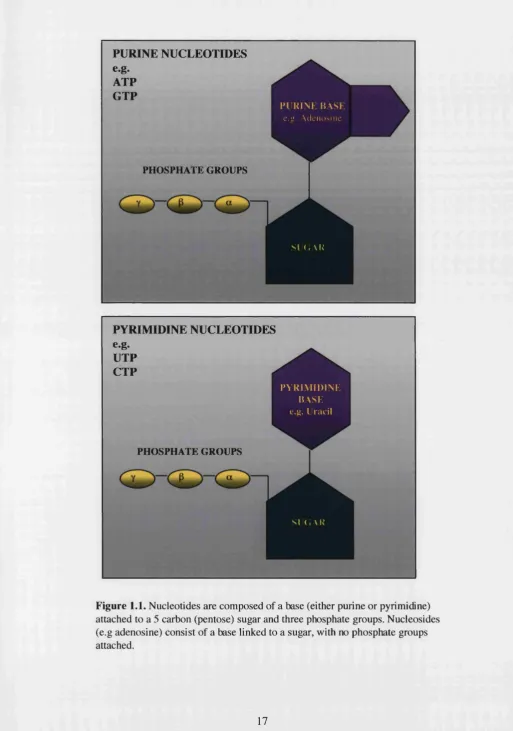
et al., 1994; Fredholm et al., 1997). (Figure 1.1 shows the structure of nucleotides).
• The PI and P2 Receptor Families
Following Burnstock’s proposal, subsequent work led to the demonstration of both PI
and P2 receptor subtypes, so that these now constitute relatively large receptor families.
Subclasses of the Adenosine (PI) Receptor. The PI receptor family
encompasses four different G protein-coupled receptors, termed A,, A2^, A^g, and A3, whose activation leads to either stimulation or inhibition of adenylate cyclase, with
corresponding changes in the levels of the intracellular second messenger, cAMP
(Fredholm et al., 1994). Analysis of experimental evidence supporting the
subclassification of PI receptors, and the physiological roles of the different subtypes is
not within the aims of this chapter, but is reviewed in Jacobson et al., 1992, and Linden
et al., 1994.
Subclasses of the P2 receptor family. There are now at least 13 different P^
receptor subtypes (Burnstock and King, 1996). This ever growing family of receptors
was initially proposed to include P2X and P2Y receptor subtypes, mediating
vasoconstriction and vasodilation respectively, and showing differential responses to
various synthetic ATP analogues (Burnstock and Kennedy, 1985). This was soon
extended to encompass two further receptor subtypes which did not fit the original P2X
PURINE NUCLEOTIDES
e.g.
ATP GTP
PHOSPHATE GROUPS
1*1 K I N K HA S I e.ii. A d e n o s i n e
S ( . VK
PYRIMIDINE NUCLEOTIDES
e.g.
UTP CTP
P Y K I M I D I N K HA SH
e . » . L r iic il
PHOSPHATE GROUPS
SI G \ K
aggregation, and a P2z receptor, activated by ATP"^ and mediating large increases of
plasma membrane conductance in several cell types. Later, responses to diadenosine-
polyphosphates (Ap^A) in various biological systems were claimed to involve specific P2
receptors that were different from the already characterised ones, and were consequently
termed P2d receptors (Pintor and Miras-Portugal, 1993). Some of these receptors also
responded to uridine nucleotides and were termed P2u receptors (O’Conner et al., 1991).
Evidence was also accumulating that suggested that different P2 receptor subtypes had
different molecular structures and electrophysiological properties, leading to the
recognition of both fast ionotropic, and slow metabotropic receptors for nucleotides
(Dubyak, 1991). This, and the cloning of the first receptors in 1993 and 1994, led to the
proposal of a new system dividing all naturally-occurring P2 receptors into two major
families, one a family of ligand-gated ion channels (the P2X receptors), and another
family of G protein-coupled receptors (the P2Y receptors) (Abbracchio and Burnstock,
1994). This classification of P2 receptor subtypes is now widely accepted, and at least 7
different ionotropic receptors (P2X,_^), and 6 different G protein-coupled receptors (P2Y,, P2 Y2, P2 Y3, P2 Y4, P2Yg and P2Yg) for nucleotides have been cloned so far from various species (Burnstock and King, 1996; Fredholm et al., 1997).
• Molecular Structure and Transduction Mechanisms of P2X Receptors.
Reviews of this class of receptors have been published by Bean, 1992, and in Dubyak
and El-Moatassim, 1993, thus in this chapter only the general features of these receptors
are discussed.
P2X receptors regulate cell function by gating ion permeability, and for the 7 cloned
subtypes, ATP or analogues of ATP are the principal ligands for this family of receptors
(Burnstock and King, 1996, and references therein). ATP can therefore be added to the
group of physiological compounds (e.g. acetylcholine, glutamate, GAB A, glycine, and
serotonin) that act as extracellular agonists for ligand-gated ion channels. Activation of
P2X receptors typically occurs within milliseconds, is in general followed by a rapid
at a number of defined synapses (Edwards et aL, 1992; Evans et al., 1992; Dubyak and
El-Moatassim, 1993). Neither G proteins nor second messengers appear to be directly
involved in the function of these P2X receptors. P2X ion channels exhibit little selectivity
for monovalent cations, but under physiological conditions Na'^ is the predominant
depolarizing ion (Benham, 1989; Evans et al., 1992; Christie et al., 1992). Activation of
P2X receptors in many tissues also results in increases in intracellular calcium
concentration ([Ca^^]J (Benham and Tsien, 1987; Benham, 1989; Schneider et al., 1991;
Christie et al., 1992), apparently occurring as a consequence of permeation of the P2X
channel(s) by Ca^^ (Benham, 1989; Bean, 1992). Activation of voltage-dependent Ca^^
channels may also account for secondary changes in [Ca^^]; following activation of P2X
receptors (Dubyak and El-Moatassim, 1993). The recent cloning of P2X receptor
subtypes has allowed for detailed analysis of recombinant P2X receptor subtypes in
isolation (in Xenopus oocyte expression studies for example), and the pharmacological
profile and channel properties of each receptor subtype is detailed in Burnstock and King,
1996. The cloning of P2X receptors has also revealed a new class of ligand-gated
receptors showing different features from the already characterised classes of the ligand-
gated receptors, such as the nicotinic and the excitatory amino acid receptors, which are
all characterised by four hydrophobic transmembrane domains (Evans et al., 1998; North,
1996). Each P2X receptor subtype is thought to have two membrane-spanning domains,
both the C- and N- terminals located intracellularly, and a large cysteine-rich extracellular
loop (Fig 1.2).
P2X subunits are able to form functional homo-oligomeric channels when expressed in
heterologous systems. Functional studies of native receptors, together with patterns of
subunit gene expression suggest that hetero-oligomeric assembly among members of this
family may also occur. Recently, strong evidence has been provided to support this. For
instance, co-expression of P2X% and P2Xg is required to produce the ATP-activated
J I \ R ( , K ( \ S I U N K - R U H - K \ T R A ( Ki l l I . AR I . OOl »
EXTRACELLULAR
INTRACELL
Figure 1.2. Structure of P2X receptors. (Adapted from North, 1996)
EXTRACELLULAR
I R W S M K M H R W t I K ) M VINS
Figure 1.3. Schematic structure of P2Y receptors, which contain seven hydrophobic transmembrane domains characteristic of G protein-coupled receptors. The N terminus is located extracellularly, and the C terminus intracellularly.
to form a novel channel (Torres et al., 1998). A recent study examined the ability of all
members of the P2X receptor family to interact using a co-immunoprecipitation assay. It
was found, that with the exception of P2Xg, all P2X subunits can form homo-oligomeric
complexes, and when co-assembly between pairs of subunits were examined, all were
able to form hetero-oligomeric complexes with the exception of P2X^ (Torres et al.,
1999). These results suggest that hetero-oligomeric assembly might underlie functional
discrepancies observed between P2X responses seen in the native and recombinant
settings, while providing for an increased diversity of signalling by ATP.
• Molecular Structure and Transduction Mechanisms of P2Y Receptors.
A broad range of extracellular hormones, neurotransmitters, chemoattractants, and other
extracellular stimuli produce their physiological effects by stimulating the second-
messenger signalling cascades that involve the action of an intermediate trimeric GTP-
binding regulatory protein (G protein). Deduced amino acid sequences based on cloned
nucleotide sequences are available for over 150 of these G protein-coupled receptors
(Parmentier et al., 1993). All of these proteins have seven transmembrane spanning
domains, and share notable conservation of sequence in these regions (Fig 1.3). Agonist-
occupied receptors in this superfamily of proteins specifically couple to one of at least 2 0 different heterotrimeric G proteins (Hepler and Gilman, 1992). Exchange of GTP for
GDP is promoted upon receptor activation. This leads to dissociation of the inactive
heterotrimeric protein into a GTP bound a-subunit, and a tightly associated dimer of p-
and y-subunits. In most cases the GTP bound a-subunit then interacts with, and activates
an effector enzyme or channel. Compelling evidence also exists for the direct regulation of
many effector proteins by py-subunits (Clapham and Neer, 1993). G protein-regulated
effector proteins range from adenylyl cyclase, the classical effector of the cAMP
signalling cascade, to inward-rectifying channels. Table 1.1 summarises the major
Table 1.1 The major families of trimeric G proteins'
F A M IL Y S O M E a - F U N C T IO N S M O D IF IE D BY
F A M IL Y S U B U N IT S B A C T E R IA L
M E M B E R S T O X IN
I Gs activates adenylate cyclase;
activates Ca^^ channels
cholera activates
Go.f ^olf activates adenylate cyclase
in olfactory sensory neurons
cholera activates
II Gi inhibits adenylate cyclase;
activates channels
pertussis inhibits
Go «0 activates channels;
inactivates Ca^^ channels;
activates phospholipase C-P
pertussis inhibits
G. « t activates cyclic GMP
phosphodiesterase in
vertebrate rod photoreceptors
cholera activates and
pertussis inhibits
III
_____ ... ______________ activates phospholipase C-p no effect
*Families are determined by amino acid sequence relatedness of the a subunits. Only selected examples are shown. About 20 a subunits, 4 (3 subunits, and 7 y subunits have been described in mammals (Taken from Alberts et al., 1994).
Phospholipase C (PLC) is the effector protein associated with cloned P2Y receptor
subtypes (Harden et al., 1998). This enzyme catalyses the hydrolysis of
phosphatidylinositol(4,5)-bisphosphate (PtdIns(4 ,5 )P2) to the Ca^^^ mobilising second messenger inositol(l,4,5)-triphosphate (Ins(l,4,5)P^), and to diacylglycerol, which
activates protein kinase C (PKC) (Berridge and Irvine, 1987). Mobilisation of Ca^"^., and
the cascade of intracellular protein phosphorylation initiated by activation of PKC, are
important regulators of cell growth, differentiation, transformation, secretion and
extracellular stimuli that regulate this pathway do so by activating seven transmembrane
spanning receptors that activate one of the four members of the class of G proteins
(Hepler and Gilman, 1992; Boyer et aL, 1994). An activated G^ a-subunit then
stimulates one of the multiple members of the phospholipase C-(3 class of isoenzymes.
The typical P2Y receptor transduction pathway is shown in figure 1.4.
To date, 7 P2Y receptors subtypes have been identified. These are P2Y,, P2Y^, P2Y^,
P2 Y4, P2Yg, P2Yg and P2Y,,. The cP2Y^ receptor has only been identified in chick (Webb et al., 1996), but shares 60% amino acid identity with the rat P2Y^ receptor
(Chang et al., 1995). However, the agonist potency profiles of P2Y^ and P2Y^ are
slightly different, so more studies are needed to determine whether the variations in the
agonist selectivities of P2 Y^ and P2 Y^ are species dependent or due to differences in expression systems before concluding that the P2 Y^ and P2 Y^ receptor truly represent different subtypes within the P2Y receptor family. Another cDNA (P2Y^) shows 20-30%
sequence homology with the other P2Y subtypes, but a question mark remains over its
functional identity (Li et al., 1997), and P2Y^, since its initial inclusion into the P2Y
family, has been identified as a leukotriene receptor (Yokomizo et al., 1996). In general,
adenine and uridine nucleotides are the ligands for these receptors (for detailed activities at
each subtype see Burnstock and King, 1996; Communi et al., 1997). However, the P2Yg
receptor is unusual in that it responds equally to ATP, UTP, ITP, CTP, GTP (Bogdanov
et al., 1997).
• Control of Cyclic AMP Levels By P2Y Receptors.
Extracellular ATP has been reported to promote a decrease in the levels of intracellular
second messenger, cyclic AMP (cAMP) in a number of target tissues (Okajima et al.,
1987; Sato et al., 1992; Yamada et al., 1992; Boyer et al., 1993). Such responses could
occur secondarily to mobilisation of Ca^^j, and activation of a Ca^^ dependent cyclic
EXTRACELLULAR
PtdIns(4,5)P INTRACELLULAR
Phospholipase C-B
Ins(l,4^P3
Ca^+ regulated responses
Cell specifîc protein phosphorylation
Figure 1.4. P2Y receptor signalling mechanisms. See text for explanation.
for phosphodiesterase independent decreases in cAMP levels involves a Gj-promoted
inhibition of adenylate cyclase activity, and therefore distinguishes these responses from
the Gq-mediated regulation of PLC described above. The regulation of cAMP levels by
native P2Y receptors have been well characterised in platelets and C6 glioma cells
(Reviewed in Boarder, 1998), but as yet the receptors linked directly to the inhibition of
adenylate cyclase in these two systems have yet to be cloned.
• Release, Metabolism and Interconversion of Nucleotides.
The very presence of receptors for extracellular nucleotides on the surface of cells
suggests, that nucleotides are released from cells and exist extracellularly, and that
mechanisms must be in place to metabolise and inactivate these molecules. It also follows
that given that intracellular nucleotides play fundamental roles in energy metabolism,
nucleic acid synthesis, and enzyme regulation, their release from cells must also be tightly
regulated.
Sources of Extracellular ATP. ATP is present in milimolar (3-5mM) concentrations
in the cytosol of all cell types. Extracellular levels of ATP will normally be maintained at
extremely low levels due to the minimal permeation of ATP and MgATP (the predominant
cytosolic form) across the plasma membrane, and due to the action of ubiquitous enzymes
that quickly metabolise extracellular nucleotides. The three routes by which ATP and
other nucleotides can be released from cells are: lysis of cells and transmembrane
transport, both of which release cytosolic ATP, and exocytosis, in which ATP stored in
vesicles or granules is released.
Packaging o f Nucleotides in Exocytotic Granules or Vesicles, and Exocytotic Release o f
Nucleotides from Cells. ATP (and ADP) is copackaged with conventional
neurotransmitters and local mediators within the exocytotic granules of many cell types.
(Dubyak and El-Moatassim, 1993). Some of the earliest speculation regarding the role of
hypothesis that ATP is packaged and released as a cotransmitter with noradrenaline (Von
Kugelgen et al., 1998; Westfall et al., 1990). However, the most detailed studies
concerning exocytotic release of ATP have been performed using nonneuronal secretory
cell types that are easily isolated and maintained as single cells. These include platelets
(Beigi et al., 1999), adrenal chromaffin cells (Rojas et al., 1985; Rojas et al., 1986;
Cheek et al., 1989; Cena and Rojas, 1990), mast cells and basophilic leukocytes
(Osipchuk and Cahalan, 1992). As is true for most types of exocytotic secretion, the
abilities of various agonists to elicit ATP secretion can be correlated with their abilities to
trigger, via different mechanisms, rapid increases in [Ca^'^jj. Intact single chromaffin cells
have been used to characterise the role of Ca^'^j in regulating the exocytotic release of ATP
in response to direct membrane depolarisation, or stimulation of nicotinic acetylcholine
receptors (Rojas et al., 1985; Rojas et al., 1986; Cheek et al., 1989; Cena and Rojas,
1990). Under all conditions, ATP secretion was blocked by removal of extracellular Ca^"^,
or blockade of voltage-dependent Ca^^ channels. Activation of mast cells by extracellular
ATP causes rapid elevation of [Ca^^lj, and ATP released from individual mast cells has
been shown to be sufficient to trigger the activation of ATP receptors on adjacent mast
cells (Osipchuk and Cahalan, 1992), Similar patterns of ATP release and cell-cell
communication were observed in a rat basophilic leukemia cell line (Osipchuk and
Cahalan, 1992). These data suggest that ATP can be used as a specific extracellular
messenger to propagate cell-cell signals in the absence of direct gap junction-based
communication.
Release o f Cytosolic ATP via Transmembrane Transport. There is generally little
permeation of ATP (or MgATP) across the plasma membrane. However, there are several
lines of evidence to suggest that cytosolic ATP (as opposed to ATP sequestered within
intracellular granules or vesicles) can be released from cells in response to physiological
or pathological stimuli. ATP is released from intact hearts, isolated cardiac myocytes and
erythrocytes following hypoxia (Clemens and Forrester, 1981; Forrester, 1990), and this
hypoxia induced increase can be attenuated by inhibitors of anion or nucleoside
than as a result of lysis or membrane damage. Even higher concentrations of cytosolic
ATP are released following tissue trauma. Such release of nucleotides may serve as
emergency signals under such conditions, and there is a growing body of evidence that
this type of signalling may have a role in the activation and maintenance of healing
mechanisms leading to tissue repair and regeneration (Neary et al., 1996b).
Vascular endothelial cells and smooth muscle secrete cytosolic ATP when treated with
agonists for Ca^"^; mobilising receptors (e.g. thrombin, noradrenaline) (Pearson and
Gordon, 1979; Westfall et al., 1990). The multidrug resistance {mdr 1) gene product, P
glycoprotein, has been shown to function as a channel for ATP (Abraham et al., 1993).
This finding raises the possibility that other proteins that belong to the ABC (ATP-binding
cassette) superfamily may also play a role in release of cytosolic ATP.
Metabolism and Interconversion of Extracellular Nucleotides.
Ecto-enzymes that rapidly hydrolyse nucleoside triphosphates and diphosphates reside on
the surface of most cells (Dubyak and El-Moatassim, 1993; Zimmermann, 1996). The
expression of individual enzymes can vary greatly between tissues and cells, and the
pattern of catalytic activities at the cell surface can be much more complex than the linear
hydrolysis of ATP to ADP, AMP and finally adenosine. Figure 1.5 summarises a number
of activities of extracellular purine metabolising enzymes and their potential interaction.
The presence of these enzymes has severely compromised pharmacological studies. The
effects of ATP (and UTP) have been difficult to distinguish from their metabolic
products, and the problem is compounded by the absence of hydrolysis resistant, P2
receptor subtype selective agonists or antagonists. A single tissue may also express
multiple receptors that recognise ATP, ADP or adenosine as well as receptors for UTP
and UDP. Thus, studies of the response of a tissue to ATP itself are compromised by
rapid conversion of ATP to ADP, which potentially acts on a different receptor(s), and
conversion of ADP to AMP and finally adenosine, which can then activate the PI family
I Diadenosine polyphosphate hydrolase ^TP-diphosphohydrolase
tJPase
rADPase
^ucleotide pyrophosphatase iucleoside-diphosphokinase
iATP:AMP phosphotransferase
i5 ’-Nucleotidase Alkaline phosphatase
Adenosine deaminase NADase
A P 4 A P 4
W k
+AMP
► AMP
► ADP
► AMP
► Adenosine
Inosine
NAD+
NMN
ADP-ribose
Nicotinamide
Figure 1.5. Extracellular pathw ays fo r the degradation, and interconversion o f nucleotides. Num bers indicate the type of enzym e involved in the reaction. N ot all cells will posses the same com plem ent o f enzymes on their surface. (A dapted from Zim m erm ann, 1996).
y-phosphate of nucleoside triphosphates to nucleoside diphosphates. In addition to the
transfer between purines, shown in figure 1.5, transfer can also occur between purines
and pyrimidines. For example, in the presence of ATP, nucleoside diphosphokinase
catalyzes the conversion of UDF to UTP: ATP+UDP—>ADP+UTP. (Lazarowski et al.,
1997).
• P2 Receptors as Regulators of Cell Growth and Differentiation.
Given that receptors for extracellular nucleotides are found on the surface of so many
different tissues, it is not surprising that they regulate a broad range of physiological
processes in adult tissues and cells. For example, ATP is involved in short term signalling
in the nervous system, exocrine and endocrine secretion, regulation of immune cell
function, pain, inflammation, and cardiovascular function (Dubyak and El-Moatassim,
1993; Abbracchio and Burnstock, 1998; Boarder and Hourani, 1998). As well as
regulating short term events, there is now considerable evidence that points to a role for
this type of signalling in regulating long term changes in cell proliferation and
differentiation, processes that are fundamental both during repair and regeneration
following tissue trauma, and during embryonic development.
Stimulation of cell proliferation by nucleotides has been demonstrated in Swiss mouse
3T3 and 3T6 fibroblasts (Huang et al., 1989; Gonzalez et al., 1990; Wang et al., 1994),
primary astrocytes and astrocytoma cell lines (Neary et al., 1994a and 1994b, Rathbone et
al., 1992; Abbracchio et al., 1994 and 1995; Ciccarelli et al., 1994), and in vascular
smooth muscle cells and endothelial cells (Wang et al., 1992; Erling et al., 1995;
Satterwhite et al., 1999). These reports suggest that it is the P2Y receptor family that
contribute to the mitogenic response. Evidence that P2X receptor activity may also
contribute to a mitogenic response is currently lacking. In the study by Huang et al., 1989
the mitogenic effects of ATP were shown to be synergistic with those induced by
factor for stimulating DNA synthesis in these cells. Pre-exposure of cells to ATP for 60
minutes before addition of a low concentration of serum, which was insufficient to be
mitogenic by itself, resulted in a 50-60 fold increase of ^H-thymidine incorporation into
DNA. ATP was also shown to synergise with members of the FGF family in inducing
DNA synthesis in astrocytes (Neary et al., 1994a). This interaction was shown to be
highly specific for members of the FGF family, since it did not occur when ATP was
combined with platelet-derived growth factor, epidermal growth factor, or nerve growth
factor.
The signalling pathways underlying these mitogenic effects appear to involve mitogen-
activated protein (MAP) kinase, a component of an intracellular protein phosphorylation
cascade, that plays an important role in proliferation and differentiation (Avruch et al.,
1993; Davis, 1993). Extracellular ATP stimulated MAP kinase in astrocytes (Neary and
Zhu, 1994; King et al., 1996), and bFGF stimulated MAP kinase to a similar extent, but
did so by a mechanism distinct from ATP. Protein Kinase A significantly reduced the
activation of MAP kinase by bFGF but not by ATP; because protein kinase A can block
the Ras/Raf pathway, this suggested that bFGF, but not ATP, activates MAP kinase by a
Ras/Raf pathway (Neary and Zhu, 1994). Treatment of astrocytes with ATP or UTP also
leads to the formation of activator protein (AP)-l complexes (Neary et al., 1996a), which
are transcriptional activators that have been implicated in the expression of a diverse array
of genes. bFGF also induced AP-1 complex formation (Zhu et al., 1995). The activation
of AP-1 activity by ATP and bFGF, was dependent on PKC, since Ro 31-8220, a PKC
inhibitor, abolished AP-1 complex formation. Activation of enzymes in the MAP kinase
family leads to increased AP-1 activity (Karin, 1995). Therefore, AP-1 may be a
downstream nuclear signal in the P2/MAP kinase pathway. The intracellular signalling
pathways downstream of P2Y receptor, and bFGF tyrosine kinase receptor activation
may merge at MAP kinase activation and lead to transcriptional changes that underlie the
synergistic enhancement of bFGF-induced mitogenesis by ATP. The AP-1 complex is a
increased in primary striatal cultures treated with P2 receptor agonists (Abbracchio et al.,
1995).
As well as regulating proliferation, extracellular nucleotides regulate the differentiation of
astrocytes. Extracellular ATP has been shown to induce the expression of the astroglial
specific marker glial fibrillary acidic protein (GFAP), promote astrocytic hypertrophy,
and elongation of astrocytic processes, events that may participate in the remodelling and
functional recovery of brain circuitries following trauma (Neary et al., 1994b; Abbracchio
et al., 1995). The mitogenic effect of extracellular nucleotides have also been investigated
in vascular smooth muscle cells (VSMCs). ATP added to VSMCs in culture induced
activation of both immediate-early and delayed early cell cycle-dependent genes which are
usually expressed within 1-23 hours after mitogenic stimulation (Malam-Souley et al.,
1993). The pharmacology of the response suggested involvement of a P2Y receptor
subtype. Based on the inability of ATP to increase late G, gene mRNA levels the authors
concluded that ATP induces a limited progression through the G, phase, but is unable by
itself to induce crossing over the G,/S phase boundary, and consequently DNA synthesis.
This observation would be in agreement with studies done on other cell types which have
suggested that ATP may act as a competence factor, and may need to act in combination
with other growth factors to trigger proliferation (Huang et al., 1989). A subsequent
study using monoclonal antibodies to cell-cycle specific nuclear antigens (PCNA and Ki-
67) to identify the cell cycle phase of each cell in primary cultures of VSMCs, showed
that activation of a P2 Y2/P2 Y4 receptor by ATP and UTP in these cells resulted in [Ca^^Jj elevation and transition from the G, to the S and M phases of the cell cycle (Miyagi et al.,
1996). The intracellular signalling cascade responsible for ATP induced proliferation of
VSMCs is also strikingly similar to the pathway described in astrocytes. In VSMCs,
activation of a P2Y receptor by ATP results in the activation of PLC, mobilisation of
Ca^^j, stimulation of PKC (a and Ô), Raf-1 and MAP kinase, and eventually induction of
• Purines as Regulators of Cell Death.
Apoptosis plays a major role in the shaping of tissues during embryogenesis. As opposed
to necrosis, apoptosis progresses through a series of well-defined morphological and
biochemical stages occurring in the nucleus and cytoplasm of the dying cell. This includes
condensation and margination of the chromatin towards the inner nuclear membrane,
followed by nuclear fragmentation into apoptotic bodies and chromatin cleavage into high
molecular weight DNA, which is subsequently degraded into smaller DNA fragments.
Adenosine has been shown to induce apoptosis in primary rat astroglial cells, and
embryonic chick sympathetic neurons (Abbracchio et al., 1995; Wakade, 1995),
endothelial cells (Dawicki et al., 1997), and in mouse and human thymocytes (Kizaki et
al., 1990; Szondy, 1994). The effects of adenosine on apoptosis of these cells result from
interaction with cell surface PI receptors, but the receptor subtypes mediating the effect in
each case is unknown, and the second messenger system by which adenosine triggers
apoptosis is also unclear (Chow et al., 1997). The ability of extracellular ATP to kill cells
is well established, particularly in cells of the immune system (Zanovello et al., 1990;
Apasov et al., 1995), and hépatocytes (Nicotera et al., 1986; Zoeteweij et al., 1996). ATP
is known to cause cell death by apoptosis and necrosis, and two members of the P2X
family have been implicated. The first is the receptor for ATP"^', P2X^ (Suprenant et al.,
1996), and the second is P2X,, which was suggested to be involved in ATP-induced cell
death by virtue of its sequence homology with the RP-2 gene, which is expressed in
thymocytes during the onset of apoptosis (Owens et al., 1991; Valera et al., 1994 and
1995). Supporting evidence for the involvement of P2X, was shown by Chvatchko et al.,
1996, who detected an increase in P2X, mRNA levels during apoptosis in-vitro, and in-
vivo. These data suggest a possible role for P2X, during T cell development in the
thymus. Although both P2X, and P2X^ are both non-selective cation channels, P2X^ is
different in that it is capable of forming a pore that allows the passage of large molecules
(<900 Dalton), as well as acting as a selective ion channel for small cations (Suprenant et
al., 1996). This may explain the observations that activation of P2X^ by ATP'^ in
al., 1996). P2 X7 has also been shown to mediate the cytotoxic effects of ATP in microglia (Ferrari et al., 1997).
• Physiological and Pharmacological Studies have Dem onstrated
Responses to Extracellular Nucleotides in a Number of Embryonic C ells
T y p es.
From the examples given in the above section it can be seen that P2 receptor signalling is
involved in regulating growth, differentiation and death of adult cells and cell lines. Since
these are processes fundamental to embryonic development, it has been postulated that
extracellular nucleotides may also be utilised as signalling molecules during
embryogenesis. The ability of these receptors to modulate the actions of signalling
molecules already known to be important in development, such as FGFs, lends support to
this idea. Direct evidence that P2 receptors direct developmental processes is scarce
however, but a number of studies have demonstrated responses to extracellular
nucleotides in embryonic cells. An ATP-activated Na"^ channel in egg membranes is
involved in sperm-induced fertilization (Kupitz and Atlas, 1993), and extracellular ATP is
a trigger for the acrosome reaction in human spermatozoa (Foresta et al., 1992). Together
with muscarinic cholinergic receptors, extracellular ATP mobilises Ca^^j in cells of the
gastrulating chick embryo (Laasberg, 1990). ATP also elicited Ca^'^j responses in cells
dissociated from stage 23-24 chick embryos (Lohmann et al., 1991). Ca^'^j responses
have also been demonstrated in the developing chick otocyst (Nakoaka et al., 1995),
cultured astrocytes from embryonic rat spinal cord (Salter and Hicks, 1995), and cultured
neurons from embryonic rat brain (Mironov, 1994). Developmentally regulated responses
to extracellular nucleotides have also been demonstrated. In the developing chick retina
large P2 Y2-like Ca^^j responses were demonstrated at embryonic day 3, and the size of the response declined until day 13, when no response could be elicited (Sugioka et al.,
chick myoblasts and myotubes to extracellular ATP has been studied extensively, and
these studies suggests involvement of P2X family members (Kolb and Wakelam, 1983;
Haggblad et al., 1985; Hume and Hônig, 1986; Hume and Thomas 1988; Thomas and
Hume, 1990a and 1990b; Thomas et al., 1991; Thomas and Hume, 1993). Extracellular
applications of ATP to developing Xenopus neuromuscular synapses in culture potentiate
ACh responses of developing muscle cells during the early phase of synaptogenesis (Fu
and Poo, 1991; Fu, 1994; Fu and Huang, 1994), and a possible role for extracellular
ATP co-released with ACh in development of the neuromuscular synapse has also been
raised (Fu and Poo, 1991; Fu, 1995).
• The P2Yg Receptor was the first P2 Receptor Subtype Shown to be
Expressed During Early Embryonic Development.
Confirmation that P2 receptor signalling may be important developmentally, came from
the cloning and characterisation of a P2Y receptor (P2Yg) that is expressed during
development of the Xenopus embryo. P2Yg was found to be expressed at stage 13-14 in
an arc corresponding to the anterior ridge of the neural plate. Expression subsequently
spread throughout the neural plate, and after neural tube closure P2Yg was no longer
detectable in caudal regions of the neural tube, but was detectable in neural tissue
emerging from the tailbud (Bogdanov et al., 1997). This pattern of expression suggests
that P2Yg may be involved in regulating early development of the nervous system, but no
functional studies have yet been reported.
• Summary
Physiological and pharmacological studies, combined with molecular cloning have
identified two families of receptors for extracellular nucleotides: the P2X receptors which
constitute a family of ligand-gated ion channels, and the P2Y receptors which are coupled
to heterotrimeric G proteins. Extracellular nucleotides, signalling through these receptors
have been shown to be regulators of cell proliferation, differentiation, and death, all of
nucleotides have also been demonstrated in a number of embryonic cell types suggesting
that these receptors are indeed expressed during embryogenesis. These data suggest that
this type of signalling has the potential to be important during development, but there is a
lack of data that shows developmentally regulated expression of specific members of the
P2 receptor families during embryonic development, and almost no data exists that has
demonstrated a specific developmental role for this type of signalling during
embryogenesis. In this thesis, I describe for the first time developmentally regulated
patterns of expression of three members of the P2 receptor families during chick
embryogenesis, and evidence is also provided that suggests that one of these receptors
Analysis of cP2Yi Expression During Chick Embryogenesis
Using Northern Blotting and In-situ Hybridisation
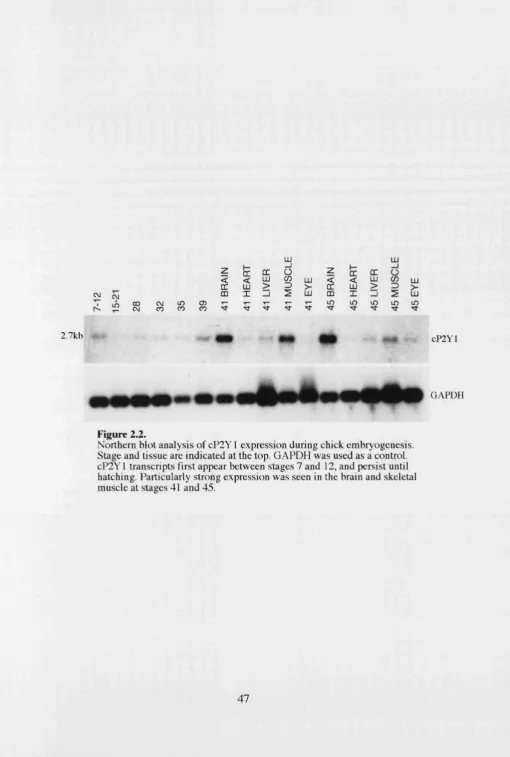
• Northern blotting shows that cP2Y i transcripts first appear between stages 7
and 12 of development. Expression persists throughout development, and just
prior to hatching there is particularly strong expression in brain and skeletal
muscle
• Wholemount in-situ hybridisation shows that during the first ten days of
development cP2Yi is expressed in the limb buds, mesonephros, somites
branchial arches and CNS.
Introduction
• Previous Studies have Shown that P2Y Receptors have the Potential to be
Important Developmentally.
As outlined in the general introduction, P2Y receptors have been shown to mediate the
effects of extracellular nucleotides on differentiation and proliferation of primary cells
and cell lines (for reviews see Abbracchio, 1996; Neary and Burnstock, 1996). Both of
these are fundamental during embryonic development. Also physiological and
pharmacological studies have demonstrated responses to extracellular nucleotides in a
number of embryonic cell types (for review see Burnstock, 1996). This and the
identification of a novel P2Y receptor subtype, P2Yg expressed in the Xenopus embryo
neural plate prior to neural tube closure, and later in neural tissue emerging from the
tailbud (Bogdanov et al., 1997) suggests that P2, and in particular P2Y receptor
• The Chick Embryo is a Good System in which to Investigate Potential
Developmental Roles for P2Y Receptor Signalling.
In this chapter the possibility that extracellular nucleotides are used as signalling
molecules during embryogenesis is explored further by looking for expression of a
specific P2Y receptor subtype during development of the chick embryo. The chick
embryo was chosen as a model organism to investigate a developmental role for this
type of signalling because responses to extracellular ATP have been demonstrated in a
number of embryonic chick tissues, isolated from various stages of development. ATP
has been shown to cause increase in intracellular calcium (Ca^^j) in cells dissociated
from the gastrulating chick embryo (Laasberg, 1990), from embryonic day 4 embryos
(Lohmann et al., 1991), from early chick otocyst (Nakoaka and Yamashita, 1995) and
retina (Sugioka et al., 1996), and in chick myoblasts, myotubes and intact skeletal
muscle (Kolb and Wakelam, 1983; Haggblad et al., 1985, Wells et al., 1995).
• There are a Number of Reasons for Choosing cP2Yj in Preference to the Other
Chick P2Y Receptors.
Of the eleven proposed P2Y receptor subtypes three have been identified in chick.
These are chick P2Y i (cP2Y%), chick P2Y] (cP2Yg), and chick P2Y^ (cP2Y^). As well
as from chick, P2Y , receptors have been cloned from a wide range of species including
rat and mouse (Tokuyama et al., 1995), human (Janssens et al., 1996), turkey (Filtz et
al., 1994), and bovine (Henderson et al., 1995) tissues. The presence of P2Y, in these
divergent species suggests that this receptor has been conserved throughout evolution,
and its presence in another model developmental organism - the mouse, made cP2Y, an
attractive starting point for investigating a role for P2Y receptor signalling during
embryonic development. As well as positive reasons for choosing cP2Y ,, there were
also reasons for not choosing the other two chick P2Y receptors. A question mark
remains over the functional identity of P2Y^. An orphan G protein-coupled receptor,
termed 6H1, with approximately 30% sequence identity to P2Y receptors has been
[35S]dATP alphas (Webb et al., 1996). It has since been shown that [35S]dATP alphaS
is not a general ligand for P2Y receptors, and this putative member of the P2Y receptor
family did not mediate nucleotide induced second messenger responses when stably
expressed in 1321N1 human astrocytoma cells (Li et al., 1997). cP2Y, was chosen in
preference to cP2 Yç, because homologues of the cP2Y^ receptor have not been identified in any other species apart from chick.
For the reasons outline above, it was decided to begin to investigate a role for P2Y
receptor signalling during embryogenesis by looking for expression of cP2Yj during
Methods
• Embryos
Fertilised White Leghorn chicken eggs were obtained from Needle farm (Essex) and
incubated at 37^ C and staged according to the Hamburger and Hamilton (HH) series
(Hamburger and Hamilton, 1951). Embryos were removed from the egg, rinsed and
dissected free of extra embryonic membranes in sterile phosphate buffered saline (PBS).
Embryos were then either fixed in 4% paraformaldehyde for use in wholemount in-situ
hybridisation or processed for RNA extraction.
• Northern Blots
Total RNA was isolated from staged embryos and embryo tissues using guanidium
isothyocyanate (CP laboratories). Poly A-f- mRNA was prepared from the total RNA
using a Poly A tract mRNA isolation system (Promega). The Poly A+ mRNA was then
electrophoresed through a MOPS formaldehyde 1% agarose gel, and transferred to
Hybond N+ membrane (Amersham) using standard techniques (Sambrook et al., 1989).
The hybridisation probe was a 1.4kb cP2Yi cDNA fragment labelled with [a- 32p]
dCTP to a specific activity of approximately 1x10^ dpm/|Xg. Probe synthesis was
carried out using a Ready to Go DNA labelling kit (dCTP), and unincorporated
nucleotides were removed using a Sephadex G-50 NICK column (both from
Pharmacia). Hybridisation was performed overnight at 42^C in 50% formamide, 5xSSC,
5xDenhardts, 0.5% SDS, lOOp-g/ml salmon sperm DNA, 50mM phosphate. The
hybridisation filter was subjected to a final wash at 65 ^C in 0.2xSSC, 0.1% SDS for 20
minutes before being exposed to X-ray film for 24 hours at -VO^C with an intensifying
screen. The same blot was stripped of bound probe according to manufacturers
instructions (Amersham) and probed with a 250bp fragment of chicken GAPDH
(glyceraldehyde-3-phosphate dehydrogenase) cDNA as a control (Panabieres et al.,
• Generation of Riboprobes.
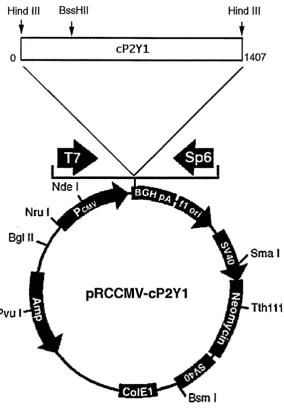
A 1.4kb cP2Yi cDNA fragment was subcloned into the Hind III site of the eukaryotic
expression vector pRCCMV (Invitrogen) to generate pRCCMV-P2Y, (see figure 2.1 for
map). pRCCMV-P2Y, was linearised by digestion with either BssH II to generate an
antisense probe, or Not I for generating a sense probe. The DNA template was then
cleaned by treatment with proteinase K, followed by phenol : chloroform: isoamyl alcohol
(25:24:1) (Sigma) extraction. A final extraction was performed in chloroform alone
before ethanol precipitation. Sense and antisense digoxygenin (Boehringer Manheim)
labelled probes for cP2Yi were made by transcription with TV (sense) and Sp6 (antisense) RNA polymerase according to the manufacturers instructions (Promega):
The following were mixed in the following order:
4|il Transcription Buffer 2|xl DTT (lOOmM)
Ipl Rnasin
4p,l NTP mix (2.5mM each ATP, GTP, CTP-1 pi of each from lOmM stock+lplH jO )
2.6pl UTP (2.5mM)
1.4pl DIG-11-UTP (2.5mM) Ipl linearised DNA template (Ipg) Ipl RNA polymerase
The reaction mix was incubated for 2 hours at 37 °C. The DNA template was removed
by addition of Ip l RQl Dnase (Promega) and incubating for 15 minutes at 37®C. 2pl
0.2M EDTA pH 8.0 was added to terminate both the polymerase reaction and the
DNase. Lithium chloride (RNase free, from Sigma) was added to a final concentration
of 0.4M prior to ethanol precipitation. The antisense probe was a 1.2kb transcript made
from the coding region 161-1407 of the published cP2Yi nucleotide sequence (Genbank
Hind ill BssHII Hind III
CP2Y1
1407
Pvul
pRCCMV-cP2Y1
S m a l
Si-Tth1l1
Figure 2.1.
A 1.4Kb fragm ent (bases 0-1407) encom passing the entire coding region o f cP 2Y 1 (bases 177-1265) w as cloned into the H in d III site o f the eukaryotic expression vector pR C C M V (Invitrogen). T he m ain features o f the vector are o u tlin e d below.
1. P ro m o ter sequences from the im m ediate early gene o f th e hum an cytom egalovirus (C M V ) for constitutive, h igh level expression o f c P 2 Y l in eukaryotic cells.
2. P o ly ad en y latio n signal, and transcription term ination sequences from the bovine grow th horm one (B G H ) gene, to enhance R N A stability.
3. T 7 an d Sp6 R N A prom oters flanking cP2Y 1 for in-vitro tran scrip tio n o f sense a n d antisense R N A .
4. T h e am p icillin resistance gene, an d the C ol E l origin for selection, and m aintenance in E. coli.
Wholemount In-Situ Hybridisation.
1. Embryos were fixed in 4% paraformaldehyde (PEA) in PBS overnight at 4®C.
2. Embryos were washed 2 x 1 0 minutes in PBS, 0.1% Tween 20 (PBT)
3. Embryos were then dehydrated:
25% methanol in PBT, lOmin 50% methanol in PBT, lOmin 75% methanol in PBT, lOmin 100% methanol in PBT, lOmin.
4. Embryos were then rehydrated by performing the above washes in reverse order
followed by a final wash of PBT for 2 x 1 0 min.
5. Embryos were bleached in 6 % hydrogen peroxide for 1 hour 6 . Wash in PBT 3 x 1 0 min.
7. To permeabilise, embryos were treated with 10|ig/ml proteinase K in PBT (for
approximately 1 minute per embryonic stage.
8 . Embryos were washed 2 x 10 min in PBT and were then post-fixed in 0.2% glutaraldehyde/4% PEA in PBT for 20 min.
9. Embryos were then washed 3 x 1 0 min with PBT.
10. Embryos were rinsed for 10 min in prehybridisation solution:
50% formamide 5 x S S C
50)J,g/ml yeast RNA 1%SDS
50|ig/ml heparin
11. The pre-hybridisation solution was replaced with fresh, and incubated at 70°C for 1
hour.
12. The prehybridisation solution was replaced with hybridisation solution containing
IjLig/ml of riboprobe and incubated at 70° C overnight.
13. The embryos were then washed as follows:
50% formamide, 5 x SSC, 1% SDS for 2 x 30 min at 70°C. 50% formamide, 2 x SSC for 2 x 30 min at 65°C
3 x 1 0 min in IxTBST containing 2mM levamisole.
14. Embryos were preblocked in 10% goat serum in TBST for 1-2 hours.
15. During this time the anti-digoxygenin antibody was preabsorbed with embryo
powder:
0.5ml of TBST (no levamisole) was added to 3mg embryo powder in an eppendorf and
heated for 30 min at 70°C. This was cooled on ice before adding 5 |Li1 goat serum and 1 p,l
anti-digoxygenin, alkaline phosphatase conjugated antibody (Boehringer Manheim).
This was shaken for 1-2 hours at 4°C. The eppendorf was then spun for 10 min, the
supernatant removed and diluted to 2mls with 1 % goat serum in TBST.
Preparation of embryo powder: Day 4-7 embryos were homogenised in a minimum
volume of PBS. 4 volumes of ice cold acetone was added and the mixture was placed on
ice for 30 minutes. The mixture was spun at 10 OOOg for lOmin and the supernatant
removed. The pellet was spread out and ground into a fine powder on a sheet of filter
paper and allowed to dry.
16. The 10% goat serum was replaced with the preabsorbed ant-Dig.AP antibody and
embryos were rocked overnight at 4°C.
17. Embryos were washed 3 x 1 5 min in TBST.
18. The TBST was changed hourly and embryos were washed throughout the day and
overnight.
19. Embryos were then washed for 3 x 15 min in freshly prepared NTMT:
lOOmM NaCl
lOOmM Tris-HCl pH 9.5 50mM MgCl^
0.1% Tween 20
20. The in-situs were developed by incubating the embryos in NTMT containing
3.5pl/ml each of NBT and BCIP. The reaction product was allowed to develop in the
dark at room temperature.
21. The reaction was stopped by washing thoroughly in PBT plus 20mM EDTA.
22. Finally embryos were refixed in 4% PEA.
To ensure complete penetration of the probe at stage 29-36, wholemount in-situ