Image Retrieval Using Features From
Pre-Trained Deep CNN
Vijayakumar Bhandi, Sumithra Devi K.A.
Abstract: Content based image retrieval (CBIR) systems use low level image representations to measure image similarity and fetch relevant images. Color, texture and shape properties are considered as important handcrafted features in traditional CBIR systems. The success of such a CBIR system depends on the choice of the handcrafted features being used. To use relevant handcrafted features, one needs to have a good knowledge of the domain where CBIR is being applied. Usage of inappropriate handcrafted features may widen the semantic gap and can to lead to poor retrieval results. Hence it is very important to extract features which are independent of prior domain understanding. In addition, it is beneficial if the features can be learnt automatically from an input image. Machine learning methods can be used for learning valuable representations from input image data. In machine learning area, Convolution neural networks (CNN) are able to create important expressive features from a given image data. Hence CNNs are well suited for image processing applications like classification, object recognition and clustering etc. Very large datasets, huge computing resources and processing time are required to train a deep CNN model effectively. There are many deep CNNs available which are pre-trained on massive datasets and distributed for public use. The knowledge learnt from these pre-trained deep CNN models can be applied to address image processing issues in new domains. VGG16 is a pre-trained 16 layer deep CNN model developed by Oxford Visual Geometry Group. In this paper, we have created a frame work to leverage VGG16 deep CNN model for extracting important features and use these features for image retrieval task. We apply this frame work for an interesting problem, to retrieve images from a weather images dataset. Results from our proposed CBIR frame work are compared with baseline CBIR which uses handcrafted features. Experimental results indicate that the features which are extracted from pre-trained deep CNN model perform better than handcrafted features when used for image retrieval application.
Index Terms: Deep convolution neural networks, Content based image retrieval, VGG16, Feature extraction, Multi-class image retrieval, Weather image processing,
—————————— ——————————
1.
INTRODUCTION
In last two decades, there has been tremendous growth in multimedia technologies and creation of huge collections of content like digital images, music and videos etc. Retrieving relevant images from a given collection has always been a challenging problem. In Content based image retrieval method [CBIR], content similarity plays very important role in matching images corresponding to a given query image. Image content representations at lower level are used for computing image similarity. These representations are called image features. There are various image features used in CBIR, the important ones are color, texture and shape properties. These features are carefully designed and have been effectively used in various image retrieval applications across domains. These are usually referred as handcrafted features. Color is an important image feature and it does not vary with variation in image scale and alignment. Color histogram describes the statistical distributions of color by quantizing the color space representation. Global color histogram is a prominent handcrafted feature which performs quite well in retrieving digital color images. Texture feature is widely used in image analysis and image processing applications. Texture property represents a repeating pattern of the local variation in image intensity. Texture feature can be statistically measured using Gray level co-occurrence matrix (GLCM) method. GLCM captures details about the positions of pixels having related gray level values. GLCM provides Statistical representations which represent texture more compactly. GLCM statistical features like Correlation, Homogeneity, Energy, Dissimilarity and Angular second moment (ASM) are widely used in CBIR applications. Other important feature used in image retrieval is shape feature. Many shape features have been developed to analyze shapes contained in an image. Hu moments are important shape feature used in image analysis, since they are invariant to scale, translation and rotational changes of the objects. Hu moments are derived from the concept of algebra moments invariants. We create a baseline CBIR framework by using a fusion of commonly used handcrafted features color,
datasets, computing resources and processing time. There are many proved CNN models which are already trained on big datasets and model weights are shared for public use. These pre-trained models can help to address image processing problems in new domains. Many recent image classification research works have made use of such pre-trained CNN models to transfer the knowledge learnt by them. Pre-trained deep CNN models like VGGNet, GoogleNet, ResNet and AlexNet etc. are extensively applied in such studies. In this work, we explore the feasibility of extracting important features learnt by a pre-trained deep CNN model and use these representations for image retrieval task. A frame work is created to use VGG16 pre-trained deep CNN model for extracting important features and use these learnt features for an interesting image retrieval problem, to fetch similar images from a weather images dataset. Our paper is organized as below: Section 2 explains the related work. Section 3 describes proposed methodology. Section 4 details the experimental work, Section 5 lists the experimental results and Section 6 summarizes conclusion of this research work.
2.
RELATED WORK
Image retrieval is an important research problem dealing with retrieval of similar images from a dataset which match to a given query image. Traditional text-based image retrieval methods used manually annotated keywords for searching the relevant images. This is labor-intensive, costly and a lengthy process. Also it is a difficult task to describe semantics of every image in a big dataset and human perception impacts it [1], [2]. This led to the development of content based image retrieval method [CBIR]. In this method, low level image representations are used to derive the similarity of images. These representations or features can be directly derived from the image data. A typical CBIR system works on query by example method, where low level content representations of query image are compared against database image content representations to extract top N similar images [1], [2]. Color, texture and shape are popularly used and accepted visual features in CBIR [1], [2]. Color feature is a prominent and widely used handcrafted feature in CBIR. Color is most distinguishing and dominant low level visual feature in CBIR [2]. Color is an effective feature since it is robust, simple to implement and requires lower storage. The global color feature performs well with variation in image position and scale. Hence color feature is most suitable for an effective image retrieval application [3]. Color histogram is the best method for representing color properties of an image [4]. Hue Saturation Value [HSV] color space representation works well with human perception of colors than Red Green Blue [RGB] color space [6]. Many CBIR systems have been designed by using Global color histogram feature and achieved good image retrieval results [5][7]. Gray level co-occurrence matrix (GLCM) method helps to represent texture properties in a compact manner [14]. Texture feature representations from GLCM like dissimilarity, correlation, angular second moment, homogeneity and energy are quite popular features in CBIR. Hu Invariant Moments can be used as shape feature descriptors and are best suited for analysis of wood images [17]. Extracting effective features is an important stage in object recognition and computer vision tasks [15]. Several researchers have focused on creating suitable image features for various of image classification applications [12]. There is a lot of interest developed about feature learning algorithms and
optimal linear combination of feature kernels and achieved good results. A novel framework and method are proposed to retrieve image sequences with the goal of forecasting complex and time-varying natural pattern [35]. In this work, temporal texture features were extracted to catch the features of the echo patterns, which are non-rigid and deformable, and that appear and disappear. Similar sequences are retrieved based on a distance measure between paths in eigenspaces derived from the feature vectors. There is not much related work available about image retrieval from a weather images collection. A weather map image retrieval system was proposed as an assistance for weather forecasting [36]. The proposed retrieval system extracts color features from connected color regions and uses them as primitive features to retrieve the weather map images similar to a given query image. Association rule mining technique was used for image matching and retrieval [37]. Image retrieval from a collection of weather images is still an interesting problem since there are no big-scale weather image datasets available for training. Also, achieving a higher retrieval performance in small dataset is difficult.
3.
PROPOSED WORK
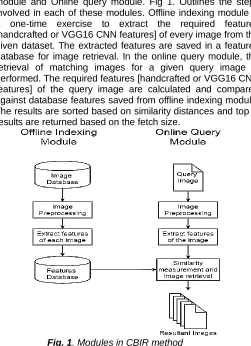
Our proposed CBIR method has two modules, Offline indexing module and Online query module. Fig 1. Outlines the steps involved in each of these modules. Offline indexing module is a one-time exercise to extract the required features [handcrafted or VGG16 CNN features] of every image from the given dataset. The extracted features are saved in a features database for image retrieval. In the online query module, the retrieval of matching images for a given query image is performed. The required features [handcrafted or VGG16 CNN features] of the query image are calculated and compared against database features saved from offline indexing module. The results are sorted based on similarity distances and top N results are returned based on the fetch size.
Fig. 1. Modules in CBIR method
We have created two CBIR frameworks, one a baseline CBIR using handcrafted features and another one is the proposed CBIR with VGG16 CNN features.
3.1 Baseline CBIR using Handcrafted Features
We created a basic CBIR framework which will use color, texture
and shape properties as handcrafted features. We will compare results from our proposed CBIR framework with this baseline CBIR to gauge its effectiveness. Details of the handcrafted features used in this study are explained in section 4.
3.2 Proposed CBIR using Features from VGG16 Deep CNN
This is our proposed frame work for utilizing features from a pre-trained deep CNN. We extract features from Pre-pre-trained VGG16 deep CNN model for image retrieval task. A deep CNN model usually consists of many layers that incrementally calculate features. As outlined in Fig. 2. deep CNN model incrementally learns the features through layers of convolutions and subsampling.
Fig. 2. Architecture of Convolution neural networks model
In this work, VGG16 deep CNN model is implemented from Python Keras package. It is a 16-layer deep CNN created by the Visual Geometry Group from University of Oxford [29]. VGG16 model is trained on ImageNet, which is a very large scale dataset containing 3+ million digital images distributed across 5000+ categories. VGG16 model consists of 5 convolution blocks and each convolution block contains two convolution layers (size 3X3) and one maxpooling layer (size 2X2). The final classification step of the model consists of fully connected (FC) layers. Our algorithm extracts 4096 features from fully connected FC2 layer as depicted in Fig 3. This is output of second and penultimate fully connected layer of the pre-trained VGG16 CNN model. The feature extraction is done for each image in the dataset and query images.
Fig. 3. Architecture of proposed VGG16 deep CNN
3.3 Implementation
Our proposed CBIR method is implemented using Python Version 3.6.10, Keras 2.3.1 module, TensorFlow 1.14 as backend on Windows 8.1 operating system (64 bit) and 8GB RAM with Intel core i5 processor.
3.4 Performance Evaluation
Image retrieval performance is measured by calculating precision values as defined in equation (1).
(1)\
4.
EXPERIMENTAL WORK
Proposed CBIR method is subjected to experimental study on a multi-class weather images dataset, which is used for weather recognition work earlier [30]. The dataset consists of 1125 color images that are grouped into 4 distinct classes as described in Table 1.
TABLE1
WEATHER IMAGE DATASET
Three images from each class which are not part of the training dataset are selected as input query for the experiment. For a selected image of a class, we can safely assume that the user is interested to fetch images from the same class. Hence, we mark resultant images from same class as relevant images and images fetched from other classes as irrelevant. The precision rates are measured by varying the number of images retrieved per run. The image retrieval experiment is carried out in two steps as explained below. Same query images have been used in both steps.
4.1 Image Retrieval using Handcrafted Features
We created a CBIR framework for image retrieval by using fusion of selected handcrafted features. Table 2 lists the handcrafted features used in this study. We use this CBIR framework as a baseline model to measure performance of proposed method over it. This CBIR represents a traditional CBIR system. GCH feature [H-8, S-12, V-3 bins] is calculated in HSV color space. Using Gray-level co-occurrence matrix (GLCM) method we compute the texture properties Correlation, Homogeneity, Energy, Dissimilarity and ASM. Shape feature is calculated by using Hu Moments. These handcrafted features are calculated for each image in the dataset and a features fusion vector is created. The fusion feature vectors are stored in features database.
TABLE2
HANDCRAFTED FEATURES USED IN BASELINE CBIR
Similarly, handcrafted features for every query image are computed and matched against entries in features database. Cosine distances method is used for features similarity measurement and top N matching images are retrieved for a given fetch size. We repeat the image retrieval experiment for each query image by varying the number of images retrieved per run. Average precision rates for various fetch sizes and for different classes are measured. Image retrieval results from baseline CBIR method are tabulated in Table 3 and 4.
4.2 Image Retrieval using Features from VGG16 Deep CNN
In this step, our proposed CBIR method using features from pre-trained VGG16 deep CNN model is subjected to experimentation. From VGG16 FC2 layer we extract 4096 features per image. During offline indexing module, these features are saved in the features database. In online query step, we compare 4096 features obtained from each query image with the features database. We use cosine distances for calculating the image similarity and retrieve top N results based on fetch size. We repeat the image retrieval experiment for each query image by varying the number of images retrieved. Average precision rates for various fetch sizes and for different classes are measured. Image retrieval results from our proposed approach are tabulated in Table 3 and 4.
TABLE3
AVERAGE PRECISION RATES FOR IMAGE RETRIEVAL PER FETCH SIZE
TABLE4
AVERAGE PRECISION RATES FOR IMAGE RETRIEVAL ACROSS CLASSES
5.
RESULTS AND DISCUSSION
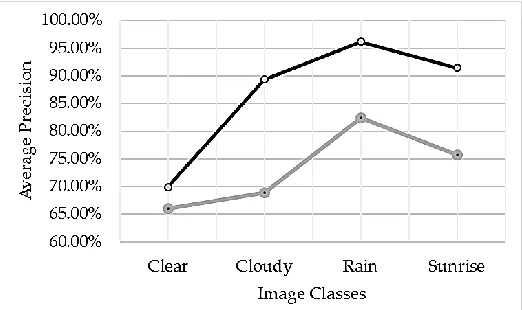
Our experiment on baseline CBIR with handcrafted features (Color, texture and shape) yields us an average precision of 73.25% across all classes of the weather images dataset. The proposed CBIR method which uses pre-trained VGG16 deep CNN features achieves an average precision of 86.73% across all classes of the dataset. The improvement in precision rate is observed across all image classes. Fig. 4. depicts the improvement in precision as recorded across different retrieval sizes. We see precision improvement across all fetch sizes. Fig. 5. depicts the improvement in precision rate as recorded across different classes. The improvement in precision rate in ―Clear‖ image class is lower as compared to other three classes (―Cloudy‖, ―Rain‖ and ―Sunrise‖), where precision improvement is profound. Experimental results show that our proposed CBIR frame work using features from pre-trained VGG16 CNN model performs better than traditional CBIR using handcrafted features (Color, texture and shape). The improvement in performance is seen across the fetch sizes and image classes.
Fig. 4. Comparing baseline and proposed CBIR for
average precision vs number of images retrieved.
Fig.5. Comparing baseline and proposed CBIR for average precision per Image class.
6.
CONCLUSION
In this work, we demonstrated that features from pre-trained deep CNN model are suitable for image retrieval task. We created a CBIR framework using features from pre-trained VGG16 deep CNN model. We tested our proposed CBIR framework on a multi-class digital dataset of weather-related images. We achieved average retrieval precision of 86.73% for the proposed CBIR framework, which clearly outperforms the average retrieval precision of 73.25% from baseline CBIR framework using handcrafted feature (Color, texture and shape). Results show 13.48% increase in the average precision by using proposed CBIR method. The improvement in average precision is seen in all classes of the dataset and number of images retrieved (fetch size). From experimental results we conclude that features from pre-trained deep CNN model can be successfully used for image retrieval task and perform better than handcrafted features used in traditional CBIR methods. Also, the VGG16 deep CNN features are better suited to perform image retrieval in weather images dataset. Future Scope: In the current work we have used VGG16 pre-trained model. Other popular pre-trained models like ResNet, AlexNet and GoogleNet etc. can be used to retrieve weather images. Some of the layers of the pre-trained CNN model can be fine-tuned and retrained on a new dataset to achieve better results.
REFERENCES
[1] M. R. Zare, R. N. Ainon and W. C. Seng, "Content-Based Image Retrieval for Blood Cells," 2009 Third Asia International Conference on Modelling & Simulation, Bali, 2009, pp. 332-335. doi: 10.1109/AMS.2009.103.
[2] S. Sreedevi and S. Sebastian, "Content based image retrieval based on Database revision," 2012 International Conference on Machine Vision and Image Processing (MVIP), Taipei, 2012, pp. 29-32.
[3] YuanYong Chen, "The image retrieval algorithm based on color feature," 2016 7th IEEE International Conference on Software Engineering and Service Science (ICSESS), Beijing, 2016, pp. 647-650.
Assurance and Security, Xi'an, 2009, pp. 381-384. doi: 10.1109/IAS.2009.156.
[5] A. Nazir, R. Ashraf, T. Hamdani and N. Ali, "Content based image retrieval system by using HSV color histogram, discrete wavelet transforms and edge histogram descriptor," 2018 International Conference on Computing, Mathematics and Engineering Technologies (iCoMET), Sukkur, 2018, pp. 1-6.
[6] P. Chmelar and A. Benkrid, "Efficiency of HSV over RGB Gaussian Mixture Model for fire detection," 2014 24th International Conference Radioelektronika, Bratislava, 2014, pp. 1-4.
[7] M. A. Tahoun, K. A. Nagaty, T. I. El-Arief and M. A-Megeed, "A robust content-based image retrieval system using multiple features representations," Proceedings. 2005 IEEE Networking, Sensing and Control, 2005., Tucson, AZ, 2005, pp. 116-122.
[8] S. Orhan and Y. Bastanlar, "Training CNNs with image patches for object localisation," in Electronics Letters, vol. 54, no. 7, pp. 424-426, 5 4 2018.
[9] Y. Wei et al., "HCP: A Flexible CNN Framework for Multi-Label Image Classification," in IEEE Transactions on Pattern Analysis and Machine Intelligence, vol. 38, no. 9, pp. 1901-1907, 1 Sept. 2016.
[10]S. Xie and H. Hu, "Facial expression recognition with FRR-CNN," in Electronics Letters, vol. 53, no. 4, pp. 235-237, 16 2 2017. doi: 10.1049/el.2016.4328.
[11]C. Hsu and C. Lin, "CNN-Based Joint Clustering and Representation Learning with Feature Drift Compensation for Large-Scale Image Data," in IEEE Transactions on Multimedia, vol. 20, no. 2, pp. 421-429, Feb. 2018. doi: 10.1109/TMM.2017.2745702.
[12]S. Kido, Y. Hirano and N. Hashimoto, "Detection and classification of lung abnormalities by use of convolutional neural network (CNN) and regions with CNN features (R-CNN)," 2018 International Workshop on Advanced Image Technology (IWAIT), Chiang Mai, 2018, pp. 1-4.
[13]A. T. Vo, H. S. Tran and T. H. Le, "Advertisement image classification using convolutional neural network," 2017 9th International Conference on Knowledge and Systems Engineering (KSE), Hue, 2017, pp. 197-202.
[14]Vimina E.R., Poulose Jacob K, ―Image Retrieval Using Local Color and Texture Features‖, Zhang T. (eds) Mechanical Engineering and Technology. Advances in Intelligent and Soft Computing, vol 125. Springer, Berlin, Heidelberg, 2012
[15]D. Sherlin, D. Murugan, "A Case Study on Brain Tumor Segmentation Using Content based Imaging", International Journal of Scientific Research in Network Security and Communication, Vol.6, Issue.3, pp.1-5, 2018 [16]N. Rezazadeh, "Initialization of weights in deep belief
neural network based on standard deviation of feature values in training data vectors", International Journal of Scientific Research in Computer Science and Engineering, Vol.5, Issue.4, pp.1-8, 2017
[17]Hongbo Mu, Dawei Qi, "Pattern Recognition of Wood Defects Types Based on Hu Invariant Moments", 2nd International Congress on Image and Signal Processing, 10.1109/CISP.2009.5303866, 17-19 Oct. 2009.
[18]Dongmei Han, Qigang Liu, Weiguo Fan, "A new image classification method using CNN transfer learning and web data augmentation", Expert Systems with Applications, Volume 95, Pages 43-56, April 2018.
[19]Y. Lou, G. Fu, Z. Jiang, A. Men and Y. Zhou, "PT-NET: Improve object and face detection via a pre-trained CNN model," 2017 IEEE Global Conference on Signal and Information Processing (GlobalSIP), Montreal, QC, 2017, pp. 1280-1284. doi: 10.1109/GlobalSIP.2017.8309167 [20]Dinesh Jackson Samuel R & Rajesh Kanna B, "Cybernetic
microbial detection system using transfer learning", Multimedia Tools Appl, 2018.
[21]D. Marmanis, M. Datcu, T. Esch and U. Stilla, "Deep Learning Earth Observation Classification Using ImageNet Pretrained Networks," in IEEE Geoscience and Remote Sensing Letters, vol. 13, no. 1, pp. 105-109, Jan. 2016. [22]Hussain M., Bird J.J., Faria D.R, "A Study on CNN
Transfer Learning for Image Classification", UKCI 2018. Advances in Intelligent Systems and Computing, vol 840. Springer, 2018
[23]S. Akcay, M. E. Kundegorski, C. G. Willcocks and T. P. Breckon, "Using Deep Convolutional Neural Network Architectures for Object Classification and Detection Within X-Ray Baggage Security Imagery," in IEEE Transactions on Information Forensics and Security, vol. 13, no. 9, pp. 2203-2215, Sept. 2018.
[24]B. Yang, J. Cao, R. Ni and Y. Zhang, "Facial Expression Recognition Using Weighted Mixture Deep Neural Network Based on Double-Channel Facial Images," in IEEE Access, vol. 6, pp. 4630-4640, 2018.
[25]Manali Shaha, Meenakshi Pawar, "Transfer Learning for Image Classification", 2nd International Conference on Electronics, Communication and Aerospace Technology, ICECA, 2018.
[26]Alena Selimović, Blaž Meden, Peter Peer, Aleš Hladnik, "Analysis of Content-Aware Image Compression with VGG16", IEEE International Work Conference on Bioinspired Intelligence (IWOBI), 2018.
[27]J. Chang, J. Yu, T. Han, H. Chang and E. Park, "A method for classifying medical images using transfer learning: A pilot study on histopathology of breast cancer," 2017 IEEE 19th International Conference on e-Health Networking, Applications and Services (Healthcom), Dalian, 2017, pp. 1-4.
[28]L. Shao, F. Zhu and X. Li, "Transfer Learning for Visual Categorization: A Survey," in IEEE Transactions on Neural Networks and Learning Systems, vol. 26, no. 5, pp. 1019-1034, May 2015.
[29]Gopalakrishnan, Kasthurirangan & Khaitan, S.K. & Choudhary, Alok & Agrawal, Ankit. ―Deep Convolutional Neural Networks with transfer learning for computer vision-based data-driven pavement distress detection‖, in Construction and Building Materials. 157. 322-330, 2017, 10.1016/j.conbuildmat.2017.09.110.
[30]Ajayi, Gbeminiyi (2018), ―Multi-class Weather Dataset for Image Classification‖, Mendeley Data, v1
http://dx.doi.org/10.17632/4drtyfjtfy.1
[31]Cewu Lu, Di Lin, Jiaya Jia, Chi-Keung Tang, "Two-class Weather Classification", IEEE Conference on Computer Vision and Pattern Recognition (CVPR), 2014
classification. Multimed Tools Appl 77, 13309–13321 (2018). https://doi.org/10.1007/s11042-017-4948-7
[34]Zheng Zhang, Huadong Ma, Huiyuan Fu, Cheng Zhang, Scene-free multi-class weather classification on single images, Neurocomputing, Volume 207, 2016, Pages
365-373, ISSN 0925-2312,
https://doi.org/10.1016/j.neucom.2016.05.015.
[35]Kazuhiro Otsuka, Tsutomu Horikoshi, Satoshi Suzuki, Image Sequence Retrieval for Forecasting Weather Radar Echo Pattern, MVA '98 IAPR Workshop on Machine Vision Applications, Nov. 17-19, 1998. Makuhari, Chiba, Japan [E]
[36]P. Reungjitranon and O. Chitsobhuk, "Weather Map Image Retrieval using Connected Color Region," 2008 International Symposium on Communications and Information Technologies, Lao, 2008, pp. 464-467, doi: 10.1109/ISCIT.2008.4700235 [F]