Improved P-hub Network Model and GA
Solution Based on Rough Set Theory
Qing Liu
NanJing University of Aeronautics and Astronautics/College of Civil Aviation, Nanjing, China Email: [email protected]
Tongshui Wu and Xianfei Luo
Civil Aviation university of China/College of Economics and Management, Tianjin, China Email: [email protected], [email protected]
Abstract—To solve NP-hard 0-1 discrete optimization problems of the uncapacitated multiple allocation p-hub median network (UMpHMP), this paper proposed an improved p-hub network model based on β- approximate rough set data mining technology to reduce the range of hub choice from n alternative hubs to the limited q q( <n) airports, which greatly reduces total number of the variables and constraints for the models. As one of the classical shortest path problems, the genetic algorithm was developed to solve the improved model. In order to illustrate the effective of new model, an experimental example of domestic 15 cities route network designing for airlines was given, the simulation results show the established index number can be abbreviated to 4 main attributes by β - reduction, and the efficiency of solution was improved for the modified network.
Index Terms—P-hub network, UMpHMP, Rough set, Genetic algorithm
I. INTRODUCTION
Hub-and-spoke network is a kind of airlines route network structure which US large airlines adopted to improve the flights time accuracy, frequency and reduce operational cost. Presently, the majority of the airlines and fleet in the world take the different patterns of hub-and-spoke.
There are many domestic and international researchers on the hub and spoke network. O’Kelly [1] established a Single distribution of quadratic integer programming model of hub and spoke network for the first time. Skorin-Kapov, O'Kelly, and Campbell et al [2, 3] reduced the frequency of the model and constructed the optimization model of UMpHMP. Ernst and Krishnamoorthy [4, 5] established a mathematical model in three subscripts, reducing greatly the number of variables and constraints so as to improve the efficiency of the solution, and solved the model through precise and heuristic algorithms. Jiang Tao [6] has proposed using the robust optimal method in shortest-circuits and has
presented the robust optimal solution under the different conditions and backgrounds. Boming Guo [7] obtained the approximate solution by using the Heuristic algorithm tabu search method which has more efficiency.
From the above discussion, we can conclude that there are some problems with the UMpHMP of traditional model can easily fall into local optimization, or the slow convergence rate.The paper has improved the UMpHMP model and simultaneously designed a genetic algorithm by making use of the rough set theory. This article is organized as follows: In Section 1, the improved optimization model is set up by rough set. In Section 2, the GA is introduced and applied to solve the model. In Section 3, simulation results are used to test the model; and in Section 4, some relevant conclusions are drawn.
II. PROBLEM MODELING
A. Basic model of p-hub network
Campbell [3] firstly proposed the UMpHMP model, which has 4
n variables and n2+2n constraints, which
can be specifically as follows:
(
)
1 1
Z Min ik km mj
n n n n
ij ijkm
m i j k
C C C
W χ +α +δ x
∑ ∑ ∑ ∑
= =1=1==
(1)
s.t.
1
n k
k y p
∑
=
=
(2)
1 1 1 , 1, ,
n n
i j k m
m k
x i j n
∑ ∑
= =
= , =
(3)
1 1, ,
n
i j k m k
m
x ≤y i j k n
∑
=
,, , =
(4)
1 1, ,
n
i j k m m
k
x ≤y i j m n
∑
=
,, , =
(5)
y
k∈
{ }
01
,
,
xi j k m≥0,i j k m, , , =1, ,n(6)
Equation (1) indicates the objective function demanding the minimum total cost of air passenger's transportation. Constraints (2) limits the number of hub-airport in the established hub and spoke network, Constraints (3) ensure that all the transportation of O-D flow must be delivered completely from the original city to the destination city. Constraints (4) and constraints (5) ensure that all the transportation of O-D flow can only be Manuscript received March 1, 2011; revised May 4, 2011; accepted
transported through the hub cities. Constraints (6) require that the variables of hub airport be 0-1 and other variables be non-negative.
B. Improved model based on rough Set
Rough set theory [8] has been introduced by Pawlak (1982), which have been successfully applied in many areas. The VPRS [9] model operates on what may be described as a knowledge representation system or information system represented by a table. This table consists of objects and attributes. The entries in the table are the values of possibly categories. An information system is composed of a 4-tuple as follows:
S=<U Q V f, , , >; (7) Where Uis a finite set of objects, Q is a finite set of attributes,V =∪q Q∈ Vq and V is the union of attribute
domains, Vq is a domain of the attribute
q
,and:
f U× →Q V is a total function such that f x q( , )∈Vq
for every q∈Q x U, ∈ , called an information function. Every object that belongs to Uis associated with a set of
values corresponding to the condition attributes C and
decision attributes D .VPRS deals with a partial classification by introducing a precision parameterβ.
Theβ value represents a bound on the conditional probability of a proportion of objects in a condition class that are classified to the same decision class. In this paper we define
β
defined to be in the domain (0.5, 1).Define thep
aprβ,aprp
β,
p
negβ, bndpβ as follows:
( )
{
|( )
}
p
a p rβ x = ∪ x∈U μχ x ≥ β
(8)
aprp
( )
x{
x U |( )
x 1}
β
χ
μ β
=∪ ∈ > − (9)
( )
{
|( )
1}
p
negβ x =∪ x∈U μχ x ≤ −β (10)
( )
{
|( )
}
p
b n dβ x = ∪ x∈U μχ x < β (11)
Constraints (2) show that p-hub cities are selected from the existing n cities. Taking into account each airport geographical location, facilities, the volume of OD flows
and the level of regional economic development, it is not suitable to take all airports as hub candidates. Rough set can decrease number of candidate hubs. The basic steps to improve UMpHMP problem by using rough set algorithm can be described as follows:
Step 1: Establishment of the attribute index system. The selection of hub airport must consider many kinds of factors, including transport capacity, airport location, urban competitiveness and transport infrastructure. Transport capacity refers to the ability to become air traffic hub, including passenger volume and cargo volume. Urban competitiveness refers to the potential of development of the city, including the per capita GDP and the regional GDP. Location means the influences of the city, including numbers of the international flights and domestic routes and flights. Transport infrastructure refers to the city comprehensive transportation foundation.
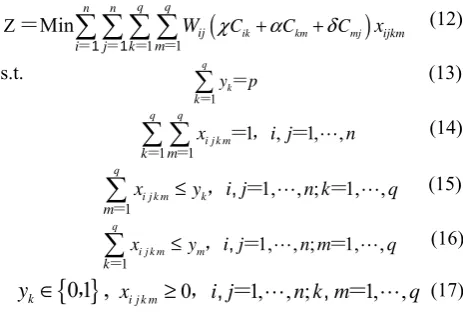
Step 2: Improvement of the original model. The range of hub cities can be contracted from n to q by making use of rough set, thus the improved UMpHMP model can be represented as follows:
(
)
1 1
Z Min ik km mj
q q n n
ij ijkm
m i j k
C C C
W χ +α +δ x
∑ ∑ ∑ ∑
= =1=1==
(12)
s.t.
1
q k
k y p
∑
=
=
(13)
1 1 1 , 1, ,
q q
i j k m
m k
x i j n
∑ ∑
= =
= , =
(14)
1 1, , ; 1, ,
q
i j k m k
m
x ≤y i j n k q
∑
=
,, = = (15)
1 1, , ; 1, ,
q
i j k m m
k
x ≤y i j n m q
∑
=
,, = =
(16)
y
k∈
{ }
01
,
,
xi j k m≥0,i j, =1, , ;n k m, =1, ,q (17)Step 3: Data collection and Processing. The collected data is different from each other in unit and the criteria, so the difference must be eliminated before the date is used. In this paper, the VPRS model is used for evaluation attribute reduction as previous introduced. The condition attributes representing a pattern's elements were
TABLE I. HUB EVALUATION INDEX SYSTEM
Index Index name Attribute Units
Transportation capacity Passenger volume a1 10,000 person
Cargo volume a2 10,000 ton
Urban competitiveness GDP per person a3 Yuan
GDP in region a4 Yuan
Location International influence a5 route
National influence a6 route
Transport infrastructure
Airport facility a7 (3C-4F)
Infrastructure of Road a8 kilometer
Infrastructure of railway a9 (station, section and bureau)
scaled approximately onto [0, 1] by the formula (18): min
(
1, ,)
max min
xj xj
rxj
xj xj
V V
V j m
V V
−
= =
− (18)
Where minVxj and maxVxj are minimal and
maximal values of the attribute
x
j within the training set data.V
rxj represents relative value between (0, 1).Step 4:
β
-attributes reduction. The measure of quality of classification for the VPRS model is defined as:
(
)
(
{
( )
}
)
( )
c a rd | ,
c a rd
x U x
P D
U χ
β μ β
γ = ∪ ∈ ≥ (19)
For a specified value of β .The value γβ
(
P D,)
measures the proportion of objects in the universe Uforwhich a classification based on decision attributesD. Theβ-reduction is the essential part of the information system, which can discern all discernable objects by the original information system. The β -reduction subset
(
,)
redβ C D includes minimum attribute set, which
satisfies the following two criteria:
γβ
(
C D,)
=γβ(
redβ(
C D D,)
,)
(20) No attributes can be eliminated from redβ(
C D,)
without affecting the requirement. Procedures for generating decision rules from an information system are as follows:r CON: C
( )
Xi DECD( )
Yjβ
⎯⎯→ ,0.5≤ ≤
β
1 (21)R represents the extraction rules, CONC is condition
attributions and DECD is decision attributions. It can be
described as:
If f x q
(
, 1)
=rq1 ∧ f x q( )
, p =rqpThenX∈Yj with
β
. Where{
q q1, , ,2 qp}
⊆C;(
r
q1, , ,
r
q2r
qp)
∈
V
q1×
V
q2× ×
V
qp.III. GENETIC ALGORITHMS
Genetic Algorithms (GA) is a kind of effective algorithm for solving NP problems. The main procedure of the GA algorithm for p-hub problem is as follows: A. Chromosome representation
Each chromosome represents an OD flow consists of four genes, which represents i, j, k, m respectively; the length for each chromosome depends on the number of airports.
B. Encoding and decoding
If there are n airports, the airports will be numbered from 1 to n in sequence. The number for each airport is represented by binary coding and m is used to represent the binary length of each gene ( 2m1 2m
n
− ≤ ≤ ).For
example, there are 6 airports in total, then m=3 can be selected, and the binary can represent 8-bit as follows:
Variable 0 1 2 3 4 5 6 7
binary 000 001 010 011 100 101 110 111 TABLE II. INFORMATION SYSTEM
Object CONc DECD
U a1 a2 a3 a4 a5 a6 a7 a8 a9 a10 Yj
1
n 3 2 2 3 3 3 3 2 3 1 H
2
n 2 1 2 2 2 2 3 1 3 2 NH
3
n 2 1 1 1 2 2 3 1 3 1 H
4
n 2 1 2 2 2 2 3 1 3 2 NH
5
n 2 1 1 1 2 2 3 1 3 1 H
6
n 3 2 2 2 3 3 3 2 3 3 H
7
n 1 1 1 2 2 1 3 1 3 1 NH
8
n 1 1 1 2 2 1 3 1 3 1 NH
9
n 2 1 2 2 1 2 3 1 1 1 NH
10
n 1 1 1 2 2 1 3 1 3 1 NH
11
n 2 1 2 2 2 2 3 1 3 2 H
12
n 1 1 1 1 1 1 1 1 3 1 NH
13
n 2 1 1 2 1 2 3 1 3 1 H
14
n 1 1 2 3 2 2 3 2 3 3 NH
15
n 1 1 1 1 1 1 1 1 3 1 NH
TABLE III. SOLUTIONS COMPARISON OF THE INITIAL MODEL AND THE IMPROVED MODEL
Hub
number Model Cost discount Hub Total cost Constraint number Variable number
2 p=
Original model α=0.6 Beijing, Changsha 1.37+07 6991 50640
0.8
α= Beijing, Changsha 1.4e+07 6991 50640
Improved model α=0.6 Beijing, Changsha 1.37e+07 5083 27236
0.8
α = Beijing, Changsha 1.4e+07 5083 27236
Where, 0-5 represents the airports of number 1-6,
(
6 5 %2 1−)
= and(
7 5 %2 2−)
= represents the first and second airport respectively.C. Generation of initial solution and determination of group size
According to the results from model, each variable of decision solution may consist of initial airport, terminal airport and hub airport. And then 150 pieces of 0, 1 character string with 24 long will be generated randomly. D. Calculation for fitness function
We take the function
( ) Min ij( )
i n j n k q m q
f X W C C Cmj x
ijkm =
∑∑∑∑
⊂ ⊂ ⊂ ⊂ χ ik+α km+δ i jkmas the fitness function. It is modified as:
max ( ) ( ) max
( )
0
C f x if f x C
f x
else
⎧ − <
⎪
=⎨
⎪⎩ (22)
Where, Cmax is a sufficiently large positive integer.
E. Selection
The selection is conducted with roulette. The probability that individual enters into the next generation is equal to the rate between its fitness value and the fitness value of the individual in whole species group, and the selected probability of category is bigger as the fitness is higher. The selected expectation value shall be as follows:
( )
( )
1
/ n
i i
i
n f x f x
=
⋅
∑
IV. EXPERIMENTAL RESULTS
One airline company intends to build a 15-citiy hub-and-spoke airline network. Those 15 cities are Beijing, Changsha, Guangzhou, Haikou, Hangzhou, Kunming, Nanjing, Shanghai, Shenyang, Wuhan, Urumqi, Xiamen, Xi’an, Zhengzhou. The evaluation information system of rough set shall be established based on the hub attributes (as table 2 shows).
Set β=0.7, then get
{
a a a a3, , ,4 6 9}
,{
a a a a4, , ,5 9 10}
,{
a a a a1, , ,4 5 9}
,{
a a a a4, , ,5 6 9}
,{
a a a a3, , ,5 6 8}
,{
a a a a3, , ,6 8 9}
asattribute abbreviations. According to process of attribute reduction, the generalized rules are listed in table 3.
From the decision rules, the cities of Haikou, Hangzhou, Nanjing and Xiamen are unsuitable for hub candidates. Setχ δ= =1, the α discount factor shall be taken different value. The following method shall be programmed with Matlab and the calculation results are compared in table 4:
According to the solution, it can be seen that when the airlines selects Beijing and Changsha as the hub, the total cost is the lowest, whatever the
α
value is, the value of total cost changes and the structure of flight route network basically keeps unchanged (Fig.1):TABLE IV. DECISION RULES
Rules Number Accuracy
1. If a3=2 and a6=3 and a8=2 and a9=3 then Y=H 2 100%
2. If a4 =1 and a5=2 and a9=3 and a10=1 then Y=H 2 100%
3. If a1=2 and a4=1 and a5=2 and a9=3 then Y=H 2 100% 4. If a3=2 and a5=3 and a6=3 and a8=2 then Y=H 2 100%
5. If a3=1 and a6=1 and a8=1 and a9=3 then Y=NH 5 100%
Fig.1 Diagram of airlines flight network for 2-hub structure
V. CONCLUSIONS
In this paper, the
β
-approximate rough set attribute reduction is proposed for multiattribute selection in the UMpHMP model, which can avoid the interference of subjective factor in hub location selection and accurately find the alternative hub set. For most NP-hard discrete optimization problems, the increase in problem size is still moderate, and thus the proposed approach has the potential of being practically useful in this case as well.Compared to the classical model, the variables and constraints of problem are reduced greatly in the improved UMpHMP model; however, the accuracy of solution and results basically conforms to the conclusion of the initial model. GA algorithm can transfer the target function into the shortest route problem so as to obtain the best solution result with higher efficiency and stable solution space.
Sources of future work include design the hybrid intelligent algorithms by combining such as tabu and GA, or simulated Annealing and GA. In addition, the robustness of network designing under uncertainty also treated as a further direction.
ACKNOWLEDGMENT
This work was supported by the Basic scientific research projects of the Central University of China (ZXH2010D010) and by the National Science Foundation of China (60979021).
REFERENCES
[1] M.O'Kelly, “A quadratic integer program for the location of interacting hub facilities,” European Journal of Operational Research, Vol. 32, 1987, pp. 393-404.
[2] J.F.Campbell, “Integer programming formulations of discrete hub location problems,” European Journal of Operational Research, Vol. 72, 1994, pp. 387-405.
[3] J.F.Campbell, “Hub location and the p-hub median problem,” Operations Research, Vol. 44 (6), 1996, pp. 923-935.
[4] A.T.Ernst and M. Krishnamoorthy, “Exact and heuristic algorithms for the uncapacitated multiple allocation p-hub median problem,” European Journal of Operational Research,Vol. 104, 1998, pp. 100-112.
[5] A.T.Ernst, M.Krishnamoorthy, “An exact solution approach based on shortest-paths for p-hub median problems,” Informs Journal on Computing, Vol. 10 (2), 1998, pp.149-162.
[6] Jiangtao,ZhuJinfu,Qingyi. “Robust Optimization of Hub-and-spoke Airline Network based on the shortest hub radiation,” System Engineering, Vol. 25, 2007, pp. 53-29. [7] BoMingguo,ZhuJinfu,YaoYun. “Constuction Method and
Application of Hub and Spoke,” System engineering, Vol. 24, 2006, pp.29-34.
[8] B.S.Ahna, S.S.Cho and C.Y. Kim. “The integrated methodology of rough set theory and artificial neural network for business failure prediction,” Expert Systems with Applications, Vol. 18, 2000, pp.65–74.
[9] Roman W.Swiniarski and Larry Hargis. “Rough sets as a front end of neural-networks texture Classifiers,” Neurocomputing, Vol. 36, 2001, pp.85–102.
Qing Liu was born in Hefei Anhui province of China on July, 1979. He is a Ph.D. candidate at the College of Civil Aviation, Nanjing University of Aeronautics and Astronautics, Nanjing, China. He is going to receive the Ph.D degree in May 2012. His main research interests include Airlines operational and management, Transportation planning, and intelligent transportation system.
Tongshui Wu was born in Baoding Hebei province of China on November, 1954. Wu is a professor at the College of Economics and Management, Civil Aviation university of China. He received his Ph.D. degree in Industrial Engineering from Nanjing University of Aeronautics and Astronautics in 1998. His current research interests cover system optimization and control, Transportation system planning, and integrated automation for complex industrial process.
Xianfei Luo was born in Jingzhou Hubei province of China on January 18, 1987. He is a graduate student in the college of Economics and Management Civil Aviation University of China. His major is in the economic and strategic management of civil aviation. He won the Mathematics and Applied Mathematics Bachelor degree of Shandong University of Science and Technology of China on June 22, 2010.