Benchmarking Cloud Security Level Agreements Using
Quantitative Policy Trees
Jesus Luna, Robert Langenberg, Neeraj Suri
Dept. of CS, TU Darmstadt, Germany{jluna, robert, suri}@deeds.informatik.tu-darmstadt.de
ABSTRACT
While the many economic and technological advantages of Cloud computing are apparent, the migration of key sector applications onto it has been limited, in part, due to the lack of security
assur-ance on the Cloud Service Provider (CSP). However, the recent
ef-forts on specification of security statements in Service Level Agree-ments, also known as “Security Level Agreements” or SecLAs is a positive development. While a consistent notion of Cloud SecLAs is still developing, already some major CSPs are creating and stor-ing their advocated SecLAs in publicly available repositories e.g., the Cloud Security Alliance’s “Security, Trust & Assurance Reg-istry” (CSA STAR). While several academic and industrial efforts are developing the methods to build and specify Cloud SecLAs, very few works deal with the techniques to quantitatively reason about SecLAs in order to provide security assurance. This paper proposes a method to benchmark – both quantitatively and qual-itatively – the Cloud SecLAs of one or more CSPs with respect to a user-defined requirement, also in the form of a SecLA. The contributed security benchmark methodology rests on the notion of
Quantitative Policy Trees (QPT), a data structure that we propose to
represent and systematically reason about SecLAs. In this paper we perform the initial validation of the contributed methodology with respect to another state of the art proposal, which in turn was empir-ically validated using the SecLAs stored on the CSA STAR repos-itory. Finally, our research also contributes with QUANTS-as-a-Service (QUANTSaaS), a system that implements the proposed Cloud SecLA benchmark methodology.
Categories and Subject Descriptors
D.2.8 [Software Engineering]: Metrics
General Terms
Algorithms, Measurement, Security
Keywords
Cloud security, Security Benchmarks, Security Level Agreements, Security Metrics, Security Quantification
Permission to make digital or hard copies of all or part of this work for personal or classroom use is granted without fee provided that copies are not made or distributed for profit or commercial advantage and that copies bear this notice and the full citation on the first page. To copy otherwise, to republish, to post on servers or to redistribute to lists, requires prior specific permission and/or a fee.
CCSW’12, October 19, 2012, Raleigh, North Carolina, USA. Copyright 2012 ACM 978-1-4503-1665-1/12/10 ...$15.00.
1.
INTRODUCTION & CONTRIBUTIONS
With security as a major driver, numerous efforts are ongoing to “create the mechanisms” required to deploy trustworthy Cloud eco-systems with mostly incipient efforts to measure the achieved trust levels. Driving this is the security-related concern in the Cloud user community of security assurance, which as mentioned by Schneier [31] is essentially “... demonstrate that your system is secure, be-cause I’m just not going to believe you otherwise”. Despite the pervasive nature of Cloud technologies and their advocated eco-nomic/technological advantages, applications migration is still lim-ited, in part, due precisely to the lack of this security assurance by the Cloud Service Provider (CSP). This lack of assurance, along with the current paucity of techniques to quantify security, often results in users being unable to assess the security of the CSP they are paying for. Despite the assumption that a given Cloud provider “seems” secure, is it actually “secure enough” for my applications? Is my personal data more secure today than before? How do I com-pare against other providers with regards to security?
Security assurance in Cloud computing has recently taken some initial and promising steps. The Cloud community e.g., work-groups at the European Network and Information Security Agency (ENISA) [12] and the Cloud Security Alliance (CSA) [10], has identified that specifying security in Service Level Agreements (ter-med as “Security Level Agreements” or SecLA over this paper) is useful to model and assess the security being offered by a CSP. At the same time, the state of the art/practice predominantly focusses on the methodologies to build and represent these Cloud SecLAs, but there is a conspicuous gap on the techniques to quantitatively
reason about Cloud SecLAs in order to provide security assurance.
Specifically the needs are for quantification, aggregation, bench-mark, negotiation, prediction and tuning of Cloud SecLAs.
Targeting this core aspect of quantitatively reasoning about Cloud SecLAs, this paper proposes a methodology to benchmark the Cloud SecLAs of one or more CSPs with respect to a user-defined require-ment, also in the form of a SecLA. In order to automatically and quantitatively reason about SecLAs, our research proposes the use of Quantitative Policy Trees (QPT) a novel data structure that can be used to “map”, and systematically process these Cloud SecLAs. Through the use of QPTs our benchmark methodology improves existing state of the art approaches by (i) providing fine-grained in-formation about security benchmarks for the Cloud and, (ii) provid-ing either quantitative or qualitative SecLA benchmarks dependprovid-ing on the end-user of this information (e.g., either a human decision-maker or an automated Cloud resource broker).
In this paper we perform the initial validation of the contributed methodology by comparing the obtained results with another re-lated approach, which in turn was empirically validated in a previ-ous research paper [24] through a real-world case study, based on
the Cloud SecLAs found on the CSA’s “Security, Trust & Assur-ance Registry” (STAR repository [10]).
As a final contribution we also introduce QUANTS-as-a-Service (QUANTSaaS), a system that implements the proposed benchmark methodology. QUANTSaaS will be publicly available1 as a tool to empower Cloud users through providing choices of CSP via the benchmarking of Cloud SecLAs and providing security
assur-ance. Further empirical validation of the presented methodology
will take place as future work, utilizing the feedback expected from the QUANTSaaS users.
The paper is organized as follows: Section 2 presents the ba-sic concepts behind the paper, Section 3 introduces the proposed benchmark methodology, Section 4 presents and discusses the ob-tained results, Section 5 surveys related work and finally Section 6 discusses our main conclusions.
2.
BASIC CONCEPTS
This section introduces the notions of Cloud Security Level Agree-ments (cf. Section 2.1) and Quantitative Policy Trees (cf. Section 2.2), that underlie the proposed benchmarking methodology in Sec-tion 3. We review the basic concepts of the Reference EvaluaSec-tion Methodology (REM) [7], a state of the art technique that was ap-plied by Luna [24] to quantify Cloud SecLAs. In Section 4 we will use these basic REM notions in order to compare it with respect to the benchmarking methodology proposed in this paper.
2.1
Cloud Security Level Agreements (SecLAs)
The concept of SecLAs currently exists in varied dimensions (cf. Section 5) and the Cloud is not an exception. The use of Cloud SecLAs has the potential to provide tangible benefits to CSPs es-pecially associated with improved security administration and man-agement practices, thus allowing for transparency to end users. The notion of SecLAs forces a stakeholder to explicitly address secu-rity. The end users can also benefit from SecLAs by understanding the costs and benefits associated with this new service model. On one hand SecLAs aim to provide service-based assurance, but on the other hand it is clear that SecLAs are not intended to replace assurance mechanisms for security policy enforcement [15].
The importance of Cloud SecLAs has also been recognized by ENISA: the development of template contracts and service level agreements (SLA) is being highlighted as one of the areas to be addressed in the European Cloud computing strategy. In a recent survey [12] ENISA highlights that many Cloud customers often do not monitor security aspects of their contracted SLA on a continu-ous basis. This implies that customers are left unaware about many important security aspects related to their services. The risk is that they find out about failing security measures only following a se-curity breach. The survey data shows that while SLAs are often used, and availability is often addressed in these SLAs, security parameters are less well covered.
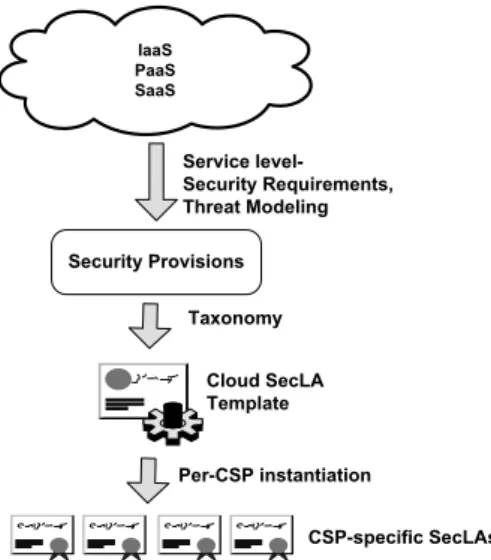
As shown in Figure 1 (introduced by Bernsmed [3]), a Cloud SecLA usually models the CSP security at the service level and, is based on either a set of expert-driven security requirements (e.g., for compliance reasons) or some kind of preliminary threat anal-ysis. The result is a collection of security statements (also called “security provisions” as in Figure 1) in the form {security attribute,
value} (e.g., {Backup Frequency, Daily} and {Encryption Key Size, 512 bits}), as also proposed in different industrial and academic
works [8], [29] and [23]. In order to be manageable, these security provisions must be organized into “categories” derived from a tax-onomy e.g., Savola [30] or the Cloud Security Alliance’s Cloud
1http://quant-security.org
Controls Matrix [9]. This set of security provisions – now or-ganized into taxonomic categories – will finally become a Cloud SecLA “template”, which can be used by CSPs to define their own SecLAs. Cloud SecLAs are usually stored in publicly available – and trusted – repositories like e.g., the Cloud Security Alliance’s (CSA) “Security, Trust & Assurance Registry” (STAR [10]). Apart from the challenges related with the creation of SecLAs in real Cloud deployments, the current paucity of techniques to
quanti-tatively reason about them has proven to be part of the obstacles
in using SecLAs, just as mentioned by Almorsy [1] and Luna [23], [24]. To start bridging this gap, this paper contributes a methodol-ogy to benchmark Cloud SecLAs.
IaaS PaaS SaaS Service level-Security Requirements, Threat Modeling Security Provisions Taxonomy Cloud SecLA Template Per-CSP instantiation CSP-specific SecLAs
Figure 1: Workflow used to create Cloud Security Level Agree-ments (SecLAs).
2.2
Quantitative Policy Trees (QPTs)
Despite the advantages of Cloud SecLAs (cf. Section 2.1), usu-ally these documents are informusu-ally formatted (e.g., free form text spreadsheets) thus limiting both humans and computers to quanti-tatively and automatically reason about them. For this reason we propose the “Quantitative Policy Trees”, an extended version of classical “AND-OR” trees, to represent Cloud SecLAs an enable the use of quantitative methodologies such as the benchmarking proposed in this paper.
CO CO-02 CO-01 IS IS-02 IS-01 SecLA AND OR AND Leaf nodes ParentL1 ParentL2
Figure 2: A simple Quantitative Policy Tree (QPT). As shown in Figure 2, an AND-OR tree is a hierarchical data
structure where branches are created with any of these two relation-ships in order to model the different strategies needed to achieve certain “goal”, usually represented by the root node. These are widely used for threat modeling (i.e., “attack trees”) and also to model security requirements as proposed by Bistarelli [5]. We uti-lize AND-OR trees in the following ways:
1. They allow the creation of “patterns” (i.e., Cloud SecLA tem-plates in our case), that can be re-used by other CSPs to design their own SecLAs, therefore taking advantage of the knowledge from the experts that originally created them. 2. AND-OR trees also allow integrating of security requirements
and the associated quantifiers. We elaborate further on QPTs in Section 3.
2.3
The Reference Evaluation Methodology
(REM) at Glance
In its basic form, REM (a) considers a set of security provisions to evaluate, (b) formalizes it to facilitate subsequent evaluation over an homogeneous metric space, (c) uses a set of reference levels (known as Local Security Levels or LSL) to apply a distance crite-rion, and (d) finally obtains a number (also called Global Security
Level or GSL) that corresponds to the policy’s security level.
For the purposes of this paper, some basic REM-related concepts are presented and the interested readers are referred to [7] for fur-ther details.
The first concept is the formal representation of any security policy by a n×m matrix, whose n rows represent single security
provisions with a maximum of m possible LSLs. For example, if the LSL associated to a Cloud Storage Provider’s provision called “File System Encryption" is 3, then the corresponding vector2will be (1,1,1,0). The REM concept of LSL is congruent with the notion of security ranges, as presented in [17].
The second REM-concept is a criteria used to quantify GSLs, and defined as the Euclidean distance3 among whatever pair of REM-matrices (A,B). Just as in Equation 1, the GSL is defined as the square root of the matrix trace of(A−B)(A−B)T, where
(A−B)Tis the conjugate transpose.
GSL(A,B) =d(A,B) =
Tr((A−B)(A−B)T) (1)
As a stand-alone security evaluation methodology, REM does not provide any additional metric to quantitatively reason about the LSL and GSL associated with each Cloud SecLA. To bridge this gap, the research presented in [24] developed a set of metrics to perform the security assessment of a CSP based on the REM-quantification of its SecLA.
3.
PROPOSED BENCHMARK
METHODOL-OGY FOR CLOUD SECLAS
The benchmark methodology presented in this section is illus-trated in Figure 3, where a predefined Cloud SecLA template (e.g., the CAIQ [9] template) and a set of CSP SecLAs (e.g., the ones stored in the STAR [10] repository), are the starting point to com-pute a security benchmark with respect to a user-defined SecLA requirement. The overall intent is to (a) systematically quantify the security level associated with each SecLA and (b) use the data from (a) to guide end-users in choosing the CSP that is closer to their security requirements.
2The LSL is usually known as the L1-Norm [33] of this vector 3Also known as the Frobenius-Norm [32]
0 10 20 30 40 50 60 70 80 A-- A- A A+ Qualitative Ranks Nu m ber o f s ecu rity provisio ns in the SecL A CSP1CSP2CSP3 1.- Define User SecLA requirements 2.- Map SecLAs to QPTs 3.- Benchmark QPT CSPs SecLA SecLA Template 0 5 10 15 20 25 30 A- A A+ Qualitative Ranks Num ber o f secu rity p rovis ion s in the S ecL A CSP1CSP2CSP3 Benchmark Results
Figure 3: Stages of the proposed Benchmark Methodology.
Considering the basic concepts of SecLA and QPT from Section 2, the following subsections detail each of the progressive blocks of our benchmark methodology.
3.1
Stage 1: Defining User’s SecLA
require-ments
During this first stage, the end-user creates their set of security requirements based on the SecLA Template given as one of the in-puts in our methodology (cf. leftmost side of Figure 3). This is a key consideration, as in practice security benchmarks can not be performed using SecLAs based on different templates (e.g., ISO27001 and HIPAA). In practice, these SecLA Templates are created by multi-disciplinary working groups (e.g., the Cloud Security Al-liance’s SLA and PLA work groups [11]). In these groups, usually industry and academia design the SecLAs’ content (i.e., the secu-rity and privacy requirements along with their associated metrics) and discuss their technical, operational and legal issues. Our on-going collaboration with the CSA aims to align the methodology proposed in this paper, with the real-world SecLAs being devel-oped by their work groups.
User-defined requirements will termed as User SecLA in this pa-per. A User SecLA is a distinctive element of Cloud SecLA, where all the security provisions are weighted in order to represent their relative importance from the user’s perspective (e.g., for some users “Encryption Key Size” might be more important than “Backup Fre-quency”). The basic guidelines for setting weights to individual security provisions are:
• Each security provision on the User SecLA will be associated with a quantitative weightωi(0≤ωi≤1).
• The sum of all the weightsωi associated with a set of
sib-ling security provisions (i.e., those having the same parent category) must be equal to 1.
• The user can choose only specific categories/security provi-sions to benchmark by assigningωi=0 to those not of
inter-est, as shown in Figure 5 and discussed in Section 4. Using the previous guidelines and based on our initial empir-ical validation (cf., Section 4), we have found that a convenient approach for assigning weights is to first set each sibling security provision with the same weight. Second, to identify important pro-visions (e.g., the ones related with mandatory requirements) and finally, to “transfer” them most of the weight (at least 50%) from those that are not critical for the operation of the Cloud service. Further validation of our methodology (cf. Section 6) will provide us with more real-world experience for setting these weights.
To complete the customization of User SecLA, the user can also select the appropriate AND/OR relationships between the
differ-ent categories of the SecLA Template. As inferred from their name, AND relationships will model hard-requirements where “Categories A, B and C are all required due to regulatory compliance”, whereas OR relationships are more adequate to model soft-requirements e.g., “Either A, B or C are needed for my to achieve my security goals”. The output of this stage will be three different classes of SecLAs, namely one SecLA Template, one User SecLA and, one or more
CSP SecLAs.
3.2
Stage 2: Mapping SecLAs to QPTs
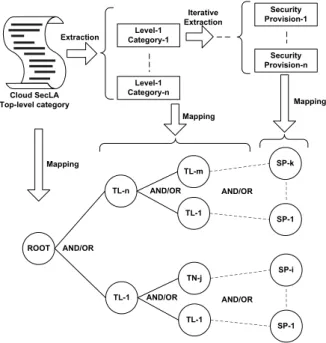
In this second stage, the Stage 1 SecLAs are transformed into corresponding QPTs, as introduced in Section 2.2. In order to map a Cloud SecLA to a QPT, we propose the process outlined in Figure 4. This resembles the creation of a SecLA (cf. Figure 1) but in
re-verse order: we start with a set of SecLA’s categories and then, via
an iterative refinement process, proceed to extract each individual security provision. Cloud SecLA Top-level category Level-1 Category-1 Level-1 Category-n Extraction Iterative Extraction Security Provision-1 Security Provision-n ROOT TL-n TL-m TL-1 SP-k SP-1 TL-1 TN-j TL-1 SP-i SP-1 Mapping Mapping Mapping AND/OR AND/OR AND/OR AND/OR AND/OR
Figure 4: SecLA-to-QPT: mapping a Cloud SecLA into a QPT Taking into account the inherent tree-like structure of a Cloud SecLA, we propose the following SecLA-to-QPT process:
1. The top-level SecLA category is directly mapped to the QPT’s root node.
2. Intermediate SecLA categories (non-leaf nodes), are mapped to the QPT’s intermediate nodes taking into account (i) their hierarchy in the SecLA (as defined by the SecLA Template) and, (ii) the AND/OR relationship that exists among these categories (inherited from the User SecLA).
3. Finally, individual security provisions (i.e., the duple
{secu-rity attribute, value} introduced in Section 2.1) are mapped
to the QPT’s leaf nodes. During this step, the user-defined weights (i.e.,ωifrom the User SecLA) are also populated to
leaf nodes.
Following this mapping process, we will obtain one User QPT and one or more CSP QPTs4. The process also results in these 4The corresponding QPT Template is not needed during the rest
QPTs being populated with the user-defined AND/OR andωi
re-quirements.
3.3
Stage 3: Benchmarking the QPTs
Over this final stage, the actual benchmarking process relates the different “CSP QPTs” with User QPT as a baseline. This stage is divided in two sub-steps, namely (1) quantitative aggregation and,
(2) ranking as detailed in the subsequent subsections.
3.3.1
Quantitative aggregation on the QPT
After the mapping stage (cf. Section 3.2), both the User QPT and the CSP QPTs have leaf nodes that contain values, either quan-titative (e.g., cryptographic key-sizes) or qualitative (e.g., a sim-ple “YES/NO” answer), associated with specific security attributes. Just as mentioned in [18], the use of non-homogeneous values rep-resents a problem from the security aggregation perspective. How-ever Casola [7] proposed a solution based on the notion of Local
Security Levels or LSL (cf., Section 2.3). A LSL is defined as a
function to map any class of security value (either quantitative or qualitative) to a user-defined quantitative security level. The con-cept of LSL is aligned with the notion of security ranges presented by Irvine and Levin [17] and has been widely used in the past (e.g. in [6], [8], [22] and [24]).
Our proposed methodology utilizes the notion of LSL to en-able the aggregation and propagation of quantitative security val-ues through the entire QPT. From the LSL definition [7], two basic assumptions are relevant here: (i) all the i-leaf nodes on the QPT have been already associated with a LSLi>0 and, (ii) there exists
a maximum value LSLmaxthat is the same for all the leaf nodes of
the QPT (i.e., 0<LSLi≤LSLmax).
Once every leaf node in the QPT has been associated with the duple{LSLi,ωi}, it is possible to propagate this values to the rest
of the tree using the aggregation rules shown in Table 1. These rules have been created taking into account the following:
• Within an AND node, the aggregated security level will de-pend on all the sibling nodes. This follows a natural notion in security, just like used in well-known scoring techniques e.g., the Common Vulnerability Scoring System (CVSS [14]).
• Following the “weakest-link” security principle, within an OR node the aggregated security level will be determined only by the sibling node with the smallest security level.
• As the notion of LSL andωionly applies to leaf nodes, the
proposed aggregation rules must be slightly modified depend-ing on the type of node bedepend-ing considered: ParentL1 are lo-cated one level above leaf nodes (e.g., “CO” and “IS” in Fig-ure 2), whereas ParentL2 are two or more levels above leaf nodes (e.g., the root “SecLA” node in Figure 2).
From Table 1 we highlight that despite individual nodes’ rity levels being linearly combined (i.e., following natural secu-rity notions), the use of weights (ωi) guarantees that all nodes will
contribute to the overall security level. This is contrary to other techniques that “masquerade” the effect of some security provi-sions, just as discussed in Section 4.1. Future works (cf. Section 6) will research the applicability of new non-linear aggregation tech-niques.
Once the User QPT and the CSP QPTs have been populated with the aggregated values (quantitatively computed from Table 1), it of the proposed methodology, but can be re-used later on when processing new SecLAs based on this same template.
Table 1: Aggregation rules for a QPT with n-sibling nodes Aggregation rule with i=1...n
Parameter AND node OR node
AggParentL1 ∑ni=1(LSLi×ωi) min(LSLi×ωi)
AggParentL2 ∑ni=1AggParentL1,i min(AggParentL1,i)
is possible to apply a ranking algorithm to determine how differ-ent CSPs under-/over-provision a user’s requiremdiffer-ents. This cen-tral idea behind the proposed benchmark methodology is developed next.
3.3.2
Ranking aggregated security values
In this paper, the notion of security benchmark is related to the problem of finding (either quantitatively or qualitatively) how a CSP fulfills user requirements. Our research proposes two differ-ent classes of benchmarks, namely QuantBnode(cf. Definition 1)
and QualBnode(cf. Definition 2), both based on the quantitative
security values already aggregated on the QPT (cf., Section 3.3.1). DEFINITION 1. The quantitative benchmark QuantBnode
asso-ciated with a specific node of the QPT, is defined as follows: QuantBnode=
AggCSP,node−AggU ser,node
Aggmax,node
Where:
• AggCSP,nodeis the aggregated security value for node in the
CSP QPT, as computed with Table 1.
• AggU ser,nodeis the aggregated security value for node in the
User QPT, as computed with Table 1.
• Aggmax,node is is the aggregated security value for node in
either User QPT or CSP QPT, as computed with Table 1 and using the maximum Local Security Level (LSLmax).
The quantitative benchmark from Definition 1 is a numeric value such that(−1≤QuantBnode≤1). If QuantBnode<0 then the
CSP is under-provisioning the user requirement, if QuantBnode>0
then the CSP over-provisions the user requirement and finally, if
QuantBnode=0 then the CSP exactly fulfills the user requirement.
In Section 4, we will show (using real-world Cloud SecLAs) that the QuantBnodemetric can be applied at any level of the QPT
(in-cluding leaf nodes), thus allowing for fine-grained benchmarks. A second metric (shown in Definition 2) aims to be more “human-friendly” by using a set of qualitative labels (e.g., {“Copper”,
“Sil-ver”, “Gold”}) to represent the benchmark’s results.
DEFINITION 2. The following expression defines QualBnode, the
qualitative benchmark associated with a specific node of the QPT: QualBnode=
QuantBnode×Ranksmax if QuantBnode≥0
QuantBnode×Ranksmax if QuantBnode<0
Where:
• QuantBnodeis the quantitative benchmark in Definition 1.
• Ranksmax is the total number of chosen qualitative labels
minus one. For example, if the set of qualitative labels is {“Copper”, “Silver”, “Gold”} then Ranksmax=2
The result of the previous metric is an integer number such that
QualBnode={−Ranksmax,...,0,...,Ranksmax}. In order to assign
it a qualitative label from the set Ranks={Label1,...,Labeln}
where n=Ranksmax+1, we use the following mapping function:
f(QualBnode→Ranks) = ⎧ ⎪ ⎪ ⎪ ⎪ ⎪ ⎪ ⎪ ⎨ ⎪ ⎪ ⎪ ⎪ ⎪ ⎪ ⎪ ⎩
Label1 if QualBnode=0
Label2 if QualBnode=1
−Label2 if QualBnode=−1
.. .
Labeln if QualBnode=Rankmax
−Labeln if QualBnode=−Rankmax
In the previous function, notice that a “negative” label such as
−Labeln literally represents the counterpart of the corresponding
“positive” label Labeln. For example “A-” and “A+”, “Silver” and
“Silver-”, and so forth.
Next, we present a case study that outlines how to apply the pro-posed benchmark methodology.
4.
CASE STUDY: BENCHMARKING CLOUD
PROVIDERS IN THE STAR REPOSITORY
As an initial effort to validate the proposed benchmarking method-ology, we applied it to the CSP data stored in the STAR repository [10], and compared the obtained results with those empirically val-idated in a previous research [24] via members of the Cloud Secu-rity Alliance. Currently, STAR contains Cloud SecLAs in the form of “Consensus Assessments Initiative Questionnaire” (CAIQ [9]) reports, which provide industry-accepted ways to document what security controls exist in Cloud offerings.
The CAIQ contains a set of 171 security provisions (all of these with a qualitative “YES/NO” answer) distributed in the following
controls: Compliance (CO) – 14, Data Governance (DG) – 15,
Fa-cility Security (FS) – 9, Human Resources Security (HR) – 4, Infor-mation Security (IS) – 71, Legal (LG) – 2, Operations Management (OP) – 5, Risk Management (RI) – 12, Release Management (RM) – 5, Resilience (RS) – 11 and Security Architecture (SA) – 23.
To perform meaningful comparisons of the obtained results with those empirically validated by Luna [24], we also use the same “extended version” of the CAIQ report containing an additional set of 29 security provisions that result in a final set of 171 + 29 = 200 security provisions to benchmark. These new security provisions allow for quantitative values (e.g., the frequency of the network penetration tests), beyond the original CAIQ’s “YES/NO” answers. An overall view of the resultant QPT is shown in Figure 5.
For comparison purposes, the analyses shown in this section also considered (i) a maximum of 4 Local Security Levels (i.e., LSL = 4 as introduced in Section 3), (ii) all leaf nodes on the QPT having the same weight (i.e., ωi), (iii) only AND branches on the QPT
– except when specifying the opposite –, (iv) a set of qualitative labels where Ranksmax=2 like in Ranks = {A–, A-, A, A+, A++ }
and finally, (v) to fulfill STAR’s usage restrictions we anonymized the identity of the benchmarked CSPs.
4.1
Analytical Results
We applied a first round of the proposed benchmarks to the same three Cloud SecLAs evaluated by Luna in [24]. The results (shown in Figure 6) have been normalized in order to allow the comparison of both approaches. Despite the differences in the obtained numeric values of the “Aggregated Security Level from SecLA” axis in Fig-ure 6, we can observe that overall the methodology proposed in this paper also found out that CSP2 had the worst security level. The
CAIQ CO CO-01 CO-06 CO-01.1 CO-06.Q1 DG DG-01 DG-08 DG-01.1 DG-08.1 FS FS-01 FS-08 FS-01.1 FS-08.2 HR HR-01 HR-03 HR-01.1 HR-03.1 IS IS-01 IS-34 IS-01.1 IS-34.1 LG LG-01 LG-02 LG-01.1 LG-02.2 OP OP-01 OP-04 OP-01.1 OP-04.5 RI RI-01 RI-05 RI-01.1 RI-05.7 RM RI-01 RI-05 RI-01.1 RI-05.1 RS RS-01 RS-08 RS-01.1 RS-08.Q1 SA SA-01 RS-08 SA-01.1 SA-14.3 28 Sec. Provs. 16 Sec. Provs. 9 Sec. Provs. 4 Sec. Provs. 84 Sec. Provs. 2 Sec. Provs. 9 Sec. Provs. 12 Sec. Provs. 5 Sec. Provs. 12 Sec. Provs. 24 Sec. Provs.
Figure 5: Quantitative Policy Tree based on the SecLA Template from the Cloud Security Alliance’s Consensus Assessments Initiative Questionnaire [9]. Highlighted shapes are the categories used in the example shown in Section 4.
methodology proposed in this paper also eliminated REM’s nega-tive “masquerading effect” , one of the most common criticisms as-sociated with its use. This “masquerading” is due to the flat-matrix structure used by REM (cf., Section 2.3), which does not take into account the inherent hierarchical structure of the Cloud SecLA (as elaborated in Section 2.2). When “masqueraded” the overall se-curity score will mostly depend on those sese-curity groups with a high-number of provisions, thus affecting negatively groups with fewer — although possibly more critical — provisions. Take for example Figure 6, which clearly shows that columns “REM Tech-nique” and “IS Policy Tree” follow the same pattern, because the CAIQ category “Information Security” (IS) is by far the one with the biggest number of security provisions in the SecLA. In Section 5 we will further discuss the main differences between the REM-based approach used in [24] and, the methodology proposed in this paper. 85.00% 86.00% 87.00% 88.00% 89.00% 90.00% 91.00% 92.00% 93.00% 94.00% 95.00% CSP1 CSP2 CSP3 A g g reg ated Se cu rity L ev el fro m Se cL A
Cloud Service Provider (CSP)
Policy Tree Technique REM Technique IS Policy Tree
Figure 6: Quantitative comparison of the benchmarking tech-nique proposed in this paper and the one based on REM [24].
Another improvement with respect to the REM-based approach used by Luna [24] allows users to benchmark Cloud SecLA at dif-ferent levels of granularity. This is shown in Table 2, where
abso-lute benchmarks were computed for three different CSPs. That is,
the reference used in these benchmarks was a Cloud SecLA where all the security provisions were set to LSL = 0. Absolute bench-marks are useful to provide decision makers with a coarse-view of the security being offered by available CSPs, in order to select an
initial subset where to perform the actual benchmarking with re-spect to their own set of security requirements.
The information shown in Table 2 is also useful to find which individual CAIQ controls report a relative CSP performance. For example, if control “CO” is the prime requisite from a business perspective, then the absolute benchmarks will advise to initially choose CSP2and CSP3over CSP1. Notice that this conclusion can not be drawn directly from the overall SecLA-level benchmarks, where CSP1and CSP3outperform CSP2.
Table 2: Absolute quantitative benchmarks obtained for three different CSP SecLAs CSP1 CSP2 CSP3 SecLA 0.94 0.91 0.94 CO 0.67 0.92 0.89 DG 0.98 0.97 0.97 FS 1.00 0.91 1.00 HR 1.00 1.00 1.00 IS 0.91 0.88 0.94 LG 1.00 1.00 1.00 OP 1.00 0.91 0.81 RI 0.93 1.00 0.97 RM 1.00 0.70 1.00 RS 0.91 0.96 0.82 SA 0.97 0.79 0.90
A second set of benchmarks was applied to our dataset of three Cloud SecLA in order to show two additional features of the method-ology proposed in this paper, namely (i) adding the notion of a
User SecLA requirement – as presented in Section 3 – as a
base-line for the benchmarks and, (ii) obtaining qualitative benchmarks that might be more meaningful than quantitative benchmarks to hu-man decision-makers. For this analysis we created a synthetic User
SecLA based on the QPT shown in Figure 5 with highlighted boxes.
This user requirement consisted of only two controls of the CAIQ, namely “Compliance” (where all leaf nodes had LSLCO=2 and the
same weightωi) and “Information Security” (where all leaf nodes
had LSLIS=3 and also the sameωi). The obtained results, shown
in Figures 7 and 8, allow us to conclude that CSP2over-provisions most of the user’s requirements (the “A+” bar in Figure 7) with re-spect to the CO control, whilst CSP1under-provisions almost half of them.
0 5 10 15 20 25 30 A- A A+ Number of
security provisions in the SecLA
Qualitative Ranks CSP1 CSP2 CSP3
Figure 7: Qualitatively ranking a User SecLA using the “Com-pliance” category (consisting of 28 leaf nodes on the QPT) of the CAIQ [9].
that CSP3followed by CSP1over-provisioned the vast majority of user’s requirements. These results are consistent with the “absolute benchmarks” from Figure 6 and Table 2, where the same couple of CSP clearly outperformed CSP2 in the “IS” control. Also in Figure 8 is worth to notice the two negative qualitative ranks (i.e., the “A-” and “A–”), which mean that at least one provision of each CSP under-provisioned the user requirement. Users of the proposed methodology should take into account that an “A+ CSP” does not mean that the CSP is 100% secure or will not suffer from secu-rity failures. The proposed rankings are meant for comparing CSPs with respect to a predefined User SecLA requirement, therefore an “A+ CSP” means that this particular provider fulfilled the user re-quirements better than an “A CSP” or an “A- CSP”. In Section 6, we discuss future work aimed to correlate obtained benchmarks with e.g., public reports of a CSP’s outages.
0 10 20 30 40 50 60 70 80 A-- A- A A+
Number of security provisions in the SecLA
Qualitative Ranks CSP1 CSP2 CSP3
Figure 8: Qualitatively ranking a “User SecLA” using the “In-formation Security” category (consisting of 83 leaf nodes on the QPT) of the CAIQ [9].
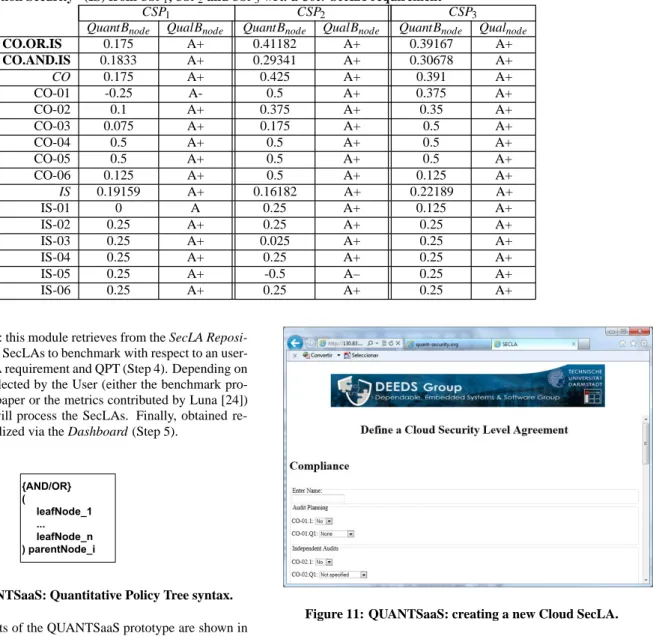
Finally, Table 3 shows with a higher level of granularity both the quantitative (cf. QuantBnodeas in Definition 1) and qualitative (cf.
QualBnodeas in Definition 2) benchmarks of the three CSP under
analysis (due to space restrictions not all the “IS”-related provi-sions are being shown). Notice that we have modeled two different user requirements in the same QPT from Figure 5: the first one just considered AND branches and the second did consider an OR relationship between the top-level categories “CO” and “IS”. The obtained benchmarks were once again congruent with Figures 7
and 8 and in fact, these allow for a higher level of detail in order to identify CSPs that under-provision some requirements (e.g., CSP1 has a negative rank in category “CO-01”).
Quantitative ranks, such as shown in Table 3, might also al-low computer systems to automatically match end-users’ SecLA requirements with one or more CSPs able to fulfill those needs. De-spite the usefulness of such processes there is a conspicuous lack of these in research or practice. In order to bridge this gap, we next present a working prototype that implements the benchmark-ing methodology proposed in this paper.
4.2
Proof-of-concept: QUANTS-as-a-Service
Despite the pervasive nature of Cloud technologies and their ad-vocated economic/technological advantages, the migration of ap-plications has been limited, in part, due to the lack of security
as-surance by the CSP. This lack of asas-surance, along with the current
paucity of techniques to quantify security, often results in users be-ing unable to assess the security of the CSP they are paybe-ing for. In order to provide users with an automatic tool to benchmark the security offered by a CSP, our research contributes to the state of the art with the “QUANTifiable Security-as-a-Service” system (QUANTS-as-a-Service or simply QUANTSaaS).
STAR SecLA GUI SecLA Management SecLA Reposi-tory Analyzer GUI Dashboard Benchmarking Other Metrics Cloud Service Providers 1.- CAIQ Information 2.- CAIQ files Download Manager QUANTS-as-a-Service
3.- SecLA, QPT 4.- SecLA, QPT User 5.- Results Protocol Adapters
Figure 9: Building blocks of the “QUANTifiable Security-as-a-Service” system.
The first version of QUANTSaaS (shown in Figure 9) imple-ments both the benchmarking methodology proposed in this paper and also the metrics contributed by Luna [24]. At the core of our QUANTSaaS system are the following building blocks:
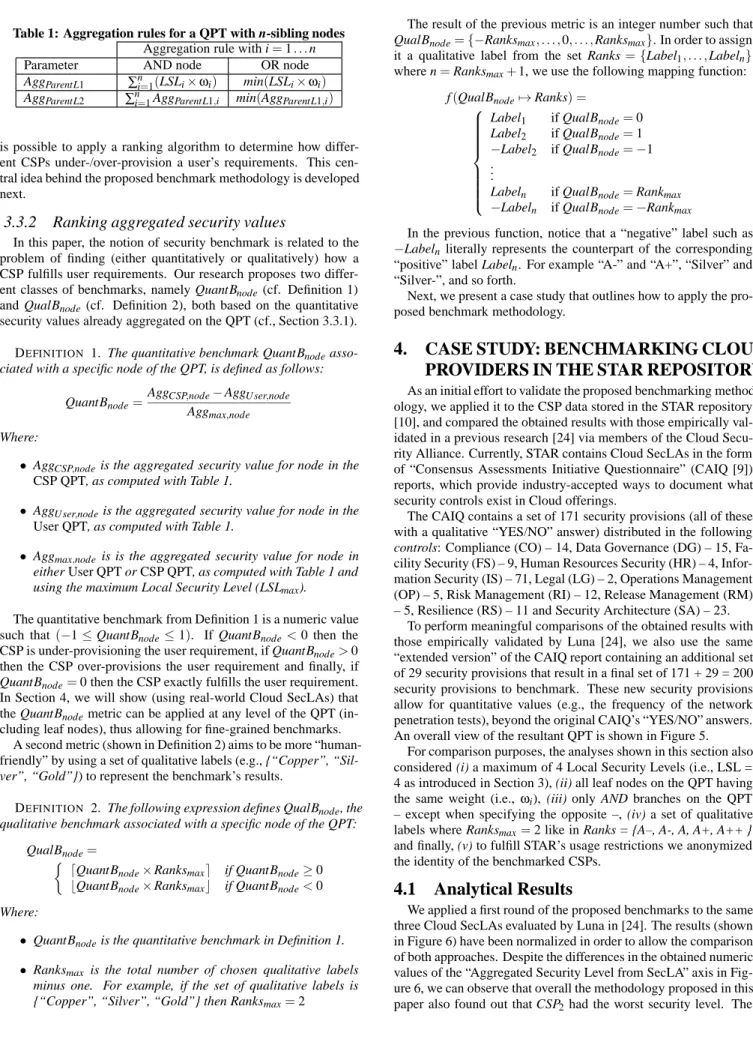
1. SecLA GUI: after a CSP has uploaded its CAIQ report to STAR (Step 1 in Figure 9) the user retrieves it via the
Down-load Manager (Step 2). Afterwards, both the CAIQ report
and the user’s required SecLA (i.e., baseline for the bench-marks including user-defined weights) are manually entered and stored into the SecLA Repository via the SecLA
Manage-ment module (Step 3). This module is also used to update,
delete and modify stored Cloud SecLAs. QUANTSaaS also allows for user-defined QPTs via plain-text files using the syntax shown in Figure 10.
2. SecLA Repository: this trusted database stores both the SecLAs and QPT structures used by the system. Also as future work, we will integrate a set of “protocol adapters” to directly in-sert/retrieve data from the SecLA Repository e.g., via CloudAu-dit [16].
Table 3: Example of obtained quantitative (QuantBnode) and qualitative (QualBnode) benchmarks for the categories “Compliance”
(CO) and “Information Security” (IS) from CSP1, CSP2and CSP3wrt. a User SecLA requirement
CSP1 CSP2 CSP3
QuantBnode QualBnode QuantBnode QualBnode QuantBnode Qualnode
CO.OR.IS 0.175 A+ 0.41182 A+ 0.39167 A+ CO.AND.IS 0.1833 A+ 0.29341 A+ 0.30678 A+ CO 0.175 A+ 0.425 A+ 0.391 A+ CO-01 -0.25 A- 0.5 A+ 0.375 A+ CO-02 0.1 A+ 0.375 A+ 0.35 A+ CO-03 0.075 A+ 0.175 A+ 0.5 A+ CO-04 0.5 A+ 0.5 A+ 0.5 A+ CO-05 0.5 A+ 0.5 A+ 0.5 A+ CO-06 0.125 A+ 0.5 A+ 0.125 A+ IS 0.19159 A+ 0.16182 A+ 0.22189 A+ IS-01 0 A 0.25 A+ 0.125 A+ IS-02 0.25 A+ 0.25 A+ 0.25 A+ IS-03 0.25 A+ 0.025 A+ 0.25 A+ IS-04 0.25 A+ 0.25 A+ 0.25 A+ IS-05 0.25 A+ -0.5 A– 0.25 A+ IS-06 0.25 A+ 0.25 A+ 0.25 A+
3. Analyzer GUI: this module retrieves from the SecLA
Reposi-tory the Cloud SecLAs to benchmark with respect to an
user-defined SecLA requirement and QPT (Step 4). Depending on the metrics selected by the User (either the benchmark pro-posed in this paper or the metrics contributed by Luna [24]) this module will process the SecLAs. Finally, obtained re-sults are visualized via the Dashboard (Step 5).
{AND/OR} ( leafNode_1 ... leafNode_n ) parentNode_i
Figure 10: QUANTSaaS: Quantitative Policy Tree syntax. Actual screen-shots of the QUANTSaaS prototype are shown in Figures 11 and 12. The former shows the SecLA GUI when used to create a new CSP entry into the SecLA Repository. The latter presents a QTP visualization inside the QUANTSaaS’ Dashboard showing the benchmark’s results.
The QUANTSaaS system will be publicly available after its final tests have passed. Interested parties are encouraged to contact the authors of this paper for requesting access to the system, because their feedback will be used to provide further empirical validation to the methodology presented in this paper (cf., Section 6 for other future activities related with QUANTSaaS).
5.
RELATED WORK
Specification and management of SLA are becoming essential components for Cloud computing. In the past, SLA specifications have mainly been considered in the Service Oriented Architectures (SOAs) and Web services fields as in WS-Agreement [2] and WSLA [21]. Unfortunately, a major limitation of these approaches is that they do not consider security aspects even if the need for incorpo-rating security in SLAs was already highlighted by Henning [15].
While the advocacy to consider security in SLAs has started,
Figure 11: QUANTSaaS: creating a new Cloud SecLA.
Figure 12: QUANTSaaS: visualizing a Cloud SecLA bench-mark via a QPT.
very few of these have focused on Cloud SecLAs per se. In particu-lar we highlight Bernsmed [3], where the authors present a method for managing the SecLA lifecycle in the context of federated Cloud
services. That work can be considered complementary to our re-search, considering that while Bernsmed [3] discuss the contents of Cloud SecLAs, they do not further elaborate about the techniques needed to conduct benchmarking.
Almorsy [1] proposes the notion of evaluating Cloud SecLAs. In their paper, a metric is introduced to benchmark a CSP’s “secu-rity categorization” of their information (either tenant or per-service), based on impact metrics for all the three dimensions of security (confidentiality, integrity and availability). However, the resulting security categorization is purely qualitative (i.e. specify-ing the High, Medium or Low security ranges) and absolute (i.e. does not take into account the user’s requirements), contrary to our proposed benchmark methodology. The benchmark method-ology presented in this paper matches our previous works on the quantitative assessment of Cloud SecLAs [23], [24]. Furthermore, the methodology proposed in this paper improves over the REM-based approach (proposed in [7] and applied to Cloud SecLA in Luna [24]) by (i) adding the notion of weighted security provisions,
(ii) providing security benchmarks at different levels of
SecLA-granularity (e.g., overall Cloud SecLA or individual security provi-sions) and (iii) eliminating the “masquerading” effect mentioned in Section 4.
Despite the few works proposing new performance benchmarks for the Cloud (e.g., Binnig [4]) to the best of our knowledge there are no further works related with the security benchmarks of CSPs. In particular we refer to related works that use the notion of SecLAs and also aimed to empirically validate their security metrics with real CSP data. Nevertheless for the sake of completeness, the rest of this section cites the efforts from other Information Technology fields aimed to benchmark security.
Often the concept of security benchmark is associated with the notion of finding vulnerabilities, as discussed by Livshits and Lam [20] and implemented in theirStanford SecuriBenchtools [19]. A similar vulnerability-based approach for security benchmarks was adopted by Parrend and Frenot [27], with a particular focus on the component-oriented OSGi platform. The authors also elaborate on a “vulnerability-pattern” to define the type of data necessary to handle OSGi vulnerabilities and also, define a quantitative metric to benchmark different OSGi implementations based on the percent-age of the known vulnerabilities protected by the adopted security mechanisms.
Security benchmarks in the computer architecture area have also been studied. For example Poe and Li proposed BASS [28], a set of vulnerability-based benchmarks for evaluating the security features of hardware modifications in order to design secure architectural and hardware mechanisms.
The challenges related with the empirical validation of security benchmarks were presented by Dumitras and Shou [13]. In order to alleviate the security and privacy concerns that appear when real data is used for security benchmarks the authors propose WINE, a platform to share different types of data sets (e.g., SPAM and malware) useful to benchmark security. Taking into account the challenges documented by Dumitras and Shou [13], our research plans to make publicly available the QUANTSaaS system so future works can use our data sets and implemented techniques to validate their own security benchmark methodologies.
Finally, in a recent paper Neto [26] elaborates the difficulties involved in applying the dependability benchmarking approach to the security context. Furthermore, the authors propose as an al-ternative to security benchmarking the so-called “trustworthiness benchmarking”, which is based on the analysis of the defense struc-ture of the system instead of based on a set of attacks that can be conceived after a threat analysis. Our proposed methodology has
followed a similar approach, by benchmarking a CSP based not on its vulnerabilities but on the quantification of their trust/assurance as documented in their Cloud SecLAs.
6.
CONCLUSIONS
In this paper we have presented a methodology to benchmark Cloud security based on the concept of Security Level Agreements. The proposed methodology was applied to the CSP’s information stored in the STAR repository of the Cloud Security Alliance, in order to be validated with respect to the results obtained – and em-pirically validated – via another state of the art Cloud security as-sessment technique [24]. Obtained results were congruent with the latter and furthermore, the proposed methodology also advanced the state of the art in two additional aspects: first, more fine-grained control over the performed benchmarks and second, the use of ei-ther quantitative or qualitative benchmarks.
Another contribution of our research is a working prototype that implements the proposed benchmark methodology. We refer to the QUANTaaS system described in Section 4. Our research has already considered making QUANTaaS publicly available in the short term, both to provide further empirical validation of our method-ology and empower end users through providing choices of service providers via the use of Cloud SecLAs. Hopefully, our research will aid to trigger security transparency and new types of SecLA-based services in CSPs. Our belief is that SecLAs will become in the short term a key factor to enable competition between CSPs based on security properties.
To the best of our knowledge the security benchmarking of CSPs is lacking, and in particular aimed to empirically validate the appli-cability of their methodologies with real CSP data. Our proposed methodology specifically addresses this gap and is also flexible, in the sense that it can be used with new Cloud SecLA Templates that might appear in the short-term (e.g., derived from both the threat analysis of real CSP architectures and, existing standards like e.g., ISO27001 and PCI). Also, our methodology is not tied to the un-derlying security scoring model, because it can easily adapt to use new ones e.g., based on maturity models [29].
The work in this paper is not aimed to substitute the Cloud secu-rity auditing function. In contrast, our secusecu-rity benchmarks build on the premise that Cloud SecLAs are trusted in the sense that they have been previously audited by experts. This is precisely the base to build the security assurance needed by Cloud users.
We are aware of the need to provide further empirical valida-tion of the proposed methodology, therefore future work will aim to demonstrate that our contributions can yield CSP rankings with some objective value. For example, we are planning to show that a User SecLA covering only the Resilience (RS) control group of the CAIQ reports, leads to a quantitative/qualitative raking of CSPs that correlates with public reports of service outages. Additional validation data is expected to come from both the QUANTSaaS users’ feedback and expert-driven reviews of the CAIQ reports (e.g., possibly through our liaison with the Cloud Security Alliance). Results of the empirical validation will be also used to develop and compare with respect to new non-linear aggregation techniques and ranking algorithms, with a particular focus on those able to deal with the uncertainty and inconsistency associated with secu-rity metrics, just motivated by Jansen [18].
Also, future activities will complement both our security bench-mark methodology and the QUANTSaaS system with the tech-niques to negotiate, predict and tune Cloud SecLAs based not only on “declarative” information (e.g., the one from the STAR reposi-tory), but also on real-time data gathered from the service provider’s infrastructure. In fact, we have started the integration of our
method-ology into the Cloud platform developed by the EU mOSAIC project [25], in order to implement the automatic negotiation of security parameters based on the notion of Cloud SecLAs.
7.
ACKNOWLEDGEMENTS
Research supported in part by EC FP7 project ABC4Trust (Grant Agreement no. 257782) and Loewe TUD CASED.
8.
REFERENCES
[1] Almorsy M., et.al. Collaboration-Based Cloud Computing Security Management Framework. In Proc. of IEEE Intl
Conference on Cloud Computing, pages 364–371, 2011.
[2] Andrieux K., et.al. Web Services Agreement Specification (WS-Agreement). Technical Report
TR-WSAgreement-2007, Open Grid Forum, 2007. [3] Bernsmed K., et.al. Security SLAs for Federated Cloud
Services. In Proc. of IEEE Availability, Reliability and
Security, pages 202–209, 2011.
[4] Binnig C., et. al. How is the weather tomorrow?: towards a benchmark for the cloud. In Proc. of the ACM Workshop on
Testing Database Systems, pages 9:1–9:6, 2009.
[5] Bistarelli S., et. al. Defense trees for economic evaluation of security investments. In Proc. of Availability, Reliability and
Security, pages 8 – 16, 2006.
[6] Casola V., et.al. Interoperable Grid PKIs Among Untrusted Domains: An Architectural Proposal. In Advances in Grid
and Pervasive Computing, volume 4459 of Springer LNCS,
pages 39–51. 2007.
[7] Casola V., et.al. A Reference Model for Security Level Evaluation: Policy and Fuzzy Techniques. Journal of
Universal Computer Science, pages 150 – 174, 2005.
[8] Casola V., et.al. A SLA evaluation methodology in Service Oriented Architectures. In Quality of Protection, volume 23 of Springer Advances in Information Security, pages 119 – 130. 2006.
[9] Cloud Security Alliance. The Consensus Assessments Initiative Questionnaire. Online:
https://cloudsecurityalliance.org/research/cai/, 2011. [10] Cloud Security Alliance. The Security, Trust & Assurance
Registry (STAR). Online:
https://cloudsecurityalliance.org/star/, 2011. [11] Cloud Security Alliance. Security and Privacy Level
Agreements working groups. Online:
https://cloudsecurityalliance.org/research/pla/, 2012. [12] Dekker M. and Hogben G. Survey and analysis of security
parameters in cloud SLAs across the European public sector. Technical Report TR-2011-12-19, European Network and Information Security Agency, 2011.
[13] Dumitras T. and Shou D. Toward a standard benchmark for computer security research: the worldwide intelligence network environment (WINE). In Proc. of the ACM
BADGERS Workshop, pages 89–96, 2011.
[14] Forum of Incident Response and Security Teams. CVSS – Common Vulnerability Scoring System. Online:
http://www.first.org/cvss/, 2012.
[15] Henning R. Security service level agreements: quantifiable security for the enterprise? In Proc. of ACM Workshop on
New security paradigms, pages 54–60, 1999.
[16] Hoff C., et.al. CloudAudit 1.0 - Automated Audit, Assertion, Assessment, and Assurance API (A6). Technical Report draft-hoff-cloudaudit-00, IETF, 2011.
[17] Irvine C. and Levin T. Quality of security service. In Proc. of
ACM Workshop on New security paradigms, pages 91–99,
2001.
[18] Jansen W. Directions in security metrics research. Technical Report TR-7564, National Institute for Standards and Technology, 2010.
[19] Livshits B. Stanford SecuriBench. Online: http://suif.stanford.edu/livshits/securibench/, 2005. [20] Livshits B. and Lam M. Finding security errors in Java
programs with static analysis. In Proc. of Usenix Security
Conference, pages 18 – 18, 2005.
[21] Ludwig H., et.al. Web Service Level Agreement (WSLA) Language Specification. Technical Report
TR-WSLA-2003-01-28, IBM, 2003.
[22] Luna J. et.al. Providing security to the Desktop Data Grid. In
Proc. of IEEE Symposium on Parallel and Distributed Processing, pages 1–8, 2008.
[23] Luna J., et.al. A Security Metrics Framework for the Cloud. In Proc. of Security and Cryptography, pages 245–250, 2011. [24] Luna J., et.al. Quantitative Assessment of Cloud Security
Level Agreements: A Case Study. In Proc. of Security and
Cryptography, (In Press).
[25] mOSAIC. mOSAIC FP7. Online:
http://www.mosaic-cloud.eu/, 2011.
[26] Neto A., et.al. To benchmark or not to benchmark security: That is the question. In Proc. of DSN HoTDep Workshop, pages 182–187, 2011.
[27] Parrend P. and Frenot S. Security benchmarks of OSGi platforms: toward Hardened OSGi. Softw. Pract. Exper., 39:471–479, 2009.
[28] Poe J. and Li T. BASS: a benchmark suite for evaluating architectural security systems. SIGARCH Comput. Archit.
News, 34(4):26–33, 2006.
[29] Samani R., et.al. Common Assurance Maturity Model: Scoring Model. Online: http://common-assurance.com/, 2011.
[30] Savola R., et.al. Towards Wider Cloud Service Applicability by Security, Privacy and Trust Measurements. In Proc. of
IEEE Application of Information and Communication Technologies, pages 1–6, 2010.
[31] Schneier B. Assurance. Online:
http://www.schneier.com/blog/archives/2007/08/assurance.html, 2007.
[32] Weisstein W. Frobenius Norm. Online:
http://mathworld.wolfram.com/FrobeniusNorm.html, 2011. [33] Weisstein W. L1-Norm. Online:

![Figure 6: Quantitative comparison of the benchmarking tech- tech-nique proposed in this paper and the one based on REM [24].](https://thumb-us.123doks.com/thumbv2/123dok_us/10743056.2962496/6.892.82.840.100.1059/figure-quantitative-comparison-benchmarking-nique-proposed-paper-based.webp)
![Figure 7: Qualitatively ranking a User SecLA using the “Com- “Com-pliance” category (consisting of 28 leaf nodes on the QPT) of the CAIQ [9].](https://thumb-us.123doks.com/thumbv2/123dok_us/10743056.2962496/7.892.95.464.87.275/figure-qualitatively-ranking-user-secla-pliance-category-consisting.webp)