K Swathi et al. Volume 3 (3), 2015, Page-737-741 CODEN (USA)-IJPRUR,e-ISSN: 2348-6465
Original Article
Method Development and Its Validation for Simultaneous
Estimation of Ramipril & Clopidogrel by RP-HPLC in
Combination Tablet Dosage Form
Koduru Swathi*, Mitta chaitanya, Kalepu swathi
Department of Pharmaceutical analysis, Bojjam Narsimhulu Pharmacy College for Women, Hyderabad- 500088, India
A R T I C L E I N F O A B S T R A C T
_______________________________________________________________________________
1. INTRODUCTION
The oral drug delivery has been known for decades as
the most widely utilized route of administration among
all the routes that have been employed for the systemic
delivery of drug via various pharmaceutical products of
International Journal of Pharma Research and Health Sciences
Available online atwww.pharmahealthsciences.net
Received: 22 Mar 2015
Accepted: 18 Apr 2015 A selective and sensitive stability-indicating high-performance liquidchromatographic method was developed and validated for the determination of Ramipril & Clopidogrel. The λmax of the two ingredients i.e. Ramipril & Clopidogrel , were found to be 210 nm and 225 nm respectively in methanol as solvent system. Accurately weighed 100 mg of Ramipril and 100 mg of Clopidogrel were transferred to 100 ml volumetric flask. About 40 ml of HPLC grade methanol was added and sonicated to dissolve. The volume was made up to mark with same solvent. Then 10 ml of the above solution was diluted to 100 ml with the solvent system. Mobile phase was prepared by taking Potassium dihydrogen phosphate buffer + Dipotassium hydrogrn phosphate (0.01 M, pH 3.0): acetonitrile (30:70). Mobile phase was filtered through 0.45 m membrane filter and degassed under ultrasonic bath prior to use. The mobile phase was pumped through the column at a flow rate of 1.0 ml/min. The HPLC system was set with the optimized chromatographic conditions to run the standard solution of Clopidogrel and Ramipril for 15 min. The retention time were found to be 2.03 min and 9.93 min respectively
Keywords:Ramipril & Clopidogrel, RP-HPLC, Acetonitrile (30:70), Retention time.
Corresponding author *
K Swathi et al. Volume 3 (3), 2015, Page-737-741
different dosage forms. The reasons that the oral route
achieved such popularity may be in part attributed to
its ease of administration and the belief that oral
administration of the drug is well absorbed. Ramipril
(Altace) is an ACE inhibitor. ACE stands for
angiotensin converting enzyme. Ramipril is used to
treat high blood pressure (hypertension) or congestive
heart failure, and to improve survival after a heart
attack.
Fig 1a, b: Structure of Ramipril and Clopidogrel
Clopidogrel (INN) is an oral, thienopyridine-class
antiplatelet agent used to inhibit blood clots in
coronary artery disease, peripheral vascular disease,
cerebrovascular disease, and to prevent myocardial
infarction (heart attack). It is marketed by
Bristol-Myers Squibb and Sanofi under the trade name Plavix.
The drug works by irreversibly inhibiting a receptor
called P2Y12, an adenosine diphosphate (ADP)
chemoreceptor on platelet cell membranes.
2. EXPERIMENTAL WORK 2.1 Method Development
Standard & sample preparation for
UV-spectrophotometer analysis:
Selection of wavelength
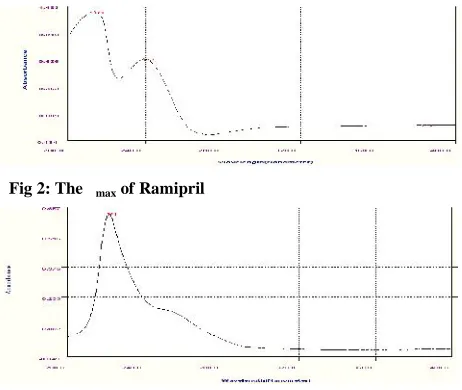
The λmax of the two ingredients i.e. Ramipril &
Clopidogrel , were found to be 210 nm and 225 nm
respectively in methanol as solvent system.the
Preparation of standard solution of Ramipril 10 mg of
Ramipril was weighed accurately and transferred into
100 ml volumetric flask. About 10 ml of HPLC grade
methanol was added and sonicated to dissolve. The
volume was made up to the mark with same solvent.
The final solution contained about 100 μg/ml of
Ramipril. Preparation of standard solution of
Clopidogrel by 10 mg of Clopidogrel was weighed
accurately and transferred into 100 ml volumetric flask.
About 10 ml of HPLC grade methanol was added and
sonicated to dissolve. The volume was made up to the
mark with same solvent. The final solution contained
about 100 μg/ml of Clopidogrel.Preparation of mix.
standard solution of Ramipril & Clopidogrel .
Accurately weighed 100 mg of Ramipril and 100 mg of
Clopidogrel were transferred to 100 ml volumetric
flask. About 40 ml of HPLC grade methanol was added
and sonicated to dissolve. The volume was made up to
mark with same solvent. Then 10 ml of the above
solution was diluted to 100 ml with the solvent system.
The resultant solution was filtered through a 0.45m
membrane filter and degassed under ultrasonic bath
prior to use. From the above standard solution several
working standard solutions are prepared by serial
dilution technique.
Fig 2: The λmaxof Ramipril
K Swathi et al. Volume 3 (3), 2015, Page-737-741
The HPLC instrument was switched on. The column
was washed with HPLC water for 45 minutes. The
column was then saturated with mobile phase for 45
minute. The mobile phase was run to find the peaks.
After 20 minutes the standard drug solution was
injected in HPLC.
2.3 Different chromatographic conditions used and
their Optimizations
The different HPLC chromatographic conditions were
used to find out the optimum chromatographic
condition for best elution of drugs.
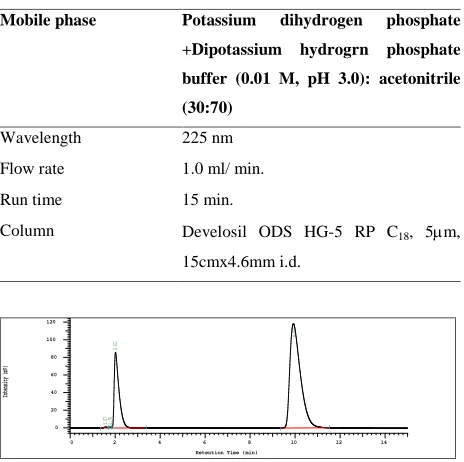
Table 1: Chromatographic condition
Mobile phase Potassium dihydrogen phosphate
+Dipotassium hydrogrn phosphate
buffer (0.01 M, pH 3.0): acetonitrile
(30:70)
Wavelength 225 nm
Flow rate 1.0 ml/ min.
Run time 15 min.
Column Develosil ODS HG-5 RP C18, 5m,
15cmx4.6mm i.d.
1.571.79
2.02
9.93
0 2 4 6 8 10 12 14
Retention Time (min) 0 20 40 60 80 100 120 Intensity (mV )
Fig 2: The chromatogram obtained after condition , typical
chromatogram of Ramipril (rt=9.93 min) and Clopidogrel (rt=
2.02 min).
Here resolution was good, theoretical plate count and
symmetry was appropriate. Also no unwanted little
peaks were seen between two peaks. Hence it was
acceptable. The selected and optimized mobile phase
was Potassium dihydrogen phosphate
buffer+Dipotassium hydrogrn phosphate (0.01 M, pH
3.0): acetonitrile (30:70) Run time was 15 min. Here
the peaks were separated and showed better resolution,
theoretical plate count and symmetry. The proposed
chromatographic conditions were found appropriate for
the quantitative determination of the drugs.
2.4 Preparation of mobile phase
Mobile phase was prepared by taking Potassium
dihydrogen phosphate buffer+Dipotassium hydrogrn
phosphate (0.01 M, pH 3.0): acetonitrile (30:70).
Mobile phase was filtered through 0.45m membrane
filter and degassed under ultrasonic bath prior to use.
The mobile phase was pumped through the column at a
flow rate of 1.0 ml/min.
2.5 Running the standard solution of Clopidogrel
2 ml of stock solution was pipetted out into a 10 ml
volumetric flask. The volume was made up to the mark
with methanol. The solution was filtered through the
0.45 m membrane filter and degassed under
ultrasonic bath prior to use. The solution was injected
into the HPLC system. The chromatogram obtained is
shown in figure 27.
1.58
2.01
10.03
0 2 4 6 8 10 12 14 Retention Time (min)
0 20 40 60 80 100 120 140 Intensity ( mV )
Fig 3: Chromatogram of Clopidogrel
Retention time was found to be 2.01 min.
2.6 Running the standard solution of Ramipril
2 ml of stock solution was pipetted into a 10 ml
volumetric flask. The volume was made up to the mark
with methanol. The solution was filtered through the
0.45 m membrane filter and degassed under
ultrasonic bath prior to use. The solution was injected
into the HPLC system. The chromatogram obtained is
shown in figure .
1.83 1.99 5.16
9.83
0 2 4 6 8 10 12 14 Retention Time (min)
0 50 100 150 200 250 Intensity ( mV )
Fig 4: Chromatogram of Ramipril
K Swathi et al. Volume 3 (3), 2015, Page-737-741
3. RESULT & DISCUSSION
The HPLC system was set with the optimized
chromatographic conditions to run the standard
solution of Clopidogrel and Ramipril for 15 min. The
retention time were found to be 2.03 min and 9.93 min
respectively.
3.1 Method Validation
Preparation and running of synthetic mixture of
Clopidogrel and Ramipril
For the specificity of the method the marketed
formulations has been taken & the solution was
injected into the HPLC system. The chromatograms
obtained are shown in figure 5.
1.571.79
2.02
9.93
0 2 4 6 8 10 12 14 Retention Time (min)
0 20 40 60 80 100 120
Intensity
(
mV
)
Fig 5: Chromatogram of synthetic mixture sample
No peaks were found at the retention of Clopidogrel
and Ramipril. Specificity studies indicating that the
excipients did not interfere with the analysis.
3.2 Linearity and Range
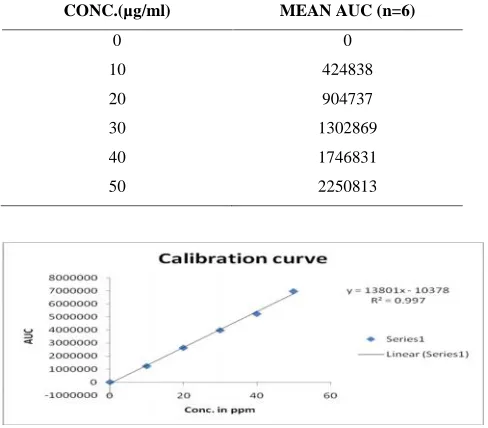
Method: for linearity various concentrations like 10,
20, 30, 40, 50 of clopidogrel & ramipril were prepared
in amixture & then injected into HPLC.
Linearity range was found to be 0-50 µg/ml for
Clopidogrel and 0-50 µg/ml for Ramipril. The
correlation coefficients were found to be 0.999 &
0.997, the slopes were found to be 44623 & 13801 and
intercept were found to be 10569 & 10378 for
Clopidogrel and Ramipril respectively.
Fig 6: Standard curve for Clopidogrel
CONC.(µg/ml) MEAN AUC (n=6)
0 0
10 424838
20 904737
30 1302869
40 1746831
50 2250813
Fig 6: Standard curve for Ramipril
Table 3: Standard curve for Ramipril
CONC. AUC
0 0
10 1228747
20 2638031
30 3983572
40 5249436
50 6979310
3.3 Accuracy: Clopidogrel
To determine the accuracy of the proposed method,
recovery studies were carried out by adding different
amounts (80%, 100%, and 120%) of pure drug of
Clopidogrel were taken and added to the pre-analyzed formulation of concentration 10g/ml. From that
percentage recovery values were calculated. The
results were shown in table-8.
Recovery study: To determine the accuracy of the
proposed method, recovery studies were carried out by
adding different amounts (80%, 100%, and 120%) of
pure drug of Ramipril were taken and added to the pre-analyzed formulation of concentration 10g/ml. From
that percentage recovery values were calculated. The
K Swathi et al. Volume 3 (3), 2015, Page-737-741
Table 4: Percentage Recovery
The mean recoveries were found to be 99.67, 99.19,
99.49 % for Clopidogrel and 99.92, 100.72, 100.40%
for Ramipril. The limit for mean % recovery is
98-102% and as both the values are within the limit, hence
it can be said that the proposed method was accurate.
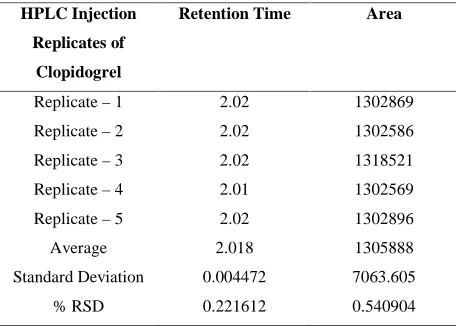
3.4 Precision: Repeatability
The precision of each method was ascertained
separately from the peak areas obtained by actual
determination of six replicates of a fixed amount of
drug. Ramipril & Clopidogrel.
Table 5: The percent relative standard deviations
HPLC Injection
Replicates of
Clopidogrel
Retention Time Area
Replicate–1 2.02 1302869
Replicate–2 2.02 1302586
Replicate–3 2.02 1318521
Replicate–4 2.01 1302569
Replicate–5 2.02 1302896
Average 2.018 1305888
Standard Deviation 0.004472 7063.605
% RSD 0.221612 0.540904
4. CONCLUSION
The LOD was found to be 0.02g/ml and 0.06g/ml
and LOQ was found to be 0.04 g/ml and 1.2 g/ml
for Clopidogrel and Ramipril respectively which
represents that sensitivity of the method is high.
5. REFERENCES
1. Becket and Stenlake, Practical Pharmaceutical
Chemistry, Part 24thEdition Cbs Publications And
Distributors, 2005, 157-168.
2. P.D. Sethi, Hplc Quantitative Analysis Of
Pharmaceutical Formulations Cbs Publications
And Distributors, 1stEdition, 2001, 69-70.
3. B.K Sharma, Instrumental Method Of Chemical
Analysis, 23rdEdition, Goal Publishers 2004.
4. Practical Hplc Method Development Lloyd
R.Snyder, Joseph J. Kirkland, Joseph L. Glajch,
Second Edition, 1, 420-430,686-704.
5. Validating Chromatographic Methods, David
M.Bliesner. 1-4.
6. International Conference On Harmonization: Ich
Q 2 (R1) Validation Of Analytical Procedures:
Text And Methodology 1995.
7. Indian Pharmacopeia 2007 Vol–I Pg.No-715.
8. British Pharmacopeia 2007 Vol-I Pg.No-136.
9. Martindale The Complete Drug Reference, Thirty
Sixth Edition.
10. Merck Index, 12th Edition. CRC Press; 12th
edition, 1996.
Conflict of Interest: None Source of Funding: Nil
Sample
ID
Concentration
(µg/ml)
%Recovery of Statistical
Analysis
Pure
drug
Formulation Pure drug
S1: 80 % 16 20 99.63 Mean=
99.67667%
S2: 80 % 16 20 99.92 S.D. = 0.223681
S3: 80 % 16 20 99.48 % R.S.D.=
0.224407
S4: 100 % 20 20 99.19 Mean= 99.19%
S5: 100 % 20 20 99.25 S.D. = 0.06
S6: 100 % 20 20 99.13 % R.S.D.=
0.06049
S7: 120 % 24 20 99.25 Mean= 99.49%
S8: 120 % 24 20 99.54 S.D. = 0.219317
S9: 120 % 24 20 99.68 % R.S.D. =