A Conceptual Review on Technological
Intergenerational Knowledge Transfer
Sabiroh Md Sabri
Faculty of Computer and Mathematical Sciences, Universiti Teknologi MARA, 40450 Shah Alam, Selangor, MALAYSIA
Email: [email protected]
Haryani Haron, Nursuriati Jamil and Emma Nuraihan Mior Ibrahim
Faculty of Computer and Mathematical Sciences, Universiti Teknologi MARA, 40450 Shah Alam, Selangor, MALAYSIA
Email: {haryani, liza, emma}@tmsk.uitm.edu.my
Abstract— By the year 2030, Malaysian population is expected to reach aged population with 3.4 million being senior citizens. The retirement of the aging people is a concern to most organisations as it also means lost of an organisation knowledge. Lack of appreciation of the value of tacit knowledge and lack of planning to capture retirees’ knowledge before they leave put many organisations in a position to suffer a loss of intellectual knowledge that may prove fatal. Therefore this research attempts to review issues that are considered essential in strategizing intergenerational knowledge transfer. In this paper, we reviewed 52 and examined various issues related to intergenerational knowledge transfer. Since transferring knowledge from older people involves a lot of challenges due to cognitive decline experience by themselves, we also studied research done in the area of social psychology and explore their applicability in knowledge transfer practice. We consider social psychology to be a discipline from which theories, models, and research results can be harnessed for knowledge management. Our review reveals important issues in the literature to be considered for successful intergenerational knowledge transfer.
Index Terms—knowledge transfer, intergenerational, knowledge recall, elderly, reminiscence, transactive memory system
I. INTRODUCTION
The world recently has been reported experiencing dramatic demographic shifts known as the ‘age-quake’ or the ‘demographic time bomb’. This phenomenon has been reported to have a profound implication on the economy and society of nations tomorrow. The United Nations has described the world trends for aging population as unprecedented, pervasive, and enduring. According to the World Population Organisation (WPO) of the UN, when the total population of a country aged 60 or above reaches at least 15% of the total population, it can be concluded that the whole population is aging, and therefore this country becomes aged [1]. Research has shown that many countries are experiencing an increasing number of elderly. In Malaysia, by 2035, the country is
estimated to reach the ageing population status which means those above the age of 60 will constitute 15% of the population [1]. The retirement of the ageing people is a concern to most organisations as it also means loss of an organisation knowledge. According to International Data Corp., Fortune 500 companies relinquish over $31.5 billion a year because they fail to distribute knowledge [2]. U.S. organisations fail to capture critical knowledge and experience from older employees nearing retirement, and only a few organisations transfer the knowledge to younger employees [3]. Reference [4] also cautioned that, as the workforce shrinks in comparison to demand, only organisations that prepare in advanced for the demographic shift will be prepared to address it. Lack of appreciation of the value of tacit knowledge and lack of planning to capture retirees’ knowledge before they leave put many organisations in a position to suffer a loss of intellectual knowledge that may prove fatal [4]. Furthermore, the great number of retired older workers is inevitably accompanied by a significant loss of knowledge [5–7]. The problem will not just be a lack of bodies but also skills, knowledge, experience and relationships walk out the door every time somebody retires and they take time and money to replace [8]. Many researches therefore agreed that organisations must critically manage their knowledge and they need to be transferred from the seniors to the younger generations to preserve the organisations’ knowledge [7], [9], [10]. To combat the dangers of corporate amnesia, intergenerational transfer of knowledge is a matter of survival [11]. However, [12] emphasized that tacit knowledge is highly personal because it resides in the people’s mind. Tacit knowledge is difficult to formalize, hence it is difficult to be communicated or shared with others. This type of knowledge is deeply rooted in someone’s action and experience and also in the ideals, values and emotions he embraces and known to be very sticky and difficult to be transferred.
strategies and mechanisms that could work for both generations. The challenges of transferring knowledge are even greater when involving transferring knowledge from older people, since this segment of the population is subject to physical and cognitive impairment at higher rates than younger people. Cognitive decline which has been identified as the third area of concern in an aging population affects older people’s ability to remember, focus, formulate ideas as well as reasoning capabilities. The declining of cognitive function in older people would hinder the recalling process and eventually make the transfer of knowledge hard to be achieved. However, many literatures suggested theories in knowledge recalling that could be explored to assist older people in recalling the knowledge. Furthermore, with the introduction of the remarkable variety of technology today, older people with cognitive impairment could be assisted and would be able to benefit from it.
Consequently, the paper outlines the theory and concept from various literatures on intergenerational knowledge transfer. This paper also explores the possibilities of harnessing reminiscence and transactive memory theories to address the issues that occur in the intergenerational knowledge transfer. Based on these theories, we draw our conceptual framework that proposes the issues to be considered in intergenerational knowledge transfer.
II. METHODOLOGY
This study adopted a systematic review method in order to investigate the intergenerational knowledge transfer. A systematic review is a literature review following a rigorous, transparent and reproducible process, which aims to identify, select, appraise, analyse and synthesize, in a systematic and comprehensive way, research evidence on a specific research topic [13]. This method is chosen because it is widely considered as the least biased and the most rational way to synthesize research evidence. It is also known as a powerful tool to provide the best available knowledge for decision making. For this purpose, we followed the basic steps suggested by [13] which include: 1) formulate research questions, 2) determine criteria for literature inclusion and exclusion, 3) search for relevant studies, 4) select the research based on the inclusion and exclusion criteria, 5) assess the selected studies, 6) synthesize and summarize study results, and 7) interpret the review results.
This study sets out to answer the two following research questions: 1) what are the issues that occur in the intergenerational knowledge transfer? 2) how can reminiscence and transactive memory system theory be used to facilitate intergenerational knowledge transfer? To answer these questions, we conducted a literature search on online databases in the field of knowledge management and social psychology using keywords that we have defined earlier. We retrieved peer-reviewed papers as well as research reports, book sections and dissertations that could provide us insights on the research topic.
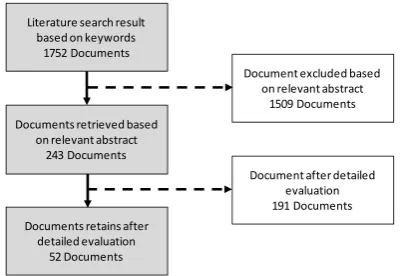
A total of 1752 papers appeared as a result of our keyword search. We skimmed through the title and abstract and downloaded 243 papers that looks relevant to our study. After a thorough evaluation, 52 papers that are related to our research were retained for further review and synthesis. Figure 1 shows the flow diagram of the systematic review methods that was carried out in this study.
Figure 1: Systematic Review Flow Diagram
The results of our review are written in subsequent sections as issues that need to be considered in intergenerational knowledge transfer.
III. KNOWLEDGE AND KNOWLEDGE MANAGEMENT
Knowledge is a mixture of someone’s experience, values, information, insights, and grounded intuition that provides an environment and framework for evaluating and incorporating new experiences and information. It originated and is functional in the mind of the originators. In organizations it is often stored in documents or repositories as well as in organizational routines, practices and norms [14]. According to [15], knowledge can be classified into two different forms that are tacit and explicit knowledge based on their nature. Reference [16] refers tacit knowledge as theknowledge that rooted in actions experience, and involvement in specific context. Tacit knowledge is difficult to be communicated and formalized [12], [17], can be only expressed in words [15] and transferred through interactions with other people, sharing experiences, mental models and also technical skills [12]. [16], [18] define explicit knowledge as articulated (spoken) and generalized knowledge which could be expressed in formal language, mathematical equations or symbols. This type of knowledge can be easily and effectively share with others [12].
In understanding knowledge, it is quite useful to be able to distinguish between declarative and procedural knowledge. According to [19], cognitive psychologists believe declarative memory is responsible for storing facts and events, which is known as knowledge. Declarative memory gives an individual the capacity to store associations, and to do so in a single trial by storing information in proposing the truth or falsity of which can
Literature search result based on keywords
1752 Documents
Documents retrieved based on relevant abstract
243 Documents
Documents retains after detailed evaluation
52 Documents
Document excluded based on relevant abstract
1509 Documents
be verbalized instantly. The system contains knowledge that can be thought and spoken about explicitly. However, in the case of memory for faces; these are very difficult to describe verbally [20]. Declarative knowledge can be altered under the influence of new memories. The retrieval process of declarative knowledge is not conscious and usually triggered by cues. However, sometimes a given cue will lead to the retrieval of only a very small amount of information that is potentially available. In expressing declarative knowledge, it requires directed attention, as compared to the expression of skills, which usually happen automatically [20].
On the other hand, procedural memory is proposed as the system containing knowledge of how to do things which guides both physical activities like cycling or swimming, and (partially) cognitive skills like playing chess or speaking in public. Usually, many attempts are needed to acquire procedural knowledge, although one-trial learning could also occur. These skills are difficult to express verbally. However, one possible way to show their presence is though performance. It can be argued that procedural memory is relatively autonomous in relation to declarative memory in a number of ways. [21] on the other hand classified knowledge based on its contents and divided knowledge into six types:
• Know-what - course of action is the right one
• Know-how - to get things done
• Know-why - something is
• Know-when - to do something, and when not to
• Know-where - to find what is needed
• Know-who - to ask
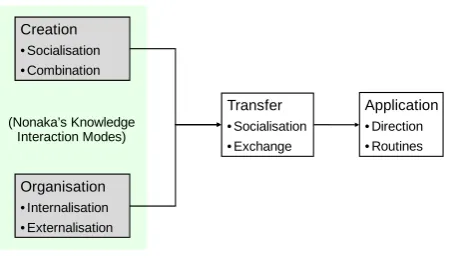
Regardless of which type or category knowledge is, it is important for knowledge to be transferred to avoid the loss. However, understanding the nature, type and category of knowledge may assist us in understanding how the knowledge could be managed. To manage knowledge effectively, many researchers have proposed various important aspects about knowledge management process to guide the way for effective knowledge management [12], [16], [22], [23]. Knowledge management as a whole involves four main processes as suggested by [24] which include knowledge creation, knowledge organization, knowledge transfer and knowledge application. The first process of knowledge management i.e. knowledge creation involves activities associated with entry of new knowledge into a system, and includes knowledge development, discovery and capture which most of the time involves tacit knowledge. The second process i.e. knowledge organization includes activities that preserve knowledge and allow it to remain in the system once introduced. It also includes those activities which retain the viability of knowledge within the system. The third process i.e. knowledge transfer refers to activities associated with the flow of knowledge from one party to another through the means of communication, translation, conversion, filtering and rendering. Lastly, the fourth process i.e. knowledge application includes the activities and events connected with the application of knowledge to business processes.
Figure 2: KM Processes and KM Sub-Processes [24]
Figure 2 above shows the relationship between knowledge management processes and subprocesses as proposed by [15] that the four main knowledge management processes are related to knowledge conversion subprocesses such as Socialisation, Externalisation, Combination and Internalisation. The idea behind these knowledge management processes and subprocesses is for the organisation to create and build up its knowledge sources and resources and make them accessible and/or available wherever and whenever they are needed through a variety of knowledge management mechanisms [25]. However, since this study only focus on knowledge transfer, other processes will not be discussed further.
IV. KNOWLEDGE TRANSFER
As one of important processes in knowledge management, many researchers have researched on various aspects of knowledge transfer and defined knowledge transfer according to their own context. Reference [26] defined knowledge transfer as a process of knowledge passing from one person to another person or from a group of people or organisations to another group of people or organisations. It is the act of conveying knowledge of one source to another, one group to another or one unit to another. In an organisation, knowledge transfer is often associated with the application of knowledge or skills to solve a particular problem. This knowledge or these skills are generally acquired through training which is considered as the first mechanism of knowledge transfer [27]. In our private lives, we often transfer knowledge to another person so easily and efficiently without noticing that we are doing it, for example when we are giving directions to a stranger or sharing our secret recipes with our friends. However, in organisations, effective and sustainable knowledge transfer is more complex because knowledge resides in organizational members, tools, tasks and their sub networks which are more complicated compared to personal knowledge. Moreover, people do not take ownership of the knowledge and make it more difficult to identify from whom the knowledge should be transferred from. Most organisation knowledge which exists in the mind of employees is tacit and sticky therefore hard to be
Organisation • Internalisation • Externalisation
Transfer • Socialisation • Exchange
Application
• Direction • Routines Creation
• Socialisation • Combination
articulated. Knowledge transfer is not about transferring knowledge alone, it also involves the willingness of the other party or recipient to absorb the knowledge to his/her own benefits [28]. Many organisations voiced their concern about transferring knowledge from older to younger workers, yet research indicates few are doing anything about it. Organisations do not realize the value of the loss of employees’ deep smarts until the workers leave their jobs [4]. Many organisations assign high priority to documentation, however not all important knowledge is stored in documents [29]. The experience of the organisation members, their ideas and decisions are also part of the organisational knowledge which is usually stored in a form of tacit knowledge. In an organisation, knowledge transfer would mean knowledge retention and help the organisation sustain. In a social context, knowledge transfer enables elderly to transfer their livelong experience and knowledge amongst themselves and to younger generations. It gives value to the elderly’s accumulated experience and knowledge and enables the creation of special contexts for generational exchange. With the world’s increasing number of retirees, many started to realize the importance of transferring knowledge from older generation to the younger generation before it is lost. We therefore need to provide a platform for elderly to enable them to transfer their knowledge effectively and efficiently.
A. Intergenerational Knowledge Transfer
Intergenerational transfer refers to the passing of information and knowledge from older to younger members of a kinship group or members of an extended family [30]. Reference [31] defined intergenerational knowledge transfer as any interaction whether one-on-one, within a group, or through written communication in print or online that conveys facts, context, connections, processes, or other insights between two generations. Two ways of passing the knowledge are through oral or multimedia means. Traditionally, transfer occurs through oral, where knowledge is verbally passed during learning activities, be it formal or not. The successful of passing the information could sometimes occur without any inscription of information. Nowadays, using multimedia means of transfer usually involve written or inscribed means which include image, audio, hypertext, and video means.
The literature has shown that a few research carried out in the intergenerational knowledge transfer has identified a few barriers. One of it is generation gap [27], [32]. A generation gap is a popular term used to describe a broad difference in values and attitudes between two generations or between elderly and younger generation [27]. The generation gap is a situation which occurs when the older and younger people do not understand each other due to differences in their opinions, habits and behaviours. The term becomes popular in Western countries during the 1960s when it was used to describe the differences in the culture of Baby Boomers and their parents. Even though there are some generational differences that have been reported throughout history, the differences between these two generations became
prominent compared to the previous one. Some of the areas that show a gap between these two generations are in fashion, music, culture and also politics. The literature has shown that each generation was shaped by the events that happened during their lifetime for example, the World War II, the Civil Rights Movements, the introduction of computers and Internet and etc. These events give a great deal of how they live their life and influence their mindset and the will power they have inside them.
Due to the differences in their expectations and mindset, there are more problems identified between these generations. One of them is communication problem. [33] in her research mentioned that research shows intergenerational communication creates more problems than opportunities. The issue begins with a difference in expectations, as Boomers are claimed to believe Gen Y should ‘“pay their dues,’” while Millennials want to advance quickly and bypass the grunt work. Potential problems continue to arise as Millennials “may not share Boomers’ beliefs and values,” since work-life balance and flexible career paths seem to be more of a priority than building a career. This same research explains another issue saying Gen Y may be “marginalized by their older and more senior coworkers,” which makes “it more difficult for Millennials to earn workplace respect and credibility”. Researchers also claim that this situation has caused problems due to lack of socialization and low level of communicative support from supervisors and affect the job turnover [34]. Therefore, intergenerational communication can be considered as a problem to organizational development and sustainability.
Working with elderly also involves challenges with their physical and cognitive decline. Even though there has been a debate on at what age cognitive decline begins, a cross-sectional age comparisons study through relevant neurobiological variables and measures of cognitive performance has revealed that cognitive decline appear to begin when adults are in their 20s or early 30s. On the other hand, some research shows that cognitive decline begins shortly after individuals reach maturity. On average we can conclude that cognitive decline usually begins at the age of 60 [35–37]. Cognitive decline in the elderly also contributes to memory decline. Memory is the explicit or implicit recall of information encoded in the recent or distant past. Current conceptualizations of memory, however, do not treat memory as a unitary system but rather divide it into hierarchical taxonomic modules based on duration of retention and the type of information that is being retrieved [38]. Reference [39] in their research argue that stories about a person’s experience, and the experiences of others, especially people in relationship are the fundamental constituents of
reconstituted memories form the basis of the individual's ‘remembered self’. Furthermore, shared story memories within social groups define particular social selves, which may strengthen or compete with individual remembered selves. Cognitive decline faced by the elderly could be one of the barriers in the intergenerational knowledge transfer as the elderly will face difficulties in recalling their knowledge.
B. Knowledge Recall
Knowledge resides in people’s mind and defined as tacit knowledge. It consists of technical abilities, mental models, faith and ingrained perspectives not subjected to the easy manifestation [12]. Due to its nature, transferring tacit knowledge is a challengeas it depends on a positive and collaborative attitude from the knowledge holders [40]. One of the processes involved in transferring tacit knowledge is knowledge recall [40–42].
For tacit knowledge to be communicated it must be first converted into elements that anyone can understand [29]. One possible approach is the transformation of tacit into explicit knowledge. During the transformation, people and organisations frequently need to recall past episodes that, for some reasons, were not adequately documented when they occurred. Before a story can serve as knowledge transfer, it must be constructed or assembled. The assembly of a real story is the process of recalling knowledge of past events that have occurred. However, this is not a straightforward task. Incomplete information caused by lapses in memory and the lack of key facts are common issue in the recalling process. People and organisations frequently need to recall past events that somehow were not documented during its occurrence. The successful reconstitution of past events depends on several variables, such as how long ago the event occurred, and whether key people are still available to tell what they know. Although it is sometimes difficult to restore all known events, an adequate recall process can get it closer [40].
According to [43], recall is the act of retrieving information or events from the past while lacking a specific cue to help in retrieving the information. A person recalls when reminiscing about something he has experienced or learned. When we want to recall an episode that has occurred in the past and which has been witnessed by a group of people, we should count on their testimony to try to reconstitute the episode. It usually happens, however, that a participant alone is unable to tell the full story because he has only a partial knowledge of the full event. Only when grouped together the set of events can start to make sense [40]. The literature has shown that the two main theories of the process of recalling are the Two-Stage Theory, also known as Austin Simonson theory and the theory of Encoding Specificity. The Austin Simonson theory states that “the process of recall begins with a search and retrieval process, and then a decision or recognition process where the correct information is chosen from what has
been retrieved”. In this theory, recognition only involves
the latter of these two stages, or processes, and this is thought to account for the superiority of the recognition
process over recall. Recognition only involves one process in which error or failure may occur, while recall involves two [44]. However, in certain situation, recall has been found to be superior as such as a failure to recognize words that can later be recalled [45].
The theory of encoding specificity finds similarities between the process of recognition and that of recall. The encoding specificity principle states that “memory utilizes information from the memory trace, or the situation in which it was learned, and from the environment in which
it is retrieved”. Encoding specificity helps to take into
further comprehend recall and analyze how these theories could be harnessed in supporting knowledge transfer.
Figure 3: Conceptual framework of memory recall and its relationship to knowledge transfer
C. Reminiscence Theory
Reminiscence refers to the process of recalling personal events or experiences from one’s past that are memorable to a person [49]. The theory of reminiscence has become a debate since [50] classic paper on life review in the elderly. The debate started negatively with Butler’s critics of reminiscence as non-purposive, escapist and impulsive behavior. Later, the concept of life review as a therapeutic intervention was introduced [51] where he suggested that taking an extensive autobiography could help older adults with the developmental task “to clarify, deepen and find use of what one has already obtained in a lifetime of learning and adapting”. Reference [52] in her research stated that reminiscing is a technique employed to help patients think and talk about their lives. This technique can be implemented in a structured group, in an unstructured group, or on an individual basis. However, implementation and evaluation of this intervention have been difficult to attain and documented. Reminiscence has been studied for various purposes among all is to determine its effect on cognitive functioning [53–55]. The sharing of personal reminiscence in a group can be seen as a process of turning intrapersonal reminiscence into interpersonal memory exchanges. Group members begin to explore, to gradually confront and to reconsider specific memories that over time form the thematic and interactional content of their experience together [56]. However, many reviews of reminiscence research and practice agree on the main limitations. Lack of conceptual clarity and evidence are some of the limitations pointed out by [57]. On the basis of these serious limitations, [57] outlined some future reminiscence research which will be used as the basis of our research. Reference [57] in their research suggest that humans have a capacity and need to retrieve, articulate, and disseminate self-narratives from memories which lay in a form of the building blocks of these narratives. This process must be initiated by some factors, which one of them a component that is called “triggers”. Memories do not occur in a vacuum but rather are situated in various social contexts. These elicited and
situated memories are filtered through a series of individual difference variables that have the power to moderate many important characteristics. Next, reminiscence serves a purpose beyond simple recall. They function to allow a person to achieve some psychosocial goal. In other words, reminiscence serves particular functions. Finally, remembering our pasts for a specific reason produces an outcome, such as strengthening a person’s sense of mastery or self-esteem.
The concept of reminiscence has been studied by many researchers, especially for elderly where reviewing memories can be used to revive interest, self-esteem and improve quality of life. Literature has also shown some studies on group productivity which discussed group versus individual. For example, it is commonly believed that "two heads are better than one”. Reference [58] reported that research indicates that when people collaborate to recall an event the group does remember more than individuals working alone. It is also possible that information recalled by others in the group may provide cues to help individuals remember items that they would not recall if working alone. From the literature, we believe that reminiscence concept can be applied not only in reviewing elderly’s memories but also in recalling their experience and knowledge. Therefore, we intend to explore the “trigger” component in [57] model of reminiscence which also will be used to recall knowledge that resides in elderly’s mind.
D. Transactive Memory Theory
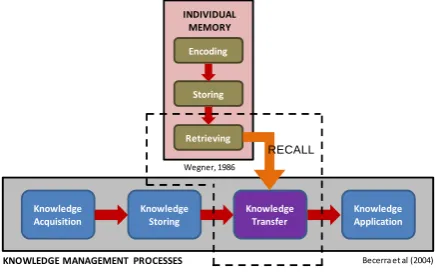
The concept of transactive memory was first proposed by [47] based on the “group mind” idea which was disfavoured among the group behaviour theorist. [47] then studied the transactive memory theory which proposed the prediction of group and individual behaviour through the understanding of how they process and structure information they acquired. Wegner explained transactive memory by starting to focus on the study of the thinking processes of an individual. He then defined transactive memory system as a set of individual memory systems in combination with the communication that takes place between individuals [59]. Transactive memory systems, as a concept of social cognition, also refer to the idea that people in a continuing close relationship tend to develop a shared system for encoding, storing and retrieving information from different substantive domains. Reference [60] in their study suggested that tacit knowledge could be individually-owned or collectively-individually-owned. By exploring transactive memory and knowing what other people know, individuals in groups can have access to external memory as well as their own individual memory. As a result, a group information-processing system is formed. Three relevant key processes of transactive memory systems are identified using the metaphor of a directory-shared computer network: directory updating, information allocation, and retrieval coordination [61]. To have a better understanding about this process, it is essential to first understand the components involved during the process.
Encoding
Storing
Retrieving
INDIVIDUAL MEMORY
Wegner, 1986
Knowledge Acquisition
Knowledge Storing
Knowledge Transfer
Knowledge Application
KNOWLEDGE MANAGEMENT PROCESSES Becerra et al (2004)
Individual m
We start b processes w three stages Figure 4 be memory. Th entered into and inform respectively.
Figure 4
The succe the success situations wh We often hav to retrieve t occurred. Th occurred are somehow fal stays in but information issue to con how the st theorists ha processes wh stored one b means that t sentence ma Processes tha during encod processes tha taking advan produced. S accompanied retrieval of memory whi can also be later retrieva
To ensure exist and o proposed the transactive m memory abo encoding, sto important in skills as if
memory
by looking a which is comm
which are e elow illustrate
e three stages memory, info mation being
4: Conceptual Ind
essful operatio of these thre hen we fail to ve encoded so them. When hree possible s e (i) inform lls out (ii) the t we could n never gets in nsider when d tored inform ave proposed hereby items
y one but are the informatio ay be stored at make or br ding to create at operate at r ntage of the o ubsequent re d by retrieval one of these ich allow us t
stored (perha al.
that the conn one way to
e incorporati memory discu
ut memory w orage and retri determining we know wh
at the basic in monly unders ncoding, stor es the proces s involve the ormation resid brought bac
dividual Memory
on of our mem ee stages. Ho o execute all t omething in ou this happens situations whe mation gets i
e information not find it, an nto the memo dealing with h
ation is org d a variety of informatio e stored as co on for examp d as connecte
eak such conn e organisation
retrieval can organised stor etrieval of eit of the other. items very to recognize th
aps as absent
nection betwee hinder mem on of “meta ussion. Metam which includes
ieval processe how well we hat, where a
ndividual mem stood to occu rage and retri
sses in indiv information b des in the mem
ck from mem
Processes [47]
mory dependin owever, there three successf ur memory bu s, memory fa en memory fa into memory
gets into mem nd lastly (iii) ory at all. An
human memo ganized? Mem
of organisat on are not m onnected sets.
le, in a form ed sets of it nections can o s. Complemen locate the item rage that has
ther one is At the same seldom yields hat disconnec t connections en information mory failure, memory” ide memory refer s knowledge a es. Metamemo e use our mem
nd how we mory ur in ieval. vidual being mory mory ng on e are fully. ut fail ailure ailure y but mory, ) the nother ory is mory tional merely This of a tems. occur ntary m by been often time, s the ctions s) for n can [47] ea in rs to about ory is mory have enco bette Exte A unde The som peop book som espe them used also info have retri stora retri abou retri prio info a no gene conc simi retri and mem mem enco info Ind P have info chan effec phen info trans by t bene acce to ot grou othe reme alon indiv liter Issu T prop anot store
oded the infor er.
ernal Memory
As much as w erestimate the literature h mething that d
ple tend to st k, papers, flop mething that d
ecially everyd m in external d as an aid th
acts as the c rmation. On e never enco ieve because age. Externa ievable, howe ut what they ieval from an r encoding rmation (i) a r otion of the lo eral requireme cept of mem ilar in indivi ieve informat external me mory items. H mory faces s
oding, storin rmation, we c
dividual Vs Gr
eople cannot e encoded can
rmation some nges could t
cts or could nomena. Indiv
rmation as t sactive encod the conversan efit of allow ess to details o thers, it also t up. It is also ers in the grou
ember items ne. The bene vidual recalli ature [40], [58 es in Current
The current tr posed that h
ther human m ed in memory
rmation, we ca
we rely on ou e use of exter has shown do not need to
tore them in ppy disks etc. do not need t day memory t memory [62 at provides so central storage certain condi oded may bec
we are able lly stored it ever, only w are and wher external mem of at least t retrieval cue o ocation of the ent for the us mory items, i. dual memory tion successfu emory if we However, bot some issues g and retrie can retrieve the
oup Memory
guarantee tha n be retrieved etimes damage ake place du also due to viduals may they are enc ing occurs, la nt as a grou wing each gr of this item u tends to colou possible tha up may provid
that they wo efits of grou ing has been 8], [63], [64]. Transactive M
ransactive me uman memo memory; being y of others. Fro
an retrieve th
ur own memo rnal memorie
that when o be rememb external mem . [47]. When to be rememb tasks, people 2]. External m
ome startling e area for a la ition, informa come availab e to access s tems of info when we kno
re they are. T mory item thu two addition or label for the e item. This s se of external .e. label and y. We should ully from bo
are able to th individual
during the eving. By e e information
at the informa d in the same ged, lost or ch ue to individ o a result o
talk about so coding them. abels are linke up. Although roup membe unknown to se
ur what is per at information
de cues to hel ould not reca up recalling n widely disc
Memory
emory introdu ory is transac g individual rom our analy
he information
ory, we often es in our life. remembering bered forever, mory such as remembering bered forever tend to store memory often reminders. It arger body of ation that we ble for us to ome external formation are w something The successful us requires the nal pieces of e item and (ii) seems to be a l storage. The location are d be able to oth individual identify the and external processes of encoding the n better.
ation that they e form as the hanged. These dual memory of transactive ome items of When such ed to the item this has the r subsequent elf but known rceived by the n recalled by lp individuals all if working compared to cussed in the
uced by [47] cted over to or group and ses, we found
some limitations with regards to the current transactive memory system.
• Limitations on human memory capacity –
human memory has a limit in terms of its storage capacity. Even though although we can store a lot in our memory we hardly can retrieve all the memory we stored.
• Poor metamemory – unsystematic label and
location structure. In the absence of person
holding metamemory, information cannot be
retrieved when metamemory is lost.
• Circumstantial – people chosen as an expert is
being forced into the situation therefore may not be the real expert.
• Information is vulnerable to modification –
during the transactive processes, information could be damaged, lost or changed.
• Must have a long standing group not
impromptu group – impromptu groups may have poor memory systems because their impromptu action is based on inferences and stereotypes and prone to exaggeration and error.
• Non mobility – people can only transact their
memory when they are physically together and they must be stationary.
As we analysed the issues faced in the current transactive memory system, we realized that, transactive memory could help the reminiscence process in knowledge transfer especially when it is supported by the use of current technology. Figure 3 shown in the earlier section depict the individual and group memory process in transactive memory as suggested by [47] and its relationship with knowledge management processes by [24]. This clearly shown that in the knowledge management process, before the knowledge could be transferred, it first need to be retrieved from an individual or group memory. Therefore, with the implementation of transactive memory theory, it would help people in
reminiscing and subsequently support knowledge transfer.
V. KNOWLEDGE TRANSFER THEORY
There were very few literature that could be found which discuss about knowledge transfer theory. Even if there were, the focus of each study was totally different from each other hence, it makes it difficult for us to compare them. Reference [65] in his research discussed three theories to predict human performance in distinctive and identifiable ways on a variety of transfer tasks. Each mechanism has been associated with a particular kind of transfer scenario that specifies the conditions necessary for transfer (i.e., type of prior knowledge and application context). The first mechanism of reference [65] interest is analogical transfer [42]. Analogical transfer is composed of three subprocesses: i) retrieving a prior knowledge structure, ii) creating a mapping between it and the current problem or situation, and iii) using that mapping to generate new knowledge structures relevant to the application context. The knowledge transferred usually
believed to be in declarative form but sometimes can also be procedural. Numbers of evidence for analogical mapping shows that although people are capable of mapping deep relational structures, the retrieval of an analogue is heavily dependent upon matches between the surface features of the current problem and prior problem solving experiences. Therefore, analogy is perhaps a better explanation for near transfer than for far transfer.
The second transfer mechanism of interest is knowledge compilation proposed by [66], [67]. Knowledge compilation was specifically proposed to explain how declarative knowledge is brought to bear on problem solving in the context of the ACT-R theory - a theory which talks about how human cognition works. This computational mechanism operates through the deliberate and explicit, step-by-step interpretation of a declarative statement that generates new production rules as a side effect. Those rules are then optimized via rule composition and the result is a procedural representation of the content of the declarative knowledge given a specific goal. The knowledge compilation mechanism can be viewed as a translation device that translates or interprets declarative knowledge into a set of procedures and actions that can be used to solve problems. Since knowledge compilation operates on declarative knowledge, it can be used in a wide variety of application contexts because the knowledge has yet to be proceduralized, or tied to the goals of a particular problem solving context. This mechanism embodies a tradeoff between applicability and efficiency in that it has wide applicability across many contexts but requires a complicated and lengthy application process to translate the declarative knowledge into a set of actions. There is some empirical support for knowledge compilation but the evidence is not extensive [67], [68].
The third transfer mechanism of interest is the error correction mechanism which proposed that the role of declarative knowledge is primarily to help a learner identify and correct his or her own errors. The constraint violation theory has both declarative and procedural components that operate in parallel, and the function of declarative knowledge is to constrain possible problem solutions. When incomplete or faulty procedural knowledge generates undesirable outcomes, these are recognized as violations of those constraints and the responsible rules are revised accordingly. The power of declarative knowledge is that it can help the learner pinpoint the cause of an error, and transfer is the process by which errors are identified and remedied. This mechanism has wide applicability in that the constraints can be applied to a variety of problems that may require different strategies or sequences of actions to produce the correct solution. The constraint violation theory has been shown to generate power law learning curve [69] and to support the design of successful tutoring systems [70].
have procedural attachments [71]. Knowledge compilation uses declarative knowledge such as instructions, advice, or tactical knowledge. Error correction uses declarative knowledge of the constraints for a particular problem domain [69]. Reference [65] study was able to test the predictions of each transfer theory, and predict what transfer mechanism will be triggered for a given set of transfer scenarios.
However, the three theories discussed by [65] who highlighted alternatives for knowledge transfer does not share any similarities with the sender-receiver framework proposed by [72]. The theory proposed by [65] are to be used when the type of knowledge is known while [72] proposed a knowledge transfer framework where the knowledge is incomplete to the sender and receiver. In developing the sender-receiver framework, they first introduce the market view of knowledge transfer and treat knowledge as a good that moves in a knowledge market where parties may have incomplete and asymmetric information about other participants and the knowledge itself. Reference [72] highlighted the two groups of participants in a knowledge transfer: senders, the person who is giving the knowledge; and receivers, the person who is receiving the knowledge. They also studied knowledge transfer in four types of information structures: symmetric complete information, sender-advantage asymmetric information, receiver-advantage asymmetric information, and symmetric incomplete information. Later, they proposed that knowledge transfers can be analyzed at nodal (focusing on the behavior of one party), dyadic (focusing on the joint behavior of a pair), and systemic (focusing on the behavior of a system consisting of providers and seekers) levels [73]. The research resulted on the impacts of information structures on knowledge. First, a firm involving in knowledge transfers must decide to which type of information structure a knowledge transfer belongs. However, determining the information structure of a knowledge transfer may not be straightforward. Second, the effectiveness of signals in knowledge markets depends critically on the information structure. Signals help a receiver select a knowledgeable sender under sender-advantage asymmetric information structure, while they only provide better estimates of the value of a sender’s knowledge under the symmetric incomplete information structure. Third, one should also be aware that the information structure of a knowledge market changes dynamically and participants of the market must adjust their strategies accordingly.
From these literature we conclude that, for successful knowledge transfer, we need to have suitable mechanisms through the consideration of transfer scenario that specifies the conditions necessary for transfer [48]. Apart from that it is also important to consider which type of information structure a knowledge transfer belongs to and decide if the mechanisms work at nodal or dyadic level.
VI. KNOWLEDGE TRANSFER STRATEGIES AND
MECHANISMS
To understand human thinking and problem solving in complex and novel situations, [48] suggested the need to
have a general theory for how people use and adapt their prior knowledge to solve new problems. [48] also added that, aspirations towards such a goal have traditionally been discussed in terms of transfer, or how knowledge acquired from one task or situation can be applied to a different one. In order to ensure the success of knowledge transfer, organization usually adopt certain mechanisms during the process of transferring the knowledge. These mechanisms are usually chosen depending on the organization’s needs and requirement as well as the suitability of their environment and working culture. Knowledge transfer mechanisms are social and structural means to facilitate the knowledge activities involving the knowledge management processes and subprocesses as suggested by [24] and shown in Figure 2 earlier. It is used in order to get the most out of knowledge sources and resources [25]. On the other hand, many organisations proposed other mechanisms to transfer knowledge such as Job Aids, Mentoring, Process Documentation, Identification of Best Practices, Communities of Practice, Job Shadowing, Critical Incident Review, Storytelling, Document Repositories and Structured On the Job Training [13], [28], [74].
cognitive pro problem-solv development including an constraint vi among others From thes successful kn suitable know it is importa mechanisms play an im knowledge tr
As the organisations knowledge f generations knowledge. O elderly to pr ensure the transfer, we out the issu intergeneratio that cognitiv main issue intergeneratio have propo mechanisms from one gen consider the which could which is on transfer. Kno aspect of hu we believe it in our study process of re or telling of e which may Reminiscenc recalling the cited by [78 extension of the knowledg system. The aggregate to body, or sys individuals in memory syst and their reco Reference [7 investigate h abilities in cognitive stra From the lit could be exp knowledge tr of technolog
ocesses of tran ving scenario t of several s nalogical tran iolation and s [48]. se literature w knowledge tra
wledge transfe ant to compr
also involve a mportant role
ransfer.
VII. D
retirement s realized th from their sen
in order to Our societies reserve our cu success of reviewed rese ues that are onal knowled e ability and k es that ne
onal knowled osed knowle
that might b neration to ano e cognitive d
lead to the d ne of the es owledge recal uman being w t is important . Reference [ ecall and inter early events o occur with ce is an int e memory and 8], transactive f an individua ge of others as e memories o form a com
stem, which nvolved in an tem are more ollections are 78] also sugg how informatio
the transactiv ain and enhan terature, we b plored more to ransfer among gies that was c
nsfer for parti os. This work
specialized th nsfer, knowle transfer-appro
we can conclu ansfer, we ne
er mechanism ehend that kn a person’s cog in ensuring
DISCUSSIONS
number i he importanc nior employe o retain the
need to retain ulture and her intergenerat earches carrie e considered dge transfer. O
knowledge re eed to be dge transfer. edge transfer be used to tr other [9; 76] b decline experi
difficulties in ssential proce
ll involves so which is the m t to consider p
77] consider raction which or a memorabl or without s teraction betw d one or mor e memory the al’s memory s a mode of an
of collabor mbined, interd elicits a syne nd contributing e effective at
generally of h gested that fut
on systems ca ve memory nce individual
believe that t o support kno g elderly. With created to imp
icular learning k has led to heories of tra
edge compila opriate proce
ude that to en ed to identify ms. Apart from
nowledge tra gnitive ability g the succes
increased, m ce of transfe
es to the you eir organizat
n knowledge ritage. In ord tional knowl ed out and po essential in Our review sho
call are two o considered Many researc r strategies ransfer knowl but none has r ienced by el knowledge r ess in knowl ome psycholo main factor of psychology th reminiscence involves reca le early experi specific purp ween the pe re individuals eory consider system to inc n external mem rative individ dependent mem
ergistic effect g to the transa information r higher quality ture research an enhance hu system to re
memory capa these two the owledge recall h the develop prove services g and o the ansfer ation, ssing nsure y the m that, ansfer y and ss of many erring unger tional from der to ledge ointed n the owed of the d in chers and ledge really derly recall ledge ogical f why heory e as a alling ience poses. erson s. As rs an clude mory duals mory t; the active recall y [79]. may uman elieve acity. eories l and pment s and enha peop tech Real gene remi help their B and iden in F In mem by r use mem tech remi over meta intro devi be a Re
ance the inde ple, we intend hnology advan lizing the imp eration to a iniscence theo p us in provid r knowledge. Based on resea
[78] on tr ntified the rese
igure 5 below
n order to ove mory, we exp
recent researc of the Intern mory group. F hnology sup iniscence for rcome the amemory and oduction of m ice in the new able to address
Figure SHAR MEM TEC esearch Gap ependence an d to combine t ncement to su portance of kn another, we
ory and trans ding a platfo arch carried ou
ansactive me earch gap that w:
Figure 5: Resea
ercome the is lore the use o h published b net as one of Figure 6 and pported tra
knowledge issues of d vulnerability mobile technol w transactive m s the mobility
6: Traditional Tr
TRANSACTIVE M
RING MEMORY
MORY RECALL
REMINISCE
CHNOLOGICAL KNOW
nd quality of the psycholog upport knowle nowledge tran
intend to sactive memo orm for elderl ut by [57] on emory system t need to be fi
arch Gap
ssues in curre of technology by [80] whom f a member i
7 below show ansactive m transfer. Thi storage limi y of informati logy and the memory conce
issue as well.
ransactive Memo MEMORY KNOWLEDGE TRANSFER MEMORY TRIGGER ENCE WLEDGE TRANSFER
life of older gy theory with edge transfer. nsfer from one explore the ory system to ly to transfer reminiscence m, we have lled as shown
nt transactive y as proposed m explore the in transactive w the idea of memory in is idea could itation, poor ion. With the use of smart ept, we should
Figure
As the organisations knowledge f generation. W to intergener issues that n knowledge emphasized knowledge, t itself affecte found that th stages of the perception o as the reliab transfer durin that affected recipient’s difficulty dur ambiguity” o was not we transfer thro Other resea knowledge t been done, individual m affect the tra contexts. Thi transactive m transfer. Sin knowledge re people [84], psychologica transfer succ We studied combined it current tran supported tr faced by the implemented Figure 8 sh discover in understandin technologica transfer.
e 7: Technology S
VIII. C
retirement s realized th from the old We analyzed rational knowl need to be c transfer. Ref how chara the recipient, d knowledge he importanc e transfer pro f an opportun bility of the ng the early i d the executio ability to ring the imple of the knowle ell understoo oughout all p arch has exa
transfer in or for instance members, such ansfer of know is paper explo memory theo nce the knowl ecall which in
we believe al part of hum cess by harnes
the current t with remin sactive mem ransactive me e current tran d in support hows the ove
the research ng this issues, al platform fo K R
Supported Transa
CONCLUSION
number i he importanc der generation paper written ledge transfer considered in ference [81] acteristics of
the context, a transfer. As c ce of these fa ocess. Factors nity to transfer source, predi initiation stag on of the tran
absorb kno ementation ph edge or the e od predicted phases of the
amined the ganisations [8 e, on how
as their abilit wledge from t ores the remini ory to be use ledge transfer nvolves psych it is importan man in makin ssing the two t transactive niscence. As
ory, we prop emory to ove
nsactive mem ting the kno rview of issu and how the we hope to be or intergenera
Knowledge Repository
active Memory
increased, m ce of transfe
n to the you n on issues re r and discusse n intergenerat in her rese f the source and the knowl cited by [82], actors varied s that affected r knowledge, icted difficult e, whereas fa nsfer, such a wledge, affe hases. The “c extent to whi the difficult transfer pro factors affe 83]. Research
characteristic ty and motiva training to tra iscence theory ed for knowl r process invo hological aspe
nt to conside ng the knowl
theories toge memory sy we analyzed posed techno ercome the is mory so it ca
owledge tran ues that we ey are related e able to prov ational knowl many erring unger elated ed the tional earch e of ledge , [81] over d the such ty of actors s the fected ausal ich it ty of ocess. ecting h has cs of ation, ansfer y and ledge olves ect of er the ledge ether. ystem d the ology ssues an be nsfer. have d. By vide a ledge T Insti High Rese High 5/3 ( [1] [2] [3] [4] [5] [6] [7] [8] [9] [10] [11] [12] [13] CO Figure 8:
The authors w itute, Univers her Education earch Accultu her Education (88/2012). M. Saravanab Star Online, p P. Babcock, “ HR Magazine R. Srikanth, J Performance M. Bridgers a Facts, the Fic no. 1, pp. A6– D. W. DeLon an aging wor R. Strack, demographic February, pp. G. Davidson, the Aging W Missions,” 20 K. Dychtwald retire. Retirem 3. pp. 48–57, D. McNicho Intergeneratio Aerospace E Phoenix, 200 K. M. Kapp Know-How f and Organiza 37, 2011. J.-F. Harvey intergeneratio Knowledge M 2012. I. Nonaka a company. Ho of innovation N. Becheikh, Landry, “How and practices KNOWLEDGE RECALL INTERGENERATIO KNOWLEDGE TRANSFER COGNITIVE DECLINE REMINISCENC TRANSACTIVE MEMORY GENERATION GAP OMMUNICATION
: Overview of Iss
ACKNOWLED
wish to than siti Teknologi n, Malaysia. T uration Grant n, Malaysia (
REFEREN
bavan, “Prepare pp. 9–11, 2012. “Shedding light e, pp. 46–54, 20 J. Benton, and in a Rapidly Ag and H. Johnson ction, the Future
–A9, 2006. ng, Lost knowle rkforce. Oxford
J. Baier, and risk,” Harv 119–128, 2008 S. Lepeak, and orkforce on Pu 007.
d, T. Erickson, ment.,” Harvard
126, Mar-2004 ls, “Tacit Kno onal KNowle Engineering C
8.
p, “Tools and from Boomers t ational Excellen
, “Managing onal knowled Management, v
nd H. Takeuc ow Japanese co . Oxford Unive S. Ziam, O. Id w to improve k
in education TRANSFER SCENARIO COGNITIVE ABILITY NATURE OF KNOWLEDGE KNOWLEDGE TRANSFER E N E TACIT EXPLICIT
sues in the Resear
DGMENT
nk Research i MARA and This work is su t awarded by (Ref No. 600
NCES
e for ageing po .
t on knowledge 004.
Y. Herrera, “A ging World,” 2 n, “The Aging W re,” ASHRAE Jo
edge. Confrontin d University Pre d A. Fahlande vard Business
8.
d E. Newman, ublic Sector Org
and B. Moriso d business revi 4.
owledge: An E edge Transfer Community,”
Techniques fo to Gamers,” ag nce, no. Augus
organizational dge transfer,”
vol. 16, no. 3.
chi, The know ompanies creat ersity Press, 199
drissi, Y. Casto knowledge tran ? Answers fro
KNOWLEDGE TRANSFER MECHANISMS AND STRATEGY KNOWLEDG TRANSFER ANALYZATIO TYPE OF INFORMATION STRUCTURE KNOWLEDGE CATEGORY T KN TECHNOLOGICAL INTERGENERATIONAL KNOWLEDGE TRANSFER
DECLARATIVE PROCEDURAL K
KNOW-WH KNOWLEDGE
rch
Management d Ministry of upported by a y Ministry of 0-RMI/RAGS
opulation,” The
e management,”
Achieving High 005.
Workforce: The ournal, vol. 48,
ng the threat of ess, 2004.
er, “Managing Review, no.
“The Impact of ganisations and
on, “It’s time to ew, vol. 82, no.
Examination of r within An University of
or Transferring global Business t 2007, pp. 22–
memory with Journal of . pp. 400–417,
wledge creating e the dynamics 95.
onguay, and R. nsfer strategies m a systematic
literature review .,” Higher Education Journal, pp. 1–21, 2010.
[14] P. Gamble and J. Blackwell, Knowledge Management – State of the Art Guide. Kogan Page, Limited, 2002. [15] I. Nonaka, “A Dynamic Theory of Organizational
Knowledge Creation,” Organization Science, vol. 5, no. 1. pp. 14–37, 01-Feb-1994.
[16] M. Alavi and D. E. Leidner, “Review: Knowledge Management and Knowledge Management Systems:
Conceptual Foundations and Research Issues,” MIS
Quarterly, vol. 25, no. 1. p. 107, Mar-2001.
[17] B. Choi and H. Lee, “Knowledge management strategy and its link to knowledge creation process,” Expert Systems with Applications, vol. 23, no. 3. pp. 173–187, Oct-2002.
[18] Y.-G. Kim, S.-H. Yu, and J.-H. Lee, “Knowledge strategy planning: methodology and case,” Expert Systems with Applications, vol. 24, no. 3. pp. 295–307, Apr-2003. [19] T. ten Berge and R. van Hezewijk, “Procedural and
Declarative Knowledge An Evolutionary Perspective,” in Theory & Psychology, vol. 9, no. 5, 1999, pp. 605–624. [20] E. Tulving, “How many memory systems are there,”
American Psychologist, pp. 385–398, 1985.
[21] D. Skyrme and D. Amidon, “The Knowledge Agenda,” Journal of Knowledge Management, no. 1, pp. 27–37, 1997.
[22] A. H. Gold, A. Malhotra, and A. . Segars, “Knowledge Management- An organisational capabilities perspective,” Journal of Management Information System, pp. 185–214, 2001.
[23] J. M. Bloodgood and W. D. Salisbury, “Understanding the influence of organisational change strategies on information technology and knowledge management strategies,” Decision Support System, vol. 31, pp. 55–69, 2001.
[24] I. Becerra-Fernandez, A. Gonzales, and R. Sabherwal, Knowledge management: Challenges, solutions, and technologies. New Jersey: Pearson Education, 2004. [25] M. Annamalai, S. M. Sabri, and S. Amin, “Knowledge
Management Mechanisms for Attrition Control in Private Higher Learning Institutions,” in Knowledge Management International Conference (KMICe) 2012, 2012, no. July, pp. 4–6.
[26] J. D. Gupta, S. K. Sharma, and J. Hsu, An overview of knowledge management: Creating knowledge based organisations. Hershey, Idea Group, 2004.
[27] C. Faye, M. Lortie, and L. Desmarais, “Guide to Knowledge Transfer Designed for Researchers in Occupational Health and Safety,” 2008.
[28] D. Piktialis and K. A. Greenes, “Bridging the Gaps - How to Transfer Knowledge in Today’s Multigenerational Workplace,” 2008.
[29] K. C. Desouza, “Facilitating tacit knowledge exchange,” Communications of the ACM, vol. 46, no. 6. pp. 85–88, 01-Jun-2003.
[30] L. L. Cavalli-Sforza and M. W. Feldman, “Cultural Transmission and Evolution: A Quantitative Approach.” 1981.
[31] A. Ballain, M. Fischer, J. Main, and K. Waters, “Intergenerational Knowledge Transfer Translated,” 2012. [32] D. Sarikhan, “Generational filter, intergenerational gap
and their impact on business,” 2009.
[33] C. Kister, “Intergenerational Communication In An Organizational Setting,” California Polytechnic State University, 2012.
[34] K. . Meyers and K. Sadaghiani, “Millennials in the workplace: a communication perspective on Millenials’
organizational relationships and performance,” Journal of Business & Psychology, pp. 225–238, 2010.
[35] M. Ronnlund, L. Nyberg, L. Backman, and L. G. Nilsson, “Stability, growth, and decline in adult life span development of declarative memory: Cross-sectional and longitudinal data from a population-based study,” Psychology and Aging, pp. 3–18, 2005.
[36] B. L. Plassman, K. a. Welsh, M. Helms, J. Brandt, W. F. Page, and J. C. S. Breitner, “Intelligence and education as predictors of cognitive state in late life: A 50-year follow-up,” Neurology, vol. 45, no. 8, pp. 1446–1450, Aug. 1995. [37] M. Aartsen, C. Smiths, T. van Tilburg, K. Knopscheer, and D. Deeg, “Activity in older adults: Cause or consequence of cognitive functioning? A longitudinal study on everyday activities and cognitive performance in older adults,” Journal of Gerontology: Psychological Science, pp. 153–162, 2002.
[38] A. M. Brickman and Y. Stern, “Aging and Memory in Humans,” Encyclopedia of Neuroscience, vol. 1, pp. 175– 180, 2009.
[39] R. C. Schank and R. P. Abelson, “Knowledge and Memory : The Real Story,” in Knowledge and Memory:
The Real Story, Hillsdale, NJ. Lawrence Erlbaum
Associates, 1995, pp. 1–85.
[40] N. Carminatti and M. R. S. Borges, “Analyzing Approaches to Collective Knowledge Recall,” Computing and Informatics, vol. 25, pp. 547–570, 2006.
[41] L. Slough, “Using Stimulated Recall in classroom
observation and professional development,” in The
American Educational Research Association, Seattle, Washington, 2001.
[42] D. Gentner, K. J. Holyoak, and B. N. Kokinov., “The analogical mind,” Cambridge, MA: MIT Press, 2001. [43] Encyclopædia Britannica, “Recall.” [Online]. Available:
http://global.britannica.com/EBchecked/topic/493353/rec all.
[44] M. Watkins and J. M. Gardiner, “A Renewed Appreciation of Generate-Recognize Theory of Recall,” Journal of Verbal Learning and Verbal Behavior, vol. 18, pp. 687–704, 1979.
[45] E. Tulving and D. M. Thomson, “Encoding specificity and retrieval processes in episodic memory.,” Psychological Review, vol. 80, no. 5, pp. 352–373, 1973. [46] P. Lynch, “Retrieval of Memories,” 2011. [Online].
Available: http://explorable.com/retrieval-of-memories. [Accessed: 15-Jun-2013].
[47] D. M. Wegner, “Transactive Memory : A Contemporary Analysis of the Group Mind,” 1986, pp. 185–208.
[48] T. J. Nokes, “Mechanisms of knowledge transfer,” Thinking & Reasoning, vol. 15, no. 1, pp. 1–36, Feb. 2009. [49] Y.-C. Lin, Y.-T. Dai, and S.-L. Hwang, “The Effect of Reminiscence on the Elderly Population : A Systematic Review,” Public Health Nursing, vol. 20, no. 4, pp. 297– 306, 1994.
[50] R. N. Butler, “The life review: an interpretation of reminiscence in the aged.,” Psychiatry, vol. 26. pp. 65–76, Feb-1963.
[51] R. N. Butler, “Successful Aging and the Role of the Life Review,” Journal of the American Geriatrics Society, pp. 529–535, 1974.
[52] C. K. Stinson, “Structured group reminiscence: an intervention for older adults.,” Journal of continuing education in nursing, vol. 40, no. 11, pp. 521–8, Nov. 2009.
aging & human development, vol. 25, no. 3, pp. 209–22, Jan. 1987.
[54] T. Hopper, N. Mahendra, E. Kim, T. Azuma, K. Bayles, and S. Cleary, “Evidence-based practice recommendations for working with individuals with dementia: Spaced-retrieval training,” Journal of Medical Speech-Language Pathology, pp. 27–34, 2005.
[55] L. Pittiglio, “Use of Reminiscence Therapy in Patients
With Alzheimer’s Disease,” Lippincott’s Case
Management, vol. 5, no. 6. pp. 216–220, Nov-2000. [56] G. S. Getzel, “Intergenerational Reminiscence in Groups
of the Frail Elderly,” Journal of Jewish Communal
Service, 1983.
[57] J. D. Webster, E. T. Bohlmeijer, and G. J. Westerhof, “Mapping the Future of Reminiscence: A Conceptual Guide for Research and Practice,” Research on Aging, vol. 32, no. 4, pp. 527–564, May 2010.
[58] M. S. Weldon and K. D. Bellinger, “Collective memory: collaborative and individual processes in remembering.,” Journal of experimental psychology. Learning, memory, and cognition, vol. 23, no. 5, pp. 1160–75, Sep. 1997. [59] D. M. Wegner, T. Giuliano, and P. T. Hertel, “Cognitive
interdependence in close relationships,” in Compatible and incompatible relationships, New York: Springer-Verlag, 1985, pp. 253–276.
[60] H. Haron and R. A. Alias, “Conceptualization of Tacit
Knowledge Dimension,” in Proceedings of the
Postgraduate Annual Rearch Seminar 2005, 2005, pp. 12–17.
[61] D. M. Wegner, “A Computer Network Model of Human Transactive Memory,” Social Cognition, vol. 13, no. 3, pp. 319–339, 1995.
[62] J. E. Harris, “External Memory Aids,” in Practical aspects of memory, London: Academic Press, 1978, pp. 172–180.
[63] Y. Ren, K. M. Carley, and L. Argote, “The Contingent Effects of Transactive Memory: When Is It More
Beneficial to Know What Others Know?,” Management
Science, vol. 52, no. 5, pp. 671–682, May 2006.
[64] Y. Yoo and P. Kanawattanachai, “Development of Transactive Memory Systems and Collective Mind in
Virtual Teams.pdf,” The International Journal of
Organizational Analysis2, vol. 9, no. 2, pp. 187–208, 1AD.
[65] T. J. Nokes, “Testing Three Theories of Knowledge Transfer,” in Proceedings of the Twenty-Sixth Annual Conference of the Cognitive. Science Society. Mahwah, NJ: Erlbaum., 1996, pp. 1029–1034.
[66] J. R. Anderson, The architecture of cognition, vol. 28, no. 2. Cambridge, MA: Harvard University Press, 1983, pp. 235–240.
[67] D. M. Neves and J. R. Anderson, “Knowledge compilation - Mechanisms for the automatization of cognitive skills,” in Cognitive skills and their acquisition, Hillsdale, NJ: Erlbaum, 1981, pp. 57–84.
[68] J. R. Anderson, J. G. Greeno, P. J. Kline, and D. M. Neves, “Acquisition of problem-solving skill,” in Cognitive skills and their acquisition, Hillsdale, NJ: Erlbaum, 1981, pp. 191–230.
[69] S. Ohlsson, “Learning from performance errors.,” Psychological Review, vol. 103, no. 2, pp. 241–262, 1996. [70] A. Mitrovic and S. Ohlsson, “Evaluation of a
constraint-based tutor for a data-base language,” International Journal of Artificial Intelligence and Education, pp. 238– 256, 1999.
[71] D. Gentner, “Structure-mapping: A theoretical framework for analogy,” Cognitive Science, vol. 7, no. 2. pp. 155– 170, Jun-1983.
[72] L. Lin, X. Geng, and A. B. Whinston, “A Sender-Receiver Framework for Knowledge Transfer,” 2005. [73] A. K. Gupta and V. Govindarajan, “Knowledge Flows
and the Structure of Control within Multinational Corporations,” The Academy of Management Review, vol. 16, no. 4, pp. 768–792, 1991.
[74] D. Benmahamed and J. Ermine, “Knowledge Management Techniques for Know-How Transfer Systems Design . The case of an Oil Company,” in Creating Collaborative Advantage through Knowledge and Innovation, World Scientific Publishing Company Pte Ltd, 2007, pp. 15–34.
[75] A. Mathieu, “University-Industry interactions and knowledge transfer mechanisms : a critical survey,” 2011.
[76] L. Jonjoubsong and T. Chinnakunwong, “A Framework for Indigenous Knowledge Transfer Focusing on the Context of Communities in the Eastern Region of Thailand,” Trends Research in Science and Technology, vol. 2, pp. 85–91, 2010.
[77] L. Dempsey, K. Murphy, a. Cooney, D. Casey, E. O’Shea, D. Devane, F. Jordan, and a. Hunter, “Reminiscence in dementia: A concept analysis,” Dementia, Aug. 2012. [78] F. K. Weigel, B. T. Hazen, and J. D. Ezell, “Transactive
Memory Theory: A Review of the Literature and Suggestions for Future MIS Research,” in Proceedings of the Southern Association for Information Systems Conference, 2012, no. 2001, pp. 217–222.
[79] A. J. Barnier, J. Sutton, C. B. Harris, and R. a. Wilson, “A conceptual and empirical framework for the social distribution of cognition: The case of memory,” Cognitive Systems Research, vol. 9, no. 1–2. pp. 33–51, Mar-2008. [80] B. Sparrow, J. Liu, and D. M. Wegner, “Google effects
on memory: cognitive consequences of having information at our fingertips.,” Science (New York, N.Y.), vol. 333, no. 6043, pp. 776–8, Aug. 2011.
[81] G. Szulanski, “The Process of Knowledge Transfer : A Diachronic Analysis of Stickiness,” 1999.
[82] L. Argote and P. Ingram, “Knowledge Transfer: A Basis for Competitive Advantage in Firms,” Organizational Behavior and Human Decision Processes, vol. 82, no. 1, pp. 150–169, May 2000.
[83] L. Argote and R. Moreland, “Transactive Memory and Work Group Performance,” 1999.
![Figure 44: Conceptual Inddividual Memory Processes [47]](https://thumb-us.123doks.com/thumbv2/123dok_us/7816139.1663970/7.595.78.269.201.334/figure-conceptual-inddividual-memory-processes.webp)