VHDL based Design of Convolutional Encoder
using Vedic Mathematics and Viterbi Decoder
using Parallel Processing
Miss. Bhagyashree V. Dagamwar Prof. Mrs. R. N. Mandavgane
M. Tech Student Associate Professor & Head of Dept. Department of Electronics & Tele-Communication
Engineering
Department of Electronics & Tele-Communication Engineering
BDCE, Sevagram, India BDCE, Sevagram, India
Prof. Mrs. D. M. Khatri Assistant Professor
Department of Electronics & Tele-Communication Engineering BDCE, Sevagram, India
Abstract
Convolutional encoding with Viterbi decoding is a powerful method in many communication systems due to the excellent error control performance. The Convolutional encoder encodes the message and then the encoded bits are generated. The bits which are encoded are again sent to the Viterbi Decoder and then the decoded output is obtained. This paper targets the Design of convolutional encoder using vedic mathematics and viterbi decoder using parallel processing. In mathematics, multiplication is the most commonly used operation. Hence, vedic multiplier is used in convolutional encoder. This algorithm follows a fast multiplication process and achieves a significantly less computational complexity over its conventional multipliers. In viterbi decoder, branch metric unit and add compare select unit are designed and pipeline and parallel processing concept is used to improve processing time and save memory space. Pipeline and parallel process performs more than one operation in the given period i.e. more than one input is given to the convolutional encoder and get more than one output at viterbi decoder. The simulation and synthesis of proposed design are done through XILINX 14.5i ISE Simulator tool and coding is in VHDL. It is observed that the proposed work is better in delay (processing time) than their counterparts.
Keywords: Convolutional Encoder, Multiplier, Vedic algorithm, Viterbi decoder, Parallel processing, VHDL, XILINX 14.5i
_______________________________________________________________________________________________________
I. INTRODUCTION
An encoder is a device that converts information from one format or code to another for the purpose of speed. Convolutional encoding is one of the forward error correction scheme. Error correction technique plays a very important role in communication systems. The error correction technique improves the capacity by adding redundant information for the source data transmission. It provides an alternative approach to block codes for transmission over a noisy channel. Convolutional code is defined by three parameters (n, k, K) where n is number of output bits, k is number of input bits and K is constraint length. In convolution encoder technique, condition is that number of input bits ‘k’ must be less than output ‘n’ of convolution encoder.
Multiplication is most important function in arithmetic operations. Since multiplication decreases the execution time of most algorithms, hence there is a need of high speed multiplier. The Vedic mathematics has been divided into sixteen Sutras which can be applied to any branch of mathematics like algebra, trigonometry, geometry etc. Vedic mathematics converts the complex calculations into simpler ones and reduces human mind works making them easier. Here “Urdhva Tiryakbhyam” sutra is used for multiplication. Performing calculations of multiplication, a computer spends a considerable
Fig. 1: Convolutional encoder of rate ½ [2]
Fig 1 shows the example of convolutional encoder produces two bit of encoded output for single bit of input, so it is called a rate 1/2 encoder.
Viterbi decoder is a basic and important block in any Code Division Multiple Access (CDMA). Viterbi decoder uses the Viterbi algorithm for decoding a data which is encoded using a Convolutional Encoder. The Viterbi Algorithm was developed by Andrew J. Viterbi. The Viterbi algorithm is a maximum likelihood decoding algorithm for convolution codes. This algorithm provides a method of finding the branch in the trellis diagram that has the highest probability of matching with the actual transmitted sequence of bits. It has one of the most popular algorithms for use in convolution decoding. The advantage of viterbi decoder has fixed decoding time.
Fig. 2: Functional Diagram of Viterbi Decoder [1]
A viterbi decoder consists of three modules: branch metric unit, add compare select unit, survivor memory unit. In this paper, we are designing viterbi decoder using parallel processing i.e., applying pipeline and parallel processing to the viterbi decoder. Parallel processing performs more than one operation in the given period. It saves processing time and memory space.
CONVOLUTIONAL ENCODER AND VITERBI DECODER
Fig. 3: Block diagram of Convolutional Encoder using Vedic Mathematics and Viterbi Decoder using Parallel Processing
Convolutional Encoder using Booth Multiplier:
Booth’s algorithm is a popular method for 2’s complement multiplication. It increases speed of the process by analyzing multiple bits of multiplier at a time. This method is used for two’s complement multiplication was designed by Andrew D. Booth in 1951. Booth algorithm is an elegant way for this type of multiplication which treats both positive and negative operands uniformly. It allows n-bit multiplication to be done using fewer than n additions or subtractions, therefore makes possible faster multiplication. It operates on the principle that strings of 1s in the multiplier require no addition but just shifting and a string of 1s in the multiplier from bit weight 2k to weight 2m can be treated as 2k+1 to 2m.
The main step is to check last two bits.
There will be iterations according to the number of multiplier. For example, if the multiplier is of 2-bit then 2 Iterations will be done, for 4-bit multiplier 4 iterations are done, and so on.
Now, start the algorithm, first the last two digits are checked and if the two bits are “00” or “11” the only Arithmetic Right Shift are done.
And if the last two bits are “01”, then B is added with A, and result is stored into B. If the last two bits are “10”, then B is subtracted from A, and result is stored into B. Finally, the result obtained is coded in binary form which gives the desired output. In this way multiplication of any two numbers is performed using booth algorithm. Fig.4 shows the convolutional encoder design using booth multiplier.
Fig. 4: Block Diagram of Convolutional Encoder Using Booth Multiplier [11]
Here, six booth multipliers are used, which are used for multiplication of two numbers, one number comes from the input of convolutional encoder a and second number is as a input of booth multiplier. Output of the all booth multipliers is given to XOR gate. The XOR gate is used to perform XOR operation. The function of D flip flop is when clock is ‘1’ then it gives output, otherwise no output is obtained. Finally, the circuit gives two outputs as Output1 and Output2.
Convolutional Encoder using Vedic Multiplier:
Vedic Mathematics deals with Sixteen Sutras. Only one Sutra “Urdhva Tiryakbhyam” has been discussed here. Urdhva tiryakbhyam sutra is based on “Vertically and Crosswise “technique. It makes almost all the numeric computations faster and easier. Multiplication of two decimal numbers 325 and 738 using urdhva tiryakbhyam is shown in Fig 5.
The numbers of steps in the process depend upon the number of the digits being used. Digits on the two ends of the lines are multiplied and resultant is added to the carry from previous step. When the number of crossing lines in a single step is greater than one then they all are added along with the previous carry. After this, only the least significant digit of the resulting number is taken as product digit and rest are considered as carry digits. Initial carry is taken as zero.
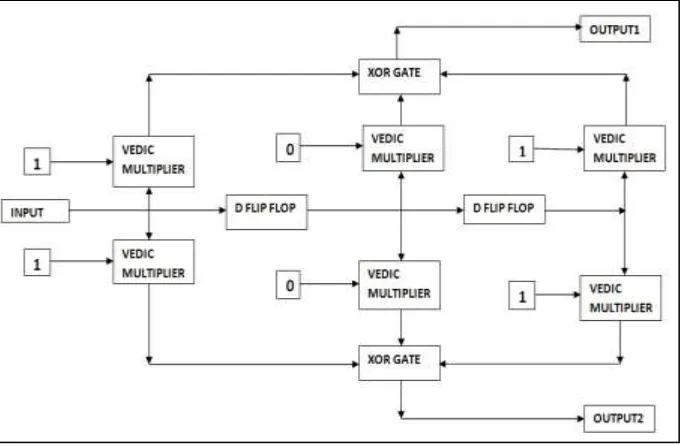
Fig 6 shows the convolutional encoder design using vedic multiplier.
Fig. 6: Block Diagram of Convolutional Encoder Using Vedic Multiplier
Here, six vedic multipliers are used, which are used for multiplication of two numbers, one number comes from the input of convolutional encoder a and second number is as an input of vedic multiplier. Output of the all vedic multipliers is given to XOR gate. The XOR gate is used to perform XOR operation. The function of D flip flop is when clock is ‘1’ then it gives output, otherwise no output is obtained. Finally, the circuit gives two outputs as Output1 and Output2.
Branch Metric Unit:
The first module of viterbi decoder is branch metric unit. Here, the received code symbol are compared to expected code symbol and count the number of differing bits and branch metrics is calculated. The branch metrics are difference between received code symbol and the corresponding branch words from the encoder trellis.
Fig. 7: Branch Metrics Calculation
Add Compare Select Unit:
The function of ACS is completing survivor paths and generating decision vector, and the whole computation process includes add operation, compare operation, and select operation. The two adders add each of the two incoming branches the corresponding states path metric and resulting new paths. The comparator compares the two partial metrics; the selector selects an appropriate branch.
Pipeline and Parallel Processing:
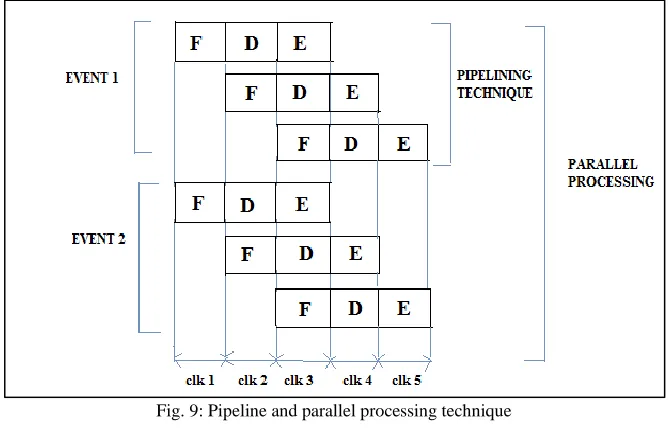
Pipeline processing is a set of data which is connected in series, where output of one element is the input of the next one. In this work, parallel processing are designed to speed up the execution of program and simultaneous processing of different tasks. In proposed viterbi decoder, we can given more than one input and we get more than one output at a single clock by using parallel processing.
Fig. 9: Pipeline and parallel processing technique
Fig. 10: Pipeline and parallel execution of viterbi decoder
II. EXPERIMENTAL RESULTS
RTL View:
Fig. 11: RTL view of Convolutional Encoder using Vedic Multiplier and Viterbi Decoder using Parallel Processing
Fig. 12: RTL view of Convolutional Encoder using Booth Multiplier and Viterbi Decoder
Fig 11 shows RTL view of Convolutional Encoder using Booth Multiplier and Viterbi Decoder. It consists of convolutional encoder, booth multiplier, branch metric unit and add compare select unit.
Simulation Result:
In this work, we are given 12 bit input to the convolutional encoder because here, XILINX 14.5 did not support 16 bit input.
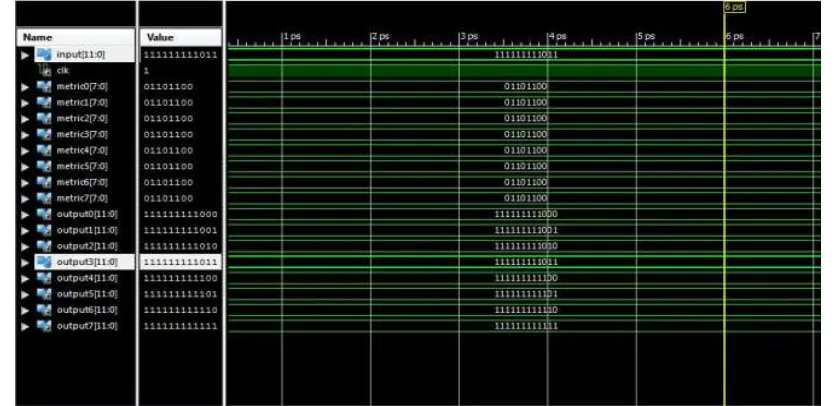
Fig. 13: Simulation Result of Convolutional Encoder using Vedic Multiplier and Viterbi Decoder using Parallel Processing
Fig 13 shows simulation result of convolutional encoder using vedic multiplier and viterbi decoder using parallel processing, Here12 bit of eight input given to the convolutional encoder gives 12 bit of eight output at viterbi decoder.
Fig 14 shows simulation result of convolutional encoder using booth multiplier and viterbi decoder, Here 12 bit of single input given to the convolutional encoder gives 12 bit of single output at viterbi decoder.
Table – 1 Comparison Table
VIRTEX 4 CE using vedic multiplier and VD using parallel processing CE using booth multiplier and VD
DELAY (Processing Time) 36.72 secs 54.54 secs
Table 1. Shows that the delay comparison between convolutional encoder using vedic multiplier and viterbi decoder using parallel processing and convolutional encoder using booth multiplier and viterbi decoder.
III. CONCLUSION
In this paper, the design and simulation of the convolutional encoder using vedic mathematics and viterbi decoder using parallel processing and convolutional encoder using booth multiplier and viterbi decoder is presented. This design has been synthesized and simulated on VIRTEX 4 using XILINX 14.5i ISE Simulator. The delay obtained for convolutional encoder using Vedic multiplier and viterbi decoder using parallel processing is 36.72secs and for convolutional encoder using booth multiplier and vietrbi decoder is 54.54secs. This comparison shows that the vedic multiplier increases the speed than booth multiplier and viterbi decoder using parallel processing saves processing time and memory space than viterbi decoder. The combinational path delay and maximum operating frequency obtained for convolutional encoder using vedic mathematics and viterbi decoder using parallel processing is 4.224ns and 236.727MHz.The architecture is efficient in speed and area and is flexible in design. The same architecture can be extended for more no of bits. The design can be implemented on FPGA/CPLD kit.
REFERENCES
[1] Bineeta Soreng, Saurabh kumar, Efficient Implementation of Convolution Encoder and Viterbi Decoder, 978-1-4673-4922-2113/$31.00 ©2013 IEEE / 2013 International Conference on Circuits, Power and Computing Technologies [ICCPCT-2013]
[2] Ms.G.S. Suganya, Ms. G.kavya, RTL Design and VLSI Implementation of an efficient Convolutional Encoder and Adaptive Viterbi Decoder, 978-1-4673-4866-9/13/$31.00 ©2013 IEEE / International conference on Communication and Signal Processing, April 3-5, 2013, India.
[3] V.Kavinilavu, S. Salivahanan et.al, Implementation of Convolutional Encoder and Viterbi Decoder using Verilog HDL, 978-1-4244-8679-3/11/$26.00 ©2011 IEEE.
[4] Lei -ou Wang , Zhe-ying Li, Design and Implementation of a Parallel Processing Viterbi Decoder Using FPGA 978-1-4244-6936-9/10/$26.00 ©2010 IEEE.
[5] Yin Sweet Wong, et. Al, Implementation of Convolutional Encoder and Viterbi Decoder using VHDL, 978-1-4244-5187-6/09/$26.00 ©2009 IEEE/ Proceedings of 2009 Student Conference on Research and Development (SCOReD 2009), 16-18 Nov. 2009, UPM Serdang, Malaysia.
[6] Hema. S, Suresh BABU. V and Ramesh P, "FPGA Implementation of Viterbi Decoder," Proceedings of thc 6th WSEAS Int. Conf. on Electronics, Hardware, Wireless and Optical Communications, Corfu Island, Grecce, Feb. 2007. pp.162-167.
[7] Qing Li, Xuan-zhong Li, Han-hong Jiang and Wen-hao He, "A High-speed Viterbi Decoder," Fourth International Conference on Natural Computation, 2008, pp. 313-316.
[8] A.J. Viterbi, "Error bounds for convolutional codes and an asymptotically optimum decoding algorithm," ieee transactions on information theory, vol. it-13, april, 1967, pp. 260-269.
[9] Yogita Bansal, Charu Madhu, Pardeep Kaur,”High speed vedic multiplier designs-A review”, Proceedings of 2014 RAECS UIET Panjab University Chandigarh, 06 – 08 March, 2011
[10] Kunchigi, V., Kulkarni, L. and Kulkarni. S.: “High speed and area efficient Vedic multiplier,” Proc. IEEE International Conference on Devices, Circuits and Systems (ICDCS), Coimbatore, 2012, pp. 360 – 364.
[11] Sishir Kalita, Parismita Gogoi & Kandarpa Kumar Sarma, Convolutional Coding Using Booth Algorithm For Application in Wireless Communication, International Journal of Electronic Signals and Systems.
![Fig. 1: Convolutional encoder of rate ½ [2]](https://thumb-us.123doks.com/thumbv2/123dok_us/7815748.1663877/2.612.57.559.439.594/fig-convolutional-encoder-rate.webp)
![Fig. 5: Multiplication of two decimal numbers using Urdhva Tiryakbhyam [10]](https://thumb-us.123doks.com/thumbv2/123dok_us/7815748.1663877/3.612.143.472.169.405/fig-multiplication-decimal-numbers-using-urdhva-tiryakbhyam.webp)