ISSN (online): 2349-784X
PSO and FPO Based Optimization for Maximum
Energy Harvesting in Wireless Sensor Network
S. Thiyagarajan P. Gowthaman
Assistant Professor Assistant Professor
Department of Electronics Science Department of Electronics
Jaya College of Arts and Science, Thiruninravur Thin film Centre, Erode Arts and Science College, Erode
M. Venkatachalam M. Saroja
Associate Professor Associate Professor
Department of Electronics Department of Electronics
Thin film Centre, Erode Arts and Science College, Erode Thin film Centre, Erode Arts and Science College, Erode
Abstract
The reduction of the energy consumption is compensated by harvesting RF energy of a WSN using a techniques realized to practical extent, considering the numerous forced limitations. In scheming energy harvesting regulation, techniques were suggested in control methods. The techniques reserved must promise in such a way the limitations are forced by the utility with regard to the quantity of acquired data is attained, whereas the lifetime of the network is increased, in contrast to present and simple arraying. Amidst several control techniques, Model predictive control (MPC) is a one of the important controlling methods. It has several effective uses. This paper contrasts MPC method for automated tuning with Flower Pollination Optimization (FPO) and Particle Swarm Optimization (PSO). The major confrontation of MPC is in tuning of control factors for several WSN targets, and PSO or FPO application for automated tuning may become member of solutions. The computational results for energy harvest of WSN reveal the influence of the suggested PSO and FPO dependent tuning.
Keywords: Energy Harvesting, FPO, MPC, PSO and Wireless Sensor Networks
________________________________________________________________________________________________________
I. INTRODUCTION
The technology of WSN is appearing as a tenable solution to numerous novel uses because of an intensive investigation that happened over decades in past. Wireless sensor network is a particular wireless network that links sensor nodes and communicate data about the region to a centralized cache. Such nodes possess the capabilities of detecting, handling, and communicating data. The important operations of WSN are collections and distributions of data from intended region that describe the physical events such as humidity, temperature, illumination, etc. [1]. Data acquired by sensors of every node can be utilized for local processing or consigned to a gateway over network through several jumps. The hardware platform for WSN is fundamentally a low power embedded systems using certain sensors integration and analog input/output channels to couple sensors.
Nodes are positioned fixed or unfixed. WSN differs largely in its features – it may be homogeneous or heterogeneous with regard to its detecting ability, it can perceive its position, it can operate by harvesting energy or rely on batteries, it can perform computation either quite basic or complex, and it can live long or throwaway. [2] This paper is specifically inspired to construct smart sensor nodes, that is, nodes that have significant onboard computing capability must have renewable energy resources.
II. MPC FUNDAMENTALS
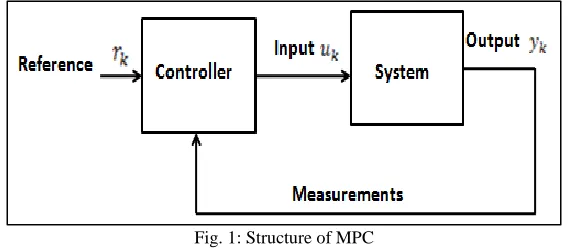
The theoretical form of MPC is shown in Fig 1. The MPC concept employs a definite system model to be directed in predicting subsequent output performance. This predicting ability permits finding optimum control issues, in which the error while tracking, such as the discrepancy between desirable reference and predicted output, is reduced on subsequent horizon, probably depend on limitations on altered inputs and outputs. Optimization is quadratic when index of the performance is stated in terms of norm l2 if
the model is linear or when the index of the performance stated by norm of l1/l∞. The optimization outcome is used based on
Fig. 1: Structure of MPC
III. PARTICLE SWARM OPTIMIZATION (PSO)
PSO is a stochastically optimizing method on the basis of the gregarious behavior of animals flocking as swarms [4]. It is appropriate in optimizing of continuous or discontinuous, convex or non-convex topography. It operates through initializing the size of candidate solutions, termed particles, over the space of parameter being explored, and subsequently refreshing their locations over iterative size, so that converges to an end (normally global) solution for optimum. In PSO, the particles size P of a population, every particle with dimension d, are originally dispersed over the space of parameter [8]. Particle q at iterative i, will have a xq(i) position, and related fitness fq(i). Every particle will have a recall about earlier best position 𝑥𝑞𝑏(𝑖) of its own and an
associated fitness𝑓𝑞𝑏(𝑖). Here𝑥𝑔(𝑖), the position of global best is the position of particle related with best fitness 𝑓𝑔(𝑖) that was
determined earlier across particle population [6]. The particle position q is subsequently refreshed, swayed toward 𝑥𝑔(𝑖)and 𝑥 𝑞𝑏(𝑖).
The common algorithm of PSO in minimizing cost function is described namely
1) Initialize the population with particle size P over dimensions d, with the lower and upper limits, in cost function space. Initialize the position𝑥𝑞𝑏for particle q, and 𝑥𝑔 is then initialized from the 𝑥𝑞𝑏 value with the lowest associated 𝑓𝑞𝑏 in the entire swarm
of P particles.
2) 𝑣𝑞(𝑖) is particle q velocity during ith iterative and is refreshed for the subsequent iterative as namely
𝑣𝑞(𝑖 + 1) = 𝜔𝑣𝑞(𝑖) + 𝑐1𝑟1(𝑖)° (𝑥𝑞𝑏(𝑖) − 𝑥𝑞(𝑖)) + 𝑐2𝑟2(𝑖)° (𝑥𝑔(𝑖) − 𝑥𝑞(𝑖)) (1)
In which ◦ specifies the product of Schur, 𝑟1(𝑖) and 𝑟2(𝑖)are vectors of random with elements evenly dispersed in [0,1] interval,
the ω the scalar positive is an inertial weight that directs the search and utilization of exploring space, and c1 and c2 are the constants
of acceleration termed as cognitive and communal constituents, appropriately [7].
Utilized velocities of particles are limited through 𝑣𝑞𝑚𝑖𝑛 ≤ 𝑣𝑞𝑎𝑝𝑝 ≤ 𝑣𝑞𝑚𝑎𝑥 in which 𝑣𝑞𝑚𝑖𝑛 and 𝑣𝑞𝑚𝑎𝑥 are the min and max values
on velocities of particles, appropriately, and 𝑣𝑞𝑎𝑝𝑝 is the exerted velocity of particle. When 𝑣𝑞(𝑖 + 1) surpasses the aforesaid limits
on velocities, the exerted velocity, 𝑣𝑞𝑎𝑝𝑝 , is assumed as min or max, that is, when 𝑣𝑞<𝑣𝑞𝑚𝑖𝑛 , let 𝑣𝑞𝑎𝑝𝑝 = 𝑣𝑞𝑚𝑖𝑛 ; if 𝑣𝑞>𝑣𝑞𝑚𝑎𝑥 , let
𝑣𝑞𝑎𝑝𝑝 = 𝑣𝑞𝑚𝑎𝑥 ; else let 𝑣𝑞𝑎𝑝𝑝 = 𝑣𝑞. The position, 𝑥𝑞(𝑖), of q at iterative of i in PSO is then refreshed for subsequent iterative
namely [9].
𝑥𝑞(𝑖 + 1)= 𝑥𝑞(𝑖)+ 𝑣𝑞𝑎𝑝𝑝(𝑖 + 1). (2)
3) Compute cost functional value at every particle position of P.
4) When to a particle of q, 𝑓𝑞(𝑖 + 1) < 𝑓𝑞𝑏(𝑖), subsequently assume 𝑥𝑞𝑏(𝑖 + 1) = 𝑥𝑞(𝑖 + 1).
If 𝑓𝑞(𝑖 + 1) < 𝑓𝑔(𝑖), assume𝑥𝑔(𝑖 + 1)𝑥𝑞(𝑖 + 1). If𝑓𝑞(𝑖 + 1) > 𝑓𝑞𝑏(𝑖) ≥ 𝑓𝑔(𝑖), then 𝑥𝑞𝑏(𝑖 + 1) and 𝑥𝑔(𝑖 + 1)persist at similar
position like in i th iterative [10].
5) Redo (2)-(4) till halting condition is reached, that is, a maximal iterative is performed, 𝑥𝑔(𝑖) will be unchanged for a specified
iterative size, etc.
Algorithm of Weight Optimization for PSO
1) A population of random with particles of size P is initialized over dimensions d, with𝑋𝑚𝑖𝑛≤ 𝑥
𝑞 ≤ 𝑋𝑚𝑎𝑥, where 𝜐𝜌 ≥ 0 and
𝑋𝑚𝑎𝑥 ≥ 0 is the min and max bounds on position 𝑥
𝑞of particle q. When better original measurements are familiar beforehand,
certain particles are commenced using such values rather.
2) For a particle q, 𝑓𝑗𝑙𝑜𝑐𝑎𝑙(𝑞, 𝑖)∀j = 1. . . n is fitness function and subsequently 𝑓𝑞(𝑖) is computed using (14).
3) On the basis of this fitness an algorithm of PSO refreshes every q particle its own best position 𝑥𝑞𝑏(𝑖) and fitness in terms of
this position, 𝑓𝑞𝑏(𝑖), ∀q = 1, . . . , P, and 𝑥𝑔(𝑖), the universal best position, its related fitness 𝑓𝑔(𝑖) and subsequently evaluates
the subsequent positions using fitness on the basis. Subsequently using these particles P, the algorithm redoes the steps from (2).
4) The algorithm stops if a halting condition is attained. In this paper it occurs if 𝑓𝑔(𝑖)gets unchanged until attaining stated
(IJSTE/ Volume 5 / Issue 6 / 011)
IV. FLOWER POLLINATION OPTIMIZATION (FPO)
Let xi= [xi1, xi2,…, xin] be the pollen population. The two scale factors are α and β. p is switching probability [8]. G is maximum
generation and
p= 0.6-0.1×(𝑀𝑎𝑥𝐼𝑡𝑒𝑟−𝑡
𝑀𝑎𝑥𝐼𝑡𝑒𝑟 )
FPO Algorithm in automatic tuning of MPC
Input: p, α,β and G.
1) Randomly create a realizable flowers/pollen gametes population of xi(t) 2) Determine the best answer
g
best in the original population3) While t is less than maximum generation 4) For all n candidates in a population do
5) Obtain p from 0.6-0.1×(𝑀𝑎𝑥𝐼𝑡𝑒𝑟−𝑡
𝑀𝑎𝑥𝐼𝑡𝑒𝑟 )
6) If rand is less than p
7) Compute using the switching probability, the pollination type of global or local is chosen and the follower locations are modified in harmony using update equations given
𝑥𝑖𝑡− 𝑔 ∗ 𝑥𝑖𝑡+1= 𝑥𝑖𝑡+ 𝐿 for global pollination
where L is the increment vector that follow Levy distribution,𝑥𝑖𝑡 is the gamete (pollen) of i or vector𝑥𝑖 as solution at t iterative
and 𝑔 ∗ is the best present solution determined amongst whole outcomes at present iterative. 8) Else consider ε as uniform distribution between 0 and 1 and compute, choose j and k 𝑥𝑖𝑡+1= 𝑥𝑖𝑡+ 𝜀(𝑥𝑗𝑡− 𝑥𝑘𝑡)for local pollination
where 𝑥𝑗𝑡∧ 𝑥𝑘𝑡are pollens from diverse flowers of the similar plants
9) end
10) The fresh locations are then inspected to find whether the result is within the zone (basic boundaries).
11) The fitness value for new solutions is calculated. When observed better, the solutions are refreshed in the population. 12) The best outcomes finally after maximum iterations are the algorithm output.
13) The best estimate is calculated by utilizing the equation (2)
V. SIMULATION
All nodes are in active modes initially during simulation. Their modes are unmodified and they develop into active mode until remote status, for example, if the battery of node reaches its least energy position𝑋𝑚𝑖𝑛. The energy regulation of the nodes at real
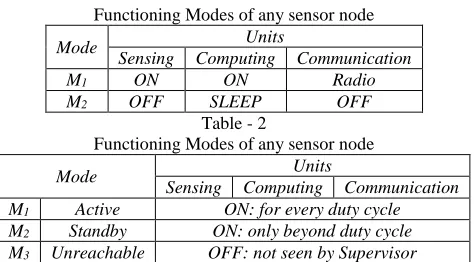
time requirement is assessed by simulation using Matlab. It is considered that every node can take one of the three modes: m = 2 operating modes and the remote status
Table – 1
Functioning Modes of any sensor node
Mode Units
Sensing Computing Communication
M1 ON ON Radio
M2 OFF SLEEP OFF
Table - 2
Functioning Modes of any sensor node
Mode Units
Sensing Computing Communication M1 Active ON: for every duty cycle M2 Standby ON: only beyond duty cycle M3 Unreachable OFF: not seen by Supervisor
The limitations on states (8), that is, the maximum and minimum energy position of the battery of node Si, are defined as 𝑋𝑚𝑎𝑥 =
𝑃𝑖𝑉𝑖and𝑋𝑚𝑖𝑛= 𝛽𝑖𝑋𝑚𝑎𝑥, respectively. 𝑃𝑖 is the theoretical power and 𝑉𝑖 is the theoretical voltage of the battery. The original value
of the state x0 is too furnished in Table 3: for every node, it takes the value of𝛽𝑖𝑋𝑚𝑎𝑥, where 𝛽𝑖 is any energy coefficient.
The weight matrices Q and R that emerge in descriptions of 𝑄´and 𝑅´ in (1) are selected on the basis of control targets namely 1) The nodes are penalized with excessive energy utilization contrasting with other nodes, Q and R are described like Q = 04×4,
R = 𝑤𝑢𝑐𝑜𝑛𝑠𝑇×𝑤
𝑢𝑐𝑜𝑛𝑠, where𝑤𝑢𝑐𝑜𝑛𝑠= iag(𝑤𝑢11,𝑤𝑢12,…𝑤𝑢41,𝑤𝑢42).
𝑤𝑢𝑐𝑜𝑛𝑠 is obtained out of 𝑤𝑢 (Table 4), in which the elements 𝑤𝑢ih, where i = 1,…4 and h = 1, 2, of 𝑤𝑢were located diagonal to
guarantee that R is a matrix with definite positive symmetry. The choice Q = 04×4lies because of that the dynamics of the states must develop effortlessly as much as possible
𝑄 = 𝑑𝑖𝑎𝑔 ( 1
𝑋1𝑚𝑎𝑥, … . . 1
𝑋4𝑚𝑎𝑥), R = 𝑤𝑢𝑐𝑜𝑛𝑠 𝑇×𝑤
𝑢𝑐𝑜𝑛𝑠
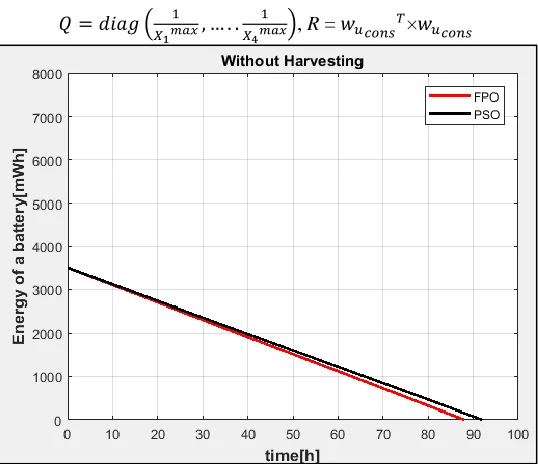
Fig. 2(a): Comparison of PSO and FPO based MPC tuning on sensor node without harvesting
Fig. 2(b): Comparison of PSO and FPO based MPC tuning on sensor node with harvesting .
Fig. 2(a) and Fig 2(b) depict the energy development in node battery with devoid of and with harvest systems appropriately. The network longevity in terms of the time interval if the mission is achieved is 90 hours with devoid of harvest system, and 180 hours using harvest systems. The oscillating action in energy of the battery of the sensor is consistent with the harvesting profile. PSO based tuning of MPC is superior in refilling drained charge of sensor battery in comparing with FPO based tuning of MPC.
VI. CONCLUSION
An optimum tuning technique of MPC using PSO and FPO are proposed. The weights optimum tuning issue of the MPC is greatly depend on feedback control law of the MPC system. The weights involved in the optimum control describes the feedback and the technique for optimal tuning of weights of WSN, involved specifically in the depleting energy cost function on the basis of the output perceived by the sensors.
(IJSTE/ Volume 5 / Issue 6 / 011)
To facilitate the discussion, it is presumed that the input for control and the states of WSN have limitations and the WSN states are entirely perceivable and the output equation for refilling of depletion energy is considered. The aim here is also in tuning the coefficients of the weights of the cost function optimally as optimum control problem of MPC. The target function implies that the best possible solution occurs as a group and, PSO and FPO seek those solutions. The expansion of meta-heuristics exploring serially the whole sets of optimum solutions must be regarded as a future work.
REFERENCES
[1] “I. F. Akyildiz, T. Melodia and K. R. Chowdhury”, “Wireless Multimedia Sensor Networks: Applications and Testbeds,” Proceedings of the IEEE, vol. 96, no 10 pp. 1588 - 1605, 2008.
[2] “C. Buratti, M. Martalò, R. Verdone and G. Ferrari”, “Wireless Sensor Networks,” in Sensor Networks with IEEE 802.15.4 Systems, Springer, 2011, pp. 3-28. w_u
[3] “Thiagarajan S, P Gowthaman, M Venkatachalam”, “PSO and FPO based Optimization of Energy Efficiency for RF powered Wireless Sensor Networks”, International Journal of Pure Applied Mathematics, Vol 119, pg no 2099-2110, 2018
[4] “J.Kennedy and R.C.Eberhart”, “Swarm Intelligence”, Morgan Kaufmann Publ, 2000. [5] “J. M. Maciejowski”, “Predictive control: with constraints”, Pearson education, 2002
[6] “N. Verma and A.P. Chandrakasan”, “An ultralow energy 12-bit rate-resolution scalable sar adc for wireless sensor nodes”. IEEE Journal of Solid-State Circuits, 42(6):1196-1205, 2007.
[7] “D. Jung, T. Teixeira, A. Barton-Sweeney, and A. Savvides”, “Model-based design exploration of wireless sensor node lifetimes”, In Wireless Sensor Networks, pages 277-292. Springer, 2007
[8] “Marwa S, E. Emary, Imane A S, H El-Mahdy”, ”Flower Pollination Optimization Algorithm for Wireless Sensor Network Lifetime Global Optimization”, International Journal of Soft Computing and Engineering (IJSCE), Volume-4, Issue-3, 2014
[9] “Wu Q”, “Energy efficient resource allocation for wireless powered communications,” IEEE Trans. Wireless Commun., vol. 15, no. 3, pp. 2312-2327, Mar. 2016. International Journal of Pure and Applied Mathematics Special Issue 22107