ISSN (e): 2250-3021, ISSN (p): 2278-8719
Vol. 09, Issue 8 (August. 2019), ||S (I) || PP 17-25
An Evaluation of the System Reliability Using Fuzzy Lifetime
Distribution Emphasising Hexagonal Fuzzy Number
Deepak Kumar
1and Anita kumari
21,2 (Department of Mathematics, D.S.B. Campus, Kumaun University, Nainital-263002 India.) Corresponding Author: Deepak Kumar
Abstract:
– The fuzzy set theory has been applied in many fields such as Management, Engineering etc. In this paper we evaluate system reliability in which the lifetimes of components are described using a fuzzy exponential distribution where formula of a fuzzy reliability function and its α – cut set are presented. The fuzzy reliability of structures is defined on the basis of hexagonal fuzzy number. Using the concept of α-cut of hexagonal fuzzy number, the fuzzy reliability functions of k-out-of-m system, series system, parallel systems and their fuzzy mean time to failure are discussed respectively. Finally, some numerical examples are presented to illustrate how to calculate the fuzzy reliability and its α-cut of FMTTF.Keywords:
Fuzzy Reliability, Fuzzy Exponential Distribution, Survival Function, Fuzzy Mean Time To Failure.--- --- Date of Submission: 26-07-2019 Date of Acceptance: 12-08-2019 --- ---
I.
INTRODUCTION
The reliability of an item is the probability that the item will perform its stated mission satisfactorily for the specified condition when used under specific time period. The most frequently used function in lifetime data analysis is the reliability function. This function gives the probability of an item operating for a given time without failure. Exponential distribution is mostly used in determining the lifetime reliability of components. However, in real situation, collections of data or system parameters are often fuzzy/imprecise because of incomplete or vague information. Therefore conventional reliability analysis is inadequate to account for such uncertainties in information. For this reason, the concept of fuzzy reliability has been proposed and developed by several authors [2, 3, 4 & 15].
In other hand a fuzzy number [9] is quantity whose values are imprecise, rather than exact as in the case with single-valued function. Dubois D. and Prade H. in 1983 has defined any of the fuzzy numbers as a fuzzy subset of the real line [7, 8, 9 & 10]. So far fuzzy numbers like triangular fuzzy numbers [5], trapezoidal fuzzy numbers [12 &16], pentagonal fuzzy numbers [13] and hexagonal fuzzy numbers [14] have been introduced with its membership functions. These numbers have got many applications [11] like non-linear equations, risk analysis and reliability. In few cases triangular or trapezoidal is not applicable to solve the problem if it has six different points; hence we make use operation of hexagonal fuzzy number to evaluate fuzzy reliability. In a particular case of the growth rate in bacteria which consists of six points is difficult to solve using trapezoidal or triangular fuzzy numbers, therefore hexagonal fuzzy numbers plays a vital role in solving the problem.
Therefore, in this paper we construct the fuzzy reliability function of systems and its α-cut set using exponential lifetime distribution. The lifetime rate of system is represented by hexagonal fuzzy number. The rest of the paper is organised as follows: Section 2 introduces the fuzzy sets and fuzzy numbers, section 3 describes the fuzzy probability theory. In section 4, we discuss formation of fuzzy survival function and Fuzzy mean time to failure (FMTTF) for series and parallel system and section 5 discuss the FMTTF and fuzzy reliability function of k -out-of-m system. Finally, Section 6 concludes the paper.
II.
PRELIMINARIES
To move forward in this section we have a brief introduction about fuzzy sets and fuzzy numbers.
Definition 2.1 (Zadeh (1965)): If a set X be fixed, then a fuzzy set A is given by
A
x
,
A( )
x
x
X
• There exist at least one xo∈X with
A(
x
0)
1
•
A( )
x
is piecewise continuousDefinition 2.3: A fuzzy number
A
His a hexagonal fuzzy number denoted byA
H
a a a a a a
1,
2,
3,
4,
5,
6
wherea a a a a a
1,
2,
3,
4,
5,
6 are real numbers and its membership function
H
A
x
is given below
1
1
1 2
2 1
2
2 3
3 2
3 4
4
4 5
5 4
6
6 6 5
0 ,
1
,
2
1
1
,
2
2
1,
1
1
,
2
1
,
2
H
A
for x
a
x a
for a
x
a
a
a
x a
for a
x
a
a
a
x
for a
x
a
x a
for a
x
a
a
a
a
x
for x
a
a
a
Fig 2. Graphical representation of a normal hexagonal fuzzy number for
x
[0,1]
Definition 2.4: An Hexagonal fuzzy number denoted by
A
H is defined as
1,
1,
2,
2
W
A
P u Q v Q v P u
foru
0,0.5
andv
0.5,
w
where, (i)P u
1
is a bounded left continuous non decreasing function over
0, 0.5
(ii)Q v
1
is a bounded left continuous non decreasing function over
0.5,
w
(iii)
Q v
2
is a bounded a continuous non increasing function over
w
, 0.5
(iv)P u
2
is a bounded left continuous non increasing function over
0.5, 0
Remark:
If
w
1
, then the hexagonal fuzzy number is called a normal hexagonal fuzzy number. HereA
w represents a fuzzy number in which “w” is the maximum membership value that a fuzzy number takes on whenever a normal fuzzy number is meant, the fuzzy number is shown byA
H for convenience.Remark:
Hexagonal fuzzy number
A
H is the ordered quadrupleP u Q v Q v P u
1
,
1,
2,
2 foru
0,0.5
and
0.5,
1 1 2 1 2 1 3 2 4 2 5 4 6 2 6 51
2
1
1
2
2
1
1
2
1
2
u
a
P u
a
a
v
a
Q v
a
a
v
a
Q v
a
a
a
u
P u
a
a
ALPHA CUT:The classical set
A
called alpha cut set is the set of elements whose degree of membership is the set ofelements whose degree of membership in
A
H
a a a a a a
1,
2,
3,
4,
5,
6
is no less than, α is defined as
1 2 1 2/
,
0, 0.5
,
0.5,1
H
A
A
x
X
x
P
P
for
Q
Q
for
α- cut operations:
If we get crisp interval by α cut operations interval
A
shall be obtained as follows for all
0,1
1 2 3 23 2 3 2
1 3 2 3 2
2
4 5 4
5 4 5 4
1 3 2 3
Consider
,
1
1
.
2
2
2
2
.
2
2
Similarly from
,
1
1
2
2
2
.
2
2
Q x
x a
i e
a
a
x
a
a
a
a
i e Q
a
a
a
a
Q
x
x a
a
a
x
a
a
a
a
i e Q
a
a
a
a
1 2 3 2 3 5 4 5 4
1 2 1 1
2
2 6 5 6
This implies
,
2
2 , 2
2
Consider
2
Similarly from
We get,
2
Q
Q
a
a
a
a
a
a
a
a
P
x
a
a
a
P x
P
a
a
a
1 2 2 1 1 6 5 6
This implies
,
2
, 2
P
P
a
a
a
a
a
a
2 1 1 6 5 6
3 2 3 2 5 4 5 4
2
, 2
0.0.5
2
2 , 2
2
0.0.5
H
a
a
a
a
a
a
for
A
a
a
a
a
a
a
a
a
for
III. FUZZY PROBABILITY THEORY
In this section, we shall present the fuzzy distribution of both Binomial and exponential attributed to Backly [1].
3.1 Fuzzy Binomial distribution
In m independent Bernoulli experiment let us assume that p, probability of a “success” in each experiment is not known precisely and needs to be estimated, or obtained from expert opinion. So that p value is uncertain and we substitute
p
forp
andq
forq
so that there is ap
p
1
and ap
p
1
withp
q
1
. Now letp r
be the fuzzy probability ofr
success inm
independent trials of the experiment. Under our restricted fuzzy algebra we obtain
mr r m r
,
P r
C p q
S
For
0
1
, where nowS
is the statement,"
S
p q p
,
p
,
q
q
,
p
q
1 "
. IfP r
P
L
,
P
U
then
min
L r r m r
m
P
C p q
S
andP
U
max
C p q
mr r m rS
And if
P a b
,
be the fuzzy probability of x success so thata
x
b
, then
,
b
x x m x m x a
P a b
C p q
S
If
P a b
,
P
L
a b
,
,
P
U
a b
,
then
,
min
b
L x x m x
m x a
P
a b
C p q
S
and
,
max
b
U x x m x
m x a
P
a b
C p q
S
Where
S
is the same with past case.3.2 Fuzzy exponential distribution
In general, if the lifetime of a component (X) is modeled by an Exponential distribution, then
,
x,
0,
f x y
e
x
where
in Exponential distribution. In this case we show the fuzzy probability of obtaining a value in the interval
c d c
,
,
0
is asP c
X
d
and compute its
- cut as follows
,
d
x L U
c
P c
X
d
e
dx
P
P
for all
,Where,
min
d
L x
c
P
e
dx
and
max
d
U x
c
P
e
dx
.IV. FUZZY RELIABILITY FUNCTIONS
Reliability or survival function (S(t)) is the probability a unit survives beyond time t.
1
x
,
0
S t
P X
t
F t
t
, and the unreliability functionQ t
is the probability of failure or the probability of an item failing in the interval
0,
t
x
,
0.
Q t
P X
t
F t
t
Suppose that we want to calculate reliability of component, such that the lifetime has fuzzy exponential distribution. So we represent parameter
with a hexagonal fuzzy number as
a a a a a a
1,
2,
3,
4,
5,
6
. The
- cut
denote as follows
2 1 1 6 5 6
3 2 3 2 5 4 5 4
2
, 2
0, 0.5
2
2 , 2
2
0.5,1
a
a
a
a
a
a
for
a
a
a
a
a
a
a
a
for
So fuzzy function of component reliability is as follows
x
t
t
S t
e
dx
e
According to that the
e
t decreasing, then
2 1 1
6 5 6
5 4 5 4 3 2 3 2
2 2
2 2 2 2
,
0, 0.5
,
0.5,1
a a a t a a a t
a a a a t a a a a t
e
e
for
S t
e
e
for
Here
S t
is a two dimensional function in terms of
andt
.FMTTF is the expected the mean time to failure. According definition of Buckley [1] FMTTF of any fuzzy system is a fuzzy number and can be calculated as follows:
0
MTTF
xf x dx S
S t dt S
When the lifetimes have fuzzy exponential distributed then:
0
1
x
MTTF
xe
dx
Example 1Let lifetime of electronic component is modeled by an Exponential distribution with fuzzy parameter
that
is “about0.70
to0.85
”
0.70, 0.72, 0.75, 0.80, 0.83, 0.85
. Then
-cut of fuzzysystem reliability and FMTTF is given by
0.04 0.85 0.04 0.70
0.06 0.86 0.06 0.69
,
0, 0.5
,
0.5,1
t t t t
t t t t
e
e
for
S t
e
e
for
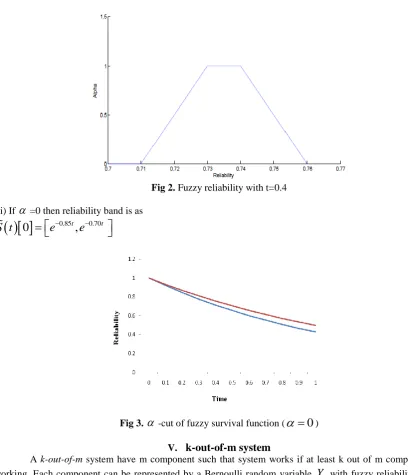
(i) If t =0.4, then fuzzy reliability is as:
0.016 0.340 0.016 0.280
0.024 0.344 0.024 0.276
,
0.0.5
0.4
,
0.0.5
e
e
for
S
e
e
for
1
1
,
0, 0.5
0.04
0.85 0.04
0.70
1
1
,
0.5,1
0.06
0.86 0.06
0.69
Fig 2. Fuzzy reliability with t=0.4 (ii) If
=0 then reliability band is as
0.85 0.700
t,
tS t
e
e
Fig 3.
-cut of fuzzy survival function (
0
)V.
k-out-of-m system
A k-out-of-m system have m component such that system works if at least k out of m components is working. Each component can be represented by a Bernoulli random variable
Y
i with fuzzy reliability (fuzzy survival probability)S t
and unreliability (fuzzy failure probability)Q t
. That is
1, with fuzzy probability
0, with fuzzy probability
i
S t
Y
Q t
Then,
1
m i i
Z
Y
the number of survivors at time t has the fuzzy Binomial distribution. So, for a k-out-of-m system consisting of m independent and identical components, the fuzzy system reliability function is given by
,
m
j m j
j m j k
R t
P Z
k
C S t
Q t
S
For
0
1
andt
0,
where S is the statement,
,
,
,
1
Both parallel and series systems are special cases of the k-out-of-m system. A series system is equivalent to a 1-out-of-m system. In the first specially case, k-out-of-m system is reducing at series systems and its fuzzy reliability function with modeled fuzzy exponential is as:
2 1 1 6 5 6
5 4 5 4 3 2 3 2
2 2
2 2 2 2
,
0, 0.5
,
0.5,1
m
a a a mt a a a mt
a a a a mt a a a a mt
R t
P Z
m
S t
S
S t
e
e
for
e
e
for
In the second especially case, k-out-of-m system is reducing at parallel systems and its
-cut fuzzy reliability function with modeled fuzzy expotential is as:
6 5 6 2 1 1
5 4 5 4 3 2 3 2
2 2
2 2 2 2
1
1
1
1
,1
1
0, 0.5
1
1
,1
1
0.5,1
m
m m
a a a t a a a t
m m
a a a a t a a a a t
R t
P Z
Q t
S
e
e
for
e
e
for
The FMTTF of k-out-of-m system calculated as follows:
06 5 6 2 1 1
5 4 5 4 3 2 3 2
1
1
1
,
0, 0.5
2
2
1
1
,
0.5,1
2
2
2
2
m m
j m j
j m
j k j k
m m
j k j k
m m
j k j k
MTTF
C S t
Q t
S
j
for
a
a
a
jt
a
a
a
jt
for
a
a
a
a
jt
a
a
a
a
jt
Example 2Consider a 3-out-of-4 system consisting of three independent and identical components. Lifetime is modeled as Example 1. Then the reliability function is given by
4 4 4 3 3 33
1
,
4
1
j j
j j
R t
P Z
C S t
S t
S t
S t
S t
S t
S t
S t
S t
According to that the
4
S t
3
1
S t
S t
3increasing, then the
-cut of fuzzy reliability function is given by
0.12 2.55 0.04 0.85 0.12 2.10 0.04 0.70
0.18 2.58 0.06 0.86 0.18 2.07 0.06 0.69
4 3
,
4 3
0, 0.5
4 3
,
4 3
0.5,1
t t t t t t t t
t t t t t t t t
e
e
e
e
for
R t
e
e
e
e
for
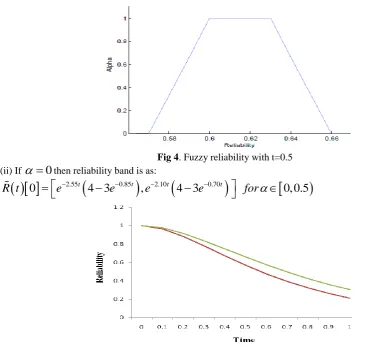
(i) If t=0.5, then fuzzy reliability is as:
0.06 1.275 0.02 0.425 0.06 1.05 0.02 0.35
0.09 1.29 0.03 0.43 0.09 1.035 0.03 0.345
4 3
,
4 3
0, 0.5
0.5
4 3
,
4 3
0.5,1
e
e
e
e
for
R
e
e
e
e
for
Fig 4. Fuzzy reliability with t=0.5 (ii) If
0
then reliability band is as:
2.55
0.85
2.10
0.70
0
t4 3
t,
t4 3
t0, 0.5
R t
e
e
e
e
for
Fig 5.
-cut of fuzzy survival function (
0
) The of
-cut FMTTF of 3-out-of-4 is as follows:
7
7
,
0, 0.5
12
0.04
0.85 12 0.04
0.70
7
7
,
0.5,1
12
0.06
0.86 12 0.06
0.69
for
MTTF
for
VI. CONCLUSION
In this paper hexagonal fuzzy number has been newly introduced for evaluating fuzzy reliability and FMTTF of reliability system. The fuzzy probability theory has been successfully applied to the reliability system in this paper. Whenever, the lifetime rate and lifetimes of components contain fuzziness and randomness respectively, conventional reliability system is not feasible. Thus we invoked successfully the fuzzy distribution to overcome this difficulty using
-cut of hexagonal fuzzy number. It also helps us to solve many optimization problems in future which have six parameters. Our fuzzy theory is a generalization of conventional theory since if lifetime rate is crisp; it turns in to conventional reliability system.REFERENCES
[1]. J. J. Buckley, Fuzzy probability and statistics, Springer-Verlage Berlin Heidelberg,3(2), 2006, 87-92. [2]. K. Y. Cai, C. Y. Wen and M. L. Zhang, Fuzzy variables as a basis for a theory of fuzzy reliability in the
possibility context, Fuzzy Sets and Systems, 42(2), 1991, 145-172.
[3]. Chen, S. M. (1994). Fuzzy system reliability analysis using fuzzy number arithmetic operations. Fuzzy Sets and Systems, 64(1), 31-38.
International organization of Scientific Research
25 | Page
[5]. Dinagar, D. & Latha, K. (2013). Some types of Type-2 Triangular Fuzzy Matrices, International Journalof Pure and Applied Mathematics, 82 (1), 21-32.
[6]. D. Dubois, and H. Prade, Twofold fuzzy sets: an approach to the representation of sets with fuzzy boundaries based on possibility and necessity measures, Journal of Fuzzy Mathematics, 3(4), 1983, 53-76.
[7]. P. S. Dwyer, Fuzzy sets. Information and Control, 8 (1), 1965, 338-353.
[8]. R. Fuller, and P. Majlender, On weighted possibilistic mean and variance of fuzzy numbers, Fuzzy Sets and Systems, 136 (1), 2003, 363-374.
[9]. S. Heilpern, Representation and application of fuzzy numbers, Fuzzy sets and Systems, 91(2), 1997, 259-268.
[10]. G. J. Klir, Fuzzy Sets: An Overview of Fundamentals, Applications, and Personal views, Beijing Normal University Press, 3(1), 2000, 44-49.
[11]. H. Lee. Kwang, First course on Fuzzy Theory and its Applications, Springer Publications, ISSN:1615-3871, 2005.
[12]. C. Parvathi, and C. Malathi, Arithmetic operations on Symmetric Trapezoidal Intuitionistic Fuzzy Numbers, International Journal of Soft Computing and Engineering, ISSN: 2231-2307, 2012.
[13]. T. Pathinathan, and K. Ponnivalavan, Pentagonal fuzzy numbers, International journal of computing algorithm, ISSN:2278-2397, 2014.
[14]. P. Rajarajeswari, , A. Sahaya, and R. Karthika, A new operation on hexagonal fuzzy number, International Journal of Fuzzy Logic Systems, 3 (3), 2013, 15-26.
[15]. D. Singer, A fuzzy set approach to fault tree analysis. Fuzzy Sets and Systems, 34 (1), 1990, 145-155. [16]. C. Wu, and G. Wang, Convergence of sequences of fuzzy numbers and fixed point theorems for incasing
fuzzy mappings and application, Fuzzy Sets and Systems, 130 (1), 2002, 383-390.