ISSN (e): 2250-3021, ISSN (p): 2278-8719
Vol. 05, Issue 02 (February. 2015), ||V3|| PP 34-44
Fuzzy Optimization Technique for Pareto Optimal Solution of
Structural Models with Stress constraints
1
Samir Dey,
2Tapan Kumar Roy
1Department of Mathematics, Asansol Engineering College Vivekananda Sarani, Asansol-713305, West Bengal, India.
2
Department of Mathematics, Indian Institute of Engineering Science and Technology, Shibpur. P.O.-Botanic Garden, Howrah-711103, West Bengal, India.
Abstract: Multi-objective non-linear programs occur in various field of engineering application. One of the applications of such program is structural design problem. In this paper, we consider a generalized form of a multi-objective structural design problem. Triangular norm based fuzzy programming technique is used to solve these problem. The test problem includes a three-bar planar truss subjected to a single load condition. The model is illustrated with numerical examples.
Keywords: Structural design, Fuzzy sets, Pareto optimal solution model, Fuzzy optimization technique, Multi-objective programming, t-norm.
I. INTRODUCTION
Optimization is the process of minimizing or maximizing an objective function (e.g. cost, weight) of a structural system which has been frequently employed as the evaluation criterion in structural engineering applications. But in the practical optimization problems, usually more than one objective are required to be optimized, such as minimum mass or cost, maximum stiffness, minimum displacement at specific structural points, maximum natural frequency of free vibration, and maximum structural strain energy. This makes it necessary to formulate a multi-objective optimization problem. The first note on multi-objective optimization was given by Pareto; since then the determination of the compromise set of a multi-objective problem is called Pareto optimization. That is why the application of different optimization technique [11,16-19] to structural problems has attracted the interest of many researchers.
In conventional mathematical programming, the coefficient or parameters of mathematical models are assumed to be deterministic and fixed. But, there are many situations where they may not be exactly known i.e., they may be somewhat uncertain in nature. Thus the decision making methods under uncertainty are needed. The fuzzy programming has been proposed from this point view. In decision making process, first Zadeh[2] introduced fuzzy set theory. Tanaka et al.[20]applied the concept of fuzzy sets to decision making problems by considering the objectives as fuzzy goals. Later on Bellman and Zadeh [3] used the fuzzy set theory to the decision making problem. Zimmermann [4] proposed a fuzzy multi-criteria decision making set, defined as the intersection of all fuzzy goals and their constraints.
In practical, the problem of structural design may be formed as a typical non-linear programming problem with non-linear objective functions and constraints functions in fuzzy environment. Some researchers applied the fuzzy set theory to Structural model. For example Wang et al. [1] first applied
-cut method to structural designs where the non-linear problems were solved with various design levels
, and then a sequence of solutions are obtained by setting different level-cut value of
. Rao [8] applied the same
-cut method to design a four–bar mechanism for function generating problem .Structural optimization with fuzzy parameters was developed by Yeh et.al [7]. In 1989, Xu [6] used two-phase method for fuzzy optimization of structures. In 2004, Shih et.al [9] used level-cut approach of the first and second kind for structural design optimization problems with fuzzy resources .Shih et.al [10] develop an alternative
-level-cuts methods for optimum structural design with fuzzy resources in 2003. Dey et.at [5] optimize structural model in fuzzy environment.Alsina et.al. [13] introduced the t-norm into fuzzy set theory and suggested that the t-norms be used for the intersection of fuzzy sets. Different types of t-norms theory and their fuzzy inference methods were introduced by Gupta et.al.[14] .The extension of fuzzy implication operators and generalized fuzzy methods of cases were discussed by Ruan et.al. [15].
the truss members; the constraints are the stresses in members. The test problem includes a three-bar planar truss subjected to a single load condition. This approximation approach is used to solve this multi-objective structural optimization model.
The remainder of this paper is organized in the following way. In section II, we discuss about structural optimization model. We discuss about mathematics Prerequisites and aggregation operator in section III and IV respectively. In section V, we discuss fuzzy optimization technique to solve multi-objective non-linear programming problem. In section VI, we discuss Pareto optimality test. In section VII, we solve multi-objective structural model using t-norms based fuzzy optimization. In section VIII, numerical solution of structural model of three bar truss. Finally we draw conclusions in section IX.
II. MULTI-OBJECTIVE STRUCTURAL MODEL
In the design of optimal structure i.e. lightest weight of the structure and minimum deflection of loaded joint that satisfies all stress constraints in members of the structure. To bar truss structure system the basic parameters (including the elastic modulus, material density, the maximum allowable stress, etc.) are known and the optimization’s target is that identify the optimal bar truss cross-section area so that the structure is of the smallest total weight, the minimum nodes displacement, in a given load conditions.
The multi-objective Structural model can be expressed as:
0
min max
( ) ( )
( ) [ ]
Minimize WT A minimize A subject to A
A A A
(1)
where A
A A1, 2,...,An
Tare design variables for the cross section, n is the group number of design variables for the cross section bar,1
n i i i i
WT A L
is the total weight of the structure,
( )
A
is the deflection of loadedjoint Li,Aiand i were the bar length, cross section area, and density of the ith group bars respectively.( )A is the stress constraint and
0 is maximum allowable stress of the group bars under various conditions, Amin andmax
A are the minimum and maximum cross section area respectively.
III. PREREQUISITE MATHEMATICS
III(a). Fuzzy Set:
Let X is a set (space), with a generic element of X denoted by x , that is X x( ) .Then a Fuzzy set (FS) is defined as A
x,A( ) :x
xX
where A:X[0,1] is the membership function of FS A. A( )x is the degree of membership of the element x to the set A.
III(b).
-Level Set or
-cut of a Fuzzy Set:The
-level set of the fuzzy set A of X is a crisp set Athat contains all the elements of X that have membership values greater than or equal to
i.e. A
x: A( )x ,xX,[0,1]
.III(c). Convex fuzzy set:
A fuzzy set Aof the universe of discourse X is convex if and only if for all x x1, 2 in
X, A
x1
1 x2
min
A
x1 ,A
x2
when 0 1.IV. AGGREGATION OPERATOR
When the rules in the decision support system contain more than one antecedent, the degrees of strength of antecedents need to be combined to determine the overall strength of the rule consequent. In the language of fuzzy sets, the membership values of the linguistic variables in the rule antecedents have to be combined using an aggregation operator. Formally, a general aggregation is a real function T: 0,1
n
0,1 , non decreasing in all arguments, with the properties T
0 0 and T
1 1.aggregation operators. Different class of aggregation operators display substantially different behavior, it is not logical to use any particular class to provide generic representation of aggregation. Therefore, we will use general aggregation operators to model aggregation of rule antecedents in decision support systems. They will provide the highest degree of adaptability and excellent empirical fit. However, if there are strong reasons to restrict the selection to a particular family of operators, we will impose the relevant constraints.
Consider general aggregation operator. The function can have a simple algebraic form, such as
1, 2,...., n
min
1, 2,... n
T x x x x x x
or
1 2
1 21
, ,...., ...
n
n n i
i
T x x x x x x x
or
1 2
1
, ,...., min 1,
n
n i
i
T x x x x
or
1, 2,....,
1n i i n
x
T x x x
n
The degree of importance of rule antecedents (vector a) can be easily incorporated into aggregation operators in variety of ways. For example
1, 1; 2, 2;...; n, n
min
1, 1
min
2, 2
... min
n, n
T x a x a x a x a x a x a
1, 1; 2, 2;...; n, n
min
1 1 2 2 ... n n,1
T x a x a x a x a x a x a
In this article, decision making method used by the weighted bounded sum operator (member of Yager family of triangular conorms).
V.
FUZZY PROGRAMMING TECHNIQUE TO SOLVE MULTI-OBJECTIVE
NON-LINEAR PROGRAMMING PROBLEM (MONLP)
A Multi-Objective Non-Linear Programming (MONPL) or Vector Minimization problem (VMP) may be taken in the following form:
( ) [ ( ),1 2( ),... ( )]
T k
Minimize f x f x f x f x (2) subject to x X
xRn:gj( )x ororbj for j1, 2,3,....,m
and li xi ui (i1, 2,3,...., )n Zimmermann (1978) showed that fuzzy programming technique can be used to solve the multi-objective programming problem.To solve MONLP problem, following steps are used:
Step 1: Solve the MONLP (2) as a single objective non-linear programming problem using only one objective at a time and ignoring the others, these solutions are known as ideal solution.
Step 2: From the result of step 1, determine the corresponding values for every objective at each solution derived. With the values of all objectives at each ideal solution, pay-off matrix can be formulated as follows:
Here x1, x2,x3,…..,xkare the ideal solutions of the objectives f x1( ), f x2( ),….., f xk( ) respectively. So Ur max
f xr( ),1 f xr( 2),...,f xr( k)
and Lr min
f xr( ),1 f xr( 2),...,f xr( k)
Where Urand Lr be upper and lower bounds of the rthobjective function f xr( ) forr1,2,3,..., k.
Step 3: Using aspiration level of each objective of the MONLP (3) may be written as follows: Find x so as to satisfy
f xr( )Lr with tolerance Pr
UrLr
for r1, 2,3,...,kxX. li xi ui (i1, 2,3,...., )n
1
( )
f x
f x
2( )
….f x
k( )
1
x
f
1*( )
x
1* 1
2
( )
f
x
…. * 1( )
kf
x
2
x
f
1*(
x
2)
* 2
2
(
)
f
x
…. * 2(
)
kf
x
…. …. …. …. ….
k
x
1*(
)
k
f
x
*2
(
)
k
f
x
*(
k)
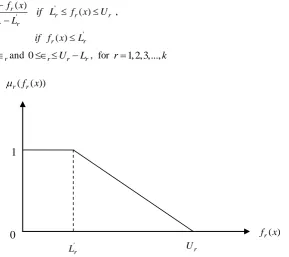
kHere objective functions of (2) are considered as fuzzy constraints. These types of fuzzy constraints can be quantified by eliciting a corresponding membership function:
' '
'
0 ( )
( )
( ( )) ( ) ,
1 ( )
r r
r r
r r r r r
r r
r r
if f x U
U f x
f x if L f x U
U L
if f x L
(3)
where L'r Lr rand 0 r UrLr, for r1, 2,3,...,k
Figure 1: Membership function for objective functions f xr( )
Having elicited the membership functions as in (3) r(f xr( ))for r1, 2,3,...,k a general aggregation function
( ) ( 1( ( )),1 2( 2( )),..., k(k ( )))
D x F f x f x f x
is introduced.
So a fuzzy multi-objective decision making problem can be defined as
( )
.
D
Maximize x subject to x X
(4)
Fuzzy decision making method used by the (weighted) bounded sum operator (member of Yager family of triangular conforms) the problem (4) is reduced to
1
1
; ( ( ))
0 ( ( )) 1 1, 2,..,
0 1, 2,..., , 1
k
r r r D
r
r r
k
r r
r
Maximize x W W f x
subject to x X
f x for r k
where W for all r k W
(5)
Step 4: Solve (5) to get optimal solution.
Some basic definitions are introduced below.
V(a). Complete Optimal Solution
*
x is said to be a complete optimal solution to the MONLP (3) if and only if there existsxXsuch thatfr
x* fr
x for r1, 2,...,k and for allxX.However, when the objective functions of the MONLPconflict with each other, a complete optimal solution does not always exist and hence the Pareto Optimality Concept arises and it is defined as follows.
V(b). Pareto Optimal Solution
'
r
L Ur
( )
r
f x
0 1
( ( ))
r f xr
*
x is said to be a Pareto optimal solution to the MONLP (3) if and only if there does not exist anotherxXsuch that fr
x* fr
x for all r1, 2,...,kand
*
j j
f x f x for at least one j,
1, 2,...,
j k .
VI. PARETO OPTIMALITY TEST
A numerical test of Pareto optimality for
x
* can be performed by solving the following problem:
1
*
, 1, 2,...,
; 0.
k
r r
r r r
r
Maximize R
subject to f x f x r k
x X
(6)
The optimal solution of (6), say x**and fr
x** are called strong Pareto optimal solution provided Vis very small otherwise it is called weak Pareto solution.VII. FUZZY PROGRAMMING TECHNIQUE IN MULTI-OBJECTIVE
STRUCTURAL MODEL
To solve the above MOSOP (1), step 1 of V is used. After that according to step 2 pay-off matrix formulated as follows:
After that according to step 2, the bounds of objective are U1 ,L1 for weight function WT A( )
(whereL1WT A( )U1) and the bounds of objective are U2 ,L2 for deflection function
A(whereL2
A U2) are identified.Above MOSOPP reduces to a FMOSOPP as follows; Find A
Such that
1
WT A L with maximum allowable tolerance P1
U1L1
2
A L
with maximum allowable tolerance P2
U2L2
0
min max
( )A [ ]
A A A
Here for simplicity linear membership functions WT
WT A
and
A
for the objective functions
WT A and
A respectively are defined as follows:
' 1
1 '
1 1
' 1 1
1
1
0
WT
if WT A L
U WT A
WT A if L WT A U
U L
if WT A U
' 2
2 '
2 2
' 2 2
2
1
0
if A L
U A
A if L A U
U L
if A U
( )
WT A
( )
A
1
A
WT
*(
A
1*)
(
A
1*)
2
According to step-3, having elicited the above membership functions crisp non-linear programming problem is formulated as follows
1 WT 2
Maximize W WT A W A
(7)
min max
1 2 1 2
0 1, 0 1,
( ) [ ],
,
0, 0, 1;
WT
subject to
WT A A
A
A A A
W W W W
The problem (7) can be written as
1 2
1 ' 2 '
1 1 2 2
U WT A U A
maximize W W
U L U L
(8)
1 2
' '
1 1 2 2
min max
1 2 1 2
0 1, 0 1,
( ) [ ], ,
0, 0, 1;
subject to
U WT A U A
U L U L
A
A A A
W W W W
VIII. NUMERICAL SOLUTION OF A MULTI-OBJECTIVE STRUCTURAL
OPTIMIZATION MODEL OF A THREE-BAR TRUSS
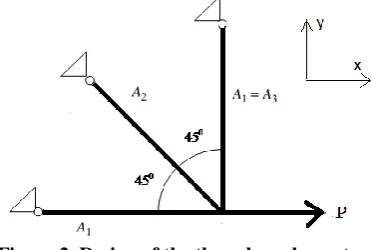
A well-known three bar [12] planar truss structure is considered. The design objective is to minimize weight of the structural WT A A
1, 2
and minimize the deflection
A A1, 2
along xand yaxes at loading point of a statistically loaded three-bar planar truss subjected to stress
constraints on each of the truss members.Figure 2. Design of the three-bar planar truss
1 2 1 2
1 2
1 2 2
1 1 2
2
1 2 2
1 1 2
1 2
1 1 2 2 1
1 2 1
2 1 2 2
1 2
2
3 1 2 2 3
1 2 1
min max , 2 2 , 2 2 , 2 2 2 , 2 2 , 2 , 2 2 ; x y T T C
i i i
Minimize WT A A L A A
PL A A
minimize A A
E A A A
PLA
minimize A A
E A A A
P A A
subject to A A
A A A
P A A
A A
PA A A
A A A
A A A i
1, 2
(9)
Where P= applied load;
=material density, L=Length, E=Young’s modulus, A1= cross section of bar-1 and bar-3, A2=cross section of bar-2. x and yare the deflection of loaded joint along xand yaxesrespectively.1Tand T2the maximum allowable tensile stress for bar 1 and bar 2 respectively.3Cis the maximum allowable compressive stress for bar 3.
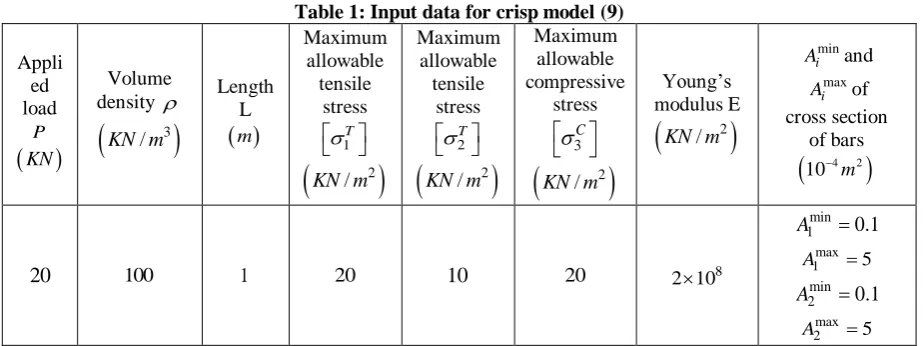
The input data for MOSOP (9) is given as follows
Table 1: Input data for crisp model (9)
Appli ed load P
KNVolume density
3
/
KN m
Length L
mMaximum allowable tensile stress 1 T
2
/ KN m Maximum allowable tensile stress 2 T
2
/ KN m Maximum allowable compressive stress 3 C
2
/
KN m
Young’s modulus E
2
/ KN m min i A and max i A of cross section of bars
4 2
10 m
20 100 1 20 10 20 8
2 10
min 1 0.1 A max 1 5 A min 2 0.1 A max 2 5 A
Solution: According to step 2 pay off matrix is formulated as follows:
1 2
( , )
WT A A x(A A1, 2) y(A A1, 2) 1
A
2.187673 20 5.8578642
A
15 3 13
A
10.1 3.960784 0.039216
Here UWT 15, LWT 2.187673, LWT' 3 Ux 20, Lx 3,
' 3.5
x
L , 5.857864
y
U , 0.039216
y
L ,
'
0.15 y
1 2
1 2
1 2 1 2
1 2
1 ( , ) 3
15 ( , )
( ( , )) 3 ( , ) 15
12
0 ( , ) 15
WT
if WT A A WT A A
WT A A if WT A A
if WT A A
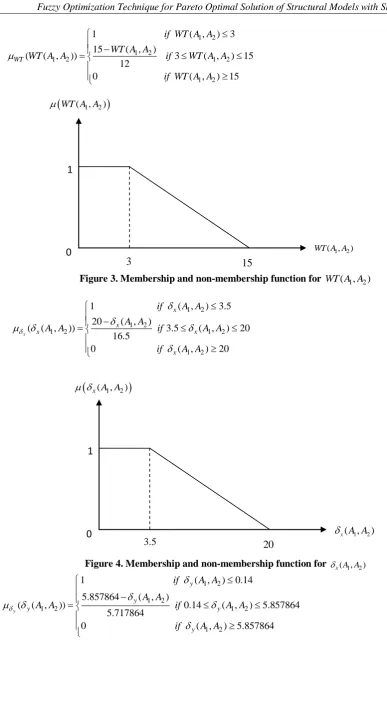
Figure 3. Membership and non-membership function for WT A A( 1, 2)
1 2
1 2
1 2 1 2
1 2
1 ( , ) 3.5
20 ( , )
( ( , )) 3.5 ( , ) 20
16.5
0 ( , ) 20
x
x
x
x x
x
if A A
A A
A A if A A
if A A
Figure 4. Membership and non-membership function for x(A A1, 2)
1 2
1 2
1 2 1 2
1 2
1 ( , ) 0.14
5.857864 ( , )
( ( , )) 0.14 ( , ) 5.857864
5.717864
0 ( , ) 5.857864
y
y
y
y y
y
if A A
A A
A A if A A
if A A
3.5 20
1 2
( , )
x A A
x(A A1, 2)
0 1
3 15
1 2
( , ) WT A A
0 1
Figure 5. Membership and non-membership function for y(A A1, 2)
Now Fuzzy decision making method used by weighted bounded sum operator (member of Yager family of triangular conorms) ,
1 ( 1, 2) 2 x( 1, 2) 3 y( 1, 2)
Maximize FW WT A A W A A W A A (10)
1 2 1 2
1 2 1 2 1 2 1 2 1 2 1 2 1 2 1 2 2 1 1 2
1 2
2 2 1 1 2
1
0 ( , ) 1; 0 ( , ) 1
0 ( , ) 1
15 ( , )
( , )
12
20 ( , )
( , )
16.5
5.857864 ( , )
( , ) 5.717864 20 2 20; 2 2 20 10; 2 20 20; 2 2 0.1 , x y x x y y subject to
WT A A A A
A A WT A A WT A A
A A A A
A A A A
A A
A A A
A A
A
A A A
A 2
1 2 3
5,
1,
A
W W W
The solution obtained from Eq. (10) is given in table 2.
Table 2: Optimal results of MOSOP (9) 1
W W2
W
3 *1 4 2 10 A m * 2 4 2 10 A m
* 1 2 2 , 10WT A A
KN
* 1 2 7 , 10x A A
m
* 1 2 7 , 10y A A
m
1 3 1 3 1 3 2.661308 0.1029932 5.425610 7.375100 0.14
0.6 0.2 0.2 1.645225 0.1 3.390449 11.80812 0.3482759
0.2 0.6 0.2 4.542762 0.3 9.394060 4.262608 0.14
0.2 0.2 0.6 2.661309 0.1029933 5.425611 7.375099 0.14
In table 3, the value of R is quite small and hence the optimal results in table 2 are strong Pareto-optimal solution and can be accepted.
0.14 5.857864
1 2
( , )
y A A
y(A A1, 2)
Table 3: Pareto optimal results of MOSOP (9)
R **
1 4 2
10
A m
** 2 4 2
10
A m
** 1 2 2
,
10
WT A A
KN
** 1 2 7
,
10
x A A
m
** 1 2 7
,
10
y A A
m
6
0.5277774 10 2.661308 0.1029933 5.425609 7.375100 0.14
IX. CONCLUSIONS
The present paper proposes a solution procedure for structural model. The results of this study may lead to the development of effective t-norm optimization method. This solution procedure may be used for solving other model of nonlinear programming problem in different field.
ACKNOWLEDGEMENT
The authors are grateful for the valuable comments and suggestions from the respected reviewers which have enhanced the strength and significance of our work.
Conflict of interests
The authors declare that there is no conflict of interests.
REFERENCE
[1] Wang,G.Y.and Wang, W.Q., “ Fuzzy optimum design of structure.” Engineering Optimization, 8,291-300,1985.
[2] L. A. Zadeh, Fuzzy set, Information and Control, vol.8, no.3, pp.338-353, 1965.
[3] R.E. Bellman and L.A. Zadeh, Decision-making in a fuzzy environment, Management Science, 17(4), B141-B164, 1970.
[4] Zimmermann, H.J., fuzzy linear programming with several objective function” Fuzzy sets and systems,1,45-55,1978.
[5] Dey.Samir. and Roy,Tapan.Kumar., “Structural Optimization Model with Imprecise Resources” , International Journal of Engineering Sciences & Emerging Technologies,6(3), 287-297,2013.
[6] Xu, C. “Fuzzy optimization of structures by the two-phase method”,Computer and Structure, 31(4),575– 580,1989.
[7] Yeh, Y.C, and Hsu, D.S. “Structural optimization with fuzzy parameters”.Computer and Structure, 37(6), 917–24, 1990.
[8] Rao, S.S., “ Description and optimum Design of Fuzzy Mathematical Systems”,
[9] Journal of Mechanisms, Transmissions, and Automation in Design, Vol.109,pp.126-132,1987.
[10] Shih,C. J. and Lee, H. W. “Level-cut Approaches of First and Second Kind for Unique Solution Design in Fuzzy Engineering Optimization Problems”, Tamkang Journal of Science and Engineering, Vol. 7, No 3, pp. 189-198 ,2004.
[11] Shih,C.J., Chi,C.C. and Hsiao,J.H. “Alternative
-level-cuts methods for optimum structural design with fuzzy resources”, Computers and Structures, 81,2579–2587,2003.[12] C. J. Shih and C. J. Chang, Mixed-discrete nonlinear fuzzy optimization for multi-objective engineering design. AIAA-94-1598-CP, pp. 2240-2246, 1994.
[13] Christensen, P. W., and Klarbring, A., “An Introduction to Structural Optimization” Springer science, 2009.
[14] C.Alsina, E. Trillas and I.Valverde, “On some logical connectives for fuzzy set
theory.J.Math.Anal.Appl.93,15-26,1981
[15] Gupta,M.M., and Qi,J., “theory of t-norms and fuzzy inference methods.” Fuzzy sets and systems,40,431-450,199.
[16] Ruan, D. and Kerre,E.E., Fuzzy implication operators and generalized fuzzy method of cases,fuzzy sets and systems,54,23-37,1993.
[17] Perez, R.E. and Behdinan, K.: Particle swarm approach for structural design optimization, [18] Computers & Structures, Vol. 85, No. 19-20, pp. 1579-1588, 2007.
[19] Dede T,Bekirog .lu S,Ayvaz Y. “Weight minimization of trusses with genetic algorithm”. Appl Soft Comput ,11(2):2565–2575,2011
[21] Sonmez M. “Discrete optimum design of truss structures using artificial bee colony algorithm”. Struct Multidiscip Optimiz,43(1):85–97,2011.
[22] Tanaka,H.,Okuda,T. and Asai,K., On fuzzy mathematical programming ,Journal of Cybernetics,3(4): 37-46,1974.
Short Bio-Data of All Authors
Samir Dey: Samir Dey, Assistant Professor of Mahematics Department , Asansol Engineering College, Asansol, West Bengal,India, received a M.Sc (Applied Mathematics) from , Indian Institute of Engineering Science and Technology, Shibpur and a M.Tech (Operations Research) from National Institute of Technology, Durgapur, India. His research interest is in application of optimization technique in different field of operations research and fuzzy systems. He is currently working toward the Ph.D. degree