ISSN: 2395-5929
www.eijfmr.com
©
Mayas Publication
A Study on Challenges and opportunities of E-Banking in
Bengaluru
V. Shivani
1& S. P. Sanjana
2& Dr. R. Rohini
3 1Mount Carmel College2 Mount Carmel College
3Assistant professor Mount Carmel College
ABSTRACT
Banking acts as a life-blood of an economy, as it helps in forecasting the future of a country. The traditional methods of banking acts as a base for the banking sector to grow and due to which there is gradual increase in our GDP. The banks have to update themselves with the changing trends and technology in their operations. By introducing new features over the existing ones they can have smooth functioning of the services they provide and attain better customer satisfaction. The concept of banking services is still not so prevalent in India when compared to our western counterparts. Through this study an attempt has been made to understand the opportunities and challenges faced in e-banking in the Indian context in general and Bengaluru in specific. It emphasises on the customer’s perspective in using E-banking services. The information is collected through a structured questionnaire and other secondary sources. For the primary data questionnaire was circulated. The analysis is drawn using mean, standard deviation and ANOVA through SPSS software.
Key words: Challenges, Customers, Opportunities and E-services
I.INTRODUCTION
In the present world, E-banking is considered as one of the major innovations in the banking sector, as it has come up with a lot of initiatives to provide quality services to its customers with the help of technology. Since there are changes in the technology as well as the lifestyle of the people banks also came forward to adopt technology in the field of banking by leaving behind their traditional methods. They also find this simple, fast, easy to use and cost effective for the customers and banks. This method eliminates the long queues in the banks and saves time of the people as they can deposit, transfer funds etc. from any part of the world through E- banking. Innovation in the functioning of banks play a vital role in shaping our economy as banking is one of the important sectors which contribute to our GDP to a greater extent. The main function of bank is accepting deposits and lending of loans, they also acts as portfolio managers to customers by guiding them in their investment decisions. Banks today are privatized, liberalized, globalised and work in a competitive environment. Since the inception of banks in India to the current date banking has undergone several changes in its operations. As per the latest
Volume-
V
Issue-1 January-2019
Received : 17th January 2019Accepted : 25th January 2019
Published : 28th January 2019
109
Emperor International Journal of Finance and Management Research
reports, it is said that banking industry is going to be the 5th largest industry by the end of 2020 and 3rd
largest by the end of 2025.
Initiatives taken by government and commercial banks include card less cash withdrawals, 24/7 banking through internet, mobile etc. Online tax collection system or OLTAS is introduces by commercial banks and government has made it easier by amending few regulations through RBI such as introduction of IT Act to make transactions easier and to run e-commerce businesses , RBI monitors and reviews to detect any threats in the banks , they have come up with different payment channels.
Banks have to face a lot of challenges in their operations while they are adopting e-banking services mainly to satisfaction of their customers, provide personalized services, severe competition, adopting technology, trying different channels of operation etc. .Banks have many opportunities to overcome their challenges like covering the rural masses, increasing the internet users and improving computer literacy, by having an USP so that they have a competitive advantage, to create loyal customers by providing after sales services and by venturing into retail lending.
II.REVIEW OF LITERATURE
Kumara Nidhi (2016) this study talks about the challenges faced by the customers and also the challenges faced by the banks .it also talks about the response of the customer towards the implementation of new system. It discusses about the current phase of e-banking in India, the various types of e services given by the banks to their customers and it also recommends the banks about improvising its system of operation
Trivedi & Patel (2013) this paper talks about the pitfalls of e-services that the customers face during transactions in India. The study conducted has given conclusions that the customer of the banks know about the e-services rendered by the banks to them .it also specifies the significance of the pitfalls as some of them affect the banking sector at a greater extent & and few can be rectified without any hassles
Farshad Havasi, Fattaneh Alizadeh Meshkany, Reza Hashemi (2013) it focuses on the analysis of e-banking in a broader sense. it talks about the development and growth of e-banking , its limitations, reasons for development of e-banking, opportunities that come their way and the challenges that they face, and the stages, methods and drawbacks of e-banking
Shri Jagadish Patil It gives an insight on the trends in the technology or the current technology introduced in the banking sector and it gives detailed inputs about the challenges faced by the customer and banks in implementing these services of e-banking.
2.1 Statement of the Problem
“A study on challenges and opportunities of e-banking in Bengaluru” deals with the challenges or discomforts faced by the customers due to the adoption of technology in place of traditional banking system. Also to know the problems faced initially in introduction of these systems.
2.2 Need for the study
The focuses to determine the challenges faced by customers and to understand the future opportunities for improvement.
2.3 Objectives
1. To know the challenges faced by the customers in using E-banking. 2. To identify the opportunities in improving E-banking.
2.4 Research instrument
collecting data of samples for the data collection. The analysis is done with comparative mean using SPSS software.
III.METHOD OF DATA COLLECTION
3.1 Primary data
Primary data is also called as first hand data .It is comparatively difficult to gather data in this method. For this, a questionnaire was prepared to suit the objectives of the study .It was then followed by data collection and the response to every question on the questionnaire will be interpreted. Most of the question is a close ended type. Primary data can also be collected by observation.
3.2 Secondary data
Secondary data is obtained from books, newspaper, journals, internet, articles etc. Secondary data is the information that has already been collected by other person for a similar study or for other purpose.
3.3 Sample design
Sample design defines how the researcher collects the data. For this study, the sample size is 130 respondents. The questionnaire in the form of Google forms were sent through mails and whatsapp. In this research, convenience sampling method is adopted to collect data.
3.4 Limitations
It was time consuming while collecting the data.
The study is based on information provided by few respondents.
The respondents were limited to Bengaluru.
Analysis and interpretation
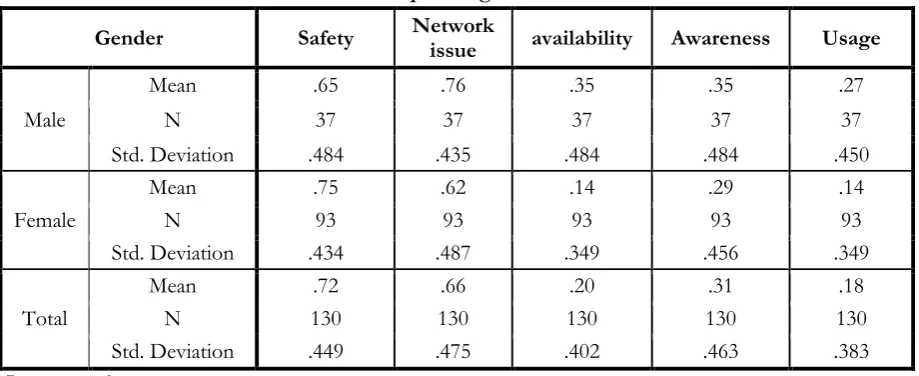
Table 1
showing the mean and Standard Deviation of perception of challenges faced with Respect to gender
Gender Safety Network issue availability Awareness Usage
Male
Mean .65 .76 .35 .35 .27
N 37 37 37 37 37
Std. Deviation .484 .435 .484 .484 .450
Female
Mean .75 .62 .14 .29 .14
N 93 93 93 93 93
Std. Deviation .434 .487 .349 .456 .349
Total
Mean .72 .66 .20 .31 .18
N 130 130 130 130 130
Std. Deviation .449 .475 .402 .463 .383
Interpretation
As per table 1, Men consider network issue as the main challenge in E – banking when compared to women. On the other hand women consider safety and security as a greater challenge. Both men and women think usage of E – banking is not a great challenge when compared to other challenges because majority of them are qualified and they understand the working of E – banking.
111
Emperor International Journal of Finance and Management Research Table 2
ANOVA
Sum of Squares Df Mean Square F Sig.
Between Groups 1.375 1 1.375 3.258 .073
Within Groups 54.017 128 .422
Total 55.392 129
Hypothesis
Ho: There is no significant difference in the perception on technology improvisation and innovation of e-banking services according to the respondent’s qualification.
H1: There is significant difference in the perception on technology improvisation and innovation of e-banking services according to the respondent’s qualification.
As per the ANOVA table, the significant value (at 0.5 significant level) is 0.73 , which indicates a moderate difference in the mean values between the two educational level groups therefore Ho is accepted i.e. There is no significant difference in the mean values on technology and innovation as per education of respondents.
IV.FINDINGS
It was found that majority of the respondents were between16-25 of age.
Majority of the respondents were females.
Most of the respondents felt network issues and safety and security is a major threat.
Most of the respondents were Post graduates as compared to others.
It was found that most of them use E- services through mobile banking and online shopping. Most of the online shopping options chosen respondents were females.
Majority of the respondents use E- services at least once a week.
Most of them fall between the income group of below 10,000 /-
Least number of respondents has used E- banking for opening an account.
Most of them have a neutral opinion regarding E- banking having more disadvantages than advantages.
Recommendations
The system of software that provides E-services should be hack proof.
The accounts could be operated through biometrics in mobile banking.
The banks should concentrate more on network issues as there are will be many users at the same time.
The banks should conduct workshops in schools and colleges on operations of E-banking services.
All the elderly must be educated about the working of E- banking as they tent to follow the old traditional method.
The bank should effectively design its app and website so it can offer services beyond what banks can offer.
The working of E-banking should be provided in all languages.
They should also develop apps for visually challenged also.
V.CONCLUSION
E- Services are one of the best creations in the banking sector as it acts as a boon for all the customers. The customers need not stand in long queues in the bank to get their work done, instead they can use E – banking for their desired services. With E- banking transferring of funds, adding beneficiary, enquire of loans, bills payments, NEFT, RTGS etc. can be performed in no time. Likewise as it has so many advantages they also come with greater disadvantages. Hacking is one of the major threats. Most of the time there will be network issues. To overcome those disadvantages is a main challenge to the banks. The government has to take more initiative regarding cyber-crimes. It has to bring in more rigid rules to control future frauds. With all hopes to see the challenges being eliminated for a safe, secured and better E- banking service.
VI.REFERENCE
1. Kumari Nidhi (2016)
https://pdfs.semanticscholar.org/4b3d/7a45d0e55935a372436b3db358dcb1c00783.pdf 2. Trivedi & Patel (2013)
http://publications.anveshanaindia.com/wp-content/uploads/2016/05/E-BANKING-IN-INDIA-INNOVATIONS-CHALLENGES-AND-OPPORTUNITIES.pdf
3. Farshad Havasi, Fattaneh Alizadeh Meshkany, Reza Hashemi (2013)