R E S E A R C H
Open Access
An adaptive approach for Linux memory
analysis based on kernel code reconstruction
Shuhui Zhang
1,2*, Xiangxu Meng
1and Lianhai Wang
2Abstract
Memory forensics plays an important role in security and forensic investigations. Hence, numerous studies have investigated Windows memory forensics, and considerable progress has been made. In contrast, research on Linux memory forensics is relatively sparse, and the current knowledge does not meet the requirements of forensic investigators. Existing solutions are not especially sophisticated, and their complicated operation and limited treatment range are unsatisfactory. This paper describes an adaptive approach for Linux memory analysis that can automatically identify the kernel version and recovery symbol information from an image. In particular, given a memory image or a memory snapshot without any additional information, the proposed technique can automatically reconstruct the kernel code, identify the kernel version, recover symbol table files, and extract live system information. Experimental results indicate that our method runs satisfactorily across a wide range of operating system versions.
Keywords: Memory forensics, Linux memory analysis, Kernel symbol
1 Introduction
The physical memory of a computer is highly useful but can be a challenging resource for the collection of digital evidence. Physical memory may first appear to be a large, amorphous, and unstructured collection of data. In fact, by examining a memory image, we can extract details of volatile data, such as running processes, logged-in users, current network connections, users’ sessions, drivers, and open files. Although criminals tend to avoid leaving any evidence in a computer’s persistent storage, it is extremely hard for them to completely remove their footprints from the memory. In some cases, physical memory is the only place where evidence can be found. In a computer oper-ating system (OS) that boots and runs completely from CD-ROM, nearly all of the valuable information exists in the physical memory of the computer. Therefore, memory forensics is becoming increasingly important.
Before 2005, the physical memory of a computer was mainly captured to retrieve strings, e.g., passwords, credit card numbers, fragments of chat conversations, IP
*Correspondence: [email protected]
1School of Computer Science and Technology, Shandong University, Shunhua Road, Jinan, China
2Shandong Computer Science Center (National Supercomputer Center in Jinan), Shandong Provincial Key Laboratory of Computer Networks, Keyuan Road, 250014 Jinan, China
addresses, or email addresses. In 2005, the Digital Foren-sics Research Workshop (DFRWS) organized a memory analysis challenge [1]. Since then, the capture and anal-ysis of the content of physical memory, known as mem-ory forensics, has become an area of intense research and experimentation [2]. Numerous studies have analyzed Windows memory images. The MemParser tool enables an examiner to load a physical memory dump of certain Windows systems, reconstruct process information, and extract data relating to specific processes [3]. PTFinder is a proof-of-concept implementation with the ability to reveal hidden and terminated processes and threads [4]. A method based on the Kernel Processor Control Region (KPCR) structure in Windows was proposed to determine the OS version and realize the translation from virtual address to physical address [5]. Moreover, technical details related to memory analysis have been discussed, including address translation [6, 7], pool allocation [8], swap integra-tion [6], carving out memory [9, 10], sensitive informaintegra-tion extraction [11, 12], and malicious code detection [13]. In short, memory analysis has been used in the wider con-text of digital forensics, virtual machine introspection, and malware detection [14].
Compared with Windows memory forensics, mem-ory analysis of Linux systems presents some practical challenges. Current Linux memory analysis technologies
require precise knowledge of the OS edition and ker-nel symbol information, which is generated at compile time. Kernel symbol information varies with the differ-ent OS editions. Furthermore, the Linux kernel is highly configurable. During the kernel build process, users may specify a large number of different options through the kernel’s configuration system. These options affect the kernel symbol information, resulting in distinct key struc-tures for the same OS version. To obtain kernel symbol information, one must configure an environment in which the OS version and configuration options are exactly the same as those in the target system. For incident response applications, obtaining precise and relevant information is currently a slow, manual process, which limits its useful-ness in rapid triaging.
To overcome these problems, this paper describes tech-niques that allow for the automatic adaptation of memory analysis tools for a wide range of kernel versions. Using dynamic reconstruction of the kernel code, it is possible to identify the OS version, disassemble correlative func-tions, and acquire kernel symbol information. Some other memory analysis systems rely on information that may not be available, whereas the proposed system only needs the analyzed memory dump. The main contributions of this paper are as follows:
• We present a multi-aspect approach to automatically identify the precise kernel version when provided with only a physical memory dump. The approach is universal, and does not rely on any prior knowledge for particular OSs.
• We devise a set of novel techniques to obtain kernel symbols from the physical memory dump instead of obtaining symbol information from the target kernel’s “System.map” file. Each time a new kernel is compiled, various symbols are assigned different addresses. New kernel versions of Linux are released frequently, and it is inconvenient to find all System.map files. • As the symbols in the System.map file are important,
and symbols exported from modules are critical for investigators, a method of parsing symbols exported from modules is presented. To recover and analyze loaded kernel module information, it is essential to understand the relevant data structures used by the target OS. As the inclusion or exclusion of a kernel configuration option can cause the insertion or removal of several members of key structures, analysis methods that rely on a stable key structure layout are inadvisable. A method to accurately and dynamically build representative data structures is also presented.
Based on the above techniques, we develop a new Linux memory analysis system named RAMAnalyzer that can identify the OS version and acquire symbol information automatically. Live system information can subsequently
be retrieved. We examine the performance of RAMAn-alyzer on various recent Linux kernels, and show that it is an adaptive solution for the Linux memory analysis problem.
The remainder of this paper is organized as follows. Section 2 introduces some background information. The proposed techniques based on dynamic reconstruction are described thoroughly in Sections 3 and 4. In Section 5, we evaluate the proposed forensics tool in terms of effec-tiveness and performance. The final section summarizes this study and states our conclusions and indicates some opportunities for future research in this area.
2 Background and related work
2.1 Problem statement
The main problem encountered by memory analysis tools when parsing the Linux kernel memory is the need for prior knowledge of the precise kernel version and symbol information. In an incident response and live analysis con-text, this prior knowledge may not always be obtainable. We assume the following scenarios:
• The specific target kernel version is unknown. • The kernel version is known but neither the
System.map file nor/proc/kallsyms information of the target system is available.
Under these scenarios, our system has three major goals: precision, efficiency, and generality.
• Precision. The OS family and precise version are both required. For instance, given a Linux kernel, we need to know not only its major version (e.g., 2.6 or 3.10), but also its minor version because the symbol’s information and data structures of various Linux kernels are different.
• Efficiency. It is necessary to automatically obtain information for the OS version and symbols within a short period of time.
• Generality. The system should be adaptive and analyze the mainstream Linux kernel memory image, rather than support only certain versions of Linux.
2.2 Kernel symbols
In the Linux kernel 2.6.×,kallsymsis used to extract all the non-stack symbols from a kernel and build a data blob. CONFIG_KALLSYMS should be configured as follows:
make menuconfig General setup —>
[*] Configure standard kernel features (for small systems) —>
[*] Load all symbols for debugging/ksymoops [*] Include all symbols in kallsyms
In the last stage of the kernel compile, the following command is executed:
nm -n vmlinux|scripts/kallsyms
Therefore, all the kernel symbols are generated and sorted according to their addresses. This list is used to create the “kallsyms.S” file, which includes several spe-cial symbols: kallsyms_addresses, kallsyms_num_syms, kallsyms_names,kallsyms_makers,kallsyms_token_table, and kallsyms_token_index. Among these symbols, kall-syms_addresses points to the addresses of all kernel
symbols in order, kallsyms_num_syms points to the
“num” value of kernel symbols, and kallsyms_names
corresponds to the symbols’ name arrays. For conve-nience,kallsyms_markers,kallsyms_token_table, and kall-syms_token_index are used for the offset index and high-frequency string compression.
The acquisition of kernel symbols is essential for analyz-ing the information contained within a physical memory dump. For example, if system calls are needed during an investigation, their addresses are stored in a kernel struc-ture called the system call table. Thesys_call_tablesymbol stores an address for this table, and may be used to enu-merate the addresses of system calls. There are several ways to obtain the symbols:
• Copy/proc/kallsyms or System.map and analyze the file [15, 16]. Care should be taken when copying the System.map file because systems with multiple kernels have multiple System.map files. Unlike /boot/System.map, /proc/kallsyms is a “proc file” that is created when a kernel boots up. This is not actually a disk file and is always correct for the kernel that is currently running. Furthermore,/proc/kallsyms contains not only kernel symbols but also symbols exported from modules.
• Additionally, the kernel build system puts the System.map inside the kernel’s executable and linkable format (ELF) executable. Symbols can be extracted using the following commands:
$ ./scripts/extract-vmlinux /tmp/vmlinuz-3.13.0-63-generic> /tmp/vmlinuz-3.13.0-63-generic.elf
$ readelf -Wa /tmp/vmlinuz-3.13.0-63-generic.elf $ objcopy -j ksymtab_strings -O binary
/tmp/vmlinuz-3.13.0-63-generic.elf vmlinux.bin- ksymtab_strings
Even a simple recompile of the same kernel is sufficient to change the symbol addresses. In previous solutions for obtaining symbol tables, methods that select symbol table profiles according to the kernel versions are obviously inaccurate. Furthermore, there is a strong need to reli-ably determine the correct profile for unknown kernels,
which are often encountered during incident response situations [17].
2.3 Linux memory analysis
In this section, we survey some related studies on Linux memory analysis. Assuming that the kernel data struc-tures are known, a modular, extensible framework named FATKit can realize general virtual address space recon-struction and visualization [18]. The open source volatility framework has been adapted to work with Linux mem-ory dumps, including Android, but it must be config-ured for the specific version of Linux being examined [15]. SecondLook is a commercial application with a GUI and command-line interface that can extract and display memory structures including processes, loaded kernel modules, and system call tables [19]. RAMPARSER was designed to reconstruct kernel data structures such as task_struct,mm_struct,File,Dentry,Qstr,inet_sock,Sock, andSocket[20]. Linux kernel versions from 2.6.9 to 2.6.27 were tested to verify its feasibility.
Each memory forensics solution has different fea-tures along with several limitations: first, the accurate OS version of a memory image must be known in advance, which means that Linux memory images with-out precise OS version information cannot be parsed correctly. Second, the analyzed system’s System.map file and kernel information are needed. These data may not be immediately available, or may have been modified by attackers to thwart forensic analysis. For example, the Kernel Debugger Block can be easily overwritten by malware [21]. Furthermore, some tools only work on specific versions and require substantial manual intervention.
3 Linux memory analysis framework based on kernel code reconstruction
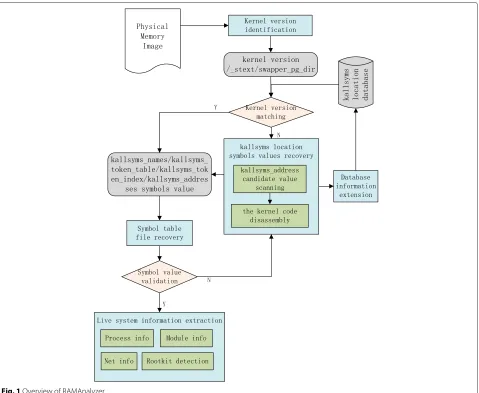
In this paper, based on kernel code reconstruction, we propose a new Linux memory analysis framework that can automatically detect the kernel version and recover the symbol table file from the memory image. As shown in Fig. 1, there are five key components in our framework:
• Kernel version identification (KVI): this component allows the OS version to be detected in two ways: linux_banner content identification and
vmcoreinfo_data content identification.
• kallsyms location symbol values recovery (KLSR): the symbol table file can be recovered from memory using kallsyms location symbols such as
Fig. 1Overview of RAMAnalyzer
• Symbol table file recovery (STFR): using the kallsyms location symbol values obtained from KLSR, the symbol table file content and kernel symbol information can be recovered.
• Live system information extraction (LSIE): several key kernel symbols are selected to extract live system information, such as process information and module information. Furthermore, the symbols exported from modules can be parsed.
• Database information extension: the addresses of the symbols are identical for identical kernel versions and compile configurations. To improve system
efficiency, a database records symbol information for known kernel versions. When the kallsyms location symbol values of new versions are recovered from KLSR, these values are saved in the database.
The detailed flow of our algorithm is described as follows:
Step I: given a physical memory image, identify the precise kernel version of the target system. Using the KVI module, the kernel version and the values of _stext and swapper_pg_dir can be obtained. Step II: check the database for preexisting symbol information. If the processed kernel version exists, extract the symbol addresses from the database and go to step IV; otherwise, go to step III.
Step III: recover kallsyms location symbol values using the KLSR module. New acquisition data are recorded in the database.
Step IV: after the acquisition of kallsyms location symbol values, the symbol table file is recovered using the STFR module.
candidate value and retrieve the kallsyms location symbol value again.
Step VI: using the kernel symbols in the symbol table file, live system information can be extracted. In particular, symbols exported by loaded kernel modules are analyzed.
From the above description, we can see that our solution has an adaptive ability to cope with different kernel versions. More details are introduced in the next section.
4 Research methodology
In this section, we describe the detailed processes of ker-nel version identification, kallsyms location symbol values recovery, symbol table file recovery, and live system infor-mation extraction.
4.1 Kernel version identification
There are two ways to obtain kernel version
informa-tion from the memory image: vmcoreinfo_data content
identification andlinux_bannercontent identification.
4.1.1 linux_banner content identification
The start_kernel() function, which is called by the startup_32() function, initializes all of the data struc-tures needed by the kernel, enables interrupts, and cre-ates another kernel thread named process 1. Finally, linux_bannerinformation is printed in the following for-mat:
const charlinux_banner[] =
“Linux version ” UTS_RELEASE “ (" LINUX_ COMPILE_BY “@”
LINUX_COMPILE_HOST “) (”LINUX_COMPILER “) ”UTS_VERSION “\n”;
By searching for the characteristic character “Linux ver-sion”, kernel version information can be obtained.
4.1.2 vmcoreinfo_data Content Identification
In the system initialization phase, the crash_
save_vmcoreinfo_init() function is triggered to initialize the content ofvmcoreinfo_data, which includes general crash kernel information such as the kernel version, page size, and symbol information.vmcoreinfo_datastarts with the character string“OSRELEASE=”; the character strings “SYMBOL(swapper_pg_dir)=” and “SYMBOL(_stext)=” are also included. By searching for these three strings, the address of vmcoreinfo_data can be located. The partial
content of vmcoreinfo_data in the memory image is
shown in Fig. 2.
The kernel version in linux_banner and
vmcore-info_datacontent should be the same. The latter contains information about the _stext, swapper_pg_dir, vmlist, mem_map, andinit_uts_ns symbols, which are also stored in the symbol table files. The values of these symbols
are virtual addresses. Generally, if swapper_pg_dir has a length value of 8, the OS is 32 bit and the physical address of swapper_pg_dir is its virtual address minus 0×c0000000. Ifswapper_pg_dirhas a length value of 16, the OS is 64 bit and its physical address is its virtual address minus 0×ffffffff80000000.swapper_pg_diris the page global directory (pdg) for a process named “swap-per” and can be used to translate between the virtual address and the physical address in the kernel address space. This symbol name differs between architectures in the symbol table file, being called swapper_pg_diron both ×86 and PPC64, but it is named init_level4_pgt on×86_64.
4.2 Kallsyms location symbol values recovery
The algorithm for the kallsyms location symbol values recovery has four main steps:
Step I: Kallsyms_address candidate value scanning. Because_stext is one of the kernel symbols, the values obtained from the procedure described in Section 4.1.2 can be used to locate thekallsyms_addresses. During the search procedure, the value of_stextmay be found in mul-tiple places. To enhance the efficiency of the algorithm, we impose some restrictions. For 32-bit systems, for exam-ple, the content before and after the found address are the addresses of kernel symbols, and so the values should be greater than 0xc0000000. Tracing back from the found address, we can obtain the value of thestartup_32 sym-bol, which can be calculated from_stext&0×ffff0000. The first symbol in /proc/kallsyms is generally startup_32, and this is where the address of the startup_32 sym-bol resides. This provides a candidate physical address for kallsyms_addresses. However, in 64-bit systems, there are several symbols before the startup_64 sym-bol, and so the test times are higher than for 32-bit systems.
Step II: The kernel code disassembly. To obtain the other four symbol values, the kernel code in memory must be disassembled correctly. Unfortunately, because the instructions for different systems and architectures are of various lengths, starting from the wrong instruction location will disassemble a completely different instruc-tion sequence. To address this challenge, we decompile the smallest amount of kernel code, instead of the whole block of required function calls.
Analyzing the source code of a Linux kernel, it is clear that operations related to the kernel symbols are mainly present in Linux/kernel/kallsyms.c. The symbols that will be re-linked against their real values during the second link stage are defined below:
extern const unsigned long kallsyms_addresses[] weak; extern const u8 kallsyms_names[] weak;
Fig. 2Partial content of vmcoreinfo_data
extern const u8 kallsyms_token_table[] weak; extern const u16 kallsyms_token_index[] weak;
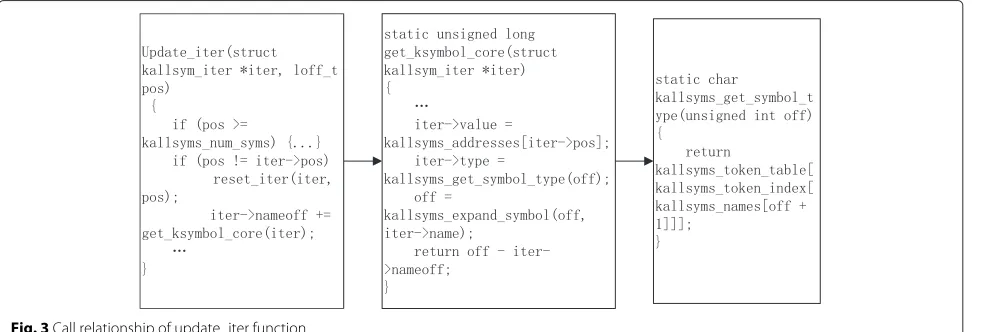
The call relationship of the update_iter function
is described in Fig. 3. In the update_iter
func-tion, the get_ksymbol_core function is called
using kallsyms_addresses. Next to the
instruc-tion “iter->value = kallsyms_addresses[iter->pos],” the kallsyms_get_symbol_type function is called
using kallsyms_token_table, kallsyms_token_index,
andkallsyms_names[off + 1].
Once the principle of theupdate_iterfunction is fully
understood, we can use the candidate value of
kall-syms_addressesobtained from step I to obtain the values of the other four symbols.
An image from the 3.6.10-4.fc18.i686.PAE system is used to illustrate the method. The value of the kall-syms_addresses symbol is found at offset 0xc4 for the update_iter function’s binary code in the image. Therefore, we step back three bytes and disassemble
the binary code. As mentioned above, our principle is to reduce the amount of disassembled code by as much as possible and improve the precision of our method. Approximately 0×2a bytes are chosen to be decompiled, and the results are as follows:
4aadc1: 8b 04 95 0c 8c 9e c0 mov 0xc09e8c0c
(%edx, 4), %eax
4aadc8: 8d 56 11 lea 0x11(%esi), %edx
4aadcb: C6 86 91 00 00 00 00 movb $0x0, 0x91 (%esi)
4aadd2: 89 46 08 mov %eax, 0x8(%esi)
4aadd5: 0f b6 83 b5 47 a2 c0 movzbl 0xc0a247b5
(%ebx), %eax 4aaddc: 0f b7 84 00 a0 95 ad c0 movzwl 0xc0ad95a0,
%eax
4aade4: 0f b6 80 10 92 ad c0 movzbl 0xc0ad9210
(%eax), %eax
Fig. 4Partial content of kallsyms_address
Fig. 5Partial content of kallsyms_names
Fig. 6Main members of module structure
Through a combined analysis of the disassembled output and the update_iter function’s source code, the values of kallsyms_names, kallsyms_token_index, and kallsyms_token_tablecan be obtained. In 32-bit systems, the value of kallsyms_num_syms is the value of kall-syms_namesminus 4.
There are some differences in 64-bit systems. Bits 0–31 of the symbol addresses are used, and the value of kallsyms_num_symsis the value ofkallsyms_namesminus 8. Although some changes take place in the binary code of theupdate_iterfunction for different Linux systems, the differences in the code segment used here are minimal.
4.3 Symbol table file recovery
After acquiring the kallsyms location symbols, the STFR method proceeds as follows:
The kallsyms_num_syms symbol points to the kernel symbol “num” in/proc/kallsyms. Thekallsyms_addresses symbol points to the addresses of all kernel symbols in order. Each symbol address has a length of 4 in 32-bit sys-tems and 8 in 64-bit syssys-tems. To obtain the correspond-ing name, thekallsyms_names,kallsyms_token_table, and kallsyms_token_index symbols are needed. The kall-syms_namessymbol points to a list of length-prefixed byte arrays that encode indexes into the token table. Accord-ing to the length, the bytes of each array are acquired and used to construct a substring. Finally, the substrings are joined together to form the type and name of the required symbol.
We again use an image from the 3.6.10-4.fc18.i686.PAE system to describe the above method.
The addresses of the required symbols are determined from the database:
c09e8c0c R kallsyms_addresses c0a247b0 R kallsyms_num_syms c0a247b4 R kallsyms_names c0ad9210 R kallsyms_token_table c0ad95a0 R kallsyms_token_index
First, translate the virtual address of the
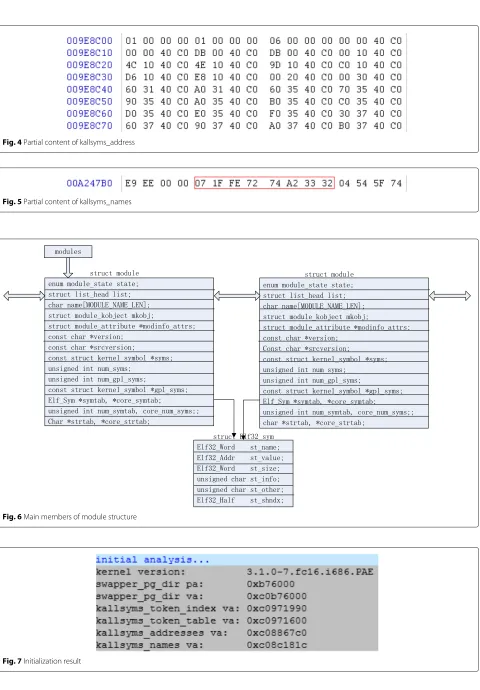
kall-syms_num_symssymbol to a physical address and obtain the num of kernel symbols in /proc/kallsyms. Likewise, convert the virtual address of the kallsyms_addresses address and read the addresses of all kernel symbols in order. The partial content of kallsyms_addresses is displayed in Fig. 4.
In the next step, the content pointed to by the kall-syms_names symbol is read and split into substrings according to its format. As shown in Fig. 5, the first byte of each substring is the length of the compression bytes. Each compression byte corresponds to several char-acters through conversion with thekallsyms_token_table andkallsyms_token_indexsymbols. Connecting all of the characters together, we obtain the type and name of the symbol. By dealing with the bytes marked in Fig. 5,
the type for the first symbol is determined to be T, which means that the symbol is in the text (code) section and the name of the first symbol isstartup_32. In combination with the result from the kallsyms_address symbol, the address of thestartup_32symbol is 0×c0400000.
To verify the correctness of the symbol values, the value of _stext obtained from the process described in this section is compared with that obtained in Section 4.1.2. If the two values are the same, the obtained symbols are available. If not, we recover the symbols using the algorithm described in Section 4.2.
4.4 Live system information extraction
After determining the kernel symbols, several key symbols are selected to obtain the live system information.
4.4.1 Gathering offsets of structure members
The structure layouts vary greatly depending upon the configuration parameters. For example, the layout of the module structure depends on the values of optional con-figuration parameters such as CONFIG_MODULE_SIG, CONFIG_SYSFS, and CONFIG_UNUSED_SYMBOLS. Thus, to properly analyze a Linux image, the offsets of important structure members must be identified. As shown in Fig. 6, the module structure plays a significant role in the extraction of module information.
Code fragments 1–3 show how equivalent statements can be compiled to form radically different instruc-tion sequences. The C source code in code fragment
1 is from the module_get_kallsym() function within
/kernel/module.c of the Linux kernel source base. This function was used to help find the offset of the num_symtab, symtab, and strtab members of the struct module.
CODE FRAGMENT #1 (C):
if (symnum<mod->num_symtab)
CODE FRAGMENT #2 (3.1.0-7.fc16.i686.PAE): 00 00 00 1E 8B 93 14 01 00 00 mov edx, dword ptr
[ebx+0x00000114]
00 00 00 24 39 D0 cmp eax, edx
CODE FRAGMENT #3 (3.6.10-4.fc18.i686.PAE): 00 00 00 38 8B 93 14 01 00 00 mov edx, dword ptr
[ebx+0x00000114]
00 00 00 3E 39 C2 cmp edx, eax
CODE FRAGMENT #4(C):
strlcpy(name, mod->strtab + mod->symtab[symnum]. st_name,
KSYM_NAME_LEN);
CODE FRAGMENT #5(2.6.32-504.el6.i686)
00 00 00 6C 8B 8B F0 00 00 00 mov ecx, dword ptr [ebx+0x000000F0] 00 00 00 72 8B 93 00 01 00 00 mov edx, dword ptr [ebx+0x00000100]
00 00 00 78 03 14 01 add edx, dword ptr
[ecx+eax] CODE FRAGMENT #6 (3.1.0-7.fc16.i686.PAE) 00 00 00 47 8B 8B 0C 01 00 00 mov ecx, dword ptr
[ebx+0x0000010C] 00 00 00 4D 8B 93 1C 01 00 00 mov edx, dword ptr
[ebx+0x0000011C]
00 00 00 53 03 14 01 add edx, dword ptr
[ecx+eax] CODE FRAGMENT #7 (3.6.10-4.fc18.i686.PAE) 00 00 00 84 8B 8E 10 01 00 00 mov ecx, dword ptr
[esi+0x00000110] 00 00 00 8A 8B 96 20 01 00 00 mov edx, dword ptr
[esi+0x00000120]
00 00 00 90 03 14 01 add edx, dword ptr
[ecx+eax] CODE FRAGMENT #8 (3.10.0-123.el7.x86_64) 00 00 00 C0 8B 93 78 01 00 00 mov edx, dword ptr
[ebx+0x00000178]
00 00 00 C6 8B 34 02 mov esi, dword ptr
[edx+eax]
00 00 00 C9 BA 80 00 00 00 mov edx, 00000080
00 00 00 CE 48 dec eax
00 00 00 CF 03 B3 90 01 00 00 add esi, dword ptr [ebx+00000190]
The module_get_kallsym function is exported as
a symbol to /proc/kallsyms, and its address can be
obtained from the process described in Section 4.3.
In this way, the state, name, module_core, and
source_list members of module structures can be
ana-lyzed based on the kdb_lsmod function defined in
/kernel/debug/kdb/kdb_main.c.
4.4.2 Process information extraction
Every process is represented by a structure named task_struct, which is defined in the /usr/src/linxu-2.4/include/linux/sched.h file. Theinit_task symbol cor-responds to thetask_structstructure address of the swap-per, where the PID is zero. Thetask_structstructures of all active processes are doubly linked to each other. By traversing the double-linked list, all of the running pro-cesses can be identified. Moreover, thetask_struct struc-ture includes some objects that correspond to information regarding the current state of a process, such as struct mm_struct *mm, struct fs_struct *fs, struct files_struct *files, andstruct thread_struct thread. Using these objects, we can obtain information on the memory management, file, and thread of the processes.
4.4.3 Module information extraction
Similar to the process information, all module structures are doubly linked to each other. By acquiring a mod-ule using themodule symbol, the other modules can be identified from this doubly linked list.
To link a module, thesys_init_module()service initial-izes the syms and gpl_syms fields of the module object so that they point to the in-memory tables of symbols
exported by the module. Some special kernel symbol tables are used by the kernel to store the symbols that can be accessed by modules with their corresponding addresses. These are contained in three sections of the kernel code segment: the _kstrtab section includes the names of the symbols, the_ksymtabsection includes the addresses of the symbols, and the _ksymtab_gplsection includes the addresses of the symbols that can be used by the modules released under a GPL-compatible license. Only the kernel symbols actually used by some existing modules are included in the table. Linked modules can also export their own symbols so that other modules can access them. Although these symbols are critical during an investigation, they have largely been neglected in previous research. For instance, thevm_listsymbol exported by the kvm module can be used to analyze the virtual machine information running on the current physical machine.
To obtain the exported symbols from the mem-ory image, some objects of the module structure can
be used, such as const struct kernel_symbol *syms,
const struct kernel_symbol *gpl_syms, Elf_Sym *symtab, and Char *strtab. Among these objects, the symtab object is particularly important because it assists in the recovery of the symbol and string tables for kallsyms.
As for other system information, the rt_hash_mask, rt_hash_table, and net_namespace_list symbols are used to obtain information about the network
con-figuration and current network connections; the
boot_cpu_data symbol is used to obtain CPU informa-tion; thelog_buf symbol corresponds to system log and
debug information; and the iomem_resource symbol
reflects the available physical address space of the target computer.
5 Evaluation
Based on the techniques described above, we developed a Linux memory analysis system named RAMAnalyzer. In this section, we present our experimental results. An experiment to test the effectiveness of RAMAnalyzer with 26 Linux kernels (from 2.6.18 to 4.2.0) is described in Section 5.1, and the performance of the proposed tool is reported in Section 5.2. All of our experiments were performed on a host machine with an Intel Core i5-4210U CPU, 4-GB memory, and a 64-bit Windows 7 OS.
5.1 Effectiveness
The following memory images were chosen: DFRWS 2008 forensics challenge, volatility memory samples, and mem-ory snapshots from virtual machines running on the VMware Workstation. The test flow and execution results of RAMAnalyzer are described below.
Taking a memory image from the 3.1.0-7.fc16.i686.PAE system as an example, the first step was to identify the kernel version by searching for linux_banner
con-tent and vmcoreinfo_data content. The database was
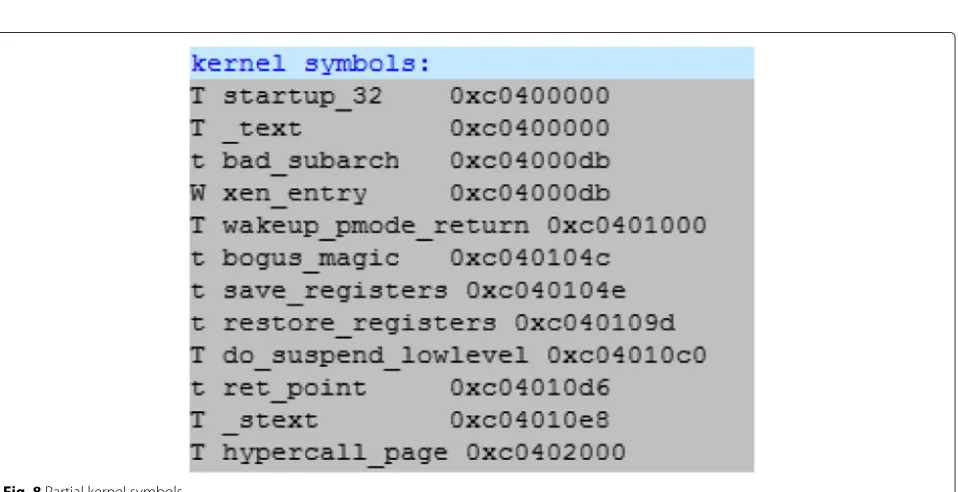
then checked to identify any prior knowledge of this kernel version. If the database returned no results, the kallsyms location symbol values were restored by disassembling the dynamically loaded code of the update_iter function in the memory image. The initial-ization result, including kernel version information and kallsyms location symbol values, is displayed in Fig. 7.
Using the kallsyms location symbol values, the kernel symbols were extracted. The partial result is shown in Fig. 8.
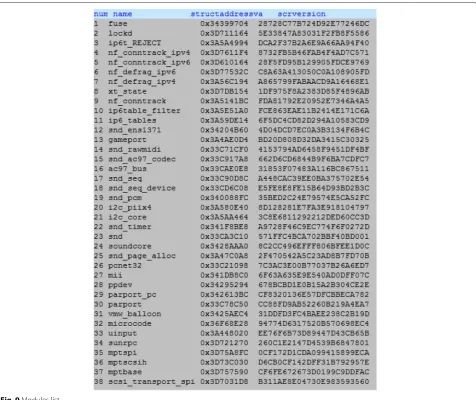
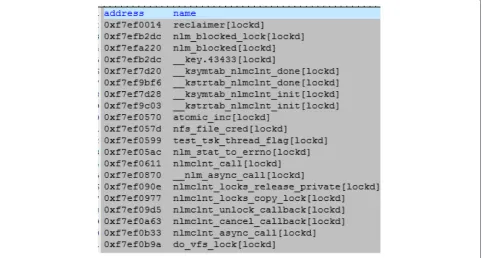
Several symbols were selected to extract live system information from the memory image, including process information, module information, network connection information, and system log information. The loaded ker-nel modules information extracted from a memory image of the 3.1.0-7.fc16.i686.PAE system are listed in Fig. 9, and the symbols exported from the lockd module are listed in Fig. 10.
5.2 Performance evaluation
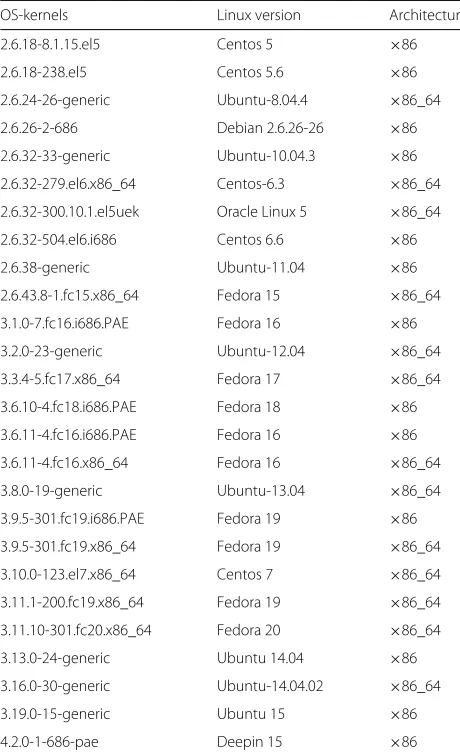
To ensure that large changes in the kernel algorithms do not affect the validity of our approach, memory images from various kernel versions were used to test the perfor-mance of RAMAnalyzer. Some of the kernels used in the experiment are listed in Table 1.
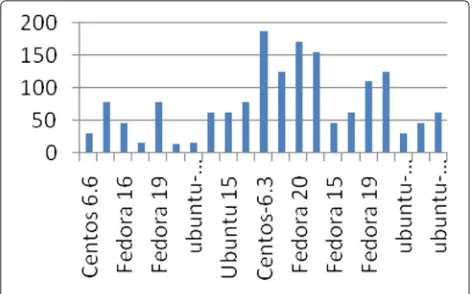
We measured the execution speed of RAMAnalyzer when only a memory image was provided. As illustrated in Fig. 1, the key steps of our approach are kernel ver-sion identification and symbol table file recovery, and these are our evaluation targets. From Figs. 11 and 12, we can see that 15–78 ms were required for kernel ver-sion identification, and 347-15,693 ms were needed for the recovery of kallsyms location symbol values and kernel symbols.
After obtaining the kernel symbols, themodulessymbol was used to find the loaded kernel modules and exported
Table 1Sample of kernel versions used for testing RAMAnalyzer
OS-kernels Linux version Architecture
2.6.18-8.1.15.el5 Centos 5 ×86
2.6.18-238.el5 Centos 5.6 ×86
2.6.24-26-generic Ubuntu-8.04.4 ×86_64
2.6.26-2-686 Debian 2.6.26-26 ×86
2.6.32-33-generic Ubuntu-10.04.3 ×86
2.6.32-279.el6.x86_64 Centos-6.3 ×86_64
2.6.32-300.10.1.el5uek Oracle Linux 5 ×86_64
2.6.32-504.el6.i686 Centos 6.6 ×86
2.6.38-generic Ubuntu-11.04 ×86
2.6.43.8-1.fc15.x86_64 Fedora 15 ×86_64
3.1.0-7.fc16.i686.PAE Fedora 16 ×86
3.2.0-23-generic Ubuntu-12.04 ×86_64
3.3.4-5.fc17.x86_64 Fedora 17 ×86_64
3.6.10-4.fc18.i686.PAE Fedora 18 ×86
3.6.11-4.fc16.i686.PAE Fedora 16 ×86
3.6.11-4.fc16.x86_64 Fedora 16 ×86_64
3.8.0-19-generic Ubuntu-13.04 ×86_64
3.9.5-301.fc19.i686.PAE Fedora 19 ×86
3.9.5-301.fc19.x86_64 Fedora 19 ×86_64
3.10.0-123.el7.x86_64 Centos 7 ×86_64
3.11.1-200.fc19.x86_64 Fedora 19 ×86_64
3.11.10-301.fc20.x86_64 Fedora 20 ×86_64
3.13.0-24-generic Ubuntu 14.04 ×86
3.16.0-30-generic Ubuntu-14.04.02 ×86_64
3.19.0-15-generic Ubuntu 15 ×86
4.2.0-1-686-pae Deepin 15 ×86
symbols. The time required for this process is shown in Fig. 13.
The experimental results prove that RAMAnalyzer can deal with memory images from a wide range of ker-nel versions and demonstrate that its execution time is acceptable.
6 Conclusions
Based on kernel code reconstruction, this paper has pro-posed an adaptive approach for Linux memory analysis that can address a Linux memory image without infor-mation about the kernel version or System.map file. We implemented a prototype named RAMAnalyzer that is made up of five main components: kernel version iden-tification, symbol table file recovery, kallsyms location symbol value recovery, live system information extraction, and database information extension. Our experimental results with a number of Linux memory images show that
Fig. 11KVI execution time
RAMAnalyzer can automatically identify the kernel ver-sion and recovery kernel symbols. Based on the kernel symbols, RAMAnalyzer then extracts live system infor-mation about the target system at the time of memory acquisition.
The primary advantages of RAMAnalyzer are:
• The ability to deal with memory images without precise kernel version information and symbol information.
• The ability to identify the precise kernel version and recovery kernel symbols automatically, which means it can deal with memory images from different kernel versions. Furthermore, kernel symbol information obtained in this way is more accurate because symbol information from identical kernel versions can vary under different configuration options.
• As well as kernel symbol information, RAMAnalyzer can acquire the symbols exported from modules, which play an important role in the investigation procedure.
• Based on the above techniques, RAMAnalyzer has adaptability to deal with mainstream Linux kernel memory images and has high execution efficiency.
Fig. 13Modules symbol recovery execution time
From the advantages of RAMAnalyzer, we can see that our solution can provide a solution for the challenge described in Section 1 and meet the need of scenar-ios described in Section 2.1. With the advent of mobile cloud computing, the development of Linux is acceler-ating and its security is becoming increasingly crucial. The techniques proposed in this paper provide foren-sics researchers with a starting point to delve into Linux memory forensics, which plays an important role in secu-rity and forensics investigations. Furthermore, these tech-niques can be conveniently embedded into other forensics frameworks.
To enhance the performance of RAMAnalyzer, the fol-lowing research will be undertaken: first, owing to the differences in the kallsyms configurations of Linux ker-nel versions, there are various initial/proc/kallsyms. To improve the processing speed, it is essential to scan the kalsyms_addresscandidate values. Second, to improve the adaptive capacity of cloud environments, RAMAnalyzer was verified to be effective using memory images from the KVM host machine. However, further experiments are required to verify its efficacy on memory images from Xen host machines.
Competing interests
The authors declare that they have no competing interests.
Authors’ contributions
SH and XX carried out the main research of this work. LH performed the experiments. SH and LH conceived of the study, participated in its design and coordination, and helped to draft the manuscript. All authors read and approved the final manuscript.
Acknowledgements
This research is supported by the National Natural Science Foundation of China (61472225), Shandong Natural Science Foundation (ZR2014FM003), and Shandong Province Outstanding Young Scientists Research Award Fund Project(BS2014DX007).
Received: 6 January 2016 Accepted: 14 June 2016
References
1. DFRWS 2005 Forensics Challenge. http://www.dfrws.org/conferences/ dfrws-usa-2005
2. L Wang, L Xu, S Zhang, Network connections information extraction of 64-bit windows 7 memory images. Forensics in Telecommunications, Information, and Multimedia.56, 90–98 (2010)
3. DFRWS 2005 Forensics Challenge: Memparser. http://sourceforge.net/ projects/memparser
4. A Schuster, Searching for processes and threads in microsoft windows memory dumps. Digit. Investig.3, 10–16 (2006)
5. R Zhang, L Wang, S Zhang, Windows memory analysis based on kpcr. Fifth International Conference On Information Assurance and Security.2, 677–680 (2009)
6. JD Kornblum, Using every part of the buffalo in windows memory analysis. Digit Investig.4(1), 24–29 (2007)
7. A Schuster, The impact of microsoft windows pool allocation strategies on memory forensics. Digit. Investig.5, 58–64 (2008)
8. S Zhang, L Wang, R Zhang, Q Guo, Exploratory study on memory analysis of windows 7 operating system. 3rd International Conference On Advanced Computer Theory and Engineering (ICACTE).6, 373–377 (2010) 9. B Dolan-Gavitt, Forensic analysis of the windows registry in memory.
Digit. Investig.5, 26–32 (2008)
10. R Van Baar, W Alink, A Van Ballegooij, Forensic memory analysis: Files mapped in memory. Digit. Investig.5, 52–57 (2008)
11. S Hejazi, C Talhi, M Debbabi, Extraction of forensically sensitive information from windows physical memory. Digit. Investig.6, 121–131 (2009) 12. Q Zhao, T Cao, Collecting sensitive information from windows physical
memory. J. Comput.4(1), 3–10 (2009)
13. M Sikorski, A Honig,Practical Malware Analysis: the Hands-on Guide to Dissecting Malicious Software. (no starch press, Scn Francisco, 2012), pp. 145–157
14. A Ligh, MH Case, J Levy, A Walters,The Art of Memory Forensics: Detecting Malware and Threats in Windows, Linux, and Mac Memory. (John Wiley & Sons, 2014), pp. 611–635
15. Volatility: Linux Memory Forensics. https://code.google.com/archive/p/ volatility/wikis/LinuxMemoryForensics.wiki
16. Rekall Memory Forensic Framework. http://www.rekall-forensic.com/ 17. MI Cohen, Characterization of the windows kernel version variability for
accurate memory analysis. Digit. Investig.12, 38–49 (2015)
18. A Petroni, NL Walters, T Fraser, WA Arbaugh, Fatkit: A framework for the extraction and analysis of digital forensic data from volatile system memory. Digit. Investig.3(4), 197–210 (2006)
19. SecondLook Linux Memory Dump Samples. https://www.forcepoint.com/ 20. A Case, L Marziale, GG Richard, Dynamic recreation of kernel data
structures for live forensics. Digit. Investig.7, 32–40 (2010)
21. T Haruyama, H Suzuki. https://media.blackhat.com/bh-eu-12/Haruyama/ bh-eu-12-Haruyama-Memory_Forensic-Slides.pdf
Submit your manuscript to a
journal and benefi t from:
7Convenient online submission
7Rigorous peer review
7Immediate publication on acceptance
7Open access: articles freely available online
7High visibility within the fi eld
7Retaining the copyright to your article