184 | P a g e
DYNAMIC ANALYSIS OF RC ELEVATED WATER
TANK FRAME STAGING SUPPORTED
Mor Vyankatesh K ¹, More Varsha T. ²
¹M.E Student , Structural Engineering,
Department of Civil Engineering, J.N.E.C, Aurangabad, (India)
²Assistant Professor , Department of Civil Engineering, J.N.E.C, Aurangabad, (India)
ABSTRACT
This paper presents dynamic analysis of elevated water tanks supported on RC framed structure with different
tank storage capacities. Effects of hydrodynamic forces on tank walls are calculated. History of earthquake
reveals that it have caused numerous losses to the life of people in its active time, and also post earthquake time
have let people suffer due to damages caused to the public utility services. Either in urban or rural areas
elevated water tanks forms integral part of water supply scheme, so its functionality pre and post earthquake
remains equally important. These structures have heavy mass concentrated at the top of slender supporting
structure hence these structures are especially vulnerable to horizontal forces due to earthquakes. Objective
paper is to understand the dynamic behavior of elevated water tanks under earthquake loading using latest
Indian code IS 1893(part 2):2014. Parameters from seismic analysis of elevated water tanks and their
comparison within different capacities including sloshing effects are calculated, lateral stiffness of frame
staging is calculated using latest STAAD Pro V8i SS6 software. Results state that there is more threat of
destruction to the tanks with higher capacities as compared to the tanks with lower capacities in a given zone.
Keywords : Convective Hydrodynamic Pressure, Elevated Water Tank, Impulsive Hydrodynamic
Pressure, Sloshing Wave Height, STAAD Pro V8i.
I INTRODUCTION
1.1 General
Indian sub-continent is highly vulnerable to natural disasters like earthquake, draughts, floods, cyclones etc.
According to IS code 1893 (Part 1):2000, more than 60% of India is prone to earthquakes. The earthquake of 26
January 2010 in Gujarat was unprecedented for the entire country, then public learnt first time that the scale of
disaster could have been far lower had the construction in the region compiled with codes of practice for
earthquake prone regions. These natural calamities are causing many casualties and innumerable property loss
every year. After an earthquake the loss which cannot be recovered are the life loss. Collapse of structures
causes people to life loss. Hence badly constructed structures kill people more than earthquake itself. Hence it
185 | P a g e
Seismic safety of liquid storage tanks is of considerable importance, as tanks storing highly concentrated liquidsin industries, or in transporting vehicles, ships can cause considerable harm for human society if damaged.
Water supply being the lifeline facility must remain functional following disaster to carter the need of drinking
and fire fighting. These structures have large mass concentrated at the top of slender supporting structure hence
these structure are especially vulnerable to horizontal forces due to earthquake as they act as the inverted
pendulum like structure.
Keeping these problems in consideration ‘Bureau of Indian Standards’ have published code especially for liquid retaining structures, ‘Criteria for earthquake resistant design of structures’ IS 1893(Part 2) : 2014 based on the
guidelines and suggestions by IITK-GSDMA for seismic design of liquid storage tanks. This paper evaluates all
the seismic analysis parameters using the recommended procedure in latest code as well as in IIT-GSDMA
guidelines, and is concentrated mainly to the Sloshing effect that is happening in the water during earthquake.
Sloshing is defined as the periodic motion of the free liquid surface in partially filled container. It is caused by
any disturbance to partially filled containers. If the liquid is allowed to slosh freely, it can produce additional
hydrodynamic pressure in case of storage tanks. Hence considerations of these forces are necessary, during
analysis.
1.2 Literature Review
A Much of literature has been presented in the form of technical papers till date on dynamic analysis of elevated
water tanks RC framed supported and concrete shaft supported. Different points are covered in that relevance
i.e. dynamic analysis, sloshing effect on tank, dynamic response of framed staging etc. Some of them are listed
below.
George W. Housner [1]: Chilean earthquake that took place in 1960 was the main plot behind this paper. He
stated about the relation between motion of water w.r.t tank and whole structure w.r.t ground. Fully filled tank,
empty tank, partially filled tank, were the three cases considered by him. Sloshing effect was neglected in first
two cases as there is no free board in first case and other no water to cause sloshing motion. Here the whole
structure behaves as one-mass structure. But in the third case sloshing effect must be considered, because here
the structure behaves as two-mass structure. Concluding he stated that the maximum force to which a half-filled
tank can be subjected is less than that of totally filled tank.
Dr. Suchita Hirde & Manoj Hedaoo [2]: Hydrodynamic analysis of elevated water tanks for various heights,
capacity and soil conditions. The effect of height of water tank, earthquake zones and soil conditions on
earthquake forces have been presented in this paper. They considered RCC circular tank with M-20 grade of
concrete and Fe-415 grade of steel for analysis. Capacity of 50,000 lit and 100.000 with staging height of 12m,
16m, 20m, 28m with 4m height of panel are considered for analysis. Following were the conclusions made in
the paper (1) Seismic forces are directly proportional to the seismic zones. (2) Seismic forces are inversely
proportional to the height of the supporting system. (3) Seismic forces increase with increase in capacity of tank.
(4) Seismic forces are higher in soft soil than that of medium and higher in medium soil than that of hard.
R Livaoglu & Dogangun [3]: This paper presents the response of the supporting system of water towers. Here
186 | P a g e
this paper they concluded that where there is high risk of seismic force, the cylindrical shaft support system maybe used because of having important advantages than the common used frame type system. They also found that
roof displacement response for frame support is higher than that of concrete shaft support system.
Sudhir K Jain, O.R. Jaiswal [4]: Recognizing the limitations and shot comings in the provision of IS code
1893-1984, this paper recommends the changes, (1) Different spring-mass model for tanks with rigid & flexible wall
are done away with instead, a single spring-mass model for both types of tank is proposed. (2) Simple
expression for sloshing height is given (3) Design horizontal seismic coefficient given in revised IS: 1893
(Part-I)-2002 is used and values of response reduction factor for different types of tanks are proposed.
1.3 Objective
[1] The main objective of this paper is to study the hydrodynamic effect on elevated water tank, with h/d ratio of
the tank constant for different capacities. Here ‘h’ is the maximum height of water in tank and ‘D’ is the internal
diameter of tank.
[2] Also to compare the analysis results of base shear and base moment with different capacities. Comparing
impulsive and convective pressure results as they may exert pressure in different magnitude.
II SYSTEM DEVELOPMENT
2.1 Impulsive and Convective mass
During an earthquake, elevated water tank with free liquid surface is subjected to horizontal ground motion, and
liquid in tank as well as tank wall are subjected to horizontal acceleration. Here the liquid in the lower region of
the tank behaves like a mass that is rigidly connected to tank wall. This mass is stated as impulsive liquid mass
(mi), which accelerates along with the wall and induces impulsive hydrodynamic pressure on tank wall as well
as base. Liquid mass in the upper region on the tank undergoes sloshing motion. This mass is stated as
convective liquid mass (mc) and it exerts convective hydrodynamic pressure on tank wall and base. Thus the
total liquid mass gets divided into two parts i.e. impulsive mass and convective mass. These mass are suitably
represented in spring mass model.
A qualitative description of impulsive and convective hydrodynamic pressure distribution on tank wall is given
in Figure 1
Fig.1a) Impulsive pressure on wall Fig.1b) Impulsive pressure on wall and base
Resultant of impulsive pressure on wall
187 | P a g e
Fig.1c) Convective pressure on wall Fig.1d) Convective pressure on wall and base
2.2 Spring mass model for seismic analysis of elevated tank
Most of the elevated tanks are partially filled. Hence two-mass idealization of the tank is more appropriate than
one-mass model. It is also being commonly used in international codes.
The response of two-degree of freedom system can be obtained by elementary structural dynamics. However,
two periods are well separated for most of the tanks. Hence, system can be considered as two uncoupled single
degree of freedom system. This two uncoupled single degree of freedom systems, one representing impulsive
plus structural mass behaving as an inverted pendulum with lateral stiffness equal to the stiffness of staging, (ks)
and the other convective mass with spring of stiffness, (kc).
Fig.2a) Two-mass idealization of elevated tank Fig.2b) Equivalent uncoupled system
2.3 Lateral stiffness of staging
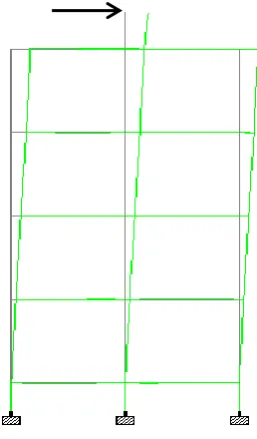
Lateral stiffness of staging is defined as the force required to be applied at the CG of tank so as to get a
corresponding unit deflection. From the deflection of CG of tank due to an arbitrary lateral force one can get
stiffness of staging. STAAD pro software is used to model the staging. Resultant of convective
pressure on wall
188 | P a g e
Fig.3 Deflected shape of tank staging for an arbitary.2.4 Numerical problem considered
Dynamic analysis of Circular elevated water tanks, supported on RC frame staging of different capacities and
following specifications are performed with respect to the procedure recommended in IS 1893 (Part 2): 2014 for
zone II.As the capacity increases the number of columns supporting are increased. A 1.2m wide gallery is
considered around the periphery of all tanks for access. Grade of concrete, grade of steel and soil condition for
circular elevated tanks are M-20, Fe415 and medium soil respectively. All tanks are provided a free board of
500mm.
Here, H = Lowest supply level from ground, D= Internal diameter of tank, h= Height of water in tank from
bottom of wall, N= Number of columns, where as, the ratio of H/D and h/D is kept constant for all capacities of
tank.
Table 1: Geometrical Specifications.
Tank
Capacity
H
D
h
H/D
h/d
N
(m
3)
(m)
(m)
(m)
-
-
(no’s)
T1
150
12
8
3
1.5
(±0.05)
0.36
(±0.01)
5
T2
250
14
9.5
3.5
9
T3
500
18
12
4.5
13
189 | P a g e
Table 2: Constants.
Sr No.
Constant
Values
1
Seismic intensity (Zone II)
0.1 (as per IS code 1893 Part 2)
2
Importance factor (I)
1.5
3
Response reduction factor (R)
4 (as per IS code 1893 Part 2)
Table 3: Components Sizes.
Sr No.
Component
Sizes (mm)
1
Roof slab
150
2
Cylindrical wall
200
3
Base slab
200
4
Roof beams
230 x 450
5
Floor beams
300 x 600
6
Braces
300 x 450
7
Gallery
110
8
Columns
500
III RESULT AND DISCUSSION
For all the above stated Circular elevated tanks, RC frame staging system was modeled in STAAD Pro and
arbitrary load was applied at the center of gravity of the tank. Following are the values of deflections and
stiffness calculated.
Table 4: Deflection and stiffness
Tank
Deflection (mm)
Stiffness (Kn/m)
T1
9.46
10570.82
T2
8.226
12156.58
T3
5.8
17241.38
190 | P a g e
3.1 Time period
Time period in impulsive mode (Ti) and time period in convective mode of vibration (Tc) is calculated and
compared with capacities of tank. Since the tank is analyzed for both tank full and tank empty condition the
values of time period in tank empty condition is also stated below.
Fig.4 Capacity v/s Time period
Fig.5 Capacity v/s Time period (empty condition)
3.2 Base shear
Total base shear (V), the horizontal force which acts at the bottom at the staging is resultant of two different
case base shears, one for impulsive mode (Vi) and for convective mode (Vc). It represents the increase in base
shear with increase in capacity of tank. Base shear in tank empty case is mostly less than that of tank full
191 | P a g e
Fig.6 Capacity v/s Base shear
3.3 Base Moment:
Since the large mass accumulation at the top of slender supporting system, the overturning moment is the
important parameter at the time of designing elevated water tank.
Fig.7 Capacity v/s Base moment.
3.4 Hydrodynamic force
Maximum hydrodynamic force per unit circumferential length for impulsive (qi) and convective mode (qc) is
given below. This force in actual is non-linearly distributed on tank wall. For uniform distribution, equivalent
pressure distribution can be considered. Further these forces will be actually applied in software for designing
192 | P a g e
Fig.8 Diameter v/s Impulsive force
Fig.9 Diameter v/s Convective force
3.5 Sloshing Wave Height:
Free Board to be provided in tank based on the maximum value of sloshing wave height. This is particularly for
the important tanks containing toxic liquids, where loss of liquid needs to be prevented. Or if required free board
193 | P a g e
Fig.10 Capacity v/s Sloshing wave Height
IV CONCLUSION
Following conclusions are made based on the aforementioned analysis presented in this paper.
1) Time period in convective mode is greater than that of impulsive mode and both the time periods increases
with increase of capacity/ structural mass of the tank.
2) The horizontal force which is acting at the staging of the structure increases with increase in capacity of
tank.
3) The deflection of staging is found to be decreasing with increase of capacity and change in staging pattern,
further causing increase in its stiffness.
4) The risk of overturning moment is more at the tanks with higher capacity and the same must be accounted
well while designing the structure.
5) Sloshing wave height result represents that, it’s necessary to provide free board for partially filled tanks or
else the roof of tanks should be designed to resist the uplift pressure of liquid.
These results can be accounted as reference for the detailed study of dynamic analysis of elevated tanks in
different zone and also to compare the different supporting systems for the same capacity of tanks.
REFERENCES
[1] George W. Housner, 1963 “The Dynamic Behaviour of Water Tank” Bulletin of the Seismological Society of America. Vol.53, No.2, pp. 381-387. February 1963.
[2] Dr Suchita Hirde, Dr Manoj Hedaoo, “Seismic Performance of Elevated Water Tank”, International Journal of Advanced Engineering Research and Studies/ Vol.I/2011.
[3] Mangulkar Madhuri N, Gaikwad Madhukar V, Review On Seismic Analysis of Elevated Water Tank. International Journal of Civil Engineering and Technology (IJCIET), Volume 4, Issue 2, March-April 2013
194 | P a g e
[5] Sudhir K Jain and M. S. Mdhekar, October-1993, “Proposed provisions for aseismic design of liquid storagetanks” Journals of Structural Engineering Vol-20, No-03.
[6] Sudhir K Jain, O.R. Jaiswal, Spetember-2005, Journal of Structural Engineering, Vol-32, No03.
[7] Bureau of Indian Standards “Criteria For Earthquake Resistant Design Of Structures” IS Code 1893 (Part2):2014, August 2014