Young Children in Foster Care
WHAT’S KNOWN ON THIS SUBJECT: Children in foster care are at risk for having developmental delays. The AAP recommends developmental surveillance and screening in pediatric practice. Clinicians have the opportunity to identify potential developmental delay and to advocate receipt of services.
WHAT THIS STUDY ADDS: Even in a pediatric medical home that provides specific attention to developmental problems, systematic use of a validated screening instrument doubled the detection rate for developmental problems.
abstract
OBJECTIVE:Our goal was to determine if systematic use of a validated developmental screening instrument is feasible and improves the de-tection of developmental delay (DD) in a pediatric medical home for children in foster care.
DESIGN AND METHODS:This study had a pre-post study design, follow-ing a practice intervention to screen all children in foster care for DD by using the Ages and Stages Questionnaire (ASQ). The baseline detec-tion rate was determined by medical chart review for all children aged 4 to 61 months who were new to foster care (NFC) during a 2-year period. After implementation of systematic screening, caregivers of young children who were NFC or already in foster care (IFC) completed the ASQ at preventive health care visits. We assessed the feasibility of systematic screening (the percentage of ASQs completed among the NFC and IFC groups). We compared the detection of DD among the baseline NFC group and the screening-NFC group by using bivariate and multivariable logistic regression.
RESULTS:Of 261 visits that occurred after initiation of screening, 251 (96%) visits had a completed ASQ form in the medical chart, demon-strating high feasibility. Among children who were NFC, the detection of DD was higher in the screening than baseline period for the entire population (58% vs 29%;P⬍.001), for each age group (infants: 37% vs 14%; toddlers: 89% vs 42%; preschool: 82% vs 44%; allPⱕ.01), and for all developmental domains. On adjusted analyses, the detection of po-tential DD in toddler and preschool children was higher among the NFC screening group than the NFC baseline group.
CONCLUSION:Systematic screening for DD using the ASQ was feasible and seemed to double the detection of DDs.Pediatrics2010;125:282– 289
AUTHORS:Sandra H. Jee, MD, MPH,a,bMoira Szilagyi, MD, PhD,a,bClaire Ovenshire, RN,bAmy Norton, MA,a
Anne-Marie Conn, MA,aAaron Blumkin, MS,aand Peter G. Szilagyi, MD, MPHa
aDivision of General Pediatrics, Department of Pediatrics, and
Strong Children’s Research Center, University of Rochester Medical Center, Rochester, New York; andbStarlight Pediatrics,
Rochester, New York
KEY WORDS
developmental delays, children, foster care
ABBREVIATIONS
AAP—American Academy of Pediatrics DD— developmental delay
NFC—new to foster care IFC—already in foster care ASQ—Ages and Stages Questionnaire WCC—well-child check
This work was presented at the Presidential Plenary, Pediatric Academic Societies’ meeting; May 4, 2008; Honolulu, Hawaii
www.pediatrics.org/cgi/doi/10.1542/peds.2009-0229
doi:10.1542/peds.2009-0229
Accepted for publication Aug 21, 2009
Address correspondence to Sandra H. Jee, MD, MPH, 601 Elmwood Ave, Box 777, Rochester, NY 14642. E-mail: sandra㛭[email protected]
PEDIATRICS (ISSN Numbers: Print, 0031-4005; Online, 1098-4275).
Copyright © 2010 by the American Academy of Pediatrics
Although routine developmental sur-veillance and periodic developmental screening of all young children is rec-ommended by the American Academy of Pediatrics (AAP),1,2most providers are not yet screening children system-atically3–5and it is unclear how to effi-ciently implement this recommenda-tion in a busy pediatric practice.6–8In addition, evidence is lacking about whether standardized screening im-proves detection of developmental de-lay (DD), especially in subpopulations of at-risk children9–13such as children in foster care, which is a population with many risk factors and docu-mented poor outcomes.14,15
Reports of the prevalence of DD among children in foster care vary widely from⬍5% to⬎80%, depending on the sample studied and screening or diag-nostic methods used.16–22 Traumatic experiences before foster care, includ-ing child abuse and neglect, exposure to domestic violence, and impaired parenting, place children in foster care at high risk for developmental problems. Despite the reported high prevalence of DD, few children in fos-ter care are screened and many chil-dren with delays remain undetected.23 Reasons for this low rate of detection include the following: changes in care-givers; lack of developmental histo-ries; and the difficulty of distinguishing immediate emotional trauma from persistent delay.
The AAP promotes the pediatric medi-cal home as a model for the compre-hensive care of children with special health care needs, including children in foster care.24–28 In Rochester, NY, children in family based foster care re-ceive their primary care at such a med-ical home, Starlight Pediatrics, which afforded the opportunity to assess the 3 study objectives: (1) evaluate the fea-sibility of using an age-specific, parent-completed screening instrument to systematically assess the
developmen-tal health of young children at routine well-child visits; (2) study the impact of systematic developmental screening on the detection of DD among children in foster care; and (3) compare the prevalence of DD among children who were new to foster care (NFC) with children who were already in the fos-ter care (IFC) system.
METHODS
Setting
Starlight Pediatrics is a general pedi-atric practice located in the county health department, which for 20 years has served all children in family based foster care in Monroe County, NY (700 children, 3400 visits per year). The staff includes health providers: 3 part-time pediatricians and 4 pediatric nurse practitioners (total of 2.3 full-time equivalents); 4 full-full-time pediatric nurses; and a part-time social worker. In this article, “providers” refers to pe-diatricians and pediatric nurse practi-tioners in our office.
Developmental Screening Instrument
The Ages and Stages Questionnaires (ASQ), Second Edition, are a set of 19 validated developmental question-naires designed for completion by caregivers of children aged 4 months to 5 years of age.29The ASQ is a brief, nondiagnostic screening tool that has been validated in other settings.30–32 Each age-specific questionnaire con-tains 30 questions covering 5 domains: communication; gross motor; fine mo-tor; problem-solving; and personal-social. We selected the ASQ over 2 other brief screening instruments that were shorter,33,34 because of the high sensitivity of ASQ and its focus on task-oriented behaviors.
Standardized Screening
In January 2007, Starlight Pediatrics changed its standard of care so that
foster parents were asked to complete an ASQ before each well-child visit for children aged 4 months to 5 years. ASQ forms were mailed the week before the child’s appointment, and caregiv-ers were reminded to bring in the form when our office secretary called the day before the scheduled appointment to confirm their appointment. Forms that were not brought into the appoint-ment were offered at the visit, or were requested to be returned by mail if there was limited time. Questionnaires were available in English and Spanish, with the majority of caregivers com-pleting the English version. Age adjust-ments were made for prematurity per ASQ protocol. We documented the rela-tionship to the child of the person fill-ing out the questionnaire and reasons for incomplete ASQs. Providers scored and reviewed ASQ results during visits.
Previously, there were no standard-ized forms completed at routine visits and providers would note any con-cerns regarding development on the well-child form. To prepare for imple-mentation of standardized screening, all providers were given verbal in-structions, a demonstration about us-ing and scorus-ing the ASQ, and guide-lines for referral. To facilitate this standard of care, we had monthly clin-ical meetings for the first 6 months of implementation to obtain feedback re-garding use of the ASQ.
Study Design and Study Population
and August 30, 2008, after implementa-tion of screening (screening cohort). The study design for objective 3 (prevalence of DD among children who were NFC ver-sus children who were IFC) involved a cross-sectional comparison of the 2 groups during the screening period.
In our study population, children were considered NFC if they were in care for ⬍3 months before the health care visit. Children were considered IFC if they had been in foster care for at least 3 months; the exception was for new-born infants who entered foster care but were too young to complete the ASQ until 4 months of age. We decided a priori to make this distinction on the basis of AAP foster care guidelines35 and clinical experience; we follow AAP foster care guidelines on performing a comprehensive physical examination, which is done at least within 3 months of entry into foster care. For this study, all children needed to have at least 1 well-child care visit during the appro-priate study period to be included. Chil-dren were excluded from the study only if they had a major handicapping condition. Identification of DD was de-termined on the basis of the first well-child check (WCC) the well-child had on en-try into care, so that the baseline group and NFC screening groups were both assessed at the same point in time on entry into care.
Measurements
During the baseline and screening peri-ods, the practice used age-specific and foster care-specific standard forms for well-child visits scheduled at AAP recom-mended intervals, with additional visits at 21, 42, and 54 months, per national foster care guidelines.35Developmental concerns were routinely recorded on WCC forms at the time of the visit.
We conducted a medical chart review and collected demographic and
devel-horts and from ASQ forms for the screening cohort. The primary out-come variable was the detection of po-tential DD as documented in the medi-cal chart. For the baseline cohort, this measure was defined as any written documentation of DD on the well-child form, problem list, or developmental section of the medical chart. For the screening cohort, a potential DD was defined as having an ASQ score below the cutoff on domain-specific norms in 1 of the 5 developmental domains36 and/or clinician assessment of delay as documented in the medical chart. Because we were using a screening rather than a diagnostic process, con-firmed DD was not an outcome. For this article, we refer to detection of a po-tential DD as simply DD.
Independent variables included
de-mographic information such as
race/ethnicity, gender, age (infant⫽ 4 –12 months of age, toddler ⫽ 13–36 months of age, and pre-schooler ⫽ 37– 61 months of age), and previous referrals for DD. On the basis of the AAP recommendations for developmental screening at the 9-month, 18-month, and 30-month visit, we stratified the sample to cor-respond roughly to 3 clinically mean-ingful age groups.2
Reliability
Two coders were selected and trained to conduct the chart reviews. Data were limited to information documented in the medical chart and ASQ. Research personnel familiar with the medical chart extracted the data. To evaluate in-terrater reliability, 10% of the charts were coded by both coders. All measures reported in this article had a minimum percentage agreement of 80%. All data were independently double-entered and verified for consistency.
measured frequency of completion of ASQs among the NFC and IFC screening cohort. To assess objective 2 (impact of standardized screening), we com-pared the detection of children with DD in the baseline NFC versus the screen-ing NFC cohort. We used multivariable logistic regression to examine associ-ations between children who did and did not have a DD, adjusting for age, race/ethnicity, and gender differences between baseline and screening co-horts. We conducted Pearson’s2and Fisher’s exact tests for comparing de-tection and referrals. To assess objec-tive 3 (prevalence of DD in NFC versus IFC groups), we used Fisher’s exact tests and the Cochran-Armitage Trend Test37to test data suggestive of a dif-ference in the detection of DD between IFC and NFC groups. We performed subanalyses by age group and devel-opmental domain. Analyses were per-formed by using Stata 10.1 software (Stata Corp, College Station, TX). A 2-sided␣⬍.05 was considered signif-icant. The University of Rochester Re-search Subjects Review Board ap-proved the study.
RESULTS
For objective 2 (impact of standardized screening) the sample included 184 children who were NFC in the baseline cohort and 128 children who were NFC in the screening cohort. For objective 3 (prevalence of DD), the sample com-prised 128 children who were NFC and 128 children who were IFC in the screening cohorts. Four children were found to be ineligible: 3 in the baseline cohort had a major handicapping con-dition; and 1 in the NFC screening group left foster care during the course of the study.
forms (2 NFC; 1 IFC) and were ex-cluded from analysis. Eligible sub-jects included in our analysis were 181 children who were NFC in the baseline group, 125 in the NFC screening group and 126 in the IFC screening group.
Foster parents completed 90% of the ASQ questionnaires, biological parents completed 4%, and other/unknown sources completed 6%. Table 1 shows sociodemographic characteristics of the subjects. There were no statisti-cally significant differences between the NFC screening cohort and the NFC baseline cohort. The IFC screening co-hort was older than the NFC screening cohort; multivariable analyses ad-justed for age.
Objective 1: Feasibility of Developmental Screening
Data from the screening cohort were used to examine the feasibility of stan-dardized developmental screening. Of 261 visits that occurred, 251 (96%) had a completed ASQ form in the chart, in-cluding 125 (96%) children in the NFC group and 126 (96%) children in the IFC group.
Providers scored the ASQ forms and reviewed results during the routine health visit, which took⬍5 minutes for most children. For caregivers who had incomplete items on the ASQ because they were unsure of their child’s abil-ity, providers offered a toy box to fam-ilies so that a hands-on demonstration could be used during the visit.
Objective 2: Impact of Developmental Screening
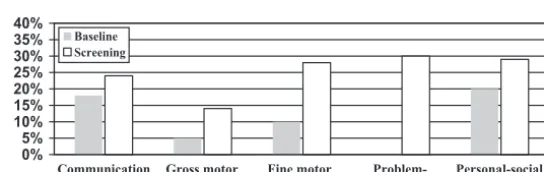
Among the children who were NFC, the rate of detection of DD was signifi-cantly higher in the screening than the baseline cohort overall (58% vs 29%; P⬍.001), for each of the 3 age groups (Fig 1), and for both boys (64% vs 35%; P⬍.001) and girls (50% vs 22%;P⬍ .001). Increased detection of DD was noted in all 5 domains measured by the ASQ (Fig 2), but was most dramatic in
0% 10% 20% 30% 40% 50% 60% 70% 80% 90% 100%
Infanta Toddlera Preschoolera Totala Baseline
Screening
FIGURE 1
Percentage of children who were NFC and identified with possible DDs compared by clinical assess-ment in the baseline period versus the ASQ in the screening period.aPⱕ.001 for all comparisons of baseline to screening cohorts according to age groups (2test).
0% 5% 10% 15% 20% 25% 30% 35% 40%
Communication Gross motor Fine motor Problem-solving
Personal-social
Baseline Screening
FIGURE 2
Percentage of children who were NFC with detected DD according to domain, compared by clinical assessment in the baseline phase versus the ASQ in the screening phase.aP⬍.01 for all comparisons of baseline to screening cohorts according to domain (2test).
TABLE 1 Demographic Characteristics of Baseline and Screening Groups for Children Who Were
NFC and Those Who Were IFC
Characteristics NFC in Baseline Cohort (N⫽181),
n(%)
NFC in Screening Cohort (N⫽125),
n(%)
IFC in Screening Cohort (N⫽126),
n(%) Child group, mean age (SD), mo 92 (50)a 73 (58) 12 (10)b
Infant, 5.9 (2.5) 48 (27)a 35 (28) 57 (45)b
Toddler, 24.5 (7.2) 41 (23)a 17 (14) 57 (45)b
Preschool, 48.9 (8.3)
Median (range) 12 (4–61)a 7 (4–61) 36 (3–61)b
Gender,n(%)
Boys 93 (51)a 67 (54) 61 (48)c
Race/ethnicity,n(%)
White, non-Hispanic 29 (16)a 33 (27) 20 (16)d
Black, non-Hispanic 94 (52)a 50 (40) 73 (58)d
Hispanic 17 (9)a 17 (13) 10 (8)d
Biracial 17 (9)a 8 (6) 16 (13)d
Other/unknown 23 (14)a 17 (14) 7 (5)d
Objective 2 (impact of standardized screening) compared NFC (baseline) versus NFC (screening). Objective 3 (prevalence of DD) compared NFC (screening) versus IFC (screening). All tests were2tests, except when age was treated as continuous
variable; this was a Wilcoxon rank-sum test.
aAll comparisons between baseline and the NFC group were not significant. bP⬍.001, comparing the NFC and IFC groups.
cNot significant, comparing the NFC and IFC groups. dP⫽.003, comparing the NFC and IFC groups.
the fine motor and problem-solving do-mains, which we stratified by age group (Fig 3).
Objective 3: Prevalence of
Potential DD Among Children Who Were NFC Compared With Children Who Were IFC
We also compared children in the NFC screening with those in the IFC screen-ing cohort (Fig 4). There was no signif-icant overall difference in detection of DD overall. However, when stratified by age, DD was substantially higher in the
NFC group than the IFC group in tod-dlers and preschoolers.
Among children identified with a DD, 82% had a delay in at least 1 domain. Children with a DD in either the problem-solving or personal-social domain had delays in at least 1 other domain 86% and 78% of the time, respectively.
We ran separate multivariable logis-tic regression analyses to assess independent associations of child demographics and cohort status (baseline versus NFC screening). DD
screening cohort versus baseline screening cohort, and those who were older, and who were boys (Ta-bles 2 and 3).
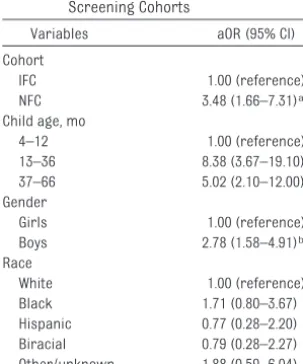
Finally, we tested independent associ-ations of child demographics and length of time in care by using multiva-riable logistic regression analyses. We found that children who were NFC in the screening cohort were more likely to be identified with being at risk for a DD than children who were IFC (Table 4). Again, this model showed that chil-dren were significantly more likely to be identified with a DD if they were older or boys.
DISCUSSION
We demonstrated the feasibility of us-ing a standardized instrument to screen for DD in a real-world, some-what specialized, clinical setting: a medical home for children in foster care. The very high (96%) completion rate for ASQs was probably attribut-able to (1) mailing ASQs before the health appointments and reminding 0%
20% 40%
Communication Gross motor Fine motor Problem-solving
Personal-social
Preschooler
FIGURE 3
Percentage of children who were NFC with detected DD according to domain and age group.aP⬍.01 for all comparisons of age groups according to domain except for the gross motor skill domain (2 test).
0% 10% 20% 30% 40% 50% 60% 70% 80% 90% 100%
Infanta Toddlerb Preschoolerc Totala
IFC
NFC
FIGURE 4
Percentage of children with detected DD, grouped according to age, comparing the IFC group versus the NFC group.aP⫽not significant;bP⫽.004;cP⫽.005.Pvalues are for comparison of children who were IFC with those who were NFC according to age group (Fisher’s exact test).
TABLE 2 Number of Developmental Domains Affected in NFC and IFC Children Whose ASQ Score
Was Below the Cutoff
No. of Domains Affected
Screening Cohort, NFC (N⫽72), %
Screening Cohort, IFC (N⫽64), %
Pa
5 17 3 .004
4 17 6
3 13 14
2 13 13
1 21 48
0 19 16
aFrom the Cochran-Armitage Trend Test.
TABLE 3 Multivariable Logistic Regression
Analysis of Characteristics Associated With Predicting Potential DD for Children in the NFC Baseline and Screening Cohorts
Variables aOR (95% CI)
Cohort
Baseline 1.00 (reference) Screening 5.07 (2.82–9.11)a
Child age, mo
4–12 1.00 (reference)
13–36 7.04 (3.65–13.58)a
37–66 7.09 (3.41–4.71)a
Gender
Girls 1.00 (reference) Boys 2.10 (1.22–3.62)b
Race
White 1.00 (reference) Black 0.66 (0.32–1.36) Hispanic 0.95 (0.36–2.51) Biracial 0.47 (0.15–1.46) Other/unknown 0.55 (0.21–1.46)
aOR indicates adjusted odds ratio; CI, confidence interval.
foster parents to complete them, (2) giving immediate feedback to foster parents by reviewing ASQ forms dur-ing the well-child visit, and (3) monthly clinical meetings with clini-cal staff to obtain feedback regard-ing use of the ASQ.
The most dramatic finding in our study was the near doubling of the detection rate of DD (from 29% to 58%) with the use of a validated developmental screening instrument. This occurred despite the relatively high baseline de-tection rate of DD. Our second major finding was the dramatic increase in the detection of delays in the problem-solving, personal-social, and fine mo-tor domains, where detection had pre-viously been poor. Use of the ASQ facilitated detection of delays in all do-mains, but especially in these domains that are less amenable to routine clin-ical assessment.
The use of the ASQ allowed us to esti-mate the overall prevalence of DD in our population. More than a decade ago, the authors of studies noted the high prevalence of developmental problems in the foster care
popula-tion.16,21,38 Our findings highlight the high prevalence of DD among the cur-rent foster care population. Our prev-alence rates were 10-fold higher than that of Steele and Buchi20 who re-ported prevalence on the basis of a statewide database rather than stan-dardized screening.
The finding that 48% of children with a DD had delays in more than 1 domain, adds to our understanding of the com-plex needs of children in foster care. The authors of other studies have documented the burden of physical, mental health, and developmental problems among children in foster care22,39–43; ours is the first study, to our knowledge, that examines the prevalence of problems in specific de-velopmental domains and according to age. This topic merits additional study because a clearer understanding of the developmental profiles of children in foster care may help to optimize their treatment.
We considered 3 possible explanations for the interesting finding that tod-dlers and preschoolers had higher rates of DD in the NFC than IFC groups. First, foster parents may overreport developmental concerns regarding a child new to their home, because they have not witnessed all the skills of which the child is capable. Second, re-moval from family and placement in a foster home is emotionally traumatiz-ing for almost all children and they may “regress” as they adjust to their new circumstances. Third, it is very likely that children enter foster care with delays related to previous trauma and psychosocial deprivation; place-ment in a more enriched environplace-ment, such as a stable and nurturing foster home may promote the child’s devel-opment. This would lead to a lowering of DD as children move from being NFC to IFC. Previous work has suggested that stable foster home placement can lead to gains in physical growth and
developmental skills,44and it is likely that analogous gains in cognitive and psychosocial development also occur. Additional research is needed to deter-mine which of these possible explana-tions are correct.
Strengths and Limitations
Two strengths of this study are that developmental screening was applied to a county-wide population of children in foster care and completion rates of the ASQ were very high. To our knowl-edge, this is the first direct test of the impact of a standardized developmen-tal screening on detection of DD for children in foster care.
There are several potential limitations to this study. First, the study was done in a specialized medical home serving children in foster care, which may limit generalizability. However, pedi-atricians are being encouraged to do universal developmental surveillance for all children, and targeted develop-mental screening for those at greatest risk. Our findings strongly support the AAP’s recommendation that the spe-cial needs population of children in foster care should have a formal devel-opmental screen in their pediatri-cian’s office, or be referred for such screening.
Our completion rate of ASQs may have been higher than that of other prac-tices. On the other hand, the already high baseline detection rates of DD posed a conservative bias, making it more difficult to detect changes be-cause of systematic screening. Thus, implementation of the ASQ in other practice settings may yield even greater improvements in the detection of DD.
A third limitation of this study is that medical chart review was used to ob-tain data about developmental surveil-lance. Data were limited to what was documented in the charts, which may have underestimated the detection of
TABLE 4 Multivariable Logistic Regression
Analysis of Characteristics Associated With Predicting Potential DD for Children in the IFC and NFC Screening Cohorts
Variables aOR (95% CI)
Cohort
IFC 1.00 (reference)
NFC 3.48 (1.66–7.31)a
Child age, mo
4–12 1.00 (reference)
13–36 8.38 (3.67–19.10)b
37–66 5.02 (2.10–12.00)b
Gender
Girls 1.00 (reference)
Boys 2.78 (1.58–4.91)b
Race
White 1.00 (reference)
Black 1.71 (0.80–3.67) Hispanic 0.77 (0.28–2.20) Biracial 0.79 (0.28–2.27) Other/unknown 1.88 (0.59–6.04)
aOR indicates adjusted odds ratio; CI, confidence interval.
aP⫽.01. bP⬍.001.
effect on our measures of clinical care before and after the screening interven-tion, and was appropriate to study the feasibility of a practice intervention.
Implications for Practice
This study supports the AAP’s recom-mended use of systematic develop-mental screening for the foster care population. Developmental screening dramatically increased the detection
the high prevalence of developmental health problems and the transience of this population in the health care sys-tem, children in foster care are likely to benefit from a more proactive approach to developmental screening than that used in other clinical settings. Future work should investigate whether timely identification of these problems im-proves service receipt and long-term outcomes for this vulnerable group.
cyon Hill Foundation (Dr M. Szilagyi) and the Robert Wood Johnson Physi-cian Faculty Scholars Program (Dr Jee).
We thank Drs Constance Baldwin and Thomas Boat for careful review of this article. We also thank the parents and children at Starlight Pediatrics and the Monroe County Department of Human Services.
REFERENCES
1. American Academy of Pediatrics, Commit-tee on Children With Disabilities. Screening infants and young children for developmen-tal disabilities. Pediatrics. 1994;93(5): 863– 865
2. American Academy of Pediatrics, Council on Children With Disabilities, Section on Devel-opmental Behavioral Pediatrics, Bright Fu-tures Steering Committee, Medical Home Initiatives for Children With Special Needs Project Advisory Committee. Identifying in-fants and young children with developmen-tal disorders in the medical home: an algo-rithm for developmental surveillance and screening.Pediatrics.2006;118(1):405– 420 3. Sand N, Silverstein M, Glascoe FP, Gupta VB, Tonniges TP, O’Connor KG. Pediatricians’ re-ported practices regarding developmental screening: do guidelines work? Do they help?Pediatrics.2005;116(1):174 –179 4. Sices L. Developmental screening in primary
care: the effectiveness of current practice and recommendations for improvement. The Commonwealth Fund, December 2007; Avail-able at: www.commonwealthfund.org/ content/publications/Fund-reports/2007/ Dec/Developmental-Screening-in-Primary- Care–The-Effectiveness-of-Current-practice-and-recommendations-f.aspx. Accessed December 1, 2009
5. Jellinek M. Caring for the psychosocial needs of children: from advocacy to struc-tural change.Ambul Pediatr.2008;8(1): 8 –10
6. Sices L, Feudtner C, McLaughlin J, Drotar D, Williams M. How do primary care physi-cians identify young children with develop-mental delays? A national survey.J Dev Be-hav Pediatr.2003;24(6):409 – 417
7. Rydz D, Srour M, Oskoui M, et al. Screening for developmental delay in the setting of a community pediatric clinic: a prospective
assessment of parent-report question-naires.Pediatrics.2006;118(4):1178 –1186 8. Hix-Small H, Marks K, Squires J, Nickel R.
Impact of implementing developmental screening at 12 and 24 months in a pediat-ric practice. Pediatrics. 2007;120(2): 381–389
9. Casanueva CE, Cross TP, Ringeisen H. Devel-opmental needs and individualized family service plans among infants and toddlers in the child welfare system.Child Maltreat.
2008;13(3):245–258
10. Perrin JM. Prevention and chronic health conditions among children and adoles-cents.Ambul Pediatr.2008;8(5):271–272 11. Inkelas M, Raghavan R, Larson K, Kuo A,
Or-tega AN. Unmet mental health need and ac-cess to services for children with special health care needs and their families.Ambul Pediatr.2007;7(6):431– 438
12. Van Cleave J, Davis MM. Preventive care uti-lization among children with and without special health care needs: associations with unmet need.Ambul Pediatr.2008;8(5): 305–311
13. Jee S, Conn KM, Nilsen WJ, Szilagyi MA, Forbes-Jones E, Halterman JS. Learning dif-ficulties among children separated from a parent.Ambul Pediatr.2008;8(3):163–168 14. Simms MD. Medical care of children who
are homeless of in foster care.Curr Opin Pediatr.1998;10:486 – 490
15. Simms MD, Freundlich M, Battistelli ES, Kaufman ND. Delivering health and mental health care services to children in family foster care after welfare and health care reform.Child Welfare.1999;78(1):166 –183 16. Simms MD. The foster care clinic: a
commu-nity program to identify treatment needs of children in foster care.J Dev Behav Pediatr.
1989;10(3):121–128
17. Leslie LK, Gordon JN, Lambros K, Premji K,
Peoples J, Gist K. Addressing the develop-mental and develop-mental health needs of young children in foster care.J Dev Behav Pediatr.
2005;26(2):140 –151
18. Hochstadt NJ, Jaudes PK, Zimo DA, Schachter J. The medical and psychosocial needs of chil-dren entering foster care.Child Abuse Negl.
1987;11(1):53– 62
19. Zimmer MH, Panko LM. Developmental sta-tus and service use among children in the child welfare system: a national survey.
Arch Pediatr Adolesc Med. 2006;160(2): 183–188
20. Steele JS, Buchi KF. Medical and mental health of children entering the Utah foster care system.Pediatrics.2008;122(3). Avail-able at: www.pediatrics.org/cgi/content/ full/122/3/e703
21. Halfon N, Mendonca A, Berkowitz G. Health status of children in foster care: the experi-ence of the Center for the Vulnerable Child.
Arch Pediatr Adolesc Med. 1995;149(4): 386 –392
22. Chernoff R, Combs-Orme T, Risley-Curtiss C, Heisler A. Assessing the health status of children entering foster care.Pediatrics.
1994;93(4):594 – 601
23. Dunn KG, MacLafferty RL. Foster Care: Health Needs of Many Young Children Are Unknown and Unmet. Washington, DC: US General Accounting Office Report; 1995; Available at: www.gao.gov/archive/ 1995/he95114.pdf. Accessed December 1, 2009
24. American Academy of Pediatrics, Medical Home Initiatives for Children With Special Needs Project Advisory Committee. The medical home. Pediatrics. 2002;110(1): 184 –186
26. Cooley WC. Redefining primary pediatric care for children with special health care needs: the primary care medical home.
Curr Opin Pediatr.2004;16(6):689 – 692 27. Cooley WC, McAllister JW. Building medical
homes: improvement strategies in primary care for children with special health care needs.Pediatrics.2004;113(5):1499 –1506 28. Palfrey JS, Sofis LA, Davidson EJ, Liu J,
Free-man L, Ganz ML. The pediatric alliance for coordinated care: evaluation of a medical home model. Pediatrics. 2004;113(5): 1507–1516
29. Bricker D, Squires J, Mounts L, et al.Ages and Stages Questionnaires (ASQ): A Parent-Completed, Child-Monitoring System. 2nd ed. Baltimore, MD: Paul H. Brookes Publishing; 1999
30. Klamer A, Lando A, Pinborg A, Greisen G. Ages and stages questionnaire used to measure cognitive deficit in children born extremely preterm. Acta Paediatr. 2005; 94(9):1327–1329
31. Skellern C, Rogers Y, O’Callaghan MJ. A parent-completed developmental questionnaire: fol-low up of ex-premature infants.J Paediatr Child Health.2001;37(2):125–129
32. Elbers J, Macnab A, McLeod E, Gagnon F. The
ages and stages questionnaires: feasibility of use as a screening tool for children in Canada.Can J Rural Med.2008;13(1):9 –14 33. Jellinek MS, Murphy J, Robinson J, et al.
Pe-diatric symptom checklist: screening school age children for psychosocial dys-function.J Pediatr.1988;112:201–209 34. Glascoe FP.Parents’ Evaluations of
Develop-mental Status: An Evidence-Based Ap-proach to Developmental-Behavioral Screening and Surveillance. Nashville, TN: Ellsworth and Vandermeer; 2007
35. American Academy of Pediatrics, District II Task Force on Health Care for Children in Foster Care.Fostering Health: Health Care for Children and Adolescents in Foster Care.
2nd ed. Lake Success, NY: American Acad-emy of Pediatrics; 2005
36. Squires J, Bricker D, Potter LW. Revision of a parent-completed developmental screen-ing tool: ages and stages questionnaires.
J Pediatr Psychol.1997;22(3):313–328 37. Agresti A. Logistic regression. In:
Categori-cal Data Analysis.2nd ed. Hoboken, NJ: John Wiley and Sons, Inc; 2002:181–182
38. Simms MD. Foster children and the foster care system, part I: history and legal struc-ture.Curr Probl Pediatr.1991;21(7):297–321
39. Halfon N, Berkowitz G, Klee L. Children in foster care in California: an examination of Medicaid reimbursed health services utili-z a t i o n . P e d i a t r i c s . 1 9 9 2 ; 8 9 ( 6 p t 2 ) : 1230 –1237
40. Simms MD, Dubowitz H, Szilagyi MA. Health care needs of children in the foster care system. Pediatrics. 2000;106(4 Suppl): 909 –918
41. Simms MD. Foster children and the foster care system, part II: impact on the child.
Curr Probl Pediatr.1991;21(8):345–369; dis-cussion 370
42. Jee SH, Barth RP, Szilagyi MA, Szilagyi PG, Aida M, Davis MM. Factors associated with chronic conditions among children in foster care.J Health Care Poor Underserved.2006; 17(2):328 –341
43. Jee SH, Antonucci TC, Aida M, Szilagyi MA, Szilagyi PG. Emergency department utiliza-tion by children in foster care.Ambul Pedi-atr.2005;5(2):102–110
44. Wyatt DT, Simms MD, Horwitz SM. Wide-spread growth retardation and variable growth recovery in foster children in the first year after initial placement.Arch Pedi-atr Adolesc Med.1997;151(8):813– 816
Needle-Free Vaccines Make Some Good Points:The Wall Street Journal(Whalen J, De-cember 12, 2009) recently reported on the development of needle-free vaccines administered through a patch placed on the skin. Current work involves vaccines to treat traveler’s diarrhea (E coli) and influenza. Their benefit includes the fact that no refrigeration is needed, which might make getting vaccination in third world countries (where electricity is not readily accessible to allow refrigeration) much easier, not to mention it can be self-administered in areas where doctors and nurses are not readily available. In developed countries, it may enable those who are needle-phobic to still get their vaccinations. The technology remains experimental with formal testing yet to be done.
Noted by JFL, MD
DOI: 10.1542/peds.2009-0229 originally published online January 11, 2010;
2010;125;282
Pediatrics
Aaron Blumkin and Peter G. Szilagyi
Sandra H. Jee, Moira Szilagyi, Claire Ovenshire, Amy Norton, Anne-Marie Conn,
Services
Updated Information &
http://pediatrics.aappublications.org/content/125/2/282
including high resolution figures, can be found at:
References
http://pediatrics.aappublications.org/content/125/2/282#BIBL
This article cites 37 articles, 7 of which you can access for free at:
Subspecialty Collections
e_sub
http://www.aappublications.org/cgi/collection/adoption_-_foster_car
Adoption & Foster Care
following collection(s):
This article, along with others on similar topics, appears in the
Permissions & Licensing
http://www.aappublications.org/site/misc/Permissions.xhtml
in its entirety can be found online at:
Information about reproducing this article in parts (figures, tables) or
Reprints
http://www.aappublications.org/site/misc/reprints.xhtml
DOI: 10.1542/peds.2009-0229 originally published online January 11, 2010;
2010;125;282
Pediatrics
Aaron Blumkin and Peter G. Szilagyi
Sandra H. Jee, Moira Szilagyi, Claire Ovenshire, Amy Norton, Anne-Marie Conn,
Care
Improved Detection of Developmental Delays Among Young Children in Foster
http://pediatrics.aappublications.org/content/125/2/282
located on the World Wide Web at:
The online version of this article, along with updated information and services, is
by the American Academy of Pediatrics. All rights reserved. Print ISSN: 1073-0397.