150
Cesspool Supervision Model Of Oil Palm Blank
Bunches In West Kalimantan (Optimization With
The Integration Of Ahp-Goal Programming)
Novira KusriniAbstract: The objectives of this research are (i) to determine the optimum model of OPEB management (ii) to determine the optimal number of OPEB in waste management, which is then recommended to the company (iii) to know the achievement of various goals/targets with limited availability of resources. This research uses quantitative and qualitative approaches. Quantitative approach is done by processing the data for financing and profit analysis in OPEB waste management which. It is then used for resource approach. A qualitative approach is undertaken for weighing purposes in the AHP analysis. The research location was determined purposively in the CPO mill of PT. Pundi Lahan Khatulistiwa in Ambawang Sub-district, Kubu Raya Regency. In order that the optimal settlement can achieve the goal/target that are minimization of environmental pollution, low cost and profit gain, then the amount of OPEB that must be managed by the company is 300 tons prioritized for TM compost of 66.67 tons and mushroom growing media of 233.33 tons. Consequently, the company's cost of Rp. 4,000,000,000.00 still spares Rp. 2,026,666,670.00. The OPEB management as oyster mushroom promises a relatively high profit compared to other OPEB managements even though the cost is not the least. This research is one of the few studies that examines the waste management model of palm oil empty bunches, mainly located in western kalimantan, Indonesia. Originality is seen from the use of optimization analysis tools with integration of Analytic Hierarcical Program (AHP) with goal programming.
Index Terms: Waste Management Model, Palm Empty Bunches, West Kalimantan, Cesspol Supervision Model, Optimization, Integration, Goal Programming.
—————————— ——————————
1 INTRODUCTION
il palm empty bunches (OPEB) is a cesspool compact from a crude palm oil (CPO) factory, which is quite large and abundant [5],[42]. Every 1 ton of oil palm can produce OPEB waste of 23% or 230 kg and the OPEB processing in palm oil mill for one day can produce hundreds of tons of OPEB. More than 640 palm oil mills throughout Indonesia produce about 23 million tons of CPO or 46% of total CPO output arount the world [43]. It is estimated that currently, OPEB waste in West Kalimantan is about 46,237.5 tons per hour (West Kalimantan Plantation Office). Utilization of waste is done by burning or partially spread on empty land as mulch/fertilizer in the area of land or in the area around the mill. In fact, OPEB has the potential to be processed into various products. Some potential uses of OPEB include fertilizer, compost, paper pulp, particle board, fuel power plant, biofuels (BBN) and biomass power (PLT Biomass), and mushroom growing medium. Currently, the management of OPEB in West Kalimantan is limited only as compost for the breeding of palm oil plantation. OPEB as a mushroom growing medium is also a promising alternative with several regencies in West Kalimantan such as Sanggau and Sambas regencies that have applied OPEB as a mushroom growing medium. Mushroom and oyster is an alternative type of fungus that can grow by using OPEB. Mushroom is one of mushroom types that has a fairly high market demand. Based on the above matter, the utilization of OPEB to become a product of value is widely open. The current problem of CPO mills is how to determine the amount of waste from the optimal OPEB that must be allocated for compost and as a mushroom growing medium adapted to the amount of OPEB produced by companies. Therefore, the determination of the optimal OPEB management model is urgent to conduct considering the limited availability of resources and technologies. The next problem is in the process of decision making faced with a problem that contains many goals/targets in it with limited resources and conflicting characteristics (multiple and conflicting goals) [19]. Management often faces a priority order of goals/targets to be achieved in the first place compared to other priorities [44].
Based on the above issue, the goals of this study are (i) to determine the optimum model of OPEB management (ii) to determine the optimal number of OPEB in waste management, which is then recommended to the company (iii) to know the achievement of various goals/targets with limited availability of resources. To answer the purpose of the research, the application of the Analytical Hierarchy Process (AHP) method concatenate by Goal Programming (GP) is the appropriate method, considering that this integration can: (i) provide solutions in allocating or combining optimal resources from multiple conflicting issues so that the decision that is made can be a satisfactory outcome of the various alternatives that are offered; (ii) optimize the aim benefit in unison by splendid all restraint that restrict restoration actions [2]; (iii) assist in predicting through the weighing and prioritization of OPEB management methods from goal constraints [9]; (iv) determine priorities within the decision hierarchy as the weight of the goal constraints. The integration of this method has proven to be a flexible tool [25]; [20]; [11]. This research is one of the few studies that examines the waste management model of palm oil empty bunches, mainly located in western kalimantan, Indonesia. Originality is seen from the use of optimization analysis tools with integration of Analytic Hierarcical Program (AHP) with goal programming. The determination of optimization model for waste management of OPEB is beneficial not only to the stakeholders (corporate/private sector) but also to assist government and academics in the effort to solve waste pollution problem as well as to minimize the level of environmental pollution resulting from the negative impacts caused by CPO mills so as to preserve the environment. Besides, the company can minimize the cost of applying the waste handling technology from CPO mills, thus increasing the added value or advantage in utilization. Several previous studies were used as references in this research separately, such as waste palm management by [30],[15],[29],[3],[38],[27],[6],[48],[26]; palm oil by
151 Model Pengelolaan EFB
Memperoleh Keuntungan Meminimalisasi Biaya
Penerapan Pengelolaan EFB Meminimalisasi
Pencemaran Lingkungan
Kompos Pembibitan
Media Tanam Jamur Tiram Kompos
TM
Kompos Pembibitan
Media Tanam Jamur Tiram Kompos
TM
Kompos Pembibita n
Media Tanam Jamur Tiram Kompos
TM
],[9],[10],[49],[37]. The originality for this paper shows the comprehensively waste palm management, palm oil, ahp goal.
2.
THEORETICAL
REVIEW
GP was first presented by Charnes and Cooper [8]and continued to grow primarily in academic publications [26]. GP focus is a decision that requires many criteria to be considered in seeking the best decision. In addition, goal programming is used for multi purpose optimization [39]. GP is also a quantitative decision-making tool for achieving desired goals by minimizing deviations from goals [23], [22]. GP model can solve management cases that require certain simultaneous achievable goals, which cannot be solved by linear programming. The difference lies in the emergence of a pair of devisional variables in the purpose function and constraint function [44]. The deviational variable serves to accommodate deviations that will occur in the left-side value of an equation of constraints toward the value of the right-side value [19]. The GP analysis aims to minimize deviations from established goals/targets in order to achieve desired goals/targets in line with the limited resources and technologies. The use of AHP in the GP model is to improve the ability of the two methods which involve qualitative and quantitative criteria. The AHP approach is former to authorize decision makers to specify the weights and priorities for goals [16]. To obtain numerical weight usually uses Delphi technique and Conjoint analysis. There are 3 (three) types of goals/targets that can be formulated in the GP Model: (i) goals/targets with priority equations; (ii) goals/targets with different priorities; (iii) goals/targets with different priorities and weights [44]. In this study, the type of goals/targets formulated in optimization function modeling with GP is the goal/target with different priorities and weights. It means that in formulating the optimization function model of GP Method, the AHP approach is firstly used to set goals/targets with different priorities and weights. Weight values that indicate a higher priority will have a greater chance of being applied. The weight value obtained from this AHP approach will be used in the calculation of the optimization value. The general form of GP mathematical model integration - the AHP model is formulated as follows [4],[39]:
∑ Si plus + Si minus + ∑ Wk Sbk plus + Wk Sbk minus
Subject To
∑ aij xj − Sbk plus + Sbk minus = gi for all i
Xj, Si plus, Si minus, Wk, Sbk plus, Sbk minus ≥ 0 for all i,k
Description:
Wk : Weight of relative deviation (AHP approach)
Sbk plus : The lower/negative deviation variable from
the k goals/targets (AHP approach)
Sbk minus : The upper/positive deviation variable from
the k goals/targets (AHP approach)
Si plus : The lower/negative deviation variable from
the i goals/targets
Si minus : The upper/positive deviation variable from
the i goals/targets
Aij : The coefficient of decision variable of
resource approach
Gi : Goals or targets to be achieved
Xj : Decision variable
3.
RESEARCH
METHOD
This research uses quantitative and qualitative approaches. Quantitative approach is done by processing the data for financing and profit analysis in OPEB waste management which. It is then used for resource approach. A qualitative approach is undertaken for weighing purposes in the AHP analysis. The research location was determined purposively in the CPO mill of PT. Pundi Lahan Khatulistiwa in Ambawang Sub-district, Kubu Raya Regency. The reason for selecting the location is that there is (i) the only CPO mill in the sub-district (ii) an abundance of unused OPEB. The study was conducted in February 2017 until July 2017. The used data were major and intermediate data. Major data were obtained through debriefing with the help of questionnaires. The respondents consisted of several experts who had experience and expertise in waste management OPEB. They are the academics, government and private. Secondary data were obtained through literature study related to the research. Stages in formulating the GP model on optimizing OPEB management are identification of decision variables, identification of objective function, formulation of target constraints with resource approach, and formulation of target constraints with AHP approach. Stages of data analysis are as follows:
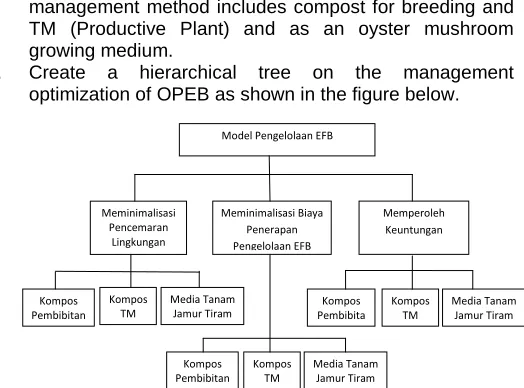
1. Set criteria and alternatives. Criteria are the goals of optimizing the OPEB management, which are: (i) the minimizing of implementation costs; (ii) the minimizing of environmental pollution; and (iii) the utilization benefits of the processed products. The alternative that is the management method includes compost for breeding and TM (Productive Plant) and as an oyster mushroom growing medium.
2. Create a hierarchical tree on the management
optimization of OPEB as shown in the figure below.
Figure 1. Hierarchical Tree of OPEB Management Model
a. Create comparison matrices in pairs.
b. Spread the questionnaire to a number of
respondents/assessors.
c. Arrange the matrix of respondent interview result and then the data are processed with expert choice 11.0.
d. Assess inconsistencies and priorities.
e. Determine priority scales from criteria and
152
f. Set the function of the target constraint equation based on the value of the AHP result coefficient.
3. Formulation of goal function
4. Coefficient value determination of constraint function variable and optimization goal with resource approach. 5. The input coefficient value into the constraint function
formulation and goal function.
6. Data analysis for the GP model by using MS excell.
4.
R
ESEARCHR
ESULTS ANDD
ISCUSSION4.1. Formulation of OPEB Management Optimization Model
1. Identification of decision variable.
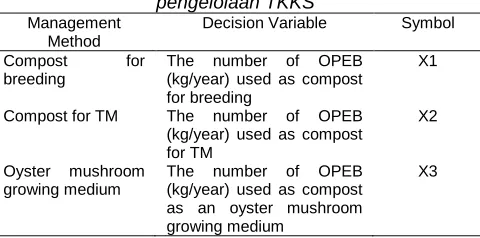
The decision variable in this research is the priority strategy model that will be selected in the OPEB management and how many OPEB should be utilized for each strategy. Table 1 below presents the decision variable in the optimization model.
Tabel 1. Variabel keputusan di dalam model optimasi pengelolaan TKKS
Management Method
Decision Variable Symbol Compost for
breeding
The number of OPEB (kg/year) used as compost for breeding
X1
Compost for TM The number of OPEB (kg/year) used as compost for TM
X2
Oyster mushroom growing medium
The number of OPEB (kg/year) used as compost as an oyster mushroom growing medium
X3
Source: Primary Data Analysis, 2017
2. Stage identification of goal function.
The goal formulation in this research adopts the Fibrian D. C (2012) research, which is the goal of optimizing OPEB management in general: (i) the cost minimizing of implementing the OPEB management model; (ii) an environmentally friendly OPEB management model or the ability to minimize environmental pollution; and (iii) the OPEB management model that can provide benefits in the utilization of its processed products
3. Constraint formulation stage with resource
availability approach.
Based on the goals of optimization that have been prepared, then the constraint equation is also adjusted. a. Goal constraint/cost target for the implementation of
OPEB management model
a X1 + b X2 + c X3 + S1 plus - S1 minus = A Description :
a : the cost of applying OPEB as compost
for breeding (Rp/kg)
b : the cost of applying OPEB as compost
for TM (Rp/kg)
c : the cost of applying OPEB as a
mushroom growing medium (Rp/kg) S1 plus : deviation under the cost constraints of
implementing the OPEB management model
S1 minus : deviation under the cost constraints of implementing the OPEB management
A : cost allocation for implementing the
OPEB management provided by the company (Rp/kg)
The Company will minimize the cost of implementing the OPEB management so that it does not exceed the budget that has already been provided (minimized S1 minus).
b. Goal constraint management of all OPEB
X1 + X2 + X3 + S2 plus - S2 minus = B Description :
S2 plus : deviation under the OPEB management
constraint
S2 minus : deviation under the OPEB management constraint
B : The number of OPEB provided by the
company to be managed (kg)
The Company will manage the OPEB as closely as possible in line with the OPEB of CPO mill results (minimized S2 plus and S2 minus).
c. Profit goal constraints implement the OPEB
management model
d X1 + e X2+ f X3 + S3 plus - S3 minus = A Description :
d : Benefits of managing OPEB as compost
for breeding (Rp/kg)
e : Benefits of managing OPEB as compost
for TM (Rp/kg)
f : Benefits of managing OPEB as a
mushroom growing medium (Rp/kg) S3 plus : deviation under the constraint of OPEB
management profit
S3 minus : deviation under the constraint of OPEB management profit
The Company will manage the OPEB generated by a profit-generating management method and cover the total cost required for the implementation of the method (minimized S3plus).
4. Constraint formulation stage with AHP approach
The AHP approach is used in formulating the goal/target constraints for optimizing the OPEB management. The AHP result is used as the coefficient value in constraint function variable and goal function of optimizing the OPEB management.
SS.x1Y1+SS.x2Y2+SS.x3Y3+Sbb plus-Sbb minus = C (minimized Sbb plus)
The formula for obtaining SS.xi is as follows:
SS.x1 = (LN1 .K1 LN1) + (LN2 .K1 LN2) + (LN3 .K1 LN3) SS.x2 = (LN1 .K2 LN1) + (LN2 .K2 LN2) + (LN3 .K2 LN3) SS.x3 = (LN1 .J LN1) + (LN2 .J LN2) + (LN3 .J LN3) Goal/target of environmental impact minimization:
K1LN1 Y1 + K2LN1 Y2 + J LN1 Y3 + Sb1 plus - Sb1 minus = ZLN1 (minimized Sb1 plus).
Goal/target of low cost:
K1 LN2 Y1 + K2LN2 Y2 + J LN2 Y3 + Sb2 plus - Sb2 minus = ZLN2 (minimized Sb2 plus)
153
K1 LN3 Y1 + K2LN3 Y2 + J LN3 Y3 + Sb3 plus - Sb3 minus = ZLN3 (minimized Sb3 plus)
Description :
Yi : Constraint on the decision variable of AHP
approach
SS.xi : Total value of goal/target LNj achievement
when applying management method i
LN1 : The weight value of the global goal/target j
K1 LNj : The weight value of the local goal/target when applying compost for breeding K2 LNj : The weight value of the local goal/target
when applying compost for TM
J LNj : The weight value of the local goal/target when applying compost for mushroom
Sbb plus : Deviation under the AHP global value
Sbb minus : Deviation above the AHP global value
C : Total of the AHP global value
Sbj plus : Deviation under the ZLNj value Sbj minus : Deviation above the ZLNj value
ZLNj : Local value of goal/target j when applying
the management method i
5. Formulation stage of goal function
The goal function formulation of OPEB management optimization is conducted by combining the GP mathematical model with resource approach and mathematical model of AHP approach. The sum of the deviations in the target / target equation function that must be minimized to achieve the desired target is the optimization function that is formed.. The goal equation function of optimizing the OPEB management is formulated as follows :
Minimize:
S1 minus + S2 plus - S2 minus + S3 plus + Sbb plus + 0.229 Sb1 plus + 0.075 Sb2 plus + 0.696 Sb3 plus.
6. The stage determines the coefficient value of the constraint function variable with the resource approach.
Table 2. Variable Coefficient Value of Constraint Function of Resource Approach
Coeffi cient Symb ol
Coefficie nt Value
Data Source
a 5,920,00 0
Cost analysis result of compost management for breeding
B 200,000 Cost analysis result of compost management for TM
C 8,400,00 0
Cost analysis result of mushroom management
d 11,000,0
00 Cost analysis result of compost management for breeding e 7,500,00
0
Cost analysis result of compost management for TM
f 15,000,0 00
Cost analysis result of mushroom management
A 4,000,00 0,000
The result of the company's interview B 300,000 The result of the company's interview C 4,000,00
0,000
The result of the company's interview
Source: Primary Data Analysis, 2017
7. The stage determines coefficient value of constraint function variable and optimization goal with AHP approach.
Table 3. Variable Coefficient Value of Function Constraint and Goal Optimization with AHP Approach
Goal/target Coefficient Value AHP Global Value
Minimization of environmental pollution
LN1 0.229
Low cost LN2 0.075
Profit gain LN2 0.696
AHP Local Value
1. Compost management model for breeding Minimization of environmental
pollution
K1 LN1 0.067
Low cost K1 LN2 0.287
Profit gain K1 LN3 0.136
2. Compost management model for TM Minimization of environmental
pollution
K2 LN1 0.661
Low cost K2 LN1 0.625
Profit gain K2 LN1 0.625
3. Compost management model for a oyster mushroom growing medium
Minimization of environmental pollution
K3 LN1 0.272
Low cost K3 LN1 0.078
Profit gain K3 LN1 0238
Source: AHP-Goal Programming Analysis, 2017
8. Stages to input the coefficient value into the formulation of constraint function and goal function that have been determined in the previous stage.
Goal function: Minimize Z:
S1 minus + S2 plus + S2 minus + S3 minus + Sbb plus + 0.229 Sb1 plus + 0.075 Sb2 plus + 0.696 Sb3 plus.
Target constraint function:
i. 5,920 X1 + 200 X2 + 8,400 X3 + S1 minus = 4,000,000 ii. X1 + X2 + X3 + S2 plus - S2 minus = 300
iii. 11,000 X1 + 7,500 X2 + 15,000 X3 + S3 minus = 4,000,000
iv. 0.132 Y1 + 0.634 Y2 + 0.234 Y3 + Sbb plus = 1 v. 0.067 Y1 + 0.661 Y2 + 0.272 Y3 + Sb1 plus = 1 vi. 0.287 Y1 + 0.635 Y2 + 0.078 Y3 + Sb2 plus = 1 vii. 0.136 Y1 + 0.625 Y2 + 0.238 Y3 + Sb3 plus= 1 and
X1, X2, X3 ≥ 0 Y1, Y2, Y3 is 0 or 1
4.2. Optimal Values of OPEB Management and Goal/target Achievement
154
the waste management of oil palm mill, especially OPEB.
Table 4. Output result of OPEB management model
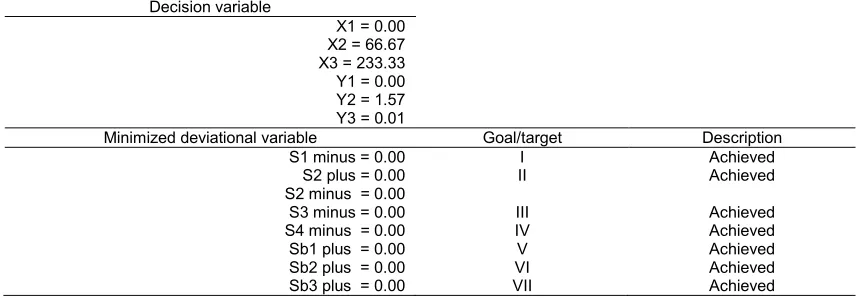
Table 5. Optimal value of the variable on the goal function and the constraint function
Several important findings based on the model that have been obtained include :
1. Resource approach.
a. In the target I. it can be seen that the total number of OPEB produced by CPO mills that is 300 tons should be utilized maximally so that the goal/target can be achieved. This can be seen from the value of S1 plus and S1 minus that is 0.00, meaning that the deviational variable can be minimized. Target I will be achieved if the company manages all OPEB of 300 tons as the mushroom growing medium that is 77.77% (233.33 tons) while the remaining is 22.22% (66.67 tons) as compost for TM.
b. In target II, it can be seen that the amount of costs
provided by the company that is Rp.
4,000,000,000/year can be managed to a minimum. This can be seen from the value of S2 minus that is 0.00, meaning that the deviational variable can be minimized. Target II will be achieved if the company uses the cost of Rp. 4,000,000,000.00 to be managed as mushroom growing media of 233.33 tons with the cost of application that is Rp. 200,000/ton (the total cost is Rp. 13,334,000.00) as well as managed as TM compost of 66.67 ton with the application cost up to
Rp. 8,400,000.00 (the total cost is Rp.
1,959,972,000.00). When viewed from these
calculations, it is known that the total use of the management cost of all 300 ton OPEB only reaches Rp. 1,973,306,000.00 of the total Rp. 4,000,000,000 so that the consequence is an excess budget of Rp. 2,026,666,670.00. Based on this, it can be said that utilizing all 300 ton OPEB requires cost that is only Rp. 1,973,306,000.00, not as expensive as Rp. 4,000,000,000. Therefore, target II will be achieved because the company succesfully manages the minimum cost possible.
c. In the target III, it can be seen that the benefits in the OPEB management are expected to be equal to the cost that can achieved and provided by the company amounting to Rp. 4,000,000,000.00. This is seen from the value of S3 minus that is 0.00, meaning that the deviational variable can be minimized. Based on the results of GP analysis, it can be reported that corporate profits that can be achieved worth Rp. 4,000,000,000.00 because the OPEB application as compost for TM that is 66.67 ton will gain a profit of Rp. 500,025,000.00. While the OPEB application as mushroom growing media of 233.33 tons will gain a profit of Rp. 3,499,950,000.00. If it studied more deeply, it can be said that in this GP analysis,
corporate profits can be greater than
4,000,000,000.00 because the cost provided by the company is not all used (excess) for the method implementation of managing OPEB, where there is an
excess budget of Rp. 2,026,666,670.00. In other words, the profit is Rp. 4,000,000,000.00 that is greater than the cost that must be spent, which is only Rp. 1,973,306,000.00. In other words, profits can cover the cost of applying all OPEB.
2. AHP Approach.
In targets V, VI and VII, it can be seen that the goals/targets of empty palm oil bunches management (minimization of environmental pollution, low cost and profit gain) can be achieved. This can be seen from the value of Sb1 plus, Sb2 plus and Sb3 plus thatis 0.00, meaning that deviational variable can be minimized. When viewed from the goals/targets, (i) in order to achieve the goal/target of the environmental pollution minimization on the target V, the priority of the OPEB management model is on TM compost. This is seen in the target V where the AHP local value is 0.661 in TM compost that is higher than that of the seed compost (0.067) and the mushroom growing medium (0.272) (ii) in order to achieve the goal/target of low cost minimization on the target VI, the priority of the OPEB management model is also on TM compost. This is seen in the target VI where the AHP local value is 0.635 in compost TM that is higher than that of the seed compost (0.287) and the mushroom growing medium (0.078) (iii) in order to achieve the goals/targets on the target VII, the priority of the OPEB management model is also on TM compost. This is seen in the target VII where the AHP local value is 0.625 in compost TM that is higher than that of seed compost (0.136) and mushroom growing medium (0.238). The consequence of the entire interpretation is that the OPEB management is prioritized to the management of compost for TM.
Managerial implication. The managerial implication of this research is the use of AHP GP method integration in producing the optimization model of OPEB management. It highly helps the company, the palm oil mill in this case, in the process of decision making about the optimal amount allocation of OPEB that must be managed so that the goal/target is achieved based on the different priority and weight.
5.
C
ONCLUSION ANDR
ECOMMENDATION155
this research needs to conduct so that the company is better in formulating the target priority determination by minimizing the deviation.
REFERENCES
[1] Abdullah, I., Mahmood, W.M.W., Fauadi, H.F.M.,
Rahman, M.N.A. and Mohamed, S.B (2017),
"Sustainable manufacturing practices in Malaysian palm oil mills: Priority and current performance", Journal of Manufacturing Technology Management, Vol. 28 Issue: 3, pp.278-298.
[2] Armindo, R. (2006), Penentuan Kapasitas Optimal
Produksi CPO (Crude Palm Oil) di Pabrik Kelapa Sawit
PT. Andira Agro dengan Menggunakan Goal
Programming, Tesis pada Institut Pertanian Bogor. [3] Asif, S. and Sargeant, A (2000), "Modelling internal
communications in the financial services sector", European Journal of Marketing, Vol. 34 Issue: 3/4, pp.299-318.
[4] Badri, M.A. (2001), A Combined AHP-GP for Quality
Control Systems. Int. J Prod Econ 72 , pp.27 - 40. [5] Bahruddin, Z.H., Lili, S., Yeni, I. and Fakhri (2015), Studi
Pemanfaatan Limbah Pelepah Sawit untuk Pembuatan Material Wood Plastic Composite. Prosiding Seminar Nasional Teknik Kimia Indonesia,Yogyakarta.
[6] Balaji, M.S., Roy, S.K. and Wei, K.K (2016), "Does relationship communication matter in B2C service relationships?", Journal of Services Marketing, Vol. 30 Issue: 2, pp.186-200.
[7] Chadawada, R., Sarfaraz, A., Jenab, K. and
Pourmohammadi, H (2015), "Integration of AHP-QFD for
selecting facility location", Benchmarking: An
International Journal, Vol. 22 Issue: 3, pp.411-425.
[8] Charnes, A. and Cooper, W.W. (1961), Management
Models and Industrial Applications of Linear
Programming,John Wiley & Sons, New York.
[9] Costa, R. and Evangelista, S (2008), "An AHP approach to assess brand intangible assets", Measuring Business Excellence,Vol. 12 Issue: 2, pp.68-78.
[10] Davies, M (2001), "Adaptive AHP: a review of marketing applications with extensions", European Journal of Marketing, Vol. 35 Issue: 7/8, pp.872-894.
[11] De Wit C.T., van Keulen, H., Seligman, N.G., and
Spharim, I. (1988), ―Application of Interactive Multiple Goal ProgrammingTechniques for Analysis and Planning of RegionalAgricultural Development‖, Agricultural Systems, Vol.26, pp.211-230. England, Elsevier Applied Science Publishers Ltd.
[12] Dinas Perkebunan Kalimantan Barat. (2015),
Kalimantan Barat Dalam Angka tahun 2015. Kalimantan Barat.
[13] Ding, S.H., Kamaruddin, S. and Azid, I.A (2014),
"Maintenance policy selection model – a case study in the palm oil industry", Journal of Manufacturing Technology Management, Vol. 25 Issue: 3, pp.415-435. [14] Fibrian D.C., Sri.M, Marimin. (2012), ―Sistem Penunjang
Keputusan Untuk Optimalisasi Pemanfaatan Limbah Padat Kelapa Sawit‖, Jurnal Teknik Industri Pertanian, Vol.20, No. 2, pp. 130-142.
[15] Frandsen, F. and Johansen, W (2011), "The study of internal crisis communication: towards an integrative framework", Corporate Communications: An International Journal, Vol. 16 Issue: 4, pp.347-361.
[16] Gass, S.I. (1986), ―A Process For Determining Priorities And Weights For Large Scale Linear Goal Programmes‖, Journal of Development Studies, Vol.21, No.4, pp. 572-652.
[17] Gunes, M. and Umarosman.N. (2005), ―Fuzzy Goal
Programming Approach on Computation of The Fuzzy Arithmetic Mean‖, Mathematical and Computational Application, Vol. 10, No. 2, pp.211-220.
[18] Hanumaiah, N., Ravi, B. and Mukherjee, N.P (2006), "Rapid hard tooling process selection using QFD‐AHP methodology", Journal of Manufacturing Technology Management, Vol. 17 Issue: 3, pp.332-350.
[19] Hartati, R.V. (2009), Pendekatan Model Fuzzy Goal
Programming Dalam Penetapan Pembobotan Prioritas Dari Metode Analytical Hierarchy Process (AHP), tesis Universitas Sumatera Utara, Medan.
[20] Hisjam, M., Adi, D.G. and Shalihuddin, D.T. (2012), ―A Sustainable Supply Chain Model Of Relationship Between Wood Supplier And Furniture Industry In Indonesia‖. Jurnal Teknosains. Vol. 1 No. 2, pp. 71-143. [21] Ho, W., Dey, P.K. and Lockström, M (2011), "Strategic
sourcing: a combined QFD and AHP approach in
manufacturing", Supply Chain Management: An
International Journal, Vol. 16 Issue: 6, pp.446-461.
[22] Hwang C.L, Abu S.M. and Hutti. (1997), Objective
Decision Making Methods And Applications, Springer – Verlag, New York.
[23] Ignizio, J.P. (1976), Goal Programming and Extensions.
Lexington Books, D.C.Heath and Company,
Massachusetts.
[24] Jenab, K., Pourmohammadi, H. and Sarfaraz, M (2014),
"An i-AHP&QFD warranty model", Benchmarking: An International Journal, Vol. 21 Issue: 6, pp.884-902.
[25] John, B. and Lorraine, G. (2003), ―A Comparison Of Two
Reference Point Methods In Multiple Objective Mathematical Programming‖, European Journal of Operational Research, 149, pp.17–34.
[26] Jones, D. and Tamiz, M., (2010), Practical Goal
Programming, Springer, New York.
[27] Jones, T., Fox, G.L., Taylor, S.F. and Fabrigar, L.R (2010), "Service customer commitment and response", Journal of Services Marketing, Vol. 24 Issue: 1, pp.16-28.
[28] Khamkanya, T., Heaney, G. and McGreal, S (2012),
"Introduction of AHP Satisfaction Index for workplace environments", Journal of Corporate Real Estate, Vol. 14 Issue: 2, pp.80-93.
[29] Kitchen, P.J. and Finbarr Daly, (2002), "Internal communication during change management", Corporate Communications: An International Journal, Vol. 7 Issue: 1, pp.46-53.
[30] Kreye, M.E (2017), "Relational uncertainty in service dyads", International Journal of Operations & Production Management, Vol. 37 Issue: 3, pp.363-381.
[31] Lee, S. and Ross, S.D (2012), "Sport sponsorship decision making in a global market: An approach of Analytic Hierarchy Process (AHP)", Sport, Business and Management: An International Journal, Vol. 2 Issue: 2, pp.156-168.
[32] Mathivanan, L. and Radhakrishna, S., (1998), "Protection of steel structures in industries with epoxy‐silicone based coatings", AntiCorrosion Methods and Materials, Vol. 45 Issue: 5, pp.301-305.
156
of palm oil, canola oil and blends on characteristics of fried plantain crisps", British Food Journal, Vol. 117 Issue: 6, pp.1793-1807.
[34] McPhail, K. and Maimunah, T.F (2012), "Regulating for rights and sustainability: biofuel in Malaysia", Sustainability Accounting, Management and Policy Journal, Vol. 3 Issue: 2, pp.252-261.
[35] Nikoloyuk, J., Burns, T.R. and Man, R.D (2010), "The promise and limitations of partnered governance: the case of sustainable palm oil", Corporate Governance: The international journal of business in society, Vol. 10 Issue: 1, pp.59-72.
[36] Nordin, K., Jamaludin, M.A., Ahmad, M., Samsi, H.W., Salleh, A.H. and Jalaludin, Z (2004), "Minimizing the environmental burden of oil palm trunk residues through the development of laminated veneer lumber products", Management of Environmental Quality: An International Journal, Vol. 15 Issue: 5, pp.484-490.
[37] Perçin, S (2008), "Use of fuzzy AHP for evaluating the benefits of information‐sharing decisions in a supply chain", Journal of Enterprise Information Management, Vol. 21 Issue: 3, pp.263-284.
[38] Poulis, A. and Wisker, Z (2016), "Modeling employee-based brand equity (EBBE) and perceived environmental uncertainty (PEU) on a firm’s performance", Journal of Product & Brand Management, Vol. 25 Issue: 5, pp.490-503.
[39] Reddy, A.R.M, Naidu, M.M. and Govindarajulu. P (2007),
―An Integrated approach of Analytical Hierarchy Process Modeland Goal Model (AHP-GP Model) for Selection of Software Architecture‖, International Journal of Computer Science and Network Security, Vol.7 No.10, pp.108-117. [40] Churkina, S.Y. (2002), Search For Efficient Solutions Of
Multi-Criterion Problems By Target-Level Method. Computational Mathematics And Modeling, Vol. 13 No. 2. pp. 208–213.
[41] Saifullah, M.K., Kari, F.B. and Othman, A (2018),
"Poverty among the small-scale plantation holders: Indigenous communities in Peninsular Malaysia", International Journal of Social Economics, Vol. 45 Issue: 2, pp.230-245.
[42] Sarwono, R., Arief, H., Rizka, P., Hendris, H.K. and Fatah, S (2016), ―Konversi Limbah Tandan Kosong Kelapa Sawit Menjadi Glukosa Dengan Proses Hidrotermal Tanpa Melalui Proses Pretreatment‖, Jurnal Biopropal Industri. Vol. 7 No.2, pp.63-71.
[43] Sawit Indonesia. (2014), Teknologi Pengolahan Limbah
Pabrik Kelapa Sawit. (online). From
:https://sawitindonesia.com/rubrikasi-majalah/inovasi/teknologi-pengolahan-limbah
pabrik-kelapa-sawit/ (11 Agustus 2017)
[44] Siswanto. (1997), Operation Research, Erlangga,
Jakarta.
[45] Tan, Y.C. and Ndubisi, N.O (2014), "Evaluating supply chain relationship quality, organisational resources, technological innovation and enterprise performance in the palm oil processing sector in Asia", Journal of Business & Industrial Marketing, Vol. 29 Issue: 6, pp.487-498.
[46] Tan, Y.C., Mavondo, F. and Worthington, S (2011),
"Organisational capabilities and relationship quality: Performance implications for palm oil processors in Malaysia", Asia Pacific Journal of Marketing and Logistics, Vol. 23 Issue: 2, pp.152-164.
[47] Thomson, K. and Hecker, L (2001), "Value‐adding communication: Innovation in employee communication and internal marketing", Journal of Communication Management, Vol. 5 Issue: 1, pp.48-58.
[48] Wu, G.C (2013), "The influence of green supply chain integration and environmental uncertainty on green innovation in Taiwan's IT industry", Supply Chain Management: An International Journal, Vol. 18 Issue: 5, pp.539-552.
157 Table 4. Output result of OPEB management model
Source: AHP-Goal Programming Analysis, 2017
Table 5. Optimal value of the variable on the goal function and the constraint function Decision variable
X1 = 0.00 X2 = 66.67 X3 = 233.33 Y1 = 0.00 Y2 = 1.57 Y3 = 0.01
Minimized deviational variable Goal/target Description
S1 minus = 0.00 I Achieved
S2 plus = 0.00 II Achieved
S2 minus = 0.00
S3 minus = 0.00 III Achieved
S4 minus = 0.00 IV Achieved
Sb1 plus = 0.00 V Achieved
Sb2 plus = 0.00 VI Achieved
Sb3 plus = 0.00 VII Achieved
Source: AHP-Goal Programming Analysis, 2017
0 66.667 233.333 0 1.5736 0.0101 2026666.67 0 0 0 0 0 0 0 0 0.04 0 0 0 0 solution min z 0
X1 X2 X3 Y1 Y2 Y3 s1+ s1- s2+ s2- s3+ s3- sbb+ sbb-Sb1+ Sb1- Sb2+ Sb2- Sb3+
Sb3-0 0 0 0 0 0 0 1 1 1 1 0 1 0 0.229 0 0.075 0 0.696 0 coefficient
constraint
5920 200 8400 0 0 0 1 -1 0 0 0 0 0 0 0 0 0 0 0 0 4000000 = 4000000
1 1 1 0 0 0 0 0 1 -1 0 0 0 0 0 0 0 0 0 0 300 = 300
11000 7500 15000 0 0 0 0 0 0 0 1 -1 0 0 0 0 0 0 0 0 4000000 = 4000000
0 0 0 0.132 0.634 0.234 0 0 0 0 0 0 1 -1 0 0 0 0 0 0 1 = 1
0 0 0 0.067 0.661 0.272 0 0 0 0 0 0 0 0 1 -1 0 0 0 0 1 = 1
0 0 0 0.287 0.635 0.078 0 0 0 0 0 0 0 0 0 0 1 -1 0 0 1 = 1