DECEPTION JAMMING SUPPRESSION FOR RADAR
Dr. Ayesha Naaz
1, Tahura Iffath
2 1Associate Professor,
2M.E. Student, ECED, Muffakham
Jah college of Engineering and Technology, Hyderabad, (India)
ABSTRACT
The problem of deception jamming suppression for a radar system and an effective spatial polarization filter strategy is outlined based on the spatial and polarization parameter joint estimates. It can make the false target filtered effectively and the desired target remained with an improved signal-to-jammer-noise ratio. In this scheme, the tri-linear decomposition model is first employed to obtain paired 2D direction of arrive and polarization parameter joint estimates of the target and jammer. Then a spatial-polarization oblique projection filter operator based on the joint estimates is constructed and utilized to project the received mixed return of radar onto to the target echo sub-linear space so as to suppress the jamming. This method is applicable on joint estimates of the target and jammer. Specific procedure of separation of main lobe and side lobe are demonstrated. However the detection probability is less in optimizing the waveform covariance matrix. An iterative algorithm is proposed to optimize the waveform covariance matrix (WCM) for maximizing the worst-case output signal-jammer-noise-ratio (SJNR) over the convex uncertainty set such that the worst-worst-case detection performance of MIMO OFDM-STAP can be maximized By exploiting the diagonal loading (DL) method, each iteration step in the proposed algorithm can be reformulated as a semi-definite programming (SDP) problem, which can be solved very efficiently.
I.
INTRODUCTION:
Electronic Counter-Countermeasures (ECCM) are “actions taken to ensure friendly use of the electromagnetic spectrum against electronic warfare.” Their main objective is to eliminate or reduce the efficiency of the enemy‟s ECM. Pulse diversity is considered as the most effective ECCM scheme against the DRFM repeat-type jammer [2]. Antenna-related ECCM are ECCM techniques based on the properties of antenna systems to reduce the effectiveness of ECM. Space selection based on antenna directivity and polarization selection based on the polarization properties of electromagnetic waves are the main ECCM strategies of discrimination the useful signals and interference. The main techniques for antenna-related ECCM based on spatial selection are coverage and scan control, reduction of main-beam width, reduction of side-lobe level, and employing of adaptive antennas.
The first group of methods based on antenna pattern and scan control may include blanking or turning of the receiver while the radar is observing the part of space containing a jammer, using multiple-beam configuration to detect a target by a beam not afflicted by jammers, random scanning to prevent deception jammers from synchronizing with the antenna scan rate, and other relevant measures. Reduction of beam width increases the angular resolution and is a valuable feature of any radar operating in a dense ECM environment. It should be kept in mind, however, that the reduction of beam width, for a given aperture size, results in increasing the side-lobe level that worsens a radar‟s anti-jamming capability, so the reasonable compromise should be found in specifying the antenna radiation pattern.
The main side-lobe-related techniques are usage of low and ultralow side-lobe antennas, side-lobe blanking (SLB) and side-lobe cancellation (SLC). The generalization of SLC techniques in combination with adaptive processing technique is the concept of adaptive arrays. This technique is very promising as it is based on advanced methods of digital beam-forming and digital signal processing and permits super resolution capabilities that can be very useful for ECCM.
Frequency Division Multiplexing (OFDM) radar based Space-Time Adaptive Processing (STAP) to the estimation errors in the initial parameter estimates by explicitly incorporating the parameter uncertainty model in the optimization problem. Because maximization of the output SINR is tantamount to maximization of the detection performance in the case of Gaussian noise [5], here the waveform covariance matrix (WCM) is optimized to maximize the worst-case output SINR of MIMO-OFDM STAP over the convex uncertainty set such that the worst-case detection performance can be maximized. To solve the resultant complicated nonlinear optimization problem, an iterative algorithm is proposed to optimize the WCM for maximizing the worst-case output signal interference-noise ratio (SINR) over the convex uncertainty set such that the worst-case detection performance of MIMO-STAP can be maximized. By exploiting the diagonal loading (DL) method, each iteration step in the proposed algorithm can be reformulated as a semi-definite programming (SDP) problem, which can be solved very efficiently.
The rest of this paper is organized as follows: The parameter estimation method is derived in Section II. In Section III, the robust waveform optimization problem to improve the worst-case detection performance is constructed.
In Section IV, simulation results are presented to verify the performance of our proposed method, whereas the conclusions are shown in Section V.
II.
PARAMETER ESTIMATION METHOD
For the tri-linear model, tri-linear alternating least squares (TALS) algorithm is often employed as the common data detection method [6–7]. The fundamental idea of TALS is to update one of the slice matrices
, , or each time using least squares (LS). The
updating method can be described to update the remaining matrices with the previously obtained estimates until convergence of the LS cost function. TALS algorithm in our scheme is discussed as follows. The LS fitting of X satisfies
(1)
and the LS update for
is
(2)
where and stand for the estimated matrices of P and A, is the obtained vector in the last iteration. Similarly, the LS updates for and are
(4)
where denotes the estimated matrix of S, (p = 1, 2) and (l = 1, 2, …, L) are the previously obtained estimates.
It is noted that TALS algorithm is prone to implement and guarantee to converge, but also suffers from slow convergence. As a modified method, COMFAC algorithm is proposed to speed up the LS fitting of TALS. First, COMFAC compresses the high dimensional three-way data into the subspaces defined by the three bases P, A, and S. Then the PARAFAC model is fitted in the compressed space. Finally, the solution followed with a few TALS steps is recovered to the original space. The estimated direction matrices , and can be utilized to estimate the 2D DOA and polarization parameters. For the return the spatial direction vector of sub-linear array (n = 1, 2, …, N) is
(5) With the logarithm transformation ln( · ) and imaginary part extraction transformation imag( · ), the above formula can be further substituted as
(6)
where , .We define
then can be expressed as
(7)
Primarily, the estimated direction vector , that is, the column of estimated direction matrix , is normalized to the referential phase center so as to avoid phase ambiguity. Then we extract the rows of followed with normalization from M+1 to 2M as matrix and obtain vector with the transformation (8). After that let , be the estimates of and , and the vector can be estimated further by LS as
(8)
Finally, the elevation and azimuth can be paired automatically through the following formulas (9)
(10)
Meanwhile, with the estimated DOA ( ), the vector can be calculated as
(11)
(12)
(13)
III.
SOLUTION TO THE OPTIMIZATION PROBLEM
It is obvious that this optimization problem contains the constant modulus constraint, and it should be a NP-hard problem. To tackle the this problem, the first constraint can be relaxed to a square constraint due to contains
, which can be rewritten as:
(14) Where
Meanwhile, with and , and hence the term is indefinite. We now treat the inner optimization problem firstly. In order to solve it, the diagonal loading (DL) method, which has been usually used in the
robust beam-forming, is employed to Ѱ such that: (15)
where , is the so-called loading factor, and is the largest eigenvalue of a matrix. Note that due to .
(16) By replacing in above with , we can obtain
(17) The inner optimization can be written as
(18)
We consider the outer optimization problem. For obtaining the optimal solution, similar to the method for solving the inner optimization problem, the DL method is employed to such that
(19)
where In the following, we choose by numerical examples. By replacing
in (14) with we can obtain
(20)
Note that due to and . As a consequence, the maximization problem in above equation can be reshaped as
(22) Similar to that in the inner optimization problem, above equation can be recast as an SDP:
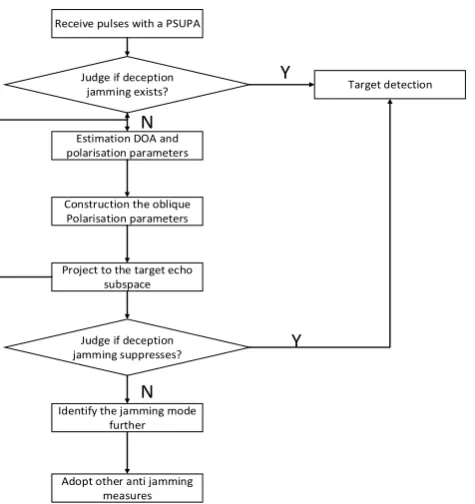
(23) The working flowchart of the PD radar with a PSUPA for deception jamming suppression is given in Figure 1. When the special target echo and deception jamming impinge on a PSUPA simultaneously, the radar system will primarily judge whether the repeat deception jammer exists, based on the processing result with regard to the current and previous PRI. If the deception jamming is detected, the radar system has to estimate the DOA and polarization parameters with our proposed method.
Receive pulses with a PSUPA
Judge if deception jamming exists?
Project to the target echo subspace Construction the oblique
Polarisation parameters Estimation DOA and polarisation parameters
Judge if deception jamming suppresses?
Adopt other anti jamming measures Identify the jamming mode
further
Target detection
Y
N
Y
N
Fig. 1.
Working flowchart of a PD radar for deception jamming suppression
target, deception jamming and noise are projected to the target echo subspace and the jamming is filtered effectively. If the above suppression is not effective enough and much deception jamming still remains, the jamming mode would be identified with other features further and other corresponding anti-jamming measures would be adopted.
IV.
SIMULATION RESULTS
Define the relative absolute average error (RAAE) as
(24)
where and are the desired value and estimate for the jth Monte Carlo trial, respectively.
Fig. 2.
Principal Cuts at Target Azimuth and Doppler
Figure 2 show the azimuth angle can be estimated even with the changes in the Doppler frequency.
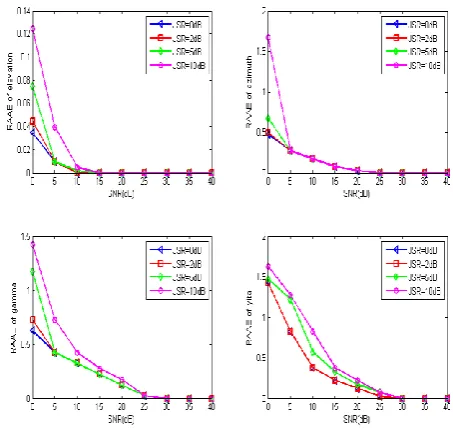
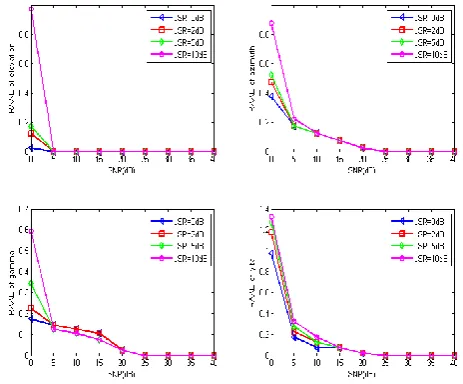
Figure 3 and 4 depict the RAAE curves of DOA and polarization estimates of target echo and jamming with different SNR and JSR. From Figure, we find that the RAAE of each estimate raises slightly with the JSR increasing and decreases with the SNR climbing for a fixed JSR.
Fig. 4.
RAAE curves of jammer’s parameters estimated
V.
CONCLUSION
In this paper, we have investigated the problem of robust waveform optimization for improving the
worst-case detection performance of MIMO PSUPA based on the tri-linear decomposition model has
been addressed, and a deception jamming suppression algorithm has been proposed. Experiment
results demonstrate that our proposed algorithm can have desirable jamming suppressing performance
which could effectively enhance the performance of radar target detection in the complicated
electromagnetic environment.
REFERENCES
[1] Muharrem Arik, Ozgur Baris Akan, ”Enabling Cognition on Electronic CounterMeasure Systems against Next-Generation Radars”, Military Communications Conference, MILCOM 2015 - 2015 IEEE.
[2] Zhang, J., Zhu, D., Zhang, G.: „New antivelocity deception jamming technique using pulses with adaptive initial phases‟, IEEE Trans. Aerosp. Electron. Syst., 2013.
[3] Dai, H., Wang, X., Li, Y., et al.: „Main-lobe jamming suppression method of using spatial polarization characteristics of antennas‟, IEEE Trans. Aerosp. Electron. Syst., 2012.
[4] Mao, X., Liu, Y.: „Null phase-shift polarization filtering for high-frequency radar‟, IEEE Trans. Aerosp. Electron. Syst., 2007.
[5] C. Y. Chen, and P. P. Vaidyanathan, "MIMO radar waveform optimization with prior information of the extended target and clutter," IEEE Trans. on Signal Processing, 2009.
[7] Zhang, X., Xu, Z., Xu, D.: „Trilinear decomposition-based transmit angle and receive angle estimation for multiple-input multiple-output radar‟, IET Radar Sonar Navig., 2011.