Littler, Nadine (2016) Brain development education pathways. British Journal of School Nursing, 11 (2). pp. 9899.
Downloaded from: http://insight.cumbria.ac.uk/id/eprint/3515/
Usage of any items from the University of Cumbria’s institutional repository ‘Insight’ must conform to the following fair usage guidelines.
Any item and its associated metadata held in the University of Cumbria’s institutional repository Insight (unless stated otherwise on the metadata record) may be copied, displayed or performed, and stored in line with the JISC fair dealing guidelines (available here) for educational and notforprofit activities
provided that
• the authors, title and full bibliographic details of the item are cited clearly when any part of the work is referred to verbally or in the written form
• a hyperlink/URL to the original Insight record of that item is included in any citations of the work
• the content is not changed in any way
• all files required for usage of the item are kept together with the main item file.
You may not
• sell any part of an item
• refer to any part of an item without citation
• amend any item or contextualise it in a way that will impugn the creator’s reputation
• remove or alter the copyright statement on an item.
The full policy can be found here.
1
Representation: National Forum of School Health Educators - February
Edition 2016
Title: Brain Development Education Pathways
Author: Nadine Littler
Institutional Affiliation: University of Cumbria
Full Details:
Senior Lecturer/Pathway Lead Specialist Community Public Health Nursing
(School Nursing).
University of Cumbria,
Department of Nursing, Health & Professional Practice,
Hornby Room 08,
Bowerham Rd Campus,
Lancaster,
LA1 3JD
Office Tel: 01524 385682
email: [email protected]
2
Adolescence marks the beginning of a metamorphic phase of physical,
emotional, social and intellectual development. Due to the complexity of this
transition, heightened mental health problems have been associated with this
progressive stage (Loftus, Kelly and Mustillo 2011). The exposure to a range of
environmental and sociological factors, in addition to cognitive vulnerabilities
may considerably increase the risk of adolescents developing mental illness.
Therefore in the first instance it is essential to raise awareness of adolescent
brain development, in order to assist practitioners in recognising and detecting
mental illness and ensuring early intervention and prompt treatment.
Brain Development:
By the age of six years a child’s brain has already grown to 96% of its total brain
volume, the remaining 4% continues to develop during adolescence through to
adulthood, whereby maturation of the brain is concluded by the age of 25 years
(Johnston 2009). A key period for brain growth occurs during the ages of 12-16
years when the functions of both grey and white matter are responsible for
developing certain regions within the brain, this process concludes with
maturation of the pre-frontal cortex.
Grey matter (cells, dendrites and neurons) account for 40% of the brain
providing the surface of the cerebral cortex, during childhood the growth and
thickness of grey matter increases, in order to develop extra brain connections.
However this reaches a peak in adolescence following the commencement of
puberty, when excess brain connections are eliminated or pruned (Lenroot &
3
This signifies the beginning of the re-modelling phase of brain development,
where grey matter decreases, and white matter (found within the deeper
tissues) increases accounting for 60% of the brain. White matter consists of
myelin sheaths formed by glial cells which act as insulators to speed up the
transmission of signals, these are responsible for communicating to different
regions within the brain, with growth continuing into adolescence and
adulthood.
Figure One: Adolescent Brain Development
Recent studies have indicated there are different brain development trajectories
for both genders (Ruigrok et al; 2014), such as the male brain being 8-10%
larger, as well as having a greater volume of grey matter than females, and
increased volumes within certain regions of the brain such as putamen, globus
pallidus, cerebrum, cerebellum and the left amydala. Essentially development
is seen predominantly within the basal ganglia structures of the brain which
have a major role in normal voluntary movement, motivation, learning, emotions
and memory. Interestingly the basal ganglia is involved in certain conditions
typically associated with males which include ADHD and Tourette’s Syndrome
4
Whereas the female brain reaches peak volumes of grey matter approximately
1-2 years earlier than males, due to commencing puberty at an earlier age
(Asato et al; 2010). Subsequently females use ten times more white matter than
males and have increased volumes within certain regions of the brain such as
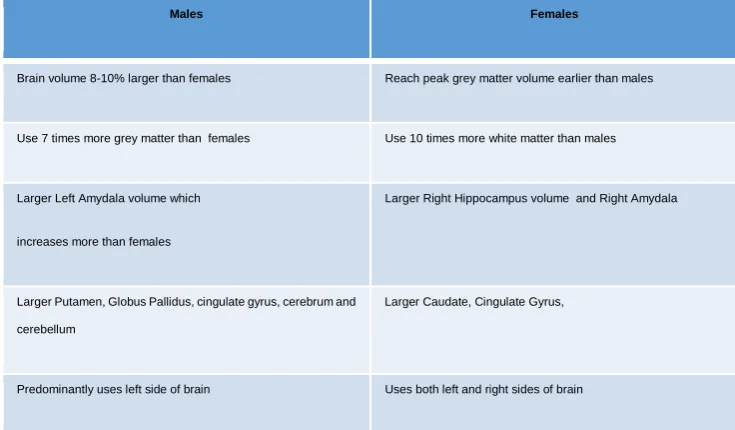
caudate, cingulate gyrus, right amydala and the right hippocampus (Figure
Two). This indicates development within the limbic system, otherwise known as
the emotion centre of the brain, which also has a major role in emotions,
formation of memories, learning, arousal, and behaviour. Similarly the limbic
system is involved in female biased disorders such as depression and anxiety
(Baron-Cohen et al; 2011).
Figure Two: Gender Differences in Brain Development
Males Females
Brain volume 8-10% larger than females Reach peak grey matter volume earlier than males
Use 7 times more grey matter than females Use 10 times more white matter than males
Larger Left Amydala volume which
increases more than females
Larger Right Hippocampus volume and Right Amydala
Larger Putamen, Globus Pallidus, cingulate gyrus, cerebrum and
cerebellum
Larger Caudate, Cingulate Gyrus,
Predominantly uses left side of brain Uses both left and right sides of brain
This reinforces the need to educate young people, parents, and professionals
on brain development in childhood and adolescence, as during this
transformative stage the brain is extremely malleable (ability to adapt and
change with experience/stress) thus creating vulnerability and the risk of mental
5 Educational Pathways:
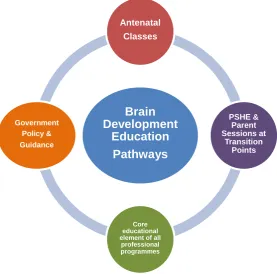
Therefore we must consider utilising a range of multifaceted educational
pathways (Figure Three) to raise awareness of this crucial period of
development. This should begin pre-birth by for example; introducing
theoretical sessions on the importance of brain development and attachment in
childhood/adolescence for pregnant women during antenatal sessions.
Similarly this could also include educating young people and parents within both
primary and secondary school settings on brain development and emotional
health and wellbeing, as part of their PSHE sessions and parent open evenings
during key transition points. Finally brain development should be a core
component within all professional educational training programmes such as
Nursing, Medicine, Teaching, Childcare, Social Work, Youth Work, Public
Health. In order to equip practitioners with foundational knowledge of brain
development, which is inextricably linked to children and young people’s
physical, social, emotional, and intellectual health, which if affected has the
6 Figure Three: Brain Development Educational Pathways
730 Words
References:
Asato, MR., Terwilliger, R., Woo, J., and Luna, B., (2010) White matter
devel-opment in adolescence: a DTI study. Cereb Cortex, 2010, 20, pp-2122-2231.
Baron-Cohen, S., Lombardo, M., Auyeung, B., Ashwin, E., Chakrabati, B., and
Knickmeyer, R., (2011) Why are Autism Spectrum Conditions more prevalent
in Males? PLoS Biology, June 2011, Vol 19, No.6. Brain
Development Education
Pathways
Antenatal
Classes
PSHE & Parent Sessions at
Transition Points
Core educational element of all
professional programmes Government
Policy &
7
Johnson, M., (2009) Available at:
http://www.thepsychologist.org.uk/archive/ar-chive_home.cfm?volumeID=22&editionID=181&ArticleID=1582.
Lenroot, R., and Giedd, J., (2011) Developmental considerations of gene by
environment interaction. Journal of Child Psychology and Psychiatry, Vol 52,
Issue 4, pp-429-441.
Loftus, J., Kelly, B.C., and Mustillo, S.A.,(2011) Depressive symptoms among
Adolescent Girls in Relationships with Older Partners: Causes and Lasting
Ef-fects? Journal of Youth Adolescence, Springer.