Developing the 2011 Integrated Pediatric Guidelines
for Cardiovascular Risk Reduction
abstract
This article reviews aspects of development of the recently released
“Integrated Guidelines for Cardiovascular Health and Risk Reduction in Children and Adolescents”for pediatric care providers that remain in the area of human judgment. Discussed will be the context in which the guidelines were developed, the formal evidence review process, a consideration of how quality grades were established, key social/ ethical issues that the panel confronted, and a critique of the final work with recommendations for future guideline development. Les-sons learned are that both a formal evidence review process is essential to developing a credible document, and human judgment is critical to producing a meaningful result. Guideline development is a dynamic process that must be continuously self-critical as new evidence is acquired and sociopolitical and environmental contexts evolve.Pediatrics2012;129:e1311–e1319
AUTHORS:Samuel S. Gidding, MD,aStephen R. Daniels,
MD, PhD,band Rae Ellen W. Kavey, MD,cfor the Expert
Panel on Cardiovascular Health and Risk Reduction in Youth
aNemours Cardiac Center, A. I. DuPont Hospital for Children,
Wilmington, Delaware;bDepartment of Pediatrics, The Children’s
Hospital, Aurora, Colorado; andcDepartment of Pediatrics,
University of Rochester Medical School, Rochester, New York
KEY WORDS
guidelines, evidence-based medicine, risk factors ABBREVIATIONS
AAP—American Academy of Pediatrics CV—cardiovascular
CVD—cardiovascular disease IOM—Institute of Medicine
LDL-C—low-density lipoprotein cholesterol NHLBI—National Heart Lung and Blood Institute
PDAY—Pathobiological Determinants of Atherosclerosis in Youth USPSTF—US Preventive Services Task Force
www.pediatrics.org/cgi/doi/10.1542/peds.2011-2903
doi:10.1542/peds.2011-2903
Accepted for publication Jan 4, 2012
Address correspondence to Samuel S. Gidding, MD, Nemours Cardiac Center, 1600 Rockland Rd, Wilmington, DE 19803. E-mail: [email protected]
PEDIATRICS (ISSN Numbers: Print, 0031-4005; Online, 1098-4275).
Copyright © 2012 by the American Academy of Pediatrics FINANCIAL DISCLOSURE:Dr Daniels serves as a paid consultant to Merck/Schering-Plough and to QLT, and receives royalties from McGraw-Hill. Drs Gidding and Kavey have indicated they have nofinancial relationships relevant to this article to disclose.
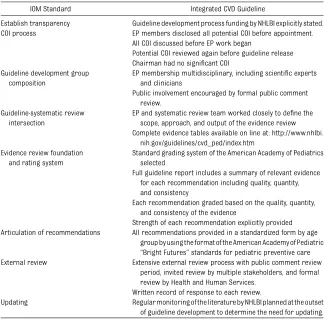
Commissioned in 2006, the 2011 “ In-tegrated Guidelines for Cardiovascular Health and Risk Reduction in Children and Adolescents” are the first guide-lines addressing cardiovascular dis-ease (CVD) risk factors from the National Heart Lung and Blood Institute (NHLBI) to be driven by an evidence-based, rather than a consensus-based process.1 Subsequent guidelines will follow this process. Previous CVD risk reduction guidelines sponsored by NHLBI have addressed a single topic and have usu-ally been consensus opinions developed by expert panels, based on careful in-terpretation of available evidence.1–3 For the new guideline, sufficient pedi-atric research related to CVD risk had been conducted to allow the develop-ment of evidence-based recommenda-tions. The guideline process adhered to recommendations in existence in 2006 such as those developed by the AGREE network, including consideration of scope, a formal evidence review, key stakeholder involvement, scientific rigor, clarity of presentation, and edi-torial independence.4 The Institute of Medicine (IOM) document,“Clinical Prac-tice Guidelines We Can Trust,”was re-leased in 2011, after completion of guideline development. In retrospect, the Expert Panel process closely mirrored those standards, as shown in Table 1.5
Despite defining a rigorous evidence evaluation process, it became clear to the panel that, no matter how carefully the evidence evaluation process was defined, human judgment would be necessary at key decision points. This article will review those human ele-ments. We willfirst discuss the context in which the guidelines were developed. The formal evidence review process will be described, with particular attention to how thefinal evidence-grading par-adigm was established. A discussion of key social and ethical issues that the panel confronted in translating the evi-dence review into recommendations will
be presented. We will conclude with a critique of thefinal work and rec-ommendations for future guideline development.
THE SOCIOPOLITICAL CONTEXT OF THE 2011 INTEGRATED GUIDELINES FOR
CARDIOVASCULAR HEALTH AND RISK REDUCTION FOR CHILDREN AND ADOLESCENTS
The Expert Panel was charged with developing evidence-based guidelines addressing all of the major risk fac-tors to assist pediatric care providers (pediatricians, family practitioners, nurses and nurse practitioners, physi-cian assistants and registered dietitians) in both the promotion of cardiovascular (CV) health and the identification and management of specific risk factors from infancy into young adulthood. This charge
itself created the first major problem. Although children with extremes of CV risk exist, these children will form a dis-tinct minority of those who go on to de-velop CVD in the future. The majority of children who develop CVD acquire risk factors in childhood, mostly through adverse behaviors such as poor nutri-tion, tobacco use, and sedentary lifestyle. Success in modifying these behaviors requires a prevention-oriented, public health approach, which can only be supported by physician guidance, as opposed to pharmacologic or other prescribed treatment interventions.6 A guideline solely devoted to the extre-mes of CVD risk, strictly calibrated to the identification of those requiring medical intervention, would not fulfill the general purpose of promoting CV health and CVD risk reduction. Those with some or in-termediate risk, as much as 85% of the adult population, would be underserved. TABLE 1 NHLBI Expert Panel Process Versus the IOM Standard
IOM Standard Integrated CVD Guideline
Establish transparency Guideline development process funding by NHLBI explicitly stated. COI process EP members disclosed all potential COI before appointment.
All COI discussed before EP work began
Potential COI reviewed again before guideline release Chairman had no significant COI
Guideline development group composition
EP membership multidisciplinary, including scientific experts and clinicians
Public involvement encouraged by formal public comment review.
Guideline-systematic review intersection
EP and systematic review team worked closely to define the scope, approach, and output of the evidence review Complete evidence tables available on line at: http://www.nhlbi.
nih.gov/guidelines/cvd_ped/index.htm Evidence review foundation
and rating system
Standard grading system of the American Academy of Pediatrics selected
Full guideline report includes a summary of relevant evidence for each recommendation including quality, quantity, and consistency
Each recommendation graded based on the quality, quantity, and consistency of the evidence
Strength of each recommendation explicitly provided Articulation of recommendations All recommendations provided in a standardized form by age
group by using the format of the American Academy of Pediatric “Bright Futures”standards for pediatric preventive care External review Extensive external review process with public comment review
period, invited review by multiple stakeholders, and formal review by Health and Human Services.
Written record of response to each review.
Updating Regular monitoring of the literature by NHLBI planned at the outset of guideline development to determine the need for updating.
Therefore, the recommendations in these guidelines would need to address the role of pediatric care providers in both the prevention of risk factor develop-ment (primordial prevention) and the prevention of future CVD by effective management of identified risk factors (primary prevention).
The CVD risk reduction guideline de-velopment process has evolved sig-nificantly over the past 50 years. The earliest guidelines for adults emerged in the 1960s in the context of a CVD epidemic, the recent identification of important risk factors (tobacco use, hypercholesterolemia, and hyperten-sion), and sufficient epidemiological, clinical, and basic research for experts to recommend risk factor control.7,8As experience with both the value and pitfalls of guidelines developed, and as more research findings became available, objective evidence evalua-tion assumed increasing importance in providing credibility for recommen-dations. In fact, several groups were developed to review the medical litera-ture in an unbiased fashion to determine if specific medical practices were indeed supported by current researchfi nd-ings.9–12These considerations led to the second critical challenge for the Expert Panel: formulating new guidelines that successfully navigated through the Scylla of existing consensus-based guidelines and the Charybdis of published evidence-based meta-analyses and systematic re-views on relatively narrow topics that had not been incorporated into a com-plete and comprehensive guideline. The final product had to provide clinicians with a useful algorithm for the many different medical contexts that pediatric risk reduction presents, in the absence of complete evidence for many of these scenarios. The clinical context of the more typical patient with multiple risk factors for CVD, or risk for multiple competing morbidities other than CVD, had to be addressed.12
DEVELOPING THE
EVIDENCE-GRADING MODEL
The specific steps in the evidence evalu-ation process are completely described in the guidelines. These follow the path of formulating critical questions for the evidence review to address, defining search criteria to identify literature re-lated to these questions with defined inclusion and exclusion criteria, re-cording thefindings of selected studies in evidence tables, grading the included studies based on an a priori defined grading system, and using the results of the evidence review to formulate specific recommendations.1 Recom-mendations were graded by the Expert Panel based on the entire body of rele-vant evidence.
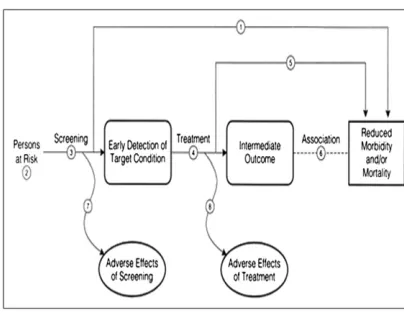
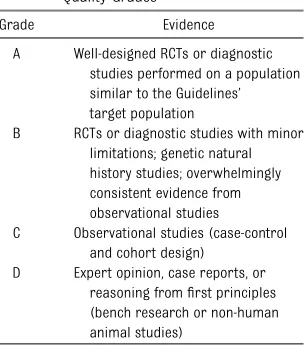
In 2006, no specific evidence review process encompassed the large scope of the panel’s charge. At its early face-to-face meetings, evidence evaluation schema and potential modifications that might be needed to accomplish the panel’s charge were discussed. Two existing evidence-grading systems seemed best suited: the US Preven-tive Services Task Force (USPSTF) gen-eral analytic framework (Fig 1) and the American Academy of Pediatrics (AAP) algorithm (Tables 2 and 3) currently used for evaluation of evidence in AAP guidelines and recommendations.13–15
Each had been previously used to address pediatric CVD prevention ques-tions. The importance of the USPSTF al-gorithm is the guarantee that both unintended as well as intended con-sequences of screening and treatment are considered in any recommendation.
The nature of atherosclerosis itself was considered in finalizing an evidence-grading system. Considerable research now exists on the development of ath-erosclerosis linking the presence of risk factors in childhood and adolescence to the presence and severity of the atherosclerotic process as assessed by both pathologic and imaging studies.6 The Bogalusa Heart Study was able to directly link risk factors measured in youth to the presence of atherosclero-sis determined pathologically at acci-dental death.16 Conversely, evidence exists linking the absence of CVD risk factors in childhood and young adult life to the absence of atherosclerosis or CVD morbidity in adulthood.17 The panel agreed that this evidence repre-sents the most convincing rationale for the development of these guidelines and is needed to be given appropriate weight.
This consideration of atherosclerosis raises a related quandary: the relative importance as an end point of athero-sclerosis development per se versus
FIGURE 1
CVD event reduction. Research on CV risk reduction in children and adoles-cents can only address the process of atherosclerosis, because the clinical end point of manifest CVD almost al-ways occurs much later in life. Without atherosclerosis (or rare pathologic con-ditions of the coronary arteries), CVD events do not occur in childhood. Re-alistically, it is only the development of atherosclerosis that can be prevented by efforts directed at children. The ev-idence review for the guidelines strongly suggests that retarding atheroscle-rosis development is a meaningful goal. The development of measures of sub-clinical atherosclerosis provides new tools for assessing the evolution of atherosclerosis.18
However, atherosclerosis by itself is not equivalent to an event: its presence only increases the likelihood that an event will ultimately occur. Thus, prevention of atherosclerosis does not necessarily provide a guarantee of long-term health, particularly if morbidities are incurred by screening or treatment in the process of prevention. Logistical and ethical dif-ficulties preclude initiation of a clinical trial in childhood for the prevention of CV events, so alternative types of evidence addressing the development and pro-gression of atherosclerosis must be
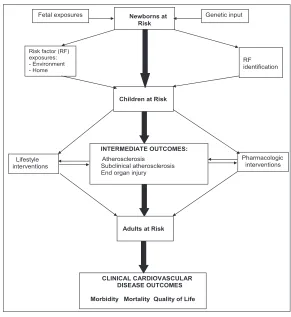
considered and weighed. The long natural history of atherosclerosis development provides the opportunity for research assessing many intermediate steps be-ginning in fetal life and extending through childhood into young adulthood. This concept is demonstrated in Fig 2, which shows the pathway from birth to CVD events and the many infl uen-ces, biological and environmental, that relate to the development of atheroscle-rosis over that time course. It is evidence from research regarding modification of these intermediate steps that con-stitutes the prime substance of a pe-diatric report.
It is important to emphasize that it is the presence of risk factors and the likeli-hood of their persistence into adult-hood that provides the rationale for pharmacologic treatment in youth, not the presence of subclinical atheroscle-rosis. Even in adults, only coronary cal-cium on computed tomography scan (not present generally until the third or fourth decade of life) provides sufficient evi-dence for risk reclassification.19As dis-cussed below, the evaluation and grading of evidence for risk persistence and its relationship to both atherosclerosis and outcomes in epidemiological and genetic studies was paramount for the panel.
The primacy of well-conducted ran-domized clinical trials was recognized as the highest level of evidence (Table 2). However, this preeminence places cer-tain limitations on a pediatric evidence-grading system. Randomized trials are best conducted with a narrowly defined problem, a single intervention, a well-defined population in which the adverse condition has a reasonable incidence or prevalence, and in which the desir-able outcome can be ascertained in a reasonable period of time. None of these conditions exists with regard to pediat-ric prevention of CVD. There are multiple risk factors for CVD, there are multiple interventions (diet treatment, behavior modification, medications), most of the
population is at risk, and the proximate desired outcomes are intermediate (ie, smoking cessation or lipid lowering as opposed to event reduction). It remains a curious fact that, in randomized trials, the achievement of smoking cessation by itself is considered an unqualified success even with high remission rates, whereas the safe lowering of low-density lipoprotein cholesterol (LDL-C) in a pa-tient with familial hypercholesterolemia, despite the higher proximate risk of an event, requires a CVD event reduction trial in the general population for some to endorse this treatment.
It was at the second level of evidence, below the level of randomized clinical trials, that use of the AAP system needs to be clarified and where a specific kind of evidence has particular relevance to the development of CVD. As shown in Table 1,“overwhelmingly consistent evi-dence from observational studies”is in-cluded in this second level of evidence. There is a remarkable consistency in the findings of many observational natural history studies of the evolution of CVD risk from childhood or young adulthood into adult life with regard to tracking risk factors across decades, factors that im-pact worsening of risk (eg, development of obesity), and the importance of risk measured early in life to either various morbidity or mortality end points mea-sured later in life. Maintenance of a low CVD risk state is associated with the absence of CVD end points later in life.
Consideration of the Pathobiological De-terminants of Atherosclerosis in Youth (PDAY) study is an effective example.6 PDAY is perforce cross-sectional, be-cause it compares pathologic mea-sures of atherosclerosis in the coronary arteries and abdominal aorta measured postmortem in 15- to 34-year-olds dying accidentally with CVD risk factors mea-sured postmortem, as well. Thus, the highest quality end point measurable in children and young adults, the pathologic extent of atherosclerosis, is linked to risk TABLE 2 Evidence Grading System: Evidence
Quality Grades
Grade Evidence
A Well-designed RCTs or diagnostic studies performed on a population similar to the Guidelines’ target population
B RCTs or diagnostic studies with minor limitations; genetic natural history studies; overwhelmingly consistent evidence from observational studies
C Observational studies (case-control and cohort design)
D Expert opinion, case reports, or reasoning fromfirst principles (bench research or non-human animal studies)
measures ranging from highly accurate (BMI), to surrogates (renal arterial wall thickness as a measure of hyperten-sion), to blood measures potentially im-pacted by resuscitation efforts and other postmortem complications (serum lip-ids, thiocyanate levels). Findings are likely underestimates of the relation-ship of risk to atherosclerosis. None-theless, results from PDAY demonstrate strong relationships between athero-sclerotic severity and extent, and the presence and intensity of known risk factors including higher age, higher non–high-density lipoprotein choles-terol, lower high-density lipoprotein cholesterol, hypertension, tobacco use, diabetes mellitus (glycohemoglobin),
and obesity, the last only in males. There was strikingly higher atherosclerotic severity and extent as the number of risk factors increased. The usefulness of the PDAYfindings has been buttressed by studies showing that PDAY risk as-sessments accurately predict subclinical atherosclerosis in living individuals and studies comparing risk distributions in the PDAY cohort with contemporary liv-ing individuals, suggestliv-ing the likelihood of hemodilution impacting serum and plasma measures.6,17,20 Consistent evi-dence from multiple observational and epidemiological studies like PDAY was of major importance in developing these guidelines and was graded as B, per the AAP grading system.
Mendelian randomization is a concept developed to take advantage of the random assignment of genetic abnor-malities in a population as a tool to provide additional insight into the nat-ural history of risk exposure. Having a genetic trait implies sustained life-time exposure, overcoming limitations of single-exposure assessments such as in observational studies. This was felt to be critical evidence, so genetic nat-ural history studies as examples of
“Mendelian randomization”were added to the second level of evidence cate-gory.21For example, in homozygous hy-percholesterolemia where LDL-C levels exceed 800 mg/dL beginning in infancy, coronary events begin in thefirst de-cade of life, and lifespan is severely shortened. In heterozygous hypercho-lesterolemia, in which LDL-C levels are minimally 160 mg/dL and typically .200 mg/dL beginning in infancy, 50% of men and 25% of women experience clinical coronary events by age 50 years.22In contrast, genetic traits asso-ciated with low cholesterol (eg, PCSK9, familial hypobetalipoproteinemia) are associated with longer life expectancy. In affected individuals, the genetic vari-ation identifies the risk status controlled for environmental exposure, because affected and unaffected siblings grow up in similar environments.
TRANSLATING EVIDENCE INTO GUIDELINES
It is important to emphasize that this is also the point at which the panel pro-cess diverged significantly from sim-ilar historic processes. In a consensus guideline, once recommendations are agreed upon, they are buttressed by a hopefully comprehensive, supportive literature review. Supporting articles are chosen arbitrarily by the Expert Panel rather than by an a priori determined selection process. Our guideline devel-opment process started only after the literature was collected and the evidence FIGURE 2
review was complete. Superficially, applying evidence grades would seem to be the most objective task in guideline development. However, many consid-erations made human judgment critical. Defining comparability of studies was important, given the considerable vari-ation in design, durvari-ation, and setting of different trials and the high level of return to pretrial behaviors in studies of lifestyle change. Many different be-havioral intervention strategies have been tested, so success rates needed to be matched to specific strategies. Be-cause the 2011 Guidelines were specif-ically for primary care settings, should
randomized trials in schools or other nonmedical sites be considered? Did more recent studies supersede well-conducted studies from the past? Pri-mary end points varied widely; in infant tobacco exposure studies with mothers as the target of intervention, end points ranged from maternal tobacco use to tobacco smoke levels in the home.
For every recommendation in the 2011 report, there exist 2 components: the evidence grade and the strength of re-commendation. Although a high evi-dence grade for multiple studies almost certainly implies a high strength of rec-ommendation, a strong recommendation
could be provided in the absence of the highest grade of evidence. Conversely, a number of interpretive factors could compromise a high evidence grade, lim-iting the strength of recommendation. A summary of considerations in linking an evidence grade to strength of recom-mendation follows.
Efficacy/Effectiveness
Efficacy means that, in a specific setting, an intervention works (eg, statins lower cholesterol in clinical trials). Effective-ness means that, in practice, primary care providers will reliably prescribe the recommended intervention, that patients will actually implement it, and that the predicted benefit will occur. Whereas in the adult literature effec-tiveness research often parallels clinical trials, there is no comparable effective-ness literature for pediatric CVD risk reduction by the use of pharmaceuticals. For behavioral interventions, many were conducted in clinical practice settings, but generalizability beyond the partici-pating practices was often not tested. For the panel, the demonstration of efficacy was considered sufficient to make a recommendation; however, if effectiveness seemed highly unlikely, a recommendation may have been tem-pered or withdrawn.
Risk/Benefit
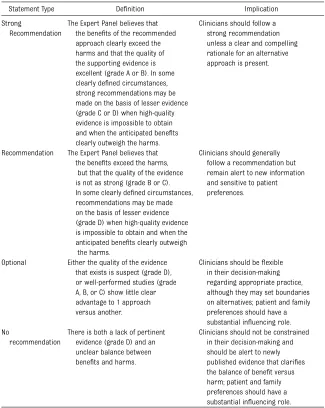
This distinction is critical in any pedi-atric guideline, because there are ele-ments of both risk and benefit that simply cannot be assessed, because these events are so far downstream. One could easily argue that the initiation of pharmacologic treatment to lower blood pressure or cholesterol would have much greater benefit if initiated earlier than later in the atherosclerotic process; conversely the impact of side effects from decades of use of a phar-macologic agent, the possibility of in-creased costs for insurance coverage, or social stigma attached to chronic TABLE 3 Guideline Definitions for Evidence-Based Statements
Statement Type Definition Implication
Strong
Recommendation
The Expert Panel believes that the benefits of the recommended approach clearly exceed the harms and that the quality of the supporting evidence is excellent (grade A or B). In some clearly defined circumstances, strong recommendations may be made on the basis of lesser evidence (grade C or D) when high-quality evidence is impossible to obtain and when the anticipated benefits clearly outweigh the harms.
Clinicians should follow a strong recommendation unless a clear and compelling rationale for an alternative approach is present.
Recommendation The Expert Panel believes that the benefits exceed the harms,
but that the quality of the evidence is not as strong (grade B or C). In some clearly defined circumstances, recommendations may be made on the basis of lesser evidence (grade D) when high-quality evidence is impossible to obtain and when the anticipated benefits clearly outweigh
the harms.
Clinicians should generally follow a recommendation but remain alert to new information and sensitive to patient preferences.
Optional Either the quality of the evidence that exists is suspect (grade D), or well-performed studies (grade A, B, or C) show little clear advantage to 1 approach versus another.
Clinicians should beflexible in their decision-making regarding appropriate practice, although they may set boundaries on alternatives; patient and family preferences should have a substantial influencing role. No
recommendation
There is both a lack of pertinent evidence (grade D) and an unclear balance between benefits and harms.
medication use from an early age might negate these benefits.
There are also unusual scenarios that develop when there is no perceived risk to an intervention. For example, anti-tobacco counseling has no risk and a small benefit demonstrated in ran-domized trials. However, in the context of the time available to a practitioner for a health maintenance visit, is the po-tential tobacco-counseling success rate sufficiently high to compromise other important counseling opportunities that might be lost if the focus of the visit is tobacco?
Specific Circumstances
Although evidence that a particular intervention is highly successful might exist, that intervention may not be gen-eralizable to a pediatric setting. Tobacco again provides a useful example, because successful behavioral and pharmaco-logic interventions exist in young adults with evidence that is grade A; however, comparable trials may not have been performed in adolescents or in specific pediatric age ranges.
Social Role of Physicians
Finally, and impossible to evaluate in an evidence paradigm, is the social role physicians play in health promotion. The absence of a proven effective treat-ment by a randomized trial for a rec-ognized health problem does not mean that patients will not still present with this concern and expect well-informed medical guidance. For example, behav-ioral interventions to address obesity in a primary practice setting are often ineffective in trials; however, the fault may not be with the specific intervention but with the ability of the patient and family to comply. Thus, the panel felt compelled to provide information as part of the report on potentially effi -cacious treatments despite the fact that implementing these strategies may of-ten be difficult.
CRITIQUE OF THE CURRENT GUIDELINE
The guideline development process ended in October 2008, and guideline publication has taken a considerable time since the formal work was con-cluded. Some of this delay was antici-pated, because a period of time for public comment was part of the formal evaluation process. However, delays related to additional governmental re-view were unanticipated. One positive aspect of the extensive review process is the fact that few of the reviewers, now numbering well into the hundreds, have suggested altering the basic recom-mendations. This suggests that, with regard to CV risk prevention, there is consensus about what needs to be ac-complished with lingering questions relating to the timing and intensity of risk modification required, the role of public health policy versus physician practice, and identification of the best methods to achieve desired goals. It is now reasonable to ask what could have been done differently and how could the process be improved.
Critical to guideline development from an evidence base is the formulation of the initial questions for evidence review. The cost-benefit of proposed recommendations was not included initially, because there is not a large literature on cost of CVD prevention beginning in youth. Thus, an additional section on issues related to screening for CVD risk was included. It is hoped that publication of the report will stimulate research specifically addressing cost or cost-benefit analysis.
There is now a substantial time gap between the closure of the evidence re-view and publication of the report. For-tunately, subsequent research reports have supported the recommendations in the guidelines. An example is the Na-tional Institute for Health and Clinical Excellence guideline from Great Britain on familial hypercholesterolemia.23In
Europe, recommendations for managing familial hypercholesterolemia, a genetic disorder affecting∼1:500 in the general population are considered separately from population-based guidelines for lipid management. The National Institute for Health and Clinical Excellence guide-line includes a cost-benefit analysis of management of genetic dyslipidemia. This perspective is different than the perspective considered in US guide-lines and in this evidence review, which is based purely on lipid levels without considering underlying causes. In ad-dition, the new guidelines limited the evidence review with regard to blood pressure. This was because, in 2006, when development of these guidelines began, the fourth report on blood pressure in childhood had just been released.2Even though this was not an evidence-based document, clinical trial information on blood pressure treatment was evaluated in the report. A full evidence-based review of blood pressure treatment will be necessary in the future.
The prevalence of diabetes mellitus, both type 1 and type 2, is increasing in the United States, and much recent re-search has been devoted to associated CV morbidity. Future guidelines will need to consider diabetes more explicitly than previously.
fact that it was impossible to directly relate diet or physical activity to impor-tant end points such as premature ath-erosclerosis.
An ongoing process of evidence review is essential because atherosclerotic CVD remains the leading cause of death in North America; evidence that this process begins in childhood and is accelerated by the presence and in-tensity of known risk factors continues to appear; and there is an increasing body of evidence addressing CV risk reduction in childhood. Continuing sur-veillance of the literature will allow guideline recommendations to be upda-ted as evidence develops. The evidence review could be sustained by using a re-vision of the current critical questions. The Expert Panel could be maintained with an established process for rotating membership and adding new repre-sentatives to sustain the high level of expertise, diversity, stakeholder repre-sentation, and energy that characterized development of the current guidelines. The panel could meet annually to review the accumulated evidence, add new areas for inclusion in the evidence review and/or new critical questions, and determine when new recommendations are needed. Disbanding the current panel will ne-cessitate a completely new evidence re-view process for development of future recommendations.
SUMMARY
This article has reviewed aspects of development of evidence-based CVD prevention guidelines for pediatric care providers that remain in the area of human judgment probing issues related to construction of an evidence
evaluation paradigm and post hoc issues that arise where competing consid-erations must be weighed beforefinal recommendations can be developed. Tables 4 and 5 provide a synthesis of guidance from this article for both practitioners and those developing guidelines. There are 3 main lessons from this experience. First, in the con-temporary era, a formal evidence re-view process is essential to developing a credible document. Second, even with a formal and objective review of the ev-idence, human judgment is critical to produce a meaningful result. Third, and implicit to the discussion, is recogni-tion that guideline development is a dy-namic process that must be continuously self-critical: new evidence is acquired, new sociopolitical and environmental
contexts evolve, and human judgment is fallible.
ACKNOWLEDGMENTS
The authors thank the members of the 2011 Expert Panel on Integrated Guidelines for Cardiovascular Health and Risk Reduction in Children and Adolescents panel for their review of this manuscript and for being great colleagues: Irwin Benuck, MD, PhD; Dimitri Christakis, MD, MPH; Barbara Dennison, MD; Matthew Gillman, MD, MS; Mary Gottesman, PhD, RN, CPNP; Peter Kwiterovich, MD; Patrick McBride, MD, MPH; Brian McCrindle, MD, MPH; Chris O’Donnell MD; Albert Rocchini, MD; Elaine Urbina, MD; Linda Van Horn, PhD, RD; and Reginald Washington, MD.
REFERENCES
1. Expert Panel on Integrated Guidelines
for Cardiovascular Health and Risk Re-duction in Children and Adolescents. Ex-pert Panel on Integrated Guidelines for
Cardiovascular Health and Risk
Reduc-tion in Children and Adolescents: sum-mary report.Pediatrics.2011;128(suppl 5): S213–S256
2. National High Blood Pressure Education
Program Working Group on High Blood Pressure in Children and Adolescents. The fourth report on the diagnosis, evaluation, TABLE 4 How Clinicians Can Use the 2011 NHLBI Pediatric Cardiovascular
Risk Reduction Guideline
•Follow the short 1-page summary, integrated with Bright Futures, to determine everyday CVD prevention practice
•Read the introduction and background to understand the Guideline development process and understand the relationship of risk factors in youth to early atherosclerosis development
•Read the individual sections for an in-depth discussion of individual risk factors, evidence evaluation, and supporting data
•Use the guideline as support while developing clinical experience in risk factor management
•Consult the references for a more complete understanding of the science and gaps in science
TABLE 5 Considerations for Future Guideline Development Based on Current Experience
•Stay current with guideline development research and policy
•Write for your intended audience, but understand that the guideline might be used by a much broader audience
•Define critical questions carefully; the structure of the literature search will define the scope of the guideline; key literature and areas of research might be missed without proper questions
•Understand the scope of recommendations that will be required before starting the evidence review, but do not develop recommendations until after the evidence review
•Establish sufficient diversity in the review panel to include both scientific expertise and input from stakeholders, defined as broadly as possible; a strong internal critique of the guideline is important before external review
•Define rules for evidence selection/evaluation and then FOLLOW THE RULES
and treatment of high blood pressure in children and adolescents.Pediatrics. 2004; 114(suppl 2):5552576
3. American Academy of Pediatrics. National Cholesterol Education Program: report of the Expert Panel on Blood Cholesterol Levels in Children and Adolescents. Pedi-atrics. 1992;89(3 pt 2):525–584
4. Appraisal of Guidelines for Research and Evaluation (AGREE). 2011. Available at: www. agreetrust.org/. Accessed October 1, 2011
5. Institute of Medicine.Clinical Practice Guide-lines We CanTrust. Washington, DC: The Na-tional Academies Press; 2011
6. McGill HC Jr, McMahan CA, Gidding SS. Preventing heart disease in the 21st cen-tury: implications of the Pathobiological De-terminants of Atherosclerosis in Youth (PDAY) study.Circulation. 2008;117(9):1216–1227
7. American Academy of Pediatrics Commit-tee on Nutrition. Prudent life-style for chil-dren: dietary fat and cholesterol.Pediatrics. 1986;78(3):521–525
8. Grundy SM, Bilheimer D, Blackburn H, et al; Report of Nutrition Committee. Rationale of the diet-heart statement of the American Heart Association. Circulation. 1982;65(4): 839A–854A
9. Health and health care. Available at: http:// rand.org/research_areas/health/. Accessed October 1, 2011
10. The Cochrane Collaboration. Available at: http://www.cochrane.org. Accessed October 1, 2011
11. Children and families. Available at: http:// www.rand.org/topics/children-and-families. html. Accessed October 1, 2011
12. Holt K, Wooldridge NH, Story M, Sofka D.
Bright Futures Nutrition. 3rd ed. Elk Grove Village, IL: American Academy of Pediatrics; 2011.
13. Bergman DA. Evidence-based guidelines and critical pathways for quality improve-ment.Pediatrics. 1999;103(1 suppl E):225– 232
14. American Academy of Pediatrics Steering Committee on Quality Improvement and Man-agement. Classifying recommendations for clinical practice guidelines.Pediatrics. 2004; 114(3):874–877
15. Haney EM, Huffman LH, Bougatsos C, Freeman M, Steiner RD, Nelson HD. Screening and treatment for lipid disorders in children and adolescents: systematic evidence re-view for the US Preventive Services Task Force.Pediatrics. 2007;120(1). Available at: www.pediatrics.org/cgi/content/full/120/ 1/e189
16. Berenson GS, Srinivasan SR, Bao W, Newman WP III, Tracy RE, Wattigney WA. Associa-tion between multiple cardiovascular risk factors and atherosclerosis in children and young adults. The Bogalusa Heart Study. N Engl J Med. 1998;338(23):1650– 1656
17. Gidding SS, McMahan CA, McGill HC, et al. Prediction of coronary artery calcium in young adults using the Pathobiological Determinants of Atherosclerosis in Youth (PDAY) risk score: the CARDIA study.Arch Intern Med. 2006;166(21):2341–2347
18. Urbina EM, Williams RV, Alpert BS, et al; American Heart Association Atherosclero-sis, Hypertension, and Obesity in Youth
Committee of the Council on Cardiovas-cular Disease in the Young. Noninvasive assessment of subclinical atherosclerosis in children and adolescents: recommen-dations for standard assessment for clini-cal research: a scientific statement from the American Heart Association. Hypertension. 2009;54(5):919–950
19. Greenland P, Polonsky TS. Time for a policy change for coronary artery calcium testing in asymptomatic people?J Am Coll Cardiol. 2011;58(16):1702–1704
20. McMahan CA, Gidding SS, Malcom GT, et al; Pathobiological Determinants of Athero-sclerosis in Youth (PDAY) Research Group. Comparison of coronary heart disease risk factors in autopsied young adults from the PDAY Study with living young adults from the CARDIA study.Cardiovasc Pathol. 2007;16(3): 151–158
21. Lewis SJ. Mendelian randomization as ap-plied to coronary heart disease, including recent advances incorporating new tech-nology. Circ Cardiovasc Genet. 2010;3(1): 109–117
22. Daniels SR, Gidding SS, de Ferranti SD; National Lipid Association Expert Panel on Familial Hypercholesterolemia. Pediatric aspects of familial hypercholesterolemias: recommendations from the National Lipid Association Expert Panel on Familial Hyper-cholesterolemia.J Clin Lipidol. 2011;5(suppl 3): S30–S37
DOI: 10.1542/peds.2011-2903 originally published online April 9, 2012;
2012;129;e1311
Pediatrics
on Cardiovascular Health and Risk Reduction in Youth
Samuel S. Gidding, Stephen R. Daniels, Rae Ellen W. Kavey and for the Expert Panel
Reduction
Developing the 2011 Integrated Pediatric Guidelines for Cardiovascular Risk
Services
Updated Information &
http://pediatrics.aappublications.org/content/129/5/e1311 including high resolution figures, can be found at:
References
http://pediatrics.aappublications.org/content/129/5/e1311#BIBL This article cites 17 articles, 10 of which you can access for free at:
Subspecialty Collections
http://www.aappublications.org/cgi/collection/cardiology_sub
Cardiology
http://www.aappublications.org/cgi/collection/surgery_sub
Surgery
following collection(s):
This article, along with others on similar topics, appears in the
Permissions & Licensing
http://www.aappublications.org/site/misc/Permissions.xhtml in its entirety can be found online at:
Information about reproducing this article in parts (figures, tables) or
Reprints
DOI: 10.1542/peds.2011-2903 originally published online April 9, 2012;
2012;129;e1311
Pediatrics
on Cardiovascular Health and Risk Reduction in Youth
http://pediatrics.aappublications.org/content/129/5/e1311
located on the World Wide Web at:
The online version of this article, along with updated information and services, is
by the American Academy of Pediatrics. All rights reserved. Print ISSN: 1073-0397.