Development of Attention Problems
WHAT’S KNOWN ON THIS SUBJECT: Television exposure is associated with attention problems in children.
WHAT THIS STUDY ADDS: The association of video games and attention problems is similar to the association of television and attention problems. These associations appear in middle childhood and late adolescence/early adulthood.
abstract
OBJECTIVES:Television viewing has been associated with greater sub-sequent attention problems in children. Few studies have examined the possibility of a similar association between video games and attention problems, and none of these has used a longitudinal design.
METHODS:A sample of 1323 middle childhood participants were as-sessed during a 13-month period by parent- and child-reported televi-sion and video game exposure as well as teacher-reported attention problems. Another sample of 210 late adolescent/early adult partici-pants provided self-reports of television exposure, video game expo-sure, and attention problems.
RESULTS:Exposure to television and video games was associated with greater attention problems. The association of television and video games to attention problems in the middle childhood sample remained significant when earlier attention problems and gender were statisti-cally controlled. The associations of screen media and attention prob-lems were similar across media type (television or video games) and age (middle childhood or late adolescent/early adult).
CONCLUSIONS:Viewing television and playing video games each are associated with increased subsequent attention problems in child-hood. It seems that a similar association among television, video games, and attention problems exists in late adolescence and early adulthood. Research on potential risk factors for attention problems should be expanded to include video games in addition to television.
Pediatrics2010;126:214–221
AUTHORS:Edward L. Swing, MS,aDouglas A. Gentile,
PhD,a,bCraig A. Anderson, PhD,a,cand David A. Walsh,
PhDb
aDepartment of Psychology, Iowa State University, Ames, Iowa; bNational Institute of Media and the Family, Minneapolis,
Minnesota; andcCenter for the Study of Violence, Ames, Iowa
KEY WORDS
attention deficit, television, video games
ABBREVIATIONS
ADHD—attention-deficit/hyperactivity disorder ASRS—Adult ADHD Self-Report Scale BSCS—Brief Self-Control Scale BIS-11—Barratt Impulsiveness Scale 11 OR— odds ratio
CI— confidence interval
AAP—American Academy of Pediatrics
www.pediatrics.org/cgi/doi/10.1542/peds.2009-1508
doi:10.1542/peds.2009-1508
Accepted for publication Apr 15, 2010
Address correspondence to Edward L. Swing, MS, Iowa State University, W112 Lagomarcino Hall, Department of Psychology, Ames, IA 50011-3180. E-mail: [email protected]
PEDIATRICS (ISSN Numbers: Print, 0031-4005; Online, 1098-4275).
Copyright © 2010 by the American Academy of Pediatrics
Attention problems, often manifested in the form of attention-deficit/hyper-activity disorder (ADHD), are associ-ated with negative outcomes for chil-dren and adolescents, including poorer school performance and in-creased aggression.1,2 Research has
examined exposure to television and video games in childhood and adoles-cence as a potential risk factor for sub-sequent attention problems.3–18It has
been hypothesized that most television shows are so exciting that children who frequently watch television have more difficulty paying attention to less exciting tasks (eg, school work).3
Oth-ers have hypothesized that because most television programs involve rapid changes in focus, frequent exposure to television may harm children’s abilities to sustain focus on tasks that are not inherently attention-grabbing.14
Most research on media and attention has looked exclusively at television, yet there are conceptual reasons to sus-pect that video games could show a similar pattern. Many video games seem to share many features (eg, high excitement, rapid changes in focus) that have been identified as potentially relevant to the television association with attention problems, making a similar association between video game playing and attention problems plausible. Most cross-sectional stud-ies (single time point) have found tele-vision exposure to be associated with greater attention problems.4–7
Longitu-dinal studies of television viewing have generally found a similar link, provid-ing evidence that television viewprovid-ing is a risk factor for subsequent attention problems3,8–11; however, a few studies
have not found a statistically signifi-cant association (single time point or longitudinal) between television view-ing and attention problems.12–14Fewer
studies to date have examined the pos-sibility that video games can produce a
similar increase in attention prob-lems. Some single time point studies found an association between video game playing and attention problems and/or ADHD diagnoses.10,17,18 Other
studies associated violent television and/or video game playing with poorer executive functioning and proactive cognitive control, which may be re-lated to attention problems.19,20 More
research is clearly needed to examine the effects of video game playing on attention problems, particularly by us-ing longitudinal designs.*
Although some research has indicated that television increases attention problems only among children in the first 3 years of life,3,11others have not
found evidence for this early childhood vulnerability.10 Some other studies
have found prospective effects of tele-vision exposure on attention problems in adolescent samples, providing addi-tional evidence that television viewing may increase attention problems be-yond early childhood.8,9Given these
dif-fering findings, more longitudinal re-search is necessary to provide a more complete picture of the ages at which screen media can influence attention problems. Furthermore, only 1 pub-lished study has examined television exposure in relation to attention prob-lems beyond age 16.9 More research
with samples of late adolescents and adults would be valuable in establish-ing the persistence of the association of television exposure and attention problems into late adolescence and early adulthood. These studies ad-dressed 3 questions: (1) Are both tele-vision and video game exposures asso-ciated with greater concurrent attention problems? (2) Are television
and video game use associated with changes in attention problems over time in middle childhood? (3) Are asso-ciations of television and video game exposures with attention problems different in middle childhood com-pared with late adolescence/early adulthood?
METHODS
Participants
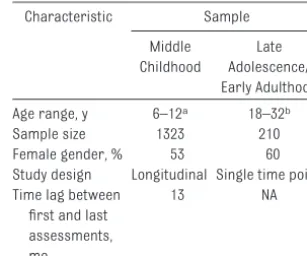
This research includes 2 samples of males and females: 1 sample from middle childhood and another sample from late adolescence/early adult-hood. Table 1 displays sample sizes, gender composition, and age ranges for these 2 samples. The middle child-hood sample was recruited from 10 schools in 2 Midwestern US states. The data for this sample were collected as part of the SWITCH obesity prevention project.25This intervention had 3 major
goals: reducing screen media expo-sure, increasing physical activity, and increasing fruit and vegetable con-sumption. These children were third-grade (430), fourth-third-grade (446), and fifth-grade (423) students at the initial *Other studies have identified improvements in visual
attention after repeated video game playing21–24;
how-ever, it should be noted that these improvements in visual attention consist of the rapid and accurate ex-traction and processing of information from the vi-sual field, abilities quite distinct from the attention problems that are associated with disorders such as ADHD.
TABLE 1 Sample Characteristics
Characteristic Sample Middle Childhood Late Adolescence/ Early Adulthood Age range, y 6–12a 18–32b
Sample size 1323 210 Female gender, % 53 60 Study design Longitudinal Single time point Time lag between
first and last assessments, mo
13 NA
NA indicates not applicable.
aAge is reported as measured at the first wave of data
collection. A total of 98.8% of this sample was between 8 and 11 years at this time. Analysis that excluded those who were younger than 8 or older than 11 did not differ mean-ingfully from analysis that used the full sample; therefore, participants of all ages were included in the reported analyses.
bA total of 96.2% of this sample was between 18 and 24
years at the time of assessment. Excluding those who were older than 24 years did not meaningfully change the re-sults of the analyses; therefore, participants of all ages were included in the reported analyses.
parents, and teachers at 4 points dur-ing a 13-month period (only 3 time points include all measures).† The 13-month follow-up rates for children, parents, and teachers were 86%, 70%, and 88%, respectively.
The late adolescent/early adult sample consisted of undergraduate students from a large public research univer-sity in the Midwestern United States (mean age: 19.8 years). This sample was assessed in a single laboratory session. These participants were recruited from introductory psychol-ogy courses and received partial course credit for their participation. All ethical procedures of the American Psychological Association were fol-lowed, and local institutional review board approval was obtained.
Television and Video Game Exposure
Both samples completed similar mea-sures of television viewing and video game playing.26 Television exposure
was based on the average time spent on weekdays during 4 time periods (6
AMto 12PM, 12PMto 6PM, 6PMto 12AM, and 12AMto 6AM) and separately on weekends during those same 4 time periods. These questions were then re-peated for video game exposure. In the middle childhood sample, both par-ents and children completed these questions regarding the child’s weekly television and video game exposure.‡
and video game exposure were completed.
Attention Problems
Attention problems were assessed in the childhood sample by teacher re-port. Teachers answered 3 items that measured attention problems in the classroom on a 5-point scale, with re-sponses ranging from “never true” to “almost always true” (eg, “This child: has difficulty staying on task; has diffi-culty paying attention; often interrupts other children’s work.”). These items showed good internal reliability (␣⫽ .91 at time 1 and .92 at time 4). Atten-tion problems were assessed in the late adolescent/early adult sample by using a composite of 3 self-report mea-sures: the Adult ADHD Self-Report Scale (ASRS; 18 items), the Brief Self-Control Scale (BSCS; 13 items), and the Barratt Impulsiveness Scale (BIS-11; 30 items).27–29 The ASRS, BSCS, and
BIS-11 all showed good internal reli-ability coefficients (␣⫽ .89, .85, and .84, respectively) in this sample. Miss-ing values on these scales were re-placed with mean response for the item for participants who were miss-ing no more than 20% of the items on the scale. The ASRS is intended as a screening tool for ADHD, showing con-vergent validity with clinical ADHD di-agnosis, suggesting a clear conceptual link to attention problems.26
De-creased ability to exert self-control and a tendency to behave in more im-pulsive ways are viewed by some re-searchers as a central impairment in ADHD,30 suggesting the potential
use-fulness of measures of trait self-control (BSCS) and impulsiveness (BIS-11) in identifying those with atten-tion problems. In this sample, the
values ofr from 0.65 to 0.75), and all were moderately correlated with self-reports of a past diagnosis with an at-tention disorder, such as atat-tention- attention-deficit disorder or ADHD (absolute values of r from 0.23 to 0.36). Each scale total was converted to a stan-dard score, and these scores were av-eraged (with self-control reversed) to form a measure of attention problems.
RESULTS
To examine the strength of the overall association between various types of media exposure and concurrent atten-tion problems, we computed correla-tion coefficients among weekly televi-sion exposure, weekly video game exposure, weekly total screen media exposure (ie, combined weekly televi-sion and video game exposure), and attention problems within the middle childhood and late adolescent/early adult samples. Table 2 reports these correlation coefficients and corre-sponding odds ratios (ORs).31§
Televi-sion exposure and video game expo-sure showed small to moderate correlations with concurrent attention problems in both samples (rbetween 0.17 and 0.23), with substantially over-lapping confidence intervals (CIs) across samples and type of screen media.
Because the data from these samples (particularly the middle childhood sample) are potentially relevant to the American Academy of Pediatrics (AAP) recommendation that children spend no more than 2 hours per day with tele-vision and video games combined, we computed logistic regressions com-paring the risk for being above the me-†Correlational analyses for this sample are based
on a weighted average of the 3 time points contain-ing relevant data. Only the baseline and final as-sessment are used in longitudinal analyses. The concurrent and time-lagged associations of televi-sion, video games, and attention problems were not meaningfully different between the interven-tion and control groups, so data that are based on the full sample are used in all reported analyses. ‡There was no a priori reason to consider 1 re-porter more accurate (children may have difficulty estimating or bias their responses, but parents may be unaware of their child’s behavior or simi-larly bias their responses), so an average weekly
amount was calculated by averaging the parent and child reports. Very similar results for the key analyses were obtained with only parent or only child reports of television/video game exposure.
dian in attention problems for partici-pants above and below the AAP-recommended television and video game levels.32,33 Those who exceeded
the AAP-recommended amount of daily television and video game exposure were more likely to be above average in attention problems (ORs: 1.67 [95% CI: 1.27–2.21] and 2.23 [95% CI: 1.13– 4.39]) for the middle childhood and late adolescent/early adult samples, respectively.储
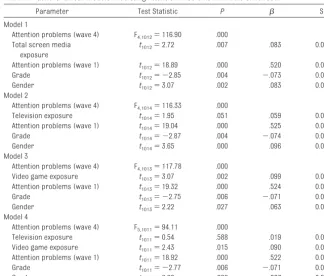
General linear models were computed to examine the longitudinal associa-tions of television and video game ex-posure with attention problems in the middle childhood sample (Table 3) and to control statistically for gender and grade level in both samples (Tables 3 and 4).¶ These general linear models
and all other subsequent analyses are based on continuous predictor and outcome variables. Such models
pro-vide more sensitive tests of the hypoth-eses than the logistic models, because they use information in the data that dichotomous logistic analyses ignore.
Models 1 through 4 (Table 3) examined the middle childhood participants’
teacher-reported attention problems at time 4, including gender, grade, and teacher-reported attention problems at time 1 as covariates to provide more
rigorous tests. Across models 1
储Similar estimates can be obtained for the risk for being above the 95th percentile in attention prob-lems (which should more closely match the preva-lence of ADHD in these populations) on the basis of being above or below the AAP-recommended amount of screen media exposure (ORs: 2.05 and 2.92 for the middle childhood and late adolescent/ early adult samples, respectively). Given the rela-tively small numbers of those with such high levels of attention problems in these samples, the power for this analysis is considerably reduced, giving these estimates much wider 95% CIs (1.00 to 4.25 and 0.36 to 23.44 for the middle childhood and late adolescent samples, respectively).
¶We also tested the possibility that the effect of addi-tional screen time on later attention problems occurs only for those whose screen time is relatively high, by including a quadratic term in preliminary screen time analyses. There was no evidence of a curvilinear ef-fect of screen time, so the quadratic terms were dropped in all reported analyses.
TABLE 2 Amount of Media Exposure Associations With Concurrent Attention Problems
Parameter Mean Daily Exposure
Median Daily Exposure
Correlation Coefficient,
r
95% CI OR 95% CI
Middle childhood sample
Television exposure 2.92 2.29 0.17 0.11–0.23 1.55 1.33–1.79 Video game exposure 1.34 0.66 0.23 0.18–0.29 1.82 1.57–2.11 Total screen media exposure 4.26 3.86 0.23 0.17–0.29 1.81 1.56–2.11 Late adolescent/early adult
sample
Television exposure 3.75 3.29 0.20 0.07–0.33 1.68 1.19–2.37 Video game exposure 1.07 0.29 0.23 0.10–0.36 1.82 1.29–2.56 Total screen media exposure 4.82 4.36 0.27 0.14–0.40 2.04 1.45–2.88
Correlation coefficients are based on analysis of continuous variables; ORs are based on a median splits of media and attention variables. Means and medians of daily exposure are included to provide context.
TABLE 3 General Linear Models Predicting Attention Problems in Middle Childhood
Parameter Test Statistic P  SE
Model 1
Attention problems (wave 4) F4,1012⫽116.90 .000 Total screen media
exposure
t1012⫽2.72 .007 .083 0.031
Attention problems (wave 1) t1012⫽18.89 .000 .520 0.028
Grade t1012⫽ ⫺2.85 .004 ⫺.073 0.026
Gender t1012⫽3.07 .002 .083 0.027
Model 2
Attention problems (wave 4) F4,1014⫽116.33 .000
Television exposure t1014⫽1.95 .051 .059 0.030 Attention problems (wave 1) t1014⫽19.04 .000 .525 0.028
Grade t1014⫽ ⫺2.87 .004 ⫺.074 0.026
Gender t1014⫽3.65 .000 .096 0.026
Model 3
Attention problems (wave 4) F4,1013⫽117.78 .000
Video game exposure t1013⫽3.07 .002 .099 0.032 Attention problems (wave 1) t1013⫽19.32 .000 .524 0.027
Grade t1013⫽ ⫺2.75 .006 ⫺.071 0.026
Gender t1013⫽2.22 .027 .063 0.028
Model 4
Attention problems (wave 4) F5,1011⫽94.11 .000
Television exposure t1011⫽0.54 .588 .019 0.035 Video game exposure t1011⫽2.43 .015 .090 0.037 Attention problems (wave 1) t1011⫽18.92 .000 .522 0.028
Grade t1011⫽ ⫺2.77 .006 ⫺.071 0.026
Gender t1011⫽2.29 .022 .067 0.029
TABLE 4 General Linear Models Predicting Attention Problems in Late Adolescence/Early Adulthood
Parameter Test Statistic P  SE
Model 5
Attention problems F3,203⫽5.21 .002
Total screen media exposure t203⫽3.62 .000 .257 0.071
Age t203⫽ ⫺0.11 .916 ⫺.007 0.069
Gender (female⫽0, male⫽1) t203⫽0.50 .620 .036 0.072 Model 6
Attention problems F4,203⫽4.12 .003
Television exposure t202⫽2.17 .031 .152 0.070 Video game exposure t202⫽2.55 .012 .198 0.078
Age t202⫽ ⫺0.06 .953 ⫺.004 0.069
Gender (female⫽0, male⫽1) t202⫽0.13 .898 .010 0.077
tention problems (rfrom 0.52 to 0.53), showing high stability of attention problems over time, as would be ex-pected. Gender also showed a positive association with attention problems in models 1 through 4 (r from 0.06 to 0.10), indicating that males were more likely than females to experience in-creased attention problems from time 1 to time 4. Grade level at time 1 was negatively associated with changes in attention problems (r from ⫺0.07 to ⫺0.08), indicating that children in the lower grade were more likely than those in the higher grades to experi-ence increased attention problems from time 1 to time 4.
Model 1 showed that total screen me-dia exposure (television and video games combined) was associated with greater subsequent attention prob-lems, even after controlling for gen-der, grade, and time 1 attention prob-lems. Models 2 and 3 showed that both television and video game exposures were separately associated with greater time 4 attention problems, al-though television exposure was only a marginally significant predictor in model 2 (P⫽.051). Model 4 includes television exposure and video game ex-posure as separate, unique predictors of attention problems. These are con-servative tests of the unique associa-tions of television and video game ex-posure with attention, because the collinearity of these types of media (r⫽0.46) reduces their ability to pre-dict attention problems uniquely. In model 4, video game exposure but not television exposure remained a signif-icant unique predictor of time 4 atten-tion problems. This indicates that ex-posure to video games was a more robust predictor of attention problems in this sample.
Models 5 and 6 (Table 4) tested the concurrent association between
tele-unique predictors) and attention prob-lems in the late adolescent/early adult sample, with participants’ age and gender included as covariates. In the late adolescent/early adult sample, both television and video game expo-sure uniquely predicted attention problems. Neither age nor gender was associated with attention problems in the late adolescent/early adult sample (r⬍0.04). Exposures to television and video games both were associated with greater attention problems when combined (model 5) or as unique pre-dictors (model 6).
To illustrate further the association of television and video game exposure on later attention problems, we gener-ated a maximum likelihood structural equation model on the basis of 3 sepa-rate correlation matrices (1 for each grade of the middle childhood sample) by using LISREL 8.5 procedures (Fig 1).34This model fit the data quite well
(2(19)⫽ 17.93, P⬎.50, normed fit
index (NFI)⫽0.967, comparative fit in-dex (CFI) ⫽1.000, root mean square error of approximation (RMSEA) ⫽ 0.000, 90% CI: 0.000 – 0.044). Allowing the path from total screen media expo-sure at time 1 to time 4 attention prob-lems to vary by gender or by grade level did not improve model fit
level do not moderate this effect. In other words, the longitudinal effect of time spent watching television and playing video games was essentially the same for boys and girls and for third-, fourth-, and fifth-graders.
DISCUSSION
In addition to replicating some past re-search on television exposure in chil-dren, these studies fill several impor-tant gaps in the research literature on screen media and attention problems. First, these studies demonstrate that amount of time spent playing video games is associated with greater at-tention problems. Second, the video game association to attention prob-lems was similar in magnitude to the television association. In fact, the video game association in the middle child-hood sample proved more reliable than the television association to at-tention problems, but caution is war-ranted in drawing conclusions about the relative importance of video game playing and television viewing on the basis of these data. In the late adoles-cent/early adult sample, both televi-sion viewing and video game playing were uniquely associated with atten-tion problems. In both samples, the to-tal time spent with screen media (both
Attention Problems Sex
Female = 0 Male = 1
Total Screen Media Exposure
Attention Problems
Time 1 13 months Time 4 .22
.18
.55 .10 .21
FIGURE 1
television and video games) was posi-tively related to attention problems. Future research should include more detailed measures of both television and video game exposure to deter-mine which features (eg, rapid scene changes) are most important. It may also prove useful to examine other forms of electronic media use (eg, films, music, cellular telephones) for similar associations with attention problems.
The middle childhood sample provided a third important new finding. Expo-sure to screen media was associated with later attention problems even when earlier attention problems and gender were statistically controlled. This provides stronger evidence than analyses of single time point data that screen media may influence attention problems; controlling for earlier atten-tion problems makes it less likely that the association of each type of medium with attention problems is attributable to other potential influences on atten-tion problems. For example, it rules out the possibility that the association between screen media use and atten-tion problems is merely the result of children with attention problems be-ing especially attracted to screen me-dia. To our knowledge, no previous lon-gitudinal study has examined video game playing and subsequent atten-tion problems. These studies provide some early evidence that video game playing in middle childhood may in-crease later attention problems.
It should be noted that the for the time-lagged association of television and video game exposure (⫽.10) is relatively small and that the link be-tween initial attention problems and attention problems 13 months later (⫽.55) is large. This suggests con-siderable stability of attention prob-lems over this period. It may be, as some authors have contended, that at-tention problems are less malleable
after early childhood.3 Nonetheless,
public health concerns (eg, the effect of lead intake on IQ in children) are often based on small effect sizes, and even such a small effect may be of con-siderable social importance given the ubiquity of television and video games.35**
A fourth important finding is that tele-vision viewing and video game playing were associated with attention prob-lems in both middle childhood and late adolescent/early adult samples. That these associations were very similar in strength is somewhat surprising, given the different methods of assess-ment used in each sample: self-report, parent report, and teacher reports among children compared with self-report only among adolescents/young adults. These similar associations across age groups raise an important possibility about the persistence of television or video game exposure ef-fects on attention problems. Whatever the ages at which watching television or playing video games may increase attention problems, the consequences may be quite long lasting or cumula-tive. Longer term longitudinal studies, perhaps including a randomly as-signed intervention, are needed to test these hypotheses.
Although these studies provide use-ful evidence for television and video game effects on attention problems, there are several limitations. Be-cause both studies rely on correla-tional data rather than randomly as-signed treatments, this limits the ability to make causal conclusions. Some unmeasured variable that is systematically associated with
tele-vision or video game exposure may account for some of the changes in attention problems. Controlling for earlier attention problems in the middle childhood sample likely re-moves the effects of most other influ-ences on attention problems, but it cannot account for variables that had a new impact on attention prob-lems between initial and final mea-surements of attention problems (eg, if children began taking medica-tions for attention disorders during the study). The late adolescent/early adult sample is measured at a single time point, making conclusions about the direction of causality inap-propriate within this sample.
Another limitation of these studies is that the television and video game exposure measures were global. It is possible that certain types of televi-sion programs and video games are associated with attention problems whereas others are not. For exam-ple, there is some evidence that edu-cational television is not associated with increased attention problems.10
Educational television may differ from noneducational television in terms of pacing or violent content or other features (although we are not aware of any evidence to date of such differences), which might account for such a difference. Similarly, there are many differences in fea-tures among video games, differ-ences that may lead to differential effects on attention problems. As fu-ture research examines television and video games and their influence on attention problems, differences that are based on finer grained anal-yses of screen media features should be examined.
Despite these limitations, these stud-ies extend knowledge about television and video game effects on attention problems. There are several areas in which additional research would be **Also, note that theof .10 represents a very
con-servative estimate of the potential effect of screen media exposure on attention problems. Just as the simple correlation of .23 may include variance that is not attributable to the predictor and thus be an overestimation of the true effect, the partial corre-lations ands may exclude some variance that actually is attributable to the predictor and thus be an underestimation.
to replicate the findings of a video game playing association with atten-tion problems in other longitudinal samples. Most of the research evi-dence thus far supports the conclu-sion that exposure to televiconclu-sion and video games increases the risk for subsequent attention problems. These studies demonstrate that the
AAP to limit children’s exposure to television and video games to no more than 2 hours per day.32,33
Fur-thermore, there are theoretical rea-sons to believe that slower paced ed-ucational, nonviolent content is less likely to cause attention problems, but more studies on this issue are especially needed.
Data for the middle childhood sample were partially sponsored by Medica Foundation, Healthy and Active Amer-ica Foundation, Fairview Health Ser-vices, and Cargill, Inc. Switch active lifestyles from MediaWise is a
regis-tered trademark of the National Institute on Media and the Family (Minneapolis, MN).
REFERENCES
1. Barry TD, Lyman RD, Klinger LG. Academic underachievement and attention-deficit/ hyperactivity disorder: the negative impact of symptom severity on school perfor-mance.J Sch Psychol.2002;40(3):259 –283 2. Mannuzza S, Klein RG, Abikoff H, Moulton JL.
Significance of childhood conduct prob-lems to later development of conduct disor-der among children with ADHD: a prospec-tive follow-up study. J Abnorm Child Psychol.2004;32(5):565–573
3. Christakis DA, Zimmerman FJ, DiGiuseppe DL, McCarty CA. Early television exposure and subsequent attentional problems in c h i l d r e n . P e d i a t r i c s . 2 0 0 4 ; 1 1 3 ( 4 ) : 708 –713
4. Miller CJ, Marks DJ, Miller SR, et al. Brief report: television viewing and risk for atten-tion problems in preschool children.J Pedi-atr Psychol.2007;32(4):448 – 452
5. Levine LE, Waite BM. Television viewing and attentional abilities in fourth and fifth grade children.J Appl Dev Psychol.2000; 21(6):667– 679
6. Ozmert E, Toyran M, Yurdakok K. Behavioral correlates of television viewing in primary school children evaluated by the child be-havior checklist.Arch Pediatr Adolesc Med.
2002;156(9):910 –914
7. Acevedo-Polakovich ID, Lorch EP, Milich R. Comparing television use and reading in children with ADHD and non-referred chil-dren across two age groups.Media Psy-chol.2007;9(2):447– 472
8. Landhuis CE, Poulton R, Welch D, Hancox RJ. Does childhood television viewing lead to attention problems in adolescence? Results from a prospective longitudinal study. Pedi-atrics.2007;120(3):532–537
9. Johnson JG, Cohen P, Kasen S, Brook JS. Extensive television viewing and the devel-opment of attention and learning difficul-ties during adolescence.Arch Pediatr Ado-lesc Med.2007;161(5):480 – 486
10. Mistry KB, Minkovitz CS, Strobino DM, Bor-zekowski DL. Children’s television exposure and behavioral and social outcomes at 5.5 years: does timing of exposure matter? Pe-diatrics.2007;120(4):762–769
11. Zimmerman FJ, Christakis DA. Associations between content types of early media expo-sure and subsequent attentional problems.
Pediatrics.2007;120(5):986 –992
12. Stevens T, Mulsow M. There is no meaning-ful relationship between television expo-sure and symptoms of attention-deficit/ hyperactivity disorder. Pediatrics.2006; 117(3):665– 672
13. Obel C, Henriksen TB, Dalsgaard S, et al. Does children’s watching of television cause attention problems? Retesting the hy-pothesis in a Danish cohort. Pediatrics.
2004;114(5):1372–1373, author reply 1373–1374
14. Anderson DR, Levin SR, Lorch EP. The effects of TV program pacing on the behavior of preschool children.AV Commun Rev.1977; 25(2):159 –166
15. Hornik R. Out-of-school television and schooling: hypotheses and methods. Rev Educ Res.1981;51(2):193–214
16. Chan PA, Rabinowitz T. A cross-sectional analysis of video games and attention def-icit hyperactivity disorder symptoms in adolescents. Ann Gen Psychiatry. 2006; 5:16
17. Bioulac S, Arfi L, Bouvard MP. Attention deficit/hyperactivity disorder and video games: a comparative study of hyperactive and control children.Eur Psychiatry.2008; 23(2):134 –141
18. Gentile DA. Pathological video-game use among youth ages 8 –18: a national study.
Psychol Sci.2009;20(5):594 – 602
19. Kronenberger WG, Mathews VP, Dunn DW, et al. Media violence exposure and execu-tive functioning in aggressive and control adolescents. J Clin Psychol. 2005;61(6): 725–737
20. Bailey K, West R, Anderson CA. A negative association between video game experi-ence and proactive cognitive control. Psy-chophysiology.2010;47(1):34 – 42
21. Green CS, Bavelier D. Action video game modifies visual selective attention.Nature.
2003;423(6939):534 –537
22. Green CS, Bavelier D. Effect of action video games on the spatial distribution of visuo-spatial attention.J Exp Psychol Hum Per-cept Perform.2006;32(6):1465–1478 23. Dye MW, Green CS, Bavelier D. The
develop-ment of attention skills in action video game players.Neuropsychologia.2009;47(8 –9): 1780 –1789
24. Castel AD, Pratt J, Drummond E. The effects of action video game experience on the time course of inhibition of return and the effi-ciency of visual search. Acta Psychol (Amst).2005;119(2):217–230
25. Gentile DA, Welk G, Eisenmann JC, et al. Evaluation of a multiple ecological level child obesity prevention program: switch what you do, view, and chew.BMC Med.
2009;7:49
26. Gentile DA, Lynch PJ, Linder JR, Walsh DA. The effects of violent video game habits on adolescent hostility, aggressive behaviors, and school performance.J Adolesc.2004; 27(1):5–22
27. Kessler RC, Adler L, Ames M, et al. The World Health Organization Adult ADHD Self-Report Scale (ASRS): a short screening scale for use in the general population.Psychol Med.
2005;35(2):245–256
28. Tangney JP, Baumeister RF, Boone AL. High self-control predicts good adjustment, less pathology, better grades, and interpersonal success.J Pers.2004;72(2):271–324 29. Patton JH, Stanford MS, Barratt ES. Factor
con-structing a unifying theory of ADHD.Psychol Bull.1997;121(1):65–94
31. Bonett DG. Transforming odds ratios into correlations for meta-analytic research.
Am Psychol.2007;62(3):254 –255
32. American Academy of Pediatrics, Commit-tee on Public Education. American
Acad-emy of Pediatrics: children, adolescents, and television. Pediatrics. 2001;107(2): 423– 426
33. Council on Communications and Media. From the American Academy of Pediatrics: policy statement—media violence. Pediat-rics.2009;124(5):1495–1503
34. Joreskog K, Sorbom D.LISREL 8: User’s Ref-erence Guide. Chicago, IL: Scientific Soft-ware International, Inc; 1996
35. Bushman BJ, Anderson CA. Media violence and the American public: scientific facts versus media misinformation.Am Psychol.
2001;56(6 –7):477– 489
The Human Genome Project at Ten Years: Still a Work in Progress:While we celebrated the tenth anniversary of the human genome project this past June, genetic scientists remain cautious as to whether or not knowledge of the ge-nome will truly result in new pharmaceutical approaches to treating diseases. According to an article inThe New York Times(Pollack A, June 15, 2010), only over the past year or so have drugs that block the effects of genetic abnormal-ities and that are thought to contribute to tumor growth, osteoporosis, and lupus began to reach the market. In fact while research and development spending by major pharmaceutical companies has doubled in the past de-cade—reaching $46 billion—the number of new drugs approved each year has not changed (25 in 2009). Drug manufacturers attribute the status quo to stiffer testing requirements by the Food and Drug Administration rather than to the inability of the human genome project to yield what was hoped to be a myriad of new pharmacotherapeutics. Robert R. Ruffolo Jr, who oversaw research and development at Wyeth Pharmaceuticals until 2008, said that “If on the first day we had discovered a new molecular target [as a result of the human genome project], it’s still going to take 15 to 20 years to make the drug. Genomics did not speed up drug development. It gave us more rapid access to new molecular targets.” Perhaps the 20thanniversary of the genome project will bear more
fruit than the 10th.
Noted by JFL, MD
DOI: 10.1542/peds.2009-1508 originally published online July 5, 2010;
2010;126;214
Pediatrics
Edward L. Swing, Douglas A. Gentile, Craig A. Anderson and David A. Walsh
Services
Updated Information &
http://pediatrics.aappublications.org/content/126/2/214
including high resolution figures, can be found at:
References
http://pediatrics.aappublications.org/content/126/2/214#BIBL
This article cites 34 articles, 8 of which you can access for free at:
Subspecialty Collections
activity_disorder_adhd_sub
http://www.aappublications.org/cgi/collection/attention-deficit:hyper Attention-Deficit/Hyperactivity Disorder (ADHD)
al_issues_sub
http://www.aappublications.org/cgi/collection/development:behavior Developmental/Behavioral Pediatrics
following collection(s):
This article, along with others on similar topics, appears in the
Permissions & Licensing
http://www.aappublications.org/site/misc/Permissions.xhtml
in its entirety can be found online at:
Information about reproducing this article in parts (figures, tables) or
Reprints
http://www.aappublications.org/site/misc/reprints.xhtml
DOI: 10.1542/peds.2009-1508 originally published online July 5, 2010;
2010;126;214
Pediatrics
Edward L. Swing, Douglas A. Gentile, Craig A. Anderson and David A. Walsh
Problems
Television and Video Game Exposure and the Development of Attention
http://pediatrics.aappublications.org/content/126/2/214
located on the World Wide Web at:
The online version of this article, along with updated information and services, is
by the American Academy of Pediatrics. All rights reserved. Print ISSN: 1073-0397.