Factors Associated With Pediatric Use of
Complementary and Alternative Medicine
WHAT’S KNOWN ON THIS SUBJECT: Using data from the 2007 NHIS, it was recently estimated that 11.8% of children in the United States use CAM.
WHAT THIS STUDY ADDS: We conducted this study to describe factors associated with pediatric CAM use, including
sociodemographic factors, medical conditions, prescription medication use, absence from school resulting from illness, and access to health care.
abstract
BACKGROUND:Limited data are available on the use of complementary and alternative medicine (CAM) and factors associated with use among the pediatric population in the United States.
METHODS:Using the 2007 National Health Interview Survey data among individuals⬍18 years of age (n⫽9417), we compared CAM users (exclud-ing those us(exclud-ing vitamins and minerals) and non-CAM users. Us(exclud-ing bivari-able and multivaribivari-able logistic regression models, we examined indepen-dent associations of CAM use with sociodemographic factors, prescription medication use, delays in health care caused by access difficulties, and common medical conditions/symptoms.
RESULTS:In an adjusted multivariable logistic model, CAM users were more likely than non-CAM users to be adolescents rather than infants or toddlers (adjusted odds ratio [aOR]: 1.61 [95% confidence interval (CI): 1.11–2.34]); live in the West (aOR: 2.05 [95% CI: 1.62–2.59]), Northeast (aOR: 1.36 [95% CI: 1.02–1.80]), or Midwest (aOR: 1.35 [95% CI: 1.04 –1.74]) com-pared with those in the South; more likely to have a parent with a college education (aOR: 4.33 [95% CI: 2.92– 6.42]); and more likely to use prescrip-tion medicaprescrip-tion (aOR: 1.51 [95% CI: 1.19 –1.92]). Pediatric CAM users were more likely to have anxiety or stress (aOR: 2.54 [95% CI: 1.89 –3.42]), der-matologic conditions (aOR: 1.35 [95% CI: 1.03–1.78]), musculoskeletal con-ditions (aOR: 1.94 [95% CI: 1.31–2.87]), and sinusitis (aOR: 1.54 [95% CI: 1.11–2.14]). Use of CAM by a parent was strongly associated with the child’s use of CAM (aOR: 3.83 [95% CI: 3.04 – 4.84]).
CONCLUSIONS:In 2007, pediatric CAM users were more likely to take prescription medications, have a parent who used CAM, and have chronic conditions such as anxiety or stress, musculoskeletal condi-tions, dermatologic condicondi-tions, or sinusitis. Research is required to guide pediatricians in making recommendations on CAM modalities for children including potential risks and/or benefits and interactions with conventional therapies.Pediatrics2010;125:249–256
AUTHORS:Gurjeet S. Birdee, MD, MPH,a,bRussell S.
Phillips, MD,a,bRoger B. Davis, ScD,a,band Paula Gardiner,
MD, MPHc
aDivision for Research and Education in Complementary and
Integrative Medical Therapies, Harvard Medical School Osher Research Center, Boston, Massachusetts;bDivision of General
Medicine and Primary Care, Department of Medicine, Beth Israel Deaconess Medical Center, Harvard Medical School, Boston, Massachusetts; andcDepartment of Family Medicine, Boston
Medical Center, Boston University School of Medicine, Boston, Massachusetts
KEY WORDS
complementary therapies, infant, child, adolescent
ABBREVIATIONS
CAM— complementary and alternative medicine NHIS—National Health Interview Survey SC—sample child
ADHD—attention-deficit/hyperactivity disorder aOR—adjusted odds ratio
CI— confidence interval
A portion of this article was presented at the North American Research Conference on Complementary and Integrative Medicine; May 15, 2009; Minneapolis, MN.
The views in this article are those of the authors and do not necessarily represent the views of the National Center for Complementary and Alternative Medicine or the National Institutes of Health.
www.pediatrics.org/cgi/doi/10.1542/peds.2009-1406
doi:10.1542/peds.2009-1406
Accepted for publication Aug 15, 2009
Address correspondence to Gurjeet S. Birdee, MD, MPH, Harvard Medical School, Division for Research and Education in Complementary and Integrative Medical Therapies, 401 Park Dr, Suite 22-A West, Boston, MA 02215. E-mail:
gurjeet㛭[email protected]
PEDIATRICS (ISSN Numbers: Print, 0031-4005; Online, 1098-4275).
Copyright © 2010 by the American Academy of Pediatrics
FINANCIAL DISCLOSURE:The authors have indicated they have no financial relationships relevant to this article to disclose.
diverse medical and health care sys-tems, practices, and products that are not generally considered to be part of conventional medicine.”1 Parents/pa-tients frequently ask health care pro-fessionals about CAM therapies; how-ever, many health care professionals feel uncomfortable advising patients and desire additional knowledge re-garding CAM therapies.2–5The Ameri-can Academy of Pediatrics Provisional Section of Complementary, Holistic, and Integrative Medicine, the Task Force on Complementary and Alterna-tive Medicine, stated: “Pediatricians and other clinicians who care for chil-dren have the responsibility to advise and counsel patients and families about relevant, safe, effective, and age-appropriate health services and thera-pies regardless of whether they are considered mainstream or CAM.”6 Us-ing data from the 2007 National Health Interview Survey (NHIS), Barnes et al7 recently estimated that 11.8% of chil-dren in the United States use CAM. This report highlighted the most frequent CAM therapies used among children: biologically based therapies (4.7%); mind-body therapies (4.3%); and ma-nipulative and body-based therapies (3.7%). Particular sociodemographic patterns were suggested; such as equal CAM use between boys and girls, higher use among non-Hispanic white patients, higher use among educated families, and regional variations with a low use in the South. In 1996, the estimated expenditures toward CAM therapies or remedies for children were $127 million and $22 million, respectively.8
Although the authors of smaller clini-cal surveys have documented higher CAM use among adolescents9and the chronically ill pediatric population,10 clinical factors associated with CAM use have not been fully explored in
na-associated with pediatric CAM use in-cluding sociodemographic factors, medical conditions, prescription med-ication use, absence from school be-cause of illness, and access to health care. We compared CAM users with non-CAM users and report indepen-dent correlates of CAM use in the pedi-atric population. We hypothesized that CAM use would be higher among pre-scription medication users, households with difficulties in accessing health care, children who missed more school be-cause of illness, and children with mus-culoskeletal conditions.
METHODS
Data Source
We examined data collected in 2007 for the NHIS by the National Center for Health Statistics and Centers for Dis-ease Control and Prevention. NHIS gathers data on the health of the civil-ian, noninstitutionalized, household population in the United States. The NHIS randomly selects households with a multistage stratified design. NHIS contains a basic module with the family core, the sample child (SC) core, the adult core, and supplemental ques-tions that vary from year to year. In 2007, a child CAM supplement was pro-vided specifically to collect data on in-dividuals ⬍18 years of age. A SC in each family was randomly selected for the SC core and the child CAM supple-ment. The SC core obtained data on medical conditions, prescription med-ication use, and use/access of health care. A knowledgeable adult family member in the household responded to the questionnaires regarding the child’s health. The child CAM supple-ment included questions for adult re-spondents about the SC’s use of non-conventional health care modalities in the previous 12 months. An adult in the household was similarly sampled for
lected data on sociodemographics, in-surance status, and use of health care services for each family member. The survey was conducted face-to-face in English and/or Spanish. The child sam-ple in 2007 had a 76.5% response rate and included data on 9417 children
⬍18 years old.
The child CAM supplement survey asked respondents about the chil-dren’s use of the following CAM modal-ities in the previous 12 months: acupuncture; ayurveda; biofeedback; chelation therapy; chiropractic or osteopathic manipulation; energy healing therapy; hypnosis; massage; naturopathy; movement techniques (Feldenkreis, Alexander technique, pi-lates, and Trager Psychophysical Inte-gration); homeopathy; Asian mind-body techniques (yoga, tai chi, and/or qigong); other relaxation techniques (meditation, progressive relaxation, guided imagery deep breathing exer-cises, support group meetings, and/or stress management class); traditional healers (Curandero, Espiritista, Hier-bero, Yerbera, Shaman, Botanica, Na-tive American healer/medicine man, and Sobador); special diets (vegetar-ian, macrobiotic, Atkins, Pritikin, Zone, Ornish, and South Beach); and herbs and nonvitamin/mineral supplements. Although the NHIS collected data on the use of vitamins and minerals, we did not include these data in our study so that we could focus on plant-based herbs or medicinal plants. Also, vita-mins and minerals are used routinely for preventive care in pediatrics.
Statistical Analysis
Alternative Medicine, we grouped CAM modalities into biologically based practices (herbal supplements and di-ets), manipulative/body based prac-tices (chiropractic/osteopathic, mas-sage, Alexander technique, pilates, Feldenkreis, and Trager psychophysi-cal integration), mind-body based practices (biofeedback, hypnosis, guid-ed imagery, yoga, tai chi, qigong, mguid-edi- medi-tation, progressive relaxation, guided imagery deep breathing exercises, support group meetings, and/or stress management class), whole medical systems (homeopathy, natu-ropathy, and ayurveda) and traditional healers (Curandero, Espiritista, Hier-bero, Yerbera, Shaman, Botanica, Na-tive American healer/medicine man, and Sobador), and energy medicine. Identical categories for CAM were used by Barnes et al7 by using the same data set.
We defined any CAM use in the previous 12 months as the primary outcome for the study, with subanalyses of the 3 most common CAM modalities identi-fied. Using data on sociodemograph-ics, medical conditions in the previous 12 months, prescription medication use, and use/access to health care, we identified potential associations to any CAM use and the 3 most common CAM modalities used in the previous 12 months. Sociodemographic categories that we examined included age catego-ries (0 – 4, 5–11, and 12–17 years), gen-der, race (Hispanic white, non-Hispanic black, non-non-Hispanic Asian, non-Hispanic all other race groups, and Hispanic), region (Northeast, South, Midwest, and West), income ($19 999 or less, $20 000 –34 999, $35 000 – 64 999, and $65 000 or more), highest education of either parent (less than high school, high school, some college, and a 4-year college or more), and health insurance (Medic-aid/Medicare, private, uninsured, and unknown). We explored the
associa-tion of CAM use with prescripassocia-tion med-ication use in the previous 3 months and difficulty in affording prescription medication in the previous 12 months. We collapsed data regarding delayed medical care because of access diffi-culties (for example, difficulty getting through on the telephone, could not get an appointment soon enough, waited too long to see doctor, was not open when you could get there, did not have transportation) into a single di-chotomous category to identify possi-ble correlates with CAM use (delay ver-sus no delay in medical access). We used the number of school days missed because of illness in the previ-ous 12 months (0 –2, 3–5, 6 –10, and
⬎10 school days) as a proxy for health status. We explored the use of CAM by parental figures (parents, grandpar-ents, foster pargrandpar-ents, legal guardians) with overall CAM use of children in the same household.
We restricted analysis of self-reported medical conditions/symptoms to those with sufficient numbers (n ⬎ 30) among CAM users for analysis to provide stable estimates of associa-tion. Some conditions/symptoms were grouped together to produce sufficient group sizes for analysis such as devel-opmental disorders (mental retarda-tion, other developmental delay, Down syndrome, or autism); headaches (mi-graine or nonmi(mi-graine); musculoskel-etal (arthritis, back or neck pain); and dermatologic conditions (acne, warts, or other skin problems). Infrequent conditions with cell sizes⬍30 such as cancer, congenital heart disease, cys-tic fibrosis, diabetes, and sickle cell anemia were excluded from analysis.
Because of the complex sampling sur-vey design of NHIS, we used SAS-callable SUDAAN 8.1 (Research Trian-gle Institute, Research TrianTrian-gle Park, NC) to obtain appropriate national es-timates. Using 2 tests of
indepen-dence, we compared
sociodemo-graphic characteristics, prescription medication use, ability to pay for pre-scription medications, missed school days because of illness, and medical conditions. Independent factors asso-ciated with CAM use were examined through bivariable and multivariable logistic regression analysis. Factors with a P value of ⱕ.20 in bivariable analysis were considered for the mul-tivariable model. The mulmul-tivariable model was built in a stepwise fashion with a backward elimination strategy retaining factors associated with CAM use with a Wald statistic P value of ⱕ.05 significance. This strategy was repeated for the 3 most common CAM modalities: mind-body techniques; bio-logical therapies; and manipulation/ bodywork.
We performed a secondary analysis to explore the relationship of CAM use by parental figures (parents, grandpar-ents, foster pargrandpar-ents, and legal guard-ians) and their children. Because not all adult respondents were parental figures in the household (eg, brothers, sisters, uncles, and aunts), we in-cluded only those households where a parental figure responded to the adult CAM supplement in this secondary analysis (n⫽7455). This study was re-viewed by our institutional review board and considered exempt from full board review.
RESULTS
The estimated prevalence of CAM use excluding vitamins in the United States by individuals⬍18 years of age in 2007 was 8.7 million. In Table 1, we report the sociodemographic characteristics and medical conditions or symptoms for CAM users and non-CAM users. Overall, CAM use was higher among ad-olescents, non-Hispanic white pa-tients, those who lived in households earning more than $65 000, or those with a parent who completed college. Compared with other parts of the
users. CAM use was higher among in-dividuals with private insurance. CAM use was higher in prescription medi-cation users than in nonprescription medication users in the previous 3 months. CAM use was also higher among households reporting a delay in medical care of children because of difficulties in access. Children who missed more school days because of illness reported higher CAM use.
With the exception of asthma or fre-quent ear infections, we found higher CAM use among children with common medical conditions or symptoms in-cluding attention-deficit/hyperactivity disorder (ADHD), allergies, asthma, dermatologic conditions, developmen-tal disorders, fever, gastrointesti-nal conditions, headaches, insomnia, learning disabilities, musculoskeletal conditions, overweight, psychological conditions, and respiratory infections. The most common subcategories of CAM use, including mind-body tech-niques, biologically based therapies, and manipulation/body work had very similar sociodemographic patterns to overall CAM use (data not presented).
Among a subset of children whose par-ents also responded to the adult sur-vey, a larger percentage of children used CAM if a parental figure used CAM (65%) as compared with children whose parental figure did not use CAM (35%).
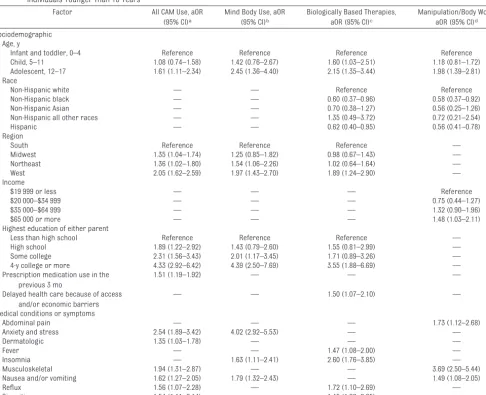
In adjusted multivariable regression analysis, we identified multiple socio-demographic variables and medical conditions independently associated with CAM use (Table 2). CAM use was higher among adolescents compared with children⬍5; those living in the West, Northeast, and Midwest than the South; households with parents with
⬎12 years of education; and prescrip-tion medicaprescrip-tion users in the previous 3 months. Medical conditions or
symp-Characteristic CAM Users (N⫽1055), %
Non-CAM Users (N⫽8254), % Demographic
Age, ya
Infant and toddler, 0–4 17.8 29.4
Child, 5–11 34.5 38.3
Adolescent, 12–17 47.7 32.3
Gender
Boys 48.3 51.5
Girls 51.7 48.5
Racea
Non-Hispanic white 71.6 55.8
Non-Hispanic black 9.1 16.6
Non-Hispanic Asian 3.8 4.2
Non-Hispanic all other races 1.9 1.5
Hispanic 13.6 21.8
Incomea
$19 999 or less 9.4 16.6
$20 000–$34 999 12.0 17.1
$35 000–$64 999 26.6 26.8
$65 000 or more 51.9 39.4
Regiona
West 27.6 22.1
Midwest 27.3 23.3
South 27.1 38.1
Northeast 18.0 16.6
Highest education of either parenta
Less than high school 5.4 13.7
High school 15.3 23.6
Some college 28.2 30.1
4-y college or more 51.2 32.6
Insurance
Medicaid/Medicare 16.1 25.2
Private 62.6 53.4
Uninsured 7.9 13.3
Unknown 13.3 7.9
Prescription medication use in the previous 3 moa 23.1 10.9
Difficulty affording prescription in the previous 12 moa 3.8 1.8
Delayed medical care because of difficulties with accessa 15.7 8.9
Missed school days because of illnessa
0–2 47.2 60.1
3–5 29.0 24.7
5–10 13.1 10.2
⬎10 10.7 5.0
Medical conditions and/or symptoms
ADHDa 12.4 6.0
Allergies
Hayfevera 17.9 9.1
Respiratory allergya 17.1 8.6
Food/diet allergya 7.6 3.5
Othera 7.9 4.6
Asthma 12.8 8.7
Dermatologic, acne and/or wartsa 16.5 7.6
Developmental disordersa 7.5 3.1
Fevera 41.1 27.8
Gastrointestinal
Nausea/vomitinga 33.8 18.9
Abdominal paina 10.9 4.2
Refluxa 9.6 3.6
Constipationa 8.3 4.3
Headachesa 13.2 6.6
Insomniaa 12.2 4.1
Learning disabilitya 13.7 6.6
Musculoskeletala 9.7 2.6
toms independently associated with higher CAM use, while controlling for other significant sociodemographic factors, were anxiety and stress, der-matologic conditions, insomnia, mus-culoskeletal conditions, nausea and/ or vomiting, gastroesophageal reflux, and sinusitis.
In 3 separate subanalyses with ad-justed regression models, we analyzed the most frequent CAM modalities (Ta-ble 2), including mind body techniques, biologically based therapies, and ma-nipulation/body work, and identified TABLE 1 Continued
Characteristic CAM Users (N⫽1055), %
Non-CAM Users (N⫽8254), % Psychological
Depressiona 7.2 2.3
Anxiety and/or stressa 21.6 6.1
Respiratory infections in the previous 12 mo
Ear infections (ⱖ3) 6.5 4.9
Sinusitusa 14.2 6.3
Chest/head coldsa 66.0 53.0
Influenza/pneumoniaa 11.1 5.8
Pharyngitisa 53.9 35.1
Parental use of CAMc 64.6 27.6
aPⱕ.005 for differences between CAM users and non-CAM users. bChild reported by adult respondent as being overweight.
cParental use of CAM represents a subset of all children sampled (n⫽7455) where a parental figure (parent, grandparent,
foster parent, or legal guardian) completed the adult survey on CAM use.
Data source: NHIS 2007. Weighted percentages were extrapolated from the US census (2000) for the child civilian, nonin-stitutionalized household population.
TABLE 2 Sociodemographic Factors and Medical Conditions Independently Associated With All CAM Use and the 3 Most Common CAM Modalities Among Individuals Younger Than 18 Years
Factor All CAM Use, aOR (95% CI)a
Mind Body Use, aOR (95% CI)b
Biologically Based Therapies, aOR (95% CI)c
Manipulation/Body Work, aOR (95% CI)d
Sociodemographic Age, y
Infant and toddler, 0–4 Reference Reference Reference Reference Child, 5–11 1.08 (0.74–1.58) 1.42 (0.76–2.67) 1.60 (1.03–2.51) 1.18 (0.81–1.72) Adolescent, 12–17 1.61 (1.11–2.34) 2.45 (1.36–4.40) 2.15 (1.35–3.44) 1.98 (1.39–2.81) Race
Non-Hispanic white — — Reference Reference
Non-Hispanic black — — 0.60 (0.37–0.96) 0.58 (0.37–0.92)
Non-Hispanic Asian — — 0.70 (0.38–1.27) 0.56 (0.25–1.26)
Non-Hispanic all other races — — 1.35 (0.49–3.72) 0.72 (0.21–2.54)
Hispanic — — 0.62 (0.40–0.95) 0.56 (0.41–0.78)
Region
South Reference Reference Reference —
Midwest 1.35 (1.04–1.74) 1.25 (0.85–1.82) 0.98 (0.67–1.43) — Northeast 1.36 (1.02–1.80) 1.54 (1.06–2.26) 1.02 (0.64–1.64) —
West 2.05 (1.62–2.59) 1.97 (1.43–2.70) 1.89 (1.24–2.90) —
Income
$19 999 or less — — — Reference
$20 000–$34 999 — — — 0.75 (0.44–1.27)
$35 000–$64 999 — — — 1.32 (0.90–1.96)
$65 000 or more — — — 1.48 (1.03–2.11)
Highest education of either parent
Less than high school Reference Reference Reference —
High school 1.89 (1.22–2.92) 1.43 (0.79–2.60) 1.55 (0.81–2.99) — Some college 2.31 (1.56–3.43) 2.01 (1.17–3.45) 1.71 (0.89–3.26) — 4-y college or more 4.33 (2.92–6.42) 4.39 (2.50–7.69) 3.55 (1.88–6.69) — Prescription medication use in the
previous 3 mo
1.51 (1.19–1.92) — — —
Delayed health care because of access and/or economic barriers
— — 1.50 (1.07–2.10) —
Medical conditions or symptoms
Abdominal pain — — — 1.73 (1.12–2.68)
Anxiety and stress 2.54 (1.89–3.42) 4.02 (2.92–5.53) — —
Dermatologic 1.35 (1.03–1.78) — — —
Fever — — 1.47 (1.08–2.00) —
Insomnia — 1.63 (1.11–2.41) 2.60 (1.76–3.85) —
Musculoskeletal 1.94 (1.31–2.87) — — 3.69 (2.50–5.44)
Nausea and/or vomiting 1.62 (1.27–2.05) 1.79 (1.32–2.43) — 1.49 (1.08–2.05)
Reflux 1.56 (1.07–2.28) — 1.72 (1.10–2.69) —
Sinusitis 1.54 (1.11–2.14) — 1.45 (1.02–2.05) —
aORs have been adjusted for age, region, parental education, prescription medication use, and medical conditions with aPvalue ofⱕ.05. bORs have been adjusted for age, region, parental education, insurance status, and medical conditions with aPvalue ofⱕ.05.
cORs have been adjusted for age, race, region, parental education, delays in access to medical care, and medical conditions with aPvalue ofⱕ.05. dORs have been adjusted for age, race, income, and medical conditions with aPvalue ofⱕ.05.
use. Mind-body use positively corre-lated with being adolescent versus in-fant or toddler, living in the West or Northeast versus the South, and higher parental education with some college or more versus parental edu-cation of less than high school. Medical conditions associated with mind-body use were anxiety/stress, in-somnia, and nausea/vomiting. Use of biologically based therapies corre-lated with being an adolescent versus being an infant or toddler, white ver-sus non-Hispanic black or Hispanic, liv-ing in the West versus the South, and parents being college educated versus parents completing less than high school. Biologically based therapies were also associated with delays in health care because of difficulties with access, and medical conditions includ-ing insomnia, fever, reflux, and sinus-itis. Manipulation and bodywork corre-lated with being an adolescent as compared with infant or toddler, being white as compared with non-Hispanic black or Hispanic, and higher income as compared with lower income. Ab-dominal pain, musculoskeletal condi-tions, and nausea/vomiting were inde-pendently associated with use of manipulation and bodywork.
In a secondary analysis restricted to those children whose parents were also queried about CAM use, we cre-ated a regression model for CAM use that included socioeconomic factors associated with CAM use in the overall mutivariable model and found that any parental use of CAM was associated with the child CAM use (adjusted odds ratio [aOR]: 3.83 [95% confidence inter-val (CI): 3.04 – 4.84]). When adjusted for parental use of CAM, other factors as-sociated with CAM use remained sig-nificant except (1) the difference be-tween adolescent CAM use and infant or toddler CAM use (0 – 4 years old)
no longer associated with pediatric CAM use.
DISCUSSION
We found that ⬎8 million individuals younger than 18 years of age used CAM in the United States in 2007. Adoles-cents, children living in the West, and those with parents with⬎12 years of education and prescription medica-tion use were independently associ-ated with higher overall CAM use. CAM use was also associated with a range of common medical conditions and symptoms including gastrointestinal problems, anxiety/stress, dermato-logic conditions, insomnia, musculo-skeletal conditions, and sinusitis. We found higher associations of anxiety or stress, insomnia, and nausea and/or vomiting among mind-body users; fe-ver, insomnia, reflux, and sinusitis among users of biologically based therapies; and abdominal pain, muscu-loskeletal conditions, and nausea and/ or vomiting among manipulation/body work users. Parental CAM use is a strong correlate of child CAM use.
In an analysis adjusted only for age, Barnes et al7also noted no differences of CAM use by gender, higher use among adolescents than younger age groups, and higher use among white children than black children or non-Hispanic children than non-Hispanic chil-dren. Barnes et al7also noted higher CAM use in households with more pa-rental education, among those who live in the West or Northeast, and among those with higher income. On the basis of an online national survey of adolescents in 2002, Wilson et al9 re-ported higher CAM use in the previous 30 days among female patients than male patients, black patients than white patients, among those living in the East than Midwest or South, and among those with perceived low family
education.
In our adjusted regression models, we found no independent relationship be-tween overall CAM use and gender or race. Only among users of biologically based therapies and manipulation/ bodywork did racial differences re-main significant with less use among non-Hispanic black patients and His-panic patients compared with white patients. Within the adult population, overall CAM use has been reported to be less among non-Hispanic black pa-tients and Hispanic papa-tients than non-Hispanic white patients.11
In our model, higher age, parental ed-ucation, and living in the West were sig-nificantly associated with CAM use. Higher income was not associated with overall pediatric CAM use, but was associated with manipulation and bodywork therapies. There may be a financial barrier for children to access manipulation and bodywork, such as chiropractic and massage, as com-pared with other CAM modalities. Our results indicating that adolescents are more likely to use CAM is consistent with data reported by Wilson et al.9
excluded anemia, cancer, congenital heart disease, diabetes, and sickle cell anemia from our analysis because of insufficient numbers. The respondents of NHIS reflect the general pediatric population, but there may be insuffi-cient sampling of children with chronic diseases to detect associa-tions with CAM use. Some of the asso-ciations with CAM use we found were with medical symptoms rather than specific medical diagnoses, such as nausea/vomiting and abdominal pain.
Overall CAM use was associated with prescription medication use in the previous 3 months. Although not signif-icantly associated with the use of bio-logically based therapies, this raises the potential for drug-herb interaction. Among adults, only half disclose their use of herbal and dietary supplements to a health care provider.24 Pediatri-cians and pharmacists need to inquire about use of herbs and supplements when prescribing medications and ac-tively monitor for adverse effects. Use of biologically based therapies was as-sociated with health access difficul-ties, suggesting that parents may turn to CAM therapies when conventional health care is not readily available. Pa-rental use of CAM is strongly associ-ated with child CAM use. This may be a
consequence of parents’ administer-ing or encouragadminister-ing CAM use for their child. Children also may model the health behavior of their parents and adopt CAM use. Parental use of CAM may predict which children use CAM as adults.
Our study has several limitations. The data were collected from an adult proxy in the household which is sus-ceptible to recall bias. Also, the adult proxy may not have known that a child or teenager was using CAM. There may be types of CAM therapies that are used by children, but not specifically asked by the survey such as music therapy. Data regarding symptoms and medical conditions are based on self-report and may not meet standard clinical definitions. The number of chil-dren with specific chronic conditions was small; therefore, associations be-tween CAM use and some chronic con-ditions may not be apparent. Associa-tions with medical condiAssocia-tions and symptoms characterize pediatric CAM users, rather than indicate intentions to treat specific conditions. Despite these limitations, we used the most currently available data set from a na-tional representative sample to de-scribe the use of CAM among the pedi-atric population.
CONCLUSIONS
CAM use is higher among adolescents, those living in the West, educated households, children whose parents use CAM, and prescription medication users. Health care providers need to inquire about CAM use in households and advise patients appropriately regarding clinical efficacy, or lack thereof, and potential adverse interac-tions with herbs-drugs. Parents’ use of CAM may suggest that their children may be using CAM as well. More re-search is necessary to establish evi-dence for CAM therapies among chil-dren, in particular with mind-body techniques, biologically based thera-pies, and manipulation/body work. With more evidence of efficacy, physi-cians will be better able to guide pa-tients to make safe and effective deci-sions regarding CAM use.
ACKNOWLEDGMENTS
Dr Birdee is supported by Institutional National Research Service Award T32AT00051-06 from the National Insti-tutes of Health. Dr Phillips is supported by Mid-Career Investigator Award K24-AT000589 from the National Center for Complementary and Alternative Medi-cine, National Institutes of Health.
REFERENCES
1. National Institutes of Health. National Cen-ter for Complementary and AlCen-ternative Medicine. Available at: http://nccam.nih. gov. Accessed April 20, 2009
2. Jean D, Cyr C. Use of complementary and alter-native medicine in a general pediatric clinic. Pe-diatrics.2007;120(1). Available at: www. pediatrics.org/cgi/content/full/120/1/e138
3. Kemper KJ, O’Connor KG. Pediatricians’ rec-ommendations for complementary and al-ternative medical (CAM) therapies.Ambul Pediatr.2004;4(6):482– 487
4. Prussing E, Sobo EJ, Walker E, Dennis K, Kur-tin PS. CommunicaKur-ting with pediatricians about complementary/alternative medicine: perspectives from parents of children with down syndrome.Ambul Pediatr.2004;4(6): 488 – 494
5. Sawni A, Thomas R. Pediatricians’ attitudes, experience and referral patterns regarding complementary/alternative medicine: a na-tional survey.BMC Complement Altern Med. 2007;7:18
6. Kemper KJ, Vohra S, Walls R; Task Force on Complementary and Alternative Medicine the Provisional Section on Complementary, Holistic, and Integrative Medicine. The use of complementary and alternative medicine in pediatrics. Pediatrics. 2008;122(6): 1374 –1386
7. Barnes PM, Bloom B, Nahin RL. Complemen-tary and alternative medicine use among adults and children: United States, 2007. Natl Health Stat Rep.2008;12(12):1–23
8. Yussman SM, Ryan SA, Auinger P, Weitzman M. Visits to complementary and alternative
medicine providers by children and adoles-cents in the United States.Ambul Pediatr. 2004;4(5):429 – 435
9. Wilson KM, Klein JD, Sesselberg TS, et al. Use of complementary medicine and di-etary supplements among US adolescents. J Adolesc Health.2006;38(4):385–394
10. Ball SD, Kertesz D, Moyer-Mileur LJ. Dietary supplement use is prevalent among chil-dren with a chronic illness.J Am Diet Assoc. 2005;105(1):78 – 84
11. Graham RE, Ahn AC, Davis RB, O’Connor BB, Eisenberg DM, Phillips RS. Use of comple-mentary and alternative medical therapies among racial and ethnic minority adults: re-sults from the 2002 National Health Inter-view Survey.J Natl Med Assoc.2005;97(4): 535–545
ents of asthmatic children in southern Is-rael.Acta Paediatr.2007;96(11):1693–1697
13. Braganza S, Ozuah PO, Sharif I. The use of complementary therapies in inner-city asthmatic children.J Asthma.2003;40(7): 823– 827
14. Sinha D, Efron D. Complementary and alter-native medicine use in children with atten-tion deficit hyperactivity disorder.J Paedi-atr Child Health.2005;41(1–2):23–26
15. Wong HH, Smith RG. Patterns of complemen-tary and alternative medical therapy use in children diagnosed with autism spectrum disorders.J Autism Dev Disord.2006;36(7): 901–909
16. Harrington JW, Rosen L, Garnecho A, Patrick PA. Parental perceptions and use of comple-mentary and alternative medicine practices for children with autistic spectrum
disor-17. Post-White J, Fitzgerald M, Hageness S, Sencer SF. Complementary and alternative medicine use in children with cancer and general and specialty pediatrics.J Pediatr Oncol Nurs.2009;26(1):7–15
18. Hamidah A, Rustam ZA, Tamil AM, Zarina LA, Zulkifli ZS, Jamal R. Prevalence and parental perceptions of complementary and alterna-tive medicine use by children with cancer in a multi-ethnic Southeast Asian population. Pediatr Blood Cancer.2009;52(1):70 –74
19. Laengler A, Spix C, Seifert G, Gottschling S, Graf N, Kaatsch P. Complementary and al-ternative treatment methods in children with cancer: a population-based retro-spective survey on the prevalence of use in Germany. Eur J Cancer. 2008;44(15): 2233–2240
20. Ko J, Lee JI, Munoz-Furlong A, Li XM, Sicherer SH. Use of complementary and alternative
21. Feldman DE, Duffy C, De Civita M, et al. Fac-tors associated with the use of complemen-tary and alternative medicine in juvenile id-iopathic arthritis. Arthritis Rheum.2004; 51(4):527–532
22. Miller JL, Binns HJ, Brickman WJ. Comple-mentary and alternative medicine use in children with type 1 diabetes: a pilot survey of parents.Explore (NY).2008;4(5):311–314
23. Sibinga EM, Shindell DL, Casella JF, Duggan AK, Wilson MH. Pediatric patients with sickle cell disease: use of complementary and al-ternative therapies.J Altern Complement Med.2006;12(3):291–298
24. Mehta DH, Gardiner PM, Phillips RS, Mc-Carthy EP. Herbal and dietary supplement disclosure to health care providers by indi-viduals with chronic conditions.J Altern Complement Med.2008;14(10):1263–1269
When Consensus Is Not the Solution:The Wall Street Journal(October 2009) recently printed the following quotation from a speech given by former British Prime Minister Mar-garet Thatcher. It is worth sharing in regard to the process of achieving consensus. “To me consensus seems to be the process of abandoning all beliefs, principles, values and policies in search of something in which no one believes, but to which no one objects—the process of avoiding the very issues that have to be solved, merely because you cannot get agreement on the way ahead. What great cause would have been fought and won under the banner ‘I stand for consensus’?” Perhaps this quote should have been shared during the health reform discussions in Congress.
DOI: 10.1542/peds.2009-1406 originally published online January 25, 2010;
2010;125;249
Pediatrics
Gurjeet S. Birdee, Russell S. Phillips, Roger B. Davis and Paula Gardiner
Medicine
Factors Associated With Pediatric Use of Complementary and Alternative
Services
Updated Information &
http://pediatrics.aappublications.org/content/125/2/249 including high resolution figures, can be found at:
References
http://pediatrics.aappublications.org/content/125/2/249#BIBL This article cites 22 articles, 1 of which you can access for free at:
Subspecialty Collections
icine_sub
http://www.aappublications.org/cgi/collection/adolescent_health:med
Adolescent Health/Medicine
grative_medicine_sub
http://www.aappublications.org/cgi/collection/complementary_-_inte
Complementary & Integrative Medicine
following collection(s):
This article, along with others on similar topics, appears in the
Permissions & Licensing
http://www.aappublications.org/site/misc/Permissions.xhtml in its entirety can be found online at:
Information about reproducing this article in parts (figures, tables) or
Reprints
DOI: 10.1542/peds.2009-1406 originally published online January 25, 2010;
2010;125;249
Pediatrics
Gurjeet S. Birdee, Russell S. Phillips, Roger B. Davis and Paula Gardiner
http://pediatrics.aappublications.org/content/125/2/249
located on the World Wide Web at:
The online version of this article, along with updated information and services, is
by the American Academy of Pediatrics. All rights reserved. Print ISSN: 1073-0397.