BMC Pediatrics
2002, 2
Research article
Assessing the quality of reports of randomized trials in pediatric
complementary and alternative medicine
David Moher*
1,2
, Margaret Sampson
1
, Kaitryn Campbell
3
, William Beckner
4
,
Leah Lepage
1
, Isabelle Gaboury
1
and Brian Berman
4
Address: 1Thomas C. Chalmers Centre for Systematic Reviews, Children's Hospital of Eastern Ontario Research Institute, Canada, 2Department of
Pediatircs, University of Ottawa, Canada, 3Faculty of Information and Media Studies, University of Western Ontario, Canada and 4University of
Maryland, Complementary Medicine Program, USA
E-mail: David Moher* - [email protected]; Margaret Sampson - [email protected];
Kaitryn Campbell - [email protected]; William Beckner - [email protected]; Leah Lepage - [email protected]; Isabelle Gaboury - [email protected]; Brian Berman - [email protected]
*Corresponding author
Abstract
Objective: To evaluate the quality of reports of complementary and alternative medicine (CAM) randomized controlled trials (RCTs) in the pediatric population. We also examined whether there was a change in the quality of reporting over time.
Methods: We used a systematic sample of 251 reports of RCTs that used a CAM intervention. The quality of each report was assessed using the number of CONSORT checklist items included, the frequency of unclear allocation concealment, and a 5-point quality assessment instrument.
Results: Nearly half (40%) of the CONSORT checklist items were included in the reports, with an increase in the number of items included. The majority (81.3%) of RCTs reported unclear allocation concealment with no significant change over time. The quality of reports achieved approximately 40% of their maximum possible total score as assessed with the Jadad scale with no change over time. Information regarding adverse events was reported in less than one quarter of the RCTs (22%) and information regarding costs was mentioned in only a minority of reports (4%).
Conclusions: RCTs are an important tool for evidence based health care decisions. If these studies are to be relevant in the evaluation of CAM interventions it is important that they are conducted and reported with the highest possible standards. There is a need to redouble efforts to ensure that children and their families are participating in RCTs that are conducted and reported with minimal bias. Such studies will increase their usefulness to a board spectrum of interested stakeholders.
Introduction
The use of complementary and alternative medicine (CAM) has become increasingly popular for both adult and pediatric populations. For example, in 1992, 11% of
a Montreal-based pediatric sample used CAM [1]. By 1997, however, this figure had grown to 17% [2]. The 1994 National Population Health Survey suggested that 15% of Canadians (any age) had used CAM during the
Published: 27 February 2002
BMC Pediatrics 2002, 2
Received: 10 December 2001 Accepted: 27 February 2002
This article is available from: http://www.biomedcentral.com/1471-2431/2/2
course of the preceding year [3]. By 1999, this figure had grown to roughly 70% [4]. Similar data has been reported for other jurisdictions [5,6].
What is less clear is the quality of evidence for the use of these products and practices. Focusing our attention on reports of randomized controlled trials (RCTs) allows us to examine the gold standard for evaluating an interven-tion's effectiveness. This enables readers to judge the ex-tent to which the results are internally valid and free of bias.
Within conventional medicine there is substantial evi-dence about the quality of reports of RCTs and the conse-quences of lower quality reporting. Schulz and colleagues have documented that only about a third of reports of RCTs adequately report allocation concealment [7]. Re-ports of inadequate allocation concealment, compared to those in which this information is adequately reported (i.e., adequate allocation concealment), exaggerate the es-timates of an intervention's effectiveness by about 30%, on average [8–10]. These investigations and others have typically focused on interventions such as pharmaceuti-cals and adult populations.
We are unaware of any systematic effort to examine the ex-tent of bias in reports of CAM RCTs specifically targeted at pediatric populations. This is important because if CAM studies are not subjected to rigorous evaluations they may jeopardize the health of children and their families [11]. Our primary focus was to evaluate the quality of reports of RCTs in the pediatric population (PedCAM). As a second-ary question we also examined whether there was a change in the quality of reporting over time.
Methods
We have previously described the assembly of a compre-hensive database of PedCAM RCTs [12]. Briefly, after de-fining CAM we searched 13 bibliographic databases using one of three search strategies. We also identified RCTs from cited references of 47 PedCAM systematic reviews [13]. The search results were downloaded to a reference database and screened. After identifying the PedCAM RCTs, clusters of trials relating to specific disease condi-tions and intervention types were identified. Three mem-bers of the research team (DM, MS, LL) nominated clusters for further consideration. Our goal was to identify 300 trials for closer examination, ensuring broad coverage of diseases and interventions from the full set of identified reports.
Once these reports were retrieved we extracted descriptive information using a 17-item structured data collection form. The questions pertained to the type of CAM used, the condition under investigation (according to the
Inter-national Classification of Disease – ICD-9), the number and gender of the included children, the number and type of outcomes used, information about the reporting of ad-verse events and whether the authors reported on any cost information. The complete questionnaire can be obtained from the authors.
We also completed a comprehensive quality assessment of each report using three methods. First, the revised CONSORT statement checklist [14] was modified so that multiple items were listed separately, which resulted in 32 items. Each item was assigned a yes or no response de-pending on whether or not the author had reported it. Second, the reporting of allocation concealment was as-sessed as adequate, inadequate, or unclear [8] Third, the Jadad scale [15], which contains two questions each on randomization and masking, and one question on report-ing of dropouts and withdrawals, was used to assess qual-ity. Each question contains a yes or no response option. In total, five points can be awarded with higher points indi-cating superior quality. Three reviewers (DM, LL and MS) completed all of these evaluations.
We did not conduct any formal training prior to evaluat-ing the RCTs usevaluat-ing any of the three methods. We have ex-tensive experience using these methods and have previously conducted training with results indicating sub-stantial agreement between raters [16]. Discrepancies were resolved by consensus between the three raters.
We compared the number of checklist criteria included in each report and the mean number of criteria included within each subheading as specified in the CONSORT checklist. We also assessed the percentage of studies that reported unclear allocation concealment and the specific item and overall quality score derived from the Jadad in-strument. The number of CONSORT checklist items re-ported was compared over time (1970s, 1980s, 1990s, 2000s) using an analysis of variance. A similar approach was used to assess the individual components and overall total score of the Jadad scale. The percentage of unclear al-location concealment was evaluated using χ2 tests.
Results
Database searching identified 3580 citations. Of these 2975 were screened from which 1468 PedCAM RCTs were identified (Figure 1). We systematically sampled 301 of these reports for further study. Twenty reports failed to meet our eligibility criteria and a further 30 reports were not evaluated (Figure 1) leaving 251 reports from which descriptive information and quality assessment was com-pleted (Table 1).
re-ports (66.7%) and more than a quarter of the RCTs were undertaken to help prevent disease (32.5%). There were 157 reports involving fewer than 100 children (mean = 47.31; standard deviation = 24.14); 63 reports included between 100 and 1000 children (mean = 298.38; standard deviation = 232.51); and 9 reports included more than 1000 children (mean = 6766; standard deviation = 8402.72).
Forty percent (12.7 out of 32) of the CONSORT checklist items were included in the reports of PedCAM RCTs (Ta-ble 2). There was an increase over time (p < 0.001) in the number of checklist items included in the reports (Table 2). Between the 1980s, when 10.8 checklist items were ported, and the 1990s, when 13.4 checklist items were re-ported, there was a 24% increase in the number of checklist items reported (p = 0.001; mean difference = -2.55 (95% confidence interval: -4.28, -0.81). There was a minor decrease in the 2000s in the number of CONSORT items reported.
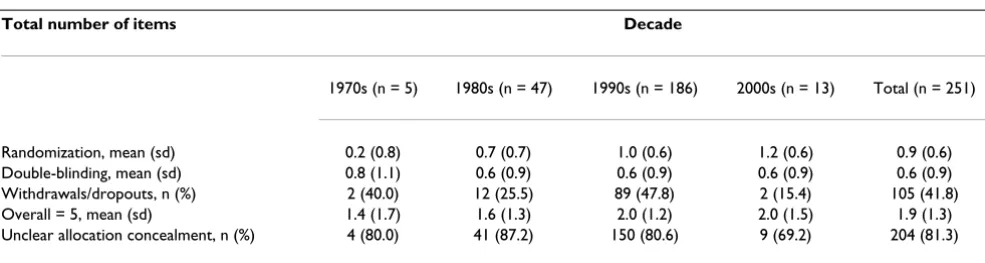
The majority (83.1%) of RCTs reported unclear allocation concealment (Table 3). We were unable to detect a change over time (p = 0.496; Table 3). The quality of reports achieved approximately 40% of their maximum possible total score as assessed by using the Jadad scale (Table 3).
There was no improvement in the quality of reporting over time (p = 0.174).
Information regarding adverse events was reported in less than one quarter of the RCTs (22.4%). Similarly, informa-tion regarding costs (e.g., cost effectiveness) was men-tioned in only a minority of reports (4.5%).
Discussion
About one third of the CONSORT checklist items were in-cluded in reports of PedCAM RCTs. Although there is still considerable room for improvement in how these studies are reported, there has been a notable increase in the qual-ity of their reports since the 1980s. The 24% increase in the number of reported CONSORT items is encouraging and probably reflects important reductions in bias in the results of RCTs. Similar results were observed when the as-sessments focused on the adequacy of allocation conceal-ment or the Jadad assessconceal-ment. Unfortunately, these results also suggest that the validity of some of the PedCAM RCT results is probably questionable. This is particularly true if our attention focuses on aspects of how randomization was reported. Only about half of the reports documented how the random numbers were generated and three quar-ters of the reports had unclear allocation concealment.
Conducting a randomized trial is a complex series of tasks and it may not always be possible to minimize some po-tential biases. For example, double blinding (masking) is questionable both ethically and scientifically when per-forming surgical trials. However, in every single rand-omized trial it is always possible to ensure that the random numbers are appropriately generated (e.g., com-puter generation) and concealed from all parties involved in the trial until the child has been randomized (e.g., cen-tralized randomization). High quality reports always in-clude this information.
Our results indicate that the quality of reports of PedCAM RCTs may be lower than that found for conventional medicine. It is difficult to be more certain because the de-gree of journal overlap between different studies is un-known. In a recent report on the assessment of 77 RCTs published in 1998, in three high impact factor journals, the average number of CONSORT items included was 27.1 (out of 40) [16]. The average Jadad score was 62% of the maximum possible score and 39% of the reports had unclear allocation concealment. Linde and colleagues re-cently reported on the quality of 207 trials in homeopa-thy, herbs and acupuncture [17]. The average Jadad score ranged from about 40% (acupuncture) to 60% (herbs) of the maximum possible total score. The Jadad scores are similar to those observed in this study. However, the CONSORT results reported here are considerably lower than observed elsewhere.
Figure 1
Flow of citations and articles through the phases of screening and eligibility evaluation
2975 records screened
1507 Failed to meet inclusion criteria: 680 Not an RCT 134 Not pediatric 682 Not a CAM intervention 11 No clinical outcome
301 selected for further study 1468 PedCAM RCTs identified
3580 records identified through database searching 1 additional trial identified through the reference lists of systematic reviews
606 duplicate records removed
20 Failed to meet inclusion criteria: 11 Not RCTs
5 Double publication or abstract of a full report already included 4 No clinical outcome
251 Quality & descriptive data reported 30 Not evaluated: 22 Language of publication* 8 Unable to obtain a copy of the report
Table 1: Conditions and Interventions selected for further study
Condition Original N N after Exclusions
Asthma 34 31
Colic 19 16
Dermatological conditions (including scars) 36 30
Diarrhea 75* 49
Malaria 21 20
Migraine / headache 19 18
Interventions / Treatment modalities Biofeedback 27 22
Chinese Herbal Medicine 20% 6
Chiropractic 7 5
Homeopathy 9 6
Massage or holding 26 25
TENS 8 8
Zinc 45 39
* We examined only 49 of 75 diarrhea studies to avoid giving undue weight to this condition. %Many of these were excluded based on language
Note: some trials involved both a condition and a treatment chosen (i.e., chiropractic for colic) and so numbers to not total to 251.
Table 2: CONSORT checklist criteria included in 251 reports of complementary and alternative medicine randomized controlled trials in children published over four decades
Total number of items Decade
1970s (n = 5) 1980s (n = 47) 1990s (n = 186) 2000s (n = 13) Total (n = 251)
Title = 1,n% 2 (40.0) 29 (61.7) 144 (77.4) 12 (92.3) 187 (74.5) Introduction = 1, n % 5 (100.0) 42 (89.4) 170 (91.4) 11 (84.6) 228 (90.8) Methods = 18, mean (sd) 5.0 (3.7) 5.8 (1.8) 7.1 (2.6) 6.5 (2.9) 6.8 (2.5) Results = 9, mean (sd) 1.0 (1.0) 1.6 (0.9) 2.5 (1.8) 2.2 (1.9) 2.3 (1.7) Discussion = 3, mean (sd) 1.2(1.3) 2.0 (1.1) 2.1 (1.0) 1.9 (1.1) 2.0 (1.0) Total = 32, mean (sd) 8.6 (5.4) 10.8 (3.0) 13.4 (4.3) 12.3 (5.3) 12.7 (4.3)
Table 3: Quality of reports of 251 complementary and alternative medicine randomized controlled trials in children using the Jadad assessment scale and the adequacy of allocation concealment
Total number of items Decade
1970s (n = 5) 1980s (n = 47) 1990s (n = 186) 2000s (n = 13) Total (n = 251)
One way to improve the quality of reporting of PedCAM RCTs is for more pediatric journals to endorse the CON-SORT statement. There is evidence to suggest that journals using the CONSORT statement, compared to those not doing so, have higher quality reports of RCTs [15]. Of course examining the quality of reporting is 'after the fact' when the trial is already completed. CONSORT can also be used by granting agencies [18]; (Allan Bernstein, Presi-dent of the Canadian Institutes of Health Research, per-sonal communication) to encourage prospective investigators to improve the conduct of their RCTs.
It is not immediately clear why we observed lower quality scores in these reports. It is possible that the PedCAM community conducts fewer RCTs and is therefore less ex-perienced. We have observed that prior to 1975 there were very few published reports of PedCAM RCTs [12], al-though there has been a sharp increase in the number of reports during the 1990s. These results might also reflect that the PedCAM community has been slower to train re-searchers in the appropriate conduct of RCTs.
Beyond examining the quality of these reports we were disappointed to find that so few reports mentioned any-thing about adverse events. This result is similar to that re-cently reported [19]. Although information on adverse events is extremely important authors have typically de-voted less space to this information than to their names and affiliations [20]. Only about one in twenty reports mentioned anything about costs, such as a cost benefit analysis, in their reports. If clinicians and policy makers are to make decisions about the utility of CAM interven-tions for the pediatric population they will need more in-formation than simply the efficacy of the intervention.
This study had a number of limitations. Our focus was on the quality of reporting of PedCAM RCTs. It is possible that the trials were appropriately conducted but had defi-ciencies in their reporting. Despite the paucity of data ad-dressing this important question, the evidence that is available points in the direction of a reasonably good cor-relation between how investigators conduct their trials and how they are subsequently reported [21,22]. We did not take a random sample of all 1468 trials identified. It is possible that our sample does not reflect the total pop-ulation and that these results cannot be generalized to all PedCAM RCTs. We selected the reports to broadly reflect the ICD categories and CAM interventions of the 1468 re-ports. We believe that our sampling approach although systematic is representative and enables us to generalize the observed results. The 2000s results need to be inter-preted with caution and are probably not representative of the population, as there were only 13 reports. The small number probably reflects the delay in indexing the studies on electronic databases. We excluded 22 reports because
they were written in languages other than English. It is possible that the quality of these reports differs in some systematic way from English language reports. Previous research suggests that the quality of RCTs reported in non-English languages is similar to those reported in non-English [23].
Randomized trials are an important tool for evidence based health care decisions. If these studies are to be rele-vant in the evaluation of CAM interventions it is impor-tant that they are conducted and reported with the highest possible standards. There is a need to redouble efforts to ensure that children and their families are participating in RCTs that are conducted and reported with minimal bias. Such studies will increase their usefulness to a board spec-trum of interested stakeholders.
Competing interests
None declared.
Acknowledgements
We thank Tammy Clifford for her expertise and guidance in the field of Complementary and Alternative Medicine, and Rose Marie Mongeon and Patricia Jackson for document retrieval.
References
1. Spigelblatt L, Laine-Ammara G, Pless IB, Guyver A: The use of alter-native medicine by children.Pediatrics 1994, 94:811-4
2. Ramsay S: In whose best interest is government-run health care?Fraser Forum. Fraser Institute. 11-13-2001. Ref Type: Electronic Ci-tation 1997
3. Millar WJ: Use of Alternative Health Care Practitioners by Canadians.Canadian Journal of Public Health 1997, 88:154-8 4. Berger E: Berger Population Health Monitor 21. 2000. Toronto, Hay
As-sociates. Ref Type: Serial (Book, Monograph)
5. Eisenberg DM, Kessler RC, Foster C, Norlock FE, Calkins DR, Del-banco TL: Unconventional medicine in the United States: prevalence, costs and pattern use.N Engl J Med 1993, 328: 246-52
6. Eisenberg DM, Davis RB, Ettner SL, Appel S, Wilkey S, van Rompay M, et al: Trends in alternative medicine use in the United States, 1990–1997: results of a follow-up national survey.
JAMA 1998, 280:1569-75
7. Schulz KF, Chalmers I, Grimes DA, Altman DG: Assessing the qual-ity of randomization from reports of controlled trials pub-lished in obstetrics and gynecology journals. JAMA 1994,
272:125-8
8. Schulz KF, Chalmers I, Hayes RJ, Altman DG: Empirical evidence of bias: Dimensions of methodological quality associated with estimates of treatment effects in controlled trials.JAMA 1995, 273:408-12
9. Moher D, Pham B, Jones A, Cook DJ, Jadad AR, Moher M, et al: Does the quality of reports of randomised trials affect estimates of intervention efficacy reported in meta-analyses?Lancet 1998,
352:609-13
10. Kjaergård LL, Villumsen J, Gluud C: Reported methodological quality and discrepancies between large and smaller rand-omized trials.BMJ 2001
11. Ernst E: The role of complementary and alternative medicine.
BMJ 2000, 321:1133-5
12. Campbell K, Sampson M, Ajiferuke I, Moher D: Publication charac-teristics of randomized controlled trials in pediatric comple-mentary and alternative medicine.Submitted for publication. 13. Moher D, Soeken K, Sampson M, Campbell K, Ben Perot L, Berman
Publish with BioMed Central and every scientist can read your work free of charge
"BioMedcentral will be the most significant development for disseminating the results of biomedical research in our lifetime."
Paul Nurse, Director-General, Imperial Cancer Research Fund
Publish with BMCand your research papers will be:
available free of charge to the entire biomedical community
peer reviewed and published immediately upon acceptance
cited in PubMed and archived on PubMed Central
yours - you keep the copyright
[email protected] Submit your manuscript here:
http://www.biomedcentral.com/manuscript/
BioMedcentral.com 14. Moher D, Schulz KF, Altman DG, for the CONSORT group: The
CONSORT statement: revised recommendations for im-proving the quality of reports of parallel group randomized trials.Annals of Internal Medicine 2001, 134:657-662
15. Jadad AR, Moore RA, Carroll D, Jenkinson C, Reynolds DJ, Gavaghan DJ, et al: Assessing the quality of reports of randomized clini-cal trials: Is blinding necessary?Control Clin Trials 1996, 17:1-12 16. Moher D, Jones A, Lepage L, for the CONSORT group: Use of the
CONSORT statement and quality of reports of randomized trials: A comparative before-and-after evaluation.JAMA 2001,
285:1992-5
17. Linde K, Jonas WB, Melchart D, Willich S: The methodological quality of randomized controlled trials of homeopathy, herb-al medicines and acupuncture.Int J Epidemiol 2001, 30:S26-31 18. O'Toole LB: MRC uses checklist similar to consorts.BMJ 1997,
314:1127
19. loannidis JPA, Lau J: Completeness of safety reporting in rand-omized trials: an evaluation of 7 medical areas.JAMA 2001,
285:437-443
20. loannidis JPA, Contopoulos-Ioannidis DG: Reporting of safety data from randomised trials.Lancet 1998, 352:1752-1753 21. Liberati A, Himel HN, Chalmers TC: A quality assessment of
ran-domized control trials of primary treatment of breast can-cer.J Clin Oncol 1986, 4:942-51
22. Hadhazy V, Ezzo J, Berman B: How valuable is effort to contact authors to obtain missing data in systematic reviews. Present-ed at the VII Cochrane Colloquium, Rome, Italy. 1999