University of Pennsylvania
ScholarlyCommons
Publicly Accessible Penn Dissertations
1-1-2015
Efficient Computation in the Brain
Xuexin Wei
University of Pennsylvania, [email protected]
Follow this and additional works at:http://repository.upenn.edu/edissertations
Part of theApplied Mathematics Commons,Neuroscience and Neurobiology Commons, and thePsychology Commons
This paper is posted at ScholarlyCommons.http://repository.upenn.edu/edissertations/2092
Recommended Citation
Wei, Xuexin, "Efficient Computation in the Brain" (2015).Publicly Accessible Penn Dissertations. 2092.
Efficient Computation in the Brain
Abstract
It has been long proposed that the brain should perform computation efficiently to increase the fitness of the organism. However, the validity of this prominent hypothesis remains debated. In this thesis, I investigate how this idea of efficient computation can guide us to understand the operational regimes underlying various cognitive functions, in particular perception and spatial cognition. In the first study, I demonstrate that such idea leads to a well-constrained yet powerful model framework for human perceptual behaviors by assuming the system is efficient both in term of encoding and decoding. This framework, when applying to human visual perception, explains many reported perceptual biases, including the repulsive biases away from prior peak, which are counter-intuitive according to the traditional Bayesian view. This framework also offers a principle way to address the common criticisms of Bayesian models in perception, which argue that Bayesian models are lack of constraints. In the second study, I demonstrate that the idea of efficiency, coupled with a few assumptions, allows us to make quantitative predictions on the functional architecture of the grid cell system in rodents. One such prediction is that the spatial scales of grid modules should follow a geometric progression, importantly, with the scaling factor to be close to the square root of transcendental number e ~1.6. Such zero-parameter predictions closely match the data reported in recent neurophysiological experiments. The theory also makes several other predictions, some of which have been confirmed by the data. This study suggests that achieving efficiency computation may also apply to neural circuits involving a high-level cognition, i.e. representation of space. In the third study, I analytically derive a generic connection between mutual information and Fisher information. This clarifies an important theoretical issue which has been misunderstood in previous neural coding literature. Additionally, it provides some powerful signatures of the Efficient coding hypothesis, which could guide future experimental tests. Together, the results presented in this thesis suggest that achieving efficient computation serves as a basic design principle which generalizes across neural systems processing low-level and high-level cognitive functions.
Degree Type
Dissertation
Degree Name
Doctor of Philosophy (PhD)
Graduate Group
Psychology
First Advisor
Alan A. Stocker
Second Advisor
Vijay Balasubramanian
Keywords
Subject Categories
EFFICIENT COMPUTATION IN THE BRAIN
Xue-Xin Wei
A DISSERTATION
in
Psychology
Presented to the Faculties of the University of Pennsylvania in Partial
Fulfillment of the Requirements for the Degree of Doctor of Philosophy
2015
Supervisor of Dissertation
Co-Supervisor of Dissertation
Alan Stocker
Vijay Balasubramanian
Assistant Professor of Psychology
Professor of Physics
Graduate Group Chairperson
John Trueswell, Professor of Psychology
Dissertation Committee:
David Brainard, Professor of Psychology
Russell Epstein, Professor of Psychology
Dedication
To my parents, Jun-Gang Wei and Xiu-Zhen Wei.
Acknowledgments
I would like to thank my advisors, Prof. Alan Stocker and Prof. Vijay Balasub-ramanian for their encouragement and support over the five-year Ph. D. period. Over time, I come to realize that Alan and Vijay differ in many ways in terms of the scientific style. However, there is one thing in common. That is to look for a simple and principled explanation underlying a set of seemingly diverse and complicated observations. I guess due to this reason, I often feel a sense of beauty and elegance in their science. I have benefited greatly from both of them.
I would like to thank Prof. David Brainard and Prof. Russell Epstein for their support throughout. As the Chair of my thesis committee, David always finds the easiest way to solve the problem every time I have a problem. Russell is always there for my random questions. I also want to thank the faculty members in the System Neuroscience group, including Prof. Josh Gold, Yale Cohen, Nicole Rust, Johannes Burge, Maria Geffen for various feedbacks on the materials presented in this thesis. Particularly, I acknowledge Josh for his valuable comments on Chapter 3 and another manuscript which is not included in this thesis, as well as spending time improving my talks.
I thank members in the CPC lab and the physics of living matter group for many interesting interactions. In particular, I want to thank Jason Prentice, for thinking about grid cells together these years. I am also especially grateful to Matjaz Jogan. He was almost always the first person listening to my stuff after I discovered something. I also want to acknowledge Pedro Ortega for sharing his knowledge about cybernetics and the ubiquitousness of rate-distortion theory. I thank Ann Hermundstad, who has kindly sent me her thesis as a template. I thank Alex Tank, Marcelo Mattar, Toni Saarela, Long Luu, Kristy Simmons, John Briguglio, Kamesh Krishnamurthy, Jan Homann for many fun conversations.
we did together in Peking University. I want to thank the folks in Penn Computa-tional Neuroscience journal clubs for every piece discussed together, including but not limited to Jeremy Manning, Yin Li, Marino Pegan, Drew Jaegle.
I want to thank all the people I met in the Cold Spring Harbor summer school in 2014. I had a wonderful experience there. In particular, I want to thank Bruno Ol-shausen, Greg DeAngelis, Greg Horwitz, Stefan Treue for the discussions on various work presented in this thesis. I want to thank Jonathan Pillow, Ann Churchland, Stephen Palmer, Geoffrey Boynton and others for many great games played to-gether.
I have been very lucky to meet and benefit from many great scientists outside UPenn during these years. The list is long so I shall not list it. Especially, I want to mention Prof. Eero Simoncelli, who always comes to my presentation in conferences. His constructive criticisms and insights have shaped this thesis in various ways. I also thank Eero for being an external member of my dissertation committee and for his careful reading of this thesis.
I am grateful to my family. My wife, Zi-Juan Chen, has always been supportive of me doing science, particularly during those difficult moments for me. Actually, if not for her, I probably would not ending up pursuing a Ph. D in UPenn. A substantial portion of the results presented here were obtained while sitting the train commuting to New Jersey, at the time when she was there. Special thanks to our dog, Small, who is now a three-year-old lovely Saint Barnard, for all the joy he brings to us.
ABSTRACT
EFFICIENT COMPUTATION IN THE BRAIN
Xue-Xin Wei
Alan Stocker
Vijay Balasubramanian
It has been long proposed that the brain should perform computation efficiently
to increase the fitness of the organism. However, the validity of this prominent
hypothesis remains debated. In this thesis, I investigate how this idea of efficient
computation can guide us to understand the operational regimes underlying
vari-ous cognitive functions, in particular perception and spatial cognition. In the first
study, I demonstrate that such idea leads to a well-constrained yet powerful model
framework for human perceptual behaviors by assuming the system isefficient both
in term of encoding and decoding. This framework, when applying to human visual
perception, explains many reported perceptual biases, including the repulsive
bi-ases away from prior peak, which are counter-intuitive according to the traditional
Bayesian view. This framework also offers a principle way to address the common
criticisms of Bayesian models in perception, which argue that Bayesian models are
lack of constraints. In the second study, I demonstrate that the idea of efficiency,
coupled with a few assumptions, allows us to make quantitative predictions on the
that the spatial scales of grid modules should follow a geometric progression,
im-portantly, with the scaling factor to be close to the square root of transcendental
number e ∼1.6. Such zero-parameter predictions closely match the data reported
in recent neurophysiological experiments. The theory also makes several other
pre-dictions, some of which have been confirmed by the data. This study suggests that
achieving efficiency computation may also apply to neural circuits involving a
high-level cognition, i.e. representation of space. In the third study, I analytically derive
a generic connection between mutual information and Fisher information. This
clarifies an important theoretical issue which has been misunderstood in previous
neural coding literature. Additionally, it provides some powerful signatures of the
Efficient coding hypothesis, which could guide future experimental tests. Together,
the results presented in this thesis suggest that achieving efficient computation
serves as a basic design principle which generalizes across neural systems processing
Contents
1 Introduction 1
1.1 Main hypothesis . . . 4
1.2 Structure of the thesis . . . 6
2 Background 9 2.1 Efficient coding . . . 9
2.2 Bayesian inference . . . 13
2.3 Neural representation of physical space . . . 17
2.4 Mutual information and Fisher information . . . 21
2.4.1 Mutual information . . . 21
2.4.2 Fisher information . . . 24
3 Bayesian observer model constrained by Efficient coding explains “anti-Bayesian percept” 30 3.1 Introduction . . . 30
3.2.1 Efficient coding and the likelihood function . . . 33
3.2.2 General predictions of the framework . . . 36
3.2.3 Model validation against human psychophysical data . . . . 41
3.3 Discussion . . . 50
4 The sense of place: grid cells in the brain and the transcendental number e 68 4.1 Introduction . . . 68
4.2 Results . . . 72
4.2.1 The setup . . . 72
4.2.2 Intuitions from a simplified model . . . 73
4.2.3 Efficient grid coding in one dimension . . . 75
4.2.4 General grid coding in two dimensions . . . 82
4.2.5 Comparison to experiment . . . 87
4.3 Discussion . . . 89
4.4 Supplementary Materials . . . 99
5 Mutual information, Fisher information, Efficient coding 124 5.1 Introduction . . . 124
5.3.1 Stam’s inequality . . . 129
5.3.2 Main result . . . 130
5.4 Implications for neural coding models . . . 134
5.4.1 Information measures of neural codes . . . 135
5.5 Efficient coding interpretation . . . 138
5.5.1 Maximizing mutual information . . . 139
5.5.2 Signatures of Efficient coding . . . 141
5.6 Discussion . . . 145
6 General discussions 149 6.1 Summary of the contributions . . . 149
6.2 Future directions . . . 151
6.2.1 Efficient coding . . . 151
6.2.2 Bayesian computation . . . 153
6.2.3 Adaptation . . . 156
List of Figures
3.1 Bayesian observer model constrained by Efficient coding. . . 34
3.2 Prediction 1: Bayesian perception can be biased away from the prior peak. . . 38
3.3 Prediction 2: Stimulus (external) and sensory (internal) noise dif-ferentially affect perceptual bias. . . 40
3.4 Biases in perceived orientation. . . 42
3.5 Relative biases in perceived orientation. . . 44
3.6 Biases in perceived spatial frequency. . . 47
3.7 Predicted biases for different loss functions.. . . 49
3.8 Equivalent efficient neural representations for the same stimulus dis-tribution. . . 55
4.1 Representing place in the grid system. . . 71
4.2 Optimal scaling factor of the grid system. . . 76
4.3 Dealing with two dimensional grid. . . 83
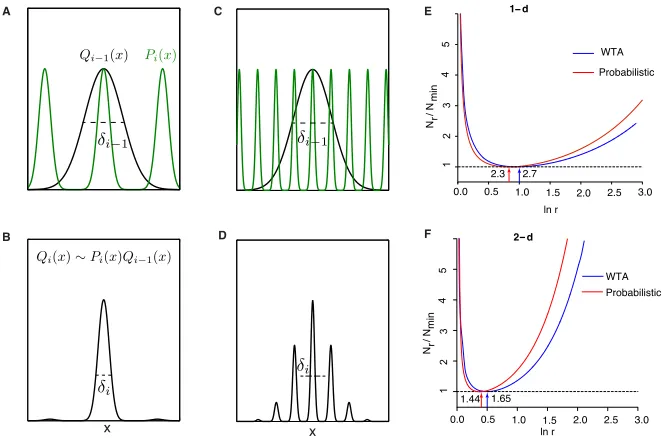
4.5 Optimizing the one dimensional grid system. . . 109
4.6 Encoding range can exceeds the period of the largest grid module. . . 118
4.7 The effect of lesioning grid modules on the distribution over location
for hierarchical vs. non-hierarchical grid schemes. . . 119
4.8 The effect of lesioning individual grid modules on place cell activity
in a simple grid-place transformation model. . . 121
5.1 Fisher information generally overestimates mutual information. . . 136
5.2 Different population tuning solutions lead to equivalent distributions
of Fisher information. . . 142
Chapter 1
Introduction
The human brain is a complex system which has attracted much endeavor to
under-stand how it works. The scientific investigations have traditionally been dominated
by the experimental approach, e.g. experimental psychology and neuroscience. In
such experiments, one typically manipulates a single variable at a time. By
observ-ing how the target variable changes, one could potentially obtain some
understand-ing about the underlyunderstand-ing process. Although a great deal of the knowledge about the
brain has been accumulated by this approach, one limitation is that it falls short
when dealing with the huge dimensionality of the underlying parameter space, and
when facing the complexity of computational machinery in the brain.
Starting from mid-20th century, scientists have gradually realized that, to
un-derstand the computations which gives rise to the various kinds of functions of the
use of mathematics and physics has many advantages and I shall only list a few
of them. First, such language makes it possible to precisely describing the process
of information processing in the neural systems. Second, one may gain some
fur-ther insights of such process by analytical investigations based on the formulated
mathematical model. Such insights, including these which may first appear to be
counter-intuitive, are otherwise difficult to obtain by, e.g. reasoning via human
language. Third, it could generate quantitative predictions to guide further
exper-imental investigation, and increase the chance of observing interesting phenomena.
The use of mathematics in neuroscience has already enjoyed some remarkable
suc-cess back to several decades ago, such as the landmark results of Hodgkin-Huxley
equations[93].
The approach of studying the brain by exploiting knowledge from mathematics
and physics have now lead to the field ofcomputational neuroscience [48]. Now there
seems to be an increasing agreement in term of that coupling the computational
approach with experimental approach offers the best promise to understand the
brain. Most existing work in the field of computational neuroscience deals with
computational models, which partly follows the tradition and style of the seminal
work of Hodgkin-Huxley equations [93]. Arguably, only a small portion of the
field deals with theories of the neural processing. Although the distinction between
theory and model is often considered to be fuzzy, I believe that the difference is real.
and model is that “(...) models describe a particular phenomenon or process, and
theories deal with a larger range of issues and identify general organizing principles”
[166]. While computational models are useful in providing quantitative descriptions
of the underlying biological process, they only shed limited general insight into the
designing principles of the brain. Overall, the computational modeling approach
often addressed the “how” question. However, a more comprehensive understanding
of the brain also requires asking the “why” question, which is typically the main
focus of theories in neuroscience.
Theories in neuroscience, although so far less well developed, have nonetheless
helped advanced our understanding of the brain in many ways. Notably, there
have been two lines of theoretical investigations which have substantial impact on
understanding of functions the brain, particularly perception. The first line of
theories promotes the idea of treating perception and cognitive functions in general
as an inference process, more specifically Bayesian inference(e.g. [103]). This route
could be traced back at least to Helmholtz (1866) [90]. In another line, neural
computation is formulated as a process of representing, recoding, and transmitting
information. Specifically, the Efficient Coding hypothesis by Attneave (1954) and
Barlow(1961) [10, 4] has sparkled a lot of following up investigations on early sensory
processing.
The research presented in the thesis is mainly driven by the theoretical approach.
otherwise appear to be unrelated, and the ability to predict what would be observed
in different situations. To this end, I have tried to test the developed theories using a
wide range of data, ranging from psychophysical measurements of human behaviors
to the neurophysiological measurements of neural populations in rodents.
1.1
Main hypothesis
The main hypothesis pursued in this thesis is thatthe brain performs computations
efficiently.
Various considerations jointly point to the concept that the computation in the
brain should be efficient (e.g. [113, 35, 112, 16, 116]). First of all, the computations
performed in the brain is costly in terms of energy. One remarkable observation is
that the brain, which typically consists 2% of the mass of the body, consumes 20%
of the resting metabolic energy [35]. Every spike and every synaptic event in the
brain requires energy [112, 116]. Second, consider the large variety of tasks which
the human brain can perform. These range from perception, navigation, identifying
objects, finding partners to solving math problems and thinking, writing. This is
particularly remarkable given the size and the limited amount of possible energy
consumption of the brain[112, 116]. To complete these various tasks successfully, the
brain has to somehow use the available information and energy efficiently. Third,
the survival pressure in evolution would tend to push the computations in the brain
pressure and limited resource (e.g. energy constraint, information constraint) faced
by the brain may have pushed the neural system toward the regime of being efficient
during evolution.
Historically, the concept ofefficiency has played an important rule in
formulat-ing theories of the brain computation. To appreciate this, let us briefly examine
these two influential lines of theories mentioned above. In the case of treating
per-ception as Bayesian inference, it could be seen as a result of couplingefficiency with
statistical estimation theory. While there are many possible ways of doing
statis-tical inference, the Bayesian inference representing the most efficient one. When
efficiency is coupled with Information theory [153], the Efficient Coding hypothesis
emerges [10, 4]. The appearance of the same concept in these two major branch
of theories should not be considered as surprising, given that efficiency provides a
fundamental, yet biologically well-grounded ingredient when formulating theories
of the brain computation.
In this thesis, building upon previous research, I test this main hypothesis in
both low-level and high-level cognitive functions of the brain, focusing on visual
perception and spatial navigation. I shall demonstrate that the idea that the brain
performs computation efficiently can explain a wide range of experimental
obser-vations, both in terms behavioral and neural measurements. Furthermore, it may
1.2
Structure of the thesis
In Chapter 1, I elaborate the concept of efficiency and why it may be relevant
for understanding the computations in the brain.
Chapter 2 aims to prepare the readers a minimal background for the materials
presented in the three following chapters, without thorough reviews of these
top-ics. In more details, it introduces i) two prominent hypothesis for understanding
perception, namely Efficient coding and Bayesian inference; ii) the basics of the
neurophysiological underpinning of spatial representation in rodent’s brain; iii) a
quick primer on Information-theoretic quantities, including the basic properties of
mutual information and Fisher information.
Chapter 3 develops a general framework for understanding perception. While
previous works on perception have either focus on the encoding or the decoding
as-pects, the presented framework integrates the idea ofEfficient coding andBayesian
decoding into a model of perceptual behaviors. I shall demonstrate that this
frame-work naturally accounts for various puzzling psychophysical observations reported
previously. The examples involved are from visual perception. This Chapter is
large part identical to a manuscript which has been submitted for consideration of
publication.
Chapter 4 applies the idea of Efficient coding to a high cognitive function, i.e.
neural coding of animal’s self-location during spatial navigation. Although
principle for understanding early sensory processing, however, it is largely unknown
whether such principle would also be relevant when studying high level cognitive
functions. In this chapter, I demonstrate that the notion of “efficiency”quantitatively
predicts the neurophysiologically observed functional architecture of the rodents’
grid cells, which form an representation of the space. This Chapter is large part
identical to a manuscript which has been submitted for consideration of publication.
In Chapter 5, I develop some analytically tools which clarifies the relationship
between mutual information and Fisher information - two widely used quantities
in neural coding. This important relationship has been misunderstood in previous
works. Furthermore, the results provide some powerful tests of Efficient coding for
future experiments. This Chapter is large part identical to a manuscript which has
been submitted for consideration of publication.
The final Chapter summarizes the contribution of the thesis, discusses open
questions and future directions which are likely to be fruitful.
Related publications and presentations
The work in Chapter 3 was conducted jointly with Alan Stocker. Part of this
work was published in Neural Information Processing System (NIPS, 2012) meeting
as a conference proceeding [184]. Part of this work was also presented in
Compu-tational and System Neuroscience meeting (CoSyNe, 2013) and Annual Meeting of
Models in Vision (Modvis, 2014) and Optical Society Vision meeting (2014). This
work won the best student poster award in VSS, 2014. This manuscript which has
been submitted for consideration of publication.
The work in Chapter 4 was conducted jointly with Jason Prentice and Vijay
Balasubramanian. Part of this work was presented in Computational and System
Neuroscience meeting (CoSyNe, 2013). A version of this work has appeared as a
format of preprint on arxiv [182]. This manuscript which has been submitted for
consideration of publication.
The work in Chapter 5 was conducted jointly with Alan Stocker. This manuscript
has been submitted for consideration of publication.
Publications and presentations not included in this thesis
X.-X. Wei & A. A. Stocker. Bayesian inference with efficient neural population
codes. In Artificial Neural Networks and Machine Learning –ICANN 2012, pages
523–530. Springer, 2012.
J. Jacobs, C.T. Weidemann, J. F. Miller, A. Solway, J. F. Burke, X.-X. Wei,
N. Suthana et al. Direct recordings of grid-like neuronal activity in human spatial
navigation. Nature Neuroscience, 16(9):1188 –1190, 2013.
X.-X. Wei, P. A. Ortega, and A. A. Stocker. Perceptual adaptation: Getting
ready for the future. Annual Meeting of Vision Sciences (VSS), 2015. Abstract.
Chapter 2
Background
Due to interdisciplinary nature of the research presented in this thesis, a brief
introduction for each topic seems to be desirable. In broad stroke, the research
are related to four different areas – Efficient coding, Bayesian inference, spatial
cognition, Information theory. Below I shall present the basics of each topic, with
the goal to facilitate the readers’ understanding of the following Chapters. Readers
who are already familiar with these topics should feel free to skip some of these
sections.
2.1
Efficient coding
One important hypothesis which drives the research on perception, in particular
early sensory procession, is the Efficient Coding Hypothesis. Efficient coding was
inspired by the seminal work of Shannon on information theory [153]. One key
con-tribution Atteave and Barlow brought into the field of neuroscience is the idea that
the mathematical framework of information theory may be relevant for
understand-ing the brain, and it may shed light on the strategy by which the neural system
process information.
Specifically, Barlow’s original version of Efficient coding concerns about how
information should be encoded in the sensory system, particularly in early visual
system. Barlow’s idea is that the sensory signal should be recoded in the most
economical way [10]. One particular way to increase efficiency, which is what Barlow
emphasized, is to make the response of the two outputs to be more independent,
i.e. redundancy reduction. The idea is simple. Redundancy between the output
units would lead to a decrease in terms of the information transmitted. Thus, if the
neural processing could somehow eliminate such redundancy, the efficiency of the
representation should be improved.
Many versions of Efficient coding theories were developed afterwards which
fol-low this idea of the efficient information transmission in the neural system. One
notable example is the proposal by Linker that the neural system should be
or-ganized in a way such that the mutual information between the input and output
should be maximized, i.e. InfoMax [121]. Importantly, Linsker also investigated
how biologically plausible learning rules might give rise to such efficient
One may wonder why there are many seemingly different versions of Efficient
coding theory co-existing in the literature. In my opinion, one reason is that
dif-ferent Efficient coding theories typically make difdif-ferent assumptions on the noise
structure of the system [154]. For example, in Barlow’s original proposal,
considera-tion of the neural noise is not included [10]. In this situaconsidera-tion, redundancy reducconsidera-tion
is a desirable goal. Linkser’s InfoMax could be related to the redundancy reduction
proposed by Barlow in the zero-noise limit. In some models, Gaussian noise are
assumed (e.g., [3, 179]). In the presence of certain type of noise, certain amount of
redundancy could actually be advantageous [3, 179, 55].
Another reason is that different theories may impose different constraints on the
overall resources and different objective functions. For instance, transmitting the
same amount information using the fewest number of spikes is, in general, a different
goal comparing to using the fewest number of neurons. These two objectives are also
different from the objective of using the smallest number of simultaneously active
neurons. These different assumptions would lead to different optimal configurations
of neural code. Interestingly, later work on sparse coding was inspired by
consider-ation of representing the input using a small number of active neurons [134, 135].
Some have argued that the optimal neural code should explicitly quantify and take
into account of the amount of energy consumption [119, 112, 7, 6, 116]. Some others
have argued that one should use the reconstruction error rather than the amount
Despite these different formulations, there seems to be one general agreement
among these theories, which is that the neural system should exploit the statistical
structure of the surrounding environment [63, 155]. This arises because,
funda-mentally, the amount of information transferred by a noisy channel, as well as the
reconstruction error, crucially depends on the probability distribution of the
in-put [153]. Because the inin-put to the sensory system will inevitably shaped (at least
partially) by the statistics of the environment, a good design of the sensory system
would have to take such statistical regularities into account.
Substantial efforts have been devoted to test the Efficient coding hypothesis
experimentally. Such investigations have lead to much success in early visual (e.g.
[111, 46, 6, 134, 59, 8, 100, 76]) and auditory processing (e.g., [120, 157]). However,
challenges remain. First, most studies have been done on early sensory system, and
it is presently unknown whether these results would generalize to relatively higher
cognitive area or not. Second, from a theoretical point of view, many previous
research have tried to predict the tuning property of individual neuron (e.g., [111,
127, 181]). However, arguably more desirable tests, which would shed more light
on the neural processing, should be tests at the neural population level. Third,
most previous work have focused on the predictions in terms of neurophysiological
2.2
Bayesian inference
Besides Efficient Coding, another major hypothesis which has profound impact on
the understanding of the perceptual process is the proposal of treating perception
as Bayesian inference (e.g. [103]). The basic idea is that perception is not simply
taking pictures of the environment like the way a camera does, rather it involves
active interpretation of the raw sensory inputs. Thus, perception could be better
viewed as an inference process. Holmherz already realized this concept in the 19th
century [90].
To appreciate the perspective of treating perception as an inference process [103],
it is useful to realize that there is virtually always ambiguity in the sensory input.
Consider the example of vision, in which 3-d environment is mapped to 2-d retinal
image. Some information becomes lost inevitably in such mapping. Also consider
the fact the noise is not only present in the stimulus itself, but it is also ubiquitous
along the sensory processing in the brain [60]. The presence of noise leads to
ambiguity when interpreting the sensory observation, and in principle could result
in many different interpretations of the same stimulus.
The noise in the perceptual process imposes a fundamental challenge for
per-ception (not only for visual perper-ception), namely, how does the perceptual system
select the specific way to interpret the input? An appealing hypothesis is that
per-ception involves efficient interpretation based on limited information gathered by
interpret the sensory observation.
Bayes’ rule
To understand how Bayesian inference works, consider the case of judging the
speed θ of an moving object. The perceptual system takes some observations of
speed of the moving object, which will be termed as “data”. Note that the process
which generates the data is typically noisy, in the sense that the mapping from a
particular speed θ to the data is not one-to-one, rather such dependence can be
summarized as a conditional probability distribution P(data|θ). The problem is
that, once the data is known, how to infer the underlying speed of the object?
Bayesian inference tells us that one should use both the prior belief on the speed of
the moving object and the evidence gathered from the observations to perform the
inference. Furthermore, crucially one should combine these two source of
informa-tion using Bayes rule (Bayes &Price, 1763). Mathematically, Bayes’ rule could be
written as
P(θ|data) = P(θ)P(data|θ)
P(data) (2.1)
This rule is the core of Bayesian inference. The term on the left-hand side
P(θ|data) is the posterior distribution onθ given thedata. On the right-hand side,
P(θ) is typically referred as prior distribution onθ, which summarize the prior belief
of θ, which summarizes the evidence gathered from the data . It is important to
emphasize that although P(data|θ) itself is a probability given θ, but with respect
to variable θ while fixing data, it is a function of θ, because its value varies with
θ. Therefore, it is appropriate to call it a likelihood function on θ, rather than a
“likelihood distribution”. Finally, the term P(data) is a normalization factor which
guarantees that P(θ|data) is a proper probability distribution.
A common goal for Bayesian models is to derive the posterior distribution onθ,
i.e. P(θ|data). This is, again, proportional to the product of the prior distribution
and the likelihood function. To get the posterior distribution, naturally one has to
obtain the prior belief and the likelihood function first.
To calculate the likelihood function precisely, in principle the full knowledge of
how the data are generated from θ is required. Such information critically depends
on the structure of the model (sometimes called “generative model” [48]). Of course,
the complexity of the problem varies depending on the structure of the model.
Chapter 3 has a detailed discussion on this issue, where I shall propose a principled
way to specify the likelihood function for certain perceptual inference problems.
How to specify the prior distribution? In practice, the selection of prior
dis-tributions is often done based on computation convenience. For example, a prior
distribution has often been chosen to be flat or Gaussian. Alternatively, a
seem-ingly more reasonable way is to pick up a “reference prior” [14] based on some
research topic in statistics [14, 101]. For perceptual inference, there may be
prin-cipled ways to specify the prior. Consider the speed example we mentioned again.
In this case, it seems reasonable to assume that such prior belief should depend on
our sensory experience in the past. This means that the prior distribution should
reflect the statistics of given variables in natural environments. Again consider the
example of the perceived speed. The prior may be thought as the statistics of the
speed in natural environments, which determines our long term sensory experience
on speed [169]. However, this is just a first-order approximation. In general, the
prior may depends on various other factors, e.g. context, individual, and so on.
Loss function
In many cases, computing the posterior distribution is not the end of the task,
because a particular Bayesian estimator may be required. For example, in the
con-text of speed estimation, a particular estimation of the speed of the object has to
be obtained, while the posterior distribution itself is not enough to specify the
per-cept. Technically, the mapping from the posterior to the Bayesian estimator could
be done by first assuming a loss function, and then constructing the corresponding
optimal estimator according to such loss [40]. Common choice of the loss functions
involves the family of Lp loss functions with pcan be chosen to be different values.
For squared error loss (p= 2), the resulting Bayesian estimator is the mean value
estimator is the median of the posterior distribution. The MAP estimator, i.e. the
mode of the posterior distribution, is obtained under 0−1 loss (p = 0). Not too
much is known on the specific loss functions used by the perceptual system. We
will return to this point in Chapter 3.
2.3
Neural representation of physical space
As we navigate around, we often have a sense of where we are in space. Actually,
knowing the self-location relative to the environment is a fundamental ability for
the purpose of survival. How does the brain support such ability? Tolman (1948)
proposed that the brain should be able to maintain a “cognitive map” of the physical
space [174]. The discovery of place cells in rodent hippocampus around 1970s
has triggered a lot of following up research on the neural basis of spatial map in
the brain [132, 133]. The most salient property of place cells is that its firing
activity is sparse in space. Individual place cell typically fires when only animal is
within a particular spot in space [132], although some place cells fire in multiple
spots in space. As we know more about the place cells, it becomes clear that
the firing activities of the place cells are also correlated with many other factors
besides the animal’s spatial location, including odor, recent experience, time and
others [138, 2, 136]. The interpretations of these multi-perplexing responses are still
subjected to debates.
un-clear whether the spatial information is originated within hippocampus or inherent
from other brain areas. The discovery of grid cells in dorsal-medial Entorhinal
Cor-tex offers some new insight to this question[86, 75]. Now it appears that place cell
may, at least partially, inherent the spatial information from grid cells. Place cells,
grid cells, together with heading direction cells[172] and boarder cells[159] may
con-sist the neural underpinning of our sense of space during navigation. Studying the
properties and functions of these cell may provide us a unique chance to uncover
how the space is represented in the mammalian brain, and how spatial maps in the
brain support navigation behaviors, which are critical for the survival of mammals.
Grid cells
In 2004, Fyhn et al., discovered that in dorsal band of Entorhinal Cortex (EC)
of the rat’s brain, neurons typically show tuning preference for space, similar as the
place cells [75]. However, unlike place cells, these cells typically fire in the multiple
spatial locations. In 2005, a following up paper by Hafting et al., demonstrated that,
surprisingly, the spatial firing fields of the cells in dmEC lies on a triangular grid [86].
These cells are thus termed as “grid cells”. Because the highly regular firing pattern
of the grid cells, it is immediately suggested that the grid cells may encode a metric
of the space [86, 129]. Grid cells are also found in pre-and parasubiculum [19],
two brain regions next to EC. Although the response pattern of grid cells can be
which determines the response of the grid cells response appear to be the animal’s
location in space.
Why are grid cells not discovered in the studies before Hafting et al. (2005) [86]?
One major reason seems to be that previous experiments have used smaller testing
rooms, which were not enough to reveal the lattice structure of the grid. In a small
environment, typically only one or even zero firing field of individual grid cells could
be observed. However, in larger recording rooms, the pattern of the grid become
visually apparent. The grid is particularly evident when the two dimensional
au-tocorrelation map of the grid firing map is calculated which effectively reduce the
noise in the original firing rate map by averaging [86]. Originally found in rats, the
grid cells are later discovered in mice[74], and in bats [187]. There are some indirect
evidence from fMRI signal suggesting that grid cells may also exist in humans [54].
Recently, my colleagues and I have reported the first direct observation of grid-like
response in human brain by analyzing data from single neuron recording of human
epilepsy patients, while they were performing a virtual navigation task [94].
The response pattern of individual grid cell can be characterized by three
pa-rameters, the spacing, the orientation, and the spatial phase. Locally, the grid
cells in rodents share similar spacing and orientation [86, 164]. The spatial phase
seems to be shifted randomly such that nearby cells do not have nearby phases[86].
Therefore, there seems to be no topographical relationship in the spatial phase.
the grids. Furthermore, the scales increase systematically along the dorsal-ventral
axis [86, 26]. At the dorsal most, the spacing of the grid is about 50cm, while at
the 75% of the dorsal-ventral axis, the spacing of the grid can be several meters
to 10 meters, according to the recording when rats running on a 18 meters linear
track[26].
One particular important property of grid cells is that they are organized in
discrete structure [164]. By a fine sampling of grid cells along about half of the
dorsal-ventral axis of EC, Stensola et al. (2012) demonstrates that grid cells could
be clustered based on the scale, orientation and ellipticity [164]. The cells within
one cluster share the same scale, orientation and ellipticity. The individual cluster
is termed as a module. These authors found up to 5 modules within individual
animal. However, because the recording was only done up to 50% of the dorsal
ventral axis of EC, more modules should be expected in whole EC. A simple linear
extrapolation suggests that the number of the grid cell modules in rodent EC should
be ∼ 10. Strikingly, the data also suggest that the grid scales follow a geometric
progression. In this particular data set, the scaling factor was found to be ∼1.42,
while in a previous study, the scaling factor was reported be∼1.7 with a relatively
smaller sample size [11].
The grid cells have attracted many computational investigations since it is
dis-covered. Most research have focus on the mechanisms and algorithms of how the
of pattern formation[176] in attractor network [72, 28, 20] and oscillatory
interfer-ence [30, 89], as well as spike rate adaptation [106].
While these computational models of grid cells aim to address thehow question,
the question of why the grid cells firing pattern should be as observed remain
mys-terious. In Chapter 4, I ask the fundamental issue in terms of why it is desirable
to use the grid code to form a representation of the space. I show that the idea of
efficient processing of spatial information quantitatively accounts for the functional
architecture of the grid cells observed in the rodent’s brain.
2.4
Mutual information and Fisher information
In this section, I introduce two important Information-theoretic quantities which
are used frequently in this thesis, namely mutual information and Fisher
informa-tion. Note that mutual information comes from Information theory, while Fisher
information has a fundamental root in statistics.
2.4.1
Mutual information
Information theory concerns the communication of information [153]. A basic
quan-tity in Information theory is entropy. Entropy characterizes the amount of
uncer-tainty associated with a random variable. For a discrete random variable X with
H[X] =Xp(x) lnp(x)
.
For a continuous random variableX with density p(x), its (differential) entropy
can be defined as
H[X] =
Z
X
p(x) lnp(x)dx
.
Mutual information quantifies how much information of one random variable
is contained in another random variable. Formally, mutual information could be
expressed as
I[X, Y] =H[X]−H[X|Y].
Note that following this definition, we can also consider
I[Y, X] =H[Y]−H[Y|X].
It can be verified that the following is true
I[X, Y] =I[Y, X].
For two continuous random variables X, Y, with joint probability densityp(x, y),
I[X, Y] =
Z
Y Z
X
p(x, y) ln
p(x, y) p(x)p(y)
dxdy.
Two important facts. First, I[X, Y] is always non-negative. Second, I[X, Y] = 0 is
equivalent to the independence of X and Y.
Information theory has profound influence in many scientific fields, including
neuroscience. In many neuroscience problems, one could treat individual neurons
or neural populations as noisy communication channel(s) and study the information
transmitted in such channel(s). For instance, denoting the stimulus variable as s,
and the neural response as r, one could compute the mutual information between
the stimulus and the response as
I[r, s] =H[r]−H[r|s].
This means that the mutual information is, technically, the difference between the
entropy of the response and the entropy of the response given a particular stimulus.
Conceptually, this captures the ratio between the volume of the response space and
the average volume of the response given a stimulus.
Alternatively, one could compute the mutual information as
computed as the difference between the entropy of the stimulus and the entropy of
the stimulus given a response. Conceptually, this is related to the ratio between the
volume of the stimulus and the average volume of the stimulus given a response.
Thus it quantifies how well a response r could tell about the stimuluss.
Recall the mathematical fact that I[s, r] is always identical to I[r, s], although
it should be apparent from the above discussions that the conceptual
interpreta-tions of these two quantities could be quite different. Practically, the mathematical
equivalence of these different expressions offers two choices for computing the
mu-tual information. Depending on the problems, one expression is usually easier to
work with compared to the other one. Unfortunately, sometimes both expressions
are difficult to compute exactly, in which cases one would need to rely on further
assumptions to work with these quantities.
2.4.2
Fisher information
Fisher information [67] is one central quantity in statistics, particularly in
estima-tion theory [115]. Fisher informaestima-tion is sometimes referred as “informaestima-tion” in
statistics [115]. Note that this should not be confused with mutual information
defined above. Fisher information characterizes the amount of information that
an observation (or measurement) m carries about an unknown parameter θ given
information can be defined as
J(θ) =
Z
∂lnp(m|θ) ∂θ
2
p(m|θ)dm. (2.2)
In this expression, p(m|θ) should be treated as the likelihood function on θ.
lnp(m|θ) represents the log-likelihood function, which is often called “support curve”[58].
The slope of the support curve is the “score”, which represents how sensitively the
likelihood function depends on the parameter θ. It is important to emphasize that
while the likelihood function depends on a particular observation m, Fisher
infor-mation does not. The reason is that the dependence on m is integrated out by
definition. Thus, it is appropriate to interpret Fisher information as a measure of
the expected sensitivity with respect to each value of the parameter θ, which is
fully determined by the encoding model which specifies the relationship between
the random variables m and θ. In some sense, Fisher information defines a metric
in the space of θ.
As a remark, there is another way to define Fisher information
J(θ) =−
Z
∂2lnp(m|θ)
∂θ2 p(m|θ)dm. (2.3)
It is straightforward to check that these two definitions are equivalent. These
defi-nitions only apply whenθ is a scalar. Ifθ is a vector, one can define a corresponding
Fisher information has many interesting properties. For the purpose of this
the-sis, I shall only introduce a few of them.
Cramer-Rao bound
Perhaps the most well-known result related to Fisher information is the
Cramer-Rao bound [41, 139]. Cramer-Cramer-Rao bound states that, under certain regularity
con-ditions, Fisher information sets an lower bound on the variance of any unbiased
estimator ˆθ. Formally, it could be expressed as
V ar(ˆθ)≥ 1
J(θ). (2.4)
In general, Cramer-Rao bound could not be reached. It can only be tight for special
kinds of statistical models. I shall come back to this point later in Chapter 5, where
the conditions to make Cramer-Rao bound tight are discussed in some more details.
Intuitively, Cramer-Rao bound means that the quality of encoding, quantified by
the Fisher information, set a physical limit on how precise any unbiased estimator
can be.
Forbiased estimator, the corresponding Cramer-Rao bound turns out to be
V ar(ˆθ)≥ [1 +b 0(θ)]2
J(θ) , (2.5)
(mean square error) of estimator ˆθ must satisfy
M SE(ˆθ)≥ [1 +b 0(θ)]2
J(θ) +b(θ)
2. (2.6)
It is useful to point out that the MSE of a biased estimator could be smaller
than J(1θ) which defines a lower bound for any unbiased estimator. Although many
might have the intuition that an unbiased estimator is advantageous compared to
a biased estimator, this result suggest that, counter to that intuition, having a bias
in the estimation could be actually desirable in certain situations.
Invariance of Fisher information
The square root of Fisher informationJ(θ) has a property of invariance, i.e.
p
J(θ)dθ =
q
J(˜θ)dθ,˜ (2.7)
where ˜θ is a re-parameterization of θ. As a corollary, the integral S =R pJ(θ)dθ
is invariant with respect to any re-parameterization of θ. Under these notations,
fJ(θ) = √
J(θ)
S behaves like a probability density. fJ(θ) is known famously as Jeffreys
prior [97], which is a widely used non-informative prior in Bayesian statistics [101].
As a remark, the integral R J(θ)pdθ when taking p other than 1
2 is not invariant
Relationship to psychophysical and neural measurements
Fisher information has widely applications in many scientific fields. In the
ex-treme, It has even been argued that Fisher information can provide a unification
of many area of science[71]. In this thesis, I shall focus on its possible applications
in terms of understanding the information processing in the brain. Let me start
by noting that Fisher information has a nice relationship with respect to the most
commonly taken psychophysical measurement, i.e. discrimination threshold. It has
been well-established that [152, 151] Fisher information sets an lower bound on the
discrimination threshold (.θ) in fine discrimination tasks:
d(θ)≥Cα
1
p J(θ),
whereCα is a constant determined by the specifics of the psychophysical procedure.
Fisher information can also be used to assess how much information a certain
neuron (or neurons) carries about a particular stimulus dimension. Consider a
Pois-son neuron with a smooth tuning curve f(θ). In this case, the Fisher information
has a nice close-form expression
J(θ) = Tf(θ)
02
f(θ) ,
where T represents the length of the integration time. There are several basic
curve of a Poisson neuron are important in terms of the Fisher information the
neuron’s response carries. Second, the neuron carries most Fisher information at
the flank of its tuning curve rather than the peak. Third, the Fisher information
scales linearly with the integration time and the gain of the neuron.
Fisher information and mutual information have intriguing relationships. On one
hand, by definition, Mutual Information and Fisher information are quite different.
Conceptually, Fisher information quantifies the local information, while mutual
information is a global measure. On the other hand, these two measures are also
Chapter 3
Bayesian observer model
constrained by Efficient coding
explains “anti-Bayesian percept”
3.1
Introduction
Perception involves two important stages of processing: 1) the representation of
incoming sensory information, and 2) the interpretation of that representation to
form a percept. Two prominent hypotheses have separately guided our
understand-ing of these two processunderstand-ing stages, but each has limitations when considered alone.
The Efficient Coding Hypothesis argues that neural resource limitations lead to
statistics of the natural environment [4, 10]. This hypothesis can explain several key
features of neural coding in early sensory areas (e.g.[134, 46, 120]), but it does not
specify how these coding characteristics can give rise to important aspects of
percep-tual behavior such as perceppercep-tual biases. In contrast, theBayesian Hypothesis posits
that perception is an act of unconscious inference that interprets the noisy sensory
representation in the context of prior knowledge about the world [90, 44, 103]. This
hypothesis provides a normative explanation for many aspects of perceptual and
sensorimotor behavior (e.g., [104, 169, 178, 98]), but it has been criticized for
us-ing arbitrary model specifications in order to explain psychophysical data [99, 21].
Here we unify ideas of Efficient coding and Bayesian inference into a new model of
perceptual behavior. Specifically, we propose an Bayesian observer model that is
constrained by assuming an efficient representation of the sensory input.
Two key components define a Bayesian observer: the prior belief that reflects the
observer’s expectation about how frequently a certain stimulus value occurs, and
the likelihood function that captures the encoding accuracy in the sensory
represen-tation of the observer. Previous studies have proposed independent constraints on
either the prior belief based on natural (e.g., [175, 83]) or learned (e.g., [96, 104])
stimulus statistics, or the likelihood function based on natural stimulus
uncertain-ties(e.g., [78, 29]) or neural physiological tuning characteristics (e.g., [169]), but
not both. In contrast, our new model formulation jointly constrains both the prior
well as the interpretation of the sensory evidence is optimized with regard to the
stimulus statistics of its sensory environment. Thus, we can specify a Bayesian
observer model for any stimulus variable with known natural statistics.
We validated our framework by formulating observer models for two perceptual
variables for which the natural statistics are known, visual orientation and spatial
frequency. The models make a number of distinct and rather surprising
predic-tions; e.g., that percepts are frequently biased away from the peaks of the prior, a
prediction that seems at odds with the standard Bayesian view. We demonstrate
that the predictions are well matched by data from several studies reporting
mea-sured biases in perceived visual orientation and spatial frequency under different
levels and sources of uncertainty. That includes biases that are seemingly
“anti-Bayesian” [23]. Our results demonstrate that by combining the ideas of Efficient
coding and Bayesian decoding, we can formulate well constrained observer models
that can account for perceptual behavior that has not been explained before. Some
earlier version of this work has been previously presented [184].
3.2
Results
We model perception as a probabilistic encoding-decoding process (Fig. 3.1a) [169]:
The presentation of a stimulus with a single valueθ elicits a noisy sensory
measure-ment m (encoding), based on which the observer then generates an estimate ˆθ(m)
assumptions in order to define our observer model. First, we assume that
encod-ing is efficient, i.e., the sensory representation is optimally adapted to the natural
stimulus distribution. Second, we assume that decoding is Bayesian and is based
on an accurate (generative) model of the sensory process, i.e., the observer’s prior
belief matches the true stimulus distribution and the likelihood function faithfully
reflects the encoding characteristics. As a result, both the observer’s prior belief and
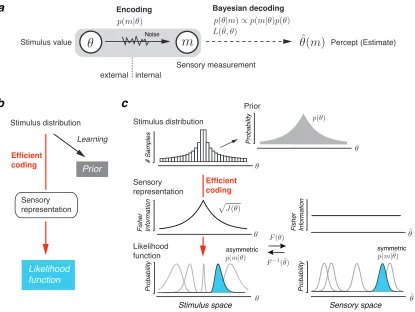
likelihood function are jointly constrained by the stimulus distribution (Fig. 3.1b).
Thus, with the additional assumption about the observer’s loss function (that states
how costly some perceptual errors are for the observer), we can make quantitative
predictions for the percept of a stimulus variable for which the natural stimulus
distribution is known. In the following we show how to formulate the model and
derive these predictions, and how they compare to measured psychophysical data.
3.2.1
Efficient coding and the likelihood function
We adopted a definition of Efficient coding that assumes that sensory encoding
maximizes the mutual information I[θ, m] between the sensory measurement m
and the stimulus variable θ with regard to the intrinsic uncertainty (internal noise)
in the sensory representation [121]. The definition establishes a link between the
Prior Probability Probability Stimulus space asymmetric c
Fisher Information
Likelihood function Prior Learning Efficient coding b Stimulus distribution # Samples Efficient coding Sensory representation Probability
Fisher Information
symmetric
Sensory space
a Encoding Bayesian decoding
Likelihood function Stimulus distribution Stimulus value Sensory measurement Percept (Estimate) Sensory representation internal external Noise
bound on mutual information [27, 127]. Assuming the bound is tight it follows that
p(θ)∝pJ(θ) (see Methods for details). (3.1)
Fisher information J(θ) is a measure of encoding accuracy and reflects the amount
of sensory resources that is dedicated to the representation of a certain stimulus
valueθ. Equation (3.1) provides an intuitive way of understanding Efficient coding:
Sensory resources should be allocated according to the stimulus distribution p(θ)
resulting in a more accurate representation of those stimulus values that occur more
frequently.
Fisher information directly constrains the likelihood function, given our general
assumption that the likelihood function faithfully reflects the encoding
characteris-tics. But it is not sufficient to fully specify the shape of the likelihood function. An
additional assumption about the noise structure is required. Let us consider a
func-tion F(θ) that maps the stimulus space to a new space in which Fisher information
is uniform (see Fig. 3.1c). We refer to this space as the “sensory space” 1. With
our chosen Efficient coding constraint Eq. (3.1) the mapping F(θ) is defined as the
cumulative of the stimulus distribution (prior) [111] (see Methods, Eq. (3.8)).
Uni-form Fisher inUni-formation implies that the noise and thus the likelihood function is
homogeneous. We introduce the additional assumption that the expected likelihood
1In reference to Gustav Fechner because discriminability, when measured in units of this space,
function (i.e. averaged out over many trials) is symmetric around the stimulus value
in the sensory space. A simple way to guarantee this is to assume, for example, the
noise to be additive and symmetric (e.g. Gaussian as illustrated in Fig. 3.1c). For
a given sensory measurement m the likelihood function in the stimulus space can
then be obtained by simply applying the inverse mapping F−1(˜θ). As a result, the
likelihood functions when formulated in stimulus space are typically asymmetric
with a long tail away from the peak of the prior distribution.
Note that by formulating the Efficient coding in terms of Fisher information
we were able to specify the likelihood function without having to assume specific
details about the tuning characteristics of the underlying neural representation.
We deliberately chose such formulation because it allowed us a more parsimonious
yet also more general description of our Bayesian observer model. In fact, as we
demonstrate later, neural populations with quite different tuning characteristics
but equivalent distributions of Fisher information can represent equivalent efficient
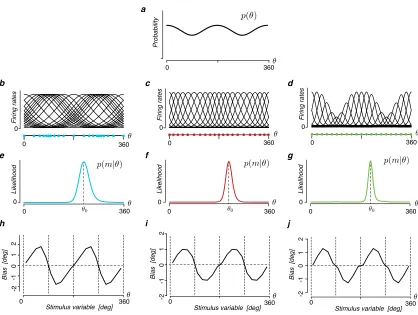
sensory representations that lead to similar Bayesian decoding characteristics.
3.2.2
General predictions of the framework
The tight link between the stimulus distribution, the encoding accuracy (i.e., the
Fisher information J(θ)), and the shape of the likelihood function has important
consequences for the resulting decoding characteristics of our Bayesian observer
that are surprising and counter-intuitive from a standard Bayesian modeling point
of view.
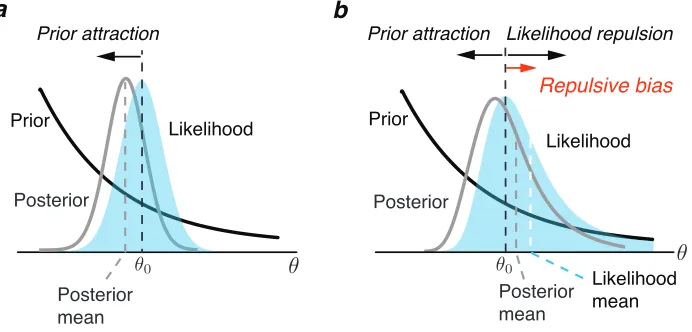
The first prediction concerns the effect of the likelihood asymmetry on perceptual
bias. A Bayesian modeling approach that assumes a symmetric likelihood function
predicts the percept to be biased towards the prior peak for relatively smooth prior
distributions (Fig. 3.2a). The situation changes, however, if the likelihood function
is asymmetric (Fig. 3.2b). Now, the asymmetry itself can lead to estimation biases
(see also [170]). In our framework, the shape of the likelihood is asymmetric for
any non-uniform stimulus distribution with a heavier tail pointing away from the
prior peak. This shape typically results in a repulsive bias component that we
refer to as the likelihood repulsion. Although the effect depends on the chosen loss
function, it is remarkably robust for commonly used choices (see Fig. 3.7). The
repulsive effect is further amplified when computing the expected bias over many
measurements of a given stimulus value θ0. The reason is that the distribution of
these measurements in the stimulus space also follows the same asymmetry; i.e.,
the noisy measurements and thus the position of the likelihood functions on each
trial are, on average, also biased away from the true stimulus value θ0. These
observations suggest a nuanced account of perceptual biases as the net result of
two bias components, one introduced by the likelihood asymmetry and one by the
prior distribution. Because of the above link, we can precisely predict the net bias
Posterior mean
Prior attraction Likelihood repulsion
Prior
Likelihood mean
Prior attraction
Prior Likelihood
Posterior mean Posterior
b a
Posterior
Repulsive bias
Likelihood
Figure 3.2: Prediction 1: Bayesian perception can be biased away from the prior
peak. a) A standard Bayesian observer model that assumes a symmetric likelihood
function typically predicts perceptual biases toward the peak of the prior. This “bias towards the prior” has been considered a fundamental characteristic of a Bayesian model. b) In our new Bayesian observer model, Efficient encoding promotes a non-homogeneous sensory representation that leads to an asymmetric shape of the like-lihood function with a long tail pointing away from the prior peak. As a result, the estimate can be biased away from the prior peak. This is illustrated assum-ing the Bayesian estimate is determined by the posterior mean (squared-error loss function). Due to its asymmetry the mean of the likelihood function is away from the peak of the prior relative to the true stimulus value θ0 (Likelihood repulsion).
the model predicts that perception is biased away from the peak of the stimulus
distribution (i.e. the prior belief). In particular, assuming small sensory noise
only and a squared-error loss function (posterior mean) we can derive analytical
solutions for the expected perceptual bias for arbitrary stimulus distributions (see
Methods for details). The predicted bias is always repulsive if the prior distribution
is well approximated by a monotonic function over the support of the likelihood
function. This prediction is quite remarkable since the “bias towards the prior” has
been considered a fundamental characteristics of Bayesian observer models.
The second prediction is that stimulus (external) and sensory (internal) noise
differently affect perceptual bias. The difference emerges because our Efficient
cod-ing assumption generally imposes an inhomogeneous sensory representation that has
a different metric than the physical space. Thus, although ultimately both sources
of uncertainties are jointly reflected in the noise of the sensory measurementmtheir
individual effects on the likelihood function are different because of the mapping
functionF (Fig. 3.3a). As a result, the same noise added at the stimulus level leads
to a different likelihood function than the equivalent noise added at the sensory
level, which results in a different bias.
Increasing sensory noise results in a likelihood function that is more asymmetric
in the stimulus space because the additional uncertainty is mapped from the sensory
space (where it is symmetric; e.g. Gaussian) to the stimulus space via the inverse
a Perceptual bias + 0 Sensory noise repulsive attractive Stimulus noise - Prior Likelihood c Prior Prior Noise level Likelihood Likelihood low high low high more repulsion more attraction Stimulus space Stimulus space Sensory noise Stimulus noise Sensory space + + b
Figure 3.3: Prediction 2: Stimulus (external) and sensory (internal) noise
differen-tially affect perceptual bias. a) Stimulus noise directly affects stimulus uncertainty
likelihood function, the increase in likelihood repulsion generally dominates, leading
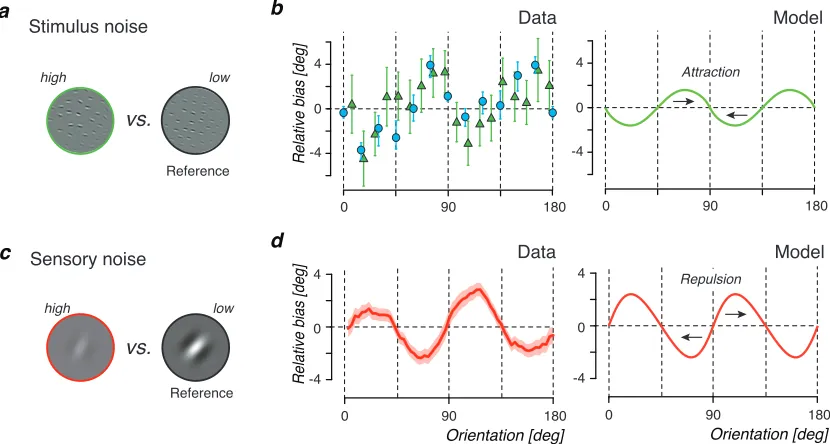
to a net increase in repulsive bias (Fig. 3.3b). Experimentally, we assume that
sensory noise (or rather the signal-to-noise ratio) can be modulated by changing
stimulus contrast or presentation time.
In summary, our Bayesian observer model predicts that perception is often
bi-ased away from the peak of the prior. Furthermore, it predicts that internal and
external noise can differentially modulate these biases: increasing internal noise
increases repulsive bias while increasing stimulus noise decreases repulsive bias,
eventually leading to attractive perceptual biases. These predictions are surprising
and at odds with predictions of standard Bayesian observer models.
3.2.3
Model validation against human psychophysical data
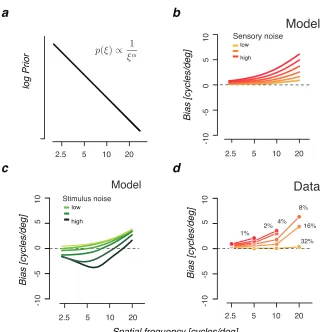
We validated the model predictions against measured perceptual biases for two
vi-sual stimulus variables with known natural stimulus distributions, local orientation
θ and spatial frequency ξ.
Orientation perception
Several studies have measured the distribution of visual orientations in natural
environments by carefully analyzing natural image data [37, 83]. The extracted
distributions are fairly robust with regard to the specifics of the analysis and the
Probability 0 0.01 Orientation [deg] 180 0 90 -10 0 10 Bias [deg] Orientation [deg] Noise Bias [deg]
@ 13.5 degs oblique
low high
Data d a b e c f low high Sensory noise -4 0 4 8 00 2 -2 0 Bias [deg] -4 4 high low Stimulus noise 0 3 -3 0 Model Model Data 180
0 90 0 90 180
180
0 90 0 90 180
Data
Orientation [deg]
-4
4
Figure 3.4: Biases in perceived orientation. a) Measured distribution of local visual orientation in natural images (gray line - re-plotted from [83]), superim-posed with the parametric description used for the model predictions (black line: p(θ) = c0(2− |sinθ|) where c0 is a normalization constant). b) Predicted mean

![Figure 3.4: Biases in perceived orientation.biases as a function of stimulus orientationa) Measured distribution of localvisual orientation in natural images (gray line - re-plotted from [83]), superim-posed with the parametric description used for the mod](https://thumb-us.123doks.com/thumbv2/123dok_us/9372826.1470769/56.612.116.527.100.358/perceived-orientation-orientationa-distribution-localvisual-orientation-parametric-description.webp)