University of New Hampshire
University of New Hampshire Scholars' Repository
Applied Engineering and Sciences Scholarship Applied Engineering and Sciences
6-1-2017
Summer learning experience for girls in grades 7–9
boosts confidence and interest in computing
careers
Mihaela C. SabinUniversity of New Hampshire, Manchester, [email protected]
Rosabel Deloge
University of New Hampshire, Manchester
Adrienne Smith Cynosure Consulting
Wendy DuBow University of Colorado
Follow this and additional works at:https://scholars.unh.edu/unhmcis_facpub
This Article is brought to you for free and open access by the Applied Engineering and Sciences at University of New Hampshire Scholars' Repository. It has been accepted for inclusion in Applied Engineering and Sciences Scholarship by an authorized administrator of University of New Hampshire Scholars' Repository. For more information, please [email protected].
Recommended Citation
SUMMER LEARNING EXPERIENCE FOR GIRLS IN GRADES 7-9 BOOSTS CONFIDENCE AND INTEREST IN COMPUTING CAREERS
Mihaela Sabin
University of New Hampshire
88 Commercial Street, Manchester, NH 03101 603 641 4144
Rosabel Deloge
University of New Hampshire
88 Commercial Street, Manchester, NH 03101 603 475 8992
Adrienne Smith Cynosure Consulting
1302 Applethorn Drive, Apex, NC 27502 919 616 1565
Wendy DuBow NCWIT
University of Colorado, Boulder CO 80303 303 735 6671
ABSTRACT
Academic exposure to computer science, encouragement to study computer science, and connecting personal interests to computing areas influence women to pursue degrees in computer science. Guided by these recommendations, we designed and offered a summer learning experience for girls in grades 7-9 in summer 2016. The goal of the program was to improve girls’ perceptions of learning computer science through academic exposure in the informal setting of a girls-only summer camp. In this paper we present a study of the girls’ perceptions of CS learning. Four constructs were used to develop pre- and post-survey items: computing confidence, intent to persist, social supports, and computing outcomes expectations. The camp appeared to have positively influenced the girls on two of the four constructs, by improving computing confidence and positive perceptions of computing careers.
INTRODUCTION
The persisting lack of gender diversity in computing education and the workplace compounds the challenge of meeting a growing demand for people with computer science skills [9, 10]. At the University of New Hampshire, the flagship public university in our State, women make up less than 10% of undergraduate computing majors, below the national share of 18%, at a time when New Hampshire’s unfilled high-tech jobs are three times higher than the number of computing graduates [11, 13]. At the high school level, women’s participation in the AP Computer Science in New Hampshire has stagnated at 12% over the past three years, despite a 44% increase in the total number of the AP CS exam takers [3].
The 2014 Google report on what influences women to pursue degrees in computer science [6] identified four leading factors: social encouragement to study computer science, having an interest in areas applicable to computer science, academic exposure to computer science, and an understanding of the broader professional applications for computer science. With these factors in mind, we participated in designing and offering the program Creative Computing Challenge,a one-week summer learning experience in computer science for girls in grades 7, 8, and 9.
Hampshire, evaluation researchers, UNH Cooperative Extension specialists, and teachers from Career and Technical Education (CTE) centers in New Hampshire [12]. The project is aimed at building access to all students to engage with and deepen their understanding of essential computing concepts and computational practices situated within the context of applications of interest to diverse learners. In addition to the Creative Computing Challenge summer camp, the project provides professional development in computational thinking for over 20 high school teachers of diverse disciplines and CS learning experiences to more than 400 high school students.
The goal of the Creative Computing Challenge student program in 2016 was to improve girls’ perceptions of learning computer science through academic exposure in the informal setting of a girls-only summer camp. In this paper we present our study of the participating girls’ perceptions of CS learning in a summer camp that took place North Conway, NH. The study’s findings suggest strategies that have the potential to address long-standing social barriers that perpetuate the narrow views of who has interest in and is prepared to “do CS.”
PROGRAM DESCRIPTION
The Creative Computing Challenge one-week summer camp was part of a 2016 youth summer program for middle and high school students at the Mt. Washington Valley Career and Technical Center in North Conway, NH. The choice of the camp’s location was motivated by creating access to CS learning in the rural parts of the state where such opportunities are scarce. Recruitment started in early spring. In less than two weeks the camp exceeded its advertised capacity of 16, and admission closed with 20 applications accepted.
Mindful of the target population for the camp, recruitment materials and the camp’s curriculum emphasized learning of mobile app development to express personal interests and encourage peer learning of places where girls live and play. The learning experience was framed as combining the girls’ creativity and expertise in what they care about with the power of a tablet and the capabilities of App Inventor.
Two UNH Cooperative Extension field specialists designed the camp’s curriculum and facilitated the learning activities. At least one computer science expert was in the computer lab every day. This teaching team incorporated inquiry and equity teaching practices and purposefully combined teaching of computing content with culturally responsive pedagogies [5]. The camp’s learning outcomes were: exposure to App Inventor tools and its features to build mobile apps; problem solving with computational means, such as component-based design, list data structure, event-driven implementation and testing; teamwork and iterative refining of computational artifacts (apps and media assets); and sharing of favorite places/things in the community through the apps with family and friends invited on the last day of the camp.
THE SURVEY
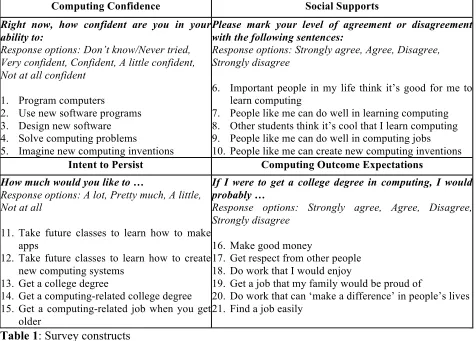
A pre- and post-survey was designed and administered to the summer camp group. Adapted from an existing survey used by the National Center for Women and Information Technology, there were 22 items that aligned with several key concepts (Table 1). For each key concept a composite score was generated. Prior to composite formation, Cronbach alpha coefficients were computed to examine the reliability of each composite. In all cases, the Cronbach alpha coefficients were acceptable, above 0.65.
Computing Confidence Social Supports
Right now, how confident are you in your ability to:
Response options: Don’t know/Never tried, Very confident, Confident, A little confident, Not at all confident
1. Program computers
2. Use new software programs 3. Design new software 4. Solve computing problems
5. Imagine new computing inventions
Please mark your level of agreement or disagreement with the following sentences:
Response options: Strongly agree, Agree, Disagree, Strongly disagree
6. Important people in my life think it’s good for me to learn computing
7. People like me can do well in learning computing 8. Other students think it’s cool that I learn computing 9. People like me can do well in computing jobs 10. People like me can create new computing inventions
Intent to Persist Computing Outcome Expectations How much would you like to …
Response options: A lot, Pretty much, A little, Not at all
11. Take future classes to learn how to make apps
12. Take future classes to learn how to create new computing systems
13. Get a college degree
14. Get a computing-related college degree 15. Get a computing-related job when you get
older
If I were to get a college degree in computing, I would probably …
Response options: Strongly agree, Agree, Disagree, Strongly disagree
16. Make good money
17. Get respect from other people 18. Do work that I would enjoy
19. Get a job that my family would be proud of
20. Do work that can ‘make a difference’ in people’s lives 21. Find a job easily
Table 1: Survey constructs
The following composites were developed based on social cognitive career theory [8], which predicts correlations between interest and confidence in the field to eventual pursuit of the field:
• Computing Confidence: confidence in their ability to engage in computational content and practices;
• Social Supports: perceiving social supports for pursuing computing, including parental and peer validation, and believing “people like me” can do computing;
• Intent to Persist: interest in pursuing computing coursework, college degrees, and IT careers;
Survey validation is supported in two ways: (1) through construct validity as the questions are tied to theory and (2) through meeting field norms for reliability. Additional questions were included on the pre-camp survey to better understand the participants’ prior experience with technology and access to computing experiences and computing experts. The post-camp survey also asked about participants’ impressions of the camp. Both sets of questions were designed with the intent of aiding to the interpretation of the findings on the key constructs.
EVALUATION RESULTS Participants
Of the twenty applications received, nineteen girls registered for and started the 5-day summer camp. Seventeen completed both the pre- and post-camp survey. More than half (53%) were white, and the large majority reported speaking English at home. A large majority (95%) also had access to a computer and WiFi at home, and 74% had already used a tablet at home and have their own cell phone with a data plan. Less than one-third had taken a computing class before this camp.
To gauge their exposure to computing education and careers as a possibility for them, campers were asked if they knew someone with a career in computing. About one-third said yes, and that these individuals had encouraged her to consider a career in computing. Most of the girls had not written a computer program before the camp.
Analysis
To study the impact of the Creative Computing Challenge summer camp program, a series of paired-samples t-tests were conducted. The analysis looked at the effect of the program on each of the four composites: Computing Confidence, Intent to Persist, Social Supports, and Computing Outcome Expectations. Because this study involves multiple comparisons of related outcomes, the False Discovery Rate (FDR) method was used to maintain an overall Type I error rate of five percent [1].
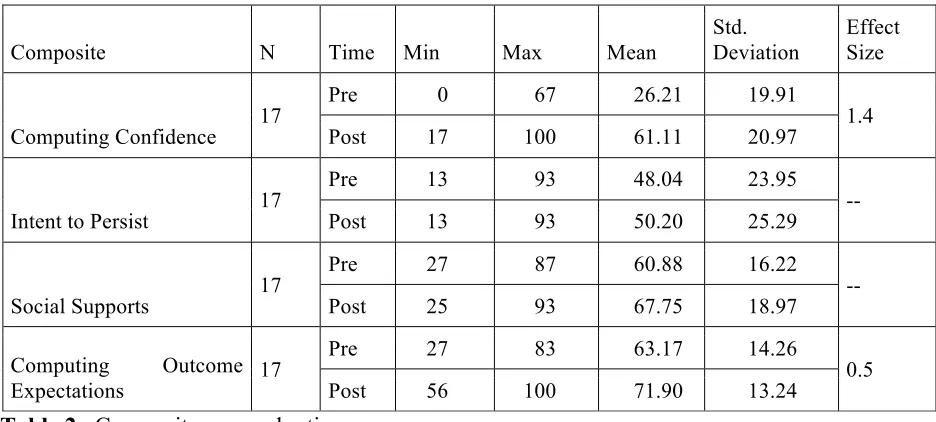
In this kind of analysis, student growth from pre-to-post time points is examined, meaning that only students with data at both time points are included in the analysis. Of those who participated, 17 completed both a pre- and post-Camp survey. Table 2 provides the composite scores at pre- and post-Camp time points. To see if the observed differences in composite scores were statistically significant (and thus, highly unlikely to be due to random chance) four paired-samples t-tests were conducted; one for each composite. Once the FDR method is applied, there were two significant differences between pre-Camp and post-Camp composite scores (two-tailed, paired-samples t-tests; p ≥ 0.05).
There was a statistically significant difference between pre-Camp and post-Camp scores on the Computing Confidence Composite (two-tailed, paired-samples t-test; p < 0.05). On average, students were more confident about computing after participating compared to their level of confidence about computing prior to the camp. The mean difference of 35 points corresponds to a large effect size of 1.4 standard deviations. The effect size was calculated as the difference between the two means, divided by the within-group pooled standard deviation. Effect sizes of about 0.20 are typically considered small, 0.50 medium, and 0.80 large [2].
paired-samples t-test; p < 0.05). The mean difference corresponds to a medium effect size of 0.5 standard deviations.
Composite N Time Min Max Mean
Std. Deviation
Effect Size
Computing Confidence 17
Pre 0 67 26.21 19.91
1.4 Post 17 100 61.11 20.97
Intent to Persist 17
Pre 13 93 48.04 23.95 -- Post 13 93 50.20 25.29
Social Supports 17
Pre 27 87 60.88 16.22 -- Post 25 93 67.75 18.97
Computing Outcome Expectations 17
Pre 27 83 63.17 14.26
0.5 Post 56 100 71.90 13.24
Table 2. Composite scores, by time
There were no statistically significant differences in the remaining two composites: Social Support Composite and Intent to Persist Composite (two-tailed, paired-samples t-tests; p ≥ 0.05).
At the end of camp, participants were asked to reflect on their experience. Eleven participants enjoyed the design process itself and remarked on how fun and easy it was to use App Inventor. One respondent wrote, “It is customization to whatever I wanted to do which made it pretty fun.” Four individuals liked seeing their ideas come to fruition and talked about “the satisfaction of seeing an idea that you thought of come to life because of you.” Two people liked creating apps because they could potentially create solutions to real-world problems. As one girl put it, “Your possibility's [sic] are endless, you can make an app or fix a system that could change the world.” Nearly three-quarters of participants (72%) reported that they would like to do more computing in the future.
DISCUSSION
This camp was intended to increase computing knowledge, confidence and interest, and it does seem to have accomplished its goals. After learning computing concepts in an applied fashion and learning new software, AppInventor, students were able to make apps about something of their own choosing, which they then showed to family members. This demonstration is an element of mastery that can be important to developing computing self-efficacy.
Several aspects of this camp were unique and may have played an important role in the positive responses participants had to the camp and to their achievement of the learning objectives:
• Inquiry- and equity-based learning approach to teaching the software and computing concepts [4].
• Computer science experts present in the learning environment for instructors and students to draw upon.
• Demonstration of learning on the last day.
The influence of these factors was not empirically tested, but is supported by previous research and observations and interviews conducted by the project evaluators. While the first three of these factors cannot always be replicated, there are important to bear in mind when developing a computing learning environment for students.
The presence of CS content experts alongside experienced practitioners in inquiry methods of teaching seems to be an effective combination for delivering content to underrepresented groups who could be apprehensive about CS because of lack of exposure to the concepts and tasks prior. Having a final project and an opportunity to share with others what they have learned reinforces learning and may provide a boost of confidence, increasing the computing confidence composite score in the post-survey. Presenting in front of family and seeing their reactions would certainly influence the extent to which girls were thinking their families would be proud if they pursued CS (one of the computing outcome expectations questions). Hearing more about computing careers during the camp and interacting with computing professionals could positively influence their outcome expectations relative to computing.
CONCLUSION
Most of the participants came to camp with little background in computing, even though most had computing technologies available at home. The camp appeared to have positively influenced the girls, primarily in terms of improving computing confidence and positive perceptions of computing careers. By the end of camp, half of the participants were calling computing “fun” and three quarters wanted to pursue more computing-related activities in the future. The program will be offered at multiple sites next summer. A larger sample size will permit the disaggregation of effects by student background, such as access to computers and CS learning opportunities (informal and formal), and level of social support outside school. More nuanced findings will further inform strategies to address social barriers that girls face at home and in schools and hinder their participation in computer science education.
ACKNOWLEDGEMENTS
Support for the project is provided by an award from the National Science Foundation's Research Infrastructure Improvement Award # IIA-1348352. We would like to thank the UNH Cooperative Extension field specialists Sarah Grosvenor and Claes Thelemarck for their curriculum development work and inquiry-based teaching methods utilized in the summer program.
REFERENCES
[1] Benjamini, Y. and Hochberg, Y. (1995). Controlling the false discovery rate: a practical and powerful approach to multiple testing. Journal of the Royal Statistical Society, B, 57, 289–300. [2] Cohen, J. (1988). Statistical power analysis for the behavioral sciences. Hillsdale, NJ: Lawrence Erlbaum Associates.
[4] Goode, J., Chapman, G., Margolis, J. (2012). Beyond curriculum: The Exploring Computer Science program. ACM Inroads, Vol 3, No 4 (June 2012), pages 47-53, ACM New York, NY, USA.
[5] Margolis, J., Goode, J., Chapman, G., and Ryoo, J. Broadening Participation: That Classroom ‘Magic’. (2014). Communications of the ACM, Vol. 57, No. 7, June 2014.
[6] Google, Inc. (2014). Women Who Choose Computer Science: What Really Matters.
[7] Hart, L.C. (2016). When “separate” may be better: Exploring single-sex learning as a remedy for social anxieties in female middle school students. Middle School Journal, 4792), 32-40. [8] Lent, R.W., Lopez Jr., A.M., Lopez, F.G., and Sheu, H.B. (2008). Social cognitive career theory and the prediction of interests and choice goals in the computing disciplines. Journal of Vocational Behavior, 73, pp. 52-62.
[9] National Science Foundation, National Center for Science and Engineering Statistics. 2015. Women, Minorities, and Persons with Disabilities in Science and Engineering: 2015. Special Report NSF 15-311. Arlington, VA.
[10] National Science Board. 2016. Science and Engineering Indicators 2016. Arlington, VA: National Science Foundation (NSB-2016-1).
[11] Rohwedder, C. (2016). Tech Jobs, Cheaper Houses: The New Silicon Cities. The Wall Street Journal (November 3, 2016).
[12] Sabin, M., DuBow, W., and Smith, A. (2015). Computing Summer Camp to Pave the Way to Rigorous and Engaging Computer Science Education in Career and Technical Education Centers. In Proceedings of Society for Information Technology & Teacher Education
International Conference 2015 (pp. 1564-1570). Chesapeake, VA: Association for the
Advancement of Computing in Education (AACE).