66
Can One Language Bootstrap the Other:
A Case Study on Event Extraction
Zheng Chen
Heng Ji
The Graduate Center Queens College and The Graduate Center The City University of New York The City University of New York
[email protected] [email protected]
Abstract
This paper proposes a new bootstrapping framework using cross-lingual information pro-jection. We demonstrate that this framework is particularly effective for a challenging NLP task which is situated at the end of a pipeline and thus suffers from the errors propagated from up-stream processing and has low-performance baseline. Using Chinese event extraction as a case study and bitexts as a new source of infor-mation, we present three bootstrapping tech-niques. We first conclude that the standard mono-lingual bootstrapping approach is not so effective. Then we exploit a second approach that potentially benefits from the extra informa-tion captured by an English event extracinforma-tion sys-tem and projected into Chinese. Such a cross-lingual scheme produces significant performance gain. Finally we show that the combination of mono-lingual and cross-lingual information in bootstrapping can further enhance the perfor-mance. Ultimately this new framework obtained 10.1% relative improvement in trigger labeling (F-measure) and 9.5% relative improvement in argument-labeling.
1
Introduction
Bootstrapping methods can reduce the efforts needed to develop a training set and have shown promise in improving the performance of many tasks such as name tagging (Miller et al., 2004; Ji and Grishman, 2006), semantic class extraction (Lin et al., 2003), chunking (Ando and Zhang, 2005), coreference resolution (Bean and Riloff, 2004) and text classification (Blum and Mitchell, 1998).Most of these bootstrapping methods impli-citly assume that:
• There exists a high-accuracy ‘seed set’ or ‘seed model’ as the baseline;
• There exists unlabeled data which is reliable and relevant to the test set in some aspects, e.g. from similar time frames and news sources; and therefore the unlabeled data supports the acquisition of new information, to provide new evidence to be incorporated to bootstrap the model and reduce the sparse data problem. • The seeds and unlabeled data won’t make the
old estimates worse by adding too many incor-rect instances.
However, for some more comprehensive and challenging tasks such as event extraction, the per-formance of the seed model suffers from the li-mited annotated training data and also from the errors propagated from upstream processing such as part-of-speech tagging and parsing. In addition, simply relying upon large unlabeled corpora can-not compensate for these limitations because more errors can be propagated from upstream processing such as entity extraction and temporal expression identification.
English and Chinese event extraction systems have the nature of generating different results on parallel documents and may complement each other. In this paper, we explore approaches of exploiting the increasingly available bilingual parallel texts ( bi-texts).
We first investigate whether we can improve a Chinese event extraction system by simply using the Chinese side of bitexts in a regular monolgual bootstrapping framework. By gradually in-creasing the size of the corpus with unlabeled data, we did not get much improvement for trigger labe-ling and even observed performance deterioration for argument labeling. But then by aligning the texts at the word level, we found that the English event extraction results can be projected into Chi-nese for bootstrapping and lead to significant im-provement. We also obtained clear further improvement by combining mono-lingual and cross-lingual bootstrapping.
The main contributions of this paper are two- fold. We formulate a new algorithm of cross-lingual bootstrapping, and demonstrate its effec-tiveness in a challenging task of event extraction; and we conclude that, for some applications be-sides machine translation, effective use of bitexts can be beneficial.
The remainder of the paper is organized as fol-lows. Section 2 formalizes the event extraction task addressed in this paper. Section 3 discusses event extraction bootstrapping techniques. Section 4 re-ports our experimental results. Section 5 presents related work. Section 6 concludes this paper and points out future directions.
2
Event Extraction
2.1 Task Definition and Terminology
The event extraction that we address in this paper is specified in the Automatic Content Extraction (ACE)1
• event trigger: the word that most clearly ex-presses an event’s occurrence
program. The ACE 2005 Evaluation de-fines the following terminology for the event ex-traction task:
• event argument: an entity, a temporal expres-sion or a value that plays a certain role in the event instance
1
http://www.nist.gov/speech/tests/ace/
• event mention: a phrase or sentence with a distinguished trigger and participant arguments
The event extraction task in our paper is to detect certain types of event mentions that are indi-cated by event triggers (trigger labeling), recog-nize the event participants e.g., who, when, where, how (argument labeling) and merge the co-referenced event mentions into a unified event (post-processing). In this paper, we focus on dis-cussing trigger labeling and argument labeling.
In the following example, Mike got married in 2008.
The event extraction system should identify “married” as the event trigger which indicates the event type of “Life” and subtype of “Marry”. Fur-thermore, it should detect “Mike” and “2008” as arguments in which “Mike” has a role of “Person” and “2008” has a role of “Time-Within”.
2.2 A Pipeline of Event Extraction
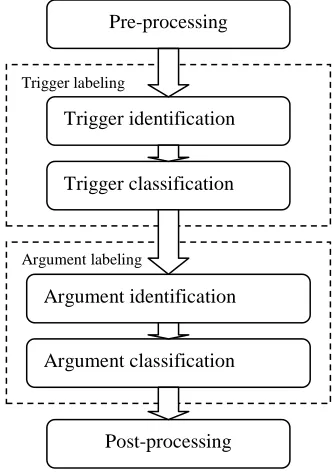
[image:2.612.346.513.408.644.2]Our pipeline framework of event extraction in-cludes trigger labeling, argument labeling and post-processing, similar to (Grishman et al., 2005), (Ahn, 2006) and (Chen and Ji, 2009). We depict the framework as Figure 1.
Figure 1. Pipeline of Event Extraction
The event extraction system takes raw docu-ments as input and conducts some pre-processing steps. The texts are automatically annotated with
Argument labeling Trigger labeling
Trigger classification Trigger identification
Argument identification Pre-processing
Argument classification
word segmentation, Part-of-Speech tags, parsing structures, entities, time expressions, and relations. The annotated documents are then sent to the fol-lowing four components. Each component is a classifier and produces confidence values;
• Trigger identification: the classifier recognizes a word or a phrase as the event trigger.
• Trigger classification: the classifier assigns an event type to an identified trigger.
• Argument identification: the classifier recog-nizes whether an entity, temporal expression or value is an argument associated with a particu-lar trigger in the same sentence.
• Argument classification: the classifier assigns a role to the argument.
The post-processing merges co-referenced event mentions into a unified representation of event.
2.3 Two Monolingual Event Extraction
Sys-tems
We use two monolingual event extraction systems, one for English, and the other for Chinese. Both systems employ the above framework and use Maximum Entropy based classifiers. The corres-ponding classifiers in both systems also share some language-independent features, for example, in trigger identification, both classifiers use the “pre-vious word” and “next word” as features, however, there are some language-dependent features that only work well for one monolingual system, for example, in argument identification, the next word of the candidate argument is a good feature for Chinese system but not for English system. To il-lustrate this, in the Chinese “的” (of) structure, the word “的” (of) strongly suggests that the entity on the left side of “的” is not an argument. For a spe-cific example, in “纽约市的市长” (The mayor of New York City), “纽约市” (New York City) on the left side of “的” (of) cannot be considered as an argument because it is a modifier of the noun “市 长”(mayor). Unlike Chinese, “of” (“的”) appears ahead of the entity in the English phrase.
Table 1 lists the overall Precision (P), Recall (R) and F-Measure (F) scores for trigger labeling and argument labeling in our two monolingual event extraction systems. For comparison, we also list the performance of an English human annotator and a Chinese human annotator.
Table 1 shows that event extraction is a difficult NLP task because even human annotators cannot
achieve satisfying performance. Both monolingual systems relied on expensive human labeled data (much more expensive than other NLP tasks due to the extra tagging tasks of entities and temporal ex-pressions), thus a natural question arises: can the monolingual system benefit from bootstrapping techniques with a relative small set of training data? The other question is: can a monolingual system benefit from the other monolingual system by cross-lingual bootstrapping?
Performance
System/ Human
Trigger Labeling
Argument Labeling
P R F P R F
English System
64.3 59.4 61.8 49.2 34.7 40.7
Chinese System
78.8 48.3 59.9 60.6 34.3 43.8
English Annotator
59.2 59.4 59.3 51.6 59.5 55.3
Chinese Annotator
75.2 74.6 74.9 58.6 60.9 59.7
Table 1.Performance of Two Monolingual Event Extraction Systems and Human Annotators
3
Bootstrapping Event Extraction
3.1 General Bootstrapping Algorithm
Bootstrapping algorithms have attracted much at-tention from researchers because a large number of unlabeled examples are available and can be uti-lized to boost the performance of a system trained on a small set of labeled examples. The general bootstrapping algorithm is depicted in Figure 2, similar to (Mihalcea, 2004).
Self-training and Co-training are two most commonly used bootstrapping methods.
A typical self-training process is described as follows: it starts with a set of training examples and builds a classifier with the full integrated fea-ture set. The classifier is then used to label an addi-tional portion of the unlabeled examples. Among the resulting labeled examples, put the most confi-dent ones into the training set, and re-train the clas-sifier. This iterates until a certain condition is satisfied (e.g., all the unlabeled examples have been labeled, or it reaches a certain number of ite-rations).
“views” (thus the whole feature set is split into dis-joint feature subsets) and each classifier can be trained on one view of the data. For each iteration, both classifiers label an additional portion of the unlabeled examples and put the most confident ones to the training set. Then the two classifiers are retrained on the new training set and iterate until a certain condition is satisfied.
Both self-training and co-training can fit in the general bootstrapping process. If the number of classifiers is set to one, it is a self-training process, and it is a co-training process if there are two dif-ferent classifiers that interact in the bootstrapping process.
Figure 2. General Bootstrapping Algorithm.
In the following sections, we adapt the boot-strapping techniques discussed in this section to a larger scale (system level). In other words, we aim to bootstrap the overall performance of the system which may include multiple classifiers, rather than just improve the performance of a single classifier in the system. It is worth noting that for the pipe-line event extraction depicted in Section 2.2, there are two major steps that determine the overall sys-tem performance: trigger labeling and argument labeling. Furthermore, the performance of trigger labeling can directly affect the performance of ar-gument labeling because the involving arar-guments are constructed according to the trigger. If a trigger is wrongly recognized, all the involving arguments
will be considered as wrong arguments. If a trigger is missing, all the attached arguments will be con-sidered as missing arguments.
3.2 Monolingual Self-training
It is rather smooth to adapt the idea of traditional self-training to monolingual self-training if we consider our monolingual event extraction system as a black box or even a single classifier that de-termines whether an event combining the result of trigger labeling and argument labeling is a reporta-ble event.
Thus the monolingual self-training procedure for event extraction is quite similar with the one de-scribed in Section 3.1. The monolingual event ex-traction system is first trained on a starting set of labeled documents, and then tag on an additional portion of unlabeled documents. Note that in each labeled document, multiple events could be tagged and confidence score is assigned to each event. Then the labeled documents are added into the training set and the system is retrained based on the events with high confidence. This iterates until all the unlabeled documents have been tagged. 3.3 Cross-lingual Co-Training
We extend the idea of co-training to cross-lingual training. The intuition behind cross-lingual co-training is that the same event has different “views” described in different languages, because the lexi-cal unit, the grammar and sentence construction differ from one language to the other. Thus one monolingual event extraction system probably uti-lizes the language dependent features that cannot work well for the other monolingual event extrac-tion systems. Blum and Mitchell (1998) derived PAC-like guarantees on learning under two as-sumptions: 1) the two views are individually suffi-cient for classification and 2) the two views are conditionally independent given the class. Ob-viously, the first assumption can be satisfied in cross-lingual co-training for event extraction, since each monolingual event extraction system is suffi-cient for event extraction task. However, we re-serve our opinion on the second assumption. Although the two monolingual event extraction systems may apply the same language-independent features such as the part-of-speech, the next word and the previous word, the features are exhibited in their own context of language, thus it is too subjec-tive to conclude that the two feature sets are or are Input:
L: a set of labeled examples,
U : a set of unlabeled examples {Ci}: a set of classifiers
Initialization:
Create a pool Uof examples by choosing P
random examples from U
Loopuntil a condition is satisfied (e.g., U , or iteration counter reaches a preset number I)
Train each classifier Ci on L , and label the examples in U
For each classifier Ci,select the most con-fidently labeled examples (e.g., the confi-dence score is above a preset threshold or the top K) and add them to L
not conditionally independent. It is left to be an unsolved issue which needs further strict analysis and supporting experiments.
The cross-lingual co-training differs from tradi-tional co-training in that the two systems in cross-lingual co-training are not initially trained from the same labeled data. Furthermore, in the bootstrap-ping phase, each system only labels half portion of the bitexts in its own language. In order to utilize the labeling result by the other system, we need to conduct an extra step named cross-lingual projec-tion that transforms tagged events from one lan-guage to the other.
3.3.1 A Cross-lingual Co-training Algorithm
[image:5.612.308.543.399.700.2]The algorithm for cross-lingual co-training is de-picted in Figure 3.
Figure 3. Cross-lingual Co-training Algorithm
3.3.2 Cross-lingual Semi-co-training
Cross-lingual semi-co-training is a variation of lingual co-training, and it differs from cross-lingual co-training in that it tries to bootstrap only one system by the other fine-trained system. This technique is helpful when we have relatively large amount of training data in one language while we have scarce data in the other language.
Thus we only need to make a small modification in the cross-lingual co-training algorithm so that it can soon be adapted to cross-lingual semi-co-training, i.e., we retrain one system and do not re-train the other. In this paper, we will conduct expe-riments to investigate whether a fine-trained English event extraction system can bootstrap the Chinese event extraction system, starting from a small set of training data.
3.3.3 Cross-lingual Projection
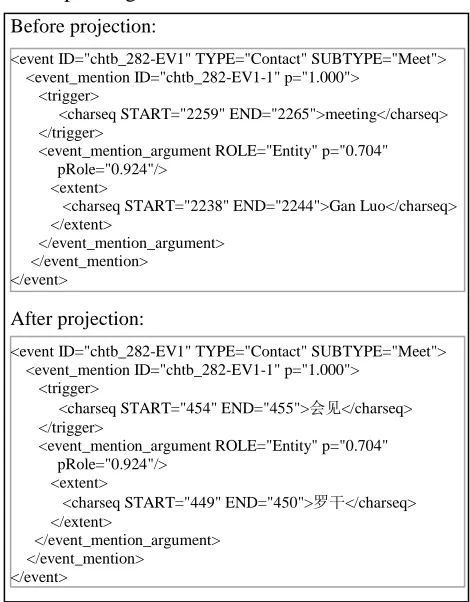
Cross-lingual projection is a key operation in the cross-lingual co-training algorithm. In the case of event extraction, we need to project the triggers and the participant arguments from one language into the other language according to the alignment information provided by bitexts. Figure 4 shows an example of projecting an English event into the corresponding Chinese event.
Before projection:
<event ID="chtb_282-EV1" TYPE="Contact" SUBTYPE="Meet"> <event_mention ID="chtb_282-EV1-1" p="1.000">
<trigger>
<charseq START="2259" END="2265">meeting</charseq> </trigger>
<event_mention_argument ROLE="Entity" p="0.704" pRole="0.924"/>
<extent>
<charseq START="2238" END="2244">Gan Luo</charseq> </extent>
</event_mention_argument> </event_mention>
</event>
After projection:
<event ID="chtb_282-EV1" TYPE="Contact" SUBTYPE="Meet"> <event_mention ID="chtb_282-EV1-1" p="1.000">
<trigger>
<charseq START="454" END="455">会见</charseq> </trigger>
<event_mention_argument ROLE="Entity" p="0.704" pRole="0.924"/>
<extent>
<charseq START="449" END="450">罗干</charseq> </extent>
</event_mention_argument> </event_mention>
</event>
Figure 4. An Example of Cross-lingual Projection Input:
1
L : a set of labeled examples in language A
2
L : a set of labeled examples in language B
U : a set of unlabeled bilingual examples (bi-texts) with alignment information
{S S1, 2}: two monolingual systems, one for language A and the other for language B.
Initialization:
Create a pool Uof examples by choosing P random examples from U
Loop until a condition is satisfied (e.g., U , or iteration counter reaches a preset number I)
Train S1on L1and S2on L2
UseS1to label the examples in U (the por-tion in Language A) and use S2to label the examples in U(the portion in Language B)
ForS1, select the most confidently labeled examples (e.g., the confidence score is above a preset threshold or the top K) , apply the operation of cross-lingual projec-tion, transform the selected examples from Language A to Language B, and put them into L2. The same procedure applies toS2.
4
Experiments and Results
4.1 Data and Scoring Metric
We used the ACE 2005 corpus to set up two mono-lingual event extraction systems, one for English, the other for Chinese.
The ACE 2005 corpus contains 560 English documents from 6 sources: newswire, broadcast news, broadcast conversations, weblogs, new-sgroups and conversational telephone speech; meanwhile the corpus contains 633 Chinese docu-ments from 3 sources: newswire, broadcast news and weblogs.
We then use 159 texts from the LDC Chinese Treebank English Parallel corpus with manual alignment for our cross-lingual bootstrapping ex-periments.
We define the following standards to determine the correctness of an event mention:
• A trigger is correctly labeled if its event type and offsets match a reference trigger.
• An argument is correctly labeled if its event type, offsets, and role match any of the refer-ence argument mentions.
4.2 Monolingual Self-training on ACE 2005
Data
We first investigate whether our Chinese event extraction system can benefit from monolingual self-training on ACE data. We reserve 66 Chinese documents for testing purpose and set the size of seed training set to 100. For a single trial of the experiment, we randomly select 100 documents as training set and use the remaining documents as training data. For each iteration of the self-training, we keep the pool size as 50, in other words, we always pick another 50 ACE documents to self-train the system. The iteration continues until all the unlabeled ACE documents have been tagged and thus it completes one trial of the expe-riment. We conduct the same experiment for 100 trials and compute the average scores.
The most important motivation for us to conduct self-training experiments on ACE data is that the ACE data provide ground-truth entities and tem-poral expressions so that we do not have to take into account the effects of propagated errors from upstream processing such as entity extraction and temporal expression identification.
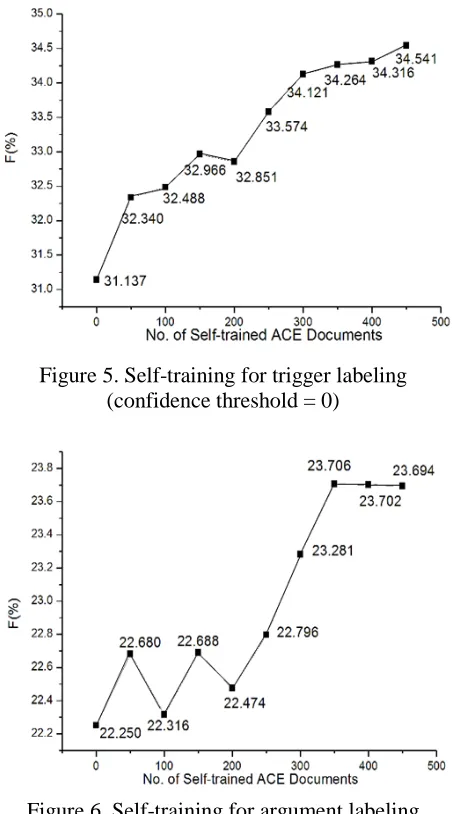
For one setting of the experiments, we set the confidence threshold to 0, in other words, we keep all the labeling results for retraining. The results are given in Figure 5 (trigger labeling) and Figure 6 (argument labeling). It shows that when the number of self-trained ACE documents reaches 450, we obtain a gain of 3.4% (F-Measure) above the baseline for trigger labeling and a gain of 1.4% for argument labeling.
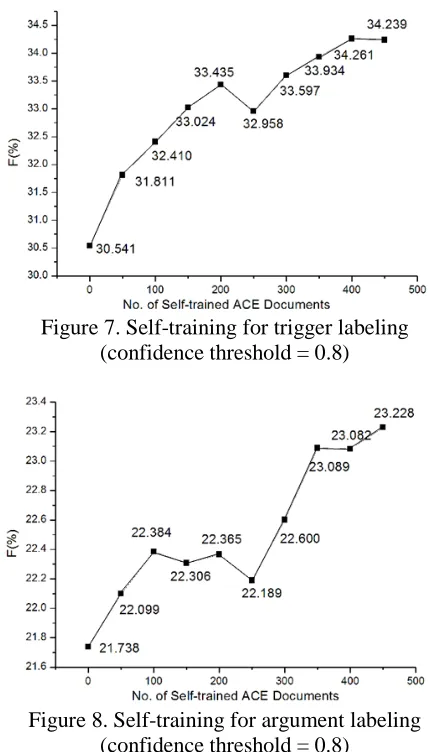
[image:6.612.315.542.295.702.2]For the other setting of the experiments, we set the confidence threshold to 0.8, and the results are presented in Figure 7 and Figure 8. Surprisingly, retraining on the high confidence examples does not lead to much improvement. We obtain a gain of 3.7% above the baseline for trigger labeling and 1.5% for argument labeling when the number of self-trained documents reaches 450.
[image:6.612.319.538.297.467.2]Figure 5. Self-training for trigger labeling (confidence threshold = 0)
[image:6.612.317.537.493.687.2]Figure 7. Self-training for trigger labeling (confidence threshold = 0.8)
Figure 8. Self-training for argument labeling (confidence threshold = 0.8)
4.3 Cross-lingual Semi-co-training on Bitexts
The experiments in Section 4.2 show that we can obtain gain in performance by monolingual self-training on data with ground-truth entities and temporal expressions, but what if we do not have such ground-truth data, then how the errors propa-gated from entity extraction and temporal expres-sion identification will affect the overall performance of our event extraction system? And if these errors are compounded in event extraction, can the cross-lingual semi-co-training alleviate the impact?
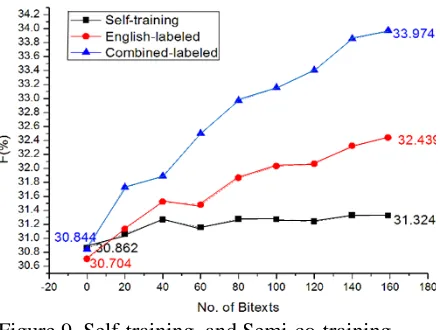
To investigate all these issues, we use 159 texts from LDC Chinese Treebank English Parallel cor-pus to conduct cross-lingual semi-co-training. The experimental results are summarized in Figure 9 and Figure 10.
For monolingual self-training on the bitexts, we conduct experiments exactly as section 4.2 except that the entities are tagged by the IE system and the
labeling pool size is set to 20. When the number of bitexts reaches 159, we obtain a little gain of 0.4% above the baseline for trigger labeling and a loss of 0.1% below the baseline for argument labeling. The deterioration tendency of the self-training curve in Figure 10 indicates that entity extraction errors do have counteractive impacts on argument labeling.
We then conduct the cross-lingual semi-co-training experiments as follows: we set up an Eng-lish event extraction system trained on a relative large training set (500 documents). For each trial of the experiment, we randomly select 100 ACE Chinese document as seed training set, and then it enters a cross-lingual semi-co-training process: for each iteration, the English system labels the Eng-lish portions of the 20 bitexts and by cross-lingual projection, the labeled results are transformed into Chinese and put into the training set of Chinese system. From Figure 9 and Figure 10 we can see that when the number of bitexts reaches 159, we obtain a gain of 1.7% for trigger labeling and 0.7% for argument labeling.
We then apply a third approach to bootstrap our Chinese system: during each iteration, the Chinese system also labels the Chinese portions of the 20 bitexts. Then we combine the results from both monolingual systems using the following rules:
If the event labeled by English system is not labeled by Chinese system, add the event to Chinese system
If the event labeled by Chinese system is not labeled by English system, keep the event in the Chinese system
If both systems label the same event but with different event types and arguments, select the one with higher confidence
From Figure 9 and Figure 10 we can see that this approach leads to even further improvement in per-formance, shown as the “Combined-labeled” curves. When the number of bitexts reaches 159, we obtain a gain of 3.1% for trigger labeling and 2.1% for argument labeling.
Figure 9. Self-training, and Semi-co-training (English- labeled & Combined-labeled)
for Trigger Labeling
Figure 10. Self-training, and Semi-co-training (English- labeled & Combined-labeled)
for Argument Labeling
5 Related Work
There is a huge literature on utilizing parallel cor-pus for monolingual improvement. To our know-ledge, it can retrace to (Dagan et.al 1991). We apologize to those whose work is not cited due to space constraints. The work described here com-plements some recent research using bitexts or translation techniques as feedback to improve enti-ty extraction. Huang and Vogel (2002) presented an effective integrated approach that can improve the extracted named entity translation dictionary and the entity annotation in a bilingual training corpus. Ji and Grishman (2007) expanded this idea of alignment consistency to the task of entity ex-traction in a monolingual test corpus without refer-ence translations, and applied sophisticated
infe-inference rules to enhance both entity extraction and translation. Zitouni and Florian (2008) applied English mention detection on translated texts and added the results as additional features to improve mention detection in other languages.
In this paper we share the similar idea of import-ing evidences from English with richer resources to improve extraction in other languages. However, to the best of our knowledge this is the first work of incorporating cross-lingual feedback to improve the event extraction task. More importantly, it is the first attempt of combining cross-lingual projec-tion with bootstrapping methods, which can avoid the efforts of designing sophisticated inference rules or features.
6 Conclusions and Future Work
Event extraction remains a difficult task not only because it is situated at the end of an IE pipeline and thus suffers from the errors propagated from upstream processing, but also because the labeled data are expensive and thus suffers from data scar-city. In this paper, we proposed a new co-training framework using cross-lingual information projec-tion and demonstrate that the addiprojec-tional informa-tion from English system can be used to bootstrap a Chinese event extraction system.
To move a step forward, we would like to con-duct experiments on cross-lingual co-training and investigate whether the two systems on both sides can benefit from each other. A main issue existing in cross-lingual co-training is that the cross-lingual projection may not be perfect due to the word alignment problem. In this paper, we used a corpus with manual alignment, but in the future we intend to investigate the effect of automatic alignment errors.
We believe that the proposed cross-lingual boot-strapping framework can also be applied to many other challenging NLP tasks such as relation ex-traction. However, we still need to provide a theo-retical analysis of the framework.
Acknowledgments
References
Avrim Blum and Tom Mitchell. 1998. Combining La-beled and UnlaLa-beled Data with Co-training. Proc. of the Workshop on Computational Learning Theory.
Morgan Kaufmann Publishers.
David Ahn. 2006. The stages of event extraction. Proc. COLING/ACL 2006 Workshop on Annotating and Reasoning about Time and Events. Sydney, Aus-tralia.
David Bean and Ellen Riloff. 2004. Unsupervised Learning of Contextual Role Knowledge for Corefe-rence Resolution. Proc. HLT-NAACL2004. pp. 297-304. Boston, USA.
Fei Huang and Stephan Vogel. 2002. Improved Named Entity Translation and Bilingual Named Entity Ex-traction. Proc. ICMI 2002. Pittsburgh, PA, US.
Heng Ji and Ralph Grishman. 2006. Data Selection in Semi-supervised Learning for Name Tagging. In ACL 2006 Workshop on Information Extraction Beyond the Document:48-55. Sydney, Australia.
Heng Ji and Ralph Grishman. 2007. Collaborative Enti-ty Extraction and Translation. Proc. International Conference on Recent Advances in Natural Lan-guage Processing 2007. Borovets, Bulgaria.
Ido Dagan, Alon Itai and Ulrike Schwall. 1991. Two languages are more informative than one. Proc. ACL 1991.
Imed Zitouni and Radu Florian. 2008. Mention Detec-tion Crossing the Language Barrier. Proc. EMNLP. Honolulu, Hawaii.
Michael Collins and Yoram Singer. 1999. Unsupervised Models for Named Entity Classification. Proc. of EMNLP/VLC-99.
Rada Mihalcea. 2004. Co-training and self-training for word sense disambiguation. In Proceedings of the Conference on Computational Natural Language Learning (CoNLL-2004).
Ralph Grishman, David Westbrook and Adam Meyers. 2005. NYU’s English ACE 2005 System Descrip-tion. Proc. ACE 2005 Evaluation Workshop. Wash-ington, US.
Rie Ando and Tong Zhang. 2005. A High-Performance Semi-Supervised Learning Methods for Text Chunk-ing. Proc. ACL2005. pp. 1-8. Ann Arbor, USA
Scott Miller, Jethran Guinness and Alex Zamanian.2004. Name Tagging with Word Clusters and Discrimina-tive Training. Proc. HLT-NAACL2004. pp. 337-342. Boston, USA
Winston Lin, Roman Yangarber and Ralph Grishman. 2003. Bootstrapping Learning of Semantic Classes from Positive and Negative Examples. Proc. ICML-2003 Workshop on The Continuum from Labeled to Unlabeled Data. Washington, D.C.