EFFECT OF SPLITTER EDGE BEHIND DIFFERENT
GEOMETRIES ON THE FLOW
M Sai Bharadwaj
1, Boddu Yashaswini
2, Paturi Venkata Sai Aditya
31,2,3
Student, Mechanical Engineering, CVR College of Engineering, (India)
ABSTRACT
Analysis of flow over different geometries having splitter edge at Reynolds numbers of 600 and 900 presented in
this paper. Splitter edge effect on flow is compared with flow over same geometries without splitter edge at same
Reynolds number. Geometries of triangle square and rectangle of equivalent area is taken to study and
triangular model having splitter edge show significant effect at Re 600 & 900.
Keywords
:
Splitter Edge, Reynoldsnumber, Vortex, Triangular Model, Square Model
I. INTRODUCTION
In many mechanical engineering applications, separated flows often appear around any object. Tall buildings,
monuments, and towers are permanently exposed to wind. Similarly, piers, bridge pillars, and legs of offshore
platforms are continuously subjected to the load produced by maritime or fluvial streams [1]. The flow details
behind these geometries depend on Reynolds number, blockage ratio, and free stream turbulence. For
square/rectangular cross section geometries, the orientation with respect to the mean flow is another important
parameter. At low Reynolds number, aspect ratio and end conditions play a significant role in determining the
flow properties. Flow past a square cylinder resembles flow past a circular cylinder as far as instabilities are
concerned. But the separation mechanism and the consequent dependence of lift, drag, and Strouhal number on
the Reynolds number are significantly different. The separation points are fixed for the square cylinder either at
the leading edge or the trailing edge, depending on the Reynolds number. Square cylinder has broader and
longer vortex compared to the circular. Wake of square cylinder cross section is sensitivity to aspect ratio and
orientation with respect to the mean flow.The effect of cylinder orientation 0, 10, 13.5, 20, and 45°at high
Reynolds number. A reduction in drag coefficient and a sharp rise in Strouhal number was seen at an angle close
to 13.5°. This effect was attributed to the shear layer reattachment over one of the edges of the cylinder [2].
Significant variation on Strouhal number of rectangular cylinders with side ratios in the range of 0.04–1 and
angles of incidence from 0 to 90°. A sharp rise in Strouhal number for a small angle of incidence is
significant.[3]The effect of aspect ratio for a circular cylinder at low Reynolds number using flow visualization
and hotwire anemometry. For an aspect ratio greater than 60, a discontinuity in the Strouhal number value in the
Reynolds number range 64 to 130 studied. There is a stabilization effect on the wake for a small aspect ratio
cylinder. The wake width increases with a reduction in aspect ratio [4]. The effect of end plates on the shedding
work analyzing the flow over different geometries having splitter edge at end.
II.COMPUTATIONAL FLUID DYNAMICS
Computational analysis is carried out to solve a flow field in two-dimensional geometries of triangle, square and
rectangle of equivalent area. And adding splitter edge at end of these geometries, analyzing the flow behavior by
considering parameters of recirculation of the separated flow, vortex size and regions formed at behind the
model. The modeling and analysis is done in Ansys 14.0 Workbench for creating the desired geometries. Pure
quadrilateral meshing is used to get structured mesh.
Standardk-ε model is used to predict the flow field Flow past the models involves recirculation (swirl) and the
effect of swirl on turbulence is included in the Standard model, due to which accuracy of the model further
increases. A UN steady state based implicit solver is used to achieve convergence. Second-order upwind scheme
was used for the discretization of all the equations to achieve higher accuracy in results. Velocity-pressure
coupling is established by pressure-velocity correlation using a PISO algorithm. Under-relaxation factors are
used for all equation to satisfy Scarborough condition. Residuals are continuously monitored for continuity, x
-velocity, y-velocity, z-velocity, k, and ε. Convergence of the solution is assumed when the values of all residuals
goes below 10-6 Enhanced wall treatment is used to solve for the near wall treatment, as y+ is more than 30 in
the whole domain.
III.RESULT AND DISCUSSION
3.1 Flow Over a Rectangular Body
Figures 3.1.1 (a, b, &c) show the velocity vectors, contours of velocity and pressure at Reynolds no. 600.
Figures 3.1.2(a, b, &c) show the velocity vectors, contours of velocity and pressure at Reynolds no 900.
Fig 3.1.2(a) Velocity vectors Fig 3.1.2(b) Velocity contours Fig 3.1.2(c) Pressure contours
There is a significant effect in the increase in the Reynolds number on the flow over rectangular model. The left
and right vortex size is 6.11mm and 5.98mm at Reynolds number 600 and 9.50mm and 9.30mm at Reynolds
number 900. As increase in Reynolds number vortex size increases. There is no variation in left and right vortex
sizes at these Reynolds numbers.
3.2 Flow over a square body
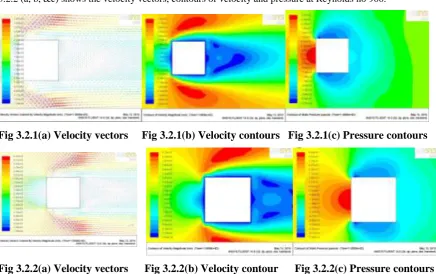
Figure 3.2.1 (a, b, &c) shows the velocity vectors, contours of velocity and pressure at Reynolds no. 600. Figure
3.2.2 (a, b, &c) shows the velocity vectors, contours of velocity and pressure at Reynolds no 900.
Fig 3.2.1(a) Velocity vectors
Fig 3.2.1(b) Velocity contours Fig 3.2.1(c) Pressure contours
Fig 3.2.2(a) Velocity vectors
Fig 3.2.2(b) Velocity contour Fig 3.2.2(c) Pressure contours
There is a significant effect in the increase in the Reynolds number on the flow over square model. The left and
right vortex size is 8.54mm and 7.97mm at Reynolds number 600 and 14.901mm and 13.68mm at Reynolds
number 900. As increase in Reynolds number vortex size increases drastically. The left vortex size is more
compared to the right vortex size at these two Reynolds number.
3.3.1(a) Velocity vectors
Fig 3.3.1(b) Velocity contour Fig 3.3.1(c) Pressure contours
t
3.3.2(a) Velocity vectors
Fig 3.3.2(b) Velocity contour Fig 3.3.2(c) Pressure contour
As increase in Reynolds number there is no significant effect on vortex size and regions of contour of
velocity profiles. The left and right vortex size is 26.03mm and 27.77mm at Reynolds number 600 and 27.44mm
and 27.69mm at Reynolds number 900. The right vortex size is more compared to the left vortex size at these
two Reynolds number.
3.4 Flow Over a Square with Splitter Edge Body
Figure 3.4.1 (a, b, &c) shows the velocity vectors, contours of velocity and pressure at Reynolds no. 600.
Fig 3.5(a) Velocity vectors
Fig 3.5(b) Velocity contours Fig 3.5(c) Pressure contours
There is no significant effect in the left and right vortex size at Reynolds number 600 on the flow over square
model with splitter edge. The left and right vortex size is 5.51mm and 5.88mm at Reynolds number 600.
3.5 Flow Over a Triangle with Splitter Edge Body
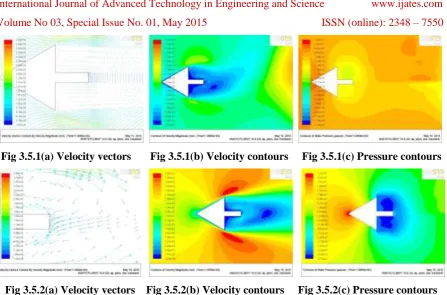
Figure 3.5.1 (a, b, &c) shows the velocity vectors, contours of velocity and pressure at Reynolds no. 600. Figure
Fig 3.5.1(a) Velocity vectors
Fig 3.5.1(b) Velocity contours Fig 3.5.1(c) Pressure contours
Fig 3.5.2(a) Velocity vectors Fig 3.5.2(b) Velocity contours Fig 3.5.2(c) Pressure contours
As increase in Reynolds number there is no significant effect on left vortex size but a significant effect is
observed on the right vortex. The left and right vortex size is 28.93mm and 25.48mm at Reynolds number 600
and 25.97mm and 32.80mm at Reynolds number 900. With increase in Reynolds number left and right vortex
behaves in an opposite manner.
3.6 Flow Over a Rectangle with Splitter Edge Body
Figure 3.6.1 (a, b, &c) shows the velocity vectors, contours of velocity and pressure at Reynolds no. 600. Figure
3.6.2 (a, b, &c) shows the velocity vectors, contours of velocity and pressure at Reynolds no 900.
effect in left and right vortex in opposite manner.
REFERENCES
[1] O. Almeida, S. S. Mansur and A. Silveira-Neto “On the flow past rectangular cylinders:physical aspects and
numerical simulation”EngenhariaTérmica (Thermal Engineering)June 2008 . 55-64.
[2] Obasaju, E. D. _1983_. “An investigation of the effect of incidence on the flow around a square section
cylinder.” Aeronaut. Q., 34, 243–259.
[3] Knisely, C. W. _1990_. “Strouhal numbers of rectangular cylinders at incidence: A review and new data.”
J. Fluids Struct., 4, 371–393.
[4] Lee, T., and Budwig, R. _1991_. “A study of the effect of aspect ratio on vortex shedding behind circular
cylinders.” Phys. Fluids A, 3_2_, 309–315.
[5] Stäger, R., and Eckelmann, H. _1991_. “The effect of endplates on the shedding frequency of circular
cylinders in the irregular range.” Phys. Fluids A, 3_9_, 2116–2121.
[6] König, R., Noack, B. R., and Eckelmann, H. _1993_. “Discrete shedding modes in the Von Karman vortex
street.” Phys. Fluids A, 5_7_, 1846–1848.
[7] Szepessy, S., and Bearman, P. W. _1992_. “Aspect ratio and end plate effects on vortex shedding from a