https://doi.org/10.5194/tc-12-3477-2018
© Author(s) 2018. This work is distributed under the Creative Commons Attribution 4.0 License.
Repeat mapping of snow depth across an alpine catchment with
RPAS photogrammetry
Todd A. N. Redpath1,2, Pascal Sirguey2, and Nicolas J. Cullen1
1Department of Geography, University of Otago, Dunedin, 9016, New Zealand 2National School of Surveying, University of Otago, Dunedin, 9016, New Zealand Correspondence:Todd A. N. Redpath ([email protected])
Received: 14 May 2018 – Discussion started: 6 June 2018
Revised: 8 September 2018 – Accepted: 3 October 2018 – Published: 8 November 2018
Abstract.Being dynamic in time and space, seasonal snow represents a difficult target for ongoing in situ measurement and characterisation. Improved understanding and modelling of the seasonal snowpack requires mapping snow depth at fine spatial resolution. The potential of remotely piloted air-craft system (RPAS) photogrammetry to resolve spatial vari-ability of snow depth is evaluated within an alpine catch-ment of the Pisa Range, New Zealand. Digital surface mod-els (DSMs) at 0.15 m spatial resolution in autumn (snow-free reference) winter (2 August 2016) and spring (10 Septem-ber 2016) allowed mapping of snow depth via DSM differ-encing. The consistency and accuracy of the RPAS-derived surface was assessed by the propagation of check point resid-uals from the aero-triangulation of constituent DSMs and via comparison of snow-free regions of the spring and au-tumn DSMs. The accuracy of RPAS-derived snow depth was validated with in situ snow probe measurements. Results for snow-free areas between DSMs acquired in autumn and spring demonstrate repeatability yet also reveal that elevation errors follow a distribution that substantially departs from a normal distribution, symptomatic of the influence of DSM co-registration and terrain characteristics on vertical uncer-tainty. Error propagation saw snow depth mapped with an accuracy of±0.08 m (90 % c.l.). This is lower than the char-acterization of uncertainties on snow-free areas (±0.14 m). Comparisons between RPAS and in situ snow depth measure-ments confirm this level of performance of RPAS photogram-metry while also highlighting the influence of vegetation on snow depth uncertainty and bias. Semi-variogram analysis revealed that the RPAS outperformed systematic in situ mea-surements in resolving fine-scale spatial variability. Despite limitations accompanying RPAS photogrammetry, which are
relevant to similar applications of surface and volume change analysis, this study demonstrates a repeatable means of accu-rately mapping snow depth for an entire, yet relatively small, hydrological catchment (∼0.4 km2)at very high resolution. Resolving snowpack features associated with redistribution and preferential accumulation and ablation, snow depth maps provide geostatistically robust insights into seasonal snow processes, with unprecedented detail. Such data will enhance understanding of physical processes controlling spatial dis-tributions of seasonal snow and their relative importance on varying spatial and temporal scales.
1 Introduction
Historically, studies of seasonal snow processes have re-lied on in situ observations. With biweekly temporal resolu-tion, Anderson et al. (2014) gained substantial insights into physical controls on seasonal snow processes, albeit with a dependence on statistical scaling to relate transect-scale ob-servations to basin-scale processes. Alternatively, the nature of automated snow measurement instrumentation often pre-cludes continuous in situ measurement across networks suf-ficiently dense to characterise fine-scale spatial variability. Kinar and Pomeroy (2015) provide a comprehensive review of instrumentation and techniques for measuring snow depth and characterising snowpacks. In summary, while instrumen-tation and methodologies exist for obtaining accurate and temporally continuous, measurements of snow depth and lated snowpack properties at point locations, adequately re-solving the high spatial variability of snow depth remains a challenge. This is exacerbated by local field conditions, such as exposure to wind or the complexity of the topography and vegetation further increasing the spatial variability in snow depth (Clark et al., 2011; Kerr et al., 2013; Winstral and Marks, 2014).
Remote sensing has provided substantial advances in quantification of seasonal snow variability, with imaging sen-sors supporting spatial and temporal resolutions that allow a range of scales to be explored. Space-borne satellite imagers provide a synoptic view and accompanying step-change ca-pability in capturing properties of snow-covered areas, al-though trade-offs exist between competing spatial, spectral and temporal resolutions (Dozier, 1989; Nolin and Dozier, 1993; Hall et al., 2002, 2015; Sirguey et al., 2009; Malen-ovský et al., 2012; Rittger et al., 2013; Roy et al., 2014; Bessho et al., 2016). Passive and active microwave sensors offer the capacity to retrieve estimates of snow water equiva-lent directly from space-borne platforms but also suffer sub-stantial limitations, including coarse spatial resolution in the case of passive microwave sensors and complexities in suc-cessfully processing snow signals and accounting for com-plex terrain in the case of both passive and active sensors (Lemmetyinen et al., 2018). Despite the progress in remotely mapping snow, reliable determination of snow depth, partic-ularly in complex terrain, remains challenging. Modern, very high-resolution stereo-capable imagers show promise for re-trieving snow depth over large areas from space, although the influence of topography on uncertainties and complica-tions introduced by shadows in alpine terrain demand atten-tion (Marti et al., 2016).
Advances in light detection and ranging (lidar) technolo-gies have become increasingly relevant for measurement of snow depth, firstly from air (Deems et al., 2013; Painter et al., 2016) and more recently from space-borne platforms (Tre-ichler and Kääb, 2017). Of the three modes of lidar data capture, terrestrial laser scanning (TLS) (e.g. Revuelto et al., 2016) offers the best performance in terms of precision and accuracy. TLS can resolve snow depth on a fine scale across relatively large areas but remains limited by view-obstruction
and logistical challenges of placing equipment in situ in complex terrain. Airborne lidar provides a balance of spa-tial resolution and accurate surface elevation measurement and, combined with density estimates, can provide SWE es-timates on the catchment scale across substantial areas of hundreds of square kilometres (Painter et al., 2016). High financial costs and logistical challenges, however, preclude regular airborne lidar data capture in many regions globally. Treichler and Kääb (2017) assessed ICESat lidar data, which is designed primarily for measuring surface elevation over polar regions to characterise seasonal snow depth in subpo-lar southern Norway. Despite reasonable estimates of snow depth, measurements were accompanied by relatively large errors for most temperate locations. ICESat measurements are also limited by their punctual nature and footprint, yield-ing a relatively sparse and coarse spatial distribution, in turn complicating inferences about spatial variability.
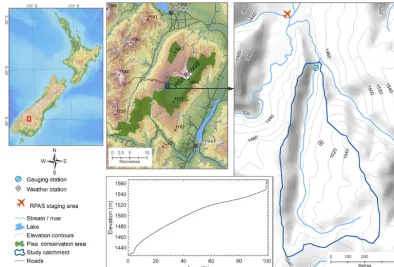
com-Figure 1.Location and hypsometry of the study catchment within the Pisa Range, New Zealand.
paring surfaces obtained while snow cover is present in the catchment. Because changes in snow depth through time, ei-ther through processes of accumulation, ablation or redistri-bution, may be subtle, the repeatability and vertical accuracy achieved by photogrammetric modelling is paramount. The aim of this paper is to test a methodology for retrieving snow depth across an entire catchment via RPAS photogrammetry from a fixed-wing platform. We seek to evaluate the perfor-mance, limitations and usefulness of this approach and assess how well snow depth can be resolved on the catchment scale. Associated challenges include minimising spatial uncertain-ties sufficiently to reliably detect changes in snow depth over time, with a decimetre level of vertical accuracy targeted, while also reducing the need and complication of extensive in situ collection of ground control points (GCPs). This ap-proach was assessed during a campaign of winter RPAS-based photogrammetric surveys of an alpine catchment in the Pisa Range, New Zealand, was undertaken.
The paper describes the field site, field and photogram-metric methods, as well as the quality and accuracy assess-ment. Results are considered in terms of the validation and repeatability of the method, as well as considering the spa-tial distribution of snow within the catchment. The discus-sion addresses the performance of RPAS photogrammetry in this context, sources and nature of the associated uncertainty as well as pitfalls and limitations that were encountered, be-fore demonstrating the insight that RPAS-derived data can provide for the study of seasonal snow. While primarily
ex-ploring and assessing the potential of RPAS photogramme-try for measuring seasonal snowpack, this study has broader implications for the wider field of modern close-range pho-togrammetry, as typically implemented from low-cost (rel-ative to manned systems) unmanned systems. While con-sidered here in terms of seasonal snow, the characterisation of RPAS photogrammetry performance presented also ap-plies to other applications involving three-dimensional sur-face and/or volume change analysis.
2 Study site
gul-Table 1.Timing details for RPAS flights during 2016. All flights were completed between noon and early afternoon.
Mission/flight Date Season Snow cover Sky conditions M001f01 17 May 2016 Autumn Minimal – remaining traces of early snowfall Clear sky, light winds M002f01 2 Aug 2016 Midwinter Extensive – winter snowpack, high surface roughness Thin high cloud, light winds M003f01 10 Sep 2016 Spring Spring melt underway, extensive snow-free areas. Clear sky, light winds
Reduced snow surface roughness
lies, basins and gorges. These ranges feature relatively large areas above the winter snowline, with complex micro-terrain features, which are of interest in the context of redistribution, preferential accumulation and ablation of seasonal snow. In combination with typically windy conditions, the topogra-phy is expected to produce complex, highly variable spa-tial distributions of seasonal snow, convolved with and po-tentially overtaking the role of elevation in influencing vari-ability in snow depth. The catchment mapped in this study is larger than areas mapped for similar studies published to date (Vander Jagt et al., 2015; Bühler et al., 2016; De Michele et al., 2016; Harder et al., 2016) and has a relatively complex topography, with several gullies dissecting the main slopes, separated by broad, steep-sided ridges. Visual assess-ment of Landsat, Sentinel-2, and MODIS imagery revealed that, while the catchment could be considered to be in the marginal snow zone, snow cover persists from June to late September in most years, thus providing opportunities for re-peated mapping and the capture of the snowpack in various states.
3 Data and methods 3.1 Field approach
3.1.1 RPAS platform and payload
We used the Trimble UX5 Unmanned Aircraft System, a fixed-wing RPAS manufactured by Trimble Navigation for photogrammetric applications. A single two-blade propeller, driven by a 700 W electric motor, propels the platform. Power is supplied from a 14.8 V, 6000 mAh lithium-polymer battery allowing a flight endurance of 50 min. Autonomous navigation is supported by a single-channel GPS receiver, which also provides approximate coordinates for each photo centre, while an accelerometer logs orientation data.
Imagery is captured by a large-sensor (APS-C) Sony NEX 5R mirrorless reflex digital camera providing a maximum imaging resolution of 4912 pixels by 3264 pixels or about 0.04 m GSD at 400 ft (122 m) a.g.l. The camera is fitted with a Voigtlander Super Wide-Heliar 15 mm f/4.5 Aspherical II lens, with focus fixed to infinity. Appropriate exposure to ensure suitable contrast on the range of imaged targets was achieved with maximum aperture, high shutter speeds between 1/1000 and 1/4000 s to minimize forward-motion
blurring and automatic ISO sensitivity. Camera settings were checked prior to each flight to accommodate varying light conditions and the relative share of ground cover (vegetation vs. snow).
3.1.2 RPAS flights
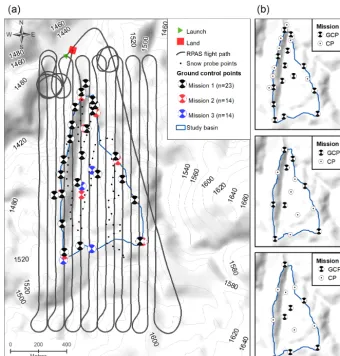
Three RPAS missions were undertaken with identical plan-ning and differing states of snow cover in the catchment (Ta-ble 1). Flight planning was carried out using the Trim(Ta-ble Aerial Imaging software. All flights imaged 15 strips, aligned along the major axis of the study catchment (Fig. 2). The study area was imaged with 90/80 % forward/sideward over-lap with respect to the lowest elevation to ensure that suffi-cient overlap was maintained when mapping rising ground. Exposure locations are determined automatically by the soft-ware to achieve the desired overlap, with the camera being triggered accordingly during flight using on-board Global Navigation Satellite System (GNSS) navigation. The dura-tion of each flight was∼35 min, with about 900 images be-ing captured per flight. The average flybe-ing altitude of the flights was 1650 m a.s.l., with a standard deviation of less than 1.5 m during the mapping phase of the flight. For both the winter and spring flights, the snow surface had consider-able texture, with a greater surface roughness overall for win-ter missions. Wind-affected recent fresh snow was present for the winter flight. It is recognised that homogeneous snow sur-faces may represent particularly challenging targets for pho-togrammetry (Bühler et al., 2017). Nevertheless, the imag-ing quality and dynamic range of the camera used in this study provided sufficient contrast for all flights, across snow as well as when imaging mixed snow-bare ground condi-tions. Subsequently, full photogrammetric restitution could be completed without the need for image post-processing (e.g. Cimoli et al., 2017).
3.1.3 Ground control survey
Figure 2.Typical flight path for the mapping of the study catchment using the Trimble UX5, GCP network established for each flight mission, and reference snow depth locations. Flight log is from the spring flight mission. The configuration of the ground control point (GCP) and check point (CP) assignment for the triangulation of each flight is shown in the panels on the right-hand side.
greater than the expected accuracy of the models. Ground control networks were established for each RPAS flight mis-sion using real-time kinematic (RTK) GNSS surveying with a Trimble R7 base station and R6 rover units. GCP locations were measured with accuracy of the order of∼0.02–0.03 m. GCPs were signalled with 0.6×0.6 m mats painted with a high-contrast circular quadrant pattern for the autumn and winter flights. For the spring flight, chalk powder was used with a stencil to mark the target directly on the snow sur-face, using the same pattern as for previous flights. The use of chalk powder eliminated the need to retrieve GCP targets following RPAS flights. All survey work, as well as produc-tion of deliverables from photogrammetry, was carried out in terms of the New Zealand Transverse Mercator (NZTM) reference system. All RTK survey work utilised a base sta-tion established on a common benchmark, established for this project, the position of which was differentially corrected with respect to nearby continually operating reference
sta-tions. GNSS data were processed using Trimble Business Center (TBC) v3.40 software.
each mission are illustrated in Fig. 2. A new GCP network was established for each survey campaign due to the inabil-ity to establish permanent markers (e.g. on poles) due to the conservation status of the study area. Although the layout of the network was similar for each mission, there were no com-mon GCPs shared between different flights, with the only common setting being the set-up of the base station for each RTK survey.
3.1.4 Reference snow depth measurements
To assess the quality of snow depth data derived from RPAS photogrammetry, independent measurements were collected by manual snow probing on 10 September 2016, the same day as the spring RPAS mission. This approach has been es-tablished as standard practice in similar studies (e.g. Nolan et al., 2015; De Michele et al., 2016). Aluminium avalanche probes with 0.01 m graduations, providing a nominal preci-sion of 0.01 m, were used. The sampling strategy involved the measurement of snow depth every 50 m along three eleva-tion contours within the study catchment, namely 1460, 1500 and 1540 m (Fig. 2). This strategy ensured that snow depth was measured across a representative sample of slope aspect and elevation, while optimizing navigation across the catch-ment. Snow depths were measured at each location by prob-ing 5 times within arm’s reach, and the location of the central measurement was surveyed with RTK GNSS, under the same protocol and achieving the same level of accuracy as the GCP survey. This provided 430 measurements of snow depth, with the mean snow depth at each of the 86 locations providing a sample for comparisons with RPAS-derived snow depth. 3.2 Data processing
3.2.1 Photogrammetric processing
The goal of aero-triangulation (AT) in photogrammetry is to transform a set of images into a scene in which geo-metrically accurate measurements can be made in three-dimensional, often geographic, space. This georeferencing process requires a transformation from the inherent coordi-nate system of the device capturing imagery (a camera) to an appropriate geographic coordinate system (Vander Jagt et al., 2015; Linder, 2016). While traditional photogrammetry has long relied on metric (calibrated) cameras, the use of off-the-shelf non-metric cameras requires the simultaneous solving of both interior orientation (the camera model) and exterior orientation. This process, known as self-calibration, applies a bundle-block adjustment to solve the camera model describing the precise focal length (f), the offset between the principal point of autocollimation and the centre of the imaging sensor plane (x0,y0), and the departure between the image point coordinate (x,y) and the idealized linear projec-tion due to lens distorprojec-tion. Camera calibraprojec-tion parameterises radial and decentering distortion with models such as that of
Brown (1971):
x0=1+K
1r3+K2r5+K3r7
x+2T1xy+T2
r2+2x2
(1)
y0=1+K
1r3+K2r5+K3r7
y+2T2xy+T1
r2+2y2,
in which K terms are the radial distortion coefficients, T
terms are the tangential distortion coefficients, and
x=x−x0 (2)
y=y−y0 (3)
r= q
x2+y2. (4)
Image coordinates corrected for lens distortion are then used in the set of collinearity equations relating object point coor-dinates (XA,YA,ZA) to the corresponding image point
coor-dinates (x0
A,y0A) to solve for the exterior orientation (Vander
Jagt et al., 2015; Linder, 2016): x0 A y0 A = (5)
fr11(XA−X0)+r12(YA−Y0)+r13(ZA−Z0) r31(XA−X0)+r32(YA−Y0)+r33(ZA−Z0)
fr21(XA−X0)+r22(YA−Y0)+r23(ZA−Z0) r31(XA−X0)+r32(YA−Y0)+r33(ZA−Z0)
.
(X0,Y0,Z0) are the coordinates of the perspective centre of the image frame in the ground coordinate system. Therij
terms represent the 3×3 rotation matrix relating the sensor coordinate system orientation to the ground coordinate sys-tem. Since the UX5 camera is fixed with respect to the plat-form, the latter combines the roll, pitch and yaw (ω,ϕ,κ) of the platform at the time of exposure. The nature of bundle-block adjustment with camera self-calibration dictates that the quality of the final photogrammetric model is highly sen-sitive to errors in both sensor position and orientation as well as inaccurate refinements of the interior orientation parame-ters (Ebner and Fritz, 1980).
3.2.2 Software and workflow
Initially, AT was carried out using the photogrammetry mod-ule of Trimble Business Center, v3.40 (TBC), which relies on a simplified implementation of the adjustment process from Inpho UAS Master. Deliverables produced using TBC, how-ever, suffered from severe elevation artefacts which limited their usefulness for further analysis. This is discussed further in Sect. 5.3.
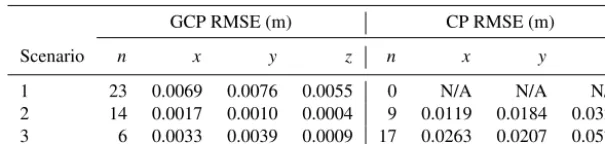
Table 2.Summary results of alternative ground control point (GCP) and check point (CP) scenarios tested for aero-triangulation within UAS Master.
GCP RMSE (m) CP RMSE (m) Scenario n x y z n x y z
1 23 0.0069 0.0076 0.0055 0 N/A N/A N/A 2 14 0.0017 0.0010 0.0004 9 0.0119 0.0184 0.0320 3 6 0.0033 0.0039 0.0009 17 0.0263 0.0207 0.0575
The AT solution is initialised by the positional parameters (X0,Y0,Z0) for each photo centre, as provided by the on-board GPS receiver. Relative adjustment is achieved after automatic tie point (TP) collection. TPs are common targets recognised in multiple overlapping images, which allow the relative position and orientation of images within the block to be determined. Subsequent measurement of GCP positions in images enables absolute adjustment. GCPs may be col-lected manually or automatically via feature recognition. In this case, targets marking GCPs were identified and selected manually. The absolute bundle-block adjustment then con-currently refines the exterior and interior orientation param-eters.
The robustness of photogrammetric modelling was as-sessed by testing several alternate control scenarios, based on the autumn mission when 23 GCPs were placed and mea-sured in the field. The following scenarios were evaluated:
1. all 23 control points as horizontal and vertical GCPs, 2. 14 control points as horizontal and vertical GCPs, 3. 6 control points as horizontal and vertical GCPs.
In each scenario, the balance of the control points was provided as check points (CPs). In retaining GCPs, we en-sured that the perimeter of the study catchment remained fully constrained within the network. As the number of GCPs decreased, the root mean square error (RMSE) for CPs pro-vided an indication of AT robustness. It was found that as few as 14 GCPs provided an acceptable triangulation across the study area, with some degradation apparent when only six GCPs were used, primarily in terms ofz(Table 2). No spa-tial structure was evident in the distribution of GCP or CP error. This assessment aided the determination of an optimal number of GCPs to minimise the time required to place and survey control points when snow is present in the catchment. On this basis, 14 control points were placed and measured in the field for each of the winter and spring missions. For all missions, the AT from which deliverables were produced utilised all surveyed points as GCPs. A second AT was car-ried out using a subset of control points as CPs, as shown in Table 3. Thus, the RMSE provided by CPs is expected to be conservative compared to the quality of the deliverables obtained from the fully constrained AT.
3.2.3 Intermediate deliverables
Standard deliverables from the photogrammetric modelling included a dense point cloud; a digital surface model, inter-polated to 0.15 m spatial resolution; and an ortho-mosaic, resampled to 0.05 m spatial resolution. The DSM and the ortho-mosaic are the principal products for further analysis. Each DSM provides the basis for determining snow depth, while the ortho-mosaics allow for assessment of the snow-covered area, and for snow-free areas to be identified when assessing the quality and repeatability of DSMs between flight missions.
3.2.4 Derivation of snow depth
Snow depth was derived by differencing DSM of flights 2 and 3 from the baseline obtained during flight 1 (ref) as fol-lows:
dDSMn=DSMn−DSMref. (6)
Equation (6) provides a map of difference between the two DSMs, henceforth referred to as the dDSM (after Nolan et al., 2015). Values of the dDSM are considered to represent snow depth, with the associated uncertainty considered in Sect. 3.3.
3.3 Quality and accuracy assessment
Summary statistics, typically based on the rms error of GCPs and CPs from the AT, indicate the expected accuracy of de-liverables. Since snow depth is determined by differencing two DSMs, error propagation can provide an assessment of uncertainty associated with the dDSM. The overall accuracy of the DSM differencing approach should also be validated against independent reference data (e.g. snow depth mea-sured in situ), temporally coincident with RPAS measure-ments. Areas of snow-free terrain during Flight 3 further sup-plement snow depth observations by providing an extensive source of samples with which to assess the repeatability of the photogrammetric modelling process.
Table 3.Summary statistics for each of the triangulations used to produce DSMs and ortho-mosaics from each of the three flight missions for ground control points (GCPs) and check points (CPs).
Flight nimages nimages GCP RMSE (m) CP RMSE (m) captured used nTP n x y z n x y z
1 885 885 100 390 14 0.0083 0.0073 0.0034 9 0.0134 0.0163 0.0220 2 920 917 98 730 8 0.0067 0.0085 0.0018 6 0.0368 0.0293 0.0409 3 891 889 88 791 8 0.0105 0.0108 0.0028 6 0.0246 0.0247 0.0457
inherent to each photogrammetric model and their propaga-tion into the dDSM. Here, the accuracy of photogrammetri-cally derived snow depth is assessed by exploring both ap-proaches. Relating photogrammetric model quality, as in-ferred from GCPs and CPs, to observed uncertainties in the determination of snow depth provides the basis for realis-tically informing uncertainties in snow depth from ongoing RPAS measurements. This in turn allows rigorous inferences about the evolution of snow depth to be made, without the need for further campaigns of in situ validation. While high-resolution reference elevation data, such as lidar-derived ele-vation or surface models would provide a useful benchmark for assessing RPAS DSM quality, no such data were available for the study area.
3.3.1 Uncertainty associated with RPAS-derived snow depth
Since snow depth is determined via DSM differencing as a linear combination of two independently measured vari-ables (Eq. 6), the uncertainty associated with snow depth (SD), measured in the vertical dimension, for each measure-ment date (n) can be obtained via Gaussian error propagation (James et al., 2012) as follows:
εdDSM= q
ε2
n+ε2ref, (7)
whereεfor each DSM is the elevation error determined from the AT as the RMSEZ value for the set of CPs. Inherent in
this simple approach is the assumption that the planimetric accuracy of each constituent DSM has negligible contribu-tion toεdDSM. CalculatingεdDSMprovides a single estimate of uncertainty assumed to apply equally throughout the map of RPAS-derived snow depth for each date. Under the as-sumption that errors are normally distributed and bias-free, the RMSEz derived from CPs identifies the standard
devia-tionσz, allowing the 90 % confidence level ofzto be deter-mined as 1.65×σZ. In turn, inferences associated with uncer-tainties for elevation differences,εdDSM, also depend on the Gaussian assumption to provide the 90 % confidence level.
In reality, perfect co-registration between constituent DSMs and the Gaussian assumption are unwarranted. Sub-sequently, inferences associated with the evolution of snow depth may be compromised due to confidence intervals be-ing conservative or immoderate. Therefore, we use dDSM for
snow-free areas to characterise the experimental distribution of errors and assess the validity of the Gaussian assumption in this context.
3.3.2 Validation against reference snow depth measurements
The approach above provides a means to determine the ex-pected accuracy of snow depth derived from RPAS pho-togrammetric surveys. In order to validate this estimate, a reference data set of in situ observations was sampled in the field using snow probes, with a nominal precision of ±0.01 m, as described in Sect. 3.1.4. De Michele et al. (2016) assessed the accuracy of RPAS-derived snow depths against snow depth surfaces interpolated from 12 point measure-ments. This approach, however, may be limited by an inabil-ity to accurately resolve the spatial variabilinabil-ity of snow depth, as well as the compounding effects of uncertainty associated with the interpolation scheme, particularly beyond the do-main defined by the measured points.
Here, 430 measurements of snow depth provided 86 mean reference values, with the standard deviation of each set of five measurements providing 95 % confidence intervals. The aim of this sampling strategy was to assess and account for co-location uncertainty and spatial variability between the RPAS and reference snow depth data sets. Reference snow depths were compared with those from the spatially coin-cident pixels from the map of RPAS-derived snow depth. RPAS-derived snow depth quality was assessed in terms of residuals and weighted linear regression between reference and RPAS-derived snow depths.
3.3.3 Repeatability of photogrammetric modelling Emergence of snow-free areas at the time of the spring flight facilitated comparison between autumn and spring DSMs on those areas. As the same terrain surface mapped from two in-dependent flights should yield identical DSMs, the residual between them provides a means to characterise the distribu-tion of errors in the photogrammetric processing, which can be readily compared to the assessment made from CPs.
be-tween illuminated snow pixels, shaded snow pixels, and veg-etation and soil-dominated snow-free pixels. Snow-free pixel classes were then grouped to provide a mask within which the distribution of spring dDSM values could be character-ized. While this approach relies on the characterisation of repeatability for snow areas, good image contrast and the high overall density of TPs generated across the image block, regardless of the presence or absence of snow, indicates that photogrammetric reconstruction performance should be comparable for both snow-free and snow-covered areas. This is a product of the camera properties, which maintain high dynamic range across scenes of mixed land cover and exten-sive snow cover. Therefore, this residual represents a mea-sure of the repeatability of the technique for measuring sur-face height change, including derivation of snow depth. 3.3.4 Resolution of fine-scale spatial variability
A primary motivation for exploring the use of RPAS pho-togrammetry for mapping a snowpack is the ability to re-solve fine-scale spatial variability in snow depth. This capa-bility was assessed by computing and comparing the semi-variograms of reference and RPAS-derived snow depths from the autumn flight. While the sample size for reference snow depths remained fixed (n=86), the semi-variogram of RPAS-derived snow depths could be calculated from many more samples. Two random samples were extracted from the spring dDSM map (n=1000 andn=5000), each yielding a semi-variogram capturing the spatial variability of snow depth with increasing detail, which were compared to that of the in situ observations.
4 Results
4.1 Photogrammetric processing 4.1.1 Quality of the triangulation
Since GCPs are used to solve the photogrammetric model, they do not provide an independent assessment of accuracy. Such an assessment is provided by the CPs, the RMSE of which was of the order of centimetres for all flights (Ta-ble 3). Planimetric RMSE (i.e. x andy) was always sub-stantially less than the GSD. Vertical RMSE (z) tended to be about double that achieved planimetrically but never ex-ceeded 0.05 m. The final models were produced from a sec-ond and more constrained AT with all surveyed points used as GCPs, thus making the assessment conservative relative to the final products.
While the RMSE of CPs increased for the winter and spring flights, possibly due to a less constrained model, the level of accuracy achieved is compatible with expectations for the determination of snow depth. Additionally, the more tightly constrained first AT reduced the error for the baseline model, in turn contributing a reduced uncertainty in derived
snow depths, despite the reduced control for subsequent ATs. For all flight missions, the photogrammetric processing per-formed well in the correlation of images and the construc-tion of the image block, as indicated in Table 3. Tie point (TP) generation relies on the successful match of unique tar-gets across multiple images, which was achieved despite the complicated contrast over snow. For all flights>80 000, TPs were generated across the imaged area.
4.1.2 Determination of snow depth
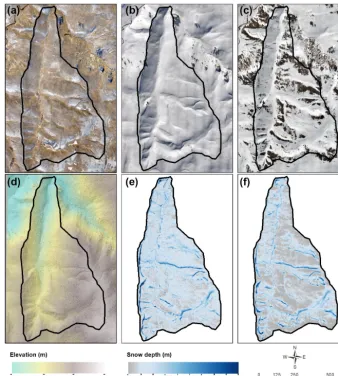
Snow depth was found to be highly variable across the study catchment for both winter and spring (Fig. 3). The mid-winter flight mapped near-complete snow cover across the study catchment, while large snow-free areas developed by the spring flight, where snow-covered area was reduced by about one-third (Fig. 3a and b). Where snow was present, depths ranged from less than 0.10 m, typically on exposed ridgelines and broad elevated slopes, to 2 m or more where cornices formed along ridgelines, as well as in gullies. Av-erage snow depth was greater for winter, although maximum depths were comparable between winter and spring. Between winter and spring, considerable ablation was observed. Ar-eas of deepest snow were spatially coincident between win-ter and spring, with the greatest retention of snow in cornices and gullies. Where shallow snow was present on ridgelines in winter, it was largely lost by spring.
4.2 Accuracy assessment and validation of snow depth 4.2.1 Propagation of aero-triangulation error
Propagation of errors under the Gaussian assumption, based on the RMSE from each AT, yielded vertical uncertainties for snow depths at the 90 % confidence level of±0.077 m for the winter flight and±0.084 m for the spring flight. This one-dimensional approach to error propagation assumes that the planimetric geolocation of individual surfaces, and sub-sequently the co-registration of surface pairs, does not con-tribute significantly to the vertical uncertainty.
4.2.2 Assessment against reference probe data
Figure 3.Processed ortho-mosaics for autumn(a), winter(b)and spring(c)flights, with corresponding autumn hill-shaded DSM(d)and maps of snow depth derived for winter(e)and spring(f).
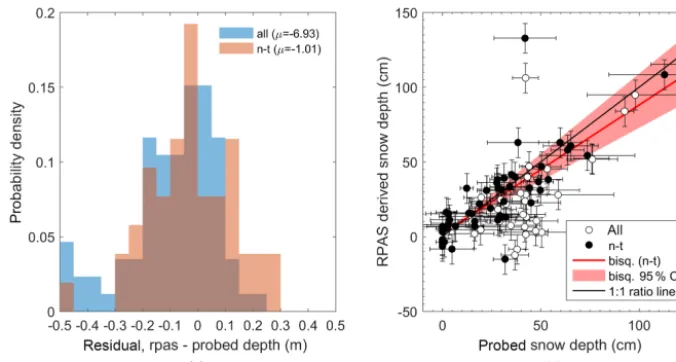
Good agreement between data sets is further demonstrated in Fig. 4b. Relatively large horizontal error bars accompany-ing the reference measurements (Fig. 4b) reflect the substan-tial spasubstan-tial variability in snow depth measured by probing, even within arm’s reach. Substantial departure occurs for ref-erence snow depths between 0.20 and 0.60 m which tend to exceed RPAS measurements. Negative depths in the RPAS-derived data set is a product of co-registration uncertainty, particularly in areas where the surface model represents large vegetation or is influenced by rock outcrops, as well as spuri-ous values from the constituent DSMs. Agreement between reference and RPAS-derived data sets improved with the re-moval of reference measurements made above tussocks. This filtering saw the R2 value improve by 22 %, while RMSE decreased by 23 % (Table 4). The 1 : 1 ratio line was con-tained within the 95 % confidence interval of the weighted (bi-square) regression between RPAS-derived and filtered reference snow depths. Some disagreement between RPAS
Table 4.Parameters of weighted regression between reference and RPAS-derived snow depths.
n β0 β1 RMSE R2 pvalue
All points 86 0.92 0.80 14.7 0.67 0.000 Non-tussock 52 1.69 0.86 11.3 0.82 0.000
derived and probed snow depths is likely due to the vary-ing areas over which snow depth was sampled by the two techniques, and resulting spatial uncertainty in comparing the two data sets.
4.2.3 Comparison of DSMs from independent RPAS flights
sur-Figure 4.Residuals between snow depths measured by RPAS photogrammetry and probing for all probe locations (“all”, blue) and non-tussock probe locations (“n-t”, red)(a), and bi-square (bisq.) weighted regression between snow depth derived from a 0.15 m RPAS grid and probed snow depths(b). Vertical error bars are determined from the error propagation associated with DSM differencing and have a magnitude of ±0.094 m, while horizontal error bars are calculated from the standard deviation of probe measurements made at each reference sampling location.
Figure 5.Map(a)and histogram(b)of the vertical residual for snow-free areas for surface models derived from the autumn and spring flights. The histogram includes fitted normal andtlocation-scale (t) distributions.
faces between the pre-winter and spring flights (Fig. 5). The small magnitude of the residuals, compatible with er-rors consistent with the uncertainty of the triangulation CPs, demonstrates the repeatability in the derivation of snow-free surfaces. Furthermore, the absence of any spatially struc-tured trend in the distribution of the residual indicates ro-bust photogrammetric modelling from the RPAS platform. At 0.15 m resolution, the snow-free pixels from the spring mission provided a large sample (n=5 936 428). The mean
residual (bias) detected with respect to the pre-winter DSM was 0.024 m (σ=0.239 m) (Fig. 5).
The set of residuals departed substantially from the Gaus-sian distribution and was better represented by the Student’s
tlocation-scale distribution (Fig. 6):
f (x)=
0v+21
σ√vπ 0 v2
v+ x−µ σ
v !−
v+1 2
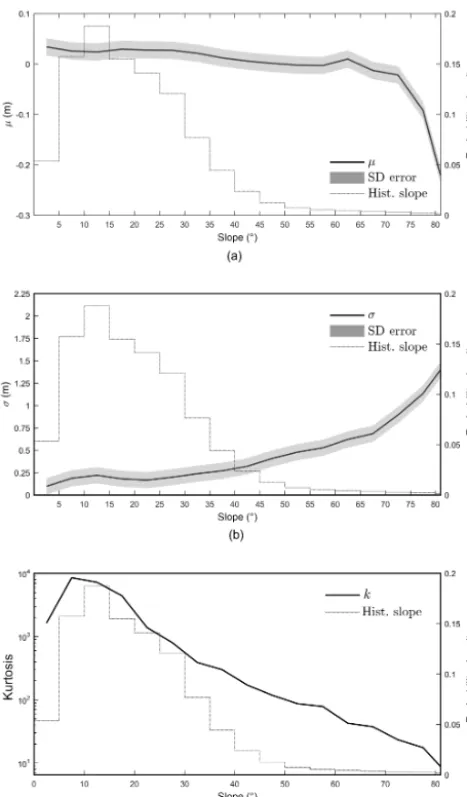
Figure 6.Mean,µ(a), standard deviation,σ (b)and distribution kurtosis(c)for the residual, in terms of discrete classes of slope (5◦ width), up to the 90th percentile of slope. Kurtosis is plotted on a log-scale and is accompanied by a standard error of 606. The slope histogram has been clipped to the 90th percentile.
whereµ,σ andv are the location, scale and shape parame-ters, respectively. Large kurtosis (calculatedk=1956) asso-ciated with the histogram of residuals in Fig. 6 shows sig-nificant departure from a Gaussian law (for which k=3) of equal standard deviation,σ. The leptokurtic experimen-tal distribution results in a narrower 90 % confidence inter-val than that estimated under the Gaussian assumption with
σ =0.24 m, while the probability of large residuals is larger than predicted by a Gaussian distribution. Overall, the mean residual (µ=0.02 m) and the precision of ±0.14 m (90 % confidence level, calculated from the distribution 90th pcentile; Fig. 6) exceeds the uncertainties estimated from er-ror propagation alone (±0.08 m at 90 % confidence level; see Sect. 4.1.1) yet support the suitable repeatability of the
pho-Table 5.Observed (calculated under Gaussian assumption) and fit-ted normal andtlocation-scale (t l-s) parameters for the residual distributions shown in Fig. 5b.
Parameter Distribution Value Observed 0.024
µ(m) Normal fit 0.036
tl-s fit 0.019 Observed 0.239
σ(m) Normal fit 0.236
tl-s fit 0.056
ν tl-s fit 2.579
Figure 7.Comparison of histograms and accompanying descrip-tive statistics for the residual between DSMs for slopes between 5 and 10◦and slopes between 70 and 75◦. Flatter slopes are found to exhibit extreme kurtosis relative to steeper slopes. Normal andt
location-scale (t) distributions are shown.
togrammetric modelling. Importantly, the significant depar-ture from a normal distribution shows that assessing the vari-ability from a Gaussian fit on stable targets (±0.39 m at the 90 % level) would significantly overestimate the confidence interval. On the other hand, the 90% confidence interval cal-culated from the fitted Student’stlocation-scale is±0.10 m (Table 5). The significance of this result with respect to sta-tistical inferences is discussed further in Sect. 5.2.2.
kurto-Figure 8.Semi-variograms for snow depth, based on measurements provided by probing (86 samples), and two random samples drawn from RPAS-derived snow depth of 1000 and 5000 observations.
sis of the residual distribution, provided insight into the role of terrain. For classes of slope up to 65◦the mean residual remains within the standard error, before becoming increas-ingly negative for the remaining classes (Fig. 6). Standard deviation exhibits a similar trend, remaining largely within the overall standard error for slope classes up to 45◦, beyond which variability increases.
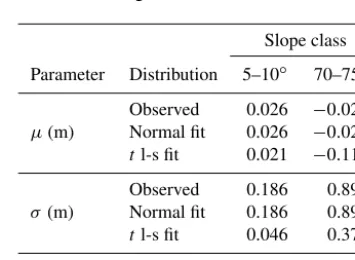
The observed pattern in the mean and standard deviation of the residual indicates that larger and more variable errors are associated with steeper slopes. Reduced kurtosis accompa-nying the error distribution on larger slopes (Fig. 6) reveals a tendency towards a Gaussian distribution of residuals as mean slope increases. Here, for slopes>50◦, kurtosis was reduced below 100, and for slopes>85◦, kurtosis was less than 10, approaching that of the normal distribution. There-fore, the statistical distribution of error, while non-normal, also varies significantly with terrain characteristics, as high-lighted by the comparison of the residual histogram for dis-crete classes of slope (Fig. 7 and Table 6). Subsequently, the overall distribution of residuals (Fig. 5b) is the result of a convolution between non-normal distributions and the hyp-sometry of the area (i.e. area-elevation distribution). 4.2.4 Characterising the spatial variability of snow
depth
The semi-variograms for RPAS-derived snow depth, com-pared to that from the reference measurements, are shown Fig. 8. They exemplify the new insight that high-resolution mapping provides into the spatial variability of snow depth.
Table 6.Observed (calculated under Gaussian assumption) and fit-ted normal andtlocation-scale (t l-s) parameters for the residual distributions shown in Fig. 7.
Slope class Parameter Distribution 5–10◦ 70–75◦
Observed 0.026 −0.022
µ(m) Normal fit 0.026 −0.022
tl-s fit 0.021 −0.118 Observed 0.186 0.892
σ(m) Normal fit 0.186 0.892
tl-s fit 0.046 0.376
ν tl-s fit 4.104 2.093
the snow depth field, thus stressing a limitation of this clas-sical method to characterise the snowpack.
5 Discussion
5.1 Performance of RPAS photogrammetry for resolving snow depth
Overall, RPAS photogrammetry is found to be suitable for determining snow depth via DSM differencing. Primarily, the achievement of uncertainties <0.14 m at the 90 % con-fidence level for derived snow depth, demonstrated empiri-cally by the repeatability analysis (Fig. 5), provides a basis for useful data capture, and robust inferences and interpreta-tions. The reported magnitudes of uncertainties account for the sources discussed further below, and compare favourably with other similar studies (Vander Jagt et al., 2015; Bühler et al., 2016; De Michele et al., 2016; Harder et al., 2016). Decimetre levels of uncertainty appear to be an emerging benchmark for snow depths measured by RPAS photogram-metry and also considered as standard for airborne lidar (Deems et al., 2013). In terms of comparisons with in situ data, Fig. 4 shows good agreement between RPAS and ref-erence snow depth, and that RPAS photogrammetry perfor-mance improves as snow depth increases. At the same time, use of probed snow depths as references for validating such data can be compromised by the nature of the underlying vegetation.
Mapping snow depth continuously at 0.15 m resolution, across an entire hydrological catchment, represents a new contribution to the quantification and characterisation of spa-tial variability in snow depth on this scale, which is up to 2 orders of magnitude greater than many similar studies to date. Before considering the broader implications of this in terms of snow processes, uncertainty, limitations and pitfalls of the approach are considered.
5.2 Sources and nature of uncertainty 5.2.1 Vegetation
Vegetation contributes to uncertainty, particularly when val-idating RPAS-derived snow depths against reference snow depths. As described in Sect. 4.2.2, the agreement between RPAS-derived and probed snow depths improved substan-tially when areas of large tussock vegetation were excluded. It is likely that the presence of tussock introduces a bias into the snow depth measurement, whereby a probe may penetrate the tussock foliage, and possibly also a sub-vegetation void, before striking the ground surface. This is similar to the cav-ity effect highlighted for airborne lidar measurement of snow (Painter et al., 2016), and similar challenges have been docu-mented by Vander Jagt et al. (2015). High-resolution dDSMs, on the other hand, resolve the vegetation surface, and so veg-etation height is inherently better accounted for.
As identified by Nolan et al. (2015), photogrammetrically derived snow depths may also be affected by the compaction of vegetation below the snowpack, which may introduce an anomalous signal of surface height change, to the point of returning false negative snow depths. Correcting observed surface height change would not be straightforward, and is not possible with the data acquired within this study. The ef-fects of vegetation compaction are likely to be greatest in the early winter. As grass typically does not rebound until after the complete removal of the winter snowpack, ongoing sub-sidence of vegetation below the snowpack through midwinter and spring is expected to be minimal. Ongoing future mea-surement of snow depth via surface differencing (regardless of the source of DSMs) will benefit from the development and incorporation of vegetation compaction and cavity mod-els.
Ultimately, this study suggests that, for areas dominated by tussock vegetation, RPAS photogrammetry may provide a more reliable means of measurement than probing. A lack of knowledge regarding the specific location of sub-snow veg-etation when making measurements by probing is likely to provide a systematic overestimation of snow depth (Fig. 4). In the New Zealand context, almost all seasonal snow oc-curs above the treeline, so the inability of photogrammetry to penetrate the forest canopy is a lesser concern than for the Northern Hemisphere.
5.2.2 Geolocation and co-registration
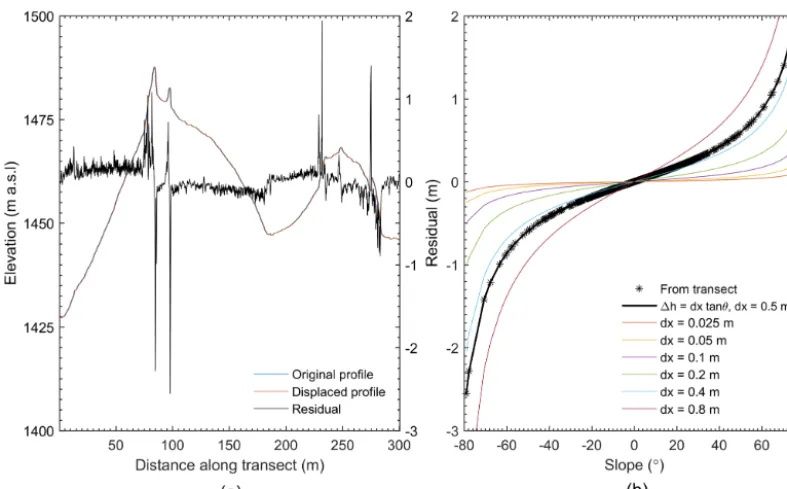
Figure 9.The vertical residual between two elevation profiles, extracted from the same DSM, along a common transect and offset horizontally by 0.5 m(a), and the resulting residuals plotted as a function of terrain surface slope, for the applied offset of 0.5 m, and a range of other offsets (dx)(b).
Consistent with Kääb (2005), the vertical error introduced by a uniform, one-dimensional (e.g. horizontal) offset, is given by the following:
1h=dxtanθ, (9)
where dx is the offset between transects (i.e. 0.5 m in this case), andθis the surface slope in degrees, as seen in Fig. 9b. It is clear from Fig. 9b that where the average slope of tar-get surfaces is low and co-registration quality is good, the error introduced to a dDSM as a product of co-registration will be minimal. Increasing slope and/or co-registration un-certainty is accompanied by increased vertical unun-certainty in the dDSM. This relationship is consistent with the findings of Sect. 4.2.3, resulting in the distribution of residuals departing substantially from the Gaussian distribution when the pro-portion of steep slopes is low. These findings provide context for the effect noted by Nolan et al. (2015), whereby a non-normal distribution of residuals associated with photogram-metric mapping of snow depth was found to narrow further when the area considered was restricted to a frozen lake (i.e. near planar) surface.
Complicating this effect is the fact that co-registration un-certainty exists in two dimensions. Subsequently, it will be-come dependent on aspect as well as slope (Nuth and Kääb, 2011), with neither possessing a uniform spatial distribu-tion. This effect is expected to be more pronounced with very high-resolution (i.e. sub-metre) surface models due to a greater frequency and magnitude of breaks in surface slope being resolved compared to coarser models. The
modifica-tion of surface slope for constituent DSMs (e.g. through the addition of snow) further convolves the propagation of ver-tical uncertainty. Despite this, the leptokurtic observed error distribution indicates that the reliance on statistics that as-sume a Gaussian distribution of errors will provide an over-estimated characterisation of the expected accuracy. Overes-timation of uncertainties may in turn affect statistical infer-ences and the computation of uncertainties on derived param-eters.
5.3 Pitfalls and limitations of RPAS photogrammetry
Initial processing using the photogrammetry module of Trim-ble Business Center (v3.40) produced strong striping arte-facts in the dDSM. Striping involved a periodic bias in sur-face height change, aligned with the 15 image strips. This was readily revealed because identical flight plans between successive surveys made constructive errors obvious, rather than convoluted with terrain variability. This systematic error was severe and problematic, particularly when considering the surface change resulting from the addition of snow cover to the ground. Extensive snow cover concealed stable refer-ences, precluding characterisation of the error and its empir-ical removal from the real signal of surface height change (e.g. Albani and Klinkenberg, 2003; Berthier et al., 2007). Products derived using UAS Master (v8.0) did not exhibit such artefacts, allowing the potential source of error associ-ated with AT from TBC to be investigassoci-ated.
The absence of systematic bias in dDSMs derived using UAS Master indicates a more reliable AT. Thus, the UAS Master triangulation provided a reference surface for further exploration of the nature of the bias propagated in the TBC triangulation. Comparisons from the winter flight are pre-sented here. The nature of the photogrammetric problem de-scribed in Sect. 3.2.1 dictates that small errors in the interior orientation and/or the rotational components of the exterior orientation can result in large, spatially structured errors in the adjusted image block (Sirguey et al., 2016).
Cimoli et al. (2017) reported an improved performance in mapping snow depth with the application of a radial lens distortion correction. In our case, no significant difference was detected between the distortion models provided for each of the two software calibrations of the same camera, for the same flight. (Fig. 11a). Minimal divergence in lens distortion was observed beyond 10 mm radius, reaching 1 % at 14.5 mm. Agreement between lens distortion models in-dicated that differing interior orientation solutions between TBC and UAS Master were not the source of the artefacts seen in products of the TBC triangulation.
Since the observed artefact was propagated along the flight lines, the roll parameter (ω) was considered. Bias in the esti-mation of this parameter could lead to a systematic elevation offset of resected points between flight lines, either raising or lowering the terrain, as documented in the case of stereo-satellite imagery by Berthier et al. (2007). Occurrence of this for multiple flights with near-identical flight lines would ex-acerbate constructive biases, resulting in the striping in the dDSM. Alternatively, pitch and yaw parameters are unlikely to produce such an artefact along the flight direction (Ebner and Fritz, 1980). The residual ofωfor individual photo cen-tres between each of the two software packages confirmed that a positive bias existed in the ω value as estimated by TBC v3.40 relative to that provided by UAS Master. The mean residual (rθ) was found to be 0.014◦.
The impact of bias inωon the resected heighthfor a target with respect to a photo centre can be estimated simply as a right-angled triangle, since values ofωare small compared to the baseline length,l, which is equal to half the distance between adjacent flight lines (see Fig. 12):
tanθ=h
l (10)
tan θ−rθ=h−1h
l (11)
1h=h−ltan rθ (12)
1h=h−ltan
arctanh
lrθ
. (13)
Using the observed value of 0.014◦ forrθ, 1hwas calcu-lated for a range of typical values of h, yielding the rela-tionship betweenh and1h as shown in Fig. 11b. Bias in the estimation of theωparameter during the AT can intro-duce a significant vertical error, dependent (non-linearly) on flying height (h), propagating an error of±0.12 m at a fly-ing height of 110 m. The increase in error with flyfly-ing height above ground level was consistent with the observed prop-agation of striping artefacts in DSM products, whereby the magnitude of the observed bias decreased as terrain height increased (Fig. 10), while absolute flying height remained approximately constant.
The observed propagation reinforces the need for vigi-lance when working with such data sets, particularly those delivered from “off the shelf” photogrammetry packages, which are becoming increasingly popular. Artefacts such as the striping identified here, and evidence of non-optimal AT, are likely to be less obvious as the complexity of the mapped terrain increases. As RTK GPS-equipped RPAS be-come more common, increased precision of initial AT pa-rameters may mitigate the risk of error introduced by spu-rious solutions for refined parameters. Currently, however, RTK systems have an increased power demand, which can substantially reduce the flight time.
5.4 Spatial and temporal trends in snow cover
pro-Figure 10.Map of the systematic artefacts in surface height change (dh) (expected to represent snow depth), propagated when differencing digital surface models (DSMs) resulting from aerial-triangulation in TBC v3.40(a)compared with the dDSM from UAS Master(b). Vertical (north–south aligned) striping is highlighted in(c), which shows the residual between dDSMs derived from TBC and UAS Master.
Figure 11.Comparison of lens distortion characterised by individual triangulations of data from the same flight carried out in two different software packages, TBC and UAS Master(a), and the error in surface height propagated by a bias in the roll parameter,ω, in relation to flying height(b). The distortion residual was only apparent at radial distances>12 mm(a), while the observed mean bias inωthat was propagated by TBC results in substantial errors in surface height(b).
cesses are represented in existing and new snow and glacier models, which will enable short-term hydrological forecasts and climate projections in snow-covered areas to be im-proved. Such data can also facilitate the use of geostatisti-cal approaches for examining controls on spatial distribution of snow, such as that applied to the Brewster Glacier, New
Figure 12.Schematic of the relationship between height (h), base-line length (l) and the interior angle (θ) that may be affected by a bias (rθ) for a terrain point position resected from images centred at p1 and p2, when the mean bias (rθ) is small (e.g. 0.014◦in this case).
The ability to resolve fine-scale variability reliably from continuous raster snow maps lessens the dependence on in-terpolation through areas of sparse data for interpreting con-trols on spatial distribution of snow. While previous studies have been able to correlate between snow and terrain proper-ties (e.g. Anderson et al., 2014), such studies rely on the in-ference of catchment-scale processes from transect-scale ob-servations. The ability to produce spatially continuous maps of snow depth across an entire catchment at a resolution of 0.15 m bridges this gap and reduces the reliance on infer-ences when scaling up from point- or transect-based in situ observations to catchment-scale processes. Such data sets provide an opportunity to build on previous work in under-standing the relationships between snow redistribution, pref-erential accumulation and ablation, terrain and meteorology (Winstral et al., 2002, 2013; Webster et al., 2015; Revuelto et al., 2016). While RPAS photogrammetry is severely limited in spatial scale compared to airborne lidar, resolving snow depth in this way across an entire catchment facilitates robust integration into hydrological models, enhanced by validation against catchment discharge (e.g. from streamflow data).
The mapping of snow depth effectively provides a vol-umetric view of the snowpack across the catchment (i.e. depth×area). The snowpack mass balance in terms of SWE can be calculated based on in situ measurements of snow density. While snow depth was only determined for two dates in this case, emergent trends within the data can be ex-plored. Between the winter and spring flights, the catchment snow-covered area (SCA) decreased from 100 % to 67 %. Bulk snowpack densities, measured gravimetrically at a sin-gle snow pit for the winter flight (314 kg m−3), and two snow pits for the spring flight (391 kg m−3), allow catchment SWE to be calculated, revealing a 20 % reduction in SWE between flights. This highlights the importance of effective
concen-tration of snow in preferred areas, and the complex spatial distribution that results. The ability to detect this, even with a temporally limited data set, indicates the potential for RPAS photogrammetry as a measurement approach for improving resolution and understanding of snow hydrology. In particu-lar, such data sets may offer a unique opportunity to assess the performance of models forced by remotely sensed data of coarser resolution in estimating SWE from estimates of subpixel fractional SCA (Bair et al., 2016).
6 Conclusions and outlook
This study has demonstrated that RPAS photogrammetry provides a suitable, repeatable means of reliably determining snow depth in an alpine catchment of low relief that pos-sesses some terrain complexity. Achieving decimetre-level accuracy for measuring snow depth provides a basis for monitoring seasonal snowpacks and associated processes, especially considering the capacity to provide very high-resolution, spatially continuous measurements across an en-tire hydrological catchment. This ability to characterise the seasonal snowpack will provide an important stepping stone for improved modelling of seasonal snow and associated pro-cesses, especially through accurate mapping of an entire hy-drological catchment.
Challenges encountered through this deployment provide important points for consideration in this and other applica-tions of close-range photogrammetry, especially from RPAS platforms, for surface and volume change analysis. Specif-ically, a small but persistent bias in photogrammetric solu-tions for the roll parameter exemplifies the possibility of sub-optimal solutions in processing software. Such a bias can in-troduce substantial systematic errors which may be difficult to correct and can compromise further analysis.
We show that uncertainty analysis from the AT only, based on a limited number of check points, may underestimate the uncertainty. Alternatively, an assessment of repeatability of photogrammetric modelling on stable ground can support a more detailed uncertainty analysis. It reveals, however, that the statistical distribution of the error of differentiated surface models is more complex than normal and governed by ter-rain parameters. The leptokurtic residual distribution demon-strates that an assumption of Gaussian law can substantially overestimate confidence intervals, in turn compromising in-ferences. This result has important practical applications for the computation of uncertainties in studies that characterise volume change from repeated surface modelling.
permit modelling and correction of such errors in the very high-resolution products that are now available.
Data availability. The data used in this research are available on request from Todd A. N. Redpath.
Author contributions. TR and PS designed the study and col-lected the data. TR processed and analysed the data and wrote the manuscript with input from PS and NC. PS and NC supervised the research.
Competing interests. The authors declare that they have no conflict of interest.
Acknowledgements. The authors are grateful to those who provided assistance in the field: Julien Boeuf, Kelly Gragg, Mike Denham, Craig MacDonell, Aubrey Miller, Sam West, Thomas Ibbotson and Alia Khan. Sean Fitzsimons provided helpful feedback on the draft manuscript. This research was carried out under the Department of Conservation Research & Collection Authorisation 53609-GEO. This research was funded by a University of Otago Doctoral Scholarship with support from the Department of Geography and an internal grant of the National School of Surveying, as well as a fieldwork grant from the New Zealand Hydrological Society. The authors thank the editor, Martin Schneebeli, and two anonymous reviewers, whose thorough and thoughtful comments improved this manuscript.
Edited by: Martin Schneebeli Reviewed by: two anonymous referees
References
Albani, M. and Klinkenberg, B.: A spatial filter for the removal of striping artifacts in digital elevation models, Photogramm. Eng. Remote, 69, 755–765, https://doi.org/10.14358/PERS.69.7.755, 2003.
Anderson, B. T., McNamara, J. P., Marshall, H.-P., and Flores, A. N.: Insights into the physical processes controlling correlations between snow distribution and terrain properties, Water. Resour. Res., 50, 4545–4563, https://doi.org/10.1002/2013WR013714, 2014.
Avanzi, F., Bianchi, A., Cina, A., De Michele, C., Maschio, P., Pagliari, D., Passoni, D., Pinto, L., Piras, M., and Rossi, L.: Cen-timetric accuracy in snow depth using unmanned aerial system photogrammetry and a multistation, Remote Sensing, 10, 1–16, https://doi.org/10.3390/rs10050765, 2018.
Bair, E. H., Rittger, K., Davis, R. E., Painter, T. H., and Dozier, J.: Validating reconstruction of snow water equivalent in Cali-fornia’s Sierra Nevada using measurements from the NASA Air-borne Snow Observatory, Water. Resour. Res., 52, 8437–8460, https://doi.org/10.1002/2016WR018704, 2016.
Berthier, E., Arnaud, Y., Kumar, R., Ahmad, S., Wagnon, P., and Chevallier, P.: Remote sensing estimates of glacier mass balances in the Himachal Pradesh (Western Hi-malaya, India), Remote Sens. Environ., 108, 327–338, https://doi.org/10.1016/j.rse.2006.11.017, 2007.
Bessho, K., Date, K., Hayashi, M., Ikeda, A., Imai, T., In-oue, H., Kumagai, Y., Miyakawa, T., Murata, H., Ohno, T., Okuyama, A., Oyama, R., Sasaki, Y., Shimazu, Y., Shimoji, K., Sumida, Y., Suzuki, M., Taniguchi, H., Tsuchiyama, H., Uesawa, D., Yokota, H., and Yoshida, R.: An Introduction to Himawari-8/9 – Japan’s New-Generation Geostationary Meteo-rological Satellites, J. Meteorol. Soc. Jpn. Ser. II, 94, 151–183, https://doi.org/10.2151/jmsj.2016-009, 2016.
Brown, D. C.: Close-range camera calibration, Photogramm. Eng., 37, 855–866, 1971.
Bühler, Y., Adams, M. S., Bösch, R., and Stoffel, A.: Mapping snow depth in alpine terrain with unmanned aerial systems (UASs): potential and limitations, The Cryosphere, 10, 1075– 1088, https://doi.org/10.5194/tc-10-1075-2016, 2016.
Bühler, Y., Adams, M. S., Stoffel, A., and Boesch, R.: Photogrammetric reconstruction of homogenous snow surfaces in alpine terrain applying near-infrared UAS imagery, Int. J. Remote Sens., 38, 3135–3158, https://doi.org/10.1080/01431161.2016.1275060, 2017. Cimoli, E., Marcer, M., Vandecrux, B., Bøggild, C. E.,
Williams, G., and Simonsen, S. B.: Application of Low-Cost UASs and Digital Photogrammetry for High-Resolution Snow Depth Mapping in the Arctic, Remote Sens., 9, 1142, https://doi.org/10.3390/rs9111144, 2017.
Clark, M. P., Hendrikx, J., Slater, A. G., Kavetski, D., Anderson, B., Cullen, N. J., Kerr, T., Hreinsson, E. Ö., and Woods, R. A.: Rep-resenting spatial variability of snow water equivalent in hydro-logic and land-surface models?: A review, Water. Resour. Res., 47, W07539, https://doi.org/10.1029/2011WR010745, 2011. Conway, J. P. and Cullen, N. J.: Cloud effects on surface
energy and mass balance in the ablation area of Brew-ster Glacier, New Zealand, The Cryosphere, 10, 313–328, https://doi.org/10.5194/tc-10-313-2016, 2016
Cullen, N. J. and Conway, J. P.: A 22 month record of sur-face meteorology and energy balance from the ablation zone of Brewster Glacier, New Zealand, J. Glaciol., 61, 931–946, https://doi.org/10.3189/2015JoG15J004, 2015.
Cullen, N. J., Anderson, B., Sirguey, P., Stumm, D., Mackin-tosh, A., Conway, J. P., Horgan, H. J., Dadic, R., Fitzsi-mons, S. J., and Lorrey, A.: An 11-year record of mass balance of Brewster Glacier, New Zealand, determined us-ing a geostatistical approach, J. Glaciol., 63, 199–217, https://doi.org/10.1017/jog.2016.128, 2017.
Deems, J. S., Painter, T. H., and Finnegan, D. C.: Lidar mea-surement of snow depth: A review, J. Glaciol., 59, 467–479, https://doi.org/10.3189/2013JoG12J154, 2013.
De Michele, C., Avanzi, F., Passoni, D., Barzaghi, R., Pinto, L., Dosso, P., Ghezzi, A., Gianatti, R., and Della Vedova, G.: Us-ing a fixed-wUs-ing UAS to map snow depth distribution: an eval-uation at peak accumulation, The Cryosphere, 10, 511–522, https://doi.org/10.5194/tc-10-511-2016, 2016.
Ebner, H. and Fritz, L.: Aerotriangulation, in: Manual of Pho-togrammetry, 4th edn., edited by: Slama, C. C., American So-ciety of Photogrammetry, Falls Church, 453–518, 1980. Fernandes, R., Prevost, C., Canisius, F., Leblanc, S. G.,
Malo-ley, M., Oakes, S., Holman, K., and Knudby, A.: Monitor-ing snow depth change across a range of landscapes with ephemeral snow packs using Structure from Motion applied to lightweight unmanned aerial vehicle videos, The Cryosphere Discuss., https://doi.org/10.5194/tc-2018-82, in review, 2018. Hall, D. K., Crawford, C. J., Di Girolamo, N. E., Riggs,
G. A., and Foster, J. L.: Detection of earlier snowmelt in the Wind River Range, Wyoming, using Landsat im-agery, 1972–2013, Remote Sens. Environ., 162, 45–54, https://doi.org/10.1016/j.rse.2015.01.032, 2015.
Hall, D. K., Riggs, G. A., Salomonson, V. V, Di Girolamo, N. E., and Bayr, K. J.: MODIS snow-cover products, Remote Sens. Environ., 83, 181–194, https://doi.org/10.1016/S0034-4257(02)00095-0, 2002.
Harder, P., Schirmer, M., Pomeroy, J., and Helgason, W.: Accuracy of snow depth estimation in mountain and prairie environments by an unmanned aerial vehicle, The Cryosphere, 10, 2559–2571, https://doi.org/10.5194/tc-10-2559-2016, 2016.
Hirschmuller, H.: Accurate and efficient stereo processing by semi-global matching and mutual information, IEEE. T. Pattern Anal., 2, 807–814, https://doi.org/10.1109/CVPR.2005.56, 2008. James, L. A., Hodgson, M. E., Ghoshal, S., and
Lati-olais, M. M.: Geomorphic change detection using his-toric maps and DEM differencing: The temporal dimen-sion of geospatial analysis, Geomorphology, 137, 181–198, https://doi.org/10.1016/j.geomorph.2010.10.039, 2012. Kääb, A.: Remote Sensing of Mountain Glaciers and
Per-mafrost Creep. Zürich: Geographisches Institut der Universi-turich, Zürich, 2005.
Kerr, T., Clark, M., Hendrikx, J., and Anderson, B.: Snow distribution in a steep mid-latitude alpine catchment, Adv. Water Resour., 55, 17–24, https://doi.org/10.1016/j.advwatres.2012.12.010, 2013.
Kinar, N. J. and Pomeroy, J. W.: Measurement of the physi-cal properties of the snowpack, Rev. Geophys., 53, 481–544, https://doi.org/10.1002/2015RG000481, 2015.
Lemmetyinen, J., Derksen, C., Rott, H., Macelloni, G., King, J., Schneebeli, M., Wiesmann, A., Leppänen, L., Kontu, A., and Pulliainen, J.: Retrieval of Effective Correlation Length and Snow Water Equivalent from Radar and Pas-sive Microwave Measurements, Remote Sens., 10, 170, https://doi.org/10.3390/rs10020170, 2018.
Lindeberg, T.: Image Matching Using Generalized Scale-Space Interest Points, J. Math. Imaging Vis., 52, 3–36, https://doi.org/10.1007/s10851-014-0541-0, 2015.
Linder, W.: Digital Photogrammetry: A Practical Course, 4th edn., Heidelberg, Springer, 2016.
Malenovský, Z., Rott, H., Cihlar, J., Schaepman, M. E., García-Santos, G., Fernandes, R., and Berger, M.: Sentinels for science: Potential of Sentinel-1, -2, and -3 missions for scientific obser-vations of ocean, cryosphere, and land, Remote Sens. Environ., 120, 91–101, https://doi.org/10.1016/j.rse.2011.09.026, 2012. Mankin, J. S., Viviroli, D., Singh, D., Hoekstra, A. Y., and
Diffen-baugh, N. S.: The potential for snow to supply human water
de-mand in the present and future, Environ. Res. Lett., 10, 114016, https://doi.org/10.1088/1748-9326/10/11/114016, 2015. Marti, R., Gascoin, S., Berthier, E., de Pinel, M., Houet, T.,
and Laffly, D.: Mapping snow depth in open alpine terrain from stereo satellite imagery, The Cryosphere, 10, 1361–1380, https://doi.org/10.5194/tc-10-1361-2016, 2016.
Nolan, M., Larsen, C., and Sturm, M.: Mapping snow depth from manned aircraft on landscape scales at centimeter resolution us-ing structure-from-motion photogrammetry, The Cryosphere, 9, 1445–1463, https://doi.org/10.5194/tc-9-1445-2015, 2015. Nolin, A. W. and Dozier, J.: Estimating snow grain size
us-ing AVIRIS data, Remote Sens. Environ., 44, 231–238, https://doi.org/10.1016/0034-4257(93)90018-S, 1993.
Nuth, C. and Kääb, A.: Co-registration and bias corrections of satel-lite elevation data sets for quantifying glacier thickness change, The Cryosphere, 5, 271–290, https://doi.org/10.5194/tc-5-271-2011, 2011.
Painter, T. H., Berisford, D. F., Boardman, J. W., Bormann, K. J., Deems, J. S., Gehrke, F., Hedrick, A., Joyce, M., Laidlaw, R., Marks, D., Mattmann, C., McGurk, B., Ramirez, P., Richard-son, M., Skiles, S. M. K., Seidel, F. C., and Winstral, A.: The Airborne Snow Observatory: Fusion of scanning lidar, imaging spectrometer, and physically-based modeling for mapping snow water equivalent and snow albedo, Remote Sens. Environ., 184, 139–152, https://doi.org/10.1016/j.rse.2016.06.018, 2016. Revuelto, J., Vionnet, V., López-Moreno, J. I., Lafaysse, M.,
and Morin, S.: Combining snowpack modeling and ter-restrial laser scanner observations improves the simulation of small scale snow dynamics, J. Hydrol., 533, 291–307, https://doi.org/10.1016/j.jhydrol.2015.12.015, 2016.
Rittger, K., Painter, T. H., and Dozier, J. : Assessment of meth-ods for mapping snow cover from MODIS, Adv. Water Resour., 51, 367–380, https://doi.org/10.1016/j.advwatres.2012.03.002, 2013.
Roy, D. P., Wulder, M. A., Loveland, T. R., C.E., W., Allen, R. G., Anderson, M. C., Helder, D., Irons, J. R., Johnson, D. M., Kennedy, R., Scambos, T. A., Schaaf, C. B., Schott, J. R., Sheng, Y., Vermote, E. F., Belward, A. S., Bindschadler, R., Cohen, W. B., Gao, F., Hipple, J. D., Hostert, P., Huntington, J., Justice, C. O., Kilic, A., Kovalskyy, V., Lee, Z. P., Lymburner, L., Masek, J. G., McCorkel, J., Shuai, Y., Trezza, R., Vogelmann, J., Wynne, R. H., and Zhu, Z.: Landsat-8: Science and product vision for terrestrial global change research, Remote Sens. Environ., 145, 154–172, https://doi.org/10.1016/j.rse.2014.02.001, 2014. Sims, C. and Orwin, J. F.: Snowmelt generation on a
hydrologi-cally sensitive mountain range, Pisa Range, Central Otago, New Zealand, J. Hydrol., 50, 383–405, 2011.
Sirguey, P., Boeuf, J., Cambridge, R., and Mills, S.: Evidence of sub-optimal photogrammetric modelling in RPAS-based aerial surveys, in: Proceedings of the GeoCart’2016 and ICA Sympo-sium on Cartography, edited by: Moore, A. and Drecki, I., New Zealand Cartographic Society Inc., 91–98, 2016.
Sturm, M., Goldstein, M. A., and Parr, C.: Water and life from snow: A trillion dollar science question, Water. Resour. Res., 53, 3534– 3544, https://doi.org/10.1002/2017WR020840, 2017.
Treichler, D. and Kääb, A.: Snow depth from ICESat laser altimetry – A test study in southern Norway, Remote Sens. Environ., 191, 389–401, https://doi.org/10.1016/j.rse.2017.01.022, 2017. Trimble: UAS Master 7.0: Tutorial, Trimble Germany, 2015. Trimble: Release Notes for UASMaster 8.0.0, Trimble Navigation
Limited, 2016.
Vander Jagt, B., Lucieer, A., Wallace, L., Turner, D., and Durand, M.: Snow depth retrieval with UAS using photogrammetric techniques, Geosciences, 5, 264–285, https://doi.org/10.3390/geosciences5030264, 2015.
Watts, A. C., Ambrosia, V. G., and Hinkley, E. A.: Unmanned air-craft systems in remote sensing and scientific research: Classifi-cation and considerations of use, Remote Sens., 4, 1671–1692, https://doi.org/10.3390/rs4061671, 2012.
Webster, C. S., Kingston, D. G., and Kerr, T.: Inter-annual variation in the topographic controls on catchment-scale snow distribution in a maritime alpine catchment, New Zealand, Hydrol. Process., 29, 1096–1109, https://doi.org/10.1002/hyp.10224, 2015. Winstral, A., Elder, K., and Davis, R. E.: Spatial Snow Modeling
of Wind-Redistributed Snow Using Terrain-Based Parameters, J. Hydrometeorol., 3, 524–538, https://doi.org/10.1175/1525-7541(2002)003<0524:SSMOWR>2.0.CO;2, 2002.
Winstral, A. and Marks, D.: Long-term snow distribution observa-tions in a mountain catchment: Assessing variability, time stabil-ity, and the representativeness of an index site, Water. Resour. Res., 50, 293–305, https://doi.org/10.1002/2012WR013038, 2014.