RESEARCH PAPER
Influence of amine group on the adsorptive removal of basic dyes
from water using two nanoporous isoreticular Zn(II)-based metal
organic frameworks
Zahra Saedi* and Mahmoud Roushani
Department of Chemistry, Faculty of Science, Ilam University, Ilam, Iran
*Corresponding Author Email: [email protected]
Dyes are the most abundant hazardous components existing in the envi -ronment because of their extensive use in industries. So, in the present study, two isoreticular Zn(II)-MOFs, TMU-16 and TMU-16-NH2, were used for the adsorptive removal of harmful cationic dyes from aquatic medi -um. In order to improve the removal efficiency, optimization of the ex -perimental conditions was carried out as a function of pH, MOF dosage, dye concentration and contact time. The maximum removal capacity was obtained at pH 12, 10 mg of MOF and 20 min as the contact time. The adsorption isotherms of each dye over both sorbents matched with the Langmuir model, and the adsorption kinetics followed the pseudo-second order kinetic model. The dye adsorption over TMU-16-NH2 is higher than that over TMU-16, indicating that the addition of amine groups in MOF network played an important role in the adsorption process, because of electrostatic interactions and hydrogen bonding. Thermodynamic studies indicated that adsorption process is spontaneous and endothermic. ARTICLE INFO
Article History:
Received 16 November 2017 Accepted 12 December 2017 Published 1 March 2018
Keywords:
Adsorptive Removal Basic Dye
Metal-Organic Frameworks TMU-16
TMU-16-NH2
ABSTRACT
This work is licensed under the Creative Commons Attribution 4.0 International License.
To view a copy of this license, visit http://creativecommons.org/licenses/by/4.0/. How to cite this article
Saedi Z, Roushani M. Influence of amine group on the adsorptive removal of basic dyes from water using two nanoporous isoreticular Zn(II)-based metal organic frameworks. Nanochem Res, 2018; 3(1): 99-108. DOI: 10.22036/ncr.2018.01.011
INTRODUCTION
Recently, an important and vital global problem is the environmental pollution by hazardous organics because of their effects on the human health and ecological systems [1-3]. The most abundant hazardous components existing in the environment are dyes. Pigments and dyes are present in waste water and natural water, because of their extensive use in industries such as the textile, leather, paper, printing, dyestuff, and plastic [4-7]. Consequently, the development of methods for the removal of dyes in waste water is of particular significance. Therefore, a variety of the physical, chemical and biological methods have been used in the removal of dyes [8, 9]. Adsorption has been widely recognized as a powerful technique for removal of dyes [10-12]. The most attractive aspect
of this technique is the comparatively low cost, wide range of applications, simplicity of design, easy operation, low harmful secondary products and facile regeneration of the sorbents [13-15].
During the last years, metal organic frameworks (MOFs), as organic-inorganic hybrid solids which can exhibit completely regular large cavities and open channels, have received much attention. These characteristics have made them the valuable organometals for frequent use in a variety of research areas, including adsorption/storage in gases [16, 17], separation of chemicals [18, 19], drug delivery [20] and catalysis [12, 22].
100 Nanochem Res 3(1): 99-108, Winter and Spring 2018
hydrogen bonds [13, 23].
In 2010, Haque et al. reported the first dyes removal application of MOFs [24]. Then, they studied kinetics and thermodynamics parameters of methyl orange and methylene blue adsorption from aqueous solution with MOF-235 [25]. MIL-101(Al) and MIL-101-NH2(Al) have been used for adsorptive removal of methylene blue and methyl orange from aqueous solutions in order to observe the effect of the amine groups on the sorption behavior [26].
The aim of this work is to introduce the efficient sorbents for significant removal of hazardous dyes from aqueous media, and understand the influence of amine functionalization on the adsorption capacity of cationic dyes. Two isoreticular porous
Zn(II)-MOFs (TMU-16 and TMU-16-NH2) have
been applied as sorbents. Chemical structures of dyes used in this work are displayed in the Table S1. Cationic dyes are dyes with basic role in the reaction and usually negative charged unites. These dyes can change the color of water and highly influence the water quality.
The effect of various parameters including pH, contact time, dye concentration and the amount of sorbent on the removal process are also investigated.
EXPERIMENTALS Materials and methods
All materials were purchased from commercial suppliers (Sigma-Aldrich and Merck Company), and used without further purification. X-ray powder diffraction patterns were performed using a Philips X’pert diffractometer with an X-Ray tube anode Co (λ=1.78897 Å). An ECS 4010 CHNS made in Costech Italy was used to elemental analyses (carbon, hydrogen, and nitrogen). FT-IR spectra (4000–400 cm−1) using KBr pellet were
recorded by VERTEX 70 FT-IR spectrometer. Surface area analysis and textural parameters were measured by Belsorp MiniII Japan instrument. Thermogravimetric analyzer TGA-50 (Shimadzu Japan) was used to thermogravimetric analysis (TGA). A Shimadzu UV-1800 spectrophotometer was applied to determine the dye concentrations.
Synthesis of MOFs
Isoreticular porous TMU-16 and TMU-16-NH2 were prepared according to the reported procedure [27]. TMU-16 and TMU-16-NH2 were synthesized using a bipyridyl-type ligand (4-bpdh) mixed into two dicarboxylate homologous
ligands, 1,4-benzenedicarboxylic acid (H2BDC) and 2-amino-1,4-benzenedicarboxylic acid (NH2 -BDC), respectively. Syntheses of TMU-16 or TMU-16-NH2 were carried out in 2 steps: firstly, preparation of 4-bpdh and then preparation
of TMU-16 and TMU-16-NH2. 4-bpdh was
synthesized according to the method reported earlier [28]. Briefly, preparation of TMU-16;
Zn(NO3)2.6H2O, 4-bpdh and H2BDC were
performed in a molar ratio of 1:0.5:1 and were dissolved in 15 mL of DMF as solvent. Then, the resulted solution was transferred into an autoclave and heated at 115 °C in oven for 3 days. TMU-16-NH2 was also prepared using the same procedure using NH2-BDC at a lower temperature (80 °C). Obtained crystals were washed by DMF and dried in a vacuum at 150 oC for 24 h.
Removal studies
Dye removal capacity of TMU-16 and TMU-16-NH2 was evaluated by adsorption measurements. Initially, an aqueous stock solution of each cationic dye (1000 mg L-1) was prepared in 100 mL of
deionized water. By consecutive dilution with deionized water, 1-30 mg L-1 standard solutions
of dyes were prepared. Calibration curves for each dye was obtained from the spectra of the standard solutions using the maximum absorbance at Optimization experiments were performed in order to fix the effective parameters of adsorptive removal, such as pH, mass of MOFs and sorption time. Before the addition of the MOFs (5-30 mg) into 10 mL of aqueous solutions of each dye at the concentration of 20-200 mg L-1, the pH (1-12) was
adjusted by dropwise addition of 0.1 M HCl or 0.1 M NaOH, respectively. Solutions were stirred for 5-60 min by magnetic stirrer at room temperature. Then, the sorbents were separated with centrifuging at 5000 rpm for 10 min. The final concentration of each dye in the solution phase was determined by UV-Vis spectrophotometer. The adsorptive amount of dyes was computed by equation 1:
q = 𝐶𝐶𝑖𝑖𝑊𝑊 𝑉𝑉 (1)− 𝐶𝐶𝑓𝑓 (1)
where q(mg g-1) is the amount of dye adsorbed
per gram of MOF, Ci (mg L-1) and C
f (mg L-1) are
concentrations of dye before and after removal, respectively. W (mg) is the mass of MOF and V (mL) is the volume of work solution [29].
101 Nanochem Res 3(1): 99-108, Winter and Spring 2018
Langmuir adsorption isotherm. Pseudo-second order kinetic model was employed to designate the kinetics of dyes adsorption. Thermodynamic functions like change in Gibbs free energy (∆G), change in enthalpy (∆H) and change in entropy (∆S), were determined from van’t Hoff equation.
RESULT AND DISCUSSION Characterization of MOFs
The synthetic MOFs were characterized by X-ray diffraction (XRD). XRD patterns of the synthesized MOFs are shown in Fig. S1. Comparing XRD patterns with previously reported results confirmed the formation of TMU-16 and TMU-16-NH2.
Removal of dyes
Effect of the pH of solution
Generally, a number of different interactions between sorbent and adsorptive, such as electrostatic, acid-base, hydrogen bonding and π–π stacking interactions could be observed in adsorptive removal of dyes over MOFs [13]. It
is well-known that adsorption of dyes is highly dependent on the pH of solution. Thus, the UV-Vis spectra of solution with 20 mg L-1 concentration of
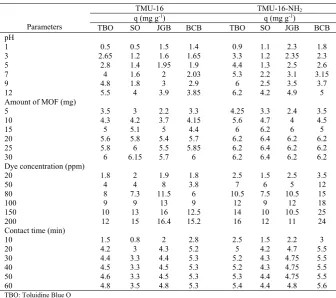
each dye at acidic and basic conditions at 300~800 nm were recorded (Fig. S2). Recorded UV-Vis spectra of dyes confirmed that the change of the initial pH of solution has a small effect on and the structure of dyes remains stable under changes of the pH of solution. At low pH, adsorption of cationic dyes over the sorbents decreases, but at high pH, the adsorption amount of dyes over the MOFs increases. These are attributed to the surface charges on MOFs. Table 1 shows the effect of pH on the removal of each dye. Due to the electrostatic interaction between negative surface of MOFs and positive charge of cationic dyes, the maximum adsorption of dyes was obtained at basic condition at pH=12.
The high adsorption of dyes over sorbents at basic conditions could be explained by Zeta potential measurements (Fig. 1). The decrease of Zeta potential suggested that the density of negative
Table 1. Influence of various experimental parameters including pH, amount of MOF, dye concentration and contact time on adsorptive removal by TMU-16 and TMU-16-NH2.
Parameters
TMU-16 TMU-16-NH2
q (mg g-1) q (mg g-1)
TBO SO JGB BCB TBO SO JGB BCB
pH 1 3 5 7 9 12 0.5 2.65 2.8 4 4.8 5.5 0.5 1.2 1.4 1.6 1.8 4 1.5 1.6 1.95 2 3 3.9 1.4 1.65 1.9 2.03 2.9 3.85 0.9 3.3 4.4 5.3 6 6.2 1.1 1.2 1.3 2.2 2.5 4.2 2.3 2.35 2.5 3.1 3.5 4.9 1.8 2.3 2.6 3.15 3.7 5 Amount of MOF (mg)
5 10 15 20 25 30 3.5 4.3 5 5.6 5.8 6 3 4.2 5.1 5.8 6 6.15 2.2 3.7 5 5.4 5.5 5.7 3.3 4.15 4.4 5.7 5.85 6 4.25 5.6 6 6.2 6.2 6.2 3.3 4.7 6.2 6.4 6.4 6.4 2.4 4 6 6.2 6.2 6.2 3.5 4.5 5 6.2 6.2 6.2 Dye concentration (ppm)
20 50 80 100 150 200 1.8 4 8 9 10 12 2 4 7.3 9 13 15 1.9 8 11.5 13 16 16.4 1.8 3.8 6 9 12.5 15.2 2.5 7 10.5 12 14 16 1.5 6 7.5 9 10 12 2.5 5 10.5 12 10.5 11 3.5 12 15 18 25 24 Contact time (min)
10 20 30 40 50 60 1.5 4.2 4.4 4.5 4.6 4.8 0.8 3 3.3 3.3 3.3 3.5 2 4.3 4.4 4.5 4.5 4.8 2.8 5.2 5.3 5.3 5.3 5.3 2.5 5 5.2 5.2 5.3 5.4 1.5 4.2 4.3 4.3 4.4 4.4 2.2 4.7 4.75 4.75 4.75 4.8 3 5.5 5.5 5.5 5.5 5.6 TBO: Toluidine Blue O
SO: Safranin O JGB: Janus Green B BCB: Brilliant cresyl Blue
102 Nanochem Res 3(1): 99-108, Winter and Spring 2018
charge over adsorbents increases with increasing the pH of solution. In the basic pH, the sorbents were covred by a layer of negative charge, therefore, capacity of removal is increased by decreasing the Zeta potential.
Effect of the MOF amount
The effect of the sorbent amount on adsorption capacity of dyes was studied in the range of 5-30 mg. Results are shown in Table 1. Initially, adsorption of each dye is proportional to the increase in the sorbent amount. As expected, availability to the surface area increases the adsorption of dyes. Gradually, removal of dyes varied with increasing the MOF dosage from 10 to 30 mg. This fact could be attributed to the overlapping or aggregation of sorption sites that decrease the available total sorption surface area for dyes molecules. Based on the results, 10 mg of sorbents was chosen as the optimum amount.
Effect of the dye concentration
Dye concentration showed a significant effect on the dye adsorption over MOFs. At first, due to increase in driving force of the concentration gradient, dye removal for both sorbents increased significantly with increasing the dye concentration, as indicated in Table 1. In high concentrations of dyes, adsorption of dyes did not significantly change, due to the aggregation of dyes around the adsorption sites.
Effect of the contact time
Contact time between dyes and MOFs is one of the important parameters affecting on the
performance of removal processes. Obtained results are shown in Table 1. The adsorption of the cationic dyes was firstly increased with contact time. Based on the results, increase of the contact time from 20 to 60 min did not change the adsorption of each dye significantly. These results ascribed to accumulation of the dye molecules around the active sites of MOFs. The UV-Vis absorption spectra of the dyes solution during the adsorption over MOFs at optimum conditions are shown in Fig. S3.
However, the dye adsorption over TMU-16-NH2 is higher than that over TMU-16, indicating that the addition of amine groups into the MOF network played an important role in adsorption due to ability of NH2 function to formation of hydrogen bonds.
Kinetic studies
Information about the rate and mechanism of adsorption was obtained from the adsorption kinetic studies. The kinetic parameters are required for better modeling and designing of an adsorption process,. Pseudo-second order kinetic model (Eq. 2) was used for adsorption of dyes over TMU-16 and TMU-16-NH2;
𝑡𝑡 𝑞𝑞𝑡𝑡 =
1 𝑘𝑘2𝑞𝑞𝑒𝑒2+
1
𝑞𝑞𝑒𝑒𝑡𝑡 (2) (2)
where qe and qt (mg g-1) are the amounts of dyes
adsorbed over sorbent at equilibrium and t time, k2 (g mg-1 min-1) is the pseudo-second order rate
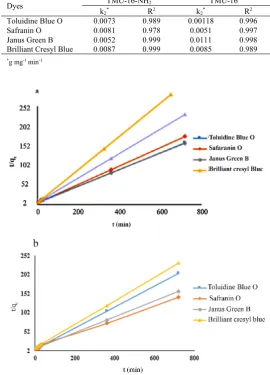
constant [30]. Kinetic data were well fitted to the pseudo-second order kinetic model due to the good calculated correlation coefficients, as indicated
Fig. 1
Fig. 1.Zeta potential curves of TMU-16 () and TMU-16-NH2 () at
103 Nanochem Res 3(1): 99-108, Winter and Spring 2018
in Fig. 2. The pseudo-second order rate constants were determined for each dye, and are summarized in Table 2.
Thermodynamic studies
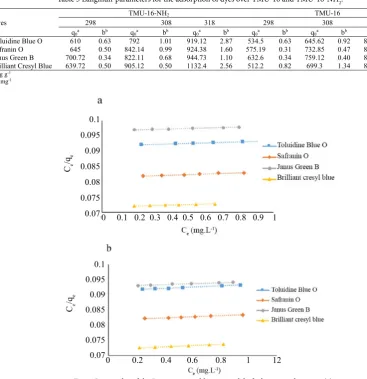
Langmuir model was used to deduce the effect of the grafting amine groups on the adsorption behavior. The adsorption capacity was calculated using the linear form of Langmuir equation:
𝐶𝐶𝑒𝑒
𝑞𝑞𝑒𝑒=
𝐶𝐶𝑒𝑒
𝑞𝑞0+
1
𝑞𝑞0𝑏𝑏 (3)(3)
where qe(mg g-1) is the amount of dyes adsorbed
at equilibrium, Ce(mg L-1) is the concentration at
equilibrium, q0(mg g-1) is the maximum adsorption,
and b is the Langmuir constant (L mg-1 or L mol-1)
[29].
After adsorption for 12 h, adsorption isotherms were obtained at 25 oC, and results are shown in
Fig. 3 and Table 3.
When amine groups are added to the network of MOFs, hydrogen bonding plays an important role in increase of adsorption ability of MOFs [13]. Adsorption capacity of each dye over TMU-16-NH2 is higher than that over TMU-16. These dyes contain sulfur, nitrogen or oxygen atoms participating in hydrogen bonding with grafted amine groups in TMU-16-NH2.
Comparison maximum dye capacity over these MOFs with reported data in the adsorptive removal
Fig. 2
Table 2Pseudo-second order kinetics parameters for dyes adsorption over TMU-16 and TMU-TMU-16-NH2.
Dyes TMU-16-NH2 TMU-16
k2* R2 k2* R2
Toluidine Blue O 0.0073 0.989 0.00118 0.996
Safranin O 0.0081 0.978 0.0051 0.997
Janus Green B 0.0052 0.999 0.0111 0.998
Brilliant Cresyl Blue 0.0087 0.999 0.0085 0.989
*g mg-1 min-1
Table 2Pseudo-second order kinetics parameters for dyes adsorption over TMU-16 and TMU-16-NH2. Table 3 Langmuir parameters for the adsorption of dyes over
TMU-16 and TMU-16-NH2.
104 Nanochem Res 3(1): 99-108, Winter and Spring 2018
of studied dyes (Table 4) demonstrated that TMU-16 and TMU-TMU-16-NH2 are excellent sorbents for removal of basic dyes. For example, in the case of Janus Green B maximum reported adsorption capacity by other sorbents is 250 mg g-1, while with
TMU-16 and TMU-16-NH2 are 632.6 and 700.72 mg g-1, respectively.
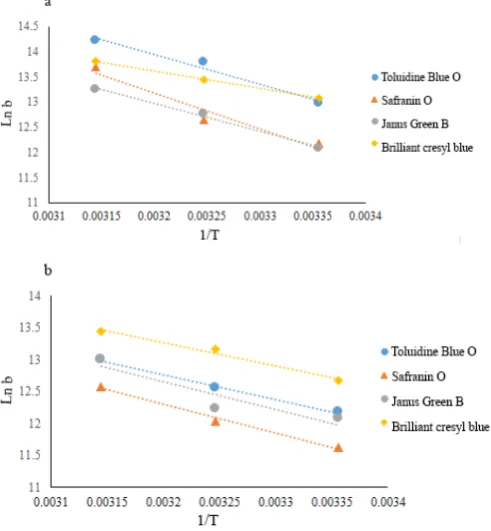
To illustrate the relationship between adsorption process and temperature, thermodynamics functions such as G, H and S were calculated by the following equations:
∆𝐺𝐺 = −𝑅𝑅𝑅𝑅 ln 𝑏𝑏 (4) (4)
l𝑛𝑛 𝑏𝑏 = ∆𝑆𝑆𝑅𝑅 −∆𝐻𝐻𝑅𝑅𝑅𝑅 (5)(5)
where Ris the gas constant (8.314 J mol-1 K-1), T
is the temperature (K) and bisLangmuir constant (L mg-1) [43]. For each dye, the temperature of 10
mL of sample solutions containing 20 mg L-1 of
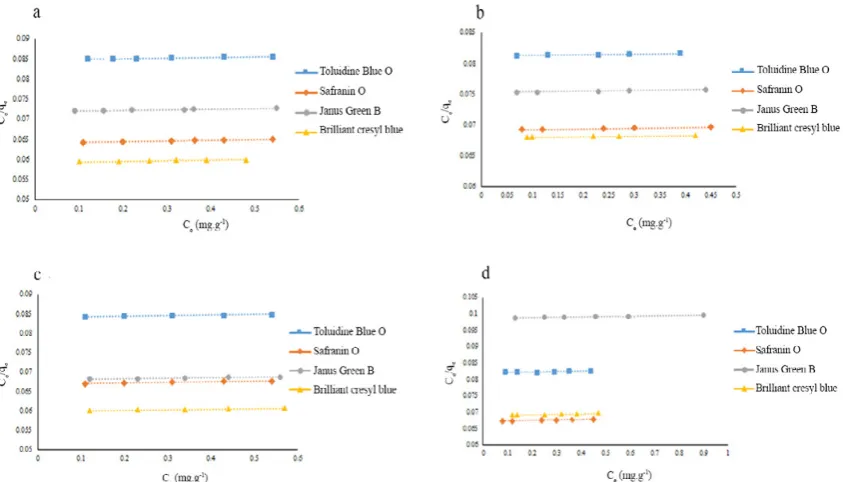
dye was adjusted at two different temperatures including 35 and 45 oC. Results are shown in
Fig. 4. Plotting of lnb vs. 1/T makes possible determination of the enthalpy and entropy of adsorption process (Fig. 5). Obtained results from the thermodynamic studies are summarized in Table 5. The negative value of G indicated that the adsorption of the dyes over 16 and TMU-16-NH2 is feasible and spontaneous. Because of the positive ∆H value, removal processes over these sorbents are endothermic. The positive values of ∆S can be due to replacement of several solvent molecules by a dye molecule that is the driving force of the reaction.
Fig. 3. Linear plot of the Langmuir equilibrium model of adsorption dyes over (a) TMU-16-NH2 and (b) TMU-16.
Table 3Langmuir parameters for the adsorption of dyes over TMU-16 and TMU-16-NH2.
Dyes 298 TMU-16-NH308 2 318 298 TMU-16 308 318
q0a bb q0a bb q0a bb q0a bb q0a bb q0a bb
Toluidine Blue O 610 0.63 792 1.01 919.12 2.87 534.5 0.63 645.62 0.92 829.23 1.44
Safranin O 645 0.50 842.14 0.99 924.38 1.60 575.19 0.31 732.85 0.47 869.21 0.82
Janus Green B 700.72 0.34 822.11 0.68 944.73 1.10 632.6 0.34 759.12 0.40 887.24 0.86
Brilliant Cresyl Blue 639.72 0.50 905.12 0.50 1132.4 2.56 512.2 0.82 699.3 1.34 866.55 1.78
a mg g-1 b L mg-1
Table 3 Langmuir parameters for the adsorption of dyes over TMU-16 and TMU-16-NH2.
Fig. 3
0 0.1 0.2 0.3 0.4 0.5 0.6 0.7 0.8 0.9 1
0 0.2 0.4 0.6 0.8 1 12 0.1
0.095 0.09 0.085 0.08 0.075 0.07
0.1 0.095 0.09 0.085 0.08 0.075 0.07 Ce /qe
105 Nanochem Res 3(1): 99-108, Winter and Spring 2018
Table 4 Comparison of maximum dyes adsorption capacity of MOFs with previously reported sorbents obtained from Langmuir adsorption isotherm model.
Dye Sorbent q (mg g-1) Ref.
Janus Green B
ZnO/Zn(OH)2–NPAC TLR-PA
PAC MMMWCNTs
CNTs OMWCNTs SDS–γ-Fe2O3 TMU-16 TMU-16-NH2
81.3-98.03 51 57 250 166.67
56 172.4 632.6 700.72
[31] [32] [32] [33] [33] [34] [35] This Work This Work
Brilliant Cresyl Blue
CMC-Ac H HN Natural Clay SDS–γ-Fe2O3 TMU-16 TMU-16-NH2
9.45 494.2
42 166.7 512.2 639.72
[36] [37] [38] [35] This Work This Work
Toluidine Blue
Gypsum Pulp fibers
TMU-16 TMU-16-NH2
25 70 534.5
610
[39] [40] This Work This Work
Safranin O
Nickel sulfide NPs Magnetic Mesoporous Clay
TMU-16 TMU-16-NH2
46 18.48 575.19
645
[41] [42] This Work This Work
TLR-PA=Phosphoric-acid-treated tendu leaf refuse, PAC= Powdered activated carbon, MMMWCNTs= Magnetic-modified multi-walled carbon nanotubes, CNTs= Carbon nanotubes, OMWCNTs =Oxidized multiwalled carbon nanotubes, HN= AAm-AMPSNa-MMT hydrogel nanocomposite, CMC-Ac H= Carboxy methyl cellulose incorporated acrylic hydrogels, NPs=Nanoparticles, SDS= Sodium dodecyl sulphate.
Table 4 Comparison of maximum dyes adsorption capacity of MOFs with previously reported sorbents obtained from Langmuir adsorption isotherm model.
Fig. 4
Fig. 4. Langmuir plots for the adsorption of dyes over sorbents at different temperatures: TMU-16-NH2 ((a), (b) at 308 and 318 K,
106 Nanochem Res 3(1): 99-108, Winter and Spring 2018
Table 5: Adsorption thermodynamics functions of dyes over TMU-16 and TMU-16-NH2.
TMU-16-NH2 TMU-16
Dyes -ΔG (kJ mol
-1) ΔH
(kJ mol-1)
ΔS (J mol
-1K-1)
-ΔG (kJ mol-1) ΔH
(kJ mol-1)
ΔS (J mol
-1K-1)
Temperature (K) Temperature (K)
298 308 318 298 308 318
Toluidine Blue O 32.14 34.17 35.2 48.81 272.19 30.17 31.1 32.19 32.08 208.81
Safranin O 30.17 31.32 33.9 59.05 289.55 28.78 29.8 31.14 37.46 222.1
Janus Green B 29.91 31.62 32.8 46.03 255.11 29.92 30.3 32.2 35.98 220.3 Brilliant Cresyl Blue 32.4 33.31 34.2 28.62 204.76 31.4 32.6 33.3 30.29 207.26
Table 5: Adsorption thermodynamics functions of dyes over TMU-16 and TMU-16-NH2.
Fig. 5
Fig. 5. Van’t Hoff equation plot of dyes adsorption over (a) TMU-16-NH2 and
(b) TMU-16.
CONCLUSION
In this study, two isoreticular nanoporous
Zn(II)-MOFs, TMU-16 and TMU-16-NH2,
were found to exhibit the excellent adsorption capability for removal of cationic dyes from aqueous solutions. These MOFs showed a superior adsorption capacity and high adsorption rate for each dye. The adsorption isotherms fitted well to Langmuir model. Higher adsorption capacity was found for TMU-16-NH2 compared to TMU-16 due tohydrogen bonding interaction between dyes and sorbent. Rate constants for each adsorption process of dye over MOFs were obtained with pseudo-second order kinetic model. Thermodynamic studies indicated that adsorption process is spontaneous and endothermic.
ACKNOWLEDGMENTS
Financial support for this work by the Ilam University, Ilam, Iran is gratefully acknowledged.
CONFLICT OF INTEREST
The authors declare that there is no conflict of interests regarding the publication of this paper.
SUPPLEMENTARY MATERIAL
The Supplementary Material for this article can be found online at: http://nanochemres.org/
REFERENCES
107 Nanochem Res 3(1): 99-108, Winter and Spring 2018
2. Richardson SD. Environmental Mass Spectrometry: Emerging Contaminants and Current Issues. Analytical Chemistry. 2012;84(2):747-78.
3. Huang Y, Keller AA. Magnetic Nanoparticle Adsorbents for Emerging Organic Contaminants. ACS Sustainable Chemistry & Engineering. 2013;1(7):731-6.
4. Crini G. Non-conventional low-cost adsorbents for dye removal: A review. Bioresource Technology. 2006;97(9):1061-85.
5. Al‐Degs YS, El‐Barghouthi MI, Khraisheh MA, Ahmad MN, Allen SJ. Effect of Surface Area, Micropores, Secondary Micropores, and Mesopores Volumes of Activated Carbons on Reactive Dyes Adsorption from Solution. Separation Science and Technology. 2005;39(1):97-111.
6. Wang S, Boyjoo Y, Choueib A, Zhu ZH. Removal of dyes from aqueous solution using fly ash and red mud. Water Research. 2005;39(1):129-38.
7. Robinson T, McMullan G, Marchant R, Nigam P. Remediation of dyes in textile effluent: a critical review on current treatment technologies with a proposed alternative. Bioresource Technology. 2001;77(3):247-55.
8. Loghman K, Mohammad M, Esmail YM, Ali N. Effect of Nano TiO2 on Self‐cleaning Property of Cross‐linking Cotton Fabric with Succinic Acid Under UV Irradiation. Photochemistry and Photobiology. 2010;86(5):1030-7.
9. Mezohegyi G, van der Zee FP, Font J, Fortuny A, Fabregat A. Towards advanced aqueous dye removal processes: A short review on the versatile role of activated carbon. Journal of Environmental Management. 2012;102:148-64.
10. Yu J-X, Wang L-Y, Chi R-A, Zhang Y-F, Xu Z-G, Guo J. A simple method to prepare magnetic modified beer yeast and its application for cationic dye adsorption. Environmental Science and Pollution Research. 2013;20(1):543-51.
11. Murugan K, Panneerselvam C, Subramaniam J, Madhiyazhagan P, Hwang J-S, Wang L, et al. Eco-friendly drugs from the marine environment: spongeweed-synthesized silver nanoparticles are highly effective on Plasmodium falciparum and its vector Anopheles stephensi, with little non-target effects on predatory copepods. Environmental Science and Pollution Research. 2016;23(16):16671-85.
12. Wang H, Yuan X, Zeng G, Leng L, Peng X, Liao K, et al. Removal of malachite green dye from wastewater by different organic acid-modified natural adsorbent: kinetics, equilibriums, mechanisms, practical application, and disposal of dye-loaded adsorbent. Environmental Science and Pollution Research. 2014;21(19):11552-64.
13. Khan NA, Hasan Z, Jhung SH. Adsorptive removal of hazardous materials using metal-organic frameworks (MOFs): A review. Journal of Hazardous Materials. 2013;244-245:444-56.
14. Zhao Z, Li X, Huang S, Xia Q, Li Z. Adsorption and Diffusion of Benzene on Chromium-Based Metal Organic Framework MIL-101 Synthesized by Microwave Irradiation. Industrial & Engineering Chemistry Research. 2011;50(4):2254-61.
15. Huang Y, Li J, Chen X, Wang X. Applications of conjugated polymer based composites in wastewater purification. RSC Advances. 2014;4(107):62160-78.
16. Sumida K, Rogow DL, Mason JA, McDonald TM, Bloch ED, Herm ZR, et al. Carbon Dioxide Capture in Metal–Organic Frameworks. Chemical Reviews. 2012;112(2):724-81.
17. Li J-R, Ma Y, McCarthy MC, Sculley J, Yu J, Jeong H-K, et al. Carbon dioxide capture-related gas adsorption and
separation in metal-organic frameworks. Coordination Chemistry Reviews. 2011;255(15):1791-823.
18. Planas N, Dzubak AL, Poloni R, Lin L-C, McManus A, McDonald TM, et al. The Mechanism of Carbon Dioxide Adsorption in an Alkylamine-Functionalized Metal– Organic Framework. Journal of the American Chemical Society. 2013;135(20):7402-5.
19. Cychosz KA, Wong-Foy AG, Matzger AJ. Liquid Phase Adsorption by Microporous Coordination Polymers: Removal of Organosulfur Compounds. Journal of the American Chemical Society. 2008;130(22):6938-9.
20. Li H, Eddaoudi M, O’Keeffe M, Yaghi OM. Design and synthesis of an exceptionally stable and highly porous metal-organic framework. Nature. 1999;402:276.
21. Du D-Y, Qin J-S, Li S-L, Su Z-M, Lan Y-Q. Recent advances in porous polyoxometalate-based metal-organic framework materials. Chemical Society Reviews. 2014;43(13):4615-32.
22. Dhakshinamoorthy A, Garcia H. Catalysis by metal nanoparticles embedded on metal-organic frameworks. Chemical Society Reviews. 2012;41(15):5262-84.
23. Britt D, Lee C, Uribe-Romo FJ, Furukawa H, Yaghi OM. Ring-Opening Reactions within Porous Metal−Organic Frameworks. Inorganic Chemistry. 2010;49(14):6387-9.
24. Haque E, Lee JE, Jang IT, Hwang YK, Chang J-S, Jegal J, et al. Adsorptive removal of methyl orange from aqueous solution with metal-organic frameworks, porous chromium-benzenedicarboxylates. Journal of Hazardous Materials. 2010;181(1):535-42.
25. Haque E, Jun JW, Jhung SH. Adsorptive removal of methyl orange and methylene blue from aqueous solution with a metal-organic framework material, iron terephthalate (MOF-235). Journal of Hazardous Materials. 2011;185(1):507-11.
26. Haque E, Lo V, Minett AI, Harris AT, Church TL. Dichotomous adsorption behaviour of dyes on an amino-functionalised metal–organic framework, amino-MIL-101(Al). J Mater Chem A. 2014;2(1):193-203.
27. Safarifard V, Morsali A. Influence of an amine group on the highly efficient reversible adsorption of iodine in two novel isoreticular interpenetrated pillared-layer microporous metal–organic frameworks. CrystEngComm. 2014;16(37):8660-3.
28. Ciurtin DM, Dong Y-B, Smith MD, Barclay T, zur Loye H-C. Two VersatileN,N‘-Bipyridine-Type Ligands for Preparing Organic−Inorganic Coordination Polymers: New Cobalt- and Nickel-Containing Framework Materials. Inorganic Chemistry. 2001;40(12):2825-34.
29. Hameed BH, Rahman AA. Removal of phenol from aqueous solutions by adsorption onto activated carbon prepared from biomass material. Journal of Hazardous Materials. 2008;160(2-3):576-81.
30. Ho YS, McKay G. Pseudo-second order model for sorption processes. Process Biochemistry. 1999;34(5):451-65.
31. Ghaedi M, Khafri HZ, Asfaram A, Goudarzi A. Response surface methodology approach for optimization of adsorption of Janus Green B from aqueous solution onto ZnO/Zn(OH)2-NP-AC: Kinetic and isotherm study. Spectrochimica Acta Part A: Molecular and Biomolecular Spectroscopy. 2016;152:233-40.
32. K. Nagda G, S. Ghole V. ScienceAsia. 2011;37(1):38.
108 Nanochem Res 3(1): 99-108, Winter and Spring 2018 Hazardous Materials. 2011;196:109-14.
34. Sobhanardakani S, Zandipak R, Sahraei R. Removal of Janus Green dye from aqueous solutions using oxidized multi-walled carbon nanotubes. Toxicological & Environmental Chemistry. 2013;95(6):909-18.
35. Afkhami A, Saber-Tehrani M, Bagheri H. Modified maghemite nanoparticles as an efficient adsorbent for removing some cationic dyes from aqueous solution. Desalination. 2010;263(1-3):240-8.
36. Mandal B, Ray SK. Removal of safranine T and brilliant cresyl blue dyes from water by carboxy methyl cellulose incorporated acrylic hydrogels: Isotherms, kinetics and thermodynamic study. Journal of the Taiwan Institute of Chemical Engineers. 2016;60:313-27.
37. Kaşgöz H, Durmus A. Dye removal by a novel hydrogel‐ clay nanocomposite with enhanced swelling properties. Polymers for Advanced Technologies. 2008;19(7):838-45.
38. İyim TB, Güçlü G. Removal of basic dyes from aqueous solutions using natural clay. Desalination. 2009;249(3):1377-9.
39. Rauf MA, Qadri SM, Ashraf S, Al-Mansoori KM. Adsorption
studies of Toluidine Blue from aqueous solutions onto gypsum. Chemical Engineering Journal. 2009;150(1):90-5.
40. van de Ven TGM, Saint-Cyr K, Allix M. Adsorption of toluidine blue on pulp fibers. Colloids and Surfaces A: Physicochemical and Engineering Aspects. 2007;294(1-3):1-7.
41. Ghaedi M, Pakniat M, Mahmoudi Z, Hajati S, Sahraei R, Daneshfar A. Synthesis of nickel sulfide nanoparticles loaded on activated carbon as a novel adsorbent for the competitive removal of Methylene blue and Safranin-O. Spectrochimica Acta Part A: Molecular and Biomolecular Spectroscopy. 2014;123:402-9.
42. Fayazi M, Afzali D, Taher MA, Mostafavi A, Gupta VK. Removal of Safranin dye from aqueous solution using magnetic mesoporous clay: Optimization study. Journal of Molecular Liquids. 2015;212:675-85.