PRODUCTION AND OPTIMIZATION OF CELLULASE BY BACILLUS SUBTILIS
USING COIR WASTE AND SAWDUST UNDER SOLID STATE FERMENTATION
Mangalanayaki R.* and Aruna A.
PG and Research Department of Microbiology, STET Women’s College, Mannargudi, Tamil Nadu, India.
Article Received on 26/11/2017 Article Revised on 17/12/2017 Article Accepted on 07/01/2018
INTRODUCTION
The recognition that environmental pollution is a worldwide threat to public health has given rise restoration. Biological degradation to a new massive industry for environmental, for both economic and ecological reasons, has become an increasingly alternative for the treatment of agricultural, industrial organic as well as toxic waste. These wastes have been insufficiently disposed leading to environmental pollution (Fabiyi and Ogunfowora, 1991). Plant lignocellulosics as organic substances are subject to attacks by biological agents such as fungi, bacteria and insects (Highley et al., 1987). Acids can breakdown the long chains in cellulose to release the sugars through hydrolysis reaction, but because of their high specificity, cellulase can achieve higher yield of glucose from cellulose (Wyman, 2004). Agricultural waste is one of the major environmental pollutants, their biotechnological conversion is not only a remedy for environmental problems but also the source of suitable microbial by products like food, fuel and chemicals (Milala et al., 2005). Agro-industrial wastes, e.g. wheat and rice bran, sugar cane bagasse, corn cobs, citrus and mango peel, are one of important wastes of food industries of Pakistan. Agricultural wastes and in fact all lignocellulosics can be converted into products that are of commercial interest such as ethanol, glucose, and single cell protein (Solomon et al., 1999). Cellulase enzyme has been reported (Fan et al., 1987; Wu and Lee,
1997; Solomon et al., 1999; Kansoh et al., 1999) for the bioconversion of lignocellulosics to these useful products. Solomon et al. (1990) achieved hydrolysis of sawdust using cellulase with activity of 0.0561IU/ml.
Enzymes of commercial or industrial importance are obtained from three main sources namely plants, animals and microorganisms. In the past, plants and animals served as main source of enzymes but today microbial sources of enzyme are becoming more popular for obvious reasons (Abu et al., 2000). In order to obtain even a small quantity of plant enzymes, a large amount of plant materials has to be used and this renders large scale production of plant enzymes uneconomical, especially if the plant has some economic values or uses. Also difficulties are encountered in the extraction of the enzyme from plants (Howard et al, 2003)
Cellulose is commonly degraded by an enzyme called cellulose. This enzyme is produced by several microorganisms, commonly by bacteria and fungi (Shin et al., 2000). Cellulose is a common material in plant cell walls and was first noted as such in 1533. It occurs narurally in almost pure form in cotton fiber. In combination with lignin and hemicelluloses, it is found in all plant material. Cellulose is the most abundant form of living terrestrial biomass (Crawford, 1981) with an estimated annual production of 1.5x tones (Shigeru Deguchi et al., 2006).
Cellulose+H2O Cellulase D-Glucose
D-Glucose+ATP Hexokinase D-Glucose 6-PHospHate+ADP D-Glucose 6-PHospHate+ ß-NAD G-6PDH 6-PG+ß-NADH
ISSN 2455-3301
WJPMR
AND MEDICAL RESEARCH www.wjpmr.com
*Corresponding Author: Mangalanayaki R.
PG and Research Department of Microbiology, STET Women’s College, Mannargudi, Tamil Nadu, India.
ABSTRACT
In the present study bacterial organisms was isolated from Agricultural waste dumping area. It was identified by Biochemical test. From these bacteria the effective cellulase producing bacteria was screened by using CMC. From these strain effective cellulase producing bacteria Bacillus subtilis was screened then to carried out the cellulase production using different soild substrate such as Saw dust and Coir Waste Then to optimize the enzyme production using different parameters such as pH, Temperature, Nitrogen and Moisture level. Compare to all substrate the Saw dust effectively to produce the cellulase then other substrate.
Cellulolytic bacteria include aerobic species such as Pseudomonas and Actynomicetes, faculatative anaerobes such as Bacillus and Cellulomonas, and strict anaerobes such as Clostritium. The commercial possibility of using Cellulase preparation to protein, glucose, alcohol and protein from cellulose is under intensive(Katz and Reese, 1968) other names Endoglucanase, Endo 1-4, glucanase, Carboxymethyl cellulose, Endo-1, 4-beta-D-glucanase Beta-1, 4-glucanase, Beta-1, 4-endoglucan hydrolase, Cellulomonas and Avicelase.
Cellulase is used for commercial food processing in coffee. It performs hydrolysis of cellulose during drying of coffee beans. Furthermore, cellulase is widely used in textile industry and in laundry detergents. Cellulase has also been used in the pulp and paper industry for various purposes. They are even used in pharmaceutical applications.
Cellulases have a wide range of applications. Potential applications are in food, animal feed, textile, fuel, chemical industries, paper and pulp industry, waste management, medical/pharmaceutical industry, protoplast production, genetic engineering and pollution treatment (Tarek and Nagwa, 2007; Beguin and Anbert, 1993; Coughlan, 1985; Mandels, 1985). This work focuses on factors relevant for improvement of enzymatic hydrolysis of lignocellulosic material saw dust and coir waste. To understand the biochemistry of lignocellulose degrading fungi, it is needed to optimize various conditions.
MATERIALS AND METHODS
Sample Collection
Soil Sample were collected from Agricultural waste dumped area in an around Orathanadu, Thanjavur (District), Tamil Nadu. It was thoroughly mixed, sieved through a 2 mm pore size sieve and placed in closed polyethylene bags and then stored in specific container.
Isolation of Bacteria from soil sample
After sample collection, serial dilution was performed for isolating microbial growth from the collected samples. For this 10ml of sterile distilled water was taken in a test tube. To this, 1g of soil was added. The tube was vigorously vortexes for 3 minutes to obtain uniform suspension of organism. A service of tube labelled as 10-5 up to 10-7 were filled with 9ml sterile distilled water. 1ml of diluted sample was transferred in the 10-5marked tube. It is further continue up to 10-7 dilution and form last dilution 1ml was disclaereled. The nutrient agar medium plates inoculated with 10-5, 10-6, 10-7 dilution for bacteria and incubated 370C for 24 hours.
Solid state fermentation for cellulase production Effect of substrates on cellulase
To find out the suitable for maximum enzyme production,5g of various agricultural residues such as Wheat bran, rice bran, orange peel, black gram husk, saw
dust and paddy straw substrates were taken in a 250ml Erlen meyer flask separately and autoclaved, moistened to 40% using sterile distilled water and inoculated with 1ml of 3 day old shaken culture.Spent medium samples were drawn every day and 1g of the dried substrate was used for biomass measurements in terms of chitin content and the rest of the sample was used for enzyme and soluble protein assay(Ray et al.,1983).
Extraction of enzyme was performed by mixing the fermented soild substrate with 20ml of distilled water and shaken for 1h to liberate the adsorbed enzyme from the substrate. Then the aqueous solution was filtered thoroughly with a Whatman No.1 filter paper and centrifuged at 15,000 rpm for 10 min at 40C.The brownish clear supernatant solution was stored under refrigeration for further analysis (Babu and Satyanarayana, 1995).
Enzyme assay Endoglucanase
Carboxymethyl cellulase activity was determined according to the method of Mandels et al., (1976).The assay mixture contained 0.5ml of 0.05 M citrate buffer (pH4.8), 0.5ml of enzyme and 0.5 ml of 2% carboxymethyl cellulose. The mixture was incubated for 30 minutes at 500C along with enzyme blank and heat inactivated enzymes as controls. The reaction was terminated by adding 3.0 ml of DNS reagent. The tubes were kept in boiling water bath for 5 minutes cooled and 20 ml of distilled water was added. The reducing sugar liberated during the reaction was measured at 540 nm. One international unit is defined as moles of glucose liberated per min under assay conditions.
Exoglucanase activity
Filter paper activity was assayed according to the methodology adopted by Mandels et al.,(1976).The assay mixture contained 50 mg filter paper strip (Whatman No.1,60 mm x 40 mm),0.5 ml of suitably diluted enzyme and 1.0 ml of 0.05M citrate buffer (pH 4.8).The mixture was incubated for 1 hours at 500C along with enzyme blank and heat inactivated enzyme as controls. The reaction was determinated by adding 3.0ml of DNS reagent. The tubes were kept in boiling water bath for 5 minutes, cooled and 20 ml of diluted water was added. The reducing sugar liberated was measured at 540 nm and quantified by using standard curve for glucose. One international unit is defined as µ moles of glucose liberated per minutes under assay conditions.
ß-Glycosidase activity
enzyme activity is defined as µ moles of para nitrophenol liberated per minutes under assay conditions.
Xylanase
Xylanase activity was assayed as per the method described by Shamala and Sreekantiah (1986).To 0.5 ml of sodium acetate buffer (0.05M,pH 5.50,1.0ml of 1% larch wood xylan and 0.5ml of enzyme was added and incubated as 500C for 30 minutes. The reducing sugar liberated was estimated by using DNS method (Miler,1959).One international unit of xylanase activity was defined as µ moles of reducing sugar liberated per minutes under assay conditions.
Optimization of cellulase production
The effect of various nitrogen sources such as soya beanmeal, alfaalfa, yeastextract, peptone, urea, triptone, ammoniumchloride, ammonium nitrate, ammonium phosphate and sodium nitrate with 40% moistened substrate at 0.5% level and incubated at room temperature after inoculation (Babu and Satyanarayana, 1995).The effect of moisture level of the soild substrate was kept varied between 20-80% and bacterial cultivations were made in optimized carbon and nitrogen medium then to carried out the effect of different pH for the production of cellulose under the pH range of 3.0-7.0 (Wang et al., 1994). The optimum temperature for maximum production of cellulolytic enzymes was determined by performing the enzyme production studies by the selected bacterial strains at different temperature viz 25,30,40,45 and 500 C, (Ray et al., 1993). Enzyme activities were measured at every day interval from the day of inoculation as per the procedure described above.
Estimation of protein
Lowry et al., (1951) method was used for estimating the soluble protein content of the filtrate taking bovine serum albumin as standard.
RESULT AND DISCUSSION
In this present study, investigations were carried out to select cellulolytic bacteria by screening, to standardize cellulose production under soild state fermentation. This was achieved by screening large number of microorganisms able to produce the desired metabolite and it continues to be an important aspect of biotechnology (Plate I).
Major implement to exploit the commercial potential of cellulases are the yield stability and cost of cellulose production. Therefore, research should also aim at exploiting the commercial potential of existing and new cellulases in nature (Coral et al., 2002). Agriculture residues such as corn stove, wheat straw, rice straw, baggase etc. were used in cellulose production (Chalal et al., 1996). In the presents study, Bacillus subtilis cellulose enzyme production was analyzed in cheap substrates like coir waste and saw dust.
Identification of bacteria
After incubation nutrient agar plate containing numerous bacteria colonies. This was identified by variuos biochemical test. The identified bacterial colonies are Bacillus subtilis, E. coli, E.aeroginosa, P.aeroginosa. From the bacteria the effective cellulase producing bacteria screened (Tables I) (Plate II).
Screening of cellulase producing bacteria
In the Czepek Dox mineral solution with cellulase powder plate produce clear zone around the colonies. The diameter of zone was measured. Through this way the effective cellulase producing bacteria strains were identified. The identified bacterial colony was confirmed by Bergey manual of determinative bacteriology (Billroth 1994). The colonies are Bacillus subtilis, E.coli, E.aeroginosa P.aeroginosa.
Table 1: Effect of natural cellulosic substrate on cellulose and xylanase production by strains of Bacillus subtilis.
Substrate Exoglucanase βGlycosidase Endoglucanase Xylanase
Sawdust 2.677 0.119 9.696 1.813
Coir waste 0.641 0.641 4.204 0.068
It is cellulase producing each isolated microorganisms order to obtain suitable candidate for high titers of cellulase, various cellulolytic bacterial strains isolated from different biotics were screened. Bacillus subtilis isolated by the best cellulase, of essential to select the appropriate microorganisms (Table 1). The screening of cellulolyic microorganisms by conventional process primarily involves the visual inspection of natural sources during the isolation process producing strain (Reese1951).
Production of cellulolytic enzymes under solid state fermentation
In the present investigation for the production of maximum cellulolytic under soild state fermentation following parameters such as substrate, nitrogen sources,
moisture level, pH of the medium were optimized. Maximum enzyme production was noticed on 5th day of fermentation the soluble protein was estimated.
Effect of substrate
Most works aimed at production of cellulolytic enzyme have centered on the use pure cellulase. Cellulase gives good cellulase though pure cellulose productivity its cost is very high. Agriculture wastes like Coir waste, and Saw dust. Were dried to substitute pure cellulase (Miron, 1981., and Kawamori et al.,1986).
production result revealed that among the 2 substrate tested saw dust was found to act as an ideal ubstrate for Bacillus subtilis with a maximum production of 9.696 IU/ml for endoglucanase, exoglucanase, β-glycosidase, xylanase enzymes respectly. Compare to saw dust waste the organisms produce low amount of cellulase by using Coir waste.
To determine the effect of various nitrogen sources on the production of 4 nitrogen sources comprising of both organic and inorganic sources such as soya been meal, peptone, urea, ammonium nitrate, at 10% were used for production of cellulolytic enzymes were investigated. The results indicated that organic nitrogen sources give better enzyme production results Bacillus subtilis produced. A maximum of 9.826, 2.814, 0.139, 1.825. (IU/ml) Endoglucanase, Exoglucanase, β-glycosidase, xylanase enzymes respectively with Saw dust on 5th day, which was followed by peptone, ammonium nitrate, urea, significantly promotes enzyme yield. Based on this study, Soya been meal was selected as nitrogen additive to the substrate to increase cellulase and xylanase production.(Table 2 and fig 2).
Ganju et al., (1990) showed that addition of peptone or ammonium nitrate increased cellulase production by haetomium thermophile. According to (Mandles and Webber (1969), the beneficial effect of peptone could be due to the organism more readily assimilated it.
Effectof pH on cellulolytic enzyme production
pH of the medium play an important role in the production of cellulolytic enzymes by several organisms such as Bacillus subtilis (Trivedi and Rao,1980), Sporotrichum thermophile, cautts and smith (1976) and Bacillus subtilis (Sternberg, 1971).
While studing the enzyme production profile by Bacillus subtilis and bacterial strains at different hydrogen ion levels (3.0-8.0), all strains responded well at pH 5.0 maximum enzyme yield was produced by Bacillus subtilis Endoglucanase 46.031, Exoglucanase 12.707,β-glycosidase, xylanase 9.083 (IU/ml) against its control Bacillus subtilis lowest activity at pH and 5.0 and pH 3.0 respectively (Table 3).
Table 2: Effect of PH on cellulase and xylanase production by strains of Bacillus subtilis.
PH Cellulase (IU/ml)
Endoglucanase Exoglucanase βGlycosidase Xylanase
3 46.031 12.707 0.563 9.083
4 38.949 10.752 0.476 7.686
5 37.533 10.361 0.459 7.407
6 32.623 9.442 0.460 5.062
7 30.758 8.902 0.434 4.773
8 29.048 8.407 0.410 4.508
Effect of incubation temperature
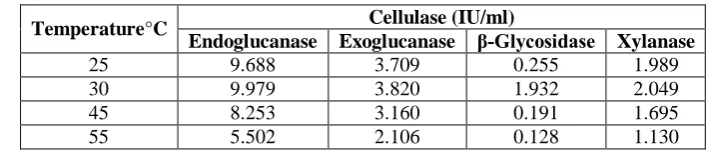
The effect of incubation temperature on the level of enzyme production under different temperature showed that optimum temperature for cellulolytic enzymes production was 300C. (Ray et al., 1993). Production of cellulolytic enzymes under different incubation temperature viz 25, 30, 45, 550 C, was studied. Bacillus subtilis showed the highest enzyme yield of 9.688. Endoglucanase 9.688 (IU/ml), Exoglucanase 3709
(IU/ml), β-glucosidase 0.255(IU/ml), xylanase at 300 C on 5th day.
The lowest activity recorded 5.502 (IU/ml), 2.106 (IU/ml), 0.128 (IU/ml), and 1.130 (IU/ml) for endoglucanase, exoglucanase, β -glycosidase, xylanase enzymes respectly at 550 C.Maximum activity was recorded by Bacillus subtilis at 300C similarly in other bacterial cultivations increased and decreasedenzyme activities were observed at 30 and 600.C (Table 4).
Table 3: Effect of temperature on cellulase and xylanase production by strains of Bacillus subtilis.
Temperature°C Cellulase (IU/ml)
Endoglucanase Exoglucanase βGlycosidase Xylanase
25 9.688 3.709 0.255 1.989
30 9.979 3.820 1.932 2.049
45 8.253 3.160 0.191 1.695
55 5.502 2.106 0.128 1.130
Effect of moisture content
Moisture content of the soild substrate is an important factor that affects enzyme production (Table 5). In the present study the optimum moisture content was
Table 4: Effect of moisture content on cellulase and xylanase production by strains of Bacillus subtilis.
Cellulase (IU/ml)
Moisture (%) Endoglucanase Exoglucanase βGlycosidase Xylanase
20 46.491 12.834 0.568 9.174
35 47.412 12.961 0.580 9.356
45 48.287 13.330 0.590 9.529
55 50.634 0.590 0.497 9.992
Among the culture tested Bacillus subtilis produced maximum unit of Endoglucanase 46.491. Exoglucanase 12.834 β –glucosidase 0.568 xylanase (IU/ml). This optimum moisture content was conductive for other bacterial strains used for enzyme production. In contrast (Ramesh and Lonsane 1996) reported that enzyme production is the highest in basal Wheat bran medium
with 65% moisture content.
CONCLUSION
In the present study bacterial organisms was isolated from Agricultural waste dumping area. It was identified by Biochemical test. From these bacteria the effective cellulase producing bacteria was screened by using CMC. From these strain effective cellulase producing bacteria Bacillus subtilis was screened Then to carried out the cellulase production using different soild substrate such as Saw dust and Coir Waste Then to optimize the enzyme production using different parameters such as pH, Temperature, Nitrogen and Moisture level. Compare to all substrate the Saw dust effectively to produce the cellulase then other substrate. The successful use of cellulosic material as carbon source is dependent on the development of economically process for cellulase production.
ACKNOWLEDGEMENT
Authors are highly acknowledged the support provided by the Correspondent, STET Women’s College, Sundarakkottai, Mannargudi for the completion of this work.
REFERENCE
1. Ali UF and Saad EI-Dein HS. Production and Partial Purification of Cellulase commplex by Aspergillus niger and A. nidulans Grown on Water Hyacinth Blend Applied Sci .Res., 2008; 4: 875,
2. Abu EA,Onyenekwe PC, Ameh DA, Agbaji AS, Ado SA cellulase ( E. C. 3 .2. 1 .3) production from Sorghum bran by Aspergillus niger SL 1; An assessment of pretreatment methods. Proceedings of the International Conference on Biotechnology; Commercialization and Food Security, Abuja, Nigeria, 2000; 153-159.
3. Ali, S., A. Sayed, R.T. Sarker and R. Alam. eaffecting cellulose production by Aspergillus terreus. World J. Microbial and Biotechnol, 1991; 7: 62-66.
4. Beguin P, Anbert JP The biological degradation of cellulose. FEMS Microbiol. Rev., 1993; 13: 57-58.
5. Bhat, M.K. Research review paper; Cellulases and releated enzymes in biotechnology. Biotechnol. Adv., 2000; 18: 355-383.
6. Beguin, P. and J. P. Aubert.. The biological degradation of cellulose. FEMS Microbial. Rev., 1994; 13: 25-58
7. Babu, K.R., and Satyanarayana, T. Alpha-amylase production by thermophilic cougulans in solid state fermentation.Proc. Biochem., 1995; 305-309. 8. Brown, C.M., Isolation methods for organisms. In;
Comprehensive Biotechnology (Eds) Bull, A., Dalton,H., Pergamon press., 1985; 213.
9. Baig MMV, Baig MLB, Baig MIA,Ysmeen M Saccharification of banana agro-waste by cellulolytic enzymes. Afr. J. Biotechnol, 2004; 3(9): 447-450.
10. MK, Bhat S Cellulose degrading enzyme and their potential industrial applications. Biotechnol. Adv. 1997; 15: 583-620.
11. Chahal DS. Solid state fermentation with Trichoderma reeseifor cellulose production. Appl Environ Microbiol, 1985; 49: 205-210.
12. Crawford, R.L, Lignin biodegradation and transformation. John Wiley and Sons, New York, 1981.
13. Coughlan MP Cellulases; Production properties and applications. Biochem. Soc. Trans, 1985; 13: 405-406.
14. Coral, G., B. Arikan., M.N. Unaldi and H. Guvenmens, Some properties of crude cellulase of Aspergillus niger Zio.Wild type strain. Turk. J. Biol., 2002; 26: 209-213.
15. Chalal, P.S., D.S. Chalal and Le, GBB, Production of cellulase in solid state fermentation of Trichoderma reesei MCG80 on wheat straw. Appl. Biochem. Biotechnol, 1996; 58: 433-42.
16. Chellapandi P, Jani HM Production of endoglucanase by the native strains of isolates in submerged fermentation. Bra. J. Microbiol, 2008; 39:122-127.
17. Depaula EH, Ramos LP, Azevedo MD the Potential of Humicola grisea var. Thermoidea for bioconversion of sugarcane bagasse. Bioresour. Technol, 1999; 68: 35-41.
19. Fan LT, Gharpuray MM, Lee YH Cellulose hydrolydrolysis. Berlin, Germany; Springer-Verlag 1987; 3: 1-68.
20. Government of Pakistan (GOP). Food composition table for Pakistan. A collaborative report of NWFP University, UNICEF and Ministry of Planning and Development; Islamabad, Pakistan, from http;//www.aiou.edu.pK/FoodSite/FCT View on Line.html, 2001.
21. Ganju, R.K., Vishayathil, P.J. and Murthy, S.K. Factors influencing production of cellulase by chaeromium thermophile. Ind J. Exp. Biol., 1990; 28: 259-264.
22. Highley, T.L., S.L.L. Murman and J.G. Palmer,.Ultrastructural aspects of cellulose decomposition by white rot fungi.Holforschung, 1987; 38; 73-78.
23. Howard RL, Abotsi E, Jansen Van REL, Howard S. Lignocellulose Biotechnology; Issue of Bioconversion and Enzyme Production. Afr. J Biotechnol, 2003; 2(12); 602-619.
24. Hammel, K.E. Fungal degradation of lignin. In; Driven by Nature; Plant Litter Quality and Decomposition. (Eds); G. Cadish and K.E. Giller. CAP sInternational Wallingford, 1997; 33-45. 25. Immanuel, G., R. Dhanusa, P. Prema and A.
Palavesam, Effect of different growth parameters on endoglucanase enzyme activity by bacteria isolated from coir retting effluents of estuarine environment. Int. J. Environ. Sci. Technol., 2006; 3; 25-34. 26. Kansoh AL, Essam SA, Zeinat AN Biodegradation
and utilization of bagasse with Trichoderma reesei. Polym. Degrad. Stab, 1999; 62; 273-278.
27. Kumakura M Preparation of immobilized cellulase beads and their application to hydrolysis of cellulosic materials. Process Biochem, 1997; 32: 555-559.
28. Katz, M., and E.T. Reese, Production of glucose by enzyme hydrolysis of cellulose. Appl. Microbiol., 1968; 16; 419-420.
29. Klysov, A.A., Trents in biochemistry and enzymology of cellulose degradation. J.Biochem, 1990; 29; 10577-10585.
30. Kui Hong, Yan MA., and Meigiu, Li., Solid State fermentation of phytase from cassava dregs. Applied Biochemistry and Biotechnology, 2001; 91-93; 777-785.
31. Kawamori, M., Morikawa, Y., Ado, Y., and Takasawa, S., Production cellulose by Trichoderma reesi on alikali treated baggasse. Appl. Microbial biotechnology, 1986; 24; 454-458.
32. Lowery, O.H., Roserbrough, N.J., Fair, A.L., and Randall R.J., Protein Measurement with the folin phenol reagent. J. Biol. Chem, 1951; 193: 255-257. 33. Lynd, L.R., P.J. Weimer, W.H. Van Zyl and I.S.
Pretorius. Microbial cellulase utilization; fundamentals and biotechnology. Microbiol. Mol. Biol. Rev., 2002; 66; 506-577.
34. Mandles, M., Production and application of Trichoderma reesei cellulase Annual report of fermentation process., 1995; 7(1): 20.
35. Milala MA, Shugaba A, Gidado A, Ene AC, Wafar J.A. Studies on the use of agricultural wastes for cellulase enzyme production by A.niger. Res J Agri and Biol Sci., 2005; 1; 325.
36. Mandels M. Applications of cellulases. Biochem. Soc. Trans. 1985; 13: 414-415.
37. Miller, G.L., Use of dinitrosalicylic acid reagent for determination of reducing sugar. Annal. Chem., 1959; 426-428.
38. Mandels, M., Andreoti, R., and Roche, Measurement of sacharifing cellulose. Biotechnolo. Bioeng. Symp, 1976; 21-33.
39. Mandles. M. The production of cellulase. Adv. Chem. Ser, 1969; 95; 39-413.
40. Person, I., F. Tjerneld and B. Hahn-Hagerdal, Fungal cellulose Enzyme Production. Proc. Biochem., 1990; 26: 65-74.
41. Rajoka MI. Regulation of synthesis of endo-xylanase and β-xylosidase in Cellulomonas flavigena; a Kinetic study.World J Microbiol Biotechnol, 2005; 21: 463-469,
42. Rajandran, A., Gunasekran, P. and Lakshmanan, M. Cellulase activity of Humicola fuscotra. Indian journal of microbiol, 1994; 289-295.
43. Ray, L., A., Ghosh, A.K. and Chattopadhyay, P.. Cellulase and glucosidase from Aspergillus niger and saccharification of some cellulosic wastes. J.microbiol Biotechnol., 1983; 8(2); 85-94.
44. Ramesh, M.V, and Lonsane, B.K., Critical importance of moisture content of the medium in α-amylase production by Bacillus licheniformis M27 in a solid state fermentation system, Appl. Microbial Biotechnol., 1996; 33: 501-505.
45. Reese, ET.,. Induction of cellulase in Trichoderma viridae as influenced by carbon sources and metals. j. Bacteria, 1951; 73(2): 269-278.
46. BO, Amigun B, Betiku E,Ojumu TV, Layokun SK Optimization of Cellulase Production by Aspergillus flavus Linn Isolate NSPR 101 Grown on Bagasse. JNSChE, 1999; 16: 61-68.
47. Solomon BO, Layokun SK, Nwesigwe PK, Olutiola PO. Hydrolysis of sawdust by cellulase enzyme derived from Aspergillus flavus Linn Isolate NSPR 101 beyond the intial fast rate period. JNSCHE, 1990; 9: 1-2.
48. Shin, C.S., J.P. Lee and S.C. Park, Enzyme Production richoderma ressei. Rut C-30 on various lignocellulosic substrate iochem. Biotech, 2000; 86(1-9): 237-245.
49. Shigeru Deguchi., Kaoru Tsujii and Koki, Cooking cellulose hot and Compressed water horikoshi. Chem. Commun., 2006; 3293.
50. Schlesinger, W.H. Biogeo chemistry; an analysis of global change. Academic, San Diego, 1991; 443. 51. Singh, A. and K. Hayashi. Microbial Cellulases.
52. Shamala, T.R., and Srikantaiah, K.R., Enzyme microbial Technology, 1986; 8: 178-182.
53. Smith, J.E., and Berry, D.R., The filamentous fungi. In; Industrial Mycology Arnold.-1, 1976.
54. Sternberg, D., Glucosidase of Trichoderma SPP. Its biosynthesis and role in Saccharification of cellulase. Appl Environ. Microbiol, 1971; 31: 648-654.
55. Thu M, Mya MO, Myint M and Sandar SM. Screening on Cellulase Enzyme Activity of Aspergillus niger Strains on Cellulosic Biomass for Bioethanol Production. GMSARN International Conference on Sustainable Development; Issues and Prospects for the GMS, 2008; 28-29.
56. Tarek AAM, Nagwa AT. Optimization of cellulase and β-glucosidase induction by sugarbeet pathogen Sclerotium rolfsii.Afr. J. Biotechnol), 2007; 6(8): 1048-1054.
57. Tansey, M.R. Agar diffusion assay for cellulolytic ability of thermophilic fungi. Arch. microbiol., 1981; 77: 1-11.
58. Trivedi, L.S., and Rao, K.K., Cellulase induction in Aspergillus fumigatus M.216. Ind.J. Expt. Biol., 1980; 18: 240-242.
59. Wyman, C. E., Ethanol Fuel. In; Encyclopedia of Energy, C. Cleveland (Ed). Elsevier, St. Louis MO., 2004; 541.
60. Wyman, C.E., Cellulosic ethanol; A unique sustainable liquid transportation fuel. MRS Bull., 2008; 33: 381-382.
61. Wu Z, Lee YY Inhibition of the enzymatic hydrolysis of cellulose by ethanol. Biotechnol. Lett. 1997; 19: 977-979.
62. Wood, T. M., and Mccrae, S.I., Purification and properties of a cellobiohydrolase form Penicillum pinophilum. Carbohydr. 1986; 331-344.