Husain et al. World Journal of Engineering Research and Technology
ENHANCED DATA SECURITY FRAMEWORK IN CLOUD
COMPUTING FOR LOSS OF DATA USING EXTENDED RSA
ALGORITHM
Biba Bobai1, Rabia Khan2,Rashid Husain*3 and A. S. Magaji4
1
Research Scholar, Kaduna State University, Nigeria.
2
MCA, Punjab Technical University, India.
3
Lecturer, Sule Lamido University, Kafin Hausa, Jigawa, Nigeria.
4
Lecturer, Kaduna State University, Nigeria.
Article Received on 08/11/2018 Article Revised on 29/11/2018 Article Accepted on 20/12/2018
ABSTRACT
Cloud computing is the process of utilizing network of remote servers
deployed on the internet to manage each and every action on data more
willingly than a local server or personal computer. The cloud has
provided many advantages/benefit to individuals and organization, but
security still exist as a major setback of the cloud as intruders or other users bridged others
data privacy. The cloud suffers from loss of data, identity theft, denial of service and lots
more. This security concerns includes Data Confidentiality, Integrity and Availability (CIA)
etc. This paper presented the security protection of user data in the cloud through a thin novel
approach incorporated with a federated cloud to generate cryptographic key pairs using RSA
algorithm.
KEYWORDS: Cloud Computing, Cryptography, Data Security, Data Control, Federated cloud, RSA Algorithm.
INTRODUCTION
There has been a tremendous increase in large volume of data storage and computation since
the emergence of cloud computing, computation has become very easy and fast. The present
World Journal of Engineering Research and Technology
WJERT
www.wjert.org
SJIF Impact Factor: 5.218*Corresponding Author
Rashid Husain
Lecturer, Sule Lamido
University, Kafin Hausa,
networking, resources storage, security and management of computing resources at ease.
Many service providers such as Google Drive, Amazon, Drop Box etc. provide an
infrastructure for cloud service users to store their data. Storage and computation of users
data on one cloud service provider usually undergo many challenges like service availability,
mechanism issues, and management reliability (Peter M., 2011).
Cloud computing is a form utilizing ever-present, less cost, on demand network access to a
networked shared pool of configurable computing resources which can be speedily
provisioned and released with minimal management effort or service provider interaction
(Peter M., 2011).
Data security in cloud computing
Data security is the one of major challenges in cloud computing. Since a third party also
shares storage of sensitive and confidential business data, it is never known what is going on
with the data (Venkata, et. al., 2011).
Cloud storage federation provides a solution to single cloud service provider’s problem
through brokerage. Cloud service users employ the cloud storage federation that takes care of
the data storage and maintenance at different cloud service providers, rather than using a single storage location, the federation replicates user’s data and distributes it to many service
providers (Wuchner et. al., 2013).
Despite the sophistication of cloud computing application service, cloud computing is fraught
with security risks and the basic security issues are brought to the attention of potential cloud
service subscribers such as authentication, auditing, confidentiality, integrity, availability and
non-repudiation. The virtualization and cloud computing delivers wide range of dynamic
resources, but the security concern is generally perceived as the huge issue in the cloud which
makes the users to resist themselves in adopting the technology of cloud computing (Venkata,
et. al., 2011).
Three Major Security Issues in Cloud (Yuhong Liu, et. al., 2015)
1. Confidentiality: this ensures that data privacy is not disclosed to unauthorized persons. Confidentiality loss occurs when privacy is breached by any individual who are unauthorized
2. Integrity: this ensures that the data held in a system is a proper representation of data intended and it has not been modified by an authorized person (Wood K. et. al., 2010).
3. Availability: this ensures that data processing resources are not made unavailable by malicious action. It is a simple idea that when a user tries to access something, it is available
to be accessed. This is vital for safety critical systems (Wood K. et. al., 2010).
Related Works
Wunchner et. al., 2013, introduced a Federated cloud to provide improve service availability and reduces vendor lock-in risks of single-provider cloud storage solutions. The Federation
therefore distributes and replicates data among different cloud storage providers. Missing
controls on data location and distribution however was a major security and compliance
issues. These men propose a novel approach of using data-driven usage control to preserve
compliance constraints in cloud storage federation. Based on common compliance
regulations and laws they provided a brief categorization of compliance problems into spatial,
temporal, and qualitative requirements. In addition, they showed how usage control policies
can be employed to constrain federation according to these categories.
Shinde et. al., 2015, proposed a work plan to eliminate the concerns regarding data privacy using encryption algorithms to enhance the security in cloud as per different perspective of
cloud customers. These engineers made used of the combination of Public and Private key
encryption to hide the sensitive data of users, and cipher text retrieval. The paper analyzed
the feasibility of applying encryption algorithm for data security and privacy in cloud
Storage. They proposed a method that improved on classical encryption technique by
integrating substitution cipher and transposition cipher which both uses alphabet for cipher
text. Since the user has no control over the data after his session is logged out, the encryption
key acts as the primary authentication for the user.
Endalew, 2016, proposed a framework of communication between applications within a payment card system with the integrated security component. The security component
contains a combined algorithm (AES, RSA and SHA2) that ensure data confidentiality and
integrity at the time of data transfer into the cloud and a selected access control technique
which is applied to the databases and library files of a banking sector. In his approach, the
approach provided a stronger security through confidentiality and integrity with respect to
card payment system for the banking industries.
Frame work of proposed system
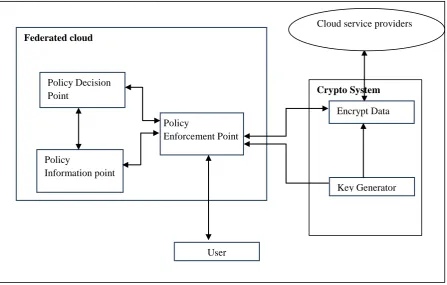
The enhanced security framework is made up of a realistic Federated cloud with an RSA
Security Crypto system that can take advantage of a technique of data compliance and
encryption in cloud computing. The Cryptosystem make use of RSA algorithm to protect any
form of malicious attempt by intruders. These cloud system security model uses RSA
Algorithm with a federated cloud computation practice as a technique to preference active
securities.
Fig. 1.0: Proposed framework.
User
The user/client is the person who chooses to make use of the cloud services. The client must
first create an account with the system before performing any operation.
Policy enforcement point
At this point, all attempts to retrieve, store, or delete data from a cloud storage is been
intercepted and further sent/retrieve the data from the crypto system after a series of
Federated cloud
Crypto System
User Policy
Enforcement Point
Policy
Information point Policy Decision Point
Encrypt Data
Policy decision point
Based on some deployed policies (Spatial, Temporal, Qualitative requirement), the Policy
Decision Point decides on execution and modification, by potentially querying the Policy
Information Point, which implements a data flow model (virtual distribution of data), for
additional context information.
Policy information point
This point implements a data flow model and updates internal state according to the modeled
semantics of the intercepted event.
Crypto system
One of the distinguishing techniques employed in public key cryptography is the use of
asymmetric keys. In this scheme, one key (public key) is used to encrypt the message while a
different key (private key) is used to decrypt it. The keys are related mathematically, but the
parameters are chosen so that calculating the private key from the public is either impossible
of prohibitively expensive.
The Cloud Service Providers
This are organizations that provides an information technology (IT) paradigm to users, which
enables ubiquitous access to shared pools of configurable system resources and higher-level
services that can be rapidly provisioned with minimal management effort, often over
the Internet. These organizations include Amazon, Google, Oracle, Microsoft, Cisco,
Verizon, Citrix, Ibm.
Computational steps for key generation in proposed system
The computational steps for key generation are;
Step 1: Generate two different primes
Step 2: Generate an even constant , such that
,
Step 4: Calculate the modulus
Step 5: Calculate the totient
Step 6: Select for public exponent an integer such that
Step 7: Calculate for the private exponent a value for such that
Step 8: Public Key
Step 9: Private Key
is known as the modulus.
is known as the public exponent or encryption exponent.
is known as the secret exponent or decryption exponent
Explaining computational steps for key generation in proposed system
Step 1: Two given prime numbers are generated randomly between the ranges of 100-9000000 which are 602918 in number.
Step 2: An even constant is generated that is less than the two random prime numbers generated in step 1. We decided to choose and even numbers because we want to subtract the
even number from each prime number generated and still have a prime number as a reminder.
Step 3: We subtract each the even number from each prime number; we now got p and q.
Step 4: The modulus is the multiplication between the two prime numbers from Step3 p and q.
Step 6: And integer e is selected such that it is greater than 1 and less than the totient value obtained from step5, and that integer must satisfy the condition that the greatest common
divisor of the integer and the totient is equal to 1. This integer is known as the public
exponent.
Step 7: We calculated d as the private exponent by taking the inverse of the integer e in step6 mod the value of our totient in step 5.
Step8: The public key is [e,n].
Step9: The private key is [d,n].
Performance Test
After the login session, the user uploads his/her data; this data is encrypted before been stored
at the service provider by the system. The time interval between the upload and encryption is
recorded, and the procedure is repeated with different sizes of data 250 times for each size of
data and the corresponding time is recorded. Using Z test to know whether to either accept or
reject a null hypotheses.
Let X1, X2, X3…Xn be the time interval.
The Average Time
The Standard Deviation
Performance of the proposedsystem
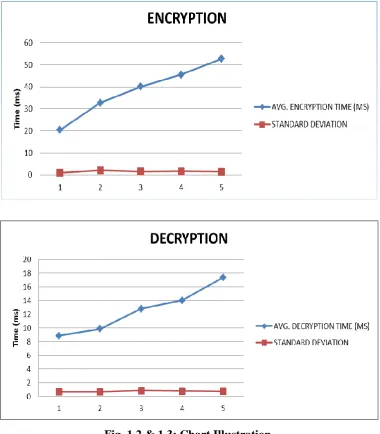
The table below shows a random set of data that was stored to the cloud using the enhanced
data security framework simulated, the following Encryption/Decryption time where obtained
Table 1.0: Performance result obtained File
Name
Size (KB)
Avg. Encryption Time (MS)
Standard Deviation
Avg. Decryption Time (MS)
Standard Deviation
.txt 1 20.436 0.907126174 8.865 0.674002186 .txt 2 32.6715 2.079785604 9.86 0.668950474 .txt 3 40.056 1.56317964 12.801 0.863724493 .txt 4 45.5545 1.644529928 14.0315 0.812677673 .txt 5 52.74 1.450335714 17.3915 0.737187222
The table shows that as the size of data increases the corresponding time of encryption
increases. This is illustrated below using a chart.
Complexity of proposed algorithm
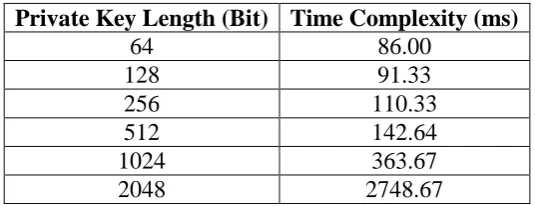
Time Complexity: Time complexity is usually computed by counting the total operations performed by system where each operation takes a fixed amount of time. An algorithm
performance time may vary with respect to the size of the input, in this case computed the
time complexity by varying the length in bits of the key and finding the required execution
time. A summary of the different sizes of key length and their execution time is given in
milliseconds as shown below.
Table 1.1: Time Complexity of RSA algorithm.
Private Key Length (Bit) Time Complexity (ms)
64 86.00
128 91.33
256 110.33
512 142.64
1024 363.67 2048 2748.67
Space Complexity: Apart from Time complexity, space complexity is also an important metric of evaluating the performance of an algorithm. It is the amount of memory which the
algorithm needs for performing its computations. The way in which the amount of storage
space required by an algorithm varies with the size of the problem it is solving. We analyzed
the space complexity between key length and run time memory consumed by the system. The
key length varies with respect to the prime numbers generated and the even constant.
Table 1.2: Space Complexity of RSA algorithm.
Private Key Length (Bit) Space Complexity (ms)
64 86.00
128 91.33
256 110.33
512 142.64
1024 363.67 2048 2748.67
CONCLUSION
The need for a more secured security framework should not be neglected as this system was
particularly designed to advance the form of security lapses encountered while using other
existing security methods to keep data safety in the cloud. The problem was best handled by
and also utilizes the cloud, which aids data/information integrity and safety, as it is not prone
to misplacement or disaster.
Hence the Enhanced security framework has improved the standard of cloud data security as
well as given users the opportunity to embrace the use of the cloud to store their information
with no doubt or fear of compromise.
REFERENCES
1. Endalew, E., “Cloud Data Security Framework for Payment Card System: the case of
Ethiopia”, Thesis Submitted to the Department of Computer Science in Partial Fulfillment
for the Degree of Master of Science in Computer Science Addis Ababa, Ethiopia, 2016.
2. Manisha R. Shinde & Rahul D. Taur, “Encryption Algorithm for Data Security and
Privacy in Cloud Storage”, American Journal of Computer Science and Engineering
Survey, AJCSES, 2015; 3(1): 034-039.
3. Peter Mell, & Tim Grance, “The NIST Definition of Cloud Computing”, 2011; [online],
Available: http://www.wheresmyserver.co.nz/storage/media/faq-files/cloud-def-v15.pdf.
4. Venkata, S. & Shivashanker, R., “Security Techniques for Protecting Data in Cloud Computing”, School of computing, BlekingeInstitute of Technology Swenden, 2011;
36-38.
5. Wood, K. & Pereira, E., “An investigation into Cloud Configuration and Security”,
International Conference for Internet Technology and Secured Transaction, 2010; 1-6.
6. Wuchner, T., Muller, S., & Fischer, R., “Compliance-preserving Cloud Storage
Federationbased on Data-driven Usage Control”, Karlsruhe Institute of Technology,
Germany, 2013.
7. Yuhong Liu, Yan Lindsay Sun, Athanasios V. Vasilakos, JungwooRyoo and Syed Rizvi, “A Survey of Security and Privacy Challenges in Cloud Computing: Solutions and Future