• No results found

INTERCALATION OF ITRACONAZOLE INTO MONTMORILLONITE: EFFECT ON RELEASE OF DRUG

N/A
N/A
Protected

Academic year: 2020

Share "INTERCALATION OF ITRACONAZOLE INTO MONTMORILLONITE: EFFECT ON RELEASE OF DRUG"

Copied!
5
0
0

Loading.... (view fulltext now)

Full text

(1)

Phatak et al. World Journal of Pharmaceutical and Medical Research

INTERCALATION OF ITRACONAZOLE INTO MONTMORILLONITE: EFFECT ON

RELEASE OF DRUG

Dr. Atul Anand Phatak* and Pratik S. Rahane

Department of Pharmaceutics, PES Modern College of Pharmacy, Nigdi, Pune-411044 Savitribai Phule Pune University, Pune, India.

Article Received on 30/09/2018 Article Revised on 21/10/2018 Article Accepted on 11/11/2018

1. INTRODUCTION

Itraconazole (ICZ) is a broad spectrum antifungal agent belonging to azole class of antifungals.[1,2] It is used for the fungal infection of fingernails and is used to treat fungal infection of toe nails. It is reported that itraconazole in oral solution form is used to treat yeast infection of mouth, throat or esophagus. But, due to its poor water solubility (1-4ng/ml) oral bioavailability (55%) its clinical use has been restricted.[3,4] These problems can be lowered by forming a complex with suitable composite for its therapeutic application. Antifungal formulations generally require high dose and also needed to be used in high frequency for maintaining the drug plasma concentration. But this leads to side effects which affects liver and the functioning of kidneys. Nanocomposite seems an effective approach towards increasing the bioavailability of ICZ.[5] Montmorillonite which belongs to smectite group of clay has shown its ability to release drug in a sustain manner, its mucoadhesivity and its detoxification.[6] MMT is a layered hydrated aluminum silicate composed of one aluminum octahedral sheet sandwiched between tow silica tetrahedral sheets. The substitution of lower valence cations in such instances leaves the nearby oxygen atoms with a net negative charge that can attract cations. It is a reversible process of intercalation which can be exchanged by different types of organic molecules.[7,8] The individual crystals of montmorillonite clay are not tightly bound hence water can intervene,

causing the clay to swell. The present study investigates intercalated Na+-MMT nanocomposite to improve efficacy of drug.[9] There is a need for improvised formulation which improves the efficacy of the drug and also reduces the dosing frequency. MMT-ICZ complex is such a formulation which can minimize the side effects and may increase the efficacy of the drug in the body. The intercalation of ICZ into Na+-MMT interlayer gallery by ion exchange reaction is carried out. In order to obtain an ideal therapeutic outcome of anti-fungal drug by oral route it must be formulated into a capsule form which may help in prolonging the release of drug in the intestine.

2. MATERIALS AND METHODS

The montmorillonite (MMT) rich bentonite clay was obtained from Sigma-Aldrich Chemicals Pvt. Ltd. Bengaluru. Sodium chloride, methanol, ammonium acetate, isopropyl alcohol was obtained from Loba chemie, Mumbai. All other solvents used for the study were of analytical grade.

2.1 Preparation of samples

Prior to the preparation of samples for testing, the cation exchange capacity (CEC) of MMT was determined by using the method developed by Busenberg E. and Clemency CV,[10] by using ammonium acetate method. On this basis the CEC of MMT = 61.1mEq/100g. This value along with the molar mass of Itraconazole helped

ISSN 2455-3301

WJPMR

AND MEDICAL RESEARCH

www.wjpmr.com

*Corresponding Author: Dr. Atul Anand Phatak

Department of Pharmaceutics, PES Modern College of Pharmacy, Nigdi, Pune-411044 Savitribai Phule Pune University, Pune, India.

ABSTRACT

Itraconazole (ICZ), an antifungal drug, which is poorly water soluble which makes it difficult to form a stable formulation with enhanced safety and therapeutically effective formulation. Nano minerals help by modulating drug delivery. The study deals with the investigation of itraconazole (ICZ) intercalated into montmorillonite (MMT) by ion exchange technique. Intercalation which is carried out acts as reversible isomorphous substitution which ensures that the cation is displaced in the media. This helps in modulating the drug delivery to overcome the toxicity and increases its efficacy. Effect of different reaction conditions like pH and temperature were studied. Optimum intercalation (90.69%) was achieved by ion exchange technique. X-ray diffraction, Fourier Transform Infra-red spectra indicated the ICZ intercalated into the clay interlayer space. The effect of intercalation of ICZ on modification of release pattern of drug was observed and showed promising results. Nanocomposite showed prolonged release of ICZ with possible improved antifungal activity in the body.

(2)

us to calculate the Optimum amount of drug which could be intercalated between the layers of MMT using formula (1).[11,12]

X = (1)

Where X – amount of modifying agent (g), CEC – cation exchange capacity (mEq/100g), M – molar mass of the modifying agent (g/mol), Y – assumed amount of montmorillonite (g).

2.2 Preparation of Na+ -MMT

Na+-MMT (MMT) was prepared by dispersing 100g of MMT clay in 1L of 0.1M NaCL solution and was stirred for 12 h. The slurry was treated three times with 0.1M NaCL solution, centrifuged and washed with de-ionised water until free of chloride ion as test by AgNO3 solution

to get Na+-MMT. The obtained Na+-MMT was purified by dispersing (50 g) in de-ionized water (5 L) and collecting the supernatant dispersion of particles <2 microns after the pre-calculated time (10 h) and height (15 cm) at 300C. The Na+ -MMT was dried at 90-1000C and ground to pass through the 200 mesh size.

2.3 Intercalation of ICZ into MMT by ion exchange reaction to get ICZ-MMT nanocomposites

The ICZ-MMT nanocomposite was prepared by treating 50ml of aqueous solution of ICZ (860mg, previously dissolved in 10mL methanol) (1 CEC)with MMT (2g) under stirring for 12 h at room temperature. At selected time interval to optimize the time required for maximum intercalation of ICZ into the interlayer of MMT, the mixture was centrifuged to get ICZ-MMT nanocomposite and the free drug in the filtrate was analyzed by UV-visible spectroscopy at 262nm. The amount of ICZ intercalated per gram of MMT was calculated by the difference of the ICZ concentration before and after the intercalation process.

2.4 Effect of pH on ICZ intercalation

The relation between pH and the intercalation amount of the ICZ in MMT was studied at optimized by keeping time and concentration of ICZ constant. 50ml of aqueous solution of ICZ was stirred with 2 grams of MMT at pH 2, 6, 8 adjusted using HCL and NaOH solutions. The remaining concentration of ICZ in the filtrate was measured by UV absorbance.

2.5 Effect of Temperature on intercalation

The relation between temperature and intercalation was studied at time (12 h) and the concentration of ICZ (860 mg). An aqueous solution of MMT (2 g) was kept at different temperature (350C, 450C, 550C, 650C) for 12 h. The remaining concentrations of ICZ in the filtrate were measured by UV absorbance.

3. Characterization of nanocomposites 3.1 Drug loading

The percentage drug loading was determined by dispersing nanocomposite (100 mg) in 10ml of methanol.

The methanolic nanocomposite dispersion was subjected to orbital shaking to dissolve the drug. The drug content was assayed by using UV-spectrophotometer (SHIMADZU, Japan) at 262nm. The drug loadingwas calculated as DL (%) = X1/X2 × 100, where X1 the

weight of ICZ in nanocomposites and X2 the total weight

of nanocomposites.

3.2 Powder X-ray diffraction

The powder X-ray diffraction (PXRD) patterns were recorded by X-ray diffractometer model number D8 (Advance Brucker AXS).

3.3 Fourier Transform Infrared Spectroscopy

Fourier transform infrared spectroscopy were recorded after appropriate background subtraction using an (FTIR – 4100typeA; JASCO, USA) equipped with a diffuse reflectance accessory (DR PRO410-M; JASCO, USA).

3.4 Scanning Electron Microscopy

Surface topography was studied by suing scanning electron microscope (SEM). Nanocomposites were mounted on double-faced adhesive tape and coated with (VG-Microtech, Uckfiled, UK) and analysed with scanning electron microscope (SEM, Cambridge, UK) operated at a 10kV acceleration voltage.

3.5 In vitro drug release

In vitro release of drug was carried out by using USP type II Dissolution test apparatus (Veego, Mumbai, India) with pH 1.2 and pH 6.8 buffurs as a dissolution medium. In brief precise amount of ICZ-MMT nanocomposite was placed in capsule and dispersed via basket in the dissolution medium. The temperature was maintained at 37±0.50C with the rotation frequency maintained at 100 rev min-1. Aliquots (1ml) were withdrawn at the predetermined time intervals and sink condition was maintained with the same volume of fresh medium and the drug release was analyzed at 262nm.

3.6 Invitro anti-fungal study

(3)

4. RESULT AND DISCUSSION 4.1 Intercalation of ICZ into MMT

The intercalation was carried out by using ion exchange technique, Na+ ions were replaced by cationic ICZ molecules. A maximum amount (90.69%) of ICZ was intercalated into MMT within 12 hrs. The intercalation remained constant even after 12hrs.

4.2 Effect of pH on intercalation

The pH of the drug solution is really important for the intercalation between cationic molecule and MMT layers. Figure 1 shows the effects of pH on the intercalation of ICZ in MMT in the pH range 2-10. A substantial increase in intercalation was observed till pH 6 after which the intercalation was reduced significantly. Lower intercalation at below pH4 was probably due to a competition between the cationic drug and H+ ions, which can exist on the MMT surface at low pH value as the silanol groups on the MMT surface get protonated. At higher pH due to uncharged ICZ molecules the intercalation was reduced. pH 6 was set as the optimum one in the subsequent experiments.

Figure 1: Effect of pH on intercalation.

4.3 Effect of Temperature on intercalation

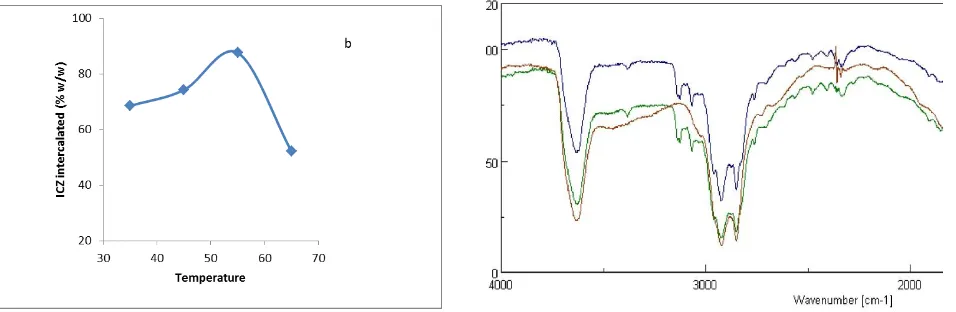
Intercalation of ICZ into MMT layers was dependent on temperature of the reaction medium as shown in Figure 2. Intercalation increased till the temperature reached 550C but reduced significantly upon further increase in the temperature.

Figure 2: Effect of temperature on intercalation.

4.4 Powder X-ray diffraction

The PXRD pattern of ICZ, MMT, MMT-ICZ nanocomposite are shown in Figure 3. ICZ showed crystalline nature. MMT showed diffraction peak (2 at 20.6o basal spacing 0.43nm; the same shifted to 19.4 (basal spacing d = 0.45) in ICZ-MMT nanocomposite. According to Bragg’s law, the peaks shifting to lower diffraction angle is due to an increase in the MMT basal spacing. This fact confirmed the MMT-ICZ ionic exchange and consequent intercalation of ICZ into the MMT interlayer.

Figure 3: PXRD patterns of ICZ, MMT-ICZ and MMT.

4.5 Fourier Transform Infrared Spectroscopy

The FT-IR spectrum of ICZ showed characteristic peaks at 3380cm-1 (absorption of NH2 group), 2964cm-1

(-CH2stretching), 1613cm -1

, 1425cm-1 are assigned to C=N and C-N bonds, respectively. MMT exhibited peaks at 3465cm-1 (-OH stretching). Figure 4 The shoulders and broadness of the –OH band are mainly due to contribution of several structural –OH groups occurring in the clay. Peaks were observed at 1643cm-1 (-OH bending of water), 1028cm-1. (Si-O stretching in [SiO4

]4-tetrahedra). 918cm-1 (Al-Al-OH bending) and 796cm-1 (Al-FE-OH bending). ICZ-MMT interaction showed new bands 3382cm-1, 3127cm-1. This also shows strong interaction of ICZ with MMT layers.

(4)

4.6 Scanning Electron Microscopy

The morphological aspects of ICZ-MMT nanocomposite was studied using scanning electron microscopy indicated almost layered rough cluster of ICZ-MMT approximately 600 nm in length Figure 5.

Figure 5: SEM of MMT-ICZ complex (×10,000).

Figure 5: SEM of MMT-ICZ complex (×500).

4.7 In vitro drug release

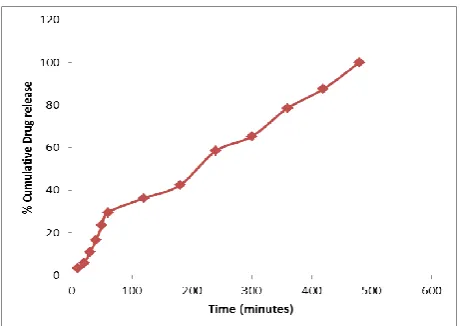
The release of ICZ from the nanocomposite in pH 1.2 and pH 6.8 is depicted in Figure 6. In gastric media, ICZ-MMT nanocomposite showed 98% release profile respectively, at 4h. In intestinal environment, the release profile was 99% at 8h respectively. The slow sustain release of ICZ from nanocomposites was observed which may be due to positively charged ICZ strongly bound to MMT which leads to slow release of ICZ in media. Figure 7.

Figure 6: In vitro release profile of MMT-ICZ in pH 1.2.

Figure 7: In vitro release profile of MMT-ICZ in pH 6.8.

4.8 In vitro anti-fungal study

The in vitro antifungal activity of ICZ-MMT nanocomposite was investigated against Candida albicans species of fungus. The in vitro therapeutic effect of MMT-ICZ and the standard ITRABOND was quantitatively evaluated at a given period of time. The results revealed that MMT-ICZ produced the zone of inhibition of 18.75mm where as the standard dosage formulation produced the zone of inhibition of 19.56mm respectively.

5. CONCLUSION

A layered nanocomposite system of Na-MMT and ICZ-MMT was developed and investigated for sustain release of ICZ which might possibly the toxic effect of ICZ and increase its therapeutic effect. Intercalation of ICZ into the interlayer of Na+-MMT was achieved via ion exchange mechanism. In vitro characterization technique such as FTIR and PXRD confirmed the entrapment of ICZ in nanocomposite. In vitro release testing revealed a sustain release of ICZ. While anti-fungal study suggests the anti-fungal potency. MMT-ICZ complex in capsule formulation minimize the side effects and also increase the efficacy of the formulation in comparison with the presently available conventional dosage form. The complex provides the drug release up to 5 hrs and thus helps in the sustain release of the drug which may help in reducing the dosing frequency of drug.

6. ACKNOWLEDGEMENT

The authors sincerely acknowledge PES Modern College of Pharmacy, Nigdi, Pune, - 411044 India for providing the laboratory and infrastructural facilities and Savitribai Phule Pune University, Pune, India for instrumentation facilities.

7. REFERENCES

(5)

framework and analysis of in vitro-in vivo correlation data for fluconazole, itraconazole, and Candida infections. Clinical Infectious Diseases, 1997 Feb 1; 24(2): 235-47.

2. Chakrabarti A, Das A, Panda NK. Overview of fungal rhinosinusitis. Indian Journal of Otolaryngology and Head and Neck Surgery, 2004 Oct 1; 56(4): 251-8.

3. Jae-Young Jung, Sun Dong Yoo, Sang-Heon Lee, KyeHyun Kim, Doo-Sun Yoon, Kyu-Hyun Lee, Enhanced solubility and dissolution rate of itraconazole by a solid dispersion technique, International Journal of Pharmaceutics, 1999; 187: 209–218.

4. Swaminathan S, Sangwai M, Wawdhane S, Vavia P. Soluble itraconazole in tablet form using disordered drug delivery approach: critical scale-up considerations and Bio-equivalence studies. AAPS PharmSciTech, 2013 Mar 1; 14(1): 360-74.

5. Bhakay A, Rahman M, Dave R, Bilgili E. Bioavailability Enhancement of Poorly Water-Soluble Drugs via Nanocomposites: Formulation– Processing Aspects and Challenges. Pharmaceutics, 2018 Jul 8; 10(3): 86.

6. Rasouli S, Davaran S, Rasouli F, Mahkam M, Salehi R. Synthesis, characterization and pH-controllable methotrexate release from biocompatible polymer/silica nanocomposite for anticancer drug delivery. Drug delivery, 2014 May 1; 21(3): 155-63. 7. Zhang JA, Anyarambhatla G, Ma L, Ugwu S, Xuan

T, Sardone T, Ahmad I. Development and characterization of a novel Cremophor® EL free liposome-based paclitaxel (LEP-ETU) formulation. European journal of pharmaceutics and biopharmaceutics, 2005 Jan 1; 59(1): 177-87. 8. Kevadiya BD, Joshi GV, Bajaj HC. Layered

bionanocomposites as carrier for procainamide. International journal of pharmaceutics, 2010 Mar 30; 388(1-2): 280-6.

9. Meenach SA, Otu CG, Anderson KW, Hilt JZ. Controlled synergistic delivery of paclitaxel and heat from poly (β-amino ester)/iron oxide-based hydrogel nanocomposites. International journal of pharmaceutics, 2012 May 10; 427(2): 177-84. 10. Busenberg E. Uemency C.V. Determination of the

cation exchange capacity of clay and soil using ammonia electrodes. Clay and clay minerals, 1973; 21: 213-217.

11. T. Mandalia, F.Bergaya, Organo clay mineral-melted polyolefin nanocomposites, Effects of surfactant/CEC ratio, J. Phys. Chem. Solids, 2006; 67: 836-845.

12. I. Legocka, E. Wierzbicka, T.M.J. Al-Zahari, O.Osawaru, Influence of halloysite on the structure, thermal and mechanical properties of polyamide 6, Polimery, 2013; 58: 24-32.

13. B.D. Kevadiya, T.A. Patel, D.D. Jhala, R.P Thumbar, H. Brahmbhatt, M.P. Pandya, S. Rajkumar, P.K. Jena, G.V. Joshi, P.K. Gandhi, C.B.

Tripathi and H.C. Bajaj: Eur. J. Pharm. Biopharm., 2012; 81: 91-101.

Figure

Figure 3: PXRD patterns of ICZ, MMT-ICZ and MMT.
Figure 7: In vitro release profile of MMT-ICZ in pH  6.8.

References

Related documents

Antihypertensive therapy in hypertensive patients imme- diately post stroke may be effective and cost-effective compared with placebo from the acute hospital perspec- tive at

The most important contributions of this paper are (i) the proposal of a concern mining approach for KDM, what may encourage other groups to start researching on

Especially large asymmetries are observed for two small subsamples of events, where also the scattered electron was recorded, revealing important contributions from

hydrolysis of patient samples positive for cyclobenzaprine or amitriptyline with four different sources of β -glucuronidase enzyme: IMCSzyme TM (genetically engineered E. Coli ),

inland rice plantations of Jasper County, South Carolina, LIDAR data was used to. examine the landscape and aid in the archaeological work being conducted there

Expansion might be characterized as 'a maintained upward pattern in the general level of costs' and not the cost of one and only or two merchandise.. Ackley characterized

The mTOR inhibitor sirolimus has shown efficacy in clinical trials investigating the treatment of patients with AML and LAM [15 – 18], while another mTOR inhibitor, everolimus,

the potential to improve classification as the signed edges introduce what can be seen as agreements (positive edges) or disagreements (negative edges) between nodes, allowing to