ISSN (Print) : 2320 – 3765 ISSN (Online): 2278 – 8875
I
nternational
J
ournal of
A
dvanced
R
esearch in
E
lectrical,
E
lectronics and
I
nstrumentation
E
ngineering
(A High Impact Factor, Monthly, Peer Reviewed Journal)
Website: www.ijareeie.com
Vol. 7, Issue 3, March 2018
Performance Analysis of LFC in Multi Area
Power System Using hybrid Firefly
Algorithm
S.Thangavel
1, M.Elavarasi
2Professor, Dept. of EEE, K.S.Rangasamy College of Technology, Tiruchengode, Tamilnadu, India1
PG Student [PSE], Dept. of EEE, K.S.Rangasamy College of Technology, Tiruchengode, Tamilnadu, India2
ABSTRACT: In multi area thermal power system, the frequency and tie-line power vary randomly with change in load demand. The interconnected power system holds frequency and desired power output at scheduled values and to control the change in tie-line power flow between control areas is the aim of load frequency control. Reliable controller is used to implement many modern control techniques. The objective can be attained by maintaining both voltage and frequency within allowable range which can produce and deliver reliable power. In multi area system hybrid firefly algorithm is used to explore the design and performance analysis of PI controller. Initially, a three-area thermal system with time delay, reheat turbine, generation rate constraint (GRC) and governor dead band non-linearity are considered and the gains of the fuzzy PI controller are optimized employing fuzzy and firefly optimization technique.
KEYWORDS: PI controller, Load Frequency control, Firefly Algorithm
I.INTRODUCTION
In modern thermal power system, Load Frequency Control (LFC) plays a vital role to maintain the system frequency and tie line power flow at their scheduled values under normal as well as when the system is subjected to small step load perturbation. Load Frequency Control issue in power systems has a long history and its literature is huge. The preliminary LFC schemes have involved over the past decades, and interest continues in proposing new intelligent LFC approaches with an improved ability to maintain tie-line power flow and system frequency close to specific values. It is well known that system frequency depends on the balance between the real power generated and the instant load demand.
ISSN (Print) : 2320 – 3765 ISSN (Online): 2278 – 8875
I
nternational
J
ournal of
A
dvanced
R
esearch in
E
lectrical,
E
lectronics and
I
nstrumentation
E
ngineering
(A High Impact Factor, Monthly, Peer Reviewed Journal)
Website: www.ijareeie.com
Vol. 7, Issue 3, March 2018
such as Differential Evolution (DE) and Craziness based Particle Swarm Optimization (CPSO). A firefly algorithm optimized fuzzy PID controller for AGC of multi-area multi-source power systems with UPFC and SMES [3]. In this paper, a two area six units power system is used and the gains of the fuzzy PID controller are optimized employing FA optimization technique using an ITAE criterion. In order to further increase the performance of the controller, a modified objective function is derived using Integral Time multiply Absolute Error (ITAE), damping ratio of dominant eigenvalues, settling times of frequency and peak overshoots with appropriate weight coefficients. In the view of above, the hybrid firefly algorithm optimization technique is applied to tune the inputs and outputs.
II. MULTI AREA POWER SYSTEM MODEL
The three-area power system consists of interconnection of three power systems.The outputs are the generator
frequency ΔF and area control error (ACE) given by,
ACE = BΔF + ΔPT (1)
Where, B is the frequency bias parameter.
Each area of the power system consists of speed governing system, turbine, and generator. Each area has three inputs and two outputs. The important constraints which affect the power system performance are time delay, reheat turbine, Generation Rate Constraint (GRC), and Governor Dead Band (GDB) nonlinearity.
ISSN (Print) : 2320 – 3765 ISSN (Online): 2278 – 8875
I
nternational
J
ournal of
A
dvanced
R
esearch in
E
lectrical,
E
lectronics and
I
nstrumentation
E
ngineering
(A High Impact Factor, Monthly, Peer Reviewed Journal)
Website: www.ijareeie.com
Vol. 7, Issue 3, March 2018
To get an accurate insight of the LFC problem, it is essential to include the important inherent requirement and the basic physical constraints and include them model. Time delay degrades a systems performance and even cause system instability.Governor dead band non-linearity is the total amount of a continued speed change within which there is no change in valve position. Dead zone is a kind of non-linearity in which the system does not respond to the given input until the input reaches a particular level.
ACE1, ACE2 and ACE3 are area control errors; R1, R2 and R3 are governor speed regulation constants; B1, B2 and B3
are frequency bias factors; u1, u2 and u3 are control inputs to speed governing system coming out of the controllers;
Tg1, Tg2 and Tg3 are governor time constants in seconds; ΔPg1, ΔPg2 and ΔPg3 are changes in governor valve
positions. Tt1 and Tt2 are turbine time in seconds. ΔK1, ΔK2 and ΔK3 are the parameters which is gain parameters
and also constants in seconds; ΔPt1 and ΔPt2 are the changes in turbine output powers; kp1, kp2
and kp3 are the power system gains; Tp1, Tp2 and Tp3are power system time constants in seconds; ΔPD1, ΔPD2 and
ΔPD3 are the changes in the load demands; ΔPTIE is the change in tie-line power; and Δf1, Δf2and Δf3 are the
deviations in the system frequencies.
Controller structure
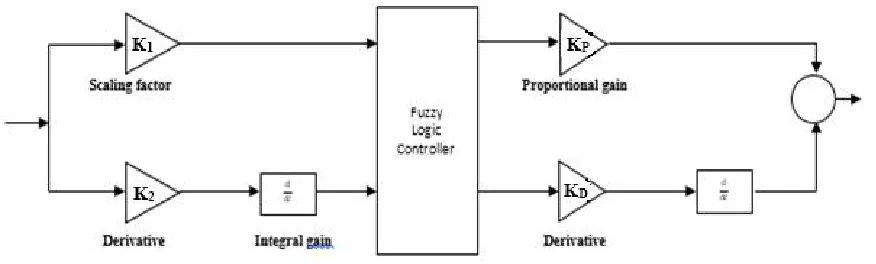
Fuzzy PI controller method is better method of controlling to the complex and unclear model systems. It can give simple, effective control, robustness, good dynamic response, rising time, overstrike characteristics. Most existing conventional PID controller fails where industrial process having degrees of non-linearity and parameters variability and uncertainty of the mathematical model of the system. However, conventional PID controller algorithm is simple, stable, easy adjustment and high reliability. Tuning parameters of such systems also difficult.
Fig. 2 Structure of PI Controller
The frequency control for fuzzy PI controllers are provided in each area. The error inputs to the controllers are the respective Area Control Errors given by:
e1 (t) = ACE1 = B1ΔF1+ ΔPTie (2)
e2 (t) = ACE2= B2ΔF2 – ΔPTie (3)
Fuzzy controller uses error (e) and derivative of error as input signals. The outputs of the fuzzy controllers u1 and u2
ISSN (Print) : 2320 – 3765 ISSN (Online): 2278 – 8875
I
nternational
J
ournal of
A
dvanced
R
esearch in
E
lectrical,
E
lectronics and
I
nstrumentation
E
ngineering
(A High Impact Factor, Monthly, Peer Reviewed Journal)
Website: www.ijareeie.com
Vol. 7, Issue 3, March 2018
III. PROBLEM FORMULATION
Design of a controller is based upon well-defined objectives meeting the system requirements and constraints. In this paper, the design objectives considered to tune the controller parameters are minimization of the settling times of frequency and tie-line power deviations, ITAE error minimization and reduction in peak overshoots of deviations in system frequency and tie-line power.The first considered objective J1, is the settling time of the deviations in the system frequencies of the two areas, the tie-line power deviations and the ACEs of the respective areas. This objective accounts for maintaining the power exchange between the control areas at its predefined values as soon as possible under any kind of load change or system disturbances. It is represented in the following
J1=TΔF1 + TΔF2+ TΔPTie + TACE1+ TACE2 (4)
where, TΔF1and TΔF2are the selling times of the frequency deviations in area 1 and area 2, respectively, TΔPTie is the settling
time for the incremental change in tie-line power and TACE1 and TACE2 are the settling times ACEs of area 1 and area 2,
respectively.The second objective J2 is considered based on ITAE criterion which is widely chosen design objective. This objective is accountable for maintaining the change in frequency to zero under any load change and minimizing the integral of the change of the frequency. It is formulated as:
J2= ∫(|Δf |+|Δf| + |ΔPTie |+ |ACE1|+|ACE2| )⋅t⋅dt (5)
where, Ts is the total simulation time.
IV. FIREFLY ALGORITHM
The Firefly Algorithm (FA) is a population-based algorithm developed by Yang. Fireflies are characterized by their flashing light produced by biochemical process bioluminescence. The flashing light may serve as the main courtship signals for mating. It is based on the following three idealized behavior of the flashing characteristics of fireflies.
(a) All fireflies are unisex and are attracted to other fireflies regardless of their sex.
(b) The degree of the attractiveness of a firefly is proportional to its brightness. Their attractiveness is proportional to the light intensity. Thus, for any two flashing fireflies, less bright firefly moves towards the brighter one. As brightness is proportional to distance, more brightness means less distance between two fireflies. If any two flashing fireflies have the same brightness, then they move randomly.
(c) The brightness of a firefly is determined by the objective function to be optimized.
In FA algorithm, there are two important issues: (1) the variation of light intensity; and (2) formulation of attractiveness. However, these parameters are either set constants or fixed empirically in the traditional FA, which may make the algorithm inefficient for the problems with complex landscapes. Researchers have made numerous contributions to the improvement of FA considering the alteration of the control parameters applied to several chaos mechanisms to tune light absorption coefficient and attractiveness coefficient.
Although much progress has been achieved on the FA-based algorithms since 2008, more efforts are required to further improve their performance:
a) Providing the sufficient analysis for the control parameter settings;
b) Efficient strategies or mechanisms for the selections of the control parameters; c) Employing heterogeneous search rules to enhance the performance of FA. The light intensity varies with the distance monotonically and exponentially as,
I(r) = Io (6)
Where Iois the original light intensity and γ is the light absorption coefficient
.
As the firefly’s attractiveness is proportional to the light intensity seen by adjacent fireflies, the attractiveness β of a
ISSN (Print) : 2320 – 3765 ISSN (Online): 2278 – 8875
I
nternational
J
ournal of
A
dvanced
R
esearch in
E
lectrical,
E
lectronics and
I
nstrumentation
E
ngineering
(A High Impact Factor, Monthly, Peer Reviewed Journal)
Website: www.ijareeie.com
Vol. 7, Issue 3, March 2018
β(r) = βo (7)
Where, βo is the attractiveness.
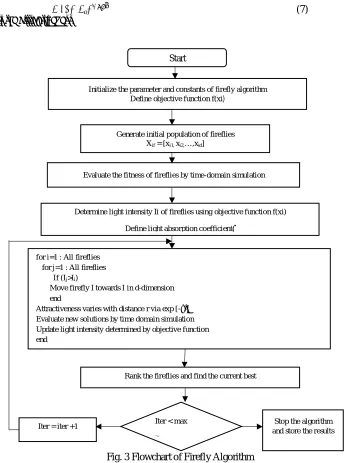
Fig. 3 Flowchart of Firefly Algorithm
The distance between any two fireflies Xi and Xj is expressed as Euclidean distance by the base firefly algorithm as,
Initialize the parameter and constants of firefly algorithm Define objective function f(xi)
Start
Generate initial population of fireflies Xif = [xi1, xi2,…,xid]
Evaluate the fitness of fireflies by time-domain simulation
Determine light intensity Ii of fireflies using objective function f(xi)
Define light absorption coefficientγ
for i=1 : All fireflies for j=1 : All fireflies If (Ij>Ii)
Move firefly I towards I in d-dimension end
Attractiveness varies with distance r via exp [-γr]
Evaluate new solutions by time domain simulation Update light intensity determined by objective function end
Rank the fireflies and find the current best
Iter < max
iter
ISSN (Print) : 2320 – 3765 ISSN (Online): 2278 – 8875
I
nternational
J
ournal of
A
dvanced
R
esearch in
E
lectrical,
E
lectronics and
I
nstrumentation
E
ngineering
(A High Impact Factor, Monthly, Peer Reviewed Journal)
Website: www.ijareeie.com
Vol. 7, Issue 3, March 2018
rij = ||xi – xj|| = ∑ ( , − , ) (8)
Where, d is the dimension of an optimization problem Xi and Xj are the best and current best of the fireflies rij is the randomization of fireflies.
V. RESULT AND DISCUSSION
ISSN (Print) : 2320 – 3765 ISSN (Online): 2278 – 8875
I
nternational
J
ournal of
A
dvanced
R
esearch in
E
lectrical,
E
lectronics and
I
nstrumentation
E
ngineering
(A High Impact Factor, Monthly, Peer Reviewed Journal)
Website: www.ijareeie.com
Vol. 7, Issue 3, March 2018
VI. TABULATION
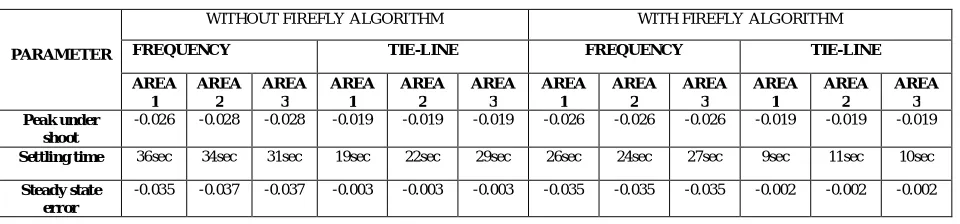
From the given comparisons, it is observed that performance of change in frequency and tie line power deviation response of hybrid firefly algorithm gives better result compared with other algorithms. The tabulation for frequency and tie-line power deviations are given as follows,
Table. 1 Steady State Analysis of With and Without Firefly Algorithm
VI. CONCLUSION
It is recognized that the load frequency control of multi area thermal power system results in maintaining frequency and tie line power deviation. Load Frequency control is a system to maintain reasonably uniform frequency, to divide the load between the generators and to control the tie line interchange schedules. The important constraints which affect the power system performance are time delay, reheat turbine, Generation Rate Constraint, and Governor Dead Band nonlinearity. The formulation of load frequency control in multi area system has been discussed and the solution
is obtained. An algorithm based on hybrid firefly algorithm optimization, which is a population-based optimization technique has been tested on multi area thermal power system for frequency and tie line power deviation. From the results obtained, it is observed that hybrid Firefly Algorithm achieves maximum frequency and tie line power deviation compared to other optimization techniques. It is found that result obtained from multi area power system using hybrid firefly algorithm gives better solution and it achieves 10 seconds.
REFERENCES
[1] Ghoshal.S.P (2004), “Optimizations of PID gains by particle swarm optimizations in fuzzy based automatic generation control”, Electric Power Systems Research, 203–212
[2] Hamed Shabani, Behrooz Vahidi and Majid Ebrahimpour (2012), “A robust PID controller based on imperialist competitive algorithm for load-frequency control of power systems”, ISA Transactions, 0019-0578
[3] Haluk Gozde and Cengiz Taplamacioglu. M (2011),“Automatic generation control application with craziness based particle swarm optimization in a thermal power system”, Electrical Power and Energy Systems, 8–16
[4] Pratap Chandra Pradhan, Rabindra Kumar Sahu and Sidhartha Panda (2015), “Firefly algorithm optimized fuzzy PID controller for AGC of multi-area multi-source power systems with UPFC and SMES”, Engineering Science and Technology, 338–354
[5] Rabindra Kumar Sahu, Sidhartha Panda and Pratap Chandra Pradhan (2015), “Design and analysis of hybrid firefly algorithm-pattern search based fuzzy PID controller for LFC of multi area power systems”, Electrical Power and Energy Systems, 0142-0615
[6] Rabindra Kumar Sahu, Sidhartha Panda and Umesh Kumar Rout (2013), “DE optimized parallel 2-DOF PID controller for load frequency control of power system with governor dead-band nonlinearity”, Electrical Power and Energy Systems, 19–33
PARAMETER
WITHOUT FIREFLY ALGORITHM WITH FIREFLY ALGORITHM
FREQUENCY TIE-LINE FREQUENCY TIE-LINE
AREA 1 AREA 2 AREA 3 AREA 1 AREA 2 AREA 3 AREA 1 AREA 2 AREA 3 AREA 1 AREA 2 AREA 3 Peak under shoot
-0.026 -0.028 -0.028 -0.019 -0.019 -0.019 -0.026 -0.026 -0.026 -0.019 -0.019 -0.019
Settling time 36sec 34sec 31sec 19sec 22sec 29sec 26sec 24sec 27sec 9sec 11sec 10sec
Steady state error
ISSN (Print) : 2320 – 3765 ISSN (Online): 2278 – 8875
I
nternational
J
ournal of
A
dvanced
R
esearch in
E
lectrical,
E
lectronics and
I
nstrumentation
E
ngineering
(A High Impact Factor, Monthly, Peer Reviewed Journal)
Website: www.ijareeie.com
Vol. 7, Issue 3, March 2018
[7] Singh Parmar.K.P , Majhi.S and Kothari.D.P (2012), “Load frequency control of a realistic power system with multi-source power generation”, Electrical Power and Energy Systems, 426–433
[8] Singh Dhillon, Jagdeep Singh Lather and Sanjay Marwah (2015), “Multi area load frequency control using particle swarm optimization and fuzzy rules”, Recent Trends in Computing, 460 – 472
[9] Sanjoy Debbarma, Lalit Chandra Saikia and Nidul Sinha (2014), “Solution to automatic generation control problem using firefly
algorithm optimized IλDm controller”, ISA Transactions, 358–366