Nafstad O, Grønstøl H: The effect of eradication of lice on the occurrence of the grain defect light flecks and spots on cattle hides. Acta vet. scand. 2001, 42, 99-106. – The influence of an eradication programme for lice on the prevalence of light flecks and spots on cattle hides was studied in 33 dairy cattle herds during a period of two and a half years. Lice were eradicated from the main group of herds after 9 to 12 months and the quality of the hides before and after treatment was compared. Hides from slaugh-tered animals were collected during the study period, tanned and examined with special emphasis on the occurrence of the grain damage light flecks and spots. The prevalence of hides without light flecks and spots increased from 24.2% before treatment to 61.6% after treatment. The prevalence of hides free from the damage increased significantly in all examined anatomical regions. The improvement in hide quality was most marked in the shoulders and neck region which corresponded to the major predilection site of cat-tle lice. The prevalence of hides with light flecks and spots started to decrease in the first period (2-40 days) after eradication. The changes after treatment suggested that most healing process took place over a period of about 4 months. The eradication programme eliminated the seasonal variation in the prevalence of light flecks and spots which was present before treatment.
cattle hide; leather; damage; light flecks and spots; eradication.
The Effect of Eradication of Lice on the Occurrence
of the Grain Defect Light Flecks and Spots on Cattle
Hides
By O. Nafstad andH. Grønstøl
Department of Large Animal Clinical Sciences, Norwegian School of Veterinary Science, Oslo, Norway.
Introduction
Light flecks and spots were described and pre-cisely defined for the first time by Webster & Bugby(1990). These investigators defined light flecks and spots as small areas of grain loss up to 3 mm in diameter that are seen on dyed crust bovine leather and associated the damage with presence of lice. Both biting lice (Damalinia (Bovicola) bovis(Linnaeus 1758)) and sucking lice (Linognathus vituli (Linnaeus 1758)) caused light flecks and spots, but biting lice seemed to be the most important. Treatment with insecticides decreased the occurrence of damage significantly (Bugby et al. 1990, Web-ster & Bugby1990). Similar damage has also been described by other authors and associated
with various ectoparasite species (Everett et al.
Eradication as a control strategy of ectopara-sites in domestic animals is described and as-sessed in general by Hiepe (1986). In the present study, a clinical evaluation of an eradi-cation programme for the control of lice in cat-tle was undertaken together with the investiga-tion of the hides. The results of the clinical evaluations indicated that eradication can be an appropriate control strategy for lice in cattle (Nafstad & Grønstøl2001b). The aim of this paper was to compare the leather quality and the occurrence of light flecks and spots on cat-tle hides before and after the eradication of lice.
Materials and methods
Design
A prospective cohort study was performed in 33 dairy herds during a period of two and a half years with animals leaving or entering the herds at any time. Hides from all animals slaughtered in the 33 herds from 1. January 1994 to 30. June
1996 were collected and examined after tanning for ectoparasite related damage. Twenty-eight of the herds were treated to eradicate lice in the second third of 1994. Five herds took part in a pilot study and were treated to eradicate lice in December 1993. Hides from these 5 herds were only included in the “after eradication” group. The treatment scheme, clinical evaluation and results of the lice eradication programme are presented elsewhere (Nafstad & Grønstøl
2001b).
Herds, animals and hides
The herds were selected by the District Veteri-nary Officers in Akershus and Østfold. Selec-tion criteria and ectoparasite status are described previously (Nafstad & Grønstøl
2001b). The herd size varied from 8 to 50 dairy cows. In total, 1032 hides were collected during the whole investigation period, 368 from the pe-riod before eradication and 664 from the pepe-riod
Ta bl e 1 A . Effect of eradication of lice on the occurrence of light flecks and spots on cattle hides.
Number Average Max. score
of of hide
hides sum scores 0 1 2 3
Before eradication 368 3.52 24.2% 37.2% 31.3% 7.3%
After eradication 664 1.46 61.6% 21.1% 14.6% 2.7%
p< 0.001
Score 0: No damage
Score 1: Slight damage, with 1-2 light fleck or spot pr. 100 cm2.
Score 2: Some damage, with 3-5 light fleck or spots pr. 100 cm2.
Score 3: Severe damage, with more than 5 light fleck or spots pr. 100 cm2.
Ta bl e 1 B. Frequency of damage on hides from animals born after eradication.
Number Average Max. score
of of hide
hides sum scores 0 1 2 3
Hides from the 49 1.61 65.3% 12.2% 16.3% 6.1%
after eradication. The mean number of hides from each herd was 13.1 before treatment with a variation from 2 to 21. The mean number from each herd after treatment was 20.2 with a variation from 7 to 51.
Examination of the hides
The tanning procedure and examination of the hides are described previously (Nafstad & Grønstøl2001a). Light flecks and spots were defined as areas of grain loss up to 3 mm in di-ameter seen on dyed crust leather (Bugby et al.
1990, Webster & Bugby1990). The evaluation was based on the number of identifiable flecks and spots and was performed according to the following scale:
Score 0: No damage.
Score 1: Slight damage, with 1-2 light flecks or spots per 100 cm2.
Score 2: Some damage, with 3-5 light flecks or spots per 100 cm2.
Score 3: Severe damage, with more than 5 light flecks or spots per 100 cm2.
Statistical methods
Eight registrations from each hide were used to derive two parameters. The maximum score was defined as the highest single registration on each hide and the sum score was defined as the sum of the 8 registrations on each hide. If only one half of a hide was available, a duplicate re-sult from the available half of the hide was used in the statistical analyses.
The Statistical Analysis System (SAS Institute Inc.1996) was used for data processing and sta-tistical analysis. Spearman's rank correlation was used for testing changes with time after eradication. Otherwise, statistical hypothesis testing was carried out by use of t-test. The sta-tistical testing was based on the frequency of hides without damage (maximum score 0) or the average of the sum scores for the groups.
Results
Effect of eradication
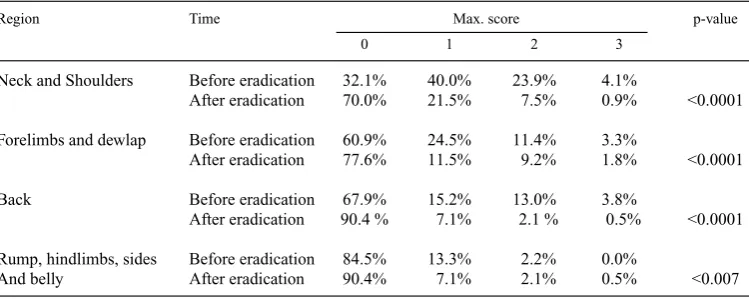
The frequency of cattle hides without light flecks and spots increased from 24.2% before Ta bl e 2 . Effect of eradication of lice on the frequency of light flecks and spots in different regions of the hide (n=1032).
Region Time Max. score p-value
0 1 2 3
Neck and Shoulders Before eradication 32.1% 40.0% 23.9% 4.1%
After eradication 70.0% 21.5% 7.5% 0.9% <0.0001
Forelimbs and dewlap Before eradication 60.9% 24.5% 11.4% 3.3%
After eradication 77.6% 11.5% 9.2% 1.8% <0.0001
Back Before eradication 67.9% 15.2% 13.0% 3.8%
After eradication 90.4 % 7.1% 2.1 % 0.5% <0.0001 Rump, hindlimbs, sides Before eradication 84.5% 13.3% 2.2% 0.0%
And belly After eradication 90.4% 7.1% 2.1% 0.5% <0.007
Score 0 - No damage
Score 1 - Slight damage, with 1-2 light fleck or spot pr. 100 cm2.
Score 2 - Some damage, with 3-5 light fleck or spots pr. 100 cm2.
the eradication of lice to 61.6% after eradica-tion. The average sum score of the hides in the group decreased from 3.52 before eradication to 1.46 after eradication. The general effects of the eradication of lice are presented in Table
1A. The results from the subgroup of hides from animals born after the eradication of lice are shown in Table 1B. There were no signifi-cant differences between this subgroup and the group of hides from all animals slaughtered af-Ta bl e 3 . Change in frequency of damaged hides after eradication.
Period no. Number Average of Percentage of
(Days after of hides hide sum Max. score hides from
eradication) scores 0 1 2 3 reinfected
herds
I 170 1.79 54.1% 25.9% 17.7% 2.4% 2.4%
(2-136)
II 162 1.29 62.4% 25.3% 10.5% 1.9% 17.9%
(137-326)
III 166 1.13 68.1% 19.3% 10.2% 2.4% 32.5%
(326-477)
IV 166 1,63 62.1% 13.9% 19.9% 4.2% 51.8%
(>477)
Change in periods I-III p< 0.001 ( Spearman correlation test)
Score 0 - No damage
Score 1 - Slight damage, with 1-2 light fleck or spot pr. 100 cm2.
Score 2 - Some damage, with 3-5 light fleck or spots pr. 100 cm2.
Score 3 - Severe damage, with more than 5 light fleck or spots pr. 100 cm2.
Ta bl e 3 B. Change in frequency of damaged hides in first 136 days after eradication.
Period no. Number Average of
(Days after of hides hide sum Max. score
eradication) scores 0 1 2 3
I 43 2.58 39.5% 37.2% 20.9% 2.3%
(2-40)
II 43 2.26 62.4% 25.3% 10.5% 1.9%
(41-87)
III 46 1.13 68.1% 19.3% 10.2% 2.4%
(88-110)
IV 38 1,19 62.1% 13.9% 19.9% 4.2%
(111-136)
ter eradication. An increasing proportion of the hides came from reinfected herds as the obser-vation period progressed, and 53% of the hides from animals born after eradication came from reinfected herds. There were no significant dif-ferences between hides from reinfected herds and hides from herds that remained free of lice. The eradication both decreased the proportion of hides with damages and the extent of damage on affected hides. The average sum score of af-fected hides decreased from 4.64 before eradi-cation to 3.80 after eradieradi-cation (p< 0.01). The quality of the hides from the herds in the pilot study did not differ from the quality of the hides in the main group after treatment. Sixty-one per cent of the 199 hides that were collected from the herds in the pilot group were free of light flecks and spots.
Effect of eradication in various anatomical regions
Following the eradication of lice, there were significant reductions in frequency of light flecks and spots in all anatomical regions exam-ined on the cattle hides (Table 2). Accordingly, the frequency of hides without damage in-creased in all anatomical regions. The neck and
shoulders were the region with the highest inci-dence of damage before treatment. This region also showed the largest change in the preva-lence of light flecks and spots after treatment.
Change with time after eradication
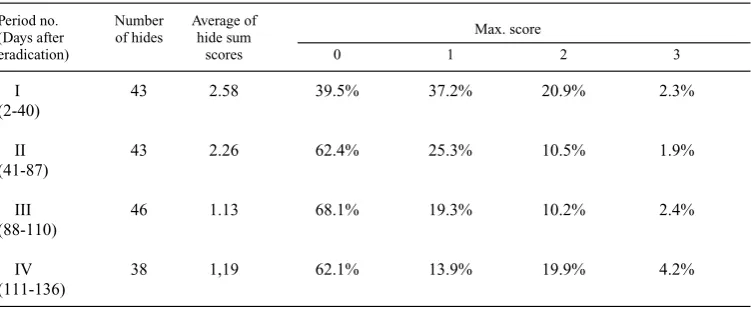
The change in the frequencies of damage dur-ing the whole period after eradication is shown in Table 3. The frequencies of hides without damage increased significantly during the peri-ods I-III. The percentage of hides from rein-fected herds increased noticeably with time af-ter eradication up to 53.8% in period IV. Hides from period I (2-136 days after eradication) are classified in more details according to time af-ter eradication in Table 3B. The frequency of hides without damage increased significantly during periods 1-3. The difference between pe-riod 3 and 4 was not statistically significant.
Seasonal effects
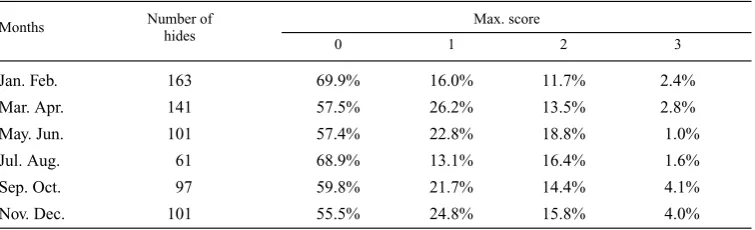
The seasonal variation in hide damage after the eradication of lice is presented in Table 4. There was no significantly seasonal variation in the frequency of light flecks and spots after treat-ment.
Ta bl e 4 . Seasonal variations in the frequency of light flecks and spots after the eradication of lice.
Months Number of Max. score
hides
0 1 2 3
Jan. Feb. 163 69.9% 16.0% 11.7% 2.4%
Mar. Apr. 141 57.5% 26.2% 13.5% 2.8%
May. Jun. 101 57.4% 22.8% 18.8% 1.0%
Jul. Aug. 61 68.9% 13.1% 16.4% 1.6%
Sep. Oct. 97 59.8% 21.7% 14.4% 4.1%
Nov. Dec. 101 55.5% 24.8% 15.8% 4.0%
Score 0 - No damage
Score 1 - Slight damage, with 1-2 light fleck or spot pr. 100 cm2.
Score 2 - Some damage, with 3-5 light fleck or spots pr. 100 cm2.
Discussion
Systematic treatment for the eradication of lice decreased the frequency of hides with light flecks and spots from 75.8% to 38.4%. The ex-tent of damage on affected hides also decreased significantly. This investigation confirms the importance of lice for the development of light flecks and spots on cattle hides and supports the observations of Bugby et al.(1990) and Webster & Bugby(1990), who were the first to suggest lice as the main cause of light flecks and spots on cattle leather.
The frequencies of hides with light flecks and spots decreased in all anatomical regions after the eradication of lice. The distribution of dam-age before treatment corresponded to the distri-bution of lice on the animals (Chalmers & Charleston 1980, DeVaney et al. 1988). The difference in the presence of damage in regions of the hide before and after treatment was most marked in the neck and shoulder region, which is the major predilection site of cattle lice. For the whole period after eradication, 38% of the hides were still affected by light flecks and spots. The period with highest frequency of hides without damage was 326 to 477 days af-ter eradication. The frequency of hides without damage subsequently decreased, probably due to the proportion of hides from reinfected herds. Given the design of the study, it was not possible to estimate an exact time of reinfec-tion. However, the lice population in the rein-fected herds was much lower after reinfection than before eradication. Because of these find-ings, it was decided to include the hides from all herds even after the reinfection. The frequency of hides with light flecks and spots from ani-mals born after eradication was similar to the frequency from animals born before eradica-tion, about 35%. These results indicate that light flecks and spots may have causes other than lice and suggest that while the hide dam-age is closely associated with lice, it is not
spe-cific for lice. According to the results of the present study, 40%-45% of the light flecks and spots seemed to have causes other than lice under Norwegian conditions. George et al.
(1986) suggested that Psoroptes ovis(Herning 1838) infestations in cattle may cause light flecks and spots, but this ectoparasite does not occur in Norway. Everett et al. (1977) found that damage similar to light flecks and spots was caused by various tick species, but could identify no evidence of hide damage caused by short nosed sucking lice (Haematopinus eurys-ternusDenny 1842), flies or mosquitoes. Under Norwegian conditions, Ixodes ricinus (Lin-neaus 1758), is the only present tick. However, this tick was not included in the present investi-gation because only two herds were localised in areas where this tick usually occurs. The distri-bution of the damage on hides also differed from the expected distribution of damage caused by ticks. Recent research by British Leather Confederation (BLC) has suggested that the stable fly (Stomoxys calcitrans Lin-naeus 1758) may be a cause of light flecks and spots (Bugby personal communication). This fly may also be a cause of hide damage under Norwegian conditions, but so far this has not been confirmed. It should be noted that the treatment in the present study may have a tem-porary effect on the fly population in the herds. However, stable fly may be a cause of the per-sistence of light flecks and spots on hides after the eradication of lice.
hides without damage increased to more than 60% during the first three to four months after treatment. This observation was possibly con-founded by the increasing proportion of hides from reinfected herds over the period of the present study. The investigation by Bugby et al.
(1990) showed very slight damage on the leather nine weeks after treatment. These au-thors suggested however, that hides from ani-mals which had been infested with lice could never be used for top quality aniline leather. More research is needed to determine more pre-cisely the duration of the healing period follow-ing injuries induced by lice.
Before treatment, the frequency of hides with light flecks and spots varied significantly during the year. The variations were consistent with lice as a main cause of the damage and the fre-quency of hide damage varied according to the changes in the lice population during the year (Nafstad & Grønstøl2001a). The demonstra-tion in the present study that this seasonal vari-ation is eliminated following the eradicvari-ation of lice, emphasises the importance of lice for the development of light flecks and spots on cattle hides.
References
Bugby A, Webster RM, Tichener RN:Light spot and fleck, part 2, animal infestation studies. Labora-tory report 186. British Leather Confederation, Northampton, 1990.
Chalmers K, Charleston WAG: Cattle lice in New Zealand: observations on the biology and ecology of Damalinia bovisand Linognathus vituli. N. Z. vet. J. 1980, 28,214-216.
Christensson D, Gyllensvaan C, Skiøldebrand E, Vir-ing S:Løss på nøtkreatur i Sverige - en inventer-ing (Lice in Swedish cattle - a survey). Svensk Vet. -Tidn. 1994, 46,119-121. (In Swedish) DeVaney JA, Rowe LD, Craig TM:Density and
distri-bution of three species of lice on calves in Cen-tral Texas. Southwestern Entomol. 1988, 13, 125-130.
Everett AL, Miller RW, Gladney WJ, Hannigan MV: Effects of some important ectoparasites on the
grain quality of cattle hide leather. J. Am. Leath. Chem. Ass. 1977, 72,6-23.
George JE, Wright FC, Guillot FS, Buechler PR: Ob-servations on the possible relationship between psoroptic mange of cattle and white spot damage on leather. J. Amer. Leath. Chem. Ass. 1986, 81, 296-304.
Hiepe T:Advances in control of ectoparasites in large animals. Angew. Parasit. 1988, 29, 201-210.
Nafstad O, Grønstøl H: Variation in level of the grain defect light flecks and spots on cattle hides. Acta Vet. Scand. 2001, 42,91-98.
Nafstad O, Grønstøl H: Eradication of lice in cattle. Acta Vet. Scand. 2001b 42,81-89. Rotz A, Mumcuoglu Y, Pohlenz JFL, Suter M,
Bros-sard M, Barth D:Experimentelle Infestation von Rindern mit Ektoparasiten und deren Einflub auf die Lederqualität (Experimental infestation of cattle with ectoparasites and their effect on leather quality). Zbl. Vet. Med. 1983, 30, 397-407.
SAS Institute Inc: SAS/STSTTM:Guide for personal computers. Version 6. Edition, Cary, NC, 1989. Webster RM, Bugby A:Light spot and fleck grain
de-fects of economic importance to the UK leather industry, part 1, identification of causal agent. Laboratory report 184. British Leather Confeder-ation, Northampton, 1990.
Sammendrag
Effekten av sanering for lus på forekomsten av narv-feilen lyse flekker og prikker på storfehuder.
viktigste predileksjonsstedet for pelslus (Damalinia bovis)og er et sentralt predileksjonssted også for blodlus (Linognathus vituli).Effekten av sanering for lus bekreftet dermed disse luseartene sin sentrale betydning for utviklingen av denne typen kvalitets-feil på lær. Nedgangen i forekomsten av lyse flekker og prikker startet umiddelbart etter sanering, den ve-sentligste kvalitetsforbedringen skjedde i løpet av de første fire månedene etter sanering. En stabil fore-komst av lyse flekker og prikker på 30-40% av
hu-dene også etter sanering kan indikere en lang avhe-lingstid, eventuelt at skader lus påfører huden slik de framstår etter garving er delvis livsvarige. Forekom-sten av skader etter sanering kan også indikere at ska-den lyse flekker og prikker ikke er spesifikk for-årsaket av lus, men også kan skyldes andre ektoparasitter. Under norske forhold er trolig stallflue (Stomoxys calcitrans)sentral i tillegg til de to lusear-tene. Sanering for lus opphevet den sesongmessige variasjonen i forekomsten av lyse flekker og prikker.
(Received February 1, 2000; accepted September 26, 2000).