J. Appl. Res. Ind. Eng. Vol. 4, No. 1 (2017) 59-66
Journal of Applied Research on Industrial
Engineering www.journal-aprie.com
Assessment of Robustness Index and Progressive Collapse in the
RC Frame with Shear Wall Structure under Blast Loading
Hadi Faghihmaleki *†
Faculty of Civil Engineering, Babol Noshirvani University of Technology, Iran.
A B S T R A C T P A P E R I N F O
In the event of a critical incident, a comprehensive damage which occurs by eliminating a structural element is called progressive collapse. At the moment of explosion, redistributing the carried load by members of damaged structural element or adjacent members may lead to excessive tension or exceeding the load capacity of the other members of that damage as a result of diffusion. To study the phenomenon of progressive collapse and structural robustness index under blast loading, four types of structures with RC moment frame with shear walls in four, seven, twelve, and fourteen story levels, have been considered with the same plan. In the above-mentioned buildings, some structural elements have been removed and the impact of these scenarios on the dynamic behavior of structures during the explosion has been examined. In this study, the potential and capacity structures against the progressive collapse and the failure modes using local dynamic analysis of the explosion have been determined. Also, structural robustness index has been evaluated. The outcome of this study is to find the most probable failure mode which can be used to improve the reliability of structures in seismic zones.
Chronicle:
Received: 18 July 2017 Revised: 16 August 2017 Accepted:21 August 2017 Available : 24 August 2017
Keywords :
Robustness index. Progressive collapse. RC moment frame with shear wall.
Explosion.
Local dynamic analysis of explosion.
1. Introduction
A strategic structure could be subjected to more than one critical action during its service life, including earthquake, wind, blast or fire. Typically, ordinary structures with a relative importance are designed and calculated when subjected to earthquake or sometimes wind load. Rarely can we find a structure with relative importance which is specifically designed against critical loads such as blast or fire. Progressive collapse is one outcome of these critical loads. The progressive collapse can be defined as a situation where local failure of a primary structural component leads to total collapse of the structure [1]. Recently, some studies have been performed on the blast-induced damage in the building and its probabilistic investigations.
* Corresponding author
Recently Rong and Li [2] undertook a probabilistic assessment of the effect of potential blast loadings and their resultant damage scale on building structures. Using Monte-Carlo simulation and single-degree-of-freedom (SDOF) system, they examined the maximum displacement and displacement ductility factor of a reinforced concrete structure with flexural frames under blast loadings. Shi et al. [3] generated a new method for progressive collapse analysis of reinforced concrete (RC) frame structures by considering non-zero initial conditions and initial damage to adjacent structural members under blast loading. They compared Numerical results with those obtained using the alternative load path method, and with those from comprehensive numerical simulations by directly applying the blast loads on the frame.
Stewart and Netherton [4] investigated the effect of window glazing damage subjected to explosive blast loading. They used structural reliability techniques to derive explosive fragility curves. In this research, the structure was subjected to explosive loading for a variety of scenarios. They obtained a risk-based measure for calculating the probable damage of a structure subjected to explosive loading. Parisi and Augenti [5] performed a research on the ability and robustness of a RC building, which was designed, based on seismic design codes and subjected to explosive loads. In their research, they generated scenarios based on the location and the amount of explosives. A Pushdown analysis was performed to evaluate the robustness of the building against explosive load. Cizelij et al. [6], proposed an analysis method for a structure subjected to blast load. Their proposed method predicted failure and non-linear responses. The obtained results were comparable to dynamic simulations.
Khandellwal et al. [7] concluded that a same-centered braced frame is less vulnerable against progressive collapse than a specially braced one. Kim and Kim [8] showed that dynamic enlargement could be bigger than 2, which is recommended by UFC and GSA. FU [9] stated that under similar general conditions, removing a column at a higher level causes greater vertical movement than removing a column at ground level. Liu [10] analyzed twist and curvature action, showing that this effect can significantly decrease bending moment by binding the beam axially. Furthermore, two methods have been suggested to improve and reinforce the beam-column connection of tall steel frame structures, which are exposed to terrorist explosions. England et al. [11] studied the importance of vulnerability evaluation of a structure on unexpected events, also dealing with the nature of such events. Moreover, a structural vulnerability theory which studies the simple form for determining the most vulnerable stage of the damage has been explained.
2. Numerical Example
61 Assessment of robustness index and progressive collapse in….
building, i.e. a strategic structure with high importance, which is designed according to the European seismic provisions. Gravity load includes live and dead loads. Dead load of floors was considered 550 kg/m2, live load 200 kg/m2 and roof load 150 kg/m2. Other types of loading including wind load and snow load were ignored. Moreover, structure-soil interaction was ignored and columns are assumed to be fixed in base. The roof is supposed to be one-way slab, 0.25m thick. The shear walls of the building, based on the architectural plan of the building, are assumed to be without any opening. On this basis, three types of shear walls are designed. Table 1 presents the properties of shear wall in each story. During blast scenario, materials are rapidly loaded by higher strain rates. Thus, plastic deformations are much less than those in the case of static loading at normal strain rates. It was found that the mechanical properties of materials during blast loading are increased. The ratio between the material property under rapid dynamic load and the same property under static loading is defined as the dynamic increase factor (DIF) [13].
2.1. Explosive loading
Explosion is a chemical process that prompts an increase in the pressure and temperature of the blast environment. In case of an explosion, a wavelet with the same speed and force as the blast, spreads in a specific period of time, which does not exceed 10-2 s. the explosion would also produce flames and high speed pressure (V> 103 𝑚
𝑠). A sudden explosion can raise the dust as well, and thus it is gravely destructive. In keeping with what is discussed, this research paper investigates the effects of sudden abnormal blast pressures on structural elements. However, the impact of the dust rose in the air and also the flames are ignored in this research. Blast overpressure time history is measured in two phases. The positive phase: it is quick and forceful; negative phase: it lasts longer but is never as strong as the positive phase. Presupposing an infinite quantity, it is possible to determine post-blast pressure time history by the use of modified Friedlander equation [14].
𝑃(𝑡) = 𝑃0+ 𝑃𝑚𝑎𝑥(1 − 𝑡
𝑡𝑑) 𝐸𝑋𝑃(−
𝑏𝑡
𝑡𝑑) (1)
where 𝑡′is the blast wave duration from the moment (t
a) when the pressure wave enters the target (𝑡′= 𝑡 - 𝑡𝑎). 𝑃𝑜 is the ambient atmospheric pressure; 𝑃𝑚𝑎𝑥 is the peak overpressure; 𝑡𝑑is the positive phase duration and b is the waveform parameter [15]. The first phase of overpressure time history can be assessed as a triangular force according to its rise time. Therefore, assuming the initiation time to be equal to 𝑡𝑎 and t < 𝑡𝑑 equation (7) can be substituted by the following:
𝑃(𝑡) = 𝑃0+ 𝑃𝑚𝑎𝑥(1 − 𝑡
where 𝑝𝑚𝑎𝑥 is blast parameter dependent on the reduced distance (z = 𝑅
𝑤1⁄3) in which R is the
distance of the target from the blast center (meter); and w is explosive charge mass (Kg, eq TNT) [16].
Fig1. 3D model view
Table 1. The properties of the shear walls used.
wall name The story of
interest Thickness of
wall (cm) Re-inforcement
Re-inforcement ratio (ρ)
W1 1,2,3,4,5
35 φ22@15cm
0.01
W2 6,7,8,9
35 φ18@15cm
0.007
W3 10,11,12,13,14,15
30 φ16@15cm
63 Assessment of robustness index and progressive collapse in….
Blasts caused by various explosive materials of different weights produce the same peak overpressure, only when their reduced distances (z) are the same. As a result, the mass (in TNT) of any explosive material can be estimated by the following:
𝑤 = 𝐻𝑒
𝐻𝑇𝑁𝑇𝑊𝑒 (3)
where 𝐻𝑒is the heats of combustion of the explosive substance and 𝐻𝑇𝑁𝑇 is the heat of combustion of TNT material. 𝑊𝑒 is explosive substance mass. Peak overpressure (𝑃𝑚𝑎𝑥) in (kg
cm2) can be calculated in this way [17]:
𝑃𝑚𝑎𝑥 = 14.0717 𝑍 +
5.5397 𝑍2 −
0.3572 𝑍3 +
0.00625
𝑍4 if 𝑍 [0.05 , 0.3] (4)
𝑃𝑚𝑎𝑥 = 6.1938 𝑍 −
0.3262 𝑍2 +
2.1324
𝑍3 if 𝑍 [0.3 , 1] (5)
𝑃𝑚𝑎𝑥 = 0.662 𝑍 +
4.05 𝑍2 +
3.288
𝑍3 if 𝑍 [1 ,10] (6) Positive phase duration of overpressure time history (s) can be deduced from the following [18]:
𝑡𝑑 = 10−3𝑘 √𝑤6
√𝑅 (7) where k is a constant usually assumed to be 1.3.
3. Seismic Progressive Collapse Analysis
In order to review frames, at first gravitational loads were inserted to the structure, and then the predefined braces were removed from the structure; afterwards earthquake acceleration was performed and its consequent response got analyzed. Simulations were carried out with relative hardness damping of 5%. In order to study structural behavior of braced frames with considered braces during the absence of important and vital members, in all three studied frame models one or two buckling braces on the first story were selected to be suddenly removed. In order to compare the controlling effects of the force with controlling impacts of transition, the transition was conducted based on the performance of such understandings. To do so, the presented limit state in FEMA 356 was used to model the parameters and acceptance criterion for nonlinear dynamic methods. In order to calculate the updated failure rotation of columns and beams under load increase, in each step the axial power of one structural element was used at the moment of calculation.
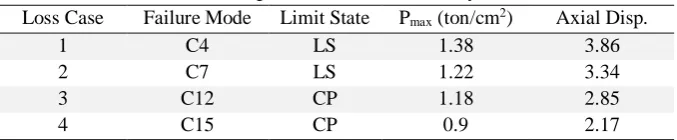
updated as a function of failure rotation. By having numerous analyses, related to limits states of FEMA 356 were calculated. Table 4 lists the performance-based analysis, related to each limit state for each scenario, in which LS and CP are Life Safety and Collapse Prevention, respectively.
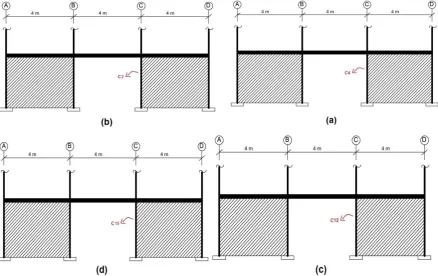
Fig 2. Numbered columns to: a. four-story structure, b. 7-story structures, c. construct 12-story, d. construct 14 floor. (The first floor of the frame number 1).
Table 2 lists the lack of modes in this research study were taken with members in every state offers. Dynamic Analysis of localized for any loss caused by an explosion [19] to determine the maximum drift and structural performance was within the class. In Fig. 3 curve Drift- maximum explosion pressure to show frames.
Table 2. Shows the lack elements.
Removed Element Frame Type
Loss Scenario
C4 Column
1
C7 Column
2
C12 Column
3
C15 Column
65 Assessment of robustness index and progressive collapse in….
Fig 3. Curve of maximum explosion Pressure- Drift of the frames.
Table 3. Results of performance-based analysis.
Axial Disp. Pmax (ton/cm2)
Limit State Failure Mode
Loss Case
3.86 1.38
LS C4
1
3.34 1.22
LS C7
2
2.85 1.18
CP C12
3
2.17 0.9
CP C15
4
According to Table 3, it can be observed that in the studied structures in all scenarios, rupture columns, the primary failure mode and original. For example, in the case of structures 1 and 2, the failure limit state LS 0.24 and 0.29 percent, according to FEMA 356, while in the absence of 3 and 4, rupture, 0.33, 0.47, respectively, are in part CP.
4. Conclusions
References
[1] Gerasimidis, S. (2014). Analytical assessment of steel frames progressive collapse vulnerability to corner
column loss. Journal of Constructional Steel Research, 95(2014), 1-9.
[2] Rong, H.C.; and Li, B. (2007). Probabilistic response evaluation for RC flexural members subjected to blast loadings. Journal of Structural Safety, 29(2), 146-163.
[3] Shi, Y.; Li Z.X.; and Hao, H. (2010). A new method for progressive collapse analysis of RC frames under
blast loading. Journal of Engineering Structures, 32(6), 1691-1703.
[4] Stewart, M.G.; and Netherton, M.D. (2008). Security risks and probabilistic risk assessment of glazing subject to explosive blast loading. Journal of Reliability Engineering and System Safety, 93(4), 627-638. [5] Parisi, F.; and Augenti, N. (2012). Influence of seismic design criteria on blast resistance of RC framed
buildings: A case study. Journal of Engineering Structures, 44, 78-93.
[6] Cizelj, L.; Leskovar, M.; Čepin, M.; and Mavko, B. (2009). A method for rapid vulnerability assessment
of structures loaded by outside blasts. Journal of Nuclear Engineering and Design, 239(9), 1641-1646.
[7] 12. Mander, J.B.; Priestley, J.N.; and Park, R. (1988). Theoretical stress-strain model for confined concrete. Journal of Structural Engineering, 114(8), 1804-1826.
[8] 13. Lu, Y.; and Xu, K. (2004). Modelling of dynamic behaviour of concrete materials under blast loading.
International Journal of Solids and Structures, 41(1), 131-143.
[9] Baker, W.E. (1973). Explosions in the air. Austin and London: University of Texas Press.
[10] Baker, W.W.; Cox, P.A.; Westine, P.S.; Kulesz, J.J.; and Strehlow, R.A. (1983). Explosion hazards and evaluation. Amsterdam: Elsevier.
[11] Henrych, J. (1979). The dynamics of explosion and its use. Amsterdam and New York: Elsevier Scientific
Publishing Company.
[12] Sadovsky, M.A. (1952). Mechanical effects of air shock waves from explosion according to experiments.
In: Physics of explosions: symposium - no. 4, AN SSR, Moscow.
[13] Council, B. S. S. (2000). Prestandard and commentary for the seismic rehabilitation of buildings. Report
FEMA-356, Washington, DC.
[14] International Conference of Building Officials. (2007). Unified Building Code.
[15] Mander, J. B., Priestley, M. J., & Park, R. (1988). Theoretical stress-strain model for confined concrete.
Journal of structural engineering, 114(8), 1804-1826.
[16] Fragiadakis, M., & Papadrakakis, M. (2008). Modeling, analysis and reliability of seismically excited structures: computational issues. International journal of computational methods, 5(04), 483-511.
[17] Asgarian, B. and Hashemi Rezvani, F. (2010). Determination of Progressive collapse-impact factor of
concentric braced frames, Proceedings of the fourteenth European conference on earthquake engineering.
Ohrid, Republic of Macedonia.
[18] Black, R. G. and Wenger, W.A.B and Popov, E.P. (1980). Inelastic buckling of steel struts under cyclic load reversals. Report No: UCB/EERC-80/40.