International Journal of Engineering Trends and Technology (IJETT) – Volume 15 Number 9 – Sep 2014
ISSN: 2231-5381
http://www.ijettjournal.org
Page 434
Design and Analysis of Rectangular Microstrip
Antenna using Slotted Substrate Structure to
Minimize Fabrication Error
Sudarshan Kumar Jain, Sandeep Toshniwal, Dr.Rajesh Purohit
Abstract
—
A wide band rectangular microstrip patch antenna with resonant frequency variation characteristics using slotted substrate structure is proposed in this paper. The antenna is designed at a frequency of 5 GHz and it has wide band characteristics. Here the different resonant frequencies are received due to slotted substrate structure of the antenna. Slotted substrate structure changes the effective dielectric constant of the substrate. The antenna is energized using the microstrip line feeding method. VSWR of the designed rectangular patch antenna is less than 2. The different characteristics of the antenna such as return loss, gain, directivity, bandwidth, radiated field and VSWR is analysed for different sizes of the slots made in the dielectric substrate of the antenna. It is observed that the designed antenna gives the various resonant frequencies for the different sizes of the slots made in the antenna substrate. So this antenna can be used to minimize the fabrication error in the designed antenna without varying the patch size. Duroid is used as substrate material for the designing of the antenna. The antenna design is simulated by using the High Frequency Structure Simulator (HFSS) software.Keywords— Microstrip antenna, Resonant Frequency,
Microstrip feeding, HFSS, VSWR
I. INTRODUCTION
Microstrip Patch antennas have many applications such as antenna for high speed vehicles, missile tanks, satellite communication and other strategic defence equipments. Numerous advantages of microstrip antenna over the conventional microwave antenna such as light weight, low cost, low volume, planar configuration and compatibility with integrated circuits associated with diversified application have observed by the researchers. It is expected that microstrip antenna will alternately replace the conventional microwave antennas for most of the application in future.
A microstrip patch antenna consists a sandwich of two parallel conducting layers separated by a single dielectric substrate as shown in fig.1
The patch conductors are normally of copper and gold. The lower conductor works as a ground plane and the upper conductor may be a simple patch of any desired shape. The conventional shape of the patch is rectangular, circular, square, triangular, elliptical etc. The ℇr of the substrate should
be low in order to enhance the fringing fields which are responsible for most of the radiations from the patch. Radiation in microstrip antenna occurs from the fringing fields existing at the open circuited end or edges of the patch. The
fringing fields at the two open circuited ends of the patch can be resolved in two components: one normal to the ground plane and the other parallel to the ground plane.
Fig. 1 Microstrip patch antenna structure
II. ANTENNA DESIGN
The antenna is designed and analysed at a resonant frequency of 5GHz for the different sizes of the slots made in the antenna substrate .The substrate used for the designing of the antenna is duroid having dielectric constant of 2.2.
ISSN: 2231-5381
http://www.ijettjournal.org
Page 435
The antenna is designed using duroid material as dielectric substrate with dielectric constant ℇr = 2.2, and thickness h=1.6
mm. The antenna is designed to operate at a frequency of 5 GHz. The substrate has a compact size of 28.36mm×26.96 mm as shown in fig.3.3. In order to fulfil the requirements of a portable device, a microstrip feed line is designed for 50Ω
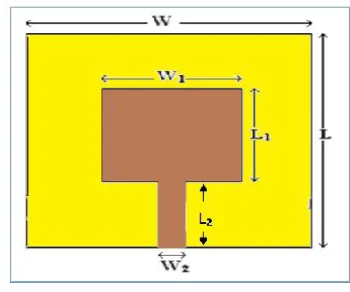
characteristic impedance with 3mm width. The first step to design a rectangular patch antenna is to compute its physical dimensions. The effective dielectric constant, physical width and length are calculated using design equations. Various optimized parameters of antenna are W=26.96 mm, W1=19.3mm, W2=3mm, L=28.36mm, L1=23.72mm,
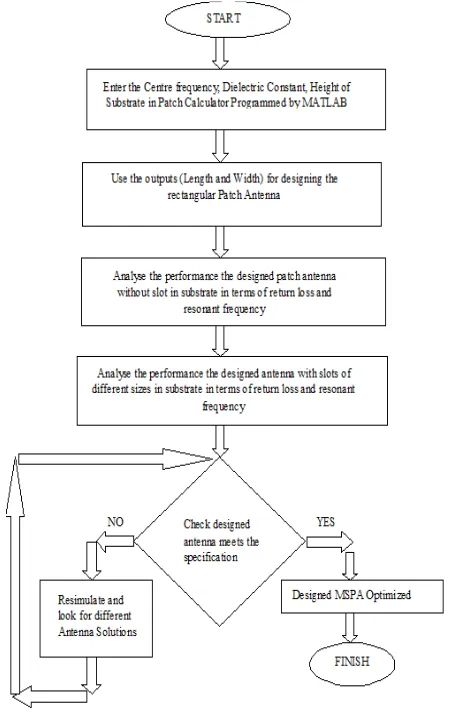
L2=8.2mm. Fig. 3 and fig.4 shows the actual HFSS design for
the designed antenna and flow chart respectively.
Fig.3 Actual HFSS design of antenna
Here the antenna design is simulated for the various sizes of the rectangular and the square slots made in the dielectric substrate. Due to the change in effective dielectric constant of the substrate the resonant frequency of the antenna changes. A ratio between the area of slot to the area of patch (As/Ap) is also calculated for finding out the percentage change in resonant frequency of the antenna since the area of patch is constant.
For each slot size and resonant frequency the designed antenna is simulated using HFSS for the various properties of antenna such as gain, directivity, return loss, voltage standing wave ratio and radiated E field etc. All the parameters are compared for the different slot sizes made in the substrate. The resonant frequency of the antenna is analysed for both conventional structure and the slotted substrate structure. From the simulated results it is found that the antenna has different resonant frequencies for the different sizes of the slot which can be used to minimize the fabrication error in the antenna without varying patch size
.
The different characteristics of the antenna such as return loss, gain, bandwidth, directivity, radiated field and VSWR is analysed for this designed antenna. It is observed that the different resonant frequencies are achieved for the different sizes of the slots made in the designed antenna using slotted substrate structure. The antenna design is simulated using High frequency structure simulator software
.
Fig.4 Flow chart for the designed antenna
TABLE 1
DESIGNED ANTENNA DIMENSIONS IN MM
WS LS AS WP LP AP AS/AP
1 1 1 19.3 23.72 457.796 0.00218
4 5 20 19.3 23.72 457.796 0.04369
7 7 49 19.3 23.72 457.796 0.10703
9 9 81 19.3 23.72 457.796 0.17693
10 10 100 19.3 23.72 457.796 0.21844
9 13 117 19.3 23.72 457.796 0.25557
11 11 121 19.3 23.72 457.796 0.26431
12 12 144 19.3 23.72 457.796 0.31455
13 11 143 19.3 23.72 457.796 0.31237
International Journal of Engineering Trends and Technology (IJETT) – Volume 15 Number 9 – Sep 2014
ISSN: 2231-5381
http://www.ijettjournal.org
Page 436
Here WS=Width of the slot, LS= Length of the slot
AS= Area of the slot, WP= Width of the Patch
LP= Length of the Patch, AP= Area of the Patch
III.RESULTS AND DISCUSSION
The designed microstrip wide band rectangular patch antenna is simulated by using the software HFSS (High Frequency Structure simulator). The simulated results for return loss, antenna gain, VSWR, directivity, electric field are observed for the different sizes of the slots made in the antenna substrate. All the outputs of the designed antenna using slotted substrate and conventional substrate is shown below
A. Simulation results without slotted substrate:
Fig.5 Return loss Vs Frequency of the antenna
It is clear from the fig.5 that a resonant frequency of 4.9799 GHz when no slotted substrate is used. The minimum return loss is -22.7361 dB.
Fig.6 VSWR of the antenna
From the fig.6 it is clear that the voltage standing wave ratio for antenna is 1.1574 or near to unity.
Fig.7 Gain of the antenna
Fig.7 shows that the maximum gain of the antenna is 8.635dB
Fig.8 Directivity of the antenna
Fig.8 shows that the maximum directivity of 9.77 dB.
B. Simulation results with slotted substrate:
1) When slot size is 1mm x 1mm:
Fig.9 Return loss Vs Frequency of the antenna
According to Fig.9 resonant frequency of 5.02 GHz is received having return loss of 26.4133dB .Bandwidth of the antenna at this frequency is 600MHz.
Fig.10 VSWR of the antenna
From 10 it is seen that the voltage standing wave ratio for the antenna is near to unity or it is 1.1004.
1.00 2.00 3.00 4.00 5.00 6.00 7.00 8.00 9.00 10.00
Freq [GHz] -25.00
-20.00 -15.00 -10.00 -5.00 0.00
d
B
(S
(1
,1
))
HFSSDesign1
XY Plot 96 ANSOFT
m1
MX1: 1.0000
-0.5067 Curve Info
dB(S(1,1)) Setup1 : Sw eep
Name X Y
m1 4.9799 -22.7361
1.00 2.00 3.00 4.00 5.00 6.00 7.00 8.00 9.00 10.00
Freq [GHz] 0.00
5.00 10.00 15.00 20.00 25.00 30.00 35.00
m
a
g
(V
S
W
R
(1
))
HFSSDesign1
XY Plot 97 ANSOFT
m1
Curve Inf o mag(VSWR(1)) Setup1 : Sweep
Name X Y
m1 4.9799 1.1574
1.00 2.00 3.00 4.00 5.00 6.00 7.00 8.00 9.00 10.00
Freq [GHz] -30.00
-25.00 -20.00 -15.00 -10.00 -5.00 0.00
d
B
(S
(1
,1
))
HFSSDesign1
XY Plot 99 ANSOFT
m1
Curve Inf o dB(S(1,1)) Setup1 : Sw eep
Name X Y
m1 5.0251 -26.4133
1.00 2.00 3.00 4.00 5.00 6.00 7.00 8.00 9.00 10.00
Freq [GHz] 0.00
12.50 25.00 37.50
m
a
g
(V
S
W
R
(1
))
HFSSDesign1
XY Plot 100 ANSOFT
m1
Cur ve Info mag(V SWR(1)) Setup1 : Sw eep
Name X Y
ISSN: 2231-5381
http://www.ijettjournal.org
Page 437
Fig.11 Gain of the antenna
Fig.12 Directivity of the antenna
2) When slot size is 7mm x 7mm:
Fig.13 Return loss Vs Frequency of the antenna
According to the Fig.13 resonant frequency of the antenna is 4.9799 GHz and the return loss is -24.1409dB. Bandwidth of the designed antenna at this frequency is 636.9 MHz so here the bandwidth is increased.
Fig.14 VSWR of the antenna
Voltage standing wave ratio for the designed antenna for the given slot size is 1.1324, that is near to unity and gives good performance.
Fig.15 Gain of the antenna
Fig.16 Directivity of the antenna
1.00 2.00 3.00 4.00 5.00 6.00 7.00 8.00 9.00 10.00
Freq [GHz] -25.00
-20.00 -15.00 -10.00 -5.00 0.00
d
B
(S
(1
,1
))
HFSSDesign1
XY Plot 96 ANSOFT
m1
Curve Info dB(S( 1,1)) Setup1 : Sw eep
Name X Y
m1 4.9799 - 24.1409
1.00 2.00 3.00 4.00 5.00 6.00 7.00 8.00 9.00 10.00
Freq [GHz] 0.00
5.00 10.00 15.00 20.00 25.00 30.00 35.00
m
a
g
(V
S
W
R
(1
))
HFSSDesign1
XY Plot 97 ANSOFT
m1
Curve Inf o mag(VSWR(1)) Setup1 : Sweep
Name X Y
International Journal of Engineering Trends and Technology (IJETT) – Volume 15 Number 9 – Sep 2014
ISSN: 2231-5381
http://www.ijettjournal.org
Page 438
3) When slot size is 9mm x 9mm:
Fig.17 Return loss Vs Frequency of the antenna
According to Fig.17 resonant frequency of 5.0704 GHz is received having return loss of -25.7725dB .Bandwidth of the antenna at this frequency is 379.2 MHz.
Fig.18 VSWR of the antenna
Voltage standing wave ratio for the antenna for this slot size is 1.1085 or near to unity
.
Fig.19 Gain of the antenna
Fig.20 Directivity of the antenna
4) When slot size is 10mm x 10mm:
Fig.21 Return loss Vs Frequency of the antenna
Fig.21 shows that a resonant frequency of 5.1608 GHz is received for a return loss of -25.2548dB .Bandwidth of the antenna at this frequency is 655.3MHz.
Fig.22 VSWR of the antenna
Fig.22 shows that VSWR for the designed antenna is 1.1155.
1.00 2.00 3.00 4.00 5.00 6.00 7.00 8.00 9.00 10.00
Freq [GHz] -30.00
-25.00 -20.00 -15.00 -10.00 -5.00 0.00
d
B
(S
(1
,1
))
HFSSDesign1
XY Plot 97 ANSOFT
m1
Curve Info
dB(S(1,1)) Setup1 : Sw eep
Name X Y
m1 5.0704 -25.7725
1.00 2.00 3.00 4.00 5.00 6.00 7.00 8.00 9.00 10.00 Freq [GHz]
0.00 12.50 25.00 37.50
m
a
g
(V
S
W
R
(1
))
HFSSDesign1
XY Plot 98 ANSOFT
m1
Curve Info mag(VSWR(1)) Setup1 : Sw eep Name X Y
m1 5.0704 1.1085
1.00 2.00 3.00 4.00 5.00 6.00 7.00 8.00 9.00 10.00
Freq [GHz] -30.00
-25.00 -20.00 -15.00 -10.00 -5.00 0.00
d
B
(S
(1
,1
))
HFSSDesign1
XY Plot 95 ANSOFT
m1
Curve Inf o dB(S(1,1)) Setup1 : Sw eep
Name X Y
m1 5.1608 -25.2548
1.00 2.00 3.00 4.00 5.00 6.00 7.00 8.00 9.00 10.00
Freq [GHz] 0.00
12.50 25.00 37.50
m
a
g
(V
S
W
R
(1
))
HFSSDesign1
XY Plot 96 ANSOFT
m1
Curve Info mag(VSWR(1)) Setup1 : Sw eep
Name X Y
ISSN: 2231-5381
http://www.ijettjournal.org
Page 439
Fig.23Gain of the antenna
Fig.24 Directivity of the antenna
5) When slot size is 11mm x 11mm:
Fig.25 Return loss Vs Frequency of the antenna
Fig.25 shows that a resonant frequency of 5.206 GHz is received for a return loss of
-
31.4652dB .Bandwidth of the antenna at this frequency is 701.5MHz.Fig.26 VSWR of the antenna
Fig.27 Gain of the antenna
Fig.28 Directivity of the antenna
1.00 2.00 3.00 4.00 5.00 6.00 7.00 8.00 9.00 10.00
Freq [GHz] -35.00
-30.00 -25.00 -20.00 -15.00 -10.00 -5.00 0.00
d
B
(S
(1
,1
))
HFSSDesign1
XY Plot 97 ANSOFT
m1
Curve Inf o
dB(S(1,1)) Setup1 : Sw eep
Name X Y
m1 5.2060 -31.4652
1.00 2.00 3.00 4.00 5.00 6.00 7.00 8.00 9.00 10.00 Freq [GHz]
0.00 5.00 10.00 15.00 20.00 25.00 30.00 35.00
m
a
g
(V
S
W
R
(1
))
HFSSDesign1
XY Plot 98 ANSOFT
m1
Curve Inf o mag(VSWR(1)) Setup1 : Sw eep Name X Y
International Journal of Engineering Trends and Technology (IJETT) – Volume 15 Number 9 – Sep 2014
ISSN: 2231-5381
http://www.ijettjournal.org
Page 440
6) When slot size is 12mm x 12mm:
Fig.29 Return loss Vs Frequency of the antenna
According to Fig.29 resonant frequency of 5.2965 GHz is received having return loss of -39.5898dB .Bandwidth of the antenna at this frequency is 697MHz.
Fig.30 VSWR of the antenna
Fig.30 shows that voltage standing wave ratio for the designed antenna for the given slot size is 1.0212.
Fig.31 Gain of the antenna
Fig.32 Directivity of the antenna
7) When slot size is 13mm x 13mm:
Fig.33 Return loss Vs Frequency of the antenna
Fig.33 shows that a resonant frequency of 5.3869 GHz is received for a return loss of -26.8486dB .Bandwidth of the antenna at this frequency is 720MHz.
Fig.34 VSWR of the antenna
1.00 2.00 3.00 4.00 5.00 6.00 7.00 8.00 9.00 10.00
Freq [GHz] -40.00
-35.00 -30.00 -25.00 -20.00 -15.00 -10.00 -5.00 0.00
d
B
(S
(1
,1
))
HFSSDesign1
XY Plot 97
m1
Curve Info dB(S(1,1)) Setup1 : Sw eep
Name X Y
m1 5.2965 -39.5898
1.00 2.00 3.00 4.00 5.00 6.00 7.00 8.00 9.00 Freq [GHz]
0.00 5.00 10.00 15.00 20.00 25.00 30.00 35.00
m
a
g
(V
S
W
R
(1
))
HFSSDesign1
XY Plot 98
m1
Curve Info mag(VSWR(1)) Setup1 : Sw eep
Name X Y
m1 5.2965 1.0212
1.00 2.00 3.00 4.00 5.00 6.00 7.00 8.00 9.00 10.00
Freq [GHz] -30.00
-25.00 -20.00 -15.00 -10.00 -5.00 0.00
d
B
(S
(1
,1
))
HFSSDesign1
XY Plot 96 ANSOFT
m1
Curve Inf o
dB(S(1,1)) Setup1 : Sw eep
Name X Y
m1 5.3869 -26.8486
1.00 2.00 3.00 4.00 5.00 6.00 7.00 8.00 9.00 10.00 Freq [GHz]
0.00 5.00 10.00 15.00 20.00 25.00 30.00
m
a
g
(V
S
W
R
(1
))
HFSSDesign1
XY Plot 97 ANSOFT
m1
Curve Info
mag(VSWR(1)) Setup1 : Sw eep
Name X Y
ISSN: 2231-5381
http://www.ijettjournal.org
Page 441
Fig.34 shows that voltage standing wave ratio for the designed antenna is 1.0952 at a resonant frequency of 5.3869 GHz
.
Fig.35 Gain of the antenna
Fig.36 Directivity of the antenna
8) When slot size is 13mm x 11mm:
Fig.37 Return loss Vs Frequency of the antenna
According to Fig.37resonant frequency of 5.3417 GHz is receive having return loss of -54.3024dB .Bandwidth of the antenna at this frequency is 775.4MHz
.
Fig.38 VSWR of the antenna
According to Fig.38 voltage standing wave ratio for the designed antenna at resonant frequency of 5.3417 GHz is 1.0039.
Fig.39 Gain of the antenna
Fig.40 Directivity of the antenna
1.00 2.00 3.00 4.00 5.00 6.00 7.00 8.00 9.00 10.00
Freq [GHz] -60.00
-50.00 -40.00 -30.00 -20.00 -10.00 0.00
d
B
(S
(1
,1
))
HFSSDesign1
XY Plot 100 ANSOFT
m1
Curve Inf o dB(S(1,1)) Setup1 : Sw eep
Name X Y
m1 5.3417 -54.3024
1.00 2.00 3.00 4.00 5.00 6.00 7.00 8.00 9.00 10.00
Freq [GHz] 0.00
5.00 10.00 15.00 20.00 25.00 30.00 35.00
m
a
g
(V
S
W
R
(1
))
HFSSDesign1
XY Plot 99 ANSOFT
m1
Curve Info mag(VSWR(1)) Setup1 : Sw eep
Name X Y
International Journal of Engineering Trends and Technology (IJETT) – Volume 15 Number 9 – Sep 2014
ISSN: 2231-5381
http://www.ijettjournal.org
Page 442
9) When slot size is 9mm x 13mm:
Fig.41 Return loss Vs Frequency of the antenna
Fig.41 shows that a resonant frequency of 5.1156 GHz is received for the specified slot size and having return loss of –27.1685dB .Bandwidth of the antenna at this frequency is 609.3MHz.
Fig.42 VSWR of the antenna
Fig.43 Gain of the antenna
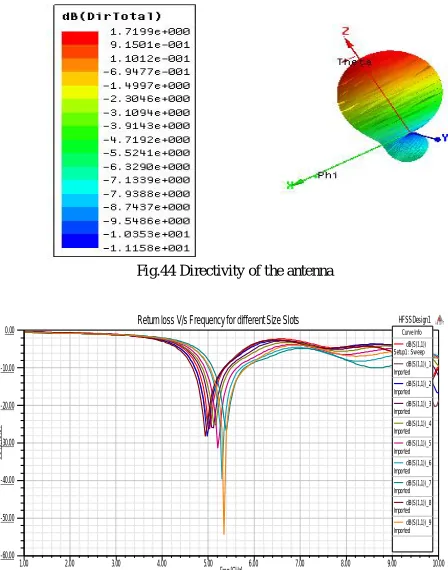
Fig.44 Directivity of the antenna
Fig.45 Return loss V/s Frequency for different size slots
Fig.45 shows the combined curve for return loss V/s frequency for different size slots made in the substrate of the designed antenna. So according to this curve various resonantfrequencies are received for different size slots.
TABLE 2
COMPARISON CHART OF OUTPUTS USING SLOTTED SUBSTRATE STRUCTURE
Slot size
(mm)
Resonant
frequency
(GHz)
Return loss
(dB) Gain
(dB)
Directivity
(dB)
VSWR Bandwidth
(MHz)
1×1 5.02 -26.41 1.40 1.44 1.10 600
7×7 4.97 -24.14 2.94 1.10 1.13 636.9
9×9 5.07 -25.77 7.83 8.05 1.10 379.2
10×10 5.16 -25.25 8.79 9.01 1.15 655.3
11×11 5.20 -31.46 9.25 9.44 1.05 701.5
12×12 5.29 -39.58 1.94 1.96 1.02 697
1.00 2.00 3.00 4.00 5.00 6.00 7.00 8.00 9.00 10.00
Freq [GHz] -30.00
-25.00 -20.00 -15.00 -10.00 -5.00 0.00
d
B
(S
(1
,1
))
HFSSDesign1
XY Plot 98 ANSOFT
m1
Curve Info dB(S(1,1)) Setup1 : Sw eep
Name X Y
m1 5.1156 -27.1685
1.00 2.00 3.00 4.00 5.00 6.00 7.00 8.00 9.00 10.00
Freq [GHz] 0.00
5.00 10.00 15.00 20.00 25.00 30.00 35.00
m
a
g
(V
S
W
R
(1
))
HFSSDesign1
XY Plot 99 ANSOFT
m1
Curve Info mag(VSWR( 1) ) Setup1 : Sw eep
Name X Y
m1 5.1156 1.0916
1.00 2.00 3.00 4.00 5.00 6.00 7.00 8.00 9.00 10.00 Freq [GHz]
-60.00 -50.00 -40.00 -30.00 -20.00 -10.00 0.00
d
B
(S
(1
,1
)
HFSSDesign1
Return loss V/s Frequency for different Size Slots ANSOFT Curve Info
dB(S(1,1)) Setup1 : Sw eep dB(S(1,1))_1 Imported
dB(S(1,1))_2 Imported
dB(S(1,1))_3 Imported
dB(S(1,1))_4 Imported
dB(S(1,1))_5 Imported
dB(S(1,1))_6 Imported
dB(S(1,1))_7 Imported
dB(S(1,1))_8 Imported
ISSN: 2231-5381
http://www.ijettjournal.org
Page 443
13×13 5.38 -26.84 2.01 2.03 1.09 720
13×11 5.34 -54.30 8.94 1.82 1.00 775.4
9×13 5.11 -27.16 1.66 1.71 1.09 609.3
4×5 4.93 -28.30 6.79 7.74 1.07 692.3
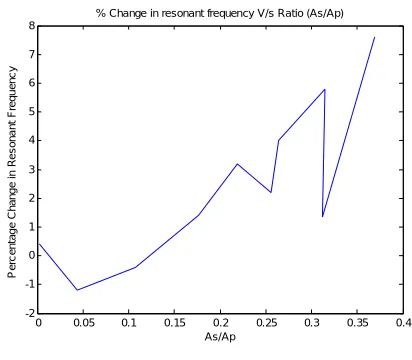
Table 2 shows the various parameter values of the antenna for the different sizes of the slots. So a curve can be drawn between the ratio (As/Ap) and the percentage change in resonant frequency value for the different size slots.
Fig.46 Change in resonant frequency Vs ratio As/Ap
So according to this curve a relation can be written for the percentage change in resonant frequency for different size slots and the ratio (As/Ap) which comes out-
y = p1*x^5 + p2*x^4 + p3*x^3 + p4*x^2 + p5*x + p6 Where Coefficients:
p1 = 16821, p2 = 9340.8, p3 = 326.06, p4 = 521.73, p5 = -60.278, p6 = 0.51056
y=% change in resonant frequency x= ratio (As/Ap)
So according to the above relation a required resonant frequency can be achieved for specific ratio of area of slot to area of patch, since the area of patch is constant, so a slot can be inserted in the substrate of the antenna without varying the size of the patch to get the required resonant frequency.
IV.CONCLUSION
So the antenna resonates at different different frequencies for the different sizes of the slots due to the change in effective dielectric constant of the substrate. According to table all the antenna characteristics such as return loss, gain, directivity, voltage standing wave ratio, and bandwidth are compared with respect to different sizes of the slots. The designed antenna gives a wide bandwidth of 775.4 MHz at a resonant frequency of 5.3417 GHz when a slot of 13mm × 11mm is made in the substrate. The voltage standing wave ratio at all the resonant frequencies received by varying the size of the slots in substrate is near to unity. So this antenna gives good performance. The relation between the percentage change in resonant frequency and the ratio(As/Ap) is used to calculate the required area of slot which is to be inserted in the original substrate to get the required resonant frequency without varying the patch size. So the fabrication error can be removed by making a slot in the substrate without varying the patch of the size.
References
[1] Zhu Yongxiang, Chen Jianjun, SongXuerui, Cao Hongxi, “The Design
Study of the Wide Bandwidth and High Gain RFID Microstrip Patch
Antenna”, Third IEEE International Conference on Intelligent System
Design and Engineering Applications-2013.
[2] K. Jhamb L. Li K. Rambabu, “Frequency adjustable microstrip annular
ring patch antenna with multi-band characteristics”, IET Microwave. Antennas Propagation, 2011, Vol. 5, Issue 12, pp. 1471–1478 & the Institution of Engineering and Technology 2011.
[3] Manvendra Singh Bhandari, Dr.Gupta ,“ Increasing resonant frequency
of Microstrip Patch Antenna by decreasing the value of dielectric constant of substrate”, International Journal of Advanced Research in Computer Engineering & Technology Volume 1, Issue 5, July 2012
[4] Alix Rivera-Albino, Constantine A. Balanis, “Gain enhancement in
microstrip antenna using hybrid substrates,” IEEE Antennas and Wireless Propagation Letters, Vol. 12, 2013
[5] Bilal Ahmed, Ilyas Saleem, “Analytical Study on Effects of Substrate
Properties on the Performance of Microstrip Patch Antenna”, International Journal of Future Generation Communication and Networking,Vol.5,No.4,December,2012
0 0.05 0.1 0.15 0.2 0.25 0.3 0.35 0.4
-2 -1 0 1 2 3 4 5 6 7 8
As/Ap
P
e
rc
e
n
ta
g
e
C
h
a
n
g
e
i
n
R
e
s
o
n
a
n
t
F
re
q
u
e
n
c
y