1
TRUST IN KNOWLEDGE TRANSFER PROCESS VIA
ELECTRONIC BANKING WEB SITE
Ali Abu Zaid1, Norhidayah Azman2
1,2Faculty of Science and Technology Universiti Sains Islam Malaysia
1[email protected] 2[email protected]
ABSTRACT
As a result of the emergence of ICT in the last two decades, the number of Internet users has increased dramatically but most of them are reluctant to provide sensitive information to banking web sites because they do not trust e-banking web sites. In order that e-banking industry can go forward to sustainability, it requires growing trust, and decreases the opportunity of unlawful operations and is founded on knowledge transfer researches. This research has adapted knowledge transfer model as a means to study trust factor in more detail and depth. Also, this research evaluates trust and determines at which stage of knowledge transfer process is of concern in a Malaysian context. Results have shown that trust has a positive effect in all stages of knowledge transfer process, and that trust has a high correlation with initiation stage via electronic banking web sites in Malaysia. This research’s contribution is to help IT practitioners involved in developing web sites as successful channels for the delivery of bank knowledge resources to users.
Keywords: trust, knowledge transfer (KT), electronic banking (e-banking).
1. INTRODUCTION
The advent of Information and Communications Technology (ICT) has led to the increased usage of e-services. Electronic banking (e-banking) products have become an alternative channel for routing banking services to customers. It has changed the face of banking in recent times by bridging geographical gaps as well as creating innovative products and services and more opportunities for both banks and customers (Khan & Karim, 2010). Practitioners and scholars have identified many benefits of e-banking such as reducing costs and time, broader reach and higher competitive advantage.
2
June 1972 in Sweden. In 2012, the United Nations Conference on Sustainable Development (UNCSD) was held in Rio de Janeiro. The conference focused on e-services research that is a global concern. The decision was taken for selecting e-banking and knowledge transfer based on the message that came out from UNCHE. Additionally, it cannot be denied the importance of e-banking in the progress of the economy to enhance economic growth. The bank web site is the preferred channel for users seeking to access information and services, especially in knowledge based web sites (Ford & Murphy, 2008). In this paper, e-banking is defined as all possible transactions of a bank which are performed with the use of electronics means via the utilization of bank web sites, to conduct financial transactions and acquire knowledge.
Knowledge, as defined and scoped for this research, includes bank knowledge resources (information and services) made explicit and available for users via bank web sites. Developments, procedures and the structures which preserve and augment storage, appraisals, allocations, clarifications and formation of knowledge are managed by an organization’s knowledge assets and are known as knowledge management (KM). It is increasingly important to e-banking in order to face the challenges of the knowledge economy and pivotal for effective KT (Santinha & de Castro, 2010). Knowledge transfer (KT) is defined for this research as a process that includes “any exchange of knowledge between or among individuals, teams, groups, or organizations” (King 2006, p.538). Traunmuller et al. (2007), confirmed that attention to KT can support better solutions. It should also be noted that e-banking web sites must meet the knowledge (information and services) needs of users and stakeholders (Alsulimani, 2013).
This paper addresses the following question: how significant is the trust factor in KT process via e-banking web site? Customers have doubts about the trust ability of e-banking (Gerrard & Cunningham, 2003). Trust has a striking influence on a user's willingness to engage in online exchanges of personal sensitive information (Ahmad, 2011). Several studies illustrate the importance of trust, where trust is itself an incentive; a trusting environment can lead users to successful KT (Kang, 2011). This paper presents findings from an empirical study of banking in Malaysia. The research has evaluated trust in transfer of knowledge from bank to users (citizens, business entities, and employees) via an e-banking web site, from the perspective of the user.
2. E-BANKING IN MALAYSIA
3
3. THEORETICAL CONCEPTS AND DEFINITIONS
The concepts ‘knowledge’, ‘knowledge transfer’ and ‘trust’ are presented and defined in this section. The aim is to provide a basis for discussion of knowledge and trust later in forthcoming sections.
3.1 Knowledge
The complex nature of knowledge has been discussed extensively in information technology (IT). Knowledge is divided into tacit knowledge and explicit knowledge. Tacit is personal, hard to formalize and not easily expressible, and includes beliefs and perspectives, whereas explicit is formal, systematic, easily communicated and shared, which includes manuals or reports (Nonaka, 1991). More specifically, in this paper, knowledge is banks knowledge resources (information and services) made explicit and available for users via an e-bank web site, which becomes meaningful to web site users when they interpret and apply them in frame of reference.
3.2 Knowledge Transfer
Knowledge, and in particular KM, has received the attention of many scholars and practitioners, (Szulanski, 2000; Cooper et al., 2006; Cooper & Lichtenstein, 2010; Azizan, 2011; Daghfous & Ahmad, 2015) and highlights the importance of KM in e-services in today’s global market place and how it can be beneficially integrated. Since e-banking is a form of e-services, KM can assist e-banking to accomplish an ambitious edge. KT is ‘any exchange of knowledge between or among individuals, teams, groups, or organizations, whether intended or unintended’ (King, 2006, p.538). In order to create a sustained competitive advantage, an efficient KT can be a source of competitive advantage for e-banking.
3.3 Trust
It has been defined as a behavior by Mayer et al. (1995). One of the most popular definitions of trust is that it is a psychological state comprising the intention to accept vulnerability based upon positive expectations of the intention or behavior of another under conditions of risk and interdependence (Rousseau et al., 1998). Trust is also referred to as the willingness to rely on and have a positive attitude towards others (Swol & Sniezek, 2005).
Trust is so important to relational exchange that it is the cornerstone of the strategic partnership between the user and the e-bank web site (Mukherjee & Nath, 2003). Therefore, when the e-banking web site capability is high, the transferred knowledge is believed to be beneficial. Furthermore, when an e-banking web site’s credibility is low, the clients tend to believe the knowledge transferred to be less persuasive and they may decrease it (Al-Salti & Hackney, 2011). Trust is the greater important role in the online habitat than the physical environment (Wingreen et al., 2012) because "trust reduces uncertainty or expectations of opportunistic behavior" (Pavlou & Gefen 2004, p.45). It also reduces plans to use e-banking (Gefen, 2002).
4
It is difficult to describe the correlation degree between the provider and user in the process of KT which consists of four stages. This research will study each stage separately to evaluate trust factor in the KT process
3.4 Szulanski’s KT Model
This paper seeks to view trust through the lens of KT. The original Szulanski’s KT model was designed to describe internal KT (inside an organization) (Szulanski, 2000). A model adapted from Szulanski’s intra-organizational KT model has been employed to facilitate evaluation of trust in KT via e-banking web sites (Cooper & Lichtenstein, 2010; Azizan et al., 2011). This model has been chosen because it is widely recognized and supported through applications over many studies.
Cooper et al. (2006) and Azizan, (2011), however, have adapted the model to studies of Critical Success Factors (CSF) for external KT in e-commerce, Business-to-Business (B2B). Azizan et al. (2011) adapted the model to study CSFs for external and internal KT in e-government context respectively. This research extends Szulanski’s KT model to evaluate trust in external KT in an e-banking context.
Szulanski’s KT (2000) intra-organizational model consists of four stages, namely initiation, implementation, ramp-up and integration. The initiation stage begins when the web site user has recognized a need for knowledge (information and services) and starts a search for knowledge to fulfill that need, consisting of all events that lead to the decision to transfer the knowledge. Once the need for that knowledge is specified, the possibility of transferring that knowledge is explored. The implementation stage begins when knowledge resources flow between the source and the recipient. The implementation related activities conclude after the recipient begins using the transferred knowledge. The ramp-up stage begins when the recipient starts using the received knowledge. During this stage, the recipient will be concerned with identifying and resolving unexpected problems that arise while using the new knowledge. Finally, the integration stage begins after the recipient achieves satisfactory results with the transferred knowledge. The use of the transferred knowledge becomes routinized. Integration is complete when old knowledge is replaced by new knowledge (Azizan et al., 2011).
3.5 Trust in KT via Bank Web Sites
5
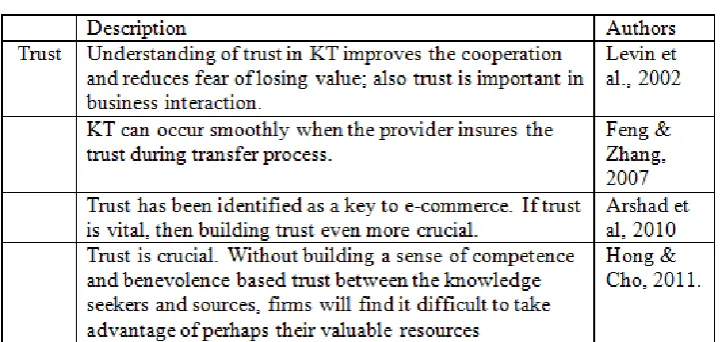
Table 1: Trust in KT via Banking Web Sites
Trust is a widespread controversial construct (Kramer & Tyler 1996). It involves a willingness to make one’s self vulnerable to others. Trust is an important facilitator in e-banking web site; it also facilitates transactions and collaboration (Sharratt & Usoro, 2003). This suggested that where relationships are high in trust, people are more willing to engage in cooperative interaction (Nahapiet & Ghoshal, 1998).
Online trust is defined as the “willingness of a consumer to be susceptible to the actions of an online banking web site dependent on the expectation that the online banking web site will perform a particular action which is important to the consumer, irrespective of their ability to monitor or control the online banking” (Alsulimani, 2013, p.21). A lack of trust has been linked with the reluctance of economic factors to support each other (Sarala & Vaara, 2010), with resistance to KT (Nahapiet & Ghoshal, 1998), and with decreased overall KT (Abrams et al., 2003). A lack of trust could also increase fear of exploitation, which is considered as an important reason for hostility to KT on the part of users. Hence, in contexts of e-banking, users will easily react negatively to cooperation in general and KT in particular.
3.6 Hypothesis
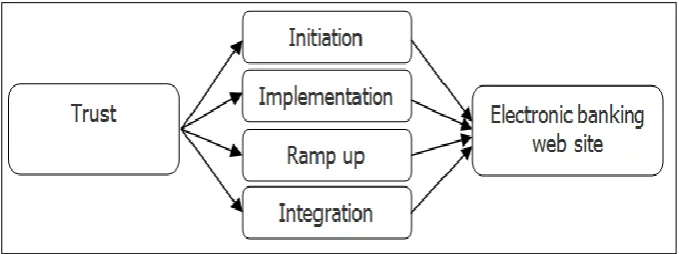
Trust is described as a willingness to accept KT on the assumption that other parties will behave within accepted norms (Milovanovic & Nis, 2006). In the context of KT, trust is looked upon as the evaluation measure of behavioral belief within the context of KT as being either favorable or harmful. Individuals in an organization naturally have a higher intention to transfer their knowledge if they perceive KT is appropriate (So & Bolloju, 2005). Hsu and Lin (2008) found a significant relationship between trust and the web site to KT. Several other researchers have also asserted that trust is vital for KT intention (Bock et al., 2005; Lin & Lee, 2005). Accordingly, the hypotheses of this research are:
H1: there is a positive relationship between trust and initiation stage in KT process. H2: there is a positive relationship between trust and implementation stage in KT
process.
H3: there is a positive relationship between trust and ramp up stage in KT process. H4: there is a positive relationship between trust and integration stage in KT process.
6
Figure 2: Theoretical framework
4. METHODOLOGY
This study had employed quantitative research involving the collection of data sources. This section discusses the research model and specifies four hypotheses about trust in KT process in e-banking domain.
4.1 Data Collection
This research had employed questionnaire, applying quantitative data collection and analysis methods. The questionnaire was adapted from survey instruments that were used by some researches to evaluate user trust in KT via e-banking web site. The population under study included students and lecturers from varying locations in Malaysia, which had been selected for four different reasons:
1) It is expected that they have more information about e-banking due to their high level of education, more access and the use of communications and internet.
2) Consists of people with different ages and experience, so a variety of age and experience groups are accessible.
3) Comprises different cities with different cultural levels. Therefore, it can be said that the population is to a great extent representative of Malaysian citizens.
4) Students and lecturers can be considered as a range of innovators in society.
7 5. DATA ANALYSIS AND RESULTS
Data analysis required transforming data collected into beneficial information. The collected data from e-banking users in Malaysia were analysed and included reliability, descriptive, and correlation analysis respectively. These results obtained from e-banking users in Malaysia, based on e-banking practices, are reported and discussed in this section. Finally, all variables tested reasonable hypothesis of normality.
5.1 Demographic and E-banking Experience of Respondents.
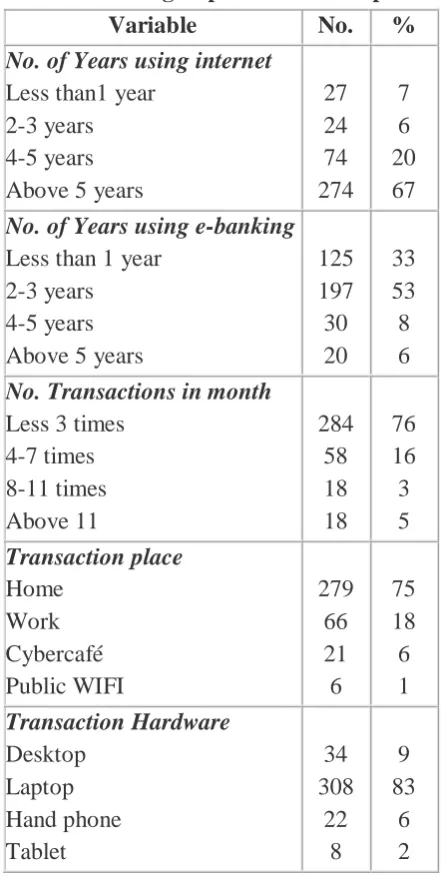
E-banking experiences for respondents reported in this research were plotted as shown in Table 2. Gender formation within the samples, males comprised of 30% (111 respondents) of the entire sample while females (261 respondents), comprised of 70% of the sample, because the number of female students and academics were more than male students, therefore the majority group was female.
Table 2: E-banking Experiences of Respondents
Variable No. %
No. of Years using internet
Less than1 year 2-3 years 4-5 years Above 5 years
27 24 74 274 7 6 20 67
No. of Years using e-banking
Less than 1 year 2-3 years
4-5 years Above 5 years
125 197 30 20 33 53 8 6
No. Transactions in month
8 5.2 Reliability and Correlation Analysis
Reliability was evaluated separately for each construct (Jensen & Szulanski, 2004). All scales had a Cronbach’s alpha greater than 0.70 (Nunnally, 1978). In the stage of hypothesis testing, correlation analysis was mainly employed in order to examine the relationship between independent variables and KT process separately. The result showed that the trust factor has a positive relationship with all knowledge transfer processes, initiation stage with significant value of 0.01, and correlation of 0.93. Lack of trust in transferring knowledge via e-banking website is a behavioral attribute that is crucial in KT process and can discourage users from engaging in transfer knowledge via e-banking websites (Delone & Mclean, 2003; Holste & Fields, 2010; Goh & Sandhu, 2013). Figure 3 showed the correlation of trust with all KT stages; implementation stage correlation 0.884, ramp up stage correlation 0.87, integration correlation 0.90.
Figure 3: The relationship of trust with all KT processes
Trust among e-banking users in KT via e-banking web sites in Malaysia has a high correlation (0.933) in initiation stage which refers to the subjective assessment of the possible side effects in engaging in e-banking web site. E-banking as an online service includes the exchange of client’s information which could be influenced by the risk of exposing sensitive information and privacy to unknown users. When customers have high expectations of the utility and outcome of using an e-banking web site for KT, they will have high intentions to transfer their knowledge. That means increasing the trust of an e-banking website which will facilitate its customers’ intentions to transfer their knowledge. Therefore, research findings shed light on how to strengthen and improve an e-banking website and communication channel so as to acquire and use customer knowledge effectively and efficiently.
5.3 Validation of the Proposed KT Model
9 6. CONCLUSION AND FUTURE WORK
This research analyzed the trust factor that influences KT process via e-banking website. The study provided a primary idea for the banking sector in Malaysia to reduce the KT barriers with reduction of cost and enhance the KT performance. The financial institutions must push themselves to the limit to compose sustainability into new strategies and remedies (Cowe, 2012). Given time and space limitations the research evaluates trust factor in KT Model and is considered the important factor in KT and lack of customer trust in knowledge and its source is one of the barriers to KT process (Cooper & Lichtenstein, 2010). For future research, the Model should be improved by searching the trust from service provider perspectives that can improve the accuracy to predict trust towards e-banking web sites in Malaysia and test the developed Model. Additional variables can be security, ICT literacy, usability, awareness and accessibility.
REFERENCES
Abrams, L. C., Cross, R., Lesser, E., & Levin, D. Z. (2003). Nurturing interpersonal trust in knowledge sharing networks. Academy of Management Executive, 17 (4): 64-77. Abu Shanab, E., Pearson, J. M. & Setterstrom, A. J. (2010). Internet Banking and Customers’ Acceptance in Jordan: The Unified Model’s Perspective, Communications of the Association for Information Systems, Vol. 26, Article 23. Ahmad, A. E. M. K. (2011). E-banking Functionality and Outcomes of Customer
Satisfaction: An Empirical Investigation. International Journal of Marketing Studies, 3(1).
Arshad, N. H. Hanapi, R. and Buniyamin, N. 2010. "IT outsourcing and knowledge transfer in Malaysia". In Engineering Education (ICEED), 2010 2nd International Congress on (pp. 16-21). IEEE.
Al-Salti, Z., & Hackney, R. (2011). Factors impacting knowledge transfer success in
information systems outsourcing. Journal of Enterprise Information Management,
24(5), 455-468.
Azizan, N. (2011). Critical success factors for knowledge transfer via Australian and Malaysian government education websites: a comparative case study.
Azizan, N., Smith, R., & Cooper, V. (2011). Critical Success Factors for Knowledge Transfer via Government Websites. Journal of e-Government Studies and Best Practices, 12.
Alsulimani, T. (2013). Framework for the Adoption of Online Banking.
Bock, G. W., Zmud, R. W., Kim, Y. G. and Lee, J. N. (2005). Behavioral intention formation in knowledge sharing: Roles of extrinsic motivators, social psychological forces, and organizational climate, MIS Quarterly, vol.29, no.1, pp. 87-112.
Cantoni, F., Bello, M., & Frigerio, C. (2001). Lowering the Barriers to Knowledge
Transfers and Dissemination: The Italian Cooperative Banks Experience. ECIS
2001 Proceedings, 10.
10
Cooper, V. A., & Lichtenstein, S. (2010). Supporting knowledge transfer in web based managed IT support. Journal of Systems and Information Technology, 12(2), 140-160.
Daghfous, A., & Ahmad, N. (2015). User development through proactive knowledge
transfer. Industrial Management & Data Systems, 115(1), 158-181.
Delone, W. H., & McLean, E. R. (2003). The DeLone and McLean model of information
systems success: a ten-year update. Journal of management information systems,
19(4), 9-30.
Feng, C. and Zhang, T. 2007. "Trust and Knowledge Transfer between Business Partners: the Mediating Effects of Three Factors". In Automation and Logistics, 2007 IEEE International Conference on (pp. 198-204). IEEE.
Ford, N., & Murphy, G. (2008). Evaluating the potential of a Web-based portal to support the leverage of professional expertise across local authority boundaries. Local Government Studies, 34(3), 397-418.
Gerrard, P. & Cunningham, J. B. (2003). The diffusion of internet banking among Singapore consumers. International Journal of Bank Marketing, 21(1), 16-28. Goh, S. K., & Sandhu, M. S. (2013). Knowledge sharing among Malaysian academics:
Influence of affective commitment and trust. The Electronic Journal of Knowledge
Management, 11(1), 38-48.
Holste, J. S., & Fields, D. (2010). Trust and tacit knowledge sharing and use. Journal of
knowledge management, 14(1), 128-140.
Husnain, A., & Avdic, A. (2015). Identifying the Contemporary Status of E-Service Sustainability Research. International Journal of E-Services and Mobile Applications (IJESMA), 7(3), 31-47.
Jensen, R., & Szulanski, G. (2004). Stickiness and the adaptation of organizational practices in cross-border knowledge transfers. Journal of International Business Studies, 35(6), 508-523.
Kang, H. (2011). Critical success factors in implementing process-oriented knowledge management systems (PKMS) in the public sector in Korea.
King, W. R. (2006). The critical role of information processing in creating an effective knowledge organization. Journal of Database Management (JDM), 17(1), 1-15.34. Kramer, R. M., & Tyler, T. R. (Eds.). (1996). Trust in organizations: Frontiers of theory
and research. Sage.
Khan, M. H. R. (2012). Adoption of Online Banking in Manila: What the Commercial Banks Should Learn to Be Competitive.
Levin, D. Z., Cross, R., Abrams, L. C. and Lesser, E. L. 2002. "Trust and Knowledge Sharing: A Critical Combination". IBM Institute for Knowledge-Based Organizations, pp.1-9.
Lin, H. F., & Lee, G. G. (2005). Impact of organizational learning and knowledge
management factors on e-business adoption. Management Decision, 43(2),
171-188.
Milovanovic, S., & Nis, S. (2006). Knowledge sharing between users and information specialists: Role of trust. Facta Universitatis Series: Economics and Organization, 3(1), 51-58.
Mukherjee, A., & Nath, P. (2003). A model of trust in online relationship banking.
11
Nahapiet, J & Ghoshal, S. (1998). Social Capital, Intellectual Capital and the Organizational Advantage, Academy of Management Review, 23(2).
Nonaka, I. (1991). The knowledge-creating company, Harvard Business Review, vol. 69, no. 6, pp. 96-104.
Nunnally, J. C. (1978). Psychometric Theory. McGraw- Hill, New York.
Pavlou, P. A., & Gefen, D. (2004). Building effective online marketplaces with
institution-based trust. Information systems research, 15(1), 37-59.
Raina, N. (2011). Malaysians the biggest online banking users in Southeast Asia. The Edge Financial Daily.
Santinha, G. & de Castro, E. A. (2010). Creating more Intelligent Cities: The Role of ICT in Promoting Territorial Governance, Journal of Urban Technology, 17 (2), 77-98. Sarala, R. M., & Vaara, E. (2010). Cultural differences, convergence, and crossvergence as
explanations of knowledge transfer in international acquisitions. Journal of International Business Studies, 41(8), 1365-1390.
Sharratt, M., & Usoro, A. (2003). Understanding knowledge-sharing in online communities of practice. Electronic Journal on Knowledge Management, 1(2), 187-196.
Singh, B., & Malhotra, P. (2004). Adoption of Internet banking: An empirical investigation
of Indian banking Sector. Journal of Internet Banking and Commerce, 9(2),
9909-05.
So, J. C. F. and Bolloju, N. (2005). Explaining the intention to share and reuse knowledge in the context of it service operations. Journal of Knowledge Management, vol.9, no.6, pp. 30-41.
Swol, L. M., & Sniezek, J. A. (2005). Factors affecting the acceptance of expert advice. British Journal of Social Psychology, 44(3), 443-461.
Szulanski, G. (2000). The process of knowledge transfer: A diachronic analysis of stickiness. Organizational behavior and human decision processes, 82(1), 9-27. Traunmuller, R., Orthofer, G., & Gieber, H. E-Government-the State of Affairs in Europe:
An Introduction to the Workshop. In Information and Communication Technologies, 2006. ICTTA'06. 2nd (Vol. 1, pp. 882-887). IEEE.
Wingreen, S. C., Baglione, S. L., & Storholm, G. R. (2012, January). Transfer of electronic commerce trust between brick-and-mortar and online business environments. In
ACIS 2012: Location, location, location: Proceedings of the 23rd Australasian Conference on Information Systems 2012 (pp. 1-12). ACIS.