Ion Heating Experiments Using Perpendicular Neutral Beam
Injection in the Large Helical Device
Kenichi NAGAOKA, Masayuki YOKOYAMA, Yasuhiko TAKEIRI, Katsumi IDA,
Mikiro YOSHINUMA, Seikichi MATSUOKA
1), Hisamichi FUNABA, Shigeru MORITA,
Takashi MUTOH, Tetsuo SEKI, Katsunori IKEDA, Masaki OSAKABE, Katsuyoshi TSUMORI,
Yoshihide OKA, Osamu KANEKO and the LHD Experimental Group
National Institute for Fusion Science, Toki 509-5292, Japan
1)Department of Nuclear Engineering, Kyoto University, Kyoto 606-8501, Japan
(Received 16 November 2007/Accepted 15 February 2008)
A perpendicular neutral beam (P-NB) injector was installed in the Large Helical Device (LHD) and utilized for high-power ion heating and measurement of the ion temperature (Ti) profile by charge exchange spectroscopy.
Significant progress was achieved in ion heating experiments using P-NB, and a highTiof 5.2 keV was achieved
at the plasma center. ATi peak profile with a steep gradient in the core region was observed, indicating an
improved mode of ion transport. The enhancement of toroidal flow in the core region was observed with the
Tirise. Transport analysis shows improvement in anomalous transport in the core region, and the neoclassical
transport remains unchanged when the highTiis realized.
c
2008 The Japan Society of Plasma Science and Nuclear Fusion Research
Keywords: perpendicular NBI, ion heating, charge exchange spectroscopy, beam fueling, confinement improve-ment, toroidal rotation, ion thermal transport
DOI: 10.1585/pfr.3.S1013
1. Introduction
Ion temperature is one of the most important param-eters for realizing a continuous fusion reaction in magnet-ically confined fusion plasmas. In particular, realization of improved modes with transport barriers such as internal transport barriers (ITB) and edge transport barriers (ETB) is necessary for high-performance plasma confinement. Improved ion transport was observed not only in toka-maks [1–3] but also in helical devices [4, 5]. The forma-tion of a steepTigradient was observed in the outer region
of electron-ITB/core electron-root confinement (CERC) in the Compact Helical System (CHS) [6]. The mechanism of, and the necessary conditions for, the improvement of ion transport in helical systems are not yet fully under-stood; thus, the study of improved ion confinement is cur-rently one of the most important issues in helical devices.
Before the 9th experimental campaign of the Large
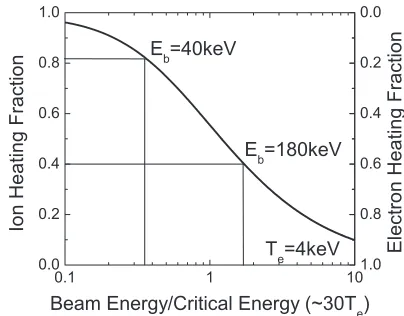
Helical Device (LHD), ion heating experiments were per-formed by tangential neutral beam (NB) injection [7]. There are three beam injectors of negative-ion-based NB with a very high beam energy of 180 keV, which are the main heating devices in LHD, and the total port-through beam power was over 14 MW [8]. However, such beams with energies considerably greater than the critical energy (Ec∼120 keV for plasmas with Te∼4 keV) mainly heat
electrons in the target plasmas, resulting in a relatively low ion heating power [9], as shown in Fig. 1. In order
author’s e-mail: [email protected]
Fig. 1 The ion/electron heating fraction of NB power as a func-tion of beam energy.
to increase the net ion-heating power per ion, the ion heat-ing experiments were performed in a high-Z discharge, in which the ion population is much lower than that of the low-Z plasmas. In LHD a highTi of 13.5 keV was
real-ized with Argon gas puffing. Although the experiments were performed in a high-Z plasma because of the low ion heating power, the achievement shows the high poten-tial of high-Tiplasma confinement in a helical
configura-tion [7, 10].
The next step is the production of high-Tiplasmas in
low-Z discharges. For this purpose, a perpendicular NB (P-NB) with a low beam energy of 40 keV was installed
in LHD in the 9th experimental campaign [11]. The NB has a high ion-heating efficiency of 80 % for plasmas with
Te = 4 keV (see Fig. 1) [9], and the direct ion heating
power was significantly increased in LHD experiments. P-NB can be utilized for profile measurement ofTiby
charge exchange spectroscopy (CXS); thus, ion heat trans-port can be estimated experimentally [12]. Moreover, P-NB has a high particle fueling rate due to a large beam cur-rent of 150 A, and it is also utilized for particle fueling and controlling the density profile. In this paper, we present recent results of the high-Ti experiments using P-NB in
LHD, in particular, the improved mode of ion transport. Beam fueling properties, the density profile dependence of
Ti, ion transport property, and toroidal flow associated with
high-Tiare also discussed.
2. Experimental Conditions
LHD is the world’s largest helical device with a superconducting coil system. The major and averaged minor radii are 3.9 m and 0.6 m, respectively. The toroidal and poloidal periods aren =10 and m=2, respectively [13]. The plasmas are heated by electron cyclotron reso-nance heating (ECH) of 2 MW, ion cyclotron heating (ICH) of 2 MW, and three tangential negative-ion-based NBIs with a total port-through power of 14 MW (BL1-3). A perpendicular NBI with the low energy of 40 keV was in-stalled in the 5-O port (outboard side port in a horizon-tally elongated cross-section) of LHD in 2005, which is called BL4. Four positive-ion sources were mounted on the beam injector, and the total port-through power was upgraded to 6 MW in 2006. Two power supply systems (BL4-A and BL4-B) can independently control the beam operation parameters such as pulse timing, beam energy, and beam duration. The nominal pulse duration is 10 sec, and the beam species is hydrogen. Beam injection with a total port-through power of 7 MW was achieved in the 10th experimental campaign [11].
Two systems of active CXS were applied to the P-NB as a probe beam. One is a toroidal system having toroidal
lines of sight, which can measure the profiles of Ti and
toroidal rotation of the plasma. The other is a poloidal sys-tem having poloidal lines of sight, which can measure the profiles of Ti and poloidal rotation of the plasma. Half
of the P-NB (BL4-A or BL4-B) is modulated (ON for 100 msec and OFF for 100 msec) for CXS measurement to acquire the background signal [12].
3. Results and Discussions
A high-current beam with low energy has a large parti-cle fueling rate. In order to investigate the beam fueling of the P-NB, the beam current scan was performed by chang-ing the number of operatchang-ing ion sources with the same gas condition in the inward-shifted magnetic configuration ofRax =3.60 m, in which the confinement of fast ions is
better than that of outward-shifted configurations of LHD [13]. The target plasma has a low density of 0.7×10¹⁹m−3
and is sustained by a tangential NB with a low port-through power of 3.7 MW in the present experiment. The electron temperature (Te) and Ti of this plasma are 2.5
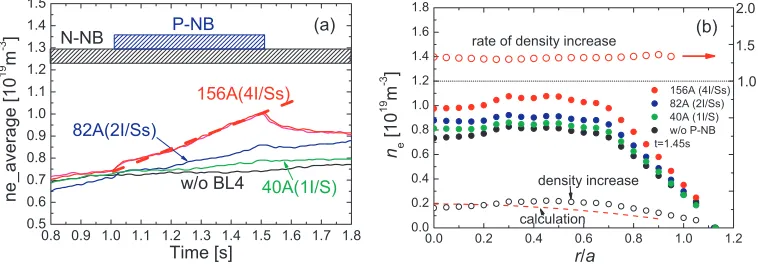
and 1.4 keV, respectively. The electron density increases with beam current during beam injection, which is shown in Fig. 2 (a), and an increase rate of 3×10¹⁶m−3s−1A−1 (2.3×10²⁰s−1MW−1) was obtained. The electron density has a flat profile and the profile of density increase rate is shown in Fig. 2 (b). The density increase rate also has a flat profile. The beam fueling calculated by the FIT code [14] is consistent with the experimental results, and is also shown in Fig. 2 (b). This result indicates that the den-sity increases due to beam fueling in the plasmas mainly heated by P-NB, while the density tends to decrease in the plasmas mainly heated by tangential NBs because of the pumping-out effect of hot electron plasmas.
The ion heating experiments using P-NB were per-formed with the inward-shifted magnetic configuration of 3.55 m≤Rax ≤3.70 m, because the heating efficiency of
P-NB of inward-shifted configurations is better than that of outward-shifted ones [13]. The P-NB power depen-dence ofTiwas investigated in the plasmas heated by
Fig. 3 CentralTias a function of ion heating power per an ion.
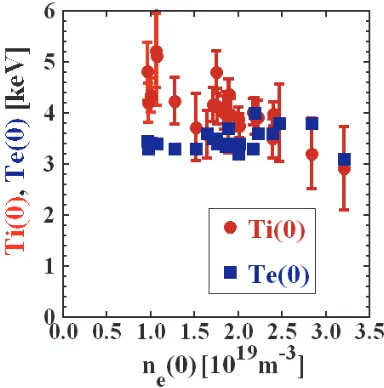
Fig. 4 CentralTias a function of central electron density.
Cen-tralTeat the same time is also shown.
NB alone. The maximumTiof each discharge is plotted in
Fig. 3 as a function of ion heating power normalized by the ion density. In this figure, it is clearly seen thatTiincreases
with ion heating power. In the case of the combination of P-NB and tangential NB heating,Tialso depends on P-NB
power. It is noted that the heating power dependence ofTi
shown in Fig. 3 continuously connects to the higher heating power region obtained in high-Zexperiments, which sup-ports the extension of these results obtained by the high-Z
discharges to the low-Zplasmas [7].
Plasmas with Ti higher thanTe were obtained after
superimposition of tangential NBs over the P-NB heated plasma, althoughTe tends to be higher thanTi in LHD
because of the high electron heating power of tangential NBs. The centralTiof 5.2 keV was achieved with the
cen-tral electron density of 1.2×10¹⁹m−3. The high-Tiregime
was extended toward high-density plasmas, and the central
Fig. 5 (a) TheTi (upper), line-averaged electron density
(mid-dle), and a peaking factor (bottom). The beam injection pattern is also shown at the bottom figure. (b) The peak-ing factor as a function of averaged density. The trend is shown by arrows.
Tiof 3 keV was achieved with the central electron density
of 3.2×10¹⁹m−3, which is shown in Fig. 4. The centralT e
is lower thanTiin the low-density region, indicating the
occurrence of selective ion heating. TeandTiare almost
same in the high-density region. This is considered to be attributable to short equi-partition time in the high-density regime.
The highest Ti of the discharge was realized in the
density decay phase after superimposition of tangential NBs. The time trace of Ti, the line-averaged electron
density, and the central density divided by the line av-eraged density as a density peaking factor are shown in Fig. 5 (a). After superimposition of tangential NB heat-ing (t = 1.1 sec), the electron density decreases and Ti
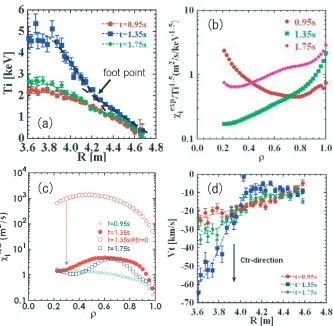
Fig. 6 (a) TheTi profiles of the plasma heated by P-NB alone (t =0.95 sec), in the high-Ti phase after superimposition of N-NB
(t =1.35 sec), and mainly heated by N-NB (t =1.75 sec). (b) The experimental ion thermal diffusivity. (c) The neoclassical ion-thermal diffusivity w/and w/o neoclassical ambipolar radial electric field. (d) The toroidal rotation profile.
t=1.35 sec. Further,Tibegins to decrease gradually while
the electron density continues to decrease. The peaking factor increases in the P-NB heating phase and decreases after superimposition of tangential NBs. This is a general tendency in LHD plasmas; the density profile becomes a peaked one in P-NB heating plasmas and a flat or hol-low one in tangential NBs. The peaking factor of the electron density still maintains a high value when Ti
reaches its maximum, while the electron density decreases quickly (Fig. 5 (b)). Therefore, it seems that the peaking factor of the electron density is important for theTi rise,
and that the peaked density profile is preferable for real-ization of a highTi.
Figure 6 (a) shows the Ti profiles at the P-NB phase
(t = 0.95 sec), the maximum Ti phase (t = 1.35 sec),
and after the decrease inTi with decrease in NB power
(t =1.75 sec). Ti has a peaked profile and a steep
gradi-ent is formed in the core region ofR < 4.25 m whenTi
becomes high. Teis 4 keV at the center and is almost the
same as theTiatR>4.25 m whent=1.35 sec. The
cen-tralTistrongly depends on theTigradient in the core
re-gion ofR<4.25 m, indicating the improvement of ion heat transport in this region. The position of the foot point, in which the gradient ofTi changes slightly, moves
depend-ing on some parameters. TheTi gradient inside the foot
point significantly changes depending on the ion heating power. However the dependences of the foot position and the temperature gradient are not obtained in detail and fur-ther investigation is necessary.
The ion thermal diffusivity was analyzed and the experimental ion diffusivities normalized by the gyro-Bohm factor in the three time slices; (the only P-NB heating phase, the highestTiphase, and the phase after the
decrease inTi) are shown in Fig 6 (b). The ion diff
usiv-ity in the high-Tiphase is significantly reduced in the core
region. The neoclassical transport was calculated by the GSRAKE code [15]. The radial electric field is provided by the ambipolar condition and is negative (ion-root) in the core region [16]. The experimental observation of ra-dial electric field or the poloidal rotation is difficult in the high-Tiphase because of a hollow carbon impurity profile
(discussed later). However, the neoclassical radial electric field is considered to be a good indication in LHD plasmas, as demonstrated in previous studies [17, 18]. The neoclas-sical ion thermal diffusivity does not change in the core region, as shown in Fig. 6 (c), whileTiincreases more than
to depend strongly onTi9/2. The temperature degradation of the neoclassical ion transport is considered to be signif-icantly suppressed by the negative radial electric field.
The toroidal flow profile was measured by the toroidal CXS system. A large toroidal flow with a velocity of 60 km/sec was generated in the core region when the high
Tiwas realized, as shown in Fig. 6 (d). The flow direction
is consistent with the predominant direction of tangentially injected NBs. These observations indicate a strong corre-lation between ion diffusivity and parallel viscosity. It is noted that large toroidal flows associated with highTiare
also observed in tokamak devices [19]; thus, the compar-ison of large flow production in high-Ti plasmas between
helical and tokamak devices is an interesting subject [12]. The poloidal rotation in the core region cannot be observed when theTi becomes high, because the carbon impurity
has a strongly hollow profile associated with theTi rise.
This “impurity hole” also shows strong correlation with theTirise. The outward flow of carbon impurity against
the negative gradient of carbon density was also observed [20]. The large error bars ofTiin the core region witht=
1.35 sec in Fig. 6 (a) are attributable to the formation of the impurity hole. Although the impurity pumping-out effect can be expected in electron-root plasmas according to the neoclassical theory, the understanding of impurity hole for-mation in the neoclassical ion-root is a new subject related to the high-Tiexperiments in helical devices.
4. Conclusion
The installation of P-NB injection resulted in signif-icant progress in high-Ti experiments in LHD: (1) an
up-graded power of direct ion heating and (2) profile mea-surements ofTi, toroidal and poloidal flows, and carbon
impurity. An improved mode of ion transport was realized in the core region and a centralTihigher than 5 keV was
achieved. The high-Ti plasma was extended toward the
high-density regime. A large toroidal flow and an impurity
hole were observed in the core region associated with the
Tirise. A negative radial electric field (neoclassical
ion-root) significantly suppresses the degradation of ion ther-mal diffusivity, and a reduction in anomalous transport was observed in the core region. These are preliminary results and not yet fully understood. Systematic experimental studies and neoclassical viscosity analysis are in progress.
Acknowledgements
The authors would like to thank the technical stafffor operation of the LHD, NBI, ECH and ICH systems. This work was supported by NIFS (NIFS07ULBB501).
[1] S. Ishida et al., 16th IAEA Fusion Energy Conference, Montreal, CN-64/A3-1, 1996.
[2] R. J. Foncket al., Phys. Rev. Lett.63, 520 (1989). [3] JET Team, Plasma Phys. Control. Fusion37, A359 (1995). [4] K. Idaet al., Phys. Rev. Lett.76, 1268 (1996).
[5] K. Idaet al., Nucl. Fusion39, 1649 (1999). [6] T. Minamiet al., Nucl. Fusion44, 342 (2004). [7] Y. Takeiriet al., Nucl. Fusion47, 1078 (2007). [8] O. Kanekoet al., Nucl. Fusion43, 692 (2003). [9] T.H. Stix, Plasma Phys.14, 367 (1972).
[10] S. Morita et al., 19th IAEA Fusion Energy Conference, Lyon, 2002, EX/P2-18.
[11] M. Osakabeet al., Proceedings of 17th International Toki Conference on Plasma Flows and Turbulence in Plas-mas and 16th International Stellarator/Heliotron Workshop 2007, Toki, P2-079, 2007.
[12] M. Yoshinumaet al., Plasma Fusion Res.3, S1014 (2008). [13] S. Murakamiet al., Fusion Sci. Technol.46, 241 (2004). [14] A. Iiyoshiet al., Nucl. Fusion39, 1245 (1999).
[15] C.D. Beidler and W.D.D’ Haeseleer, Plasma Phys. Control. Fusion37, 463 (1995).
[16] S. Matsuokaet al., Plasma Fusion Res.3, S1056 (2008). [17] K. Ida,et al., Nucl. Fusion45, 391 (2005).
[18] M. Yokoyamaet al., Nucl. Fusion47, 1213 (2007). [19] Y. Koide et al., Plasma Phys. Control. Fusion 38, 1011
(1996).