RESEARCH ARTICLE
THE ROLE OF PHARMACY REPLENISHMENT SYSTEMS IN DECREASING PHARMACEUTICAL
WASTE IN THE UK
1
Charlotte Akerman,
1Mahmood Hussain Shah,
1Abdullah Maitlo and
2*Waqar Ahmed
1
Lancashire Business School, University of Central Lancashire, Preston PR1 2HE
2
School of Medicine and Dentistry, University of Central Lancashire, Preston PR1 2HE
ARTICLE INFO
ABSTRACT
This paper examines pharmacy replenishment systems and how these can be used to decrease pharmaceutical waste. The factors that contribute to pharmaceutical waste are patient understanding; supply chain management and the accuracy of pharmacy replenishment systems. Qualitative methods have been employed in order to gain an understanding of the concepts within a single case pharmacy. These include document collecting, observation and interviews to build a robust case study. This paper shows that pharmacy replenishment systems benefit from end user involvement in terms of increasing their accuracy and therefore decreasing pharmaceutical waste. In addition, patients create waste because approximately66.7% of the patients require more information about their medication. This source of pharmaceutical waste is currently being tackled through the new medical services.
Copyright © 2013 Charlotte Akerman et al. This is an open access article distributed under the Creative Commons Attribution License, which permits unrestricted use, distribution, and reproduction in any medium, provided the original work is properly cited.
INTRODUCTION
A pharmacy replenishment system is a program that recommends order quantities for items dispensed over a set
period of time to produce a suggested order (Donselaar et al.,
2010). The system holds the current on the shelf stock figures and maximum and minimum stock quantities for each item within the dispensary from which a recommended order is produced. In turn this aids the end user’s decision making process in creating an order that fulfils the demands of the pharmacy (Peterson, 2004). The waste of medicines is a major concern for the government. There is approximately £150m pharmaceutical waste every year contributing to the total of £300billion medicine waste in the UK (Adams, 2012; PSNC, 2010). The majority of this waste is patient returns of unused medication, care home waste from monitored dosage systems (MDS) and use ‘when required’ medicines (PRN’s) (Adams, 2012). However, pharmacy replenishment systems hold incorrect stock figures, meaning that stock is being over ordered and therefore contributing to pharmaceutical waste (Kok and Shang, 2007). The government is highly concerned and have transferred the responsibility and thus pressure onto businesses.
*Corresponding author: Waqar Ahmed
School of Medicine and Dentistry, University of Central Lancashire, Preston PR1 2HE
Without a fully functioning and robust system a business will struggle to meet the targets set by the government. However, there are other factors that could decrease pharmaceutical
waste (Donselaar et al., 2010; Adams, 2012; PSNC, 2010).
These also need to be analysed to evaluate the role that
pharmacy replenishment systems play in decreasing
pharmaceutical waste.
Literature Review
This paper identifies the gaps in the literature and provide a base and context for further research. The nature of pharmaceutical waste is also defined within the context of this research. The main areas that were taken into consideration were the pharmacy replenishment systems and supply chain management within community pharmacies alongside other factors contributing to pharmaceutical waste. There is a general agreement that pharmaceutical waste is a category within medicine waste that refers to expired and returned
medication (Wiffen et al., 2012; Zimmermann et al., 2011;
Letcher and Vallero, 2011; Basavanthappa, 2008). Letcher and Vallero (2011) suggest that pharmaceutical waste is produced by pharmacies through stock that has been ordered and never dispensed, possibly due to being held for a specific patient, then their medication or condition changes, leaving the medication no longer required in stock.
ISSN: 0976-3376
Asian Journal of Science and Technology Vol. 6, Issue 06, pp. 1550-1557, June, 2015ASIAN JOURNAL OF
SCIENCE AND TECHNOLOGY
Article History:
Received 30th March, 2015
Received in revised form
08th April, 2015
Accepted 22nd May, 2015
Published online 29th June, 2015
Key words:
Pharmacy Replenishment Systems, Supply Chain,
Supply Chain Network, Replacement System, Database,
However Zimmermann et al. (2011) describes pharmaceutical waste as also including medicines excluded from trade and spoiled medicines that have been generated from a number of sources such including hospitals, social care and experimental laboratories. The ways in which pharmaceutical waste is created have also been discussed. These refer mainly to households and pharmacies, suggesting that these two groups are the main reasons for an increase in pharmaceutical waste
(Zimmermann et al., 2011; Wiffen et al., 2012; Letcher and
Vallero, 2011). A pharmacy replenishment system is a program that recommends that order quantities should be based on dispensing data over a period of time (Donselaar, 2010). These orders can be checked, adjusted and sent. Some systems send the order automatically at a pre-set time
(Chisholm-Burns et al., 2012). Mc Guire (2011) suggests that
pharmacy replenishment systems will continuously review orders when stock transactions take place. For example, when an item is dispensed the system will review the recommended
order as the current demand has increased. Anderson et al.
(2010) supports this as pharmacy systems have the ability to perform real-time inventory management. However automated replenishment systems can move a pharmacy closer to the Just-in-Time ideal (Chisholm-Burns, 2012).
Pharmacy replenishment systems that require end user involvement may not be as efficient in achieving JIT and increase pharmaceutical waste. Pharmacy systems use the
UMLS (Unified Medical Language System) which
incorporates the vocabulary used in the medical network. UMLS ensures that “all words and phrases that have the same
meaning are grouped under a concept name” (Anderson et al.,
2010). Pharmacy systems using this language will link together. For example, when a drug is dispensed in a pharmacy dispensing system the replenishment system will order the
same drug grouped under that concept name (Anderson et al,
2010). If both systems were based on an integrated systems solution then the same words or phrases would be used in both systems thus eliminating the possibility of discrepancies. This decreases the risk of ordering the wrong item due to linking errors and reduce pharmaceutical waste.
Many sources show that pharmacy replenishment systems functionality includes allowing users to filter through vast amounts of information to produce reports. These include
out-of-stocks, stock files, forecasting and overstocks
(logisticsit.com, 2006; Manhattan Associates, 2012;
Chisholm-Burns et al., 2012; Mc Guire, 2011). This functionality should
aid a decrease in pharmaceutical waste as it allows users to view overstocks and aim to decrease them. McGuire (2011) expands on the functionality of replenishment systems suggesting that they continuously review the recommended order and end users can view order history which aids forecasting. In turn this functionality could aid waste reduction as reporting benefits mangers decision making on stock ordering, as long as the stock figures and data within the system is accurate. Pharmacy replenishment systems are often designed to reduce the amount of stock held at any one time
and aid source reduction (Monckza et al., 2008; Zimmer,
2012) through accurate stock figures they provide recommended orders based on demand, calculated through dispensing data (Kogan and Tapiero, 2007). Mc Guire (2011) also suggests that replenishment orders are based on demand. However, he notes that the time period on which the data that
recommendations are based should be the same at each stage of the supply network to avoid demand distortion and inaccurate orders. The replenishment system may order slow moving items that may not be required if the system is based on a long time period of dispensing data as it believes there is a pattern in demand (Peterson, 2004). Thus, the amount of dispensing data that replenishment systems are based on is very important to the amount of pharmaceutical waste created due to the system (McGuire, 2011). Pharmacy replenishment systems allow users to view order history and check, review, adjust and send recommended orders. However, these functions rely on the accurate data used in order recommendations. Further research is required to evaluate the accuracy of order pharmacy replenishment systems and order recommendations. Pharmacy replenishment systems accuracy depends on the data used within the system and how it is maintained. Manhattan Associates (2012) suggest that pharmacy replenishment systems are accurate requiring less user involvement. This allows Alliance-Boots to benefit from increased productivity as employees spend less time checking orders. The disadvantage of this is that users are less likely to spot ordering errors, leading to shortages or overstocks, increasing the risk of pharmaceutical waste.
This is supported by Li (2007) who suggests that a periodic review system with a fixed time interval prompts employees into a review routine, ensuring that the order is correct before the pre-set order time. The accuracy of dispensing data also influence pharmacy replenishment systems and how the system updates over time as demand varies (Peterson, 2004; McGuire, 2011). McGuire (2011) suggests that less frequent forecasts give lower variability in demand making them more accurate as the recommendations are based on more data. This accuracy would decrease the amount of pharmaceutical waste as the pharmacy manager could make informed decisions on stock needs and when it needs to be ordered. To help to minimise stock levels within pharmacy, orders are placed and arrive twice daily (Goundrey-Smith, 2012). Therefore, longer forecasts suggested by McGuire (2011) may aid the accuracy for initial data in the replenishment system as this need to be accurate for future recommendations and forecasts.
However, in order to reduce pharmaceutical waste pharmacies could hold four weeks dispensing stock in order to reduce the possibility of expired stock. GP’s usually prescribe regular medication for 28 days (PSNC, 2010); this gives a regular time period for demand forecasting in order to produce orders that reflect actual demand (McGuire, 2011). However, smaller pack sizes prevent intermittent demand patterns as the stock isn’t split down once it reaches the pharmacy so as each pack is used a new pack is ordered to replace it (McGuire, 2011). A model used by Peterson (2004) assumes that “the usage pattern is consistent throughout the ordering period”, as this is rarely the case in pharmacies over ordering could occur (DeHoratius
et al., 2008). Stock should however be replenished
immediately to keep in time with customer demand, allowing for accurate recommendations at any given time (McGuire, 2011). Inaccuracies in replenishment systems, where physical stock and system stock figures show a difference may increase pharmaceutical waste as order recommendations are not
accurate (Waller et al., 2006; Donselaar, 2010). The accuracy
variability also affect the accuracy of pharmacy replenishment systems. Further research is required to analyse how accurate stock figures are and how they become inaccurate, which can be done through collecting stock adjustment data reports. Pharmacy replenishment systems accuracy could also be affected by end user involvement in adjusting stock figures as this distorts demand data (Donselaar, 2010), leading to a possible increase in pharmaceutical waste due to the inaccuracies of stock figures. This is supported by McGuire (2011) as once demand has shown fluctuations the end user will constantly have to adjust stock figures and order recommendations until the system has reverted back to the standard demand, increasing the risk of pharmaceutical waste until this can be achieved. However, considering Peterson’s (2004) model end user involvement is required to ensure stock isn’t over ordered as demand for all items may not be constant during the ordering period. This requires the user to have an idea of the reorder point so to reduce the risk of out of stocks as this would cause customer dissatisfaction (Peterson, 2004).
Waller et al. (2006) suggests that there are two types of
demand, stationary and non-stationary, in non-stationary demand fluctuations occur, therefore inaccuracies are more likely to occur. Within pharmacy demand is non-stationary as it is currently increasing (Adams, 2012). As pharmacy services improve, demand for medication should become more stable (PSNC, 2010). Therefore, in time pharmacy replenishment systems should become more accurate as demand stabilises.
Pharmacy replenishment systems are based on historical data and fluctuations are accounted for by the end user adjusting stock figures to ensure the pharmacy has enough stock to fulfil demand. Hence, as demand becomes more stationary less end user involvement is required and the system can run as designed. Demand varies and end users are required to make adjustments, which may increase or decrease the accuracy of pharmacy replenishment systems. End users don’t need to spend time checking orders. However, they are less likely to spot errors in recommended orders. Therefore, further research is required to see how end user involvement affects the accuracy of the system and whether the users trust the system to be accurate and affect how they use the system. Supply chain management is the management of a network of businesses involved in getting the raw material to an end product into a store (Leeman, 2010; Walker and Jones, 2012). It involves customers, retailers and suppliers, with customers providing the demand level for the retailers to order from their suppliers as illustrated below in figure 1 (Hugos, 2011). In pharmacy the efficient management of this network is essential as ensuring that enough stock is on the shelf to meet demands is important due to the consequences of patients being without medication (Xie and Breen, 2012).
Supply chain management relies on accurate inventory. If the inventory is inaccurate then a company may struggle to reach
full efficiency within their supply chain (Waller et al., 2006).
An inefficient supply chain in pharmacies may cause over ordering if safety stock was measured incorrectly. This risk increases as the lead time increases (McGuire, 2011). Sari (2008) also notes that less safety stock will be ordered as a shorter lead time decreases the bullwhip effect therefore aiding a decrease in possible pharmaceutical waste.
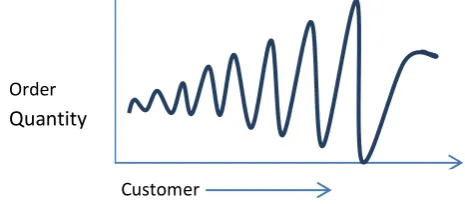
Figure 2 shows that the order quantity is distorted through the supply chain, usually in order to guarantee a product in time to meet demand (Li, 2007; Sari, 2008; Rainer and Cegielski, 2010). The bullwhip effect can be caused by perceptions of demand. For example, ordering more stock due to long or uncertain lead times (Li, 2007). The time and frequency of deliveries affects the amount ordered to cover demand between each order (Whewell, 2010). McGuire (2011) also suggests that shorter lead times reduce safety stock and ‘just in
case’ ordering meaning that there would be less
pharmaceutical waste in the supply chain as pharmacies move closer to just in time systems (Rainer and Cegielski, 2010). There are often delays in scheduled orders and serious quality
problems in products in many businesses (Kirytopoulos et al.,
2008). Therefore, companies are more likely to order extra stock to decrease the risk of being out of stocks whilst delayed deliveries are still in the process.
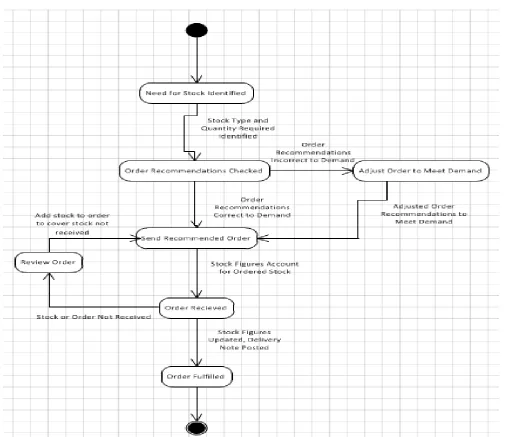
Figure 3 shows that if an order is not received, stock figures are reviewed and the stock is reordered to cover the shortage. However, if the missing order was then to be received after a delayed period the pharmacy would be overstocked increasing the risk of pharmaceutical waste due to safety stock being ordered due an inefficient supply chain and poor management. Companies that have the technical capabilities to share information across the supply chain should collaborate to decrease costs and inventory levels. Decreasing the amount of pharmaceutical waste across the company (Xie and Breen,
2012; Ramanathan, 2012; Sari, 2008). Juntter et al. (2007)
states that information flows in supply chains are crucial to good supply chain performance. Chain management is critical in decreasing pharmaceutical waste as the higher quality information shared the higher the chance of efficiency with a
JIT ordering system, rather than just in case or safety stock
ordering (Chisholm-Burns et al., 2012). If the supply chain
doesn’t run smoothly then more safety stock being ordered as delays in orders being received leads to ordering more stock. The shorter the lead time the less safety stock ordered. Demand perceptions can cause bullwhip effect due to uncertain or long lead times.
SUPPLIER
RETAILER
CUSTOMER
Figure 1. Basic Supply Chain Network
Customer
Manufacture
Order
Quantity
Many other factors create pharmaceutical waste including patient deaths, stockpiling in homes, medication changes by
prescriber or patient and dispensing errors (Jesson et al.,
2005). Mackridge and Marriott (2007) suggest that the repeat prescribing system widely used in the UK contributes to a surplus of stock in patient’s homes. 70-80% of prescribed items are believed to be ‘on repeat’. This can increase pharmaceutical waste if the system has been abused (Duerden
et al., 2011). This system enables pharmacy staff to reorder
the patient’s medication without the patient having to go back to the GP each month. Therefore it relies heavily on pharmacy staff and the patient to know what they need to order each month. This becomes an issue if ‘when required’ medication is constantly being order that may not be needed (Adams, 2012). If ‘when required’ medication is being used constantly the patient may need a review to be put on stronger medication. Another fault in the system is that patients may not need every item each month and may order everything they have on their repeat prescription due to a lack of understanding. It has been identified that two thirds of patients need more information about the medication they are taking (Royal Pharmaceutical Society, 2011).
This suggests a lack of patient understanding is wide spread and will continue to increase pharmaceutical waste. Jesson
et al. (2005) also suggests that medication reviews are
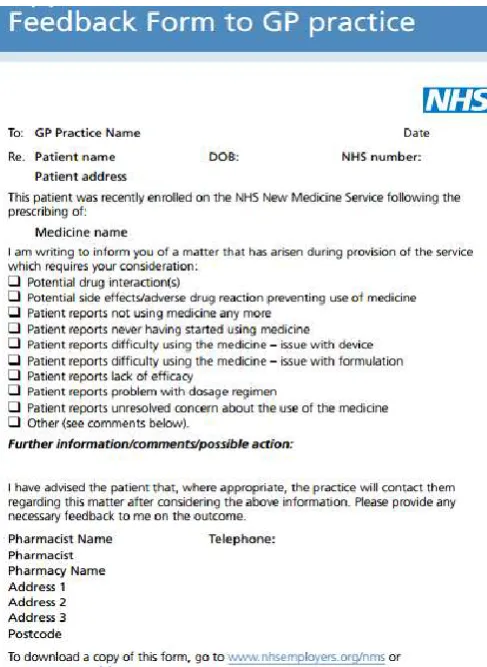
inadequate. Patients are not getting the care they need or understand how to use their medication, resulting in a drug stockpile and poor compliance. The Royal Pharmaceutical Society (2011) supports this with research that shows a third of patients are not taking their medication as instructed after 10 days of starting the course. However, the New Medicine Service (NMS) is in place within pharmacies to aid patients understanding and gain the maximum benefit from their medication. For example some medication works better if it is taken in the morning, but the GP may not have given these instructions on the prescription. Figure 4 shows the feedback form that is sent back to the GP from the pharmacy new medicine service review. This helps to reduce pharmaceutical waste since there may be more waste if the patient has adverse effects or medication changes (NHS, 2012). However, in the long term the patient understands how to use their medication and is on the correct medication for their condition therefore they are less likely to return unused medication
Figure 4. GP NMS feedback form (adopted) (NHS, 2012)
which accounts for roughly 23% of medication returns (Jesson
et al., 2005). A close working relationship between GP’s and
pharmacists will aid the effectiveness of prescribing (Chapman, 2012). For example, prescribing gastro protection medication with an NSAID would decrease the chances of adverse reactions therefore reducing pharmaceutical waste. Trueman (2010) also notes that the flexibility of GP prescribing could reduce waste, if a smaller quantity could be prescribed if the medication is not long term. There are many other factors that create pharmaceutical waste which are being tackled through schemes. Therefore researching pharmacy employees views on factors such as a GP and Pharmacist working relationship would enable an evaluation of how important these factors are in relation to pharmaceutical waste. For example, GP’s may not view patient knowledge as a contributing factor to pharmaceutical waste as they often do not see the amount of returned medication to pharmacies.
There are many methods to reduce pharmaceutical waste including considering item quality, improving order practices and increasing public awareness of pharmaceutical waste (El-Hagger, 2007; Franchetti, 2009; ascp.com, 2009). El-Hagger (2007) also includes supply management through the expiry date as a method to decrease pharmaceutical waste. For example, short dated stock should be sent to stores that use large quantities to decrease pharmaceutical waste. Franchetti (2009) suggests that communicating internally and externally is a very important factor in reducing waste. This is encouraged by ascp.com (2009) who suggests that educating stakeholders will increase awareness of the options to dispose of waste and what happens to unused medication after
disposal. It is a common misunderstanding that returned medicines can be reused in the pharmacy. This is unethical in the UK (Royal Pharmaceutical Society, 2011a). This waste can through implementing waste policies to identify the root cause within an organisation and working to decrease this waste (Department of Health, 2013). Another method to reduce pharmaceutical waste is to encourage shorter dispensing cycles to reduce the number of unused medication (ascp.com, 2009). There are many methods to decrease pharmaceutical waste, many of which are difficult to implement on a large scale.
MATERIALS AND METHODS
A case study based on primary research within a community pharmacy was analysed enabling an evaluation of the end user effects on the accuracy of pharmacy replenishment systems and develop an understanding of the functionality of a replenishment system. The case study was also connected to supply chain management through an analyses of delivery times and order deadlines affecting pharmacy orders in relation to the amount required for efficient operation. The supply chain was analysed through collecting data on delivery times, order transmissions and the ordering process. This information was collected through 5 semi-structured interviews with members of staff working in pharmacies within the same area to prompt extra information on the topic. This allowed analysis of the data to show whether end users order more stock if the delivery time is later. Secondary research was also used to further investigate how management of the supply chain could contribute to decreasing pharmaceutical waste. Qualitative secondary research was used to investigate other factors that increase pharmaceutical waste, in order to determine the effects of pharmacy replenishment systems in decreasing pharmaceutical waste. These sources included journals, books and published articles over 5 years if feasible due to the rapid developments in technology. Based on these methods conclusions on the influence of pharmacy replenishment systems in decreasing pharmaceutical waste were reached.
RESULTS AND DISCUSSION
The case study research showed that the full functionality of pharmacy replenishment systems has not been implemented since it is in pilot stage. The missing function is the ability to produce reports from the system including out of stocks, forecasting and overstocks. Therefore, increasing the ability to create pharmaceutical waste as users cannot make use of valuable reports. Literature suggests that the reporting functionality could help to decrease pharmaceutical waste
through source reduction (Monckza et al., 2008; Zimmer,
understanding of the functionality of pharmacy replenishment systems has been obtained and reinforced by a real case study. Full functionality of pharmacy replenishment systems has not implemented; however this has a minimal effect on pharmaceutical waste in comparison to other factors mentioned earlier. The main contributing factor to decreasing pharmaceutical waste arising from the case study is the strong positive correlation between the number of stock adjustments and the stock file accuracy. Hence, more end user interactions with the system increased the accuracy of the system which in turn gives less pharmaceutical waste as suggested. The end users could distort demand through adjusting stock figures (Donselaar, 2010). The demand is however non-stationary as item numbers increase over the three years, which according to
the literature means inaccuracies are more likely (Waller et al.,
2006). This may explain the interview response, that states end users don’t trust the system and feel like they constantly have to make stock adjustments as supported by McGuire, (2011), who suggests that end users will have to adjust stock figures due to demand fluctuations. This proves that the end user has control over the accuracy of pharmacy replenishment systems and therefore can reduce waste through using the system in this way to increase its accuracy.
This case study revealed some of the reasons why users believe stock figures are inaccurate are categorisation of the items do not reflect their use in the store, the server is overloaded causing a time delay and therefore does not reflect accurate stock figures. Finally, labelling and dispensing errors. These findings contradict with literature. It does mention that recommendations are based on demand and if demand is distorted then the system may not mirror the shelf stock or use of an item effectively (Kogan and Tapiero, 2007). An important finding form the case study research is that the order recommendations provided by the system are based on 26 weeks of dispensing data. According to the literature this suggests that order recommendations are more accurate as they are based on more data, so there is less chance of demand variability (McGuire, 2011). This introduces surplus stock as the data during summer months for hay fever is used in the winter, leaving the pharmacy overstocked in winter months as the system is not design for seasonal variance.
McGuire (2011) also suggests that to avoid demand distortion and inaccurate orders, data at each stage of the supply network should be over the same time period. Pharmacies hold 4-5 weeks stock and GP’s prescribe in 28 days, matching this with order recommendations based on 26 weeks data introduces inconsistencies across the supply chain, in terms of a regular time periods between ordering. This inconsistency could increase pharmaceutical waste as demand could be distorted. The case study also showed that end users tend to order more stock if the order is delivered later to ensure they don’t run out of stock. Whewell (2010) also suggests that the time and frequency of deliveries affect the amount ordered, with McGuire (2011) suggesting that the shorter the lead time the less ordered as shown by our case study findings. Therefore, meeting the objective of evaluating the supply chain in order to measure the order quantity compared to the time of delivery. Our case study shows that users are aware of the procedures when orders are delayed to ensure the pharmacy does not become overstocked. This allows for supply and waste to be managed effectively in terms of supply chain
issues. Pharmacy staff will order more stock as a reassurance
if orders have been delayed (Kirytopoulos et al., 2008).
However, the case study findings have shown that staff do not order more stock unless it is urgently required for patients. Our research also showed that pharmacy staff believes that patients lack understanding about their medication which also increases pharmaceutical waste, supporting the findings that two thirds of patients need more information about their medication (Royal Pharmaceutical Society, 2011). A working relationship between the pharmacist and GP would increase patient understanding and decrease pharmaceutical waste. Analysis and evaluation of the functionality and accuracy of pharmacy replenishment systems by defining the functions used within the case pharmacy show that users have a major effect on the accuracy of pharmacy replenishment systems. This has also been achieved through end user involvement as it has proven that end users interaction with the system increases the accuracy of the system and therefore decreases pharmaceutical waste. An assessment of supply chain management and other factors in relation to the creation of pharmaceutical waste has also been done. The supply chain plays an important role in pharmaceutical waste reduction, as delayed orders can increase waste if not managed correctly. However, in this case they are managed efficiently and help reduce pharmaceutical waste. An analysis of the other factors that could cause pharmaceutical waste show that patient understanding is a major factor in decreasing pharmaceutical waste. This can be increased through informing stakeholders of the costs of waste and increasing their knowledge of medication through the increased use of improved medication reviews.
Conclusions
This investigation has shown that pharmacy replenishment systems can decrease pharmaceutical waste, depending on how they are used and maintained. The research showed that the more end users make stock adjustments the more accurate the stock files become, this contradicts the literature finds that suggest less end user involvement (Manhattan Associates, 2012). End user involvement has been shown to increase the accuracy of the pharmacy replenishment system, using a data set of thirty records which provided a strong basis for analysis. Hence, the end users play a major role in decreasing pharmaceutical waste through pharmacy replenishment systems and increase the system accuracy in the future. Demand fluctuations, however, could make this problematic due to the inaccuracies that could occur and therefore the implied bullwhip effect. Patient understanding of their medication has also been found to be a major contributor to pharmaceutical waste in agreement with literature. Supply chain management may be a contributing factor depending on how delays are managed. In this specific case delays were successfully managed hence was not a contributing factor to pharmaceutical waste. This research focused on only one pharmacy and needs to be studied widely within the pharmaceutical industry.
REFERENCES
Adams, K., 2012. Up in Smoke: £150m of medicines a year, http://www.guardian.co.uk/society/2012/jul/03/prescription
-medicine-unused?INTCMP=SRCH Last Accessed:
Anderson, P., O., McGuinness, S., M. and Bourne, P., E., 2010. Pharmacy Informatics, CRC Press
ascp.com, 2009. Reducing Pharmaceutical Waste,
http://www.benzos.une.edu/documents/Gavett_ReducingP
harmWasteWhitePaper_000.pdf Last Accessed:
17/04/2013
Basavanthappa, 2008. Community Health Nursing, Jaypee Brothers Publishers
Chapman, C., 2012. Pharmacists cut GP Prescribing Errors Rate, Chemist and Druggist, Vol: 277, Issue: 6819, pp 8 Chisholm-Burns, M., A., Vaillancourt, A., M. and Shepherd,
M., 2012. Pharmacy Management, Leadership, Marketing and Finance, Jones & Bartlett Publishers
Cohen, L., Manion, L., Morrison, K. and Morrison, K., R., 2007. Research Methods in Education, Routledge
DeHoratius, N., Mersereau, A., J. and Schrage, L., 2008. Retail Inventory Management When Records Are
Inaccurate, Manufacturing & Services Operations
Management, Vol:10, Issue: 2, pp 257-277
Department of Health, 2013. Environment and Sustainability: Health Technical Memorandum 07-01: Sage Management of Healthcare Waste, https://www.gov.uk/government/ uploads/system/uploads/attachment_data/file/167976/HTM _07-01_Final.pdf Last Accessed: 17/04/2013
Donselaar, K., H., Gaur, V., Woensel, T., Broekmeulen, R., A., C. and Fransoo, J., C., 2010. Ordering Behaviour in
Retail Stores and Implications for Automated
Replenishment, Management Science, Vol: 56, Issue: 5, pp766-784
Duerden, M., Millson, D., Avery, A. and Smart, S., 2011. The
Quality of GP Prescribing, The King’s Fund,
http://e3idocs.fmhs.fastmail.net/Quality_of_GP_prescribin g.pdf [Last Accessed: 04/01/2013]
Franchetti, M., J., 2009. Solid Waste Analysis and Minimization: A Systems Approach, McGraw-Hill
Goundrey-Smith, S., 2012. Information Technology in Pharmacy: An Integrated Approach, Springer
Hugos, M., H., 2011. Essentials of Supply Chain Management, Wiley & Sons
Jesson, J., Pocock, R. and Wilson, K., 2005. Reducing Medicines Waste In the Community, Primary Health Care Research & Development, Sage Publications, Vol: 6, Issue: 2, pp 117-124
Kirytopoulos, K., Leopoulos, V. and Voulgaridou, D., 2008. Supplier Selection in Pharmaceutical Industry: An Analytic
Network Process Approach, Benchmarking: An
International Journal, Vol: 15, Iss: 4, pp494-516
Kogan, K. and Taperio, C. S., 2007. Supply Chain Games: Operations Management and Risk Valuation, Springer Kok, A., G. and Shang, K., H., 2007. Inspection and
Replenishment Policies for Systems with Inventory Inaccuracy, Manufacturing and Service Operations Management, Vol: 9 Issue: 2, pp185-205
Leeman, J. J. A., 2010. Supply Chain Management: Fast, Flexible Supply Chains in Manufacturing and Retailing, Books on Demand
Letcher, T. M. and Vallero, D. A., 2011. Waste: A Handbook for Management, Academic Press
Li, L., 2007. Supply Chain Management: Concepts, World Scientific
Logisticsit.com, 2006. Alliance Boots Wholesale Supply Chain Gets Performance Boost with Manhattan Associates’ Integrated Planning Solutions, http://www.logisticsit.com/
articles/2006/10/03/2288-alliance-boots-wholesale-supply-chain-gets-performance-boost-with-manhattan-associates [Last Accessed: 29/11/2012]
Mackridge, A., J. and Marriott, J., F., 2007. Returned
Medicines: Waste or a Waste Opportunity?, Journal of
Public Health, Vol: 29, Iss: 3, pp 258-262
Manhattan Associates, 2012. Alliance Boots Achieves Immediate Inventory Savings and Improved Service Levels
with Manhattan Solutions, www.manh.com/library/
MANH-Alliance_Boots-CaseStudy.pdf[Last Accessed:
29/11/2012]
Mc Guire, G., 2011. Handbook of Humanitarian Health Care
Logistics, available at:
www.humanitarianhealthcarelogistics.com, [Last
Accessed: 12/12/12]
NHS, 2012. New Medicine Service Guidance, http://www. nhsemployers.org/Aboutus/Publications/Documents/NHS %20New%20Medicine%20Service%20Guidance%202012 .pdf , [Last Accessed: 04/01/2012]
Peterson, A., 2004. Managing Pharmacy Practice: Principles,
Strategies and Systems, CRC Press, 1st Edition
PSNC, 2010. NHS Medicines Waste Evaluation, http://www. psnc.org.uk/news.php/910/nhs_medicines_waste_evaluatio n [Last Accessed: 07/10/2012]
Rainer, R., K. and Cegielski, C., G., 2010. Introduction to
Information Systems: Enabling and Transforming
Business, Wiley & Sons
Ramanathan, U., 2012. Supply chain collaboration for improved forecast accuracy of promotional sales, International Journal of Operations & Production Management, Vol. 32 Iss: 6 pp. 676 – 695
Royal Pharmaceutical Society, 2011. New NHS Pharmacy Service Will Cut Medicines Waste and Improve Health, http://www.rpharms.com/pressreleases/pr_show.asp?id=28 1 [Last Accessed: 12/12/12]
Royal Pharmaceutical Society, 2011a. Medicines, Ethics and Practice: The Professional Guide for Pharmacists, Edition 35
Sari, K., 2008. Inventory inaccuracy and performance of
collaborative supply chain practices, Industrial
Management & Data Systems, Vol. 108 Iss: 4 pp. 495 – 509
Trueman, P., 2010. Evaluation of the Scale, Causes and Costs of Waste Medicines, http://php.york.ac.uk/inst/yhec/web/ news/documents/Evaluation_of_NHS_Medicines_Waste_ Nov_2010.pdf [Last Accessed: 30/11/2012]
Walker, H. and Jones, N., 2012. Sustainable supply chain management across the UK private sector, Supply Chain Management: An International Journal, Vol. 17 Iss: 1 pp. 15 - 28
Waller, M., A., Nachtmann, H. and Hunter, J., 2006. Measuring the impact of inaccurate inventory Information
on a retail outlet, The International Journal of Logistics
Management, Vol. 17 Iss: 3 pp. 355 – 376
Whewell, R., 2010. Supply Chain in the Pharmaceutical
Industry: Strategic Influences and Supply Chain
Responses, Gower Publishing Ltd
Wiffen, P., Mitchell, M., Snelling, M. and Stoner, N., 2012. Oxford Handbook of Clinical Pharmacy, Oxford University Press
Approach, Supply Chain Management: An International Journal, Vol. 17 Issue: 1 pp. 40 – 53
Yin, R., K., 2009. Case Study Research: Design and Methods, Fourth Edition, Sage Publications
Zimmer, C., 2012. Minimum Impact, Health Facilities Management, Vol: 25, Iss: 3, pp43-47
Zimmermann, A., Lubomira, W. and Popowskim P., 2011. Procedures Regarding Expired Medicinal Products – Select
Legal Issues, Polish Journal of Environmental Studies,
Vol. 20 Iss: 4 pp. 1093 – 1096.