An empower hamilton loop based data
collection algorithm with mobile agent
for WSNs
Jin Wang
1,2, Xiujian Gu
3, Wei Liu
3, Arun Kumar Sangaiah
4and Hye‑Jin Kim
5*Introduction
A WSN can be viewed as a distributed and self-organized network which consists of many miniature sensor devices mostly assigned throughout the sensing area randomly [1]. Recently, advance in the technology of sensor networks have been highly recog-nized to implement various large-scale wireless sensor technology applications such as environment monitoring, health care, agriculture, military and smart home [2–4]. Meanwhile, there are still numerous research fields remaining to be studied in WSN applications, including localization, data fusion, data transmission and energy efficiency. The energy shortage of sensor nodes is a crucial problem in terms of prolonging the net-work lifetime. Rationalizing the energy distribution of sensor nodes is a crucial challenge to improve network performance [5, 6].
Wireless routing protocol is a hot topic in the research of distributed sensor networks. The routing protocol of sensor network is responsible for the reliable
Abstract
In wireless sensor networks (WSNs), sensor devices must be equipped with the capa‑ bilities of sensing, computation and communication. These devices work continuously through non‑rechargeable batteries under harsh conditions, the batter span of nodes determines the whole network lifetime. Network clustering adopts an energy neutral approach to extend the network life. The clustering methods can be divided into even and uneven clustering. If even clustering is adopted, it will cause the cluster head nodes (CHs) in vicinity of the base station to relay more data and cause energy hole phenomenon. Therefore, we adopt a non‑uniform clustering method to alleviate the problem of energy hole. Furthermore, to further balance and remit resource overhead of the entire network, we combined the PEGASIS algorithm and the Hamilton loop algorithm, through a mixture of single‑hop and multiple hops mechanisms, insert‑ ing a mobile agent node (MA) and designing an optimal empower Hamilton loop is obtained by the local optimization algorithm. MA is responsible for receiving and fusing packet from the CHs on the path. Network performance results show that the proposed routing algorithm can effectively prolong network lifetime, equalize resource expenditure and decrease the propagation delay.
Keywords: Wireless sensor networks, Hamilton loop, Energy efficiency, Delay, Optimization algorithm
Open Access
© The Author(s) 2019. This article is distributed under the terms of the Creative Commons Attribution 4.0 International License (http://creat iveco mmons .org/licen ses/by/4.0/), which permits unrestricted use, distribution, and reproduction in any medium, provided you give appropriate credit to the original author(s) and the source, provide a link to the Creative Commons license, and indicate if changes were made.
RESEARCH
*Correspondence: hye‑[email protected]
5 Business Administration
Research Institute, Sungshin W. University, Seoul, South Korea
transmission of data between source node and destination node, including routing selection and data forwarding. According to whether the network topology is hierar-chical, network routing protocols can be classified as flat routing protocols and lay-ered routing protocols [7].
Flat routing protocols include flooding protocol [8–10], sensor protocols for infor-mation via negotiation (SPIN), directed diffusion (DD) protocol. The planar routing protocol is applicable to the network with planar structure, all nodes have equal sta-tus, and the protocol is relatively simple. There are lots of relay nodes in the transmis-sion from the source node to the destination node, and they can share the network load. However, the organization of nodes, the establishment of routing, the con-trol and maintenance of the overhead need to occupy a large amount of bandwidth, thereby limiting the transmission rate of network data greatly. In addition, when the network scale is large, data transmission requires consuming large amounts of energy, and the scalability of the network is poor. Motivated by this aspect, the flat routing protocol applies only to smaller networks.
Layered routing protocols mainly used in hierarchical network, it divides the whole network into multiple clusters [11]. The layered protocol is proposed to reduce net-work resource overhead, which effectively can prolong the whole netnet-work cycle [12]. Compared to the flat routing protocols, hierarchical routing has great advantages in energy efficiency, transmission delay and packet loss rate, therefore, it is necessary to adopt the routing protocols in large networks. In the process of dividing the clusters, it can be divided into uniform clustering and non-uniform clustering techniques [13]. Both methods have their respective characteristics, the former can save the calcula-tion cost of re-planning cluster formacalcula-tion, while the latter can mitigate the problem of hot nodes [14].
Recently literature shows that in the period of data dissemination, MA deployed in sensing field can reduce the network load, overcome asynchronous transmission, and decrease the loss packet rate [15, 16]. A mobile agent that roam in sensing field is con-trolled by autonomous programs, and it takes charge of aggregating data packets from the CHs of the whole network in complicated network environment intelligently. Many studies have shown that deploying MAs in the sensing area can facilitate effective data propagation and consolidation in WSNs.
In this paper, we propose an effective data aggregation algorithm based on empower Hamilton loop for WSNs, we combined the PEGASIS algorithm and the Hamilton loop algorithm, through a mixture of single-hop and multi-hop mechanisms, and includes a mobile agent (MA) node on the Hamilton loop, MA is responsible for receiving and fus-ing CHs on the path. Network performance analysis result show that the proposed rout-ing algorithm can effectively extend network life cycle, balance network overhead and decrease propagation latency.
Related work
In the recent, many researchers take more efforts into using network energy properly to improve network performance [17, 18]. The routing protocols are classified into two cat-egories to address the energy consumption problem, as the aforementioned techniques, flat routing protocols apply only to smaller networks [19], therefore, we adopt hierarchical routing protocol with respect to the clustering process.
As we all known, A classical hierarchical routing algorithm, low energy adaptive cluster-ing hierarchy (LEACH) has been proposed in [20]. In LEACH protocol, CH collects and process network information resources from its own cluster members (CMs), and each CH transmits the data to the BS by single hop. The protocol stipulates that new CH nodes are randomly elected in each round to balance the load of sensor nodes and extend the network life cycle. The disadvantage is that the unreasonable deployment of CHs causes the conse-quence of unbalanced energy consumption in certain parts of the network region. Espe-cially those nodes far away from the BS will experience premature energy exhaustion. Later on, Liu et al. [21] put forward a Genetic Algorithm based LEACH (LEACH-GA) to utilize genetic algorithm to determine the selection of CHs optimally, the algorithm optimize the threshold of CH selection, but did not take the remaining energy of CH into account.
In [22, 23], a chain-structured routing protocol, power efficient gathering in sensor infor-mation system (PEGASIS) is put forward, it is based on greedy algorithm to establish net-work topology. The main routing of PEGASIS is that sensor node forwards data packet to the nearest node by forming a chain among the nodes. Apparently, the shorter transmis-sion distance become, the smaller required energy consumes in each round [24]. Generally speaking, PEGASIS reduces the energy consumption by shortening the distance of trans-mission, while it will cause the CHs in vicinity of the base station to relay more data and increase the transmission delay. So in this paper, in order to make up for the deficiency of this protocol, we did not use this algorithm to traverse the entire network completely, but combined with Hamilton loop algorithm to complete the data communication between networks. There are many researches on the combination of cluster and chain. Zarei et al. [25] proposed a distributed routing algorithm based on clustering routing protocol (CBRP), which is a hybrid protocol architecture cluster and tree. CBRP adopt single-hop mecha-nism to deliver the data packet of root node to BS. However, the inestimable shortcoming is that it contains large amounts of non-data messages between sensor nodes when delivering data to BS, leading to extra communication overhead.
EEUC (Energy Efficient Uneven Clustering) [26] is an energy efficient clustering routing algorithm. The basic principle of the algorithm is as follows. Firstly, several candidate clus-ter head nodes are elected by random function. Secondly, the competitive radius of CHs is measured according to the Euclidean distance between each CH to BS. Finally, when the distance between two CHs is less than their competitive radius, high-energy nodes are appointed as their joint CHs. The equation for computing the competitive radius is as follows,
where R0c is a fixed value, it merely needs to guarantee normal communication between
nodes? c is a constant, and the simulation result proves that the network performance Rc=(1−c
Dmax−D(Si,BS) Dmax−Dmin
achieves the most ideal effect when the optimal value is 0.5. Symbol Dmax and Dmin are the maximum and minimum distance of CH to BS separately, and D(Si,BS) is the
dis-tance from current CH to BS. It is obviously that the smaller the competitive radiuses of the CH node near the base station, the smaller the number of member nodes it contains, and it will have enough energy to serve as the relay node in the next rounds. This proto-col can effectively alleviate the problem of non-uniform energy depletion, thus extend-ing the network life cycle.
Recently, Scholars have invested more energy in the design, deployment and manage-ment of MA. It is a promising research direction to solve the lack of network resource by adding MA in WSNs. MA is used as the media for data communication between CHs and BS. DGMA is a data collection algorithm based on MA in dynamic WSNs [27, 28], and the algorithm design an emergency event driven program. The sequence that MA accesses throughout the network has great influences on the routing optimization and network lifetime. The MAs traverse entire sensing field to collect information from each member node. In [29], directional diffusion based on mobile agent (MADD) was proposed. Target sensor nodes propagate the announcing signal to BS when the source node in the target field detects a critical event. According to the received signal pack-ets, the sink node statically picks out the most suitable source node to be accessed by MA, which automatically determines the priority of accessing sensors sequence in the transfer of MA. The hybrid structure algorithm plans a low latency route for WSN, and balance the unique drawback between static and mobile network structure, but it has no obvious effect on improving energy efficiency of sensor nodes.
Our proposed energy‑efficient routing algorithm
Basic assumptions
In this paper, to design the clustering protocol, we make some assumptions about
net-work model. The netnet-work structure consists of one BS, one MA and n common sensor
devices, these nodes are deployed in sensing filed. Each sensor node has a specific id, the identity of sensor nodes are represented as {S1, S2, S3 ,…, Sn} respectively. We make the assumptions as follows:
• All sensor devices are stationary and deployed randomly. Each one is denoted by a detailed coordinate.
• Mobile agent has sufficient energy so that the problem of energy exhaustion is not considered.
• All sensors are isomorphic and have the same ability to process data.
• All sensor nodes have the same battery capacity and cannot harvest energy from the external environment.
Network model
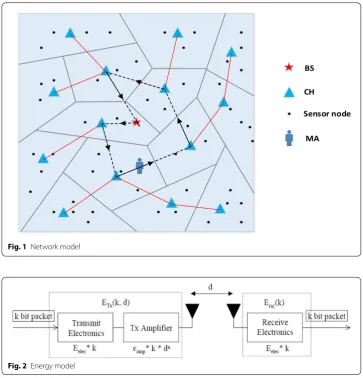
below figure, the dotted black line with arrows represents the moving trajectory of MA, and data packets transmission among the clusters can be described as red lines.
Energy model
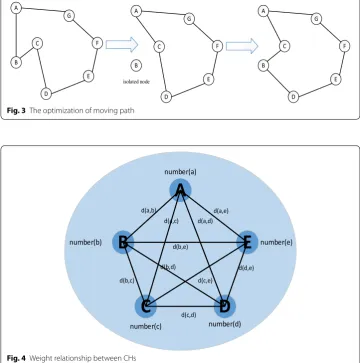
We present the simple radio energy consumption model in Fig. 2 [18]. Firstly, the trans-mitter sends k bit packet, which can be divided into signal generation stage and signal amplifier stage. The energy consumption in the signal amplifier phase is determined by the size of the packet, while the energy consumption in the signal amplifier phase is determined by the size of the packet and the distance between the receiver and the transmitter. Secondly, the receiver is responsible for gathering the packet and it also pro-duces energy expenditure. The specific energy consumption formula can be seen in the following formula (1).
This part mainly discusses the energy model of the network. The battery of sen-sor devices is a fundamental constraint with respect to the energy dissipation of the network. We regard the initial energy of sensor nodes as E0 , and these nodes are not rechargeable. Network energy consumption mainly refers to the forwarding and receiv-ing process of data packets, and the specific calculation formulas are respectively stated
CH BS
Sensor node
MA
Fig. 1 Network model
in formulas (1) and (2) [30]. Transmission energy is expressed as ETx(k,d) , where coef-ficient k is the number of bits that forward signal packet, and d is the communication distance between the forwarding node and the receiving node.
In this formula, the size of transmission message k= 2000 bits when each node
for-wards the packet, and the threshold value d0=Efs/Emp . Furthermore, in energy set-tings, the radio energy parameter Eelec= 50 nJ/bit, Efs= 10 pJ/bit/m and Emp= 0.0013 pJ/ bit/m.
The process of clustering construction
Firstly, each node in the network will randomly generate a number between 0 and 1. If the random number of sensor node is less than the preset threshold value T , the node is elected as the candidate CH. Secondly, the competitive radius of the candidate CH is set. Different from the previous algorithm, the competitive radius of the EEUC algorithm is improved. By combining the Euclidean distance and residual energy between the nodes, the competitive radius of the node is more reasonably planned, as shown in formulas (3)–(6).
where, Di is the distance from the common sensor member node to its CH, Dmax and
Dmin are the furthest and closest distances from the node in the sensing region to BS
respectively. We use c to represent the distance between them, and e is the ratio between the residual energy of the current sensor and the average residual energy of all the sen-sors. In formula (5), where ω is a regulation coefficient that is used to optimize the weight relationship between distance and energy. We set a limit on the value of c , and when it exceeds this range, set a corresponding threshold for it. Rbc is denoted as
bench-mark competitive radius and take the Rbc= 90 m. Usually, k1= 0.5 and k2= 2 are used to reasonably control the competitive radius. When the distance between the two candi-date CHs is less than their competition radius, the node with more energy is elected as a CH, and another candidate are disqualified.
After the election process of CHs, ordinary nodes join the appropriate cluster once receiving the broadcast information from CH. In the algorithm, we proposed three (1) ETx(k,d)=ETx−elec(k)+ETx−amp(k,d)
=
k·Eelec+Efs·k·d2,d<d0
k·Eelec+Emp·k·d4,d≥d0
(2) ERx=k·Eelec
(3)
d= Di−Dmin Dmax−Dmin
(4)
e= nEri
jErj
(5) Ri=
factors for selecting cluster, namely, the remaining energy of CHs, the distance from cur-rent ordinary node to BS and the distance from the node to other CHs. Finally, the fit-ness function f(i,j) of ordinary node i added to CH j is proposed, as shown in formula (6).
where, α is the energy regulation coefficient, β and ε are the regulation coefficient between the node distance from BS and another node separately. All of these coefficients are between 0 and 1, and α+β+ε=1.
Our proposed algorithm
Clustering phase
In this paper, we use non-uniform clustering method to divide the whole sensing area.
First, each node will generate a random number Randi . We optimized the previous
threshold setting, taking the residual energy of the node into account, and redefined the threshold T(n) as shown in formula (7).
where p represents the expected percentage of nodes selected as CHs; r is denoted as the maximum number of rounds in the network; G is a set of common nodes that have not been selected as CHs within 1
p cycles; Eri represents the remaining energy of node i ; E represents the average residual energy of the whole sensor network. The calculated threshold T(n) is compared with the random number Randi generated by each node. If Randi <T(n) , the node is selected as the candidate CH.
Then, BS broadcasts clustering information to the entire sensing area. After receiv-ing the broadcast, the candidate CH determines its competitive radius by usreceiv-ing formula (3)–(5) according to the distance from the node to BS and the residual energy of the node. If the distance among the adjacent CHs is less than their competitive radius, the node with more energy is selected as the cluster head node. Once entering the clustering stage, the common node selects a suitable cluster according to the message broadcast by each CH. Taking into account the distance between nodes to BS, the distance between nodes and the residual energy of nodes, the fitness function (6) of each ordinary node is obtained. A node is declared a member node of the cluster when the maximum fitness value between the node and a CH.
Conventional hamilton loop problem
In 1857, Hamilton, a British mathematician, proposed the famous Hamilton circuit problem, which arose when the mathematician wanted to design a plan to travel around the world. Hamilton wanted to travel to all the countries, and he wanted to find a suit-able path, starting from the beginning, traveling to all the countries in a certain order, as long as he could not go to the same country repeatedly and finally back to the starting point. From a mathematical point of view, a loop is designed to pass through each vertex (6)
f(i,j)=αErj
E0 +β
Dj
d(i,j) +ε
Dk
d(i,k)
(7) T(n)=
p
1−p(rmod1p) Eri
E, n∈G
(country) once and for all. Subsequently, this problem further evolved into a traveling salesman problem (TSP), namely, the problem of empowering Hamilton loop minimi-zation. It not only guarantees that the constructed path is a Hamilton loop, but also requires that the selection target of the path is the minimum total distance of all paths.
The classic Hamilton algorithm is mainly to find a loop that can traverse all the CHs, so that MA can start from the BS and pass through all the CHs that are required only once and finally return to the starting point. Next, in order to reduce the total cost of MA traversing these CHs, we need to optimize the loop.
In simple terms, this problem can be handled by the enumeration method, but the cal-culation amount of the method is too large, reaching the number of n-1 factorial, so the enumeration method is not feasible for the complex network environment. Later, heuris-tic algorithm is proposed to calculate the approximate solution of the problem through the features of some optimal solutions or the features that should not be present, but the solution obtained by this method is not the optimal solution of the problem. We put for-ward an idea of local optimization to optimize the known Hamilton loop.
Empower Hamilton loop optimization algorithm
Step 1: Determine the starting point of the cycle with BS. A Hamilton loop is obtained for each CH near BS using the classical algorithm;
Step 2: Cut across the line (in the formed Hamilton loop, the current CH is regarded as the starting point of cutting, and the intermediate node is isolated, and the other nodes are connected among the three CHs connected to each other), generate an isolated CH;
Step 3: The isolated CH node is reconnected to the loop to form a new Hamilton loop according to the principle of path energy consumption minimization, the minimum of energy consumption is measured by the weight between the cluster head nodes in formula (9);
Step 4: If the total weight of the path changes, replace the old loop with a new loop, and take the current CH as the new starting point of the cycle, put back to step 2. Otherwise, move the starting point to the next CH, and enter step 5; Step 5: Determine whether the loop is completed, that is, whether the current cluster
head node is a base station; if so, the algorithm terminates. Otherwise, go to step 2.
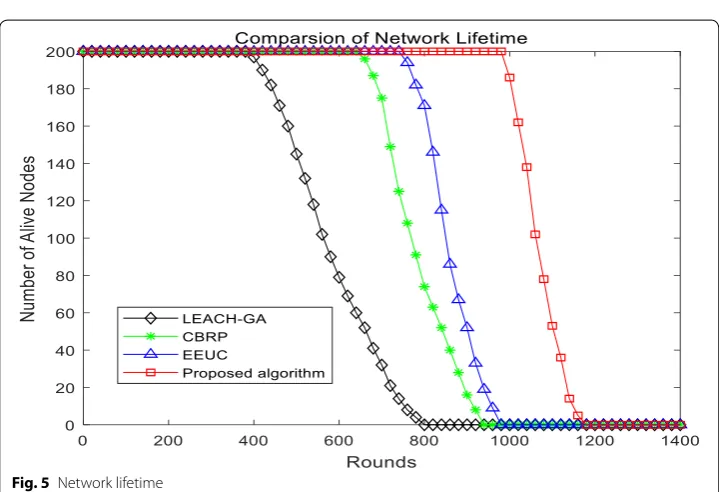
To describe the algorithm above in a brief way, we provide an intuitive process to locally optimize the moving path according to the Empower Hamilton loop optimization algorithm in Fig. 3.
Data transmission phase
need to set a threshold of Tc , and the derivation of Tc follows the formula (8). Where c is the radius adjustment coefficient, the simulation results show that when c=0.5 , the entire network performance is optimal.
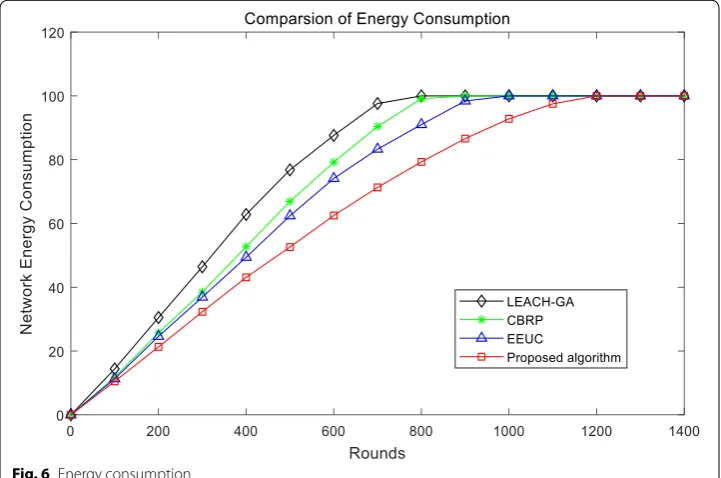
Furthermore, in Fig. 4a–e are used to represent CHs in different clusters respectively, meanwhile number represents the packets size of each CH calculated, d is denoted as the distance between two CHs. The weight relationship between CHs is presented by the dis-tance between them and the size of their own packets, in the following work, we can find an optimal MS movement path through the weight relationship between them.
Specific weight calculation formula is satisfied (9), where α is coordination coefficient, d(i,j) represents the distance between CH i and j , number(i) is denoted as the packet size of CH i.
(8) Tc=c·
m
i Ri m
(9) Weighti=max
j
1
α·d(i,j)+(1−α)·number(i)
A
C
B
D
E F
G A
C
B
D
E F G
isolated node
A
C
B
D
E F G
Fig. 3 The optimization of moving path
A
B
C
D
E
number(a)
number(b)
number(c) number(d)
number(e)
d(a,b)
d(b,c)
d(b,d) d(b,e)
d(c,d) d(c,e)
d(d,e)
d(a,c) d(a,d)
d(a,e)
Performance evaluation
In the part of experiment, we have simulated network environment in Matlab on Micro-soft Windows 7 professional platform to analyze the performance of our proposal. For convenience of comparison, LEACH-GA algorithm, CBRP algorithm and EEUC
algorithm were used for comparison [22, 25]. Using the energy consumption model
mentioned in this article, the measurement results of each algorithm for the energy con-sumption from nodes, the packet forward rate of packets and delay are presented. The values of relevant experimental parameters are shown in Table 1.
In Fig. 5, The network lifetime under different algorithms is analyzed. Compared with other algorithms, the proposed algorithm greatly extends the life cycle of the network, which is mainly reflected in the longer stable stage of the whole network and the steeper slope of node death. It is apparent that our proposed algorithm did not appear the node Table 1 Simulation parameters
Parameter name Value
Network size (R) 200*200 m
The coordinates of BS (base station) (100, 100)
Number of nodes (N) 200
Packet length (l) 2000 bits
Initial energy ( E0) 0.5 J
Energy consumption on circuit ( Eelec) 50 nJ/bit
Free‑space channel parameter ( εfs) 10 pJ/bit/m 2
Multi‑path channel parameter ( εmp) 0.0013 pJ/bit/m 4
Distance threshold ( d0)
εfs/εmp= 87.7 m
Benchmark competition radius ( Rbc) 90 m
Number of MA (mobile agent) 1
death phenomenon until the number of rounds is close to 1000, while all the nodes of other algorithms have almost died during this time period, and LEACH-GA algorithm has crashed when it run to 724th rounds. Based on the idea of empowering Hamil-ton loop to collect data packets, an optimal agent traverse route is planned. It not only extends the longevity of the node, but also achieves the effect of balanced energy con-sumption and alleviates the problem of energy hole.
As is clearly shown in Fig. 6, in comparison with the sum of energy consumption
among the other three algorithms, it is obvious that our proposed scheme is superior to other algorithms in terms of the stability period and the network lifetime. The gentler the slope is, the less energy will be consumed per round, indicating that our algorithm is more energy efficient compared with other algorithms. Our proposed algorithm will consume 10.5 joules of energy per 100 rounds approximately, while the energy consump-tion of the other three algorithms are 11.3, 12.2 and 14.2 respectively. As can be seen from the chart, when the number of rounds reached 1200, the total energy of the net-work was exhausted, while other algorithms have a netnet-work life of less than 1000 rounds. In short, the less energy consumed, the longer the lifetime of the entire network.
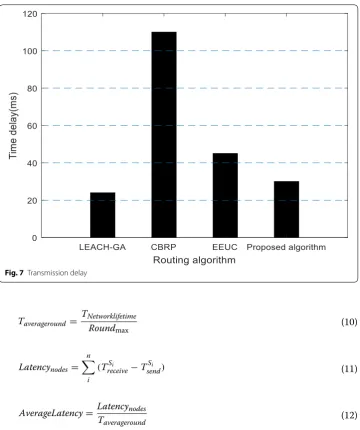
Network average transmission delay is another important standard to evaluate net-work performance. The average delay time between the beginning of propagating a data and its arrival at the other node required to receive the data [31, 32]. Where, the calculation formula of the average delay is obtained from formulas (10)–(12). From the simulation performance of the experiment in Fig. 7, the LEACH-GA algorithm and the proposed algorithm proposed are relatively low in delay, and the delay difference value between our algorithm and CBRP algorithm is 80 ms and 15 ms with respect of time delay, Apparently, our algorithm is an ideal compromise algorithm, it combines the advantages of LEACH-GA and CBRP algorithm for alleviating the energy consumption and reducing the transmission delay respectively.
In Formula (10), we calculated the average time to run a round. Symbol Roundmax rep-resents the maximum rounds in the network life cycle. TSi
send and T Si
receive are time periods for sending and receiving packets respectively.
Conclusion
In this paper, Empower Hamilton Loop based Data Collection Algorithm by Mobile Agent is proposed in Uneven Clustering for WSN. With the aim of alleviating the prob-lem of energy hole, we adopt a non-uniform clustering method, the method mitigate transmission load of the nodes in vicinity of the base station. Furthermore, to further balance and decrease the resource expenditure of the entire network, we combined the PEGASIS algorithm and the Hamilton loop algorithm, adopts a mixture of single-hop and multiple hops mechanisms, and includes MA on the optimal Hamilton moving loop, MA is responsible for aggregating and fusing data packets from the CHs on the loop. Network performance analysis results show that the proposed routing algorithm can (10)
Taverageround =
TNetworklifetime
Roundmax
(11) Latencynodes=
n
i
(TreceiveSi −TsendSi )
(12) AverageLatency= Latencynodes
effectively prolong network life cycle, equalize energy consumption and reduce network delay. Although LEACH-GA algorithm delay was slightly lower than our algorithm, but it will consume the most energy consumption of each round, so its life cycle is short. The energy saving effect of our algorithm is better than CBRP and EEUC algorithm, mean-while, the efficiency of two algorithms are not ideal in terms of transmission latency. Therefore, the proposed algorithm is more reliable and effective compared to other pro-tocols. In the future, we intend to adjust the number of MA and change the value of the benchmark competition radius to specifically analyze the influence of these variables on network performance.
Acknowledgements
This work is supported by the National Natural Science Foundation of China (61772454, 61811530332, 61811540410). Professor Hye‑Jin Kim is the corresponding author.
Authors’ contributions
JW and HJK conceived and designed the experiments; XG and WL performed the experiments; AKS analyzed the data and helped to revise this paper, HJK advised on the simulation settings and JW wrote this paper. All authors read and approved the final manuscript.
Funding
This work is supported by the National Natural Science Foundation of China (61772454, 61811530332, 61811540410). Availability of data and materials
The data that support the findings of this study are available from the corresponding author upon reasonable request. Competing interests
The authors declare that they have no competing interests. Author details
1 Hunan Provincial Key Laboratory of Intelligent Processing of Big Data on Transportation, School of Computer and Com‑
munication Engineering, Changsha University of Science and Technology, Changsha, China. 2 School of Information
Science and Engineering, Fujian University of Technology, Fujian, China. 3 College of Information Engineering, Yangzhou
University, Yangzhou, China. 4 School of Computing Science and Engineering, Vellore Institute of Technology (VIT), Vel‑
lore, India. 5 Business Administration Research Institute, Sungshin W. University, Seoul, South Korea.
Received: 28 November 2018 Accepted: 30 April 2019
References
1. Akyildiz IF, Su W, Sankarasubramaniam Y et al (2002) Wireless sensor networks: a survey. Comput Netw 38(4):393–422
2. Chen M, Gonzalez S, Vasilakos A, Cao H et al (2011) Body area networks: a survey. Mobile Netw Appl 16(2):171–193 3. Bhuiyan MZA, Wang G, Cao J (2015) Deploying wireless sensor networks with fault‑tolerance for structural health
monitoring. IEEE Trans Comput 64(2):382–395
4. Wang J, Cao J, Ji S et al (2017) Energy efficient cluster‑based dynamic routes adjustment approach for wireless sen‑ sor networks with mobile sinks. J Supercomput 73(7):3277–3290
5. Khan JA, Qureshi HK, Iqbal A (2015) Energy management in wireless sensor networks: a survey. Comput Electr Eng 41(1):159–176
6. Tu Y, Lin Y, Wang J, Kim JU (2018) Learning with generative adversarial networks on digital signal modulation clas‑ sification. Comput Mater Con 55(2):243–254
7. Pantazis NA, Nikolidakis SA, Vergados D (2013) Energy‑efficient routing protocols in wireless sensor networks: a survey. IEEE Commun Surv Tut 15(2):551–591
8. Kanavalli A, Sserubiri D, Shenoy PD et al (2010) A flat routing protocol for sensor networks. In: Proceeding of interna‑ tional conference on methods and models in computer science, IEEE, pp 1–5
9. Salman HM (2014) Survey of routing protocols in wireless sensor networks. Int J Sens Sens Netw 2(1):1–6 10. Al‑Karaki JN, Kamal AE (2004) Routing techniques in wireless sensor networks: a survey. IEEE Wirel Commun
11(6):6–28
11. Singh SK, Singh MP, Singh DK (2010) A survey of energy‑efficient hierarchical cluster based routing in wireless sen‑ sor networks. Int J Adv Netw Appl 2(2):570–580
12. Yin C, Xi J, Sun R, Wang J (2018) Location privacy protection based on differential privacy strategy for big data in industrial internet of things. IEEE Trans Industr Inf 14(8):3628–3636
13. Guiloufi ABF, Nasri N, Kachouri A (2016) An energy‑efficient unequal clustering algorithm using ‘sierpinski triangle’ for WSNs. Wireless Pers Commun 88(3):449–465
15. Venetis IE, Pantziou G, Gavalas D, et al (2014) Benchmarking mobile agent itinerary planning algorithms for data aggregation on WSNs. In: International conference on ubiquitous & future networks, IEEE. pp 105–110
16. Wang J, Ju C, Kim H et al (2017) A mobile assist coverage hole patching scheme based on particle swarm optimiza‑ tion for wsNs. Cluster Comput. https ://doi.org/10.1007/s1058 6‑017‑1586‑9
17. Wang J, Ju C, Gao Y et al (2018) A PSO based energy efficient coverage control algorithm for wireless sensor net‑ works. Comput Mater Con 56(3):433–446
18. Wang J, Cao Y, Li B, Kim H et al (2017) Particle swarm optimization based clustering algorithm with mobile sink for WSNs. Future Gener Comput Syst 76:452–457
19. Tseng YC, Kuo SP, Lee HW et al (2004) Location tracking in a wireless sensor network by mobile agents and its data fusion strategies. Info Process Sens Netw 47(4):448–460
20. Heinzelman WR, Sinha A, Wang A et al (2000) Energy‑scalable algorithm and protocol for wireless micro sensor networks, acoustics, speech and signal processing. Proc IEEE Int Conf 6:3722–3725
21. Tirkolaee EB, Hosseinabadi AAR, Soltani M et al (2018) A hybrid genetic algorithm for multi‑trip green capacitated arc routing problem in the scope of urban services. Sustainability 10(5):1366
22. Lindsey S, Raghavendra CS (2003) PEGASIS: power‑efficient gathering in sensor information systems. Aerospace Conf Proc 42(3):1125–1130
23. Zhao M, Ma M, Yang Y (2014) Efficient data gathering with mobile collectors and space‑division multiple access technique in wireless sensor networks. Comput IEEE Transact 18(3):400–417
24. Zeng D, Dai Y, Li F et al (2018) Adversarial learning for distant supervised relation extraction. Comput Mater Con 55(1):121–136
25. Li CF, Ye M, Chen GH, et al (2005) An energy‑efficient unequal clustering mechanism for wireless sensor networks. In: Protocol of the IEEE, international conference on mobile ad‑hoc and sensor systems, pp. 597–604
26. Kamble SP, Thakare NM (2014) A novel cluster‑based energy efficient routing with hybrid, protocol in wireless sensor networks. Int J Eng Res Appl 4(8):113–117
27. Yao J, Zhang K, Yang Y et al (2017) Emergency vehicle route oriented signal coordinated control model with two‑ level programming. Soft Comput 1:1–12
28. Yin C, Zhang S, Yin Z, Wang J (2017) Anomaly detection model based on data stream clustering. Cluster Comput. https ://doi.org/10.1007/s1058 6‑017‑1066‑2
29. Chen M, Kwon T, Yuan Y et al (2007) Mobile agent‑based directed diffusion in wireless sensor networks. Eurasip J Appl Signal Processing 1:219
30. Rhim H, Tamine K, Abassi R et al (2018) A multi‑hop graph‑based approach for an energy‑efficient routing protocol in wireless sensor networks. Hum Cent Comput Info Sci 8(1):30
31. Alazzawi L, Elkateeb A (2008) Performance evaluation of the wsn routing protocols scalability. J Comput Netw Com‑ mun 1:1–9
32. Ullah F, Abdullah AH, Kaiwartya O et al (2017) Medium access control (MAC) for wireless body area network (WBAN): superframe structure, multiple access technique, taxonomy, and challenges. Hum Cent Comput Info Sci 7(1):34
Publisher’s Note