R E S E A R C H
Open Access
Utterance copy through analysis-by-synthesis
using genetic algorithm
Fabíola Araújo
*, Aldebaro Klautau and José Filho
Abstract
Background: Utterance copy consists in estimating the input parameters to reconstruct a speech signal using a speech synthesizer. This process is distinct from the more traditional text-to-speech but yet used in many areas, especially in linguistics and health. Utterance copy is a difficult inverse problem because the mapping is non-linear and from many to one. It requires considerable amount of time to manually perform utterance copy and automatic methods, such as the one proposed here, are of interest.
Methods: This work presents our system based on genetic algorithm (GA) to automatically estimate the input parameters of the Klatt synthesizer using an analysis-by-synthesis process.
Results: Results are presented for synthetic (computer-generated) and natural (human-generated) speech, for male and female speakers. These results are compared with the ones obtained with WinSnoori, the only currently available software that performs the same task.
Conclusions: The experiments showed that the proposednewGASpeechsystem is an effective alternative to the laborious manual process of estimating the input parameters of a Klatt synthesizer. And it outperforms the baseline by a large margin with respect to five objective figures of merit. For example, in average, the mean squared error is reduced to approximately 60.4 % and 75.2 % when natural target voices from male and female speakers are used, respectively.
Keywords: Genetic algorithms; Utterance copy; Speech synthesis
Background
Utterance copy (or copy synthesis) corresponds to imi-tating the human voice via a synthesizer [1] and has important clinical applications [2]. For example, special-ists use utterance copy to artificially produce the voices of patients who cannot normally speak due to trauma, dis-ease, or surgery, and from the estimated set of parameters, they can better understand the related problems [2–4]. Thus, the task is that, given a target utterance (a sentence, word or phoneme spoken by the person of interest), one has to find the set of parameters that, when used as the input of a synthesizer, generates an artificial voice that resembles the target one. This task can be done manually, by trial-and-error, or automatically.
This paper presents a genetic algorithm called new-GASpeechthat performs the utterance copy task through
*Correspondence: [email protected]
Signal Processing Laboratory of the Federal University of Pará, Rua Augusto Corrêa, - 01 – Guamá, Belém-PA, CEP 66075-110, Brazil
a process ofanalysis-by-synthesis[2]. The obtained results are compared with the ones produced by the baseline WinSnoori [1], which to the best of the author’s knowl-edge is the only freely available software that automati-cally estimates Klatt input parameters for utterance copy. Another related work is Procsy [5], but its current version requires additional input files, such as phonetic transcrip-tions that are not readily available.
The results presented in this work are for bothsynthetic speech, which is obtained with a text-to-speech (TTS) system, andnatural speech, for male and female speak-ers. Due to the difficulty of an objective evaluation of the synthetic voices, several complementary figures of merit were adopted, namely: the log-spectral distance (DLE), signal-to-noise ratio (SNR) [6], root-mean-square error (RMSE), Perceptual Evaluation of Speech Quality (PESQ) [7], and P.563, a single-ended method for objective speech quality [8].
sections, respectively. The results and conclusions are presented in “Results and discussion” and “Conclusions” sections.
Klatt synthesizer
Klatt [9, 10] is a formant-based synthesizer adopted in many speech studies (e. g., [2, 11]) because most its inputs are closely related to physical parameters. This leads to a high degree of interpretability, which is essential in some studies of the acoustic correlates of voice quality, such as male/female speech conversion and simulation of breath-iness, roughness, and vocal fry. The Klatt synthesizer has been used to mimic natural speech [12, 13] as well as pathological voices [2]. There are of course other synthe-sis techniques, together with methods for obtaining the associated input parameters, such as [14]. However, some-times the interpretation of the role of each input parame-ter is not as easy as for Klatt and alparame-ternative synthesizers seem less popular.
The Klatt synthesizer uses a production mechanism based on a source-filter model [9, 15] that allows mod-eling the vocal tract through a linear filter, with a set of resonators in parallel or/and cascade that vary in time. There are several versions of Klatt synthesizers but the most popular ones are Klatt80 [9], KLSYN88 [10] and a modified version of Klatt80 by Jon Iles [16]. Our sys-tem usesKLSYN88(Fig. 1), which has 48 parameters. All these parameters are detailed in [10] and, here, just a brief description is provided.
Only 41KLSYN88parameters are effectively used here, and from the remaining seven, six of them are assumed to be zero (not shown in Fig. 1) andSQis part of a voic-ing source that is not adopted in this work (Fig. 1, orange rectangle). The KLGLOTT88 voicing source was used and comprisesF0 (fundamental frequency),AV (amplitude of voicing),OQ(open quotient),FL(flutter), andDI (diplo-phonia). The TL and AH parameters are parts of the voicing source and are responsible for an extra tilt of voic-ing spectrum and the amplitude of aspiration, respectively [10]. Five resonators in cascade are needed to simulate laryngeal sounds by the formants frequencyF1toF5and
their bandwidths B1 to B5, respectively. The resonators
in parallel are responsible for modeling fricative sounds through parametersA2Fto A6F, and for controlling the amplitude of fricative source AF and their bandwidths B2FtoB6F.
The baseline WinSnoori is a free software for speech analysis that generates the Klatt parameters from the waveform input speech file. It makes utterance copy
generated by DECtalk [17], which is atext-to-speech(TTS) system produced by Fonix Corporation that internally uses KLSYN88 as the backend synthesizer. The gener-ated voices by DECtalk possess high intelligibility and its demo version was provided to LaPS (Signal Process-ing Laboratory of the Federal University of Pará) for research purposes. Because DECtalk generates speech using KLSYN88, it is very useful for our research given that, in this case, the “correct” Klatt input parameters are known, which does not occur when using natural speech.
More specifically, for each utterance specified by an input text, DECtalk generates an output file having 18 parameters that can be mapped to the 13 parameters of the HLSyn synthesizer [18] input file through a script developed in Java by our group and called DEC2HLSyn. The HLSyn can then be used to generate the input file of theKLSYN88, having the 48 necessary parameters to perform speech synthesis with Klatt. Generally speaking, HLSyn is a “high-level” synthesizer that expands its 13 input parameters into the 48 parameters of the “low-level” KLSYN88synthesizer [18].
Methods
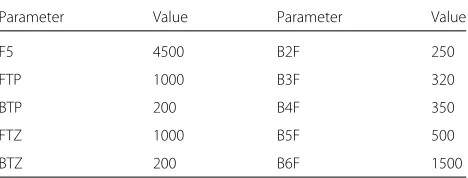
In this study, 240 sentences [19] were submitted to the DECtalk TTS to produce synthetic voices for 6 different speakers (3 males and 3 females). Grouping the sentences into categories of male and female speakers, histograms of all parameters were generated and, from the histograms, it was possible to identify that DECtalk imposes variation of only 25 parameters (shown in black in Fig. 1), out of the 41 aforementioned, regardless of the speaker, while the others are kept at constant values. Parameters FL, DF1, DB1, andA6Fhave zero as constant value. The other con-stant parameters have their values listed in Table 1 and the parameters that vary over time are listed in Table 2. As in [10], only five resonators are adopted in this work, such thatF6 andB6 are not used. The suggested range of parameter values defined in [10] is expanded by DECtalk for parametersAF,B1,FNP, andFNZ[20].
The KLSYN88 input file is formed by several rows, each one representing a voice segment and having the combi-nation of 25 different parameter values, which are used to synthesize the synthetic speech for that frame in this work (Fig. 2).
Fig. 1The KLSYN88 formant synthesizer adapted from [10]
Non-Dominated Sorting Genetic Algorithm II (NSGA-II) [21] with the Root Mean Squared Error (RMSE) as fit-ness function to evaluate the solution. The time to execute newGASpeechon a long utterance is significant, but the process is feasible because it can be done offline and does not demand time from a specialist to perform a manual utterance copy.
Genetic algorithm for utterance copy
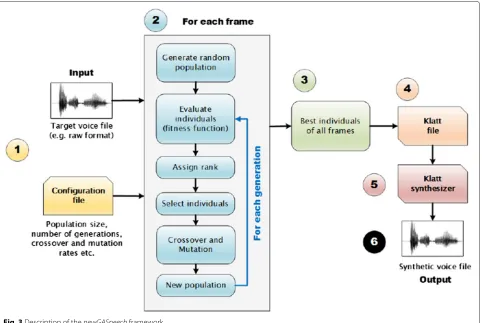
The analysis-by-synthesis process begins by segmenting the input target voice file into frames of approximately 5 ms and obtaining information through a configuration file as shown in Fig. 3 (step 1). For each frame, a full run of GA is executed (several iterations). The parameters to synthesize the frame compose a chromosome that has its fitness calculated after using its corresponding parameters to feed Klatt. The fitness is the RMSE calculated between the target and synthesized signal frames. Care has to
Table 1Klatt parameters with constant values different from zero
Parameter Value Parameter Value
F5 4500 B2F 250
FTP 1000 B3F 320
BTP 200 B4F 350
FTZ 1000 B5F 500
BTZ 200 B6F 1500
be exercised to properly re-initialize the synthesizer’s state (memory of its digital resonators, etc.) along the whole process that executes several GAs. After evaluating the population, a rank is assigned to each individual and those with better ranks are selected to undergo crossover and mutation. As a result, a new population is generated and, in turn, undergoes evaluation, selection, crossover, and mutation steps again. The whole process is repeated until the algorithm reaches one of the stopping criteria
Table 225KLSYN88’s changing parameters
P. Min Max Unit P. Min Max Unit
F0 0 5000 Hz F4 2400 4990 Hz
AV 0 80 dB B4 3000 4990 Hz
OQ 0 99 % B5 100 1500 Hz
TL 0 41 dB FNP 450 870 Hz
DI 0 100 % BNP 40 1000 Hz
AH 0 80 dB FNZ 180 1000 Hz
AF 0 70 dB BNZ 40 1000 Hz
F1 180 1300 Hz A2F 0 80 dB
B1 30 1040 Hz A3F 0 80 dB
F2 550 3000 Hz A4F 0 80 dB
B2 40 1000 Hz A5F 0 80 dB
F3 1200 4800 Hz AB 0 80 dB
Fig. 2KLSYN88 input file
[22] (step 2). The best individuals for each frame compose a Klatt input file which is synthesized and outputs a syn-thetic voice file that aims at mimicking the target voice (steps 3 to 6).
In most cases, the speech signal does not change abruptly from one frame to another. In order to improve convergence and suggest continuity with respect to the previous population, the framework has the option of runningInterframe[22]. In this case, the best individuals of the previous frame are copied to initialize the popula-tion of the next frame (recall that a new GA-populapopula-tion is initialized for each frame).
Coding and decoding of chromosome
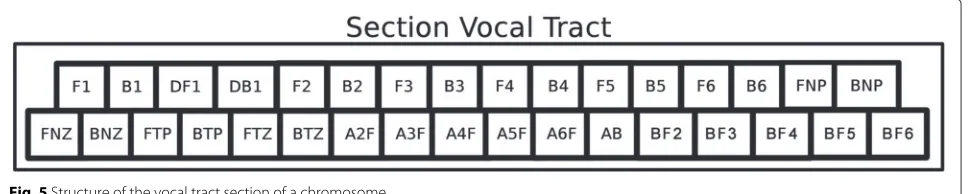
The population is comprised of individuals with chromo-somes that have genes which represent the Klatt synthe-sizer input parameters of a frame. Genes are grouped in two sections:FvandTvthat store the parameters of voic-ing source and vocal tract, respectively. Figures 4 and 5 illustrate all genes that may compriseFvandTvsessions, respectively.
In addition to the sections mentioned above, the chro-mosome also has a voicing gene. This gene performs the necessary function of indicating if the chromosome rep-resents a voiced or unvoiced segment. If the segment
Fig. 4Structure of the voicing source section
is unvoiced, F0 andAV parameters are zero, otherwise the sound is identified as voiced and both have nonzero values.
Look-ahead mechanism
Usually, the speech signal synthesized by Klatt is com-posed of several frames. A frame should not be treated independently because it might potentially influence the next frames. Therefore, a frame configuration may be good for the current frame; although, it may impact negatively on the signal of the following frames. The Look-Ahead mechanism [20] allows the evaluation of the synthesis of the current frame configuration together with nf following frames, greatly increasing the problem search space. Figure 6 illustrates the chromosome structure.
Bv is the voicing source gene, Fv, Tv, and La are the sections: voicing source, the vocal tract, and Look-Ahead mechanism, respectively.Bv, Fv, and Tv were previously addressed. TheLasection stores Look-Ahead frames and its size depends on the amount ofkframes needed ahead to solve the problem. Experiments demonstrated in this study that to estimate the 25 parameters mentioned in the “Methods” section at leastnf =2 Look-Ahead frames are needed with all its frames having the same weight equal to one. Thus,Lasection contains at leastBv,Fv, andTvfor the next 2 frames.
This minimum amount of Look-ahead frames is based on the time intervalt0 between impulses to generate a
voiced excitation. Hence, the number of samplesT0
corre-sponding tot0seconds isT0=t0fs, wherefsis the sample rate in Hz. For any periodic signal, the fundamental fre-quency f0 = 1/t0 (in Hz) is one over the fundamental
periodt0. Hence, to obtainT0as a function of the
param-eter F0, it remains to note that Klatt uses an integer
Fig. 6Division of chromosome into sections
parameter F0 = 10f0 to represent f0 [10]. Therefore,
T0 = fs/(F0/10) is the approximate number of samples separating voicing impulses. In this research,fs = 11025 and each frame is represented by 71 samples. Figure 7 shows the signal of the voicing source to 4 frames whereN is the current. In this case, the frameNhasF0 value equal to 943 and, according to theT0equation, the next impulse
will occur 116.9 samples ahead from the beginning of the period in this frame, in other words in frameN+2.
TheF0 average value in the experiments was 975.5 for male voiced frames, therefore, the F0 value set for the current frame only impacts in the second follows and the frame N is as important as other. For female speakers, the F0 average value was greater (≈ 1595.5) than male. Applying theT0equation to calculate the number of
sam-ples for the next impulse were required approximately 69.1 samples. This indicates that for female speakers only N+1 Look-ahead frame is required because theF0 value impacts directly in the next frame.
Dimensionality of the search space
Each Klatt parameter has its own possible range of values [10], with these values restricted to be integer numbers. For a single frame, the size of the search spaceSis given by:
S= Np
n=1
(Un−Ln+1) (1)
where Np is the number of parameters to be estimated andUnandLn, respectively, represent the upper and lower bounds of integer and consecutive values of parameter
71 142 213 284 −1500
−1000 −500 0
Samples
frame N−1 frame N Frame N+1 Frame N+2
Fig. 7Impulses of a voiced excitation
n. For example, if the framework is estimatingNp = 25 parameters for one frame, and each can assumeUn−Ln+ 1 = 50 distinct values,∀n, the search space is given by S = (51)25 ≈ 5×1042. This dimension gets even larger
when the search space includes the Look-Ahead frames and is then given byS(nf+1). Hence, procedures such as GA are an important tool to address this problem.
Results and discussion
Utterance copy recent experiments were performed in two ways: first to assess the GA convergence regarding the dimensionality of the search space and second to compare the synthesized male and female voices obtained by the newGASpeechand the WinSnoori using as target natural and synthetic voices. The main motivation to use syn-thetic and natural voices was to have finer control of the experiments in the former, given that the correct values of the input parameters are known, and test our system with natural voices of unknown speakers in the latter. The DECtalk voices were from six American male and female speakers and the words were listed in the Table 3.
The used natural voices were from the TIDIGITS cor-pus [23]. These voices are pronunciations by six American male and female speakers of the digits:two,four,six,eight, andninetotaling 30 speech signals.
Table 3Male and female words list—synthetic voices
Index Frank Harry Paul Betty Ursula Wendy
1 air awe are air bean death
2 dill earl end dill earl fern
3 hurl gill is hurl tang is
4 jam them no jam them then
5 who wish there who wish there
ThenewGASpeechwas configured as shown in Table 4. The crossover and mutation rates are adaptive and may be decremented in 0.01 by each generation. This occurs until the minimum rate equal to 0.01 is reached. However, the rates are only decreased if the population presents diver-sity. The option of runningInterframewas used and 10 % of the best chromosomes from the previous frame were copied to initialize part of the next frame population. For the following simulations, GA was configured to always estimate the 25 varying parameters (“Methods” section).
Files generated by DECtalk and from TIDIGITS corpus were used as input to bothnewGASpeechand WinSnoori. The target and synthetic signals were then aligned accord-ing to their cross-correlation and the results evaluated using the metrics: SNR, RMSE, DLE, PESQ, and P.563. It should be noted that none of these metrics perfectly correlate with subjective evaluations. However, informal listening tests indicated a very good match between the overall result of the four metrics and a MOS-like subjec-tive evaluation.
The SNR value should be as large as possible indicat-ing that the signal power is much higher than the “noise” power. While for RMSE andDLE, the smaller the better. PESQ and P.563 compares two speech signals and assigns scores ranging from 1 to 5, with 1 being “bad quality” and 5 “excellent quality”. An important difference between these
Table 4newGASpeechconfiguration
Parameter Value
Number of generations 5000
Population size 800
Initial crossover rate 50 %
8.17e−59 6.79e−44 9.25e−29 8.09e−14 Z 0
20 40 60 80 100 120
39.4
71.8
91.1 95.3
103.4
Dimension percentage
RMSE Average
Fig. 8RMSE average for five words of Paul speaker
last two is that P.563 is single-ended, i.e., it does not use the target file when assigning a score. This is interesting in utterance copy because the other four metrics require a reasonable time-alignment between the target and syn-thetic signals while P.563 does not. However, the P.563 is not appropriate for speech signals with duration shorter than 3 s [8] and, because of that, it was not used to evaluate the signals from TIDIGITS.
Dimensionality of the search space
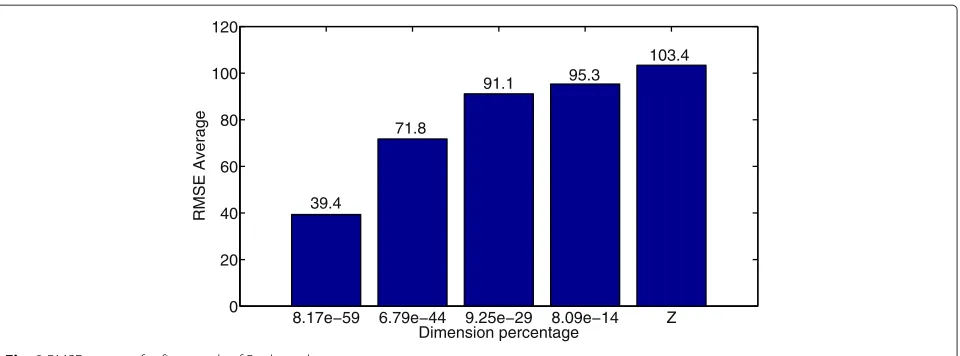
To evaluate how dimensionality influences the fitness function (RMSE), the option of informing was devel-oped frame by frame and, for each parameter, a restricted range of values around the correct one. Experiments were performed using five words uttered by one of the male speakers shown in Table 3, and thenewGASpeech’s config-uration was as follows: population of 1000 individuals, 300 generations, and the same initial crossover and mutation rates specified in the Table 4. From the correct parameters values for a given frame, they were varied in±2, 4, 8, 16, and 32 %.
In this experiment, the largest search space dimension occurs when 25 parameters are estimated and the correct
parameter values are restricted to the variation of±32 %. The variableZ is this dimension and was calculated by Eq. 1. Its value is approximately 6.86E+102, including
the dimension of the 2 Look-ahead frames required. Other dimensions of the search space, for ±2, 4, 8, and 16 % variations of the parameter values, were normalized by Z. Figure 8 illustrates the average RMSE calculated for all words. It can be seen that the search space is huge and the RMSE only decreases significantly when it is reduced by several orders of magnitude.
Experiments with synthetic target voices
Figures 9 and 10 show the results for synthetic speech using “boxplot” graphs, for male and female speakers. In all performed tests, the result obtained bynewGASpeech was better for all speakers than the one by WinSnoori according to the chosen figures of merit, with those of Wendy with larger difference in favor of newGASpeech with lower RMSE (91.6 %), greater PESQ (28.4 %), SNR (99.6 %), and P.563 (78.3 %) medians although the DLE has not been the lowest (91.2 %). These
percent-ages reflect the variation with respect to the baseline. All female and male speakers obtained similar results when
Fig. 10 aPESQ,bSNR,cP.563,dRMSE, andeDLEvalues for female speakers
using GA (Table 5), except for the SNR average which was 96.8 % higher for female than for male.
Experiments with natural target voices
In experiments using natural target voices, as seen in Figs. 11 and 12, the GA obtained voices with higher PESQ and SNR, and lower RMSE and DLE than the baseline.
Results of female speakers performed better than male. The female Speaker 2 presents the best PESQ median value (3.19) although the RMSE (40.21) andDLE (0.028)
of the newGASpeech was not the lowest value and the SNR (21.45) not be the highest if compared to other speakers.
Comparing the results obtained with synthetic and nat-ural target voices (Table 5), the newGASpeech had a greater RMSE reduction of 43.5 % and 35.7 % for female and male speakers although the PESQ reduced too. The SNR increased for male and decreased for female voices, and theDLEincreased significantly for both (≈ 88 % in
average). The P.563 value is considered high for the results with synthetic target voices with an average value of 4.4 for male and female, but of course the results with natural speech are more important.
For all experiments, WinSnoori was outperformed. Comparing the results of the baseline for synthetic versus natural target voices, the PESQ median reduced≈14 % for female and increased the same percentage for male speak-ers. The SNR increased a little, and as in the GA, the major
difference was the reduction of the RMSE,≈75 % average, for male and female, and increase of theDLEin≈86 % for
both.
Percentage error of thenewGASpeechestimated parameters for the synthetic voices
Given that the correct values were known, for all exper-iments with male and female synthetic voices (Table 3) using GA, the percentage error (PE) was calculated as
PE=100×pˆk−pk pk
% (2)
for all 25 estimated parameters, where pˆk is the esti-mated Klatt parameter value by GA and pk its target value. The goal is to observe, in the input parameters space, what are the parameters with the best and worst estimations.
For each word, thePEaverage was calculated for voiced frames to avoid silence and low-energy unvoiced frames. Female and male speakers had seven parameters with an average PE less than 10 % and this same number of parameters with average error in the range between 10 % and 50 %. These parameters belong to the voicing source and cascade branch and are listed in Table 6.
The parameters with the smallest PE in Table 6 are those that impact the synthesized speech the most. For example, the parameters belonging to the parallel branch, respon-sible for the production of fricative sounds, had PE >
Table 5Medians fornewGASpeech(GA) and WinSnoori (Wsno) by voice type for male speakers
Male Female
Natural voice Synthesized voice Natural voice Synthesized voice
Metrics/median GA Wsno GA Wsno GA Wsno GA Wsno
RMSE 50.3 126.9 78.3 585.6 54.8 221.2 97 799
DLE 0.04 0.38 0.004 0.05 0.028 0.26 0.004 0.036
PESQ 2.5 1.7 3.4 1.5 2.9 2.0 3.7 2.3
P.563 – – 4.4 1.5 – – 4.5 1
Fig. 11 aPESQ,bSNR,cRMSE, anddDLEvalues for male speakers
100 % indicating that these parameters did not strongly influence in the distortion of the generated signal. In con-trast,F1 was the parameter with highest accuracy for male speakers (98 %) given its strong impact on the generated speech. Curiously, for all speakers,AHandTLwere in the same PE range.
Conclusions
This work presented the current version of the
new-GASpeech framework, which is based on GA and
performs utterance copy through a process of analysis-by-synthesis. The obtained results were compared with the ones produced by the baseline WinSnoori.
The proposed software significantly outperformed WinSnoori with respect to five objective figures of merit: RMSE, SNR, spectral distortion, PESQ, and P.563 scores. The results were obtained for synthetic and nat-ural speech files covering both male and female speak-ers. Compared to previous results, the RMSE decreased by 72.8 % and 64.8 % for male and female speakers, respectively.
This is on-going work with improvements to be made. For example, after the systems are properly tuned, a sys-tematic subjective evaluation will be conducted. Another aspect that was taken in account in the design of the cur-rent experiments is that breadth, instead of depth, was prioritized. Future experiments will adopt larger amount of speech data, especially with relatively long sentences.
Another important future work is to evaluate the results according to the input parameters themselves (their time evolution, dynamic range, etc.). Because the problem has a many-to-one mapping, it happens that a solution has a good match with the target speech when only the syn-thetic speech is taken into account, but a relatively poor set of input parameters.
ThenewGASpeechwill be made freely available for users of Klatt-based utterance copy applications. The final goal is to provide an easy-to-use solution that focuses on utter-ance copy for health applications. In spite of having more than three decades, the Klatt synthesizer is still a popular formant synthesizer and this motivates the development of associated tools.
Cascade branch PE<10 % F1, F2, F4, B4, and B5 F4, FNP, B4, and B5
10 %<PE<50 % F3, B3, FNP, BNP, and FNZ F1, F2, F3, B3, and BNP
Competing interests
The authors declare that they have no competing interests.
Authors’ contributions
FA is the main author of this paper, which is the result of her doctoral thesis in the Electrical Engineering Graduate Program at Federal University of Pará. Besides her academic research that comprises the literature review, she led the development team, made simulations and collected all data results of the genetic algorithm and baseline software. AK is FA’s research advisor. He was responsible for proposing the problem and guides the research. JF is a Master’s student who participated in the results discussions and is part of the research group. All authors have contributed in drafting, writing and revising the manuscript and agree to be accountable for all aspects of the work, thus taking public responsibility for the content. All authors read and approved the final manuscript.
Authors’ information
FA obtained her Master’s degree in Computer Science at the Federal University of Pernambuco (Recife-PE, Brazil) and is professor at the Federal University of Pará (Castanhal-PA, Brazil). AK obtained his Ph.D. degree in Electrical Enginnering at University of California (San Diego, USA) and is a professor at the Federal University of Pará (Belém-PA, Brazil). JF is a Master’s student in Computer Science at the Federal University of Pará (Belém-PA, Brazil) and graduated in Computer Science at Centro Universitário do Estado do Pará.
Author details
Received: 5 September 2014 Accepted: 21 September 2015
References
1. Laprie Y (2002) The WinSnoori user’s manual version 1.32. Manuel technique. hal.inria.fr/inria-00107630
2. Bangayan P, Long C, Alwan AA, Kreiman J, Gerratt BR (1997) Analysis by synthesis of pathological voices using the Klatt synthesizer. In: Speech Communication, vol 22. Elsevier Science Publishers B. V., Amsterdam, The Netherlands, The Netherlands. pp 343–368
3. Kain E, Niu X, Hosom JP, Miao Q, Santen JV (2004) Formant resynthesis of dysarthric speech. In: IEEE Workshop on Speech Synthesis. pp 25–30 4. Fraj S, Schoentgen J, Grenez F (2012) Development and perceptual
assessment of a synthesizer of disordered voices. In: The Journal of the Acoustical Society of America, vol 132. Acoustical Society of America, Suite 300 1305 Walt Whitman Road Melville, NY 11747-4300. pp 2603–2615 5. Heid S, Hawkins S (1998) PROCSY: A hybrid approach to high-quality
formant synthesis using HLsyn. In: Third International Workshop on Speech Synthesis. Jenolan Caves, Australia. pp 219–224
6. Al-Akhras M, Daqrouq K, Al-Qawasmim AR (2010) Perceptual evaluation of speech enhancement. In: Systems Signals and Devices (SSD), 2010 7th International Multi-Conference. Institute of Electrical and Electronics Engineers. pp 1–6
7. ITU-T Recommendation P.862 (2001) Perceptual Evaluation of Speech Quality (PESQ): An Objective Method for End-To-End Speech Quality Assessment of Narrow-Band Telephone Networks and Speech Codecs. www.itu.int/rec/T-REC-P.862. Accessed 20 January 2014
8. ITU-T Recommendation P.563 (2004) Single-ended method for objective speech quality assessment in narrow-band telephony applications. www. itu.int/rec/T-REC-P.563-200405-I/en. Accessed 02 July 2014
9. Klatt D (1980) Software for a cascade/parallel formant synthesizer, Vol. 67. Acoustical Society of America, Suite 300 1305 Walt Whitman Road Melville, NY 11747-4300
10. Klatt D, Klatt L (1990) Analysis, synthesis, and perception of voice quality variations among female and male speakers, Vol. 87. Acoustical Society of America, Suite 300 1305 Walt Whitman Road Melville, NY 11747-4300 11. Jinachitra P, Smith III JO (2005) Joint estimation of glottal source and
vocal tract for vocal synthesis using Kalman smoothing and EM algorithm. In: Applications of Signal Processing to Audio and Acoustics. Institute of Electrical and Electronics Engineers. pp 327–330
12. Anumanchipalli GK, Cheng YC, Fernandez J, Huang X, Mao Q, Black AW (2010) KlaTTStat: Knowledge-based Statistical Parametric Speech Synthesis. In: 7th ISCA Workshop on Speech Synthesis 13. Shrivastav R, Sapienza CM (2006) Some difference limens for the
perception of breathiness, Vol. 120. Acoustical Society of America, Suite 300 1305 Walt Whitman Road Melville, NY 11747-4300
14. Liu C, Kewley-Port D (2004) STRAIGHT: A new speech synthesizer for vowel formant discrimination. In: Acoustic Research Letters Online. pp 31–36 15. Lemmetty S (1999) Review of Speech Synthesis Technology. Master’s
thesis, Department Electrical and Communication Engineering - Helsinki University of Technology, Finland
16. Laprie Y, Bonneau A (2002) A copy synthesis method to pilot the Klatt synthesizer. In: 7th International Conference on Spoken Language Processing. ICSLP2002 - INTERSPEECH 2002, Denver, Colorado, USA. p 4 17. Hallahan WY (1995) DECtalk Software: Text-to-Speech Technology and
Implementation. In: Digital Technical Journal, vol 7. pp 5–19
18. Hanson HM, McGowan RS, Stevens KN, Beaudoin RE (1999) Development of Rules for Controlling the HLSyn Speech Synthesizer. In: Proceedings of the Acoustics, Speech, and Signal Processing, vol 1. Institute of Electrical and Electronics Engineers. pp 85–88
19. Rothauser EH, Chapman WD, Guttman N, Hecker MHL, Nordby KS, Silbiger HR, Urbanek GE, Weinstock M (1969) IEEE recommended practice for speech quality measurements. In: IEEE Transactions on Audio and Electroacoustics, vol 17. Institute of Electrical and Electronics Engineers. pp 225–246
20. Trindade J, Araujo F, Klautau A, Batista P (2013) A genetic algorithm with look-ahead mechanism to estimate formant synthesizer input parameters. In: IEEE Congress on Evolutionary Computation. Institute of Electrical and Electronics Engineers. pp 3035–3042
21. Srinivas N, Deb K (1994) Multiobjective Optimization Using Nondominated Sorting in Genetic Algorithms. In: Evolutionary Computation, vol 2. Massachusetts Institute of Technology, MIT Press Cambridge, MA, USA. pp 221–248
22. Oliveira F, Trindade J, Borges J, Couto I, Klautau A (2011) Multi-objective genetic algorithm to automatically estimating the input parameters of formant-based speech synthesizers. In: INTECH Open Access Publisher, vol 2. INTECH Open Access Publisher. pp 283–302