Bio-Inspired Routing Protocol Based on Pheromone
Diffusion in Mobile Ad Hoc Networks
Hyun-Ho Choi
Dept. of Electrical, Electronicand Control Engineering Hankyong National University
Anseong 17579, Korea
[email protected]
Jung-Ryun Lee
School of the ElectricalEngineering Chung-Ang University
Seoul 06974, Korea
[email protected]
Bongsoo Roh, Mijeong
Hoh, HyungSeok Choi
Agency for Defense Development Daejeon 34188, Korea
{saintroh,hmj,chs}@add.re.kr
ABSTRACT
Bio-inspired routing protocols use the principle of swarm intelligence, which finds the optimal path to the destina-tion in a distributed and autonomous way in dynamically changing environments; therefore, they can maximize the routing performance, reduce the control overhead, and re-cover a path failure quickly according to the change in the network topology. In this paper, we propose a bio-inspired routing protocol for mobile ad hoc networks. The proposed protocol uses a technique of overhearing for obtaining rout-ing information without additional overhead. Through over-hearing, a pheromone is diffused around the shortest path between the source and the destination. On the basis of this diffused pheromone, a probabilistic path exploration is exe-cuted and the useful alternative routes between the source and the destination are collected. Therefore, the proposed routing protocol can gather up-to-date effective routing in-formation while reducing the control overhead. The simula-tion results show that the proposed routing protocol outper-forms the typical ad hoc on-demand distance vector (AODV) and AntHocNet protocols in terms of the delivery ratio and the end-to-end delay and significantly decreases the routing overhead against AntHocNet.
Categories and Subject Descriptors
C.2.2 [Network Protocols]: Routing protocols
General Terms
Algorithm, Design, Performance
Keywords
Routing protocol, bio-inspired routing, mobile ad hoc net-work, overhearing, pheromone diffusion
1. INTRODUCTION
Mobile ad hoc networks (MANETs) have a dynamic topol-ogy and an unstable wireless channel. Link failure frequently occurs because of path loss, fading, interference, limited ra-dio resource, and node mobility. Node failure may happen because of limited battery power and breakdown or demoli-tion of user terminals. Moreover, there exist multiple multi-hop sessions and considerable data traffic that have various quality of service (QoS) requirements in MANETs. There-fore, a MANET provides a highly dynamic topology for the routing protocol.
In the dynamic topology environment, the topology infor-mation identified by a routing protocol is already past in-formation at the time of data transmission. Therefore, it is impossible for nodes to transfer data through the opti-mal path all the time in MANETs, but it is just possible to use the best available path by using the currently identified topology information. Considering this realistic restriction, one of the key factors to determine the performance of the routing protocol is the amount of the latest useful routing information that can be acquired while reducing the over-head of the control packet transmission. Inherently, there exists a tradeoff between the control overhead and the rout-ing performance; hence, the routrout-ing protocol should be de-signed to minimize the overhead while adaptively satisfying the required performance for a given network environment [1].
Various types of routing protocols have been proposed for MANETs [2], [3]. They have different characteristics accord-ing to the design philosophy. A proactive routaccord-ing protocol generates control packets periodically and thus, induces a high routing overhead. On the other hand, a reactive routing protocol is event-driven and thus causes a long path setup delay. In addition, a single path routing protocol is vulner-able to topology changes. On the other hand, a multipath routing protocol consumes more network capacity and ter-minal resources. Moreover, a source routing protocol creates additional overhead per data packet to include the complete path to the destination in the header. However, a hop-by-hop routing protocol requires every node to manage its own routing table.
Compared with the typical MANET routing protocols, the bio-inspired routing protocols have the following advantages: First, a routing protocol inspired by the swarm behavior is
BICT 2015, December 03-05, New York City, United States Copyright © 2016 ICST
suitable for autonomously finding the shortest path to the destination in MANETs because a swarm of ants or bees finds the optimal route to food in a distributed manner in dynamic environments. Second, the bio-inspired routing protocol can efficiently maintain the shortest path while re-ducing the occurrence of the overhead because the swarm in-telligence maintains the optimal path flexibly in a resource-limited environment. Third, the bio-inspired routing pro-tocol can quickly repair a link or node failure because the swarm effectively solves various unpredictable problems in the real world [4]-[6].
In this paper, we propose a bio-inspired routing protocol for MANETs. The proposed routing protocol uses a function of overhearing from the broadcast nature of wireless media in order to obtain the routing information without any over-head. Through this overhearing technique, a pheromone is diffused around the shortest path between the source and the destination. Thereafter, based on this diffused pheromone, a probabilistic path exploration is executed around the short-est path and the alternative routes that are disjoint from the shortest path are discovered. These operations are in-spired by the behavior of ants [7], [8]. That is, the ants’ con-tinuous movement between the source and the destination accumulates the pheromones on the shortest path and then these pheromones naturally diffuse into the periphery of this path. Once the shortest path in use is broken, the ants try to find another route along the diffused pheromone around the shortest path. By applying such a navigation method of real ants, the proposed routing protocol can achieve an efficient and seamless packet transmission while reducing the control overhead. The proposed routing protocol is validated by an OPNET simulator with respect to the end-to-end perfor-mance and the control overhead.
The rest of this paper is organized as follows: Section 2 re-views the operations of ad hoc on-demand distance vector (AODV) and AntHocNet as the benchmark protocols of the proposed routing protocol. Section 3 explains the operation of the proposed bio-inspired routing protocol in detail. Sec-tion 4 shows the performance of the proposed protocol in terms of the routing performance and the control overhead compared with the AODV and AntHocNet protocols. Fi-nally, Section 5 presents the conclusions drawn in this study.
2. RELATED WORKS
For the most important benchmark protocol, we choose AODV and AntHocNet. AODV is a representative MANET rout-ing protocol and AntHocNet is a representative bio-inspired routing protocol. In this section, we describe the character-istics of AODV and AntHocNet and review their limitations.
2.1 AODV
AODV is by far the most cited and studied routing proto-col for MANETs [9], [10]. AODV is the on-demand version of the destination-sequenced distance vector (DSDV) proto-col [11]. Like DSDV, it uses hop-by-hop routing based on distance vector tables, but does not use the Bellman-Ford algorithm. Being a reactive algorithm, AODV starts a route discovery process when a node has data to send to a desti-nation that it has no information about. In this process, the source node floods a route request (RREQ) over the net-work. During this flooding process, the intermediate nodes
receiving the RREQ leave a pointer towards the source in their routing table. When the RREQ reaches the destina-tion, a route reply (RREP) is sent back to the source, which follows the preset pointers back to the source and adds the reverse pointers towards the destination. By doing so, when the RREP arrives at the source, the path between the source and the destination is newly established. Then, data packets are routed from the source to the destination following the pointers set by the RREP. When there is a failure anywhere along the path, a route error (RERR) is generated to warn the source, which starts a new route discovery process.
2.2 AntHocNet
AntHocNet is a routing protocol based on the distance vec-tor but uses the pheromone instead of it [12]-[14]. The pheromone is a stochastic value derived from the distance vector, and its use is a key feature of the bio-inspired rout-ing protocols. AntHocNet is a hybrid routrout-ing protocol, con-sisting of the reactive route setup and the proactive route maintenance processes. AntHocNet starts a reactive route setup process when the source has no routing information about the destination of the data packet. The source floods a reactive forward ant over the network to find a route to the destination. Each intermediate node forwards the reactive forward ant via unicasting in case it has routing informa-tion about the ant’s destinainforma-tion, and via broadcasting oth-erwise. Unlike AODV, the reactive forward ants store the full array of nodes that they have visited on their way to the destination. The first reactive forward ant that reaches the destination is converted into a reactive backward ant, which retraces the exact path that was followed by the for-ward ant back to the source. On its way, each intermediate node and the source update the routing tables on the basis of the quality information collected by the reactive back-ward ant; therefore, the first path between the source and the destination is established.
Once the first route is constructed by the reactive route setup process, AntHocNet starts the proactive route mainte-nance process, which consists of two subprocesses: pheromone diffusion and proactive ant sampling. The aim of the pheromone diffusion subprocess is to spread the pheromone informa-tion that was placed by the ants. All nodes in the network periodically broadcast hello messages containing the best pheromone information that they have available. Upon re-ceiving the hello messages, neighboring nodes derive a new pheromone for themselves and further forward it in their own periodic broadcasts. The pheromone obtained by this pheromone diffusion is called a virtual pheromone and is managed separately from theregular pheromone placed by the ants.
as follows:
Pd in=
£
max(τd in, ωdin)
¤β2
P j∈Nd
i £
max(τd ij, ωdij)
¤β2, β2≥1 (1)
wherePd
in denotes a probability that a nodeichooses node nas the next hop to reach the destinationd,τd
ijandω d ij
rep-resent the regular and the virtual pheromones, respectively, for the route fromitodoverj,Nd
i denotes the set of
neigh-bors ofiover which a path todis known, andβ2 represents
a parameter that controls the exploratory character of the ants. In this way, the proactive forward ants can leave the routes that were followed by previous ants and follow the other routes that have emerged from pheromone diffusion. Once a proactive forward ant reaches the destination, it is converted into a proactive backward ant that travels back to the source and leaves the regular pheromone along the way. That is, proactive ants can follow a virtual pheromone and then, once they have experienced that it leads to the destination, convert it into a regular pheromone. One could say that pheromone diffusion suggests new paths and that proactive ants check them out.
In AntHocNet, data packets are forwarded by using only regular pheromones. Each forwarding decision is taken using a stochastic formula, as follows:
Pind = ¡
τd in
¢β3
P j∈Nd
i ¡
τd ij
¢β3, β3≥1 (2)
which gives preference to the next hops that are associated with higher pheromone values.
2.3 Limitations of Typical Routing Protocols
The flooding mechanism for route discovery in AODV in-duces a large overhead because it propagates the RREQ to the entire network. Moreover, it should perform the flooding every time the link failure occurs because AODV is a single-path routing protocol. Eventually, the flooding overhead becomes more serious in the relatively high mobility envi-ronment. In addition, AODV does not use any route main-tenance process after the route setup and thus, has no addi-tional overhead for it. However, it has a disadvantage that nodes cannot always use the optimal path if the topology changes. In order to overcome this problem, some AODV-based multipath routing protocols have been proposed in the literature, but they require a high operational complexity and have not been formally discussed in the standardization [15]-[17].
AntHocNet generates a large overhead in the proactive route maintenance process because all the nodes in a network must periodically transmit hello messages including the best pheromone information for the pheromone diffusion, and the proactive ant packets must be periodically exchanged between the source and the destination for the proactive ant sampling. This periodic transmission of control packets in each node acts as a large overhead and thus, lowers the transmission efficiency of the data packets in MANETs. Fur-thermore, the pheromone diffusion in AntHocNet basically follows the routing table update mechanism of DSDV, but it is not suitable for highly dynamic or large-scale networks [11]. Therefore, the pheromone diffusion process in
AntHoc-Net decreases the convergence speed to adapt to topology changes in a high mobility environment; thus, it may not provide accurate routing information for the destination. Moreover, the proactive ant sampling in AntHocNet uses the maximum between the regular and the virtual pheromones to calculate the probability of the next hop. Thus, if there is no significant change in the virtual pheromone, it mainly depends on the regular pheromone and leads to a problem calledstagnation, where the ants explore the same path re-peatedly. The stagnation problem implies the unnecessary generation of proactive ants; therefore, the overhead is in-creased and the probability to select the optimal path is consequently decreased according to the topology changes [14].
3. PROPOSED BIO-INSPIRED ROUTING
PRO-TOCOL
In this section, we provide an overview of the proposed bio-inspired routing protocol and then explain its operation in detail.
3.1 Overview
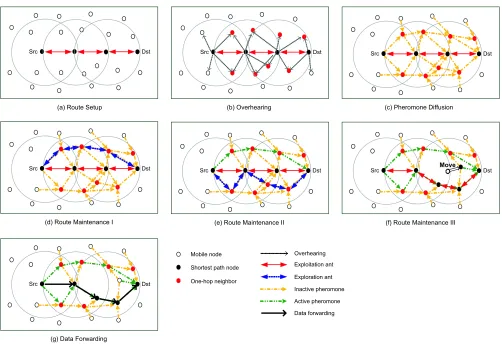
Figure 1 shows seven snapshots to explain the overall oper-ation of the proposed routing protocol. In each snapshot, the following operations are executed:
(a) Route Setup: The shortest path from the source to the destination is set up at the beginning. The proposed routing protocol uses the same route setup process as AODV for a fast route setup. After the route setup, data and acknowledgement packets and forward and backward exploitation ants are transferred along the found shortest path. The forward and backward ex-ploitation ants are newly defined agent packets for the proposed routing protocol and are transmitted period-ically in order to maintain the shortest path between the source and the destination. The details of the ex-ploitation ants will be provided in Section 3.2.
(b) Overhearing: Nodes in the vicinity of the shortest path overhear the forward exploitation ant transmitted from the source to the destination and/or the backward ex-ploitation ant transmitted from the destination to the source. Only the node that overhears both the forward and backward exploitation ants within a certain period of time becomes aone-hop neighbor of that path.
Src Dst Src Dst
Src Dst
Src Dst
Src Dst Src Move Dst
Src Dst
(a) Route Setup (b) Overhearing (c) Pheromone Diffusion
(d) Route Maintenance I (e) Route Maintenance II (f) Route Maintenance III
(g) Data Forwarding
One-hop neighbor Shortest path node Mobile node
Exploitation ant Overhearing
Inactive pheromone Exploration ant
Active pheromone Data forwarding
Figure 1: Operation of the proposed bio-inspired routing protocol.
(d)-(f ) Route Maintenance: For route maintenance, the
source node periodically generates forward exploita-tion ants and forward exploraexploita-tion ants. If the desti-nation node receives a forward exploitation ant and a forward exploration ant, it transmits to the source node the backward exploitation ant and the backward exploration ant, respectively, as a response. The for-ward/backward exploitation ant moves to the destina-tion/source along the highestactive pheromone in or-der to exploit the current best path between the source and the destination, which leads to the maintenance of the shortest path and the determination of the one-hop neighbors around it. On the other hand, the forward exploration ant moves to the destination probabilisti-cally in proportion to the inactive pheromone diffused around the exploitation ant path in order to offer al-ternative routes. The inactive pheromone on the path passed by the exploration ant is changed into the ac-tive pheromone by the backward exploration ant, and then, this path can be used for transmitting the data and ACK packets and the exploitation ant packets. On the other hand, the active pheromone is changed into the inactive pheromone after a certain period of time from the update time. Figures 1(d) and 1(e) show that some alternative paths are set around the shortest path between the source and the destination by the periodic transmission of the exploration ant. As shown in
Fig-ure 1(f), the exploitation ant uses a new shortest path if the topology is changed by the movement of a node. In the dynamic topology, the exploitation ants try to ensure the shortest path between the source and the destination and the exploration ants try to provide the alternative paths around this shortest path.
(g) Data Forwarding: Data packets are forwarded to the destination only along the active pheromones. The next hop is determined probabilistically in proportion to the active pheromone.
3.2 Detailed Operation
We explain the detailed operation of the proposed bio-inspired routing protocol according to the following seven key func-tions:
3.2.1 Routing Table Management
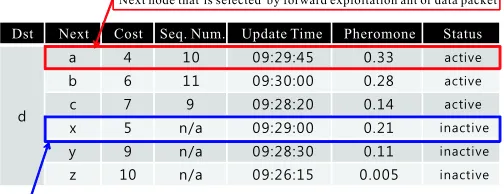
Dst Next Cost Seq. Num. Update Time Pheromone Status
Next node that is likely to be selected by forward exploration ant with a high probability Next node that is selected by forward exploitation ant or data packet
Figure 2: Example of routing table in the proposed routing protocol.
• Next: This indicates the next node to which the packet can be forwarded. Since the proposed routing protocol is the multipath routing protocol, the multiple next nodes for one destination are managed.
• Cost: This implies the total cost consumed to transmit a packet to the destination over the next node. The cost information is derived from the RREQ, RREP, ex-ploitation ant, and exploration ant packets. The cost can be defined using various metrics, such as the num-ber of hops, delay, expected transmission time (ETT), expected transmission count (ETX), received signal strength (RSS), and bandwidth [3].
• Sequence Number: This is updated as the sequence number in the received control packet only if the re-ceived sequence number is greater than the recorded sequence number. The sequence number is used for preventing the duplicated update from the same con-trol packet.
• Update Time: This registers the time when the corre-sponding routing information is updated.
• Pheromone: This indicates the goodness of the next node to deliver a packet to the destination. The pheromone is inversely proportional to the elapsed time as well as the cost. That is, the pheromone decreases as the elapsed time increases by considering the evaporation of the pheromone. Here, the elapsed time t is de-fined as “t= current time−update time”. Therefore, the pheromone τd
ij for the route from a node i over
the next node j to reach the destination dis defined as τd
ij = ¡
1/cd ij
¢α¡
1/td ij
¢β
, where cd
ij and tdij denote
the cost and the elapsed time for the corresponding route, respectively, andα≥1 andβ≥1 represent the weighting parameters.
• Status: The status is set to “active” when the route in-formation is obtained by receiving the control packets (i.e., RREQ, RREP, RERR, and ants). However, it is set to “inactive” when the route information is obtained by the pheromone diffusion (i.e., overhearing the ex-ploitation ants or receiving the hello message). The ac-tive status is changed into the inacac-tive status after the ROUTE TIMEOUT timer expires, and the inactive route information is deleted after the ROUTE DELETE timer expires. The active route information is used for forwarding the data and exploitation ants, and the
inactive route information is used for forwarding the exploration ant.
For the example shown in Figure 2, the data packet and the forward exploitation ant destined ford are forwarded toa
because its pheromone is the highest among the active route information. On the other hand, the forward exploration ant is likely to be forwarded to x with a high probability in proportion to the pheromone values in the inactive route information. The details about this selection algorithm are provided in Section 3.2.5.
3.2.2 Route Setup
The route setup procedure starts when there is no routing information about the destination of the data packet gener-ated at a node. The basic route setup procedure follows the same flooding mechanism as AODV for the fast route setup. Therefore, the source floods the RREQ over the network and the destination replies to the source with the RREP when receiving the RREQ. If the RREP arrives at the source, the routing path between the source and the destination is es-tablished. If the source does not receive the RREP until the RREQ timeout occurs, it retries the RREQ flooding.
3.2.3 Overhearing
Every node in the network overhears the forward and back-ward exploitation ants that are not intended for it. Through this overhearing process, the node can determine whether or not it is a one-hop neighbor of a certain source-destination path by itself. The node becomes the one-hop neighbor only when it overhears both the forward and the backward ex-ploitation ants for the same source-destination pair during a predetermined time. The one-hop neighbors calculate the cost to the destination from the overheard ant packets and update the routing table. The updated cost value is calcu-lated ascd
ij =cdj+c j
i. That is, the total cost of the route
from itod overj,cd
ij, is the sum of the cost fromj to d, cd
j, which is contained in the overheard ant packets, and the
cost fromitoj,cj
i, which is locally maintained by the hello
messages.
3.2.4 Pheromone Diffusion
The first pheromone diffusion is executed by the overhearing process. The second is achieved by the one-hop neighbors’ periodic broadcast of the hello messages that contains the smallest cost for the destination of the overheard source-destination pair. If some nodes receive the hello messages from the one-hop neighbors, they update the cost to the corresponding destination by using cd
ij =s d j+c
j
i where s d j
denotes the smallest cost fromjtodobtained from the hello message and cji represents the cost fromito j maintained
locally. With this cost update, the additional routing formation is updated. These pheromones are treated as in-active pheromones because they are indirectly obtained by overhearing the exploitation ants and broadcasting the hello messages.
3.2.5 Route Maintenance
performed by the exploration ants. The source periodi-cally transmits the forward exploitation ant after the initial route setup. The forward exploitation ant selects the next hop with the highest pheromone in the active routing infor-mation and is forwarded to the destination via unicasting. Upon receiving the forward exploitation ant, the destination generates the backward exploitation ant as a response. In the same way, the backward exploitation ant is forwarded to the next node with the highest pheromone toward the source via unicasting. During this process, the nodes on the path through which the forward and backward exploitation ants have passed update their routing table for the source and the destination nodes. In this way, the shortest path is maintained because the exploitation ants move along with the best active pheromone between the source and the des-tination.
Moreover, the source periodically transmits the forward ex-ploration ant after receiving the initial backward exploita-tion ant. The forward exploraexploita-tion ant is forwarded via uni-cast to the next node, which is selected probabilistically in proportion to the inactive pheromones, by using the follow-ing equation:
Pind = ¡
µd in
¢γ1
P j∈Nd
i ¡
µd ij
¢γ1, γ1≥1 (3)
wherePd
indenotes the probability that nodeichooses node n as the next hop for destination d,µd
ij represents the
in-active pheromone for the route from i over j to reach d,
Nd
i indicates the set of neighbors of i over which an
inac-tive pheromone is known, andγ1denotes a parameter value
that can control the exploratory behavior of the ants. Un-like the exploitation ant, the forward exploration ant records the information of the intermediate nodes, through which it arrives at the destination, in its header. Upon receiving the forward exploration ant, the destination generates the backward exploration ant as a response. The backward ex-ploration ant is delivered to the source exactly along the re-verse of the path through which the forward exploration ant has passed. In this process, the nodes on the path through which the forward and the backward exploitation ants have travelled update their routing table and set the status to “active”. That is, the inactive pheromones are changed into active pheromones by the exchange of exploration ants, and then, these active pheromones can be used for forwarding the exploitation ants and data packets.
3.2.6 Data Forwarding
For the load balancing in the network, data packets are for-warded probabilistically on the basis of the following prob-ability:
Pd in=
¡ τd
in
¢γ2
P j∈Nd
i ¡
τd ij
¢γ2, γ2≥1 (4)
whereτd
ij denotes the active pheromone for the route from ioverjto reach d,Nd
i represents the set of neighbors ofi
over which an active pheromone is known, andγ2 indicates
a parameter value that controls the spreading of data. This formula is very similar to the one used for the forward explo-ration ant, as shown in (3), but uses the active pheromone and a different parameterγ2. This separates the
exploita-Table 1: Simulation parameters
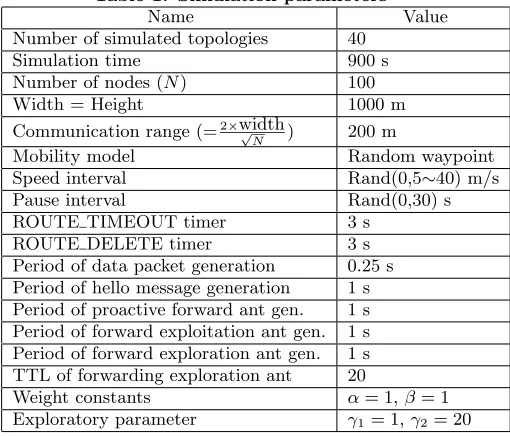
Name Value
Number of simulated topologies 40
Simulation time 900 s
Number of nodes (N) 100
Width = Height 1000 m
Communication range (=2×width
√
N ) 200 m
Mobility model Random waypoint
Speed interval Rand(0,5∼40) m/s
Pause interval Rand(0,30) s
ROUTE TIMEOUT timer 3 s
ROUTE DELETE timer 3 s
Period of data packet generation 0.25 s Period of hello message generation 1 s Period of proactive forward ant gen. 1 s Period of forward exploitation ant gen. 1 s Period of forward exploration ant gen. 1 s TTL of forwarding exploration ant 20
Weight constants α= 1,β= 1
Exploratory parameter γ1= 1,γ2= 20
tion path and the exploration path between the source and the destination.
By the adaptation ofγ2, the data forwarding is spread less
or more with respect to the best available routes. By setting
γ2 low, the data are spread over multiple routes, and thus,
the traffic load to the network is distributed. By setting
γ2 high, on the other hand, the data are concentrated on
the best routes, and thus, the shortest end-to-end delay is achieved [14].
3.2.7 Route Recovery
Link failures are detected if lower-layer protocols report the failure of the unicast transmission of a control or data packet, or if a node fails to receive the periodic hello messages from its neighbors. If a node has no next hop information for data transmission because of a link failure, it deletes the corresponding routing table information and broadcasts an RERR to notify its neighbors of the link failure. The nodes receiving the RERR update their routing table for the link to the node that sent this RERR. If some nodes still have data to send, but no next hop information in the updated routing table, they rebroadcast the RERR. In this way, the link failure is notified to the relevant nodes on and on. Even-tually, if the source receives the RERR and has no next hop information for the destination, it restarts the route setup process.
4. RESULTS AND DISCUSSION
RWP maximum speed (m/s)
5 10 15 20 25 30 35 40
Fraction of delivered data packets
0.6 0.65 0.7 0.75 0.8 0.85 0.9 0.95 1
AODV AntHocNet Proposed
Figure 3: Fraction of delivered data packets vs.
RWP maximum speed.
RWP maximum speed (m/s)
5 10 15 20 25 30 35 40
Average end-to-end packet delay (s)
0 0.05 0.1 0.15 0.2 0.25 0.3 0.35 0.4
AODV AntHocNet Proposed
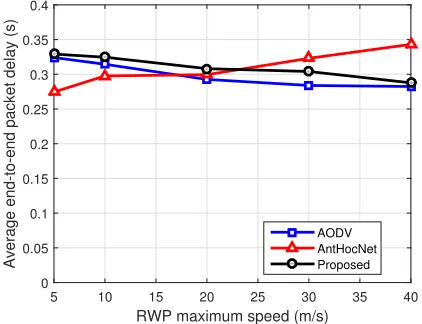
Figure 4: Average end-to-end packet delay vs. RWP maximum speed.
Figure 3 shows the fraction of correctly delivered data pack-ets versus the maximum node speed for random waypoint (RWP) mobility. Data packets can be lost because of a link failure because the retransmission of lost data is not allowed by assuming the UDP traffic. Overall, the data delivery ra-tio decreases as the mobility increases because link failures occur more frequently. AODV has the lowest delivery ratio because it is not a multipath routing protocol. Compared with AODV, both AntHocNet and the proposed protocol show high delivery ratios. However, the proposed protocol has a considerably higher delivery ratio than AntHocNet when the mobility increases. This is because the proposed routing protocol finds more effective alternative paths than AntHocNet in order to prepare for a future link failure.
Figure 4 shows the average end-to-end delay of the delivered data packets versus the maximum node speed for RWP mo-bility. As the mobility increases in AODV, the link failures occur more often and the shortest path is re-established, which has a rather good effect on the end-to-end delay. In AntHocNet, the end-to-end delay increases as the mobility
RWP maximum speed (m/s)
5 10 15 20 25 30 35 40
Overhead in number of packets
0 5 10 15 20 25 30 35 40
AODV AntHocNet Proposed
Figure 5: Overhead in number of packets vs. RWP maximum speed.
RWP maximum speed (m/s)
5 10 15 20 25 30 35 40
Overhead in number of bytes
0 2 4 6 8 10 12 14 16
AODV AntHocNet Proposed
Figure 6: Overhead in number of bytes vs. RWP maximum speed.
increases because it does not adaptively use the shortest path according to the topology changes. On the other hand, the proposed routing protocol shows a gradually decreas-ing delay performance as the mobility increases because it adaptively uses an alternative path, which provides a smaller routing cost than the previous routing path according to the topology changes.
diffusion, and thus, the overhead is significantly high. On the other hand, AODV has no periodically generated control packets, and thus, its overhead is very low. As the mobility increases, the overheads of both AODV and AntHocNet in-crease because link failures occur more frequently. However, the overhead of the proposed routing protocol is located be-tween that of AODV and that of AntHocNet and is notably maintained at an almost constant value with respect to the mobility level because a link failure rarely occurs even when the mobility increases.
5. CONCLUSION
The proposed bio-inspired routing protocol allows nodes to use the overhearing function, and hence, the one-hop neigh-bor nodes around the shortest path between the source and the destination are determined autonomously. Then, a pheromone is diffused within only the coverage of one-hop neighbors, and consequently, the overhead of control packet transmis-sion is significantly decreased. Moreover, the proposed rout-ing protocol performs a probabilistic path exploration on the basis of the diffused pheromone and ensures effective alter-native paths between the source and the destination. For the route maintenance, two types of ant packets are de-signed. The exploitation ants serve to secure the shortest path between the source and the destination, and the ex-ploration ants are used for providing the alternative paths around it in order to prepare for link failures. These sepa-rate roles of the ants enable the use of the shortest path to the maximum possible extent in the dynamic topology and an effective discovery of alternative paths without the route stagnation problem. The OPNET simulation results show that the proposed routing protocol outperforms the AODV and AntHocNet protocols in terms of the data delivery ra-tio and the end-to-end delay, and significantly decreases the routing overhead against AntHocNet. The proposed rout-ing protocol shows a higher performance gain as the mobility increases, so it is expected to be applied to MANETs with high mobility and dynamic channels, such as tactical and vehicular ad hoc networks.
6. ACKNOWLEDGMENTS
This research was supported by Agency for Defense Devel-opment (ADD-IBR-245).
7. REFERENCES
[1] Hosseini, S. H., Ghazani, N., Lotf, J. J., and Alg, R. M. 2009. A new survey of routing algorithms in ad hoc networks. InProceedings of the 3rd International Conference on Communications and information technology (CIT’09), Wisconsin, USA, 296-300. [2] Marina, M. K. and Das, S. R. 2005. Routing in Mobile
Ad Hoc Networks.Ad Hoc Networks, Springer (2005), 63-90.
[3] Hanzo, L. and Tafazolli, R. 2007. A survey of QoS routing solutions for mobile ad hoc networks.IEEE Communications Surveys & Tutorials. 9, 2 (July 2007), 50-70.
[4] Dressler, F. and Akan, O.B. 2010. Bio-inspired networking: from theory to practice.IEEE Communications Magazines, 48, 11 (Nov. 2010), 176-183.
[5] Bitam, S., Mellouk, A., and Zeadally, S. 2015.
Bio-Inspired routing algorithms survey for vehicular ad hoc networks.IEEE Communications Surveys & Tutorials, 17, 2 (May 2015), 843-867.
[6] Zhang, Z., Long, K., Wang, J., and Dressler, F. 2014. On swarm intelligence inspired self-organized
networking: its bionic mechanisms, designing principles and optimization approaches.IEEE Communications Surveys & Tutorials, 16, 1 (July 2014), 513-537. [7] Bonabeau, E. and Theraulaz, G. 2000. Swarm smarts.
Scientific American, 282, 3 (2003), 72-79. [8] Jackson, D. E. and Ratnieks, F. L. 2006.
Communication in ants.Current biology, 16, 15 (2006), R570-R574.
[9] Perkins, C. E. and Royer, E. M. 1999. Ad-hoc on-demand distance vector routing. InProceedings of the 2nd IEEE Workshop on Mobile Computing Systems and Applications, (Feb. 25-26, 1999), New Orleans, LA, 90-100.
[10] Perkins, C. E. 2003.Ad hoc On-Demand Distance Vector (AODV) Routing. IETF RFC 3561.
[11] Perkins, C. and Bhagwat, P. 1994. Highly dynamic destination-sequenced distance-vector routing (DSDV) for mobile computers. InProceedings of ACM
SIGCOMM’94, ACM, New York, USA, 234-244. [12] Di Caro, G., Ducatelle, F., and Gambardella, L. M.
2005. AntHocNet: an adaptive nature-inspired algorithm for routing in mobile ad hoc networks. European Transactions on Telecommunications (ETT), 16, 5 (Sep. 2005), 443-455.
[13] Ducatelle, F., Di Caro, G., and Gambardella, L. M. 2005. Using ant agents to combine reactive and proactive strategies for routing in mobile ad hoc networks.International Journal of Computational Intelligence and Applications (IJCIA), 5, 2 (2005). [14] Ducatelle, F. 2007.Adaptive routing in ad hoc wireless
multi-hop networks.Ph.D. Dissertation. (May 2007) Lugano, Switzerland.
[15] Marina, M. K. and Das, S. R. 2006. Ad hoc on-demand multipath distance vector routing.Wirel. Commun. Mob. Comput.6 (2006), 969-988.
[16] Zhou, J., Xu, H., Qin, Z., Peng, Y., and Lei C. 2013. Ad hoc on-demand multipath distance vector routing protocol based on node state.Communications and Network, 5 (2013), 408-413.
[17] Jaisankar, N., and Saravanan, R. 2010. An extended AODV protocol for multipath routing in MANETs. IACSIT International Journal of Engineering and Technology, 2, 4 (2010), 394-400.
[18] Chang, X. 1999. Network simulations with OPNET. InProceedings of the 31st conference on Winter simulation: Simulation—a bridge to the future-Volume 1, ACM. (Dec. 1999), 307-314.
[19] Choi, H.-H., Lee, H.-G., and Lee, J.-R. 2014. A new energy-aware source routing protocol for maximization of network lifetime in MANET.IEICE Trans. on Information and Systems, E97-D, 2 (Feb. 2014), 335-339.