GSJ: Volume 7, Issue 11, November 2019, Online: ISSN 2320-9186
www.globalscientificjournal.com
Area Of Photon And Electron Are The Major Evidence To
Causes Ejection Of One Electron By One Photon And Show
Photon Is Composition.
1
Saddam Husain Dhobi,
1Pintu Verma,
1Puskar Bajagain,
1Md Jahangeer Rangrej.
All Authors is currently pursuing masters degree program in physics in Tribhuvan University, Kathmandu-44600, Nepal and Innovative Ghar Nepal Laboratory, Innovative Ghar Nepal, Lalitipur-44700, Nepal
Corresponding E-mail: [email protected] , [email protected] , [email protected] , [email protected]
Key Words
Cross-section area, Distribution of energy, Photon is composition, Field, Matter, Photoelectric effect, Compton effect, Raman Effect, Matter-light interaction etc.
ABSTRACT
When the bundle of photon incidence on the surface of consider material the energy of bundle photons goes to distributed to con-sider surface of material. Now, if we concon-sider a single photon from the bundle then the energy of this photon also goes to distribu-tion to the consider surface of material. The distribudistribu-tion of the energy of single photon is only possible if it is composidistribu-tion i.e. photon has tiny segment photon in side it.
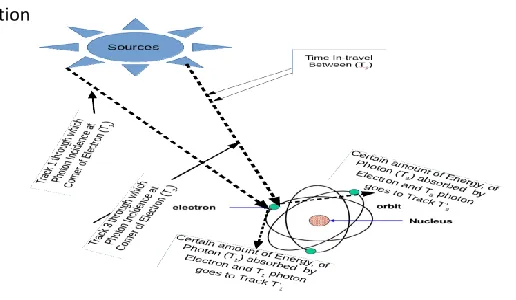
Let the source emit the light or photon and photon incidence on the surface of an electron. In figure we are consider three track T1,
T2 and T3 among these three, T1 and T2 indicate the track of photon incidence on the surface of a electron partially. During the
par-tially incidence on the surface of electron photon can not transformer its total energy to electron and electron are unable to leave the orbit of an atom but the track between T1 and T3 of photon are able to transfer the energy to electron sufficient and electron are
able to leave the orbit of an atom. Example T2 tack photon are able to transfer the energy to electron or electron area able to
ob-served the energy from the photon.
Figure 1 show the incidence of photon from the source to an electron at different position of electron i.e. either at center or at cor-ner or partially. But the phenomenon of photoelectric effect is only causes by central incidence photon on electron because it has maximum contact with electron and
transfer the maximum energy to elec-tron while other photon is less than that of central photon.
Figure 1: Incidence of Photon on electron at difference position.
Figure 2 indicate the incidence of the photon from sources to an electron partially and unable to kick the electron from the atom due to less observation of energy from
photon or only partially observation of photon energy.
Figure 2: Phenomena of Photon when partially interact with electron corner and electron doesn’t goes on excited state.
Figure 3: Excitation of electron when photon incidence at center of electron. We have from planks distribution law for monochromatic (or spectral) energy density of radiation and given by
*1,2+ (Plank distribution law ).
𝑑𝐸𝑉 =
8𝜋ℎ 𝑐3
𝜈3
𝑒𝑥𝑝(ℎ𝜈
𝑘𝑇)−1
𝑑𝜈𝑑𝑉. . . (2)
Similar for surface area dA the energy distribution from (2) is given as
𝑑𝐸𝐴=8𝜋ℎ𝑐3
𝜈3
𝑒𝑥𝑝(ℎ𝜈
𝑘𝑇)−1
𝑑𝜈𝑑𝐴. . . (3)
For, monochromatic intensity, B (ν, T), is generally related to the differential amount of radiant energy, dE, that crosses an area ele-ment, dA, in directions confined to a differential solid angle, dΩ, being oriented at an angle θ to the normal of dA is given as
𝑑𝐸 = 𝐵(𝜈, 𝑇)𝑐𝑜𝑠𝜃𝑑𝐴𝑑𝛺𝑑𝜈𝑑𝑡. . . (4)
, in the time interval between t and t + dt and the frequency interval between ν and ν + dν.
Thus with the help of above we can obtained
𝑑𝐸 =4𝜋𝑐 𝐵(𝜈, 𝑇)𝑐𝑜𝑠𝜃𝑑𝐴𝑑𝛺4𝜋𝑐𝑑𝑡𝑑𝜈 =4𝜋𝑐 𝐵(𝜈, 𝑇)𝑑𝜈𝑑𝑉. . . (5)
The quantity dΩ/(4π) in (5) above expresses the probability of radiation propagation in a certain direction.
Also, we have relation B(ϑ, T) dϑ = B (ν (ϑ), T) dν , where ϑ stands for any variable like radian frequency, ω, wavelength, λ related to the frequency ν via the transformation ν (ϑ), *3+.
Individual photon detection can be treated as independent events that follow a random temporal distribution. According to classic Poisson process, and the number of photons N measured by a given sensor element over a time interval t is described by the discrete probability distribution
𝑃𝑟(𝑁 = 𝑘) =𝑒−𝜆𝑡(−𝜆𝑡)𝑘! 𝑘. . . (6)
Boltzmann has shown that the entropy of a monatomic gas in equilibrium is equal to 𝜔𝑅𝑙𝑛(𝑃0) where P0 is the number of
possi-ble complexions corresponding to the most probapossi-ble velocity distribution, R being the well known gas constant, ω the ratio of the mass of a real molecule to the mass of a mole, which is the same for all substances. But for, according to the electromagnetic theory of the radiation the velocities of the atoms are completely independent of the distribution of the radiation energy, the total number of complexions is simply equal to the product of the number relating to the velocities and the number relating to the radia-tion and for total entropy we have, 𝑓[𝑙𝑛(𝑃0𝑅𝑜)] = 𝑓(𝑙𝑛𝑃0) + 𝑓(𝑙𝑛𝑅0) and where f is a factor of proportionality *5+.
Planks uses Maxwell-Boltzman statistics to calculate the radiation energy and according to him at temperature T the numbers of os-cillation having energy nhν is given by ,
where K is boltzman Constant. The total energy of oscillation having energy nhν is given by 𝐸𝑛= 𝑛ℎ𝜈𝑁𝑛, total energy of all oscillation in black body is
𝐸 = ∑ 𝐸𝑛 and total oscillation in black body is 𝑁 = ∑ 𝑁𝑛*6+.
For the case of normal clinical exposures, the X-ray CT measurements zi are often modeled as the sum of a Poisson distribution rep-resenting photoncounting statistics and an independent Gaussian distribution representing additive electronic noise *7+.
This Poisson equation, is also the distribution is for a light source where individual photons are independent of one another and the source is rated at an average intensity. The thermal light field is an example where light fired is a superposition of many wave states with random amplitudes and phases, caused by the exciting of individual atoms randomly and coherence time property comes into play *8+.
The probability of finding a proton inside the atom, and more specifically, inside the nucleus is given by
and electron is give as
where: ra is the atomic radius, re is the electron
radius, rn is the nucleus radius, and rp is the proton radius *9+.
Proton charge radius from electron scattering experiments has stabilized around 0.87 − 0.88𝑓𝑚 with an average of
𝑟𝑝= (0. .006)𝑓𝑚. Also, CODATA2010 value of 𝑟𝑝= (0. .0051)𝑓𝑚 is based on electron scattering and Lamb shift
meas-urements from regular hydrogen *10+.
According to CPH theory a photon contains n number of CPH that they are moving with the speed of c in the structure of photons.
The given mass of a CPH is m, so its momentum is 𝑃 = 𝑚𝑐and the momentum of photon is 𝑃 = 𝑛𝑚𝑐*11+.
Methodology
Let us consider the cross-section area of the pinhole through which the photon is passes is Ap and and incidence on the surface area
of electron Ae. The incidence photon have such amount of energy hf which is capable for photoelectric phenomena after incidence
on the surface of materials. Since the cross-section are of incidence photon is less than the surface area of consider the atom, then the probability of incidence photon on the surface area of a atom of material is greater i.e. approximately equal to 1. Moreover, the probability of ejecting the electron from the atom is one to one when photon meet the electron of an atom.
When a bundle of monochromatic light (from Laser: 5V DC Laser Diode) of certain energy passes through the hole of cross section area 0.785 × 10⁻⁶𝑚2 incidence on the surface of poly silicon surface (Solar Panel: Resun-Solar 107-61 4V) the cross-sectional area of
single photon was found 𝐴𝑝= 6.465066886 × 10⁻²³𝑚2= 6.465066886 × 10⁻¹⁹𝑐𝑚2*13+.
Now classically the radius of an electron we have
*14+. where, me= mass of electron, c= velocity of light an e= charge of electron on putting the standard classical value of these in
equation (1) we gete 0.785 × 10⁻⁶𝑚2.
On considering the electron is spherical
𝐴𝑒= 4𝜋𝑟𝑒2= 4 × 3.14(2.82 × 10⁻¹³𝑐𝑚)2
𝐴𝑒 = 99.882144 × 10⁻²⁶𝑐𝑚2= 9.9882144 × 10⁻²⁵𝑐𝑚2
𝐴𝑒= 9.9882144 × 10⁻²⁵𝑐𝑚2
On taking the cross-section are of photon and electron ratio we get,
Approximate, Ap~647267Ae
This show that the cross-section area of photon is greater than that of cross-section area of electron or surface area of electron by 647269.5346 times .
Since, Ap be the cross-section area of photon and Ae be the surface area of electron then when the photon incidence on the electron
99.882144 x 10 ) cm
Aep=( 6.5 x 10⁻¹⁹- 9.9882144 x 10⁻²⁵) cm2
Aep=( 6.5 - 9.9882144 x 10-6) x 10-19 cm2
Aep=( 6.5 -0.99882144 x 10-5) x 10-19 cm2
Aep= 6.499990012 x 10⁻¹⁹ cm2
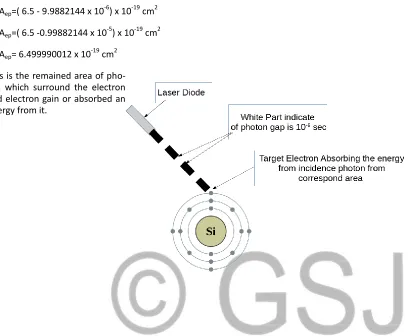
This is the remained area of pho-ton which surround the electron and electron gain or absorbed an energy from it.
Figure 4: Incidence photon on target material atom-electron in 10-9sec after emitted from diode laser.
Since the cross-section area of red photon is 6.5 x 10⁻¹⁹ cm2 and the energy carries in this cross-section area is 1.78eV as the fre-quency of the red wavelength is 4.3x10¹⁴ Hz and h=6.62x10⁻³⁴J.s, which is calculated from hf= 4.3x1014 Hz x 6.62x 10-34J.s =1.78eV.
This implies that 1.78ev energy is contain on 6.5 x 10⁻¹⁹ cm2 cross-section area of consider photon. Or, 6.5 x 10⁻¹⁹ cm2 cross-section area of photon carry at 1.78ev energy.
Or, 1cm2 cross-section area of photon carry at (1.78)/(6.5 x 10-19) eV energy.
Since the surface area of electron is 99.882144 x 10⁻²⁶cm2 and when photon incidence on it the energy of photon of cross-section area 99.882144 x 10⁻²⁶cm2 is absorbed by electron i.e.
Therefore, 99.882144 x 10⁻²⁶cm2 cross-section area of photon transfer the energy to electron (1.78 x 99.882144 x 10-26cm2.)/(6.5 x 10-19) eV energy.
Or, 99.882144 x 10⁻²⁶cm2 cross-section area of photon transfer the energy to electron 27.3523 x 10⁻⁷ eV energy.
Or, 99.882144 x 10⁻²⁶cm2 cross-section area of photon transfer the energy to electron 2.73523 x 10⁻⁶ eV energy.
This show that when photon contact or incidence on the electron surface it transfer its energy of cross-section area 99.882144 x 10
-26cm2 to electron at instant.
incidence photon in 10-9 sec the photoelectric effect is impossible for suitable incidence energy photon.
This shows that the 1.78eV energy of photon having cross-section area 6.5 x 10⁻¹⁹ cm2 is transfer to electron having surface area 99.882144 x 10⁻²⁶cm2 in 10-9 sec.
From this we can also said,
An electron absorbed 1.78eV energy in 10-9 sec from cross-section area of photon 6.5 x 10⁻¹⁹ cm2.
Or, 1eV (10-9/1.78)sec
Or, 2.73523 x 10⁻⁶ eV (2.73523 x 10-6 x10-9/1.78)sec
Or, 2.73523 x 10⁻⁶ eV 1.5366 x 10⁻¹⁵sec
This show that an electron absorbed 2.73523 x 10⁻⁶eV from photon cross-section area 99.882144 x 10⁻²⁶cm2 in 1.5366 x 10⁻¹⁵sec.
Now, the time taken to absorbed remain energy of photon is (10-9 –1.5366 x10⁻¹⁵) from remained area of photon 6.499990012 x 10
-19
cm2.
More clearly we can say that 9.99x10⁻¹⁰ sec required to absorbed the remaining energy of photon from cross-section area 6.499990012 x 10⁻¹⁹ cm2.
RESULT AND DISCUSSION
As we know the laser emitted a photon with an in-travel of 10-9 sec and in our work we consider this situation. Since the cross-section area of photon of consider laser (red) is 6. 465066886x10-19 cm2 and the energy of photon carrying in this cross-sections area is 1.78eV, which is absorbed by an electron of surface area 99.882144 x 10⁻²⁶cm2 in 10-9 sec for photoelectric effect or phenomena. This show that if an material work function is 1.11eV (Solar Cell Type) then the energy of photon must be greater than 1.11eV for photo electric phenomena, in our cases we consider red photon whose energy is 1.78eV. Numerically, here we calculated a photon of 6. 465066886x10-19cm2 incidence on electron surface having 99.882144 x 10⁻²⁶cm2 cross-section area of photon transfer the en-ergy to electron 2.73523 x 10⁻⁶ eV energy in 1.5366 x 10⁻¹⁵sec and the remain energy of remain part of same photon is transfer in 9.99x10⁻¹⁰ sec.
CONCLUSION
From above, we have calculated time to transfer or absorbed of energy from a red photon to electron which going to take part in photoelectric effect. Here, time which we calculated play an important role to show that the photon is composition or contain tiny segment photon. That is a single photon to go the photoelectric effect having suitable energy take certain time to kick out the elec-tron from the material atom and these time are discuss in result and discussion. In simply 2.73523 x 10⁻⁶ eV is absorbed in 1.5366 x 10⁻¹⁵sec and (1.78-2.73523 x10⁻⁶) needed 9.99x10⁻¹⁰ sec required to observed the remaining energy of photon from cross-section area 6.499990012 x 10⁻¹⁹ cm2. This time is only possible if photon is composition if photon is not composition the calculation is im-possible to calculate.
Acknowledgment
[1] “ The Quantum Theory of Light, Chapter 3: Radiation,” Thomson Learning, Inc., p73, 2005.
[2] J. Norton, “The Logical Inconsistency of the Old Quantum Theory of Black Body Radiation,”Philosophy of Science, vol. 54, no. 3, pp. 327-350, 1987.
[3] G. Kramm and N. Molders, “Planck’s Blackbody Radiation Law : Presentation in Different Domains and Determination of the Related
Dimension-al Constants,” Journal of the Calcutta Mathematical Society (In Press), pp. 4-11, 12 November, 2009.
[4] S. W. Hasinoff, ”Photon, Poisson Noise,” Google Inc., pp. 1-2, 2012. (Preprint).
[5] M. Planck, “On the Theory of the Energy Distribution Law of the Normal Spectrum,“ Verhandl. Dtsch. phys. Ges., vol. 2, no. 237, p6, 1900. English
translation from “The Old Quantum Theory,” ed. by D. T. Haar, Pergamon Press, pp. 82, 1967.
[6] S. Gupta, “Black Body Radiation,” Indian Institute of Science, Banglore, pp. 18-19, December 2003.
[7] Q. Ding, Y. Long, X. Zhang and J. A. Fessler, “Statistical Image Reconstruction Using Mixed Poisson-Gaussian Noise Model for X-Ray CT,” pp. 2,
19 jun, 2018.
[8] J. Grider, K. Thompson, and R. Wensley, “Photon Statistics, Department of Physics,” Saint Marys College of Ca, St. Marys Rd Moraga, Ca, pp. 2,
1928.
[9] E. Jiménez, N. Recalde and E. J. Chacón, “Extraction of the Proton and Electron Radiifrom Characteristic Atomic Lines and Entropy Principles,”
Entropy, vol. 19, no. 293, pp. 4, 2017.
[10] M. Kohl, “The Muon Scattering Experiment (MUSE) at PSI and the Proton radius puzzle,” EPJ Web of Conferences, 81, pp. 1, 2014.
[11] H. Javadi, “Unified CPH Theory Force,” Energy and Mass, pp. 6.
[12] H. Javadi, F. Forouzbakhsh and H. Daei Kasmaei, ”What is CPH Theory?,” The General Science Journal, pp. 26, October 14, 2016.
[13] S. H. Dhobi, R. C. Pangeni, K. Yadav and MD. J. Rangrej, “Experimental Calculation of Voltage Generated by Numbers of Atom When Photon
Incident and Cross-section Area of Single Photon,” International Journal of Biology, Physics & Mathematics, vol.5, no.1, pp. 1-11, 2019.