Effect of Counterions on Structure and Stability of Aqueous
Uranyl(VI) Complexes. A First-Principles Molecular
Dynamics Study.
Journal: Inorganic Chemistry
Manuscript ID: ic-2009-01298q.R1
Manuscript Type: Communication
Date Submitted by the Author:
Complete List of Authors: Buehl, Michael; University of St. Andrews
Schreckenbach, Georg; University of Manitoba, Department of Chemistry
Sieffert, Nicolas; University of St. Andrews Wipff, Georges; University Louis Pasteur, Chimie
1
Effect of Counterions on Structure and Stability of Aqueous
Uranyl(VI) Complexes. A First-Principles Molecular Dynamics
Study.
Michael Bühl,*‡ Georg Schreckenbach,$ Nicolas Sieffert,‡ and Georges Wipff& University of St. Andrews. School of Chemistry. North Haugh. St. Andrews. Fife. KY16 9ST. Scotland. United Kingdom. E-mail: [email protected].
University of Manitoba, Department of Chemistry, Winnipeg, Manitoba, Canada, R3T 2N2
UMR 7177 CNRS, Laboratoire MSM, Institut de Chimie, 4 rue Blaise Pascal, 67000 Strasbourg, France
RECEIVED DATE (will be automatically inserted after manuscript is accepted)
Inclusion of NH4+ as counterions in Car-Parrinello
molecular dynamics (CPMD) simulations of anionic uranyl(VI) complexes is proposed as viable approach to model "real" aqueous solutions. For [UO2F4(H2O)]2−
in water, it is shown that inclusion of two NH4+ ions
strengthens the bond between uranyl and the water ligand by ca. 2 kcal/mol, improving the accord with experiment. According to CPMD simulations for [UO2X5][NH4]3 in water (X = F, OH), the fifth fluoride is
bound much stronger than the fifth OH−. Implications for a recently proposed model for oxygen exchange in uranyl hydroxide are discussed.
In order to make the vision of a virtual actinide lab come true, reliable computational modeling of actual experiment-al conditions is of the essence. Classicexperiment-al molecular dynamics (MD) simulations are an attractive way to account for conditions involving temperature, solvents, and counterions.1 Combining this know-how with the accuracy
achievable with current flavors of density functional theory (DFT) by way of DFT-based MD techniques has opened new and fruitful routes to study actinide complexes in silico.2,3 We have been using the Car-Parrinello MD
(CPMD) approach to model structural, kinetic, and thermo-dynamic properties of a variety of uranyl(VI) complexes in aqueous solution. For the simple uranyl hydrate, aqueous [UO2(H2O)5]2+, a protocol involving constrained CPMD/
BLYP simulations and pointwise thermodynamic integrat-ion (PTI) has been successfully applied to compute free energies of deprotonation2c and the barrier for water
ex-change,2b as well as the binding energies of nitrate,2d
chloride,2e and fluoride2f ligands. In all these cases,
experi-mental reference data have been reproduced within ca. ±2.5 kcal/mol, a respectable accuracy for present-day DFT. The more involved dynamical approach often outperforms static computations with simple continuum models for solvation.
Chart 1.
During our studies of uranyl fluorides, [UO2F4(H2O)]2−
(1, Chart 1) has emerged as daunting challenge for theory because at all levels applied, the water ligand turned out to be unbound.2f Even though a shallow minimum appears for
this ion in CPMD/PTI simulations, a free energy for water dissociation of ∆A = −7.2 kcal/mol was obtained. This
result appeared to be at odds with experiment, because this ion has been characterized by X-ray crystallography4 and
because there is evidence for its existence in aqueous solution from EXAFS data.5 Static optimizations and
CPMD simulations have reproduced the stability of this ion in the crystal environment of [UO2F4(H2O)][NMe4]2.2H2O,
and have shown that the presence of the counterions is instrumental for this stability.6 Because the EXAFS
experi-ments have employed a large (9-fold) excess of NaF in order to produce the tetrafluoride, it has been speculated that this excess of counterions in solution, which was not included in the CPMD simulations, could help to stabilize the water ligand.2f We now report the first CPMD
simulat-ions addressing this question by taking countersimulat-ions explicit-ly into account.7
Rather than using Na+, a large and sluggish ion due to
its rigid hydration sphere, we first explored smaller "onium" ions for this purpose. Hydronium ions, H3O+, were
deemed highly attractive because of their fast proton trans-port in water and, hence, an expected fast equilibration. However, initial efforts to simulate an aqueous solution of [UO2F4(H2O)][H3O]2 were thwarted by rapid protonation of
a fluoride ligand and concomitant HF dissociation from the uranyl center. No such problems were encountered with ammonium ions, and simulations of [UO2F4(H2O)][NH4]2
with fixed U-O(water) distances remained stable for a total
Revised Version 17 Sept. 2009
Page 1 of 4
ACS Paragon Plus Environment Submitted to Inorganic Chemistry
2
of ca. 20 ps along the water dissociation pathway. Initially placed close to the fluoride ligands in the first solvation shell (see first snapshot in Figure 1), the ammonium ions tumbled noticeably and showed also some diffusive mobility, see Figure S1 in the Supporting Information (SI).
∆A /
kcal mol−1
rU-O/ Å ∆A /
kcal mol−1
rU-O/ Å
Figure 1. Change in free energy, ∆A, upon dissociation of the water ligand from 1 at 320 K. Triangles and dashed line: pristine ion in water, from reference 2f; circles and solid line: with two NH4+ counterions,
showing selected typical snapshots from the trajectories. Reaction coordinates are the U-O distances.
Table 1: Computed and experimental geometrical parameters (distances in Å) for aqueous uranyl fluoride and hydroxide complexes. Mean values (in parentheses: standard deviations) over 2 ps of CPMD trajectories are reported, both for pristine ions and with n NH4+ gegenions present (n is the negative charge of the complex).
Complex/parameter pristine + n NH4+ X-Raya EXAFSa
[UO2F4(OH2)]2− (1)
d(U=O) 1.86(3)b 1.86(3)b 1.79c 1.80d d(U-O) 2.83(5)b 2.75(18)b 2.47c 2.48d d(U-Fa) 2.30(9)b 2.29(9)b 2.26c 2.26d d(U-Fb) 2.25(8)b 2.27(8)b 2.29c 2.26d
[UO2F4]2−
d(U=O) 1.86(2)e 1.87(4) - -
d(U-F) 2.24(7)e 2.24(7) - -
[UO2F5]3− (2)
d(U=O) 1.87(4) 1.86(4) 1.76±0.03f 1.80d
d(U-F) 2.33(7) 2.34(8) 2.24±0.02f 2.26d
[UO2(OH)4]2−
d(U=O) 1.89(4)g 1.91(3)g 1.82(1)h 1.83(0)i d(U-O) 2.30(6)g 2.29(7)g 2.26(2)h 2.26(5)i [UO2(OH)5]3− (3)
d(U=O) - j 1.88(4) - 1.79(1)h
d(U-O) - j 2.43(9) - 2.22(1)h
aIncluding estimated uncertainties, where available. bDuring ca. 1 ps of
metastable simulation before water dissociation, see text. cReference 4a. dReference 5. eFrom reference 2f. fReference 9. gSimulation containing an
additional OH− in the bulk. hReference 13. iReference 12. jUnstable
(spontaneous OH− protonation and dissociation of resulting water ligand).
The water-dissociation profile with counterions (solid line in Figure 1) is qualitatively similar to that without (dashed line), showing the same shallow minimum at rU-O≈
2.8 Å. However, the driving force for water dissociation is noticeably reduced upon NH4+ addition, from −7.2 kcal/mol
to −5.3 kcal/mol. Recalling that hybrid functionals8 are
like-ly to further reduce this value (by ca. 2 kcal/mol according to B3LYP single-point calculations),2f the simulations are
now more consistent with a noticeable population of 1 in solutions of high ionic strength. When the constraint is lifted at the end of the run with rU-O = 2.6 Å, the water
ligand stays bound for ca. 1.3 ps, fluctuating around r = 2.75 Å (Table 1), before finally trailing off into the bulk. The same had been found for pristine 1 in water, where a slightly larger mean distance of r = 2.83 Å had been obtained,2f consistent with the reinforcement of the
uranyl-water bond upon addition of the counterions. Quantitative-ly, the uranyl-water affinity in aqueous 1 suggested by EXAFS (refined r = 2.48 Å),5 is still underestimated con-siderably. Nonetheless, inclusion of NH4+ appears to be a
viable way to model effects of counterions computationally. This approach has been further explored for [UO2F5]3−
(2), which is known in the solid state.9 In order to probe for the possible existence of 2 in aqueous solution, we have run unconstrained CPMD simulations without and with three NH4+ ions present in the box. In both simulations, the
com-plex remains stable for up to 4 ps. Subsequently, we have followed the dissociation of one F− in the system with the
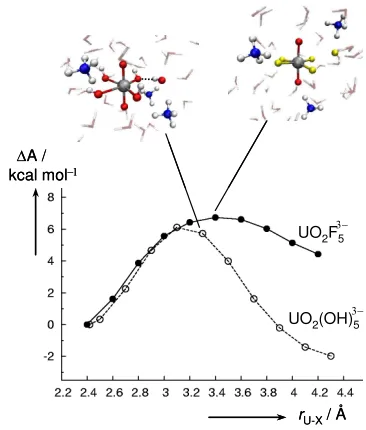
counterions. After passing a barrier of ∆A‡ = 6.7 kcal/mol, the free energy appears to level off at ∆A = 4.4±1.1
kcal/mol (filled circles in Figure 2), marking the formation of an outer-sphere complex. Adding a simple correction from the literature for full dissociation of an ion pair com-posed of a di- and a monoanion, ∆∆G = −2.4 kcal/mol,10
affords a final estimate of ∆A = −2.0 kcal/mol for the
reverse reaction, i.e. fluoride binding to the tetrafluoride: [UO2F4]2− + F−→ [UO2F5]3− (1)
Interestingly, a noticeable driving force is predicted for this process. Experimentally, this value is unknown, but from the free fluoride-binding energies of uranyl di- and tri-fluoride, ∆Go = −3.2 kcal/mol and −1.1 kcal/mol,11
respect-ively, a small and positive value can be inferred for ∆G of eq 1. The simulated ∆A value of −2.0 kcal/mol is thus
probably just within the usual error margin of our CPMD-based approach for uranyl complexes, ±2.5 kcal/mol,2b-f
suggesting that with counterions, even highly charged ions can be described reasonably well with our methodology.
Finally, we have studied a related complex that has attracted renewed interest, [UO2(OH)5]3− (3). Identified by
EXAFS as possible12 or even major component13 in highly
alkaline uranyl solutions, this ion has recently been proposed as an intermediate involved in the oxygen scrambling between axial oxo and equatorial O-donor ligands.14 In an unconstrained CPMD run in pure water,
pristine 3 is found to be unstable: it immediately deproton-ates a neighboring water molecule, affording [UO2(OH)
4-(H2O)]2−. The latter, much like the related fluoride 1,
quickly loses the coordinated water ligand under formation of [UO2(OH)4]2−. When an unconstrained simulation is
started from 3 surrounded by three NH4+ ions near the
equatorial plane, one of the latter ions is deprotonated to give [UO2(OH)4(H2O)]2− and NH3. Apparently, 3 is much
more basic than 2. To avoid this problem, we fixed all NH
Page 2 of 4
ACS Paragon Plus Environment Submitted to Inorganic Chemistry
[image:3.612.69.283.112.328.2] [image:3.612.50.300.450.627.2]3
distances in the simulations of [3][NH4]3 to the mean value
over the unconstrained run for [UO2F4][NH4]2, 1.05 Å.
With this setup, [3][NH4]3 remained (meta-)stable for 3 ps.
rU-X/ Å
∆A /
kcal mol−1
UO2F3−5
UO2(OH)3−5
rU-X/ Å
∆A /
kcal mol−1
UO2F3−5
UO2(OH)3−5
Figure 2. Changes in free energy, ∆A, upon dissociation of one of the equatorial ligands from 2 (solid line and circles) and 3 (dashed line and
open circles) including counterions at 320 K. Selected snapshots are shown near the transition state regions.
Eventually, the distance between U and the O atom of an OH− ligand flanked by two NH
4+ ions was taken as
react-ion coordinate and was elongated stepwise to afford the profile displayed in Figure 2 (open circles). At r = 2.7 Å, the dissociating OH− abstracted a proton from a nearby
water molecule, initiating the well-known relay mechanism for proton transport in water.15 To keep the simple distance
coordinate, from that point onwards the (U)HO...HOH hydrogen bond was frozen at 1.57 Å, the mean value before proton transfer (see Figure S2 in the SI). No other proton abstractions were encountered on the rest of the path.
Up to r = 3.1 Å, the dissociation profile is very similar to that of 2, but beyond that distance the forming [UO2(OH)4]2−.OH− ion pair is stabilized significantly.
Inspection of the trajectories reveals one possible reason for this finding: at that point the dissociating OH− "turns back"
to the uranyl complex, donating a hydrogen bond to a neighboring hydroxide ligand (see dotted line in the top left snapshot in Figure 2). As a dissociating F− cannot do this,
the resulting [UO2F4]2−.F− ion pair is much higher in
energy. For the hydroxide, after passing a barrier of ∆A‡ = 6.1 kcal/mol, the outer-sphere complex is reached at ∆A =
−2.0±1.1 kcal/mol. With the same correction for full
dissociation mentioned above, a driving force of ∆A = 4.4 kcal/mol is obtained for the reverse process, eq 2, with a corresponding barrier of ∆A‡ = 10.5 kcal/mol.
[UO2(OH)4]2− + OH−→ [UO2(OH)5]3− (2)
This process has recently been suggested to be the rate-limiting step in the exchange between O atoms from the uranyl moiety and equatorial ligands.14 Static DFT/PBE
computations with a polarizable continuum model of solvation have afforded ∆G‡ = 21.3 kcal/mol (∆H‡ = 12.5
kcal/mol),14 in apparent qualitative accord with experiment,
∆G‡ = 15.2 kcal/mol at 298K (∆H‡ = 9.8 kcal/mol).13 Our estimated free activation energy, 10.5 kcal/mol, is smaller, but is in the same ballpark as these data, inviting further investigation of this intriguing exchange process.
In summary, we propose to use NH4+ as simple model
counterion in CPMD simulations of anionic uranyl com-plexes. For [UO2F4(H2O)]2−, addition of two such
counter-ions strengthens the bond between the metal and the water ligand noticeably, by ca. 2 kcal/mol, thereby improving the accord with respect to experiment. Applying this method-ology to pentacoordinate [UO2X5]3− species reveals
inter-esting intrinsic differences between X = F, which is predict-ed to be bound, and X = OH, which is prpredict-edictpredict-ed to be unbound. By mimicking actual experimental conditions, an ever more realistic and accurate modeling of uranyl chemistry in solution is within reach.
Acknowledgment: We wish to thank EaStCHEM for support and access to the EaStCHEM Research Computing Facility, as well as Dr. H. Früchtl for technical support. GS acknowledges funding from the Natural Sciences and Engineering Research Council of Canada (NSERC).
Supporting Information Available: Computational details and
further graphical material. This material is available free of charge on the Internet at http://pubs.acs.org.
References
‡ University of St. Andrews $ University of Manitoba & Laboratoire MSM Strasbourg
(1) E.g. Chaumont, A.; Wipff, G. J. Phys. Chem. B2008, 112, 12014. (2) For instance: a) Bühl, M.; Diss, R.; Wipff, G. J. Am. Chem. Soc.,
2005, 127, 13506. b) Bühl, M.; Kabrede, H. Inorg. Chem. 2006, 45, 3834. c) Bühl, M.; Kabrede, H.; ChemPhysChem 2006, 7, 2290. d) M. Bühl, V. Golubnychiy, Inorg. Chem. 2007, 46, 8129. e) Bühl, M.; Sieffert, N.; Golubnychiy, V.; Wipff, G. J. Phys. Chem. A2008, 112, 242. f) Bühl, M.; Sieffert, N.; Wipff, G. Chem. Phys. Lett. 2009, 467, 287.
(3) (a) Infante, I; Van Stralen, B; Visscher, L. J. Comput. Chem. 2006,
27, 1156. (b) Nichols, P.; Bylaska, E. J.; Schenter, G. K.; de Jong, W. J. Chem. Phys. 2008, 128, 124507.
(4) (a) [H3NC2H4NH3]2+ counterion, CSD refcode BEZLEX: Ivanov, S.
B.; Davidovich, R. L.; Mikhailov, Y. N., Shchelokov, R. N. Koord. Khim.
1982, 8, 211. (b) NMe4+ counterion, CSD refcode DAPWUM: Mak, T. C.
W., Yip, W.-H. Inorg. Chim. Acta1985, 109, 131.
(5) Vallet, V.; Wahlgren, U.; Schimmelpfennig, B.; Moll, H.; Szabo, Z.; Grenthe, I. Inorg. Chem. 2001, 40, 3561.
(6) Bühl, M. Can. J. Chem. 2009, 87, 818.
(7) Employing the same methods (CPMD/BLYP) and techniques as in our previous studies, see e.g. ref 2f and the SI for further details.
(8) Hybrid functionals can be superior to pure gradient-corrected ones when it comes to thermochemistry of uranium oxofluorides, see: Shamov, G. A.; Schreckenbach, G.; Vo, T. N. Chem. Eur. J. 2007, 13, 4932.
(9) K3[UO2F5]: Zachariasen, W. H. Acta Cryst. 1954, 7, 783.
(10) See for instance: Morel, F. M. M.; Hering, J. G. Principles and Applications of Aquatic Chemistry, Wiley, New York, 1993, p. 399, where a simple expression for electrostatic interactions between ions in a dielectric continuum was used for this estimate (log K = 1.74).
(11) From the βn0 values given in: Grenthe, I.; Fuger, J.; Konings, R. J.
M.; Lemire, R. J.; Muller, A. B.; Nguyen-Trung, C.; Wanner, H. Chemical Thermodynamics Vol. 1: Chemical Thermodynamics of Uranium, Wanner, H.; Forest I. (Eds.), Elsevier, Amsterdam 1992.
(12) Moll, H.; Reich, T.; Szabo, A. Radiochim. Acta2000, 88, 411. (13) Clark, D. L.; Conradson, S. D.; Donohoe, R. J.; Keogh, D. W.; Morris, D. E.; Palmer, P. D.; Rogers, R. D.; Tait, C. T. Inorg. Chem.
1999, 38, 1456.
(14) Shamov, G. A.; Schreckenbach, G. J. Am. Chem. Soc. 2008, 130, 13735.
(15) See e.g.: Marx, D.; Tuckerman, M. E.; Hutter, J; Parrinello, M., Nature1999, 397, 601.
Page 3 of 4
ACS Paragon Plus Environment Submitted to Inorganic Chemistry
[image:4.612.81.264.81.296.2]4
Graphical abstract
∆
A /
∆
A /
NH
4+ions are proposed as model counterions in Car-Parrinello molecular dynamics simulations of
anionic uranyl(VI) complexes in water, such as [UO
2F
4(H
2O)]
2−(see adjacent graphic) or [UO
2X
5]
3−(X
= F, OH).
Page 4 of 4
ACS Paragon Plus Environment Submitted to Inorganic Chemistry