28060 4 5 7 1 0
Theory and Practice of System
Development Methodologies:
A Conceptual Framework
David Fulton
A dissertation submitted in partial fulfillment o f the requirements for the degree of
Doctor of Philosophy of the
University of London
Department o f Computer Science University College London
ProQuest Number: 10106674
All rights reserved
INFORMATION TO ALL USERS
The quality of this reproduction is dependent upon the quality of the copy submitted.
In the unlikely event that the author did not send a complete manuscript and there are missing pages, these will be noted. Also, if material had to be removed,
a note will indicate the deletion.
uest.
ProQuest 10106674
Published by ProQuest LLC(2016). Copyright of the Dissertation is held by the Author.
All rights reserved.
This work is protected against unauthorized copying under Title 17, United States Code. Microform Edition © ProQuest LLC.
ProQuest LLC
789 East Eisenhower Parkway P.O. Box 1346
Acknowledgements
My thanks to Keith Rapley at British Airways, Simon Groves and Steve Edge at Savant Consulting and Andy Roberts at IBM Consulting for their help in setting the case studies up and organising both individual interviews and review meetings. A special thanks to all those developers in these organisations who made a direct contribution. Your names may have not been remembered, but your thought-provoking and insightful contributions certainly were.
Again, I am indebted to all those respondents to the survey, too many to mention, for making a valuable contribution to this research. Your responses were revealing,
colourful, often witty and in some cases completely baffling. I hope that the results of the research justify the length of the survey.
Many thanks to the following for dispensing pearls of wisdom along the way:
V C Page, Page Associates Limited; Andy Smith, University of Luton; Russel Winder, Kings College, London; Paul Wemick, Imperial College, London; Bob Malcolm, Malcolm Associates; Ismail Ismail, University College London; Martin Ashton, Reuters Ltd.; Arif Iqbal, University College London; Rory Channer, AIT Limited.
The help, guidance and friendship of my supervisor, Angela Sasse, is especially noted and appreciated. Thanks for believing in me.
Special thanks to Velia Smith, of Reuters America Inc. for finding copious amounts of ‘ 11 19/32 by 8 11/16* sized paper in a land where the label ‘A4’ carries no meaning.
Thanks also to my boss, Michele Franchi of Reuters America Inc. for giving me the time off to smooth over the odd crack in the thesis. Chapter 8 could not have been re-drafted for the umpteenth time without your help.
Finally, thanks to my parents Donald and Maureen Fulton, and to my soul-mate, Kerry Flynn, for all their encouragement over the years. You may not have understood in most cases what I was doing, or indeed why I was doing it, but your love and support carried me through.
“People who write about methodology often forget that It is a matter of strategy, not of morals”.
George Homans (1949) The strategy o f industrial sociology in American Journai of Socioiogy, 54(4), pp. 330- 337.
Abstract
This work examines the differences between the theory of information systems analysis and design and commercial practice. The customisation or informal interpretation of methods have in the past been identified as a failure of practitioners to adopt methods of “good practice” or to improve the professionalism of analysis and design work. This thesis argues that failure is a misnomer, and if indeed it is to be used it should be attributed elsewhere; the most suitable candidate being that the theory of the mainstream software engineering discipline, formally embodied in the methodologies that are produced, fails to address some of the complexities of practical systems analysis and design. The most apparent complexity is that methodologies, in the majority of cases, have to be interpreted and customised to reflect the gap between theory and practice. This thesis argues that this gap reflects that the engineering credentials for the software engineering discipline have been built on overly rigid and insecure foundations, and that greater understanding of development practice and the promotion of the engineering credentials of the discipline are mutually compatible goals. The results of some of the most important case studies in this field, together with a comprehensive set of case studies carried out as part of this research, are used to identify some of the factors influencing the interpretation of method and the realisation of development strategy. The results of this research suggest that theory of development practice can be developed. This thesis identifies a number of the determinants for this process, and develops a conceptual framework within which these determinants can be linked. The conceptual framework advances research knowledge in this area by providing both a framework by which case study results can be compared and a framework by which methodology users can understand and in certain places predict the pressures for customisation.
Contents
Acknowledgements 2
Abstract 4
Contents 5
1 - Introduction 12
1.1 Introduction 12
1.2 The Problem Defined 14
1.3 Exploration of the Problem 15
1.4 Scope of the Thesis 19
1.5 Claims Made in the Thesis 20
1.5.1 General Claims 20
1.5.2 The Main Argument 21
1.6 Contributions of the Thesis 22
1.7 The Research Problem Outlined 23
1.8 The Product of Research 26
1.8.1 Conceptual Frameworks 27
1.9 Summary 30
1.10 An Outline of this Thesis 3 0
2 - Methodology Development 32
2.1 Introduction 32
2.2 The Concept of Methodology 33
2.3 A Brief History of Information Systems Methodology 34 2.4 Schools of Thought on Systems Development 42 2.5 Rockart’s Model of Organisational Learning 43
2.6 The Role of Process in the Framework 50
2.7 Research Issues 50
2.8 Summary 52
3 - Critical Review: Attempts to Bridge the Rift 54
3.1 Introduction 54
3.2 Attempts to Bridge the Rift 54
3.2.1 A Toolbox of Methodologies 54
3.2.2 A Toolbox of Techniques 56
3.2.2.1 Toolbox of Techniques: A Contingency Structure 57 3.2.2.2 Toolbox of Techniques: A Taxonomic Structure 60
3.2.2.3 Observations 67
3.3 Deterministic Models 69
3.3.1 An Exploration of Criteria Listed in the Critical Review 70
3.3.1.1 Uncertainty 70
3.3.1.2 Organisational Context 72
3.3.1.3 Adaptation and Implementation Strategies 73 3.3.2 An Exploration of Criteria Originating in Other Disciplines 74
3.4 Summary and Conclusions 75
4 - Research Methodology 77
4.1 Introduction 77
4.2 Discussion of the Merits of Particular Approaches 77
4.2.1 Unstructured Interviewing 78
4.2.2 Structured Interviewing 78
4.2.3 Case-Studies 79
4.2.4 Field Work 79
4.2.5 Surveys 80
4.2.6 Summaries and Observations 80
4.3 Research Approach 80
4.3.1 Exploratory Interviewing and Case Studies 82
4.3.2 Survey Development 82
4.4 Research Techniques 83
4.4.1 Visual Indexing 83
4.4.2 Grounded Theory 91
4.4.2.1 Data Preparation 92
4.4.2.2 Initial Analysis 93
4.4.2.3 Core Analysis 95
4.4.2.4 Outcomes 97
4.5 Application of the Research Methodology 97
4.6 Conclusions 98
5 - Case Studies 101
5.1 Introduction 101
5.2 Aims of this Chapter 101
5.3 Studies Referenced in this Research 101
5.4 Process of Analysis 104
5.5 The Problems with this Type of Approach 105
5.6 Studies 106
5.6.1 Organisational References 106
5.6.2 Methodology Usage 108
5.6.3 Dynamic Situational Determinants 109
5.6.4 The Evolution of Strategy 109
5.6.5 Sununary and Conclusions (of Studies) 110 5.6.6 Initial Attempts at a Conceptual Framework 111
5.7 Conclusions 112
6 - A Practical Exploration of Determinants 113
6.1 Introduction 113
6.2 Aims of the Practical Case Studies 113
6.2.1 Why Rapid Application Development (RAD)? 113
6.2.2 Rapid Application Development 115
6.2.3 Interpretation of RAD 117
6.2.4 Process of Analysis 122
6.3 Comparison of Case Studies 124
6.3.1 Organisation A 124
6.3.1.1 Initial Statement of Objectives 126
6.3.1.2 Development Pressures 127
6.3.1.3 Organisational Context 127
6.3.1.4 RAD Strategy 128
6.3.2 Organisation B 129
6.3.2.1 Initial Statement of Objectives 129
6.3.2.2 Development Pressures 130
6 3 2 3 Organisational Context 130
6.2.2.4 RAD Strategy 131
6.3.3 Organisation C 132
6.3.3.1 Initial Statement of Objectives 132
6.3.3.2 Development Pressures 132
6.3.3.3 Strategy 133
6.3.3.4 Organisational Context 133
6.4 Lessons Learnt 133
6.5 Findings 136
6.6 Observations 136
6.6.1 Development Pressures 137
6.6.2 Initial Statement of Objectives 140
6.6.3 Methodological Values 141
6.6.4 Development Strategy 142
6.6.5 Organisational Culture 142
6.7 Conclusions 143
7 - Survey Outline and Results 145
7.1 Introduction 145
7.2 Rationale 145
7.3 Application 146
7.4 Survey Structure 147
7.4.1 System Characteristics 148
7.4.2 Development Paradigm 149
7.4.3 Initial Statement of Objectives 150
7.4.4 User Experience 150
7.4.5 Developer Experience 150
7.4.6 Definition of Job Roles 151
7.4.7 Change Request Authorisation 151
7.4.8 Stability of Processes 151
7.4.9 System Development Strategy 151
7.4.10 Development Model 152
7.4.11 Emphasis of the Strategy 152
7.4.12 Impact of Types of Requirements 153
7.4.13 The use of a Methodology 153
7.4.14 The use of Tools and Techniques 153 7.4.15 The Importance of Tool Characteristics to the Projects
Success 154
7.4.16 The Types of Problems the Project had Difficulty Dealing
With 154
7.5 Results: Overview 155
7.6 Results: Primary Entities 156
7.6.1 Strategy 157
7.6.2 Organisational Context 159
7.6.3 Methodology 161
7.6.4 Initial Statement of Objectives 162
7.6.5 Development Pressures 165
7.7 Results: Secondary Entities 166
7.7.1 Exploration of Links Between Organisation and Strategy
Entities 166
7.7.2 Exploration of Links Between Organisation and Initial
Statement of Obj ectives Entities 168 7.7.3 Exploration of Links Between Initial Statement of Objectives
and Development Pressure Entities 169
7.7.4 Exploration of Links Between Initial Statement of Objectives
and Strategy 173
7.7.5 Exploration of Links Between Strategy and Methodology 175 7.7.6 Exploration of Links Between Strategy and Development
Pressures 177
7.7.7 Exploration of Links Between Organisation Context and
Methodology 178
7.7.8 Initial Statement of Objectives against Methodology 178 7.7.9 System Characteristics against Strategy 180 7.7.10 Techniques used in Comparison to Development Strategy 182
7.8 Problem Analysis 183
7.8.1 The Impact of Changing Requirements 183 7.8.2 Tool/Technique Characteristics by Strategy Categorisation 185 7.8.2.1 The Experimentation Characteristic 185 7.8.2.2 The Abstract Envisionment Characteristic 186 7.8.2.3 The Concrete Envisionment Characteristic 186 7.8.2.4 The Communication Characteristic 186 7.8.2.5 The Exploration Characteristic 188
7.8.3 Problems by Strategy 188
7.8.3.1 Problems in Dealing vrith Requirements Change 188 7.8.3.2 Problems in getting Suitable User Feedback 188 7.8.3.3 Problems in Ensuring the Quality of the
Application 190
7.8.3.4 Problems with Turnover of Staff 190 7.8.3.5 Problems with not Concentrating Sufficiently on
Functionality 190
7.8.3.6 Problems vrith Getting Agreement on Changes 190
7.9 Critical Evaluation 191
7.10 Conclusions 192
8 - Definition of the Conceptual Framework 193
8.1 Introduction 193
8.2 Structure of the Conceptual Framework 194
8.3 Primary Entities 197
8.3.1 Organisation 197
8.3.2 Methodology 201
8.3.3 Strategy 203
8.3.4 Development Pressures 204
8.3.5 Initial Statement of Objectives 208
8.4 Secondary Entities 210
8.4.1 Organisational Familiarity 210
8.4.2 Organisational Constraints 211
8.4.3 Communication Needs 211
8.4.4 Development Paradigm 212
8.4.5 Strategy Demands 213
8.4.6 Methodology Constraints 213
8.4.7 Initial Focus 214
8.4.8 Development Needs 215
8.4.9 Strategy Constraints 215
8.4.10 Initial Focus of Development 216
8.4.11 Mutable Requirements 216
8.4.12 Novelty of Requirements 217 8.4.13 Impact of Developer Experience 218 8.4.14 Inter-connectivity of Requirements 218
8.5 Emergence 218
8.5.1 The LAS project 220
8.5.2 TAURUS 221
8.6 Conclusions 223
9 - Future Directions and Evaluation 224
9.1 Introduction 224
9.2 Recap of the Problem and Project Aims 224 9.3 The Fit of This Work Within the Discipline of Interactive Computing
Systems Design 225
9.3.1 Engineering Knowledge 225
9.3.2 Problems in Promoting Research of this Kind 226
9.3.3 Evolution of Method 227
9.3.4 Emergence 228
9.3.5 The End of Methodology? 229
9.4 What Can We Learn from Case Studies? 233
9.4.1 The Importance of Grounded Theory 234 9.4.2 The Importance of Conceptual Frameworks 234
9.5 Conclusions 235
9.5.1 Comparisons with other Research Domains 235
9.5.2 Comparisons with Other Models 236
Appendices
A. Glossary 238
B. Review of Case Studies: Models and Notes 244 C. Definitions and Notes resulting from Case Studies 251
D. Survey 334
References 342
Figures
1.1 The Gap Between Theory and Practice 15
1.2 The Proteus Case Study (Anon, 1994): Problems in handling
requirements change 28
1.3 Conceptual Framework of Dissemination of Educational Innovations
(The Network Inc, 1979) 29
2.1 Components/Structure of a Methodology 33
2.2 A Simple Taxonomy of the Most Popular Structured Methodologies
(based on Sasse & Fulton, In Press) 37
2.3 Technical Impact on the Application of IT and Methodologies 40 2.5 The Growth of Uncertainty in Systems Development 46
2.6 Determinants of Methodology Customisation 49
2.7 Strategy as an Interpretation of Methodology 50 2.8 Factors Influencing Practice and Theory of System Development 52
3.1 The Multi view Framework 59
3.2 The Street-Map Analogy (Benyon & Skidmore, 1987) 61 3.3 Three Domains of Discourse in the Design Process (Kensing &
Munk-Madsen, 1993) 65
3.4 Comparison of Theory 68
3.5 The Impact of Changing Requirements (Chudge & Fulton, 1996) 71
3.6 Communication in an Organisational Context (Gowler & Legge,
1978) 73
3.7 The Impact of the Development Paradigm (from Grudin, 1991) 75
3.8 An amalgamated Model of Selection Criteria 76
4.1 Objects in the Domain Space (based on Fulton (1994)) 85 4.2 An Example Representation of the Responsibilities Within a Work
Context (Fulton & Sasse, 1996) 86
4.3 Using Requirements Change to Drill Down 87
4.4 Steps in Grounded Theory Analysis (Pidgeon et al, 1991) 93
4.5 Example text and coded concepts 94
4.6 The concept card 95
4.7 A definition of a concept 96
4.8 The associated memo for the provisional definition record in figure 4.6 97
4.9 The relation between research steps 98
5.1 The Initial Conceptual Framework 111
6.1 RAD’s Approach to Handling the Software Crisis 115 6.2 The RAD Structure (based on Kerr & Hunter, 1994) 116
6.3 Intermediate Conceptual Framework 137
6.4 Categorisations of Development Practice 139
6.5 The Initial Statement of Objectives 140
6.6 Categorisation of Methodology Values 141
6.7 Categorisations Within the Strategy Element 142 6.8 Gowler & Legge’s (1978) Organisational Context Model 143
7.1 Web-Based Survey 147
7.2 Expectations against Results for the Strategy Entity 158 7.3 The Impact o f Starting Points on The Formality of Requirements 164 7.4 Corrections to The Initial Statement of Objectives 164 7.5 The Impact of Change: Dependencies on Initial Statement of
Objectives 171
7.6 The Impact of Change: Depending on Developer Experience 172 7.7 The Relationship between Experience and the Initial Statement of
Objectives 172
7.8 Relationship between Initial Statement of Objectives and Strategy 174 7.9 Relationship between Strategy and Development Pressures 177 7.10 Initial Statement of Objectives against Development Paradigm
against the Use of Methodology 180
7.11 The Relationship between Experience and Requirements Change 184
7.12 Tool Characteristics Against Strategy 187
7.13 Problems Against Strategy 189
8.1 The Final Conceptual Framework 196
8.2 Components of the Primary Entity Organisation 201 8.3 Components and Categorisations of the Primary Entity Development
Pressures 207
8.4 Components and Categorisation of the Primary Entity Initial
Statement of Objectives 210
9.1 Interactive Development: Stages in Increasing its Applicability as an
Engineering Discipline 228
9.2 Stages in the CMM model and the benefits of moving up the scale
(Putnam, 1993) 231
9.3 Balancing Determinants (Fulton, 1997b) 233
9.4 Framework for Methodology Customisation (Hughes & Reviron,
1996) 236
Tables
2.1 A Taxonomy of Development Philosophies 43
3.1 Primary Uses of models (Benyon & Skidmore, 1987) 63 3.2 Six Areas of Knowledge in User-Developer Communication (Kensing
& Munk-Madsen, 1993) 66
3.3 Criteria for Methodology/Strategy/Technique Selection 69
3.4 Requirements and Their Origins (Marker, Eason & Dobson, 1993) 72
5.1 Case Studies and the Areas they Deal With 102
6.1 Case Studies Analysed as Part of This Research 125
6.2a Summary of Findings 135
6.2b Summary of Findings 136
7.1 The Spread of Respondent Origin 156
7.2 Organisational Context Testing 160
7.3 Methodology Usage 161
7.4 The Impact of Development Paradigm on Starting Point 163 7.5 User Experience Against Legacy System Replacement 165 7.6 User and Developer Experience Against Projects 166 7.7 The Impact of the Organisational Context Against Strategy 167 7.8 Organisational Context - Relationships with Starting Point and
Development Paradigm 170
7.9 The Relationship between Development Paradigm & Strategy 175 7.10 The Relationship Between Strategy & Methodology 176 7.11 The Relationship Between Organisational Context & Methodology 179
7.12 System Characteristics against Strategy 181
7.13 Techniques against Strategy 182
7.14 The Relationship Between Organisation Context and Mutable
Requirements 185
8.1 The Organisation Primary Entity 198
8.2 The Methodology Primary Entity 202
8.3 The Strategy Primary Entity 204
8.4 The Development Pressures Primary Entity 205
8.5 The Initial Statement of Objectives Primary Entity 209 8.6 The Organisational Familiarity Secondary Entity 211 8.7 The Organisational Constraints Secondary Entity 211
8.8 The Communication Needs Secondary Entity 212
8.9 The Development Paradigm Secondary Entity 213
8.10 The Strategy Demands Secondary Entity 213
8.11 The Methodology Constraints Secondary Entity 214
8.12 The Initial Focus Secondary Entity 215
8.13 The Development Needs Secondary Entity 215
8.14 The Strategy Constraints Secondary Entity 216
8.15 The Initial Focus of Development Secondary Entity 216
8.16 The Mutable Requirements Secondary Entity 217
8.17 The Novelty of Requirements Secondary Entity 217 8.18 The Impact of Developer Experience Secondary Entity 218 8.19 The Inter-connectivity of Requirements Secondary Entity 218
B.l Papers and References 244
C. 1 Interviewee and Project Details 251
Chapter 1 - Introduction
1.1 Introduction
One of the on-going debates in computer science is the search for a more holistic understanding of the process of design and development of computer systems. The catalysts for such a search are readily apparent in the professional journals and magazines which support the discipline, one of the most emotive being the failure, in several well publicised cases, of attempts to develop efficient and effective working computer systems. The reasons diagnosed for such failures are as varied as the range of systems that fail. Poor management, improper use of tools, poor training, inadequate attention paid to user issues etc., are just some of the problems that are regularly highlighted. Often the immediate aftermath of such failures are dominated by informal (and sometimes formal) enquiries trying to identify the problems and make sure the problems are permanently eradicated.
One of the main consequences of these attempts to leam fi-om practice has been the development of information systems methodologies - formalised firameworks designed to guide design activities - in order to improve the practice of systems development, instil ‘good practice’, ensure ‘professionalism’* and reduce the chances of such failures occurring in the future.
Although the development of formal methodologies has undoubtedly improved the process of analysis and design, there are a number of pertinent issues that still have been largely unsolved or actively resist being solved:
• The poor take-up o f methods: despite a heightened awareness of the benefits of methodology usage, more explicit demands in terms of adherence to quality assurance regimes and an increasing number of methods in circulation, there are a number of organisations or groups who use small sub-sets of a methodology or do not use methods at all.
‘ The definition o f such terms often depending on the philosophical bias of the methodology developer.
• Philosophical disagreements on the focus o f methodology: A number of philosophical paradigms have evolved with drastically differing viewpoints on the ownership of technology-based solutions, and the relative importance of social or technical aspects of information systems development.
• The proliferation o f problems to which IT is applied: The increasing maturity of technical knowledge and capability has lead to systems (mostly interactive systems) being developed where no methodological frameworks have been applied in the past, or where current methodologies have been hard to utilise.
The end result of such emergent trends is paradoxical (not to mention embarrassing). While methodologies have been developed as a response to practical problems, there have been a number of ongoing disagreements on how to apply them in practice, or outright failure in applying them at all. Fitzgerald (1996) sums up the problem rather neatly:
“ In theory, there is no difference between theory and practice. In practice there is!" p. 17
This thesis investigates these paradoxical trends, identifies contextual aspects of development that are (to this point) beyond the scope of methodologies, and produces a conceptual framework of information systems development in order to provide:
• a method-independent model by which existing and future case-studies in this area can be evaluated;
• a framework by which contextual and deterministic variables can be related to method use;
• a framework by which process-based (including ad-hoc) approaches can be justified.
This chapter further outlines the rationale for this research topic, highlighting how the lack of detailed empirical research into methodology use has hindered our ability to fill the ‘gap’ between theory and practice. The pertinent aims of the research project are outlined, together with a description of some of the products of the research project and
the contribution these products make to the field of computer science in general and software engineering and information systems methodology (ISM) research in particular.
1.2 The Problem Defined
This thesis opened with a quote from Homans (1949), who made the observation that the attention paid to the conceptual and philosophical differences between the conflicting schools of thought on methodology use often obscured the results gained in using a methodology. The quotation may seem inappropriate, especially given that Homans is reflecting on the use of methodology in traditional terms, i.e. the methodology being a framework for research (or the study of research), rather than a framework for development^. However, the same criticisms can be made of the disciplines with an active interest in information systems analysis and design, where the conflicting views of the rationalistic or reflective schools on information systems development have often overshadowed attempts at understanding the actual process (or practice) of analysis and design.
Conflict between differing philosophical schools of information systems development and the search for more efficient and effective techniques and notations has obscured one of the more pressing problems, in that the gap (see Figure 1.1) between the theory and practice of systems design remains acute. Theory (as represented by the methodological frameworks being developed) undergoes a process of interpretation in order to be used in practice - methodologies are only very rarely used as prescribed. This phenomenon has been well documented in other research projects, and the reaction of researchers to the interpretation of method has differed. Some have pointed this out as a failure of the method to communicate aspects of its use or to train analysts, or as evidence of a shortfall in the analytical coverage of the method, (e.g. Edwards et al., 1989b). Others have used this fact to indict current development practice (Nicholls, 1987; Eva & Guilford, 1996). This research takes a different perspective on the problem, suggesting that the interpretation of method is inevitable and, in the majority of cases, a desirable consequence.
^ Which is the manner in which the term has been interpreted. Method and methodology are also used interchangeably.
aspects of practice that are open to formalisation
gap
Practice Theory
aspects of theory that can be readily interpreted /
Figure 1.1: The gap between theory and practice
The problem this thesis tackles is ‘if practice is fundamentally different from theory, what mechanisms or models can we use in order to understand the deterministic qualities impacting on the use of methodologies (therefore making our theoretical models more applicable) and what can we derive from these models in order to understand more about the contextual nature of analysis and design?’.
1.3 Exploration of the Problem
Our interpretation of Homans’ quote can be clarified further by reminding ourselves of the meaning of methodology in this context. Jayaratna (1994) offers the following definition:
'‘^An explicit way o f structuring one’s own thinking and actions. Methodologies contain model (s) and reflect particular perspectives o f ''reality” based on a set o f philosophical paradigms. A methodology should tell you "what” steps to take and "how” to perform those steps but most importantly the reasons "why” those steps should be taken, in that particular order.'" p. 10
The models used within methodological frameworks have been defined, and are commonly agreed upon, to the extent that many techniques and models are used by methods with conflicting philosophical paradigms, even if the notations used may differ. Answering the what? how? why? questions has proved to be a far more difficult task to accomplish within a methodological structure, and has often been a responsibility taken up by developers, who in a number of cases have actively customised the method in
order to meet their own interpretation of “reality”. The use (or misuse) of methods by developers and other seemingly ad-hoc behaviours has often been a target for criticism:
builders built buildings in the same manner as most programmers write
programs, the first woodpecker would have destroyed civilisation. "
At first glance this quote from Gerald Weinberg (personal communication, 1997) quote may not seem to have any relevance to the field in question - dealing as it does with programming practice. However, it is an analogy that is seen to have a resonance within the wider system development community, and has been copied, repeated and updated to match the times in the years since its original publication. A search on the world-wide- web will result in a number of interpretations. There are versions of the quote where ^builder' has been replaced by ^architect' and programmers wrote programs’ by ''designers design information systems’ only the last six words of the quote survive constant translation. The original quote, and the enthusiasm with which it has been propagated, serves as a symptom of a deeper concern over the professionalism of those involved in developing information systems.
Critics of current systems development practice have, for a long time, made comparisons between the practice of developing information systems and that employed in the more mature design sciences. The comparison has been made in order to lament the seemingly ad-hoc - and by association - unprofessional approaches to design used in the generation of information systems. Some proponents of structured methodologies have taken this analogy even further, by illustrating the advantages of rationalistic notations to design by comparing the use of modelling techniques in a systems design methodology with the techniques used by architects to design a building (e.g. Ashworth & Goodland, 1990).
While such comparisons may cheer those who feel that there is (or needs to be) a scientific basis to all aspects of software engineering, the comparison is an invalid one for a number of reasons, these being:
• That software is intangible: While a tangible object (like a building) can be visualised in advance, a software-based system is ftmdamentally intangible - its only
existence is in the minds of the developers or users - and the realisation of a software system is likely to change many times over the life-time of a project in order to reflect the changing needs and aspirations of stakeholders.
• Software has no permanence: While a building has an explicit function, and may fulfil that function for a great many years, software has little permanency - it can often be a realisation of business rules that are only valid for a limited period of time.
• Software development has poor scientific foundations: A building would have been designed using a number of universally accepted procedures and design notations. By contrast, the software development community is made-up of disciplines and cliques with seemingly inconsolable philosophical differences (Wemick,1996; Winder & Wemick, 1996). The fragmentation of the field can be seen in the vast number of approaches and methodologies used for designing computer-based systems.
Lastly - and this ties into the preceding points:
• The tools we use to develop systems allow us to be flexible: When a buildings foundations are laid, the architect has little scope to change the final shape or utility of the building. This is not the case with systems development, and it is increasingly the case that users are aware of this fact (Wetherbe et al., 1994).
The most revealing difference between the two cases is not to be found in the ways in which a software system differs in comparison to a building, but in the history of architectural design and other design sciences. The woodpecker did indeed have a hand in (almost) destroying civilisation, as did any number of natural disasters and man-made disasters over the centuries. The discipline of building and building design did not emerge from the trees and caves, bleary-eyed like our ancestors, but developed over time.
An analogy helps to illustrate the point. A number of cavemen, with some mdimentary knowledge of building shelters and stone-carving leave their over-crowded cave in order to build their own dwellings. Soon after leaving the cave, they come across a flat, sandy beach, with a good supply of building materials nearby. Building a small shelter, they are
amazed to see it washed away (along with several of their fellows) at the high-tide. After this freakish occurrence, they decide to think more carefully about their ‘requirements’. They then build a much bigger shelter out of hewn stone, mud bricks and slate - because the problem was obviously that the old shelter was too fickle. The next high-tide, the building sinks into the wet sand. The survivors agree that this was a simple co-incidence - the gods were simply not smiling on them. And so they build another bigger building, and that gets washed away, and so on. Eventually, the surviving cavemen come to the conclusion that you simply cannot build on wet sand.
The common knowledge underlying the scientific basis of the building sciences is derived firom experiences with woodpeckers (metaphorical or otherwise). Earthquake- proof buildings were only ever developed when the original buildings in a city were knocked down. The leaning tower of Pisa is testament to the rule ‘*thou shalt not build 200ft towers with shallow foundations in soft clay", just as the crooked spire on Chesterfield Cathedral is testament to the rule "thou shalt not build spires with pliable soft-woods
The point being made with these examples is that, while the building sciences have had 4000 years of case-studies to look back at, the software development community has had less than a quarter of a century. Very little in the way of ‘rules’ - based on our own ‘cavemen’ experiences, are actually in place. No-one knows what is the best way to develop computer systems. All the woodpecker quote accomplishes is to show the disparity between theory - ‘systems should be developed following correct^ steps’ - and practice - ‘practitioners interpret theory, because the method doesn’t give suitable answers to the what? how? why? questions, and does not take into account the contextual factors underlying development work’.
Criticisms of current development practice cannot be discounted altogether; the professionalism of those developing systems always has to be improved. However, it is the aim of this thesis to show that professionalism should not be regarded as following steps by rote. Regardless of the philosophical stance of the approach or methodology used to develop information systems, particularly highly interactive systems, the shape of
^Correct according to a particular methodology.
a development team and the underlying strategy employed to develop a system are contingent on a number of important factors - factors which may have important consequences for the methodologies and techniques involved. These factors include:
• the organisational context within which the system is developed; • the development paradigm used in developing the system; • the experience of both developers and user representatives; • the degree of uncertainty over the requirements for a system.
This thesis provides a framework by which these four elements can be investigated and integrated. Theory'* is developed in order to show the links between a number of inter related factors - the result being that the strategy, or process of developing a system, can be separated from the stages of a methodology - and the two can be compared to see where conflicts between the two and resulting interpretation of methodology can arise.
The term ‘process’ as applied to this research has a number of interpretations, and is an issue that increases in importance throughout this thesis. Returning to the Theory- Practice model (Figure 1.1), the term ‘process’ has two different interpretations:
• within theory: a prescribed series of steps or actions to reach a required goal; • within practice: an evolving set of steps or actions to reach a required goal.
Understanding the process of analysis and design in practice should improve the ability of researchers in this area to generate suitable formal process models - in essence, new methodological models. The role of process in the conceptual framework is explored in more detail in section 2.6.
1.4 Scope of the Thesis
This work is intended to be applicable to all work situations, not only those with reference to interactive systems analysis and design. While some researchers have quite rightly argued that the use of methodology is domain-specific, the methodology
^Theory very much based on empirical research of practice.
requirements being different when developing a safety-related project in comparison to a stand-alone interactive system, increasingly, the distinction between domains is being blurred - as interactivity becomes a core element of many computer systems. The increasing uncertainty of requirements across domains gives us a symptom of these changes. The applicability of this distinction is tested in later chapters.
This research sees the use of methodology as being socially-negotiated - hence the interpretation of methodology to meet the perceptions and needs of stakeholders. One type of system development that might fall out of the scope of this research is direct single end-user development and programming, where the user is the analyst, designer, programmer and (sole) user of the end-product. It could be argued that the concerns about methodology use in this context are purely about scalability, rather than communication - and therefore are outside the scope of this thesis.
1.5 Claims made in the Thesis
1.5.1 General Claims
There are a number of claims that this research makes about the use of methodology:
• Methodology use is socially negotiated, depending on a number of deterministic factors.
• Existing empirical case studies allow us to generate a poorly detailed but relevant model of such factors.
• The use of a conceptual framework to describe these factors gives us a vehicle by which to identify similarities across case studies, therefore improving our domain knowledge.
• The areas in which the conceptual framework is weak give us good pointers to future research avenues in this discipline.
• The conceptual framework gives us a mechanism to evaluate the effectiveness of a particular development strategy within a particular context.
1.5.2 The Main Argument
To return to the caveman analogy outlined in the introductory stages of this chapter, the information systems methodology discipline is still standing on the beach. We have watched several of our edifices collapse into the sand or being washed away into the sea, and have drawn a number of quite separate conclusions from each of these events but we, as the following example illustrates, still fail to draw collective knowledge by being able to look back at all of our experiences and drawing up a more thorough collective model of the experience.
The failure of the London Ambulance Service call-out system (LASCAD) illustrates the problems involved in developing a collective model for case study findings^ As a consequence of the failure of the system, a number of rigorous or speculative case studies were developed, each with differing interpretations of the core source of failure. Three interpretations in particular presented themselves:
• Managerial failure: The official enquiry (LAS, 1993) castigated management for their poor project management.
• Expectation failure: Benyon-Davies (1995) defined the problem as a failure to manage expectations by not getting users involved in a participatory process.
• Technical failure: Flowers (1994) defined the problem as technical, the developers using development tools with bugs or that did not work as expected.
It is important to note that there is an overlap between the diagnosis of the official enquiry (LAS, 1993) and Benyon-Davies (1995). However, there is still a fundamental problem of interpretation', the selection of one of the three case studies may very well determine the nature of the impression that the reader gets of the failure of the LASCAD system.
This problem is magnified if we consider case studies as a whole. Case studies are rarely generalisable (Bell, 1987); indeed, in an area with many research cliques and schools of thought, the selection of case studies can very often determine the nature of the message
*An overview of the LASCAD project is outlined in section 8.4.1.
that the reader receives about appropriate approaches to analysis and design. The second dimension of the interpretation problem is the approach taken in generating the case study itself; where, in all cases, the interpretative role of the researcher can heavily influence outcomes and conclusions. A solution to the interpretation problem needs to look at both dimensions.
As well as an increase in the number of empirical case studies, researchers have called for such developments in the past, in order to improve the relevance of case study findings (e.g. Hornby & Clegg, 1992). There are a number of problems that need to be tackled in order to achieve this. The framework has to be at a sufficiently coarse granularity that the findings of past case studies can be incorporated - irrespective of the focus or detail of the case study in question. There are areas in which our collective knowledge is still weak and hard to represent with any degree of confidence - organisational norms being an example. Despite these problems, this thesis argues that frameworks can be built in order to represent such relationships and present a theoretical model of the strategy of methodology usage.
1.6 Contributions of the Thesis
The contributions of the thesis to the discipline have been hinted at in earlier sections (notably 1.5.1). This section summarises the prime contributions of this research to understanding our use of methodologies. This can only serve as an advance posting for a more detailed discussion of the relevance of results of this research, carried out in chapter 9, where the distinction between the short-term contributions and the long-term consequences for the software engineering and information systems methodology (ISM) disciplines are outlined.
The contributions outlined in this thesis can be summarised as follows:
• a theory in which to link disparate models of deterministic influences; • a framework by which the results of existing case studies can be compared; • a framework by which future research can be guided;
• a framework that highlights the areas in which our domain knowledge is weak.
A discipline that will directly benefit from research of this kind is methodology engineering (Heym & Osterle, 1993). The field of methodology engineering has evolved along similar lines to the topic of this research - by identifying that there is a disparity between the theory and practice of information systems analysis and design. The perceived short-comings of existing applications of Computer-Aided Software Engineering (CASE) tools have been an important catalyst for this area of research, as CASE tools make the underlying methods and techniques and, more importantly, the relationships between methods and techniques more visible to analysts and designers, but also impose a rigid ‘process’ - coupling together techniques that an analyst may not need, but be forced to use in order to achieve the desired result (an example of which is provided by Nandhakumar & A vison, 1996). The fundamental concept behind methodology engineering is that a methodology can be tailored to specific ‘situations’^. Whilst the field of methodology engineering offers an interesting avenue to ‘bridge the gap’ between practice and theory, particularly in developing understanding of the links between techniques within a ‘modular’^ methodological model*, progress in this area is restricted by a lack of domain knowledge^ because of the narrow range of case study material available. This research study makes an important contribution in addressing some of these current weaknesses and should be seen to have broadly compatible aims.
1.7 The Research Problem Outlined
Recent developments in the information systems methodology field have illustrated four clear trends:
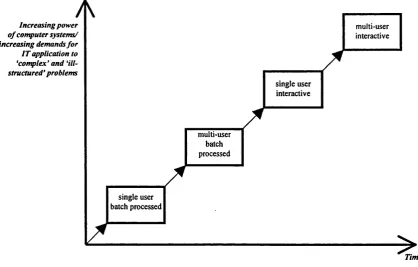
1. The gradual evolution o f methods: Changes in technology, and the accessibility and pervasion of technology have influenced 'paradigm shifts' in methodology development and usage.
^ A situation is defined as an instance within a particular time and context. ’’ A model with interchangeable components.
* The theoretical foundations of methodology engineering are compatible with those of livari (1989), which are covered in section 3.2.2.2.
® A domain is defined as a body of general knowledge - knowledge about the domain - that increases over time. The lack of strong domain knowledge would mean that current methodology engineering approaches are only suitable for situation-specific use, and are rarely generalisable.
2. The development o f contrasting disciplines within the information systems methodology community: 'paradigm shifts' have influenced the fragmentation of the discipline into schools of thought running along rationalistic, reflective and systems-theory based lines.
3. Specialised methodologies: The concept of a universally-applicable analysis and design methodology, tacitly encouraged by the early reflective-science based structured analysis and design techniques, has been largely replaced by the consensus of opinion favouring a methodology for a particular design task, or the use of contingency approaches.
4. The introduction (primarily as a research topic) o f toolboxing approaches: frameworks that implicitly reject the concept of a methodology and instead focus on the characteristics of techniques and their strengths in relation to a given design task.
By some accounts, there are more that 1000 systems analysis and design methodologies in use today (Jayaratna, 1995). This figure excludes the vast number of ad-hoc development approaches, or the methodologies that have been customised to suit a particular organisation, losing some of the flavour of the original methodology but still incorporating much of their character.
The development of new methods or methodologies and the customisation of existing ones continues to be a subject of intense debate within the information systems development community, as does the increasing interest in ad-hoc approaches (Maclaren et al., 1991). There are a number of factors that are commonly believed to have an impact in determining the character of a project and the tools and techniques utilised. One factor is the wider cultural environment within which a development may take place. For example, cultural differences could explain the historically higher levels of interest in participatory approaches to development in North America and Scandinavia, and the proliferation of structured methodologies in the UK and western Europe.
The experience and competence of the individual developer or designer can also be a factor worth considering. There have been a number of reported cases where elements of
a methodology have been dropped because of difficulties in understanding modelling techniques or aspects of a methodology, e.g. the differences between logical and physical modelling in the Structured Systems Analysis and Design Methodology (SSADM), (Edwards et al., 1989b). Research has also shown that the inexperienced designer is more prone to following a methodology "by the textbook", while experienced designers are more likely to customise a methodology as and when needed (Maclaren et al., 1991).
These factors are important, but difficult to identify or to assess and quantify. In addition, these factors are not sufficient for explaining the diversification of development practice within cultural boundaries, or the spread of tool usage across design teams where designers have similar backgrounds and levels of experience. The impact of organisational factors and system related issues also have to be taken into account - as the information systems that are being developed exist within an organisational context and are therefore affected by organisational factors (Maclaren et al., 1991).
Case studies are the accepted method of understanding the impact of organisational factors on system development but have an important weakness if used for the basis of increasing our knowledge of system practice - moving from the specific to the general proving to be so difficult. So many complex contextual factors could determine the success of individual approaches to development. While individual case studies can help us to understand the impact of contextual factors, they cannot inform us of the possibilities of particular approaches in another environment - where the same contextual factors may not exist.
While it may seem that we are left with a long, chaotic list of "what ifs", there are some aspects of systems development that may have broadly deterministic qualities- influencing the use of tools and techniques and the development strategy employed. The development paradigm (Grudin, 1991), the organisational culture of the development environment (Hornby & Clegg, 1992), the degree of uncertainty over requirements (Harker, Eason & Dobson, 1993) and the manner in which a systems development strategy can reflect environmental factors (Land, 1989 & Guttierez & Greenberg, 1993) have all been identified in the past as possible areas where such deterministic qualities could be present and, hopefully, identified.
Why is it important to identify such factors? Well, the main reason is to remove an interesting paradox. While the number of methods used for systems development have grown rapidly, there is no evidence to suggest that the popularity of methods has removed some of the fundamental problems involved with developing computer systems.
The evolution of methods and methodologies has not resulted in a situation where some of the on-going concerns about system development (like meeting time or cost constraints, acceptance by users, etc.) are thought to be readily ameliorable. Furthermore, the increasing diversification in methodology use, while being partly influenced by greater understanding of specific organisational and individual designer and user needs, has not resulted in a systematic understanding of how the approach taken to develop the system relates to the problem being dealt with, or the deterministic factors and influences on methodology take-up or usage.
The essential novel contribution of this thesis is to attempt to identify these factors and the inter-relationships between them by means of a conceptual framework. The conceptual firamework is used in order to clarify some of the constraints and possibilities for designers within a particular context - using some of the case studies and models identified in previous work as part of the source material. The fi-amework can then be used to develop more flexible mechanisms for choosing development strategies and the tools themselves, presenting meta-structures within which both methodologies and contingency approaches can be evaluated as to their suitability for a development, and the extent of likely customisation (if needed) can be assessed.
1.8 The Product of Research
In order to solve some of the problems outlined in section 1.7, a theoretical model needs to be thoroughly grounded in available empirical data. Conceptual fi*ameworks have been used in order to summarise the findings of three main avenues of research, these being:
• an exploration of the findings of several published case studies in this area; • existing theories as described by deterministic models from a number of domains;
• practical case studies and questionnaires carried out as part of this research.
This section clarifies what is meant by conceptual framework, and outlines the restrictions and requirements of conceptual framework modelling in this research programme.
1.8.1 Conceptual Frameworks
Conceptual frameworks are constructs more normally associated with the material gathered at the initiation of a research project, rather than as a final product of a research activity (Miles & Huberman, 1994). Conceptual frameworks are constructs, developed in graphical or textual form, that describe the research area that the research is focusing on, and define the factors, variables and other dependencies that have been noted as being relevant to studies of the research topic, and - more importantly - the relationships between identified areas. Conceptual frameworks most usually serve as a terms of reference for a research project, aiding the conceptual analysis of a research topic and forcing the researcher to be selective at an early stage. They can be developed in order to suit the size or ambition of a research activity - from simple models describing only a few high-level conceptual entities^ ^ and rudimentary relationships, right through to concise theoretical constructs utilising a large number of attributes and detailed relationships between attributes.
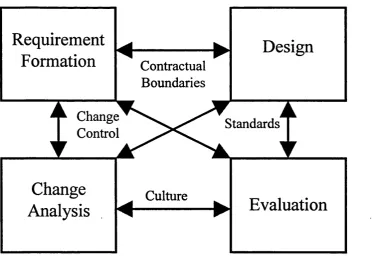
Of course, conceptual frameworks can develop along with the understanding of the research area, and this concept is illustrated within this thesis, as initial 'bins' or entities are defined in the early chapters and are further developed as the research material is expanded upon. Two conceptual firameworks are illustrated in Figure 1.2 and 1.3 to illustrate what initial conceptual firameworks can often look like. In the case of the PROTEUS project (Anon, 1994), which produced a range of tools and techniques for managing changes in system requirements in specialised industries, the four identified entities are coupled together with a number of relationships, the details of which are kept to a low-level.
Requirement
<4
---^
Design
Formation
ContractualBoundaries Change
Control
Change
Analysis
Standards
Culture
Evaluation
Figure 1.2: The PROTEUS project (Anon,1994): Problems in handling requirements change
The second conceptual framework (The Network Inc., 1979) uses a slightly different schematic representation, but still doesn't try to detail relationships, even though the researchers, in this case, have identified some of the more important contributory factors governing the success of the dissemination of educational innovations. Miles & Huberman (rather inappropriately) refer to these types of models (where relationships are characterised by two-directional arrows) as 'no-risk' frameworks - having no bounding conditions in order to differentiate between vital relationships and instances of relationships.
In developing the conceptual frameworks for this research activity, the following research objectives were defined:
• The conceptual frameworks would be graphical: The difficulties in communicating text-based models and theories meant that a graphical notation would be used, primarily because the use of a variety of notations at the end of the research would help to illustrate important areas and communicate important information.
or 'Bins' as Miles & Huberman (1994) call them, using the metaphor to denote the storage of a
POLICYMAKERS
• Context • Characteristics • Behaviour
LINKERS INNOVATORS
• Context <---►• Characteristics • Characteristics
• Behaviour
ADOPTERS » Context • Characteristics » Behaviour
IMPROVEMENT EFFORT SUCCESS INDICATORS • Qaility of Implementation
• Expected Continuation • Extent of Diiffusion
• Nature and Extent of Changes
Figure 1.3: Conceptual Framework of Dissemination of Educational innovations (The Network Inc., 1979)
The conceptual framework should be at a level o f detail sufficient to fill one page: As Miles and Huberman (1994) note, the academic rigour required to define the entities, relationships and other concepts in a page-based graphical format can help to communicate such complexities.
Initial frameworks should be based on existing models and theories: Models showing deterministic qualities of system development/group work (from a variety of disciplines) should be employed in order to provide a sound theoretical basis for much of the later research.
potentially large number of related attributes
Frameworks are developed over the course of the thesis to illustrate the evolution of the conceptual framework from ‘no-risk’ to ‘detailed’ theoretical models.
1.9 Summary
The remaining chapters of this thesis elaborate further on the research problem that has been tackled and the results gained. This chapter has placed the research problem in the wider context of computer science research and has detailed the assumptions made, the rationale for research and some of the products to be delivered as part of the research programme.
1.10 An Outline of this thesis
Chapter 2 establishes the disciplinary background and context for the research text presented in this thesis. The concept of methodology is presented and explored in detail. Some of the factors which influence the interpretation of methodology are identified. The chapter finishes by defining the scope of the research project.
Chapter 3 looks at other attempts to deal with the problem of the gap between practice and theory. Three approaches, each using a different interpretation of the ‘toolboxing’ approach to soften the procedural constraints of traditional methodologies, are examined and criticised. The research in this thesis is positioned in order to meet or tackle the short-comings of the approaches studied.
Chapter 4 describes the research method used on this project. The rationale for the research approach used is explored; first by the evaluation of the possible approaches for gathering research information and then by pin-pointing the types of information required in order to gather credible and defensible data. Two complementary research methods are introduced. The chapter finishes by evaluating their importance as research tools for this project in particular and why grounded theory in particular may prove to be an important tool for dealing with the second dimension of the interpretation problem, as described in section 1.5.2.
Chapter 5 examines a number of empirical studies of development practice, pin-pointing instances of methodology customisation and identifying initial components of the conceptual framework.
Chapter 6 attempts to corroborate the findings of chapter 5 by looking at the use of Rapid Application Development (RAD) within three organisations. The chapter finishes with initial attempts at categorising the behaviours of the major elements of the conceptual framework based on data collected from the case studies.
Chapter 7 introduces the development survey, carried out in order to assess and expand initial models. The structure of the survey is explored, and a concise analysis of the results is carried out. The chapter ends with a critique of the method used and an evaluation of (a), the results gathered, and (b) the impact that those results have on the final conceptual framework.
Chapter 8 uses the three threads of the research (case study review, case studies and survey) to draw together the main framework and associated categorisations. References to each of the component elements are developed and an appraisal of the framework is made.
Chapter 9 is used to conclude the research, and serves as much as a postscript to the study as an evaluation of the findings. The text concentrates on two important areas. The first, and most important, section attempts to position this research in relation to recent developments in the information systems methodologies discipline, and those of other schools and cliques with interests in promoting interactive computing systems design. The second highlights the necessary changes in research practice in order to make progress in this area of research viable and sustainable.
Chapter 2 - Methodology Development
2.1 Introduction
The purpose of this chapter is to establish the disciplinary background and context for the research text presented in this thesis. The concept of methodology is explored in detail. A historical account of the development of information system methodology (ISM) is introduced, and this is used to illustrate the relationship between the practice of systems development and the theoretical models underlying systems analysis and design methods. The gap between theory and practice is explored, and some of the factors which influence the interpretation of a methodology are identified. The rationale for customisation is explored, and the scope of this research project is explicitly defined.
2.2 The concept of methodology
The information systems methodology community is a grouping with a relatively short history as a distinct research discipline. This is partly due to the fact that methodology (as applied to the development of computer systems) is a concept that has only recently been defined in any detail. A methodology within the ISM context can be seen to have several defining attributes. If we return to Jayaratna’s (1994) definition, a methodology has five key attributes:
• it contains a number of methods and models;
• it reflects a particular philosophical perspective on reality; • it should tell you what steps to take;
• it should tell you how to perform those steps;
• it should give the reasons why those steps must be taken;
In essence, a methodology is a framework by which a development project can be planned, evaluated and managed. A methodology, as a framework, consists of a number of other elements, two of which are illustrated in Figure 2.1.
METHODOLOGIES Illustrate the underlying
philosophical
compatibility’s/ order the
I ^
flow of information | up o f betweenMETHODS
Structure the modelling
I
Made characteristics ofI
up ofTECHNIQUES/TOOLS
Figure 2.1: Components/structure of a methodology
The major defining difference between individual methodologies is not necessarily in the techniques/tools or methods involved. A number of methodologies with competing philosophical paradigms use similar resources.* A simple comparison between the techniques used within Multiview (Avison & Wood-Harper, 1990) - a contingency based approach constructed around the SSM (Checkland & Scholes, 1990) method - with those within the SSADM (CCTA, 1995) methodology will identify a number of differences and, significantly, a number of overlaps between the two methodologies. A comparison between structured methodologies will identify minor differences, often in the emphasis placed on specific modelling techniques, and the notations used. The most common fundamental difference between methodologies is often in the philosophical paradigms that each conform to, and the values each methodology communicates. A number of differences (in interpretation) between methodologies can then present themselves, including:
• methodology as a replacement for skilled labour; • methodology as a tool for achieving consensus; • methodology as a agent for labour emancipation.
‘ Short descriptions of a number of such methodologies - including those mentioned in this chapter - are outlined in the glossary of this text.
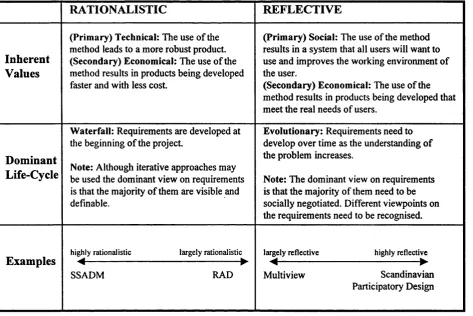
The values of some methodologies are purely technical or economical in nature. The replacement of expensive, individualistic skilled analysts with a structured method advocating prescriptive design approaches is only one such example. Other methodologies address purely social values one of the most extreme of which is the Scandinavian school of design (typified by the papers in Greenbaum & Kyng (1991)). A further group of methodologies address design as a continuous process dealing with a number of viewpoints, with Multiview (Avison & Wood-Harper, 1990) being an example of a methodology where the achievement of consensus is a major goal. Each philosophical clique has its own views on the benefits or dangers of customisation, and these are reflected in the rigour of the methodological models they promote. This issue will be explored in more depth in a later section of this chapter.
There are historical antecedents/reasons for the fragmentation of the information systems methodology discipline, and these are explored in the next section.
2.3 A Brief history of Information Systems Methodology
While the discipline associated with ISM is only a recent development, there are a number of developments predating modem computing that have influenced the approaches we take to developing systems and the manner in which the theory of the discipline originated. Some authors look back further^; this text concentrates on events in the last 40 years. While it is common for authors to look at the invention of the field of Software Engineering, through the work of Royce (1970) on the software life-cycle, Weinberg (1971) on programming practice and the papers in Naur, Randall & Buxton (1976) - defining the concepts of Software Engineering, as the starting point of modem methodological theory, the elements of software engineering pertaining to the design process owe their origins to work in the business systems arena several years earlier, as the first commercially viable computer systems started to appear.
There are a number of antecedents for the development of the first business system methodologies. In particular, the concept of a ‘design science’ was influenced by the commercial availability of computer systems. In the early-to-late 1960’s, the rapid