216
Why Do Primary School Students Need Disaster
Mitigation Knowledge? (Study Of The Use Of
Koase Comics In Primary Schools)
Eddy Noviana, Otang Kurniaman, Munjiatun, Nugraheti Sismulyasih Sb, Sri Dewi Nirmala
Abstract : Disaster mitigation learning is preliminary knowledge in detecting disasters in Indonesia, for that it needs KOASE comic media as an alternative learning media. The research method uses a quasi-experiment with a one-group pretest-posttest design with a sample of 72 primary school students, data collection techniques by doing pretest and posttest which are analyzed using the formula of learning outcomes, after getting categorized according to student knowledge. The results of research on pretest disaster mitigation knowledge data 60.30 with sufficient categories, and 79.70 posttest data with good categories while to see improvement using N-Gain with an average of 0.42 with intermediate categories. So it can be concluded that the use of KOASE comic media in disaster mitigation learning can improve student knowledge outcomes about disaster mitigation.
Index Terms: disaster mitigation knowledge, KOASE comics.
—————————— ——————————
1.
INTRODUCTION
Disaster mitigation is a series of efforts to reduce disaster risk, both through physical development and awareness-raising and capacity building to face the threat of disaster. Disasters themselves are events or series of events that threaten and disrupt people's lives and livelihoods caused by natural factors and / or non-natural factors and human factors that result in human casualties, environmental damage, property losses, and psychological impacts. Disasters can include fires, tsunamis, earthquakes, volcanic eruptions, floods, landslides, tropical storms, and others. Knowledge is an individual process that is obtained from the interaction of the senses possessed by humans with the situation and environmental conditions in which humans are. Knowledge is the result of knowing, and this happens after people have sensed a certain object. This sensing occurs through the five human senses, namely the sense of sight, sense of hearing, sense of smell, sense of taste and sense of touch. Most of the human knowledge is obtained through the eyes (the sense of sight) and the ears (the sense of hearing). Knowledge will also influence the domain in the formation of a person's behavior. Experience shows that natural disasters so far have caused significant losses and suffering due to the combination of natural hazards and the complexity of other problems [1]. Therefore, to minimize losses and suffering from the impact of disasters, disaster mitigation knowledge is needed. Knowledge of disaster mitigation is a process and activity of thinking of individuals through the interaction of the sense of sight and hearing in seeing disasters, both before, during and already occurring disaster [2], the research question is whether the use of KOASE comic media can increase disaster mitigation knowledge? Therefore, it is necessary to conduct a
quasi-experimental study using the KOASE comic learning media on the theme of disaster preparedness in primary schools.
Schools are an effective and efficient means to continue, grow and develop disaster mitigation knowledge through the learning process. Learning is essentially a conscious effort owned by an educator to educate students, thus able to direct through the interaction of students with other learning resources, to achieve the desired goals of the educator. Primary school students are individuals in the cognitive development phase at the operational level of the congress, meaning that in the process of delivering disaster mitigation knowledge must be translated into concrete and tangible forms. It can be seen more clearly that learning is an interaction between two directions, namely from an educator and students, both of which occur through good and directed communication so that it can produce a target that has been previously determined. Learning resources that can be used by students are learning media.Learning media is one form of means that is considered capable of translating abstract concepts into more concrete processes in learning. Graphic media is one of the media that can communicate reality and thoughts more clearly through a combination of expressing words and images [3]. Based on the description above it can be concluded that the media is one part that cannot be separated from the teaching and learning process between educators and students [4]. One suitable media to be applied in learning is graphic media, namely Comics. Comics can facilitate students in the learning process, for example in reading [5] because comics are quite interesting reading to be read by primary school students. Children's enjoyment of comics can be used as the main point in the choice of objects for the development of learning media [6] [7]. The learning media developed in this study is a comic named KOASE. KOASE is an abbreviation of School Children Comics which is one of the means or learning media that contains disaster mitigation knowledge which is packaged in the form of stories with picture illustrations. The information presented in the comics on the theme of disaster preparedness contains the knowledge of activities before, during and after a disaster occurs [8]. The various disasters presented in this KOASE include geological and hydrometeorological disasters in Indonesia, earthquake disasters, tsunami disasters, volcanic eruption disasters, flood disasters, landslides, drought disasters, and forest and land ————————————————
Eddy Noviana, Universitas Riau, Pekanbaru, Indonesia. E-mail: [email protected]
Otang Kurniaman, Universitas Riau, Pekanbaru, Indonesia. E-mail: [email protected]
Munjiatun, Universitas Riau, Pekanbaru, Indonesia. E-mail: [email protected]
Nugraheti Sismulyasih Sb, Universitas Negeri Semarang, Indonesia.
E-mail: [email protected]
217 fires. It is hoped that KOASE learning media can contribute to
the knowledge of primary school students about disaster mitigation. Seeing the explanation presented above, this research will reveal the knowledge of disaster mitigation of primary school students before and after using the KOASE learning media on the theme of disaster preparedness.
2
MATERIALS
AND
RESEARCH
METHODS
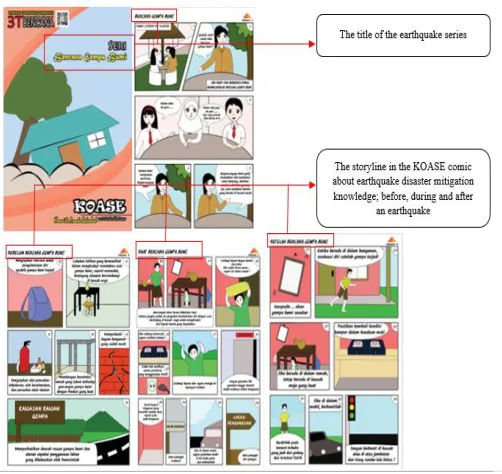
The material used in this study is a KOASE comic that contains knowledge of disaster mitigation provided for primary school students, which consists of series: geological and hydrometeorological disasters in Indonesia, series: earthquake disasters, series: tsunami disasters, series: mountain eruption disasters volcano, series: flood disaster, series: landslide disaster, series: twister disaster, series: drought disaster and series: forest and land fire disaster. The following is an example of a KOASE comic developed as shown in Figure 1 below:
Figure 1. Example of a KOASE comic image to provide
information about earthquake disaster mitigation knowledge
The research design used was the one-group pretest-postest design [9]. The research was begun by giving instruments about disaster mitigation knowledge pretest, then treatment was carried out by giving KOASE comics to be read and understood by students, and then ending by giving questions about disaster mitigation knowledge posttests. For more details depicted in Figure 2 below:
Figure 2. Procedure for conducting research
The research subjects were 72 students in grade V in primary schools, consisting of 3 classes with 24 students in each
class. Research data is knowledge data about disaster mitigation knowledge for primary school students. The research instrument used was a matter of disaster mitigation tests of 31 questions, consisting of (a) 4 questions of geological and hydrometeorological disaster knowledge in Indonesia; (b) 4 questions about earthquake disaster knowledge; (c) 3 questions about tsunami disaster knowledge; (d) 4 questions about knowledge of volcanic eruption disaster; (e) 3 questions about flood disaster knowledge; (f) 3 questions about landslide disasters knowledge; (g) 3 about tornado disaster knowledge; (h) 4 questions drought problems knowledge; and (i) 3 questions about forest and land fire disasters knowledge . Data collection techniques in this study used to test techniques. After the disaster mitigation knowledge data is collected, the next step is to conduct data analysis. Data analysis techniques used are as follows:
1) Determination of the acquisition of scores by the formula: 𝑆𝑐𝑜𝑟𝑒 = 𝑥 100.
2) Determination of the average score acquisition by the formula: 𝐴𝑣𝑒𝑟𝑎𝑔𝑒 = .
3) Determination of score acquisition categories and average scores are as follows:
Categories of acquisition scores and average scores
No Interval Categories
1 Table 1. 81 – 100 Very Good
2 61 – 80 Good
3 41 – 60 Sufficient
4 21 – 40 Less
5 0 – 20 Very Less
4) Determination of the increase in the average score of disaster mitigation knowledge using the formula: 𝑁 𝐺𝑎𝑖𝑛 =
[10]
5) Determining the category of average improvement in the score of disaster mitigation knowledge is as follows:
Table 2. Categories for Increasing NGain Score Knowledge of Disaster Mitigation [10]
No Interval Categories
1 > 0.7 High
2 0.3 – 0.7 Intermediate
3 < 0.3 Low
3
RESULTS
AND
DISCUSSION
Results
218 pretest is done for 60 minutes. After students work on the
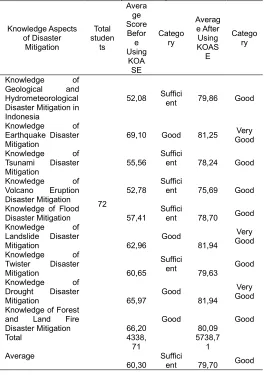
pretest questions about disaster mitigation, the next step is to ask students to read the KOASE comic for one week. Then after the students read the comics for one week, the researcher did the test again by giving 31 post-test questions (pretest questions were exactly the same as the post-test questions) for 60 minutes. The following are the pretest scores and posttest scores of students' disaster mitigation knowledge using the KOASE comics on the theme of disaster preparedness, as shown in Table 3 below.
Tabel 3. Data of Primary School Student Disaster Mitigation Knowledge Using KOASE Learning Media (Theme: Disaster
Preparedness)
Knowledge Aspects of Disaster
Mitigation
Total studen ts
Avera ge Score Befor
e Using
KOA SE
Catego ry
Averag e After Using KOAS E
Catego ry
Knowledge of Geological and Hydrometeorological Disaster Mitigation in Indonesia
72
52,08 Sufficient 79,86 Good
Knowledge of Earthquake Disaster Mitigation
69,10 Good 81,25 Good Very
Knowledge of Tsunami Disaster Mitigation
55,56
Suffici
ent 78,24 Good
Knowledge of Volcano Eruption
Disaster Mitigation 52,78
Suffici
ent 75,69 Good
Knowledge of Flood
Disaster Mitigation 57,41
Suffici
ent 78,70 Good Knowledge of
Landslide Disaster
Mitigation 62,96 Good 81,94
Very Good Knowledge of
Twister Disaster
Mitigation 60,65
Suffici
ent 79,63 Good Knowledge of
Drought Disaster
Mitigation 65,97
Good
81,94
Very Good Knowledge of Forest
and Land Fire
Disaster Mitigation 66,20
Good
80,09
Good
Total 4338,
71
5738,7 1 Average
60,30
Suffici
ent 79,70 Good
219
Figure 3. Average Score Diagram of Knowledge of Disaster
Mitigation Students before and after using KOASE Learning Media (Theme: Disaster Preparedness)
Figure 3 above describes the increase in disaster mitigation knowledge of primary school students. This can be seen from the increase in average scores before and after the use of KOASE comics by primary school students. For knowledge about geological and hydrometeorological disasters, the average score of 52.08 increased to 79.82. Student knowledge of earthquake disasters has increased from an average of 69.10 to 81, 25. Regarding student knowledge of the tsunami disaster has increased from an average score of 55.56 to 78.24. Students' knowledge about volcanoes has increased from an average of 52.78 to 75.69. Students' knowledge about flood disaster experienced an increased score from 57.41 to 78.70. About the knowledge of students about landslides experienced an increased score from 62.96 to 81.94. From the knowledge of students about twister disaster, the score increased from 60.65 to 79.63. Students' knowledge about drought experienced an increase in the score which was initially 65.97 to 81.94. And students' knowledge of forest and land fires increased in the previous average score of 62.20, rising to 80.09. Improved learning outcomes seen in the N-Gain index as table 4.
Tabel 4. Data on Increasing Knowledge of Disaster Mitigation for Primary School Students by Using KOASE
Learning Media (Theme: Disaster Preparedness) Knowledge Aspects of Disaster
Mitigation
Total student
s
Average Improve d Score
Ngain Category Knowledge of Geological and
Hydrometeorological Disaster Mitigation in Indonesia
72
0,51 Intermediat e
Knowledge of Earthquake Disaster Mitigation
0,38 Intermediat e Knowledge of Tsunami Disaster
Mitigation 0,47 Intermediate
Knowledge of Volcano Eruption Disaster Mitigation
0,41 Intermediat e Knowledge of Flood Disaster
Mitigation
0,41 Intermediat e Knowledge of Landslide Disaster
Mitigation
0,46 Intermediat e Knowledge of Twister Disaster
Mitigation
0,38 Intermediat e Knowledge of Drought Disaster
Mitigation 0,40 Intermediate
Knowledge of Forest and Land Fire Disaster Mitigation
0,39 Intermediat e
Total 3,81
Average 0,42 Intermediate
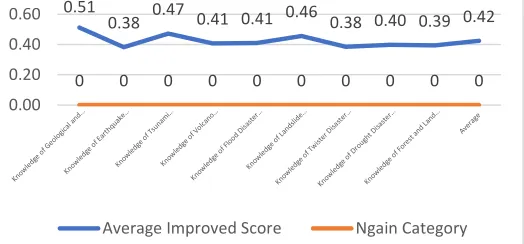
From table 4 above provides information that the N-Gain index of students' knowledge about geological and hydrometeorological disasters with an average of 0.51 in the medium category. N-Gain index on earthquake disaster knowledge an average of 0.38 with the intermediate category. N-Gain index on tsunami disaster knowledge with an average of 0.47 in the intermediate category. N-Gain index on knowledge of volcanic disasters with an average of 0.41 in the intermediate category. N-Gain index on flood disaster knowledge with an average of 0.41 and intermediate category. N-Gain Index knowledge of landslide disasters with an average of 0.46 in the intermediate category. N-Gain index of
Figure 4. Increased Knowledge of Student Disaster Mitigation
twister disaster knowledge with an average of 0.38 in the intermediate category. And N-Gain index of knowledge about drought with an average of 0.40 in the intermediate category. And also the N-Gain index of knowledge on forest and land fire disasters with an average of 0.39 in the intermediate category, to be more clearly seen in Figure 4 below.
DISCUSSION
In primary school teachers need to teach the basics about disaster mitigation, this is because schools are the right means to grow and develop student knowledge. Disaster mitigation education is carried out with the aim of (a) providing information to students about correct knowledge about disasters; (b) provides a systematic understanding of protection, and (c) equip students through practical training how to protect themselves and how they can respond to disasters appropriately and quickly [8]. In primary school, the teacher is responsible for making learning interesting so students are motivated and eager to follow the learning. The use of instructional media is one of the tips that teachers can use to be able to create interesting learning. Learning media can accompany the teacher's explanation so that students more easily understand things that are explained, with the use of media in learning, students can immediately see the same thing and do not differ among other students. By feeling and seeing the same thing, students' assumptions will be more directed at the similarity and uniformity of material acceptance. Through a learning process that is designed intentionally by educators about the disaster, mitigation knowledge is expected to be able to have an impact on students 'readiness in facing disasters and can facilitate teachers in measuring students' knowledge of disaster mitigation [11] [2] [12] [13]. Students still have imagination but are more directed and more organized [14], one of which can be used is to use learning media in each learning so that learning objectives will be more
0.51
0.38 0.47 0.41 0.41 0.46 0.38 0.40 0.39 0.42
0 0 0 0 0 0 0 0 0 0
0.00 0.20 0.40 0.60
220 easily achieved. Besides, comic media can also improve
memory because children learn in a fun way that is in their way by imagining and directed through the provision of material available in the KOASE comics [14] and can also give effect to students who have memory weaknesses [15]. Based on the data obtained after doing the pre-test and post-test there is an increase in the knowledge of disaster mitigation students in primary schools using the KOASE comic media. The use of KOASE media can increase disaster mitigation knowledge because comics have an entertainment function that can be utilized for educational purposes [8]. Disaster mitigation learning supported by using KOASE comic media increases students' knowledge in understanding how to prepare themselves before a disaster occurs when a disaster occurs and after a disaster, this is because in the KOASE comic it is packed with natural disaster mitigation materials that often occur in Indonesia nicely and attractively. Disaster mitigation learning is important to be taught to students in primary schools, this is because at this time community awareness of the importance of preparation to deal with disasters is lacking. This can be seen from the disastrous events that have been occurring more frequently due to a lack of awareness and understanding of the government and the community towards potential disaster vulnerabilities and mitigation efforts [16]. With the learning of disaster mitigation, it is hoped that students in primary schools can take action to reduce the effects of a natural disaster hazard before it occurs [17]. Therefore, the use of comic KOASE disaster mitigation
needs to be introduced in learning in schools [18]. The use of KOASE comic media can increase students' knowledge of disaster mitigation in primary schools after using KOASE comic learning media that contains material on disaster mitigation. This allows students to understand and know about the conditions of their environment [19]. Comics can be used as an effective media to teach material about disaster mitigation because the text reads in comics are only a few, and there are pictures to support the text presented in the comics so students can easily understand the material being taught [20]. The character of primary school children prefers the number of images with little text [21]. The tendency of primary school children to use KOASE comic media provides the ability to make it easier for readers to understand and remember the contents of stories related to disaster mitigation [22] [23].
4
CONCLUSIONS
The use of KOASE comic media can increase students' knowledge of disaster mitigation in primary schools so that by studying disaster mitigation students already have sufficient knowledge to be able to take appropriate actions before, during and after a disaster occurs.
ACKNOWLEDGMENT
The highest appreciation was conveyed with respect to Lembaga Penelitian dan Pengabdian kepada Masyarakat Universitas Riau, Pekanbaru, Indonesia who have provided assistance and financial support to carry out research development of Komik Anak Sekolah (KOASE) as a learning media for disaster mitigation education in primary schools..
REFERENCES
[1] Sadisun I.A.2013. Mitigasi Bencana : Dari pendekatan berbasis komunitas hingga peranan IPTEK. Invited Speaker. Pada Pelatihan Dasar Manajemen Bencana. Jakarta: BAZNAS – DOMPET DHUAFA REPUBLIKA.
[2] Suarmika, P. E., & Utama, E. G. (2017). Pendidikan mitigasi bencana di sekolah dasar. Jurnal Pendidikan Dasar Indonesia, 2(2), 18–24.
[3] Sudjana, N., Rivai A. (2013). Media Pengajaran. Bandung: Sinar Baru Algensindo.
[4] Maryani, E. (2016). Model Pembelajaran Mitigasi Bencana Dalam Ilmu Pengetahuan Sosial Di Sekolah Menengah Pertama. Jurnal Geografi Gea, 10(1). https://doi.org/10.17509/gea.v10i1.1664
[5] Tatalovic, M. (2009). Science comics as tools for science education and communication: A brief, exploratory study. Journal of Science Communication, 8(4).
[6] Farinella, M. (2018). The potential of comics in science communication. Journal of Science Communication, 17(1), 1– 17. https://doi.org/10.22323/2.17010401
[7] Damopolii, I., & Rahman, S. R. (2019). The effect of STAD learning model and science comics on cognitive students achievement. Journal of Physics: Conference Series, 1157(2). https://doi.org/10.1088/1742-6596/1157/2/022008
[8] Noviana, E. (2019). MEDIA PEMBELAJARAN KOMIK SEBAGAI SARANA LITERASI INFORMASI DALAM PENDIDIKAN MITIGASI BENCANA DI SEKOLAH DASAR. PROSIDING SEMINAR NASIONAL PENDIDIKAN GURU SEKOLAH DASAR FAKULTAS KEGURUAN DAN ILMU PENDIDIKAN UNIVERSITAS RIAU, 61–73. https://doi.org/10.33578/psn.v1i1.7781
[9] Mc. Millan, J. H., & Schumacher, S. (2001). Research in Education; Fifth Edition. United States: Addison Wesley Longman. Inc.
[10] Meltzer, D. E. (2002). The relationship between mathematics preparation and conceptual learning gains in physics: A possible ―hidden variable‖ in diagnostic pretest scores. American Journal
of Physics, 70(12), 1259–1268.
https://doi.org/10.1119/1.1514215
[11] Phelps, G., & Schilling, S. (2004). Developing measures of content knowledge for teaching reading. Elementary School Journal, 105(1), 31–48. https://doi.org/10.1086/428764
[12] Nandi, & Marlyono, S. G. (2019). The Influence of Geography Lessons in Disaster Mitigation Education toward Preparedness of Senior High School Students in Face of the Disaster. IOP Conference Series: Earth and Environmental Science, 286(1). https://doi.org/10.1088/1755-1315/286/1/012012
[13] Tuswadi, & Hayashi, T. (2014). Disaster Prevention Education in Merapi Volcano Area Primary Schools: Focusing on Students’ Perception and Teachers’ Performance. Procedia Environmental
Sciences, 20, 668–677.
https://doi.org/10.1016/j.proenv.2014.03.080
[14] Wahyuningsih, A. N. (2012). Pengembangan Media Komik Bergambar Materi Sistem Saraf Untuk Pembelajaran Yang Menggunakan Strategi Pq4R. Journal of Innovative Science Education, 1(1), 102–110
221
[16] Nugroho, A. (2019). PENGEMBANGAN MODEL PEMBELAJARAN MITIGASI BENCANA GUNUNG MELETUS DI SEKOLAH DASAR LERENG GUNUNG SLAMET. Jurnal Pengabdian Masyarakat, 53(9), 1689–1699. https://doi.org/10.1017/CBO9781107415324.004
[17] Coburn, A. W., Spence, R. J. S., & Pomonis, A. (1994). Mitigasi Bencana. Disaster Management Training Program, 74.
Retrieved from
http://rovicky.files.wordpress.com/2009/10/mitigasi-bencana.pdf [18] Kastolani, W., & Mainaki, R. (2018). Does Educational Disaster
Mitigation Need To Be Introduced In School? SHS Web of
Conferences, 42, 00063.
https://doi.org/10.1051/shsconf/20184200063
[19] Ramadhan, S., Sukma, E., & Indriyani, V. (2019). Environmental education and disaster mitigation through language learning. IOP Conference Series: Earth and Environmental Science, 314, 012054. https://doi.org/10.1088/1755-1315/314/1/012054 [20] Anafiah, S. (2014). PEMANFAATAN KOMIK ANAK SEBAGAI
MEDIA MITIGASI BENCANA. Widyapanya, 42(2), 25–28. [21] Handhika, J. (2012). PENGEMBANGAN SCIENCE COMIC
BERBASIS PROBLEM BASED LEARNING SEBAGAI MEDIA PEMBELAJARAN PADA TEMA BUNYI DAN PENDENGARAN UNTUK SISWA SMP. Jurnal Pendidikan IPA Indonesia, 1(2), 109–114.
[22] Heisler, F. (2017). A Comparison of Comic Book and Non-Comic Book Readers of the Elementary School. Journal of Educational Research, 40(6), 458–464. Retrieved from http://www.jstor.org/stable/27528820