OPTICAL GENERATION OF TUNABLE
MILLIMETER WAVE /SUB
MILLIMETER WAVE SIGNALS USING
AN OVERDRIVEN MACH-ZEHNDER
LIGHT INTENSITY MODULATOR AND
A SEMICONDUCTOR OPTICAL
AMPLIFIER
Dr. Madhumita Bhattacharya,
Dept. of Physics
Gushkara Mahavidyalaya, Gushkara West Bnegal, India. E-mail : [email protected]
Abstract
In this paper, the author proposes an optical technique for the generation of tunable mm-wave/sub-mm wave signals. The main components required for the implementation of the proposed system is an overdriven Mach-Zehnder light intensity modulator and a semiconductor optical amplifier (SOA). By applying high microwave drive power to the Mach-Zehnder modulator, higher harmonic light intensity modulations can be achieved. By selecting the fifth modulation sidebands as the pump signals to the SOA, four-wave-mixing (FWM) effect in the nonlinear SOA medium produces two new opitcal waves called as the idler waves. These idler waves are amplified and then heterodyned in a wideband photodiode to generate the desired mm-wave/ sub-mm wave signals. The phase noise of the generated signal is low since the two idler waves are phase correlated. In the proposed scheme, the frequency of the generated mm wave signal is thirty times the frequency of the applied microwave drive.
Keywords : mm wave, Mach-Zehnder modulator, SOA, FWM.
1. Introduction
Among the different optical methods for the generation of mm wave signals, the most basic and simple method is done by heterodyning two optical carrier waves in a photodiode. At the output of the photodiode, the difference frequency electrical signal is produced. To generate stable and low noise electrical signal, the two optical carriers should be phase coherent. Many techniques of making the two optical waves coherent can be found in the literature. The authors in their earlier papers have proposed optical injection locking scheme [11] and the use of optical phase locked loop [12] to generate low noise mm wave signals by beating two coherent optical waves. Photonic generation of mm wave signal utilizing four wave mixing effect in a semiconductor optical amplifier is also reported in literature [13-15]. FWM arises due to nonlinearity of the SOA.
The novelty of the proposed scheme is that the frequency of the generated mm wave signal is 30 times the frequency of applied microwave drive. Here, an overdriven Mach-Zehnder light intensity modulator is used to produce higher harmonics intensity modulation. The modulator is said to be over driven when the microwave signal voltage,
V
m applied to the modulator is greater than the half wave voltage of the modulator,V
π. Byproviding proper dc bias to the modulator, intensity modulation of the optical carrier can be generated at the harmonic frequencies of the fundamental microwave drive. By applying appropriate microwave drive voltage the fifth order modulation sidebands having frequencies,
(
f
c±
5
f
m)
can have maximum amplitude.f
c andm
f
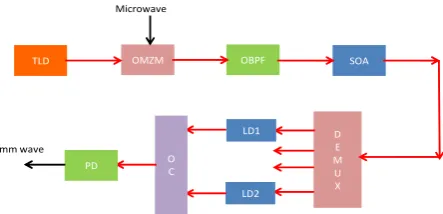
are the frequencies of the optical carrier wave and the applied microwave drive respectively. All the higherorder modulation sidebands have negligible amplitude and can be neglected. When the intensity modulated waves passes through an optical band stop filter, the optical carrier and first and third order modulation sidebands are suppressed. A fiber bragg gratting can be used as the optical filter. So, at the output of the optical filter, the fifth order modulation sidebands with appreciable amplitude are present. These two sidebands enter the SOA as two pump signals. Nonlinear four wave mixing occurs within the SOA and two new idler lightwaves are generated at the output of the SOA. The combined output lightwave from the SOA enters the demultiplexer. The demultiplexer separates the four different optical waves in different channels. An arrayed –wave guide grating (AWG) can be used as the demultiplexer. The idler waves are selected and power amplified in injection –locked semiconductor laser diodes and are then heterodyned in a wideband photodiode to generate the difference frequency electrical signal. In this scheme, the frequency of the electrical signal produced is thirty times the frequency of the applied microwave drive signal applied to the modulator. Since the two idler optical waves are phase coherent, the phase noise of the generated mm wave signal is also very low. The components required for the implementation of the proposed mm wave generator are available commercially.
2. System Description
The schematic diagram of the proposed mm wave generator is shown in Fig.1. A tunable laser diode, TLD emits the continuous wave (CW) optical carrier wave. This lightwave is intensity modulated in an over driven Mach-Zehender light intensity modulator, OMZM. The modulator is said to be overdriven when the microwave drive voltage applied to the modulator,
V
m is greater than the half-wave voltage of the modulator,π
V
. Due to this overdrive, intensity modulation occurs at harmonics of the microwave drive frequency. If thedc voltage applied,
V
dc to the modulator is2
πV
, the frequency components present at the output of the modulator consist of the optical carrier having frequency
f
c and the odd modulation sidebands havingfrequencies
(
f
c±
nf
m)
, wheren
is any odd integer. The amplitudes of then
th sideband is proportional to)
(
m
J
n , whereπ
π
V
V
m
=
m .J
n(
x
)
is the Bessel function of first kind ofn
th order and argument x. By choosingV
m=
1
.
6
V
π, the fifth order modulation sideband will have the maximum amplitude which is proportional toJ
5(
5
)
. The next higher order sidebands have negligible amplitude and can be neglected. This intensity modulated lightwave passes through the optical band stop filter, OBPF which suppresses the optical carrier and the first and third order modulation sidebands. So, at the output of the filter, the two fifth order sidebands having frequencies(
f
c±
5
f
m)
are present. These two modulation sidebands act as the two opticalp p
d
f
f
f
2=
2
2−
1 respectively. In the proposed scheme,f
1p=
(
f
c−
5
f
m)
andf
2p=
(
f
c+
5
f
m)
, so)
15
(
2
1 21d
f
pf
pf
cf
mf
=
−
=
−
andf
2d=
2
f
2p−
f
1p=
(
f
c+
15
f
m)
. These two idler waves are phasecoherent. A demultiplexer, DEMUX separates the output signal from the SOA into four different frequency components, namely,
f
1p,
f
2p,
f
1dand
f
2d. The two idler waves are power amplified in injection lockedlaser diodes [11]. LD1 and LD2 are two laser diodes whose free running frequencies are close to
d d
and
f
f
1 2 respectively. When external lightwave having frequenciesf
1dand
f
2dare injected to the laserdiodes, injection-locking can be achieved. In the locked condition, the frequency of the laser diodes, LD1 and LD2 follow the frequency of the injected signals and the optical power of the locked signals will be close to the free running powers of the laser diodes. The idler waves are power amplified and are combined in an optical coupler and are incident on the wideband photodiode, PD. Beating of the two optical waves occur inside the photodiode and at the output of the photodiode, the difference frequency electrical signal is generated. The frequency of the electrical signal in the proposed configuration is equal to
f
2d−
f
1d=
30
f
m. The frequency ofthe generated mm wave signal is 30 times the frequency of the applied microwave drive signal. If the applied microwave drive frequency is 5 GHz, mm wave signal having frequency 150 GHz can be generated. By changing the frequency of the applied microwave drive signal, the frequency of the generated mm-wave signal can be continuously tuned. This technique can be used to generate sub-mm waves and terahertz waves. The limitation comes from the availability of photodiodes. At present, UTC photodiodes are available having bandwidth 300 GHz [16]. So, if high bandwidth photodiodes or photodetectors are available in future, this scheme can produce stable and spectrally pure sub- mm wave and terahertz signals.
TLD OMZM OBPF SOA
D E M U X LD1
LD2 O
C PD
Microwave
mm wave
Figure 1. The schematic circuit diagram of the proposed mm-wave / sub-mm wave generator. TLD: tunable laser diode ; OMZM : overdriven Mach-Zehnder light intensity modulator ; OBPF : optical bandstop filter ; SOA : Semiconductor optical amplifier ; Demux : demultiplexer ; LD1 & LD2 : laser diodes ; OC : optical coupler ; PD : wideband photodiode. Electrical path ; Optical path
3. Analysis
Let the CW lightwave from the tunable laser diode (TLD) be expressed as
E
i(
t
)
=
E
iexp
j
(
ω
ct
+
θ
)
...(1)where
E
i is the peak amplitude of the optical electric field,ω
c is the angular frequency of the lightwaveand
θ
is the phase angle.The microwave drive signal applied to the over driven Mach-Zehnder modulator can be expressed as
)
cos(
)
(
t
V
t
where
V
m is the voltage amplitude andω
m is the angular frequency of the microwave drive. The dc biasapplied to the modulator (OMZM) is chosen to be
V
dc=
V
π/
2
, whereV
π is the half-wave voltage ofthe modulator.
The intensity modulated lightwave at the output of the Mach-Zehder modulator can be expressed as
)
(
exp
)
(
)
(
1
t
P
t
j
t
E
=
ω
c ...(3) where{
1
(
cos
(
(
))}
2
)
(
t
P
t
P
=
i+
φ
dc+
φ
m ;
P
i is the input optical power,π
π
φ
V
V
dcdc
=
andt
V
V
m m
m
π
ω
φ
πcos
)
(
=
Putting
V
dc=
V
π/
2
, the intensity of the modulated optical carrier can be expressed as
P
(
t
)
=
(
P
i/
2
){
1
−
sin(
m
cos
(
ω
mt
))}
...(4)where
(
)
π
π
V
V
m
=
m is the modulator drive parameter.Expanding eqn.(4) in terms of Bessels function we get
)]}
1
2
cos(
)
(
2
[
1
{
)
2
/
(
)
(
t
P
1J
2 1m
n
t
P
=
i−
n∞= n−−
ω
m ….(5) whereJ
k(
x
)
is Bessel function of first kind of orderk
with argumentx
. Substituting the value ofP
(
t
)
fromeqn.(5) to eqn.(1), it can shown that the output light is modulated by the microwave signal and the odd harmonics. As the M-Z modulator is overdriven, intensity modulation occurs at harmonics of the microwave drive frequency. Since we have assumed m=5, the fifth order modulation sidebands have the maximum amplitude. The higher order sidebands have less optical power and can neglected. This intensity modulated lightwave when passes through the optical bandstop filter, the optical carrier and the first and third order modulation sidebands having frequencies
f
c ,(
f
c±
f
m)
and(
f
c±
3
f
m)
can be suppressed. At the output ofthe optical filter the two fifth order sidebands are present. These two waves are injected to the SOA. FWM effect takes place and two new idler waves are generated. The frequencies of the idler waves are given by
)
15
(
f
c−
f
m and(
f
c+
1
5
f
m)
respectively. A demultiplexer separates the output lightwave from the SOAinto different frequency channels. The two idler waves are selected and are amplified by injection-locked laser diodes. These two amplified idler waves are phase correlated and are combined in an optical coupler and heterodyned in a wideband photodiode to generate the difference frequency electrical signal. The combined optical waves incident on the photodiode can be expressed as
2
[
(
)
exp
(
)
exp
(
)
]
1
)
(
t
=
E
1t
j
ω
1t
+
θ
1+
E
2j
ω
2t
+
θ
2Y
d d...(6)
1
E
andE
2 are the peak amplitudes of the output lightwaves from the laser diodes LD1 and LD2 respectively.The output photocurrent of the photodiode can be written as
)}] ( 30 cos{( 2 [
2 1 2 2 1 2
2 2
1 ω θ θ
η + + + −
= E E E E t
Ipd m
...(7)
η
is the responsivity of the wideband UTC photodiode. The generated electrical signal having frequencym
f
30
will fall in the desired millimeter wave region by choosingf
m. The generated power of the mm wavesignal is calculated to be
L o
mm
P
R
P
2 22
1
η
=
Here we have assumed the laser diodes LD1 and LD2 have the same optical power,
P
o andR
Lis the loadresistance of the UTC photodiode. The generated power depends on the responsivity of the photodiode. As the bandwidth of the photodiode increases, the responsivity of the photodiode decreases and less power is generated. Typically, assuming the laser diode optical power,
P
o = 50 mW,η
= .27 A/W,R
L=
50
Ω
,calculated mm-wave power at the frequency 150 GHz is calculated to be 4.5 mW .
4. Conclusion
An optical method for the generation of tunable mm-wave /sub -mm wave signals is proposed in this paper. An over driven Mach-Zehnder light intensity modulator and a SOA are used in the implementation of the proposed system. In an overdriven M-Z light intensity modulator, the optical wave is modulated by higher order harmonics of the applied microwave drive signal. Selecting the fifth order modulation sidebands as the pump waves for the SOA, FWM effect occurs inside the nonlinear SOA medium. Two new optical idler waves are generated by the FWM effect. These two optical signals are amplified , combined and mixed in a photodiode to generate the difference frequency electrical signal. In our scheme, the frequency of the generated mm wave signal is 30 times the microwave drive frequency. By changing the microwave drive frequency, the generated mm wave signal frequency can be tuned and can be extended to submm /THz band. Since the two optical waves heterodyned in the photodiode are phase correlated, the phase noise of the generated electrical signal is very small.
References
[1] G. Grosskopf, D. Rohde, R. Eggemann etal, “Optical millimeter-wave generation and wireless data transmission using a dual-mode laser ”, IEEE Photonics Technology Letters (2000), vol.12, pp.1692-1694.
[2] J.S. Leng, Y.C. Lai, W.Zhang and J.A.R. Williams, “A new method for microwave generation and data transmission using DFB laser based on fiber bragg gratings”, IEEE Photonics Technology Letters (2006), vol.18, pp.1729-1731.
[3] J.P. Yao, “Microwave photonics, ” IEEE J. Lightwave Technology (2009), vol 27, pp. 314-355.
[4] A. Saharia, P. Jangid, “Microwave-photonic frequency multiplication using four-wave mixing and fiber bragg gratings”, IJECT (2013), vol.4, pp.30-32.
[5] M.J. Fice, E. Rouvalis, F. Van Dijk, A. Accord, F. Lelarge, C.C. Rehaud, G. Carpintero and A. J. Seeds, “ 146 GHz millimetre-wave radio-over fiber photonic wireless transmission system,” Optics Express (2012), vol. 20, pp.1769-1774.
[6] C. Lin, P.Shih, W. Jiang, J.Chen, P.Peng, and S. Chi, “ A continuously tunable and filterless optical millimeter-wave generation via frequency octupling, ” Optics Express (2009), vol. 17,pp. 19749-19756.
[7] W. Li and J. Yao, “ Microwave frequency multiplication using two cascaded Mach-Zehnder modulators, ”Proc. 2009 Asia-Pacific Microwave Photonics Conf. (2009), Beijing.
[8] A. Hirata, M. Harada and T. Nagatsuma, “120-GHz wireless link using photonic techniques for generation, modulation, and emission of millimeter-wave signals,” IEEE Journal of Lightwave Technology (2003), vol.21, pp.2145-2153.
[9] S. Pan, Z. Tang, D. Zhu, D. Ben and J. Yao, “Injection-locked fiber laser for tunable millimeter-wave generation,” Optics letters (2011), 36 (24) 4722-4724.
[10] W. Liu, M.Wang, J.Yao, “Tunable microwave an sub-terahertx generation base on frequency quadrupling using a single polarization modulator”, IEEE J. Of Lightwave Technology(2013), vol.31, no.10, pp.1636-1644.
[11] M .Bhattacharya, B.Sarkar and T. Chattopadhyay, “Optical generation of mm and sub mm waves through optical sideband injection locking of semiconductor lasers, ’’ IEEE Photonics Technology Letters (2002), vol.14, pp.1611-1613.
[12] M. Bhattacharya, A.K. Saw, and T. Chattopadhyay, “Optical generation of mm-wave signals through phase-locking of two modulation sidebands of a pair of laser diodes,” IEEE Photonics Technology Letters (2004), vol.16, no.2, pp.596-598.
[13] C. Zhang, L.Wang, and K. Qiu, “ Proposal for all-optical generation of multiple frequency millimetre-wave signals for ROF system with multiple base stations using FWM in SOA”, Optics Express (2011), vol. 19, no.15, pp. 13957-13962.
[14] Q.Wang, H. Rideout, F.Zeng and J.Yao, “Millimeter-wave frequency tripling based on four-wave mixing in a semiconductor amplifier”, IEEE Photonics Technology Letters (2006), Vol.18, no.23, pp.2460-2462.
[15] A. Kumar and V. Priye, “Photonic generation of high frequency millimetre-wave and transmission over optical fiber”, Applied optics (2016), vol.55, no. 22, pp. 5830-5839.