PERFORMANCE ANALYSIS OFPLANT DISEASE
DETECTION
POONAM DEVI
M.Tech Scholar, Department of Electronics and Communication Engineering
Bhagat phool Singh Mahila Vishwavidyalaya, Khanpur Kalan, sonipat, Haryana, India
ABSTRACT: One the critical issue for supportable agriculture is identification of plant diseases. The major difficult in monitoring or treating plant diseases are huge amount of work, and also need the excessive processing time, therefore image processing is used for the detection of plant diseases. This analysis at various images processing stage to utilize the acquired information in different form. In this paper, A Neural network & k-means clustering is presented for plant disease identification. An efficient diagnosis system that focuses on plant diseases identification by these techniques is proposed.
Keywords: plant: image segmentation Clustering:-k-mean, neural network. Disease
identification. Feature extraction.
INTRODUCTION: Today, image processing is having its significance in all application areas so this visible aspect. This visible information aspect connects the real time object with computer system. It enables the computer –human interaction under the specification of application. There is the requirement or meaningful information for object representation as well as to identify the relative diseases of the object. Agriculture product or objects are required to observe to identify some infection or the disease to save the entire crop. Each agriculture product can be described by multiple associated components through out of its growth. This component can be seed, leave, stanch, root, soil, flower, or fruit. In this paper, a study to the feature extraction and defined of agriculture image. The feature extraction is the process used in classification effective and accurate recognition. in this section, the problem associated with agriculture image processing are discussed. In section, the work described by earlier research on different problem and methods of agriculture image processing. Feature extractions are discussed. Result and conclusion oblation from the work is discussed.
CAUSES OF PLANT DISEASE: plant disease and crop disease can occur and spread because
reason some of the common causes of the plant disease 1.non infection dieses-this disease caused by natural agencies.1.lighting 2.rain 3wind 4.drought 5.flooding.
EXISTING WORK: Lot of work is already defined by different researchers for feature
extortion and image segmentation. This kind of work is applied on different image associated with different application. Some of the work described by earlier researcher is discussed and
.Author [1] provided a work based on framework modeling and feature adaptive analysis to improve the classification feature and improve and feature extraction. Author the statistical derivation respective to the feature formation at pre processing stage so that the improved result will be obtained from the work Author[2] has provided a work on disease identification and classification under process the disease modeling and feature extraction modeling so that the phase specific analysis will be formed. Author defined region feature extraction and selection with supervised learning and analysis. Author [3] has provided an improved feature integrated intelligent method for disease identification on an agriculture image author defined neural network diagnostic feature map, classification and identification and process defined the classification and identification. Author [4] provided a comparative analysis for disease for disease recognition from leaf image using some machine learning algorithm author identified the plant disease. Author (5) the plant object analysis under and proceed under sum to perform the disease classification. Author (6) Clustering is the method of gathering the objects together in a block which have similar properties. We can say it unsupervised learning. In many applications, the clustering algorithm plays a vital role author(7) also applied work on grapes leaf and applied the analysis on feature different form of neural network including back propagation neural
network neural network ,generalized regression network and function . PROPOSED CLUSTERING TECHNIQUES NEURAL NETWORK USED FOR PLANT
DIEASEAS:- K-mean Clustering
Clustering is the method of gathering the objects together in a block which have similar properties. We can say it unsupervised learning. In many applications, the clustering algorithm plays a vital role. We can consider clustering is considered as good one if it satisfies following situation: [6]
(Intra-cluster distance) the distance between objects in same cluster should be minimum.
(Inter-cluster distance) while two clusters should be separated with maximum distance.
Objective to minimize: F(Intra, Inter)
The Steps for K-Mean Clustering are as follows:
Step1: Choose value of K that represents number of clusters.
Step2: Define partition for initial and value of initial mean vector for each cluster. Step3: Each remaining individual
Step4: Calculate average that compare with cluster1
Add value of individual A to the sum of values for An in Cluster1, then make a division with total sum of that score.
Add value of individual B to the sum of values for B in Cluster1, and then make a division with total sum of that score.
Step5: Calculate average that compare with cluster2
Add value of individual A to the sum of values for an in cluster2, then make a division with total sum of that score.
Add value of individual B to the sum of values for B in Cluster2, and then make a division with total sum of that score.
Step6: If value of average near about the mean of cluster1 then this individual belongs to Cluster 1, and the averages found now become the new mean vectors for Cluster 1.
Neural network : An Artificial Neuron is known as a technical method of biological neuron. ANN consists of a number of nodes, called neurons. Neural networks are typically organized in layers. In neural network all the neurons in the input layer transmit signal to each neuron of hidden layer. Weights and constants are used to represent the strength of each signal, which are calculated through the training phase. Multi-Layer perception (MLP) is one of the feed-forward neural networks use many layers to define connection between I/O layer. Feed-forward means that data flows in one direction from input to output layer (forward). Multiple layers of neurons with nonlinear transfer functions allow the network to learn relationships between I/O vectors in nonlinear and linear way. Multilayer perceptions (MLPs), which can be trained using a back-propagation algorithm is a very popular choice for many researchers. The neural network modelling is defined to perform the recognition of plant disease or the leaf the work stage modelling given under here 1. Number of input neures2.traning period 3.learing rate 4.momentum
FLOWCHART OF PROPOSED WORK:
The flowchart of proposed work is shown in fig. given below-
Fig. - Flowchart of Proposed work
: We need a dataset which is generated by any digital camera. It may be a leaf of any crop which is suffering with any disease.
: Load dataset in MATLAB Platform for further steps using following scripts Imread („filename‟)
Here, filename represent the name of the image file (including any applicable extension).
: We perform data pre-processing and segmentation method. In this step we make some small segment as like cluster of the complete data. K-mean technique is used for segmentation of image.
: Feature extractions, is the process done after segmentation. According to the segmented information and predefined dataset some features of the values should be extracted. This extraction could be the any of statistical, structural, fractal or signal processing. Morphological operators are used for extraction of feature.
: Now we perform neural network classifier for classification of disease of that suffered leaf.
Read
Image
Generatesomeempty matrices for further
usage
Out = [Op1; Op2]; ARRANGE THEOUTPUT
Train = Data (O.training,:); Trained the Data
Network = feedforwardnet ([10 20 22],'trainrp');
network = train(network,Feature',target); Output inclassification
of data on diseases basis and find accuracy
RESULT & DISCUSSION:-
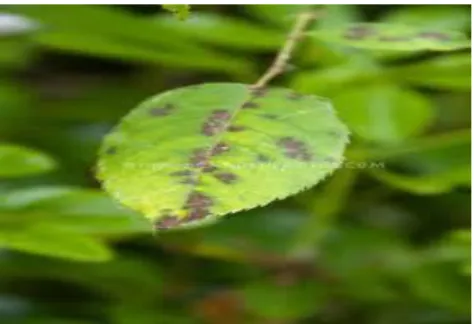
Basic and necessary need for initialization of diseases detection system is dataset from which we want to detect particular segment. The following figure represents the image which we used in our research work for detection of diseases.
: First of all we input images of leaf. These images collected in a single image. As shown in following figure 8.1. Both techniques are applied on this image. We apply our modified technique with back propagation neural network.
Figure: Image for input in work
: After loading file in programmed, our next step is to make it compatible with MATLAB tool. MATLAB works only in matrix form. Each pixel of image represent a value of matrix and the conversation id represent in black and white form as following:
Figure: Image compatible with MATLAB
: Now we need to make small segments of complete image. A combination of small segments makes a cluster of similar type. So to perform next step we need the go through segmentation process.
: All segments have some properties and some feature which of some are similar to other segments and some are different from others. Now we need to extract the features from the all segments.
Figure
Extraction of feature from all segments
: This step is performed on the basis of record collected from last step. This is a clustering performing step. We need a technique for making cluster that is k-mean clustering technique. A cluster is collection of similar type segments. The features which are similar is collected a common
Figure 8.5 apply k-mean clustering technique
: The performance measured from the last step is recorded. Now we want to improve that performance using a new technique that is back propagation technique. This technique will improve the accuracy for edge detection and grading the food quality.
Figure: Apply neural networks for detecting diseases from an infected leaf
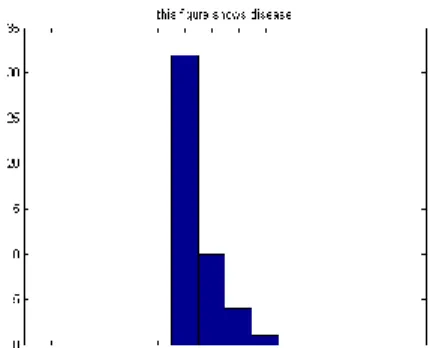
Figure: the graph represents number of diseases
Figure: Time consumption in all process to detect diseases
Figure: The represents the comparison of both neural network and k-mean
Table I accuracy by all process Time consumption and Sr. No. Technique Name Time Consumption Accuracy 1. Neural Network 1.8982 0.91489 2. K-mean 5.9956 0.78
CONCLUSION: In this paper, A study to defined feature extraction method is presented, the
paper also disused the agriculture image ,k-means clustering ,neural network ,support vector machine, plant processing identification this work a is prided is recognition of plant image .the work is main three stage first of main stage is effective extraction is done using segmentation and feature are generated over the life image and k-mean used and apply the Neural Network applied to performance recognition and apply multiply sample set an d proved the 90% accuracy image
REFERENCES:-
[1] L. Wang and Y. Huang, combined opportunity cost and image classification for non –linear image enhancement” in procc. IEEE cisis‟12, pp.135-140, 2012
[2] A. Akhtar, automated plant disease analysis .performance comparisons of machine learning techniques”, in proc. IEEE13, pp.60-65, 2013,
[3] Sannakki S.S., Rajpurohit V.S., Nargund V.B., Nargund and p. kulkarni “diagnosis and classification of grape leaf disease using neural network, proc.13, , pp.1-5 2013
[4] A.Akhtar, A.Khanum, S.A.Khan and A.S plant disease analysis .performance comparison of machine learning techniques”, in proc. IEEE13, pp.60-65, 2013
[5] R.Zhou, S.Kaneko, F.Tanka, M.Kayamoriand Shimizu,early detection and continuous quantization of plant disease using template matching and support vector machine algorithms, first into sympositium on computing and network Matsuyama , pp.300-304. 2015
[6] Rahul Malik, Raj Kumar, “Validity Measure of Cluster Based On the Intra-Cluster And Inter-Cluster Distance”, in International Journal of Electronics and Computer Science Engineering (IJECSE), Vol. 1, No. 4, pp 2486-2491,2012
[7] Kalpana Shrivastava, Neelesh Gupta, Neetu Sharma “plant Image Segmentation using Modified K Means Clustering” in International Journal of Computer Applications Vol. 103, No 16, , pp 12-15. October 2014
[8]SmitaNaikwad, NiketAmoda,” Advances In Image Processing For Detection Of Plant Diseases,” International Journal of Application or Innovation in Engineering & Management (IJAIEM), Vol2, Issue 11, November 2013.
[8] Savita n. ghaiwat.parulArora, detection and classification of plant leaf diseases using image prosing techniques: A review”, international journal of recent advances in engineering technology (IJRAET), ISSN (online):2014, pp.2347-2812
[9] Dr.K.ThangaduraiandK.Padmavathi,” Computer Vision image Enhancement For Plant Leaves Disease Detection,” World Congress on Computing and Communication Technologies2014
[10] H.Wang, G.LI, Z.Maand X.LI,”application of Neural Network to image
Ge recognition of plant diseases, system and informatics, in proc. IEEE Int.Conf.on, yantai, 2012pp.2159-2164