Please cite this article as: L. Davarpanah, E. Abdollahzadeh Sharghi, Performance of Continuous Electrocoagulation Process for Turbidity Removal from Sand Filter Backwash Water, International Journal of Engineering (IJE), IJE TRANSACTIONS C: Aspects Vol. 32, No. 12, (December 2019) 1696-1703
International Journal of Engineering
J o u r n a l H o m e p a g e : w w w . i j e . i rPerformance of Continuous Electrocoagulation Process for Turbidity Removal from
Sand Filter Backwash Water
L. Davarpanah*, E. Abdollahzadeh Sharghi
Materials and Energy Research Center, Meshkindasht, Karaj, Iran
P A P E R I N F O
Paper history: Received 16 May 2019
Received in revised form 04 November 2019 Accepted 08 November 2019
Keywords:
Electrocoagulation Energy Consumption Sand Filter Backwash Water Turbidity Removal Voltage
A B S T R A C T
The presence of particles such as algae, clay, organic materials and water-soluble substances often create turbidity or color in water. In recent years, electrocoagulation process has attracted an extensive attention due to its advantages. Since sand filters are widely used in water treatment industry and their corresponding backwash water is large in volume, turbidity removal will save water consumption and its recycling. In this study, real samples of backwash water from sand filters of a water treatment plant in Alborz province were collected. The turbidity removal was further evaluated under operating conditions of 6, 12, 18 and 30 V as the exerted voltages, electrode distances of 1 and 1.5 cm, different initial turbidities (391 NTU as sample 1 and 175 NTU as sample 2), iron and steel as the sacrificial electrodes in a continuous electrocoagulation reactor. According to the results, the optimum conditions without considering the process economy was found to be 30 V, the iron electrode and electrode distance of 1 cm and samples 1 and 2 had an effective turbidity removal efficiency of 98.4 and 91.6%, respectively.
doi: 10.5829/ije.2019.32.12c.01
1. INTRODUCTION1
Most surface waters (rivers, freshwater lakes and reservoirs of dams) contain large amounts of turbidity that need to be purified [1, 2]. Suspended solids and colloids are mainly responsible for turbidity in surface water [3]. Presence of particles such as algae, clay, organic particles and water-soluble substances often create opacity or color in water. The solubility of these particles depends on their density and size and particles with a density above the water eventually settle down due to gravitational forces. On the other hand, small particles especially particles that have a density close to water, such as bacteria and colloid particles, may never settle in water and remain as suspended particles [4]. One of the common processes for water treatment involves addition of metal salts (such as aluminum, iron, etc.), which causes the instability of colloidal particles
*Corresponding Author Email: [email protected] (L.
Davarpanah)
followed by their settlement after coagulation. In this way, chemicals such as alum, lime, etc. are widely used to remove turbidity. But, this treatment method has weaknesses, including consumption of large amounts of chemicals, chemicals supply and injection problems and production of a large amount of sludge that requires further dewatering and disposal [5].
In the past few years, electrocoagulation (EC) as an environmentally friendly process has attracted special attention. This process is efficient and cost effective, so that for some pollutants the removal efficiency is up to 99% [6]. The EC technique uses principles of electrochemistry and coagulation and has been used for the treatment of wastewater in the United States since the early 20th century and re-flourished in the 1990s due to the advanced development in technologies [7].
are often aluminum or iron, because these two metals are more affordable and available [8]. This process consists of three steps: 1) electro-oxidation of the anode and formation of coagulant materials, 2) neutralization of the surface charge, suspending and breaking the particles and 3) aggregating the formed species in the form of clot [9]. If the iron metal is selected as the electrode, the following electrochemical mechanisms occur in the electrocoagulation process (Equations (1) to (3)) [10]:
In anode:
(1)
(2)
In cathode:
(3)
In a study conducted by Rahmani [4], the efficacies of turbidity removal from model water by means of three sacrificial electrodes i.e., iron, aluminum and steel were found to be 93, 91 and 51% at 20 V in 20 minutes, respectively. In another study by Isanloo et al. [6] a turbidity removal of 97.6% from a synthetic sample in batch mode electrocoagulation was reported using aluminum electrode in pH=7, 50 V in 30 minutes. Also, in a study by Derayat et al. [11], electrocoagulation decreased turbidity of surface water (Suleiman-Shahsonghur Dam, Kermanshah) from 0.6 to 0.15 NTU. Adapureddy and Goel [12] found that increase in initial pollutant concentrations resulted in a decrease in turbidity removal efficiency from 98% at 100 NTU to 78% at 500 NTU in batch electrocoagulation of synthetic drinking water. On the other hand, electrocoagulation has been found as a promising technique in feed water of reverse osmosis plant with an efficiency of 98% [13]. In the present work, electrocoagulation was tested as an alternative method for turbidity removal from backwash water of sand filters of one of water treatment plants in Alborz province (Iran) and effect of different parameters such as applied voltage, inter-electrode distance and electrode material was studied in detail. Performance of EC process and the operating cost for the removal of turbidity was calculated and well presented.
2. MATERIALS AND METHODS
The backwash water samples were collected from one of the water treatment plants of Alborz province (Iran). Since the water samples entering the treatment plant have variable turbidities in different seasons of the year, so the turbidity of the backwash water changes as well.
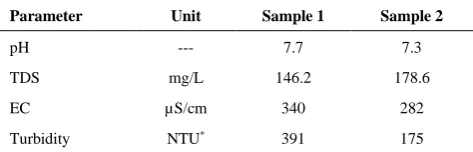
The characteristics of the two backwash water samples employed in the present work are presented in Table 1.
A continuous electrocoagulation reactor made with Plexiglass as illustrated in Figure 1 was operated with 1 L working volume. The electrodes were connected to an external DC power supply (MASTECH HY36010MR, China) providing 0 to 30 V. In this system, stainless steel and iron electrodes with dimensions of 5.9×12 cm and thickness on 1 mm were used. The residence time in each of the experiments was also fixed at 10 min. The influent was fed to the reactor by an AnTech peristaltic pump (Turkey) from the bottom of the reactor. To measure the turbidity of the effluents, an AL450T-IR AQUALYTIC turbidity meter (Germany) was used. A HACH digital multi-parameter (HQ40D model) was also applied to measure pH, electrical conductivity (EC) and total dissolved solids (TDS) of the samples.
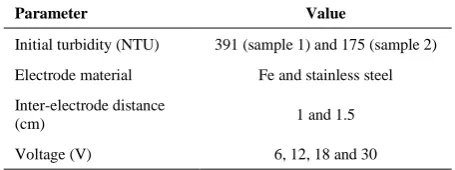
As shown in Table 2, the effect of different operating parameters such as the inter-electrode distance, electrical potential, the electrode material and the initial turbidity, as well as the effect of secondary mixing after the electrocoagulation process were investigated. The mixing process was carried out by the jar device at 50 rpm for 30 min. Electrodes were also arranged in monopolar.After start-up of the EC reactor and applying the desired residence time (i.e., 10 min) as well as other operating parameters (details of the operational parameters are shown in Table 2), the
TABLE 1. Characteristics of sand filter backwash waters used
in this work
Parameter Unit Sample 1 Sample 2
pH --- 7.7 7.3
TDS mg/L 146.2 178.6
EC µS/cm 340 282
Turbidity NTU* 391 175
Nephelometric Turbidity Unit *
effluents were sampled and physical properties such as pH, EC, TDS and turbidity were measured after a settling time of 2 h. Additionally, to investigate the effect of secondary mixing on effluent characteristics, the blended samples were also subjected to settlement for 2 h and then their physical properties were measured. It should be noted that in all graphs, symbols 1 and 2 represent the samples with initial turbidities of 391 and 175NTU, respectively.
3. RESULTS AND DISCUSSION
3. 1. Effect of Applied Voltage Operating voltage and electric current are critical parameters in electrocoagulation process. In order to study the effect of voltage on turbidity removal efficiency, experiments were performed at 5 different voltages: 6, 12, 18 and 30 V (current densities of 8.5, 15.7, 22.8 and 37.1 A/m2, respectively), and the results are presented in Figure 2. By increasing the applied voltage from 6 to 30 V, the output turbidity decreased and its removal efficiency increased for both samples. It is well-known that when voltage increases, the electrical current increases and according to Faraday's law (Equation 4 where m is dissolved metal mass (g), I, electric current (A), t, electrolysis time (s), M, molar mass, F, Faraday constant (96,485 C/mol), and n, metal valence), the amount of anode dissolution depends on the amount of electricity passing through the anode and the solution which further affects the efficiency of the coagulation process [14, 15].
Adapureddy and Goel [10] reported the same finding where by increasing the voltage from 5 to 25 V, the turbidity removal percentage increased from 37.7 to 99%. According to studies by Aziz and Joshi [16], application of higher voltage was not as effective as lower values for longer time spans. In another study by Seid-Mohammadi et al. [17], increasing applied voltages from 10 to 30 V, speed and efficiency of removal process increased, while reaction time decreased for both Al and Fe electrodes tested. In the present work, the increased turbidity removal (4.8 and
TABLE 2. Different experimental conditions for turbidity
removal used in the present work
Value Parameter
391 (sample 1) and 175 (sample 2) Initial turbidity (NTU)
Fe and stainless steel Electrode material
1 and 1.5 Inter-electrode distance
(cm)
6, 12, 18 and 30 Voltage (V)
7.6% for samples 1 and 2, respectively) by increasing voltage from 6 to 30, could be due to increased coagulant dose and bubble generation rate [18]. The optimum operating current density as the key operational parameter may be the most efficient mode of separation and turbidity removal efficiency of more than 85% in the lowest applied voltage (i.e., 6 V) is indicative of running electrocoagulation process at the lowest current density which subsequently provides an economic treatment process.
The system under study is an electrocoagulation treatment unit in which in-situ coagulants are formed by applying electric current. According to the study by Panikulam et al. [7] in which electrocoagulation using an oscillating anode for turbidity removal was performed, the coulombic efficiency of the anodic dissolution was calculated by ICP analysis for a range of operating conditions and using Faraday’s law (Equation 4). In that study, the current efficiency of around 100% was reported corresponding to the formation of Fe3+ ions (in the presence of chloride). In the present study, atomic absorption analysis was performed on treated water (after secondary mixing and sedimentation) to infer the retained metal ion and ensuring that drinking water standards are met (the maximum allowable iron concentration in drinking water is 0.3 mg/L according to EPA drinking water regulations) and the results showed that less than 0.7 mg/L of Fe3+ ion was remained at the highest applied current density (i.e., 37.1 A/m2) and coagulants dissolution from anode reacting with contaminants was completed. These results could confirm that high coulombic efficiency was achieved at all current densities applied and no visual color was detected in the treated water while, excess iron concentration could be easily removed using supplementary methods such as aeration-filtration.
(4)
avoiding the formation of aggregates. In contrast, an excessive distance between electrodes decreases the formation of flocs and adsorption of contaminants would be low [19, 20]. Ohmic potential drop as a result of solution resistance increases by increasing the distance of the electrodes and here in the present study, no significant potential or current drop was observed which confirms no inhibition for anodic oxidation [21].
In a study conducted by Xu and Zhu [22], the increase in inter-electrode distance from 5 to 25 mm reduced the efficiency of the electrocoagulation system. In another study on the treatment of dairy wastewater, turbidity was removed up to by 95% employing inter-electrode distance of 1 cm [23].
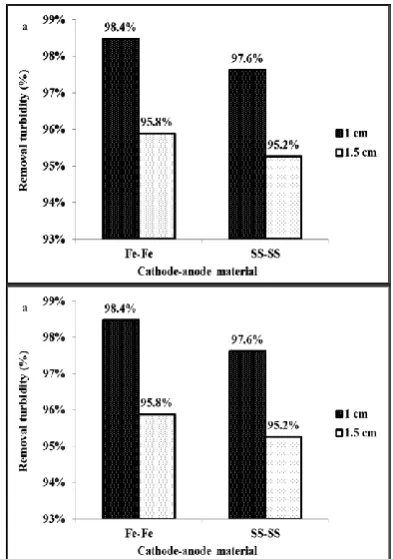
3. 3. Effect of Cathode-Anode Electrode Material Since the electrode of electrochemical cells is considered as the heart of the reactor, therefore choosing the right material is very important. The turbidity removal with respect to electrode type (i.e., cathode-anode material) was further evaluated and Figure 4a shows the effect of using iron and steel as anode electrodes (the cathode-anode material is the same) while in Figure 4b, the effect of the iron and steel as cathode electrode is presented with using Fe as the anode electrode.
Figure 2. Effect of applied voltage on output turbidity (a) and
turbidity removal (b) for Fe electrode and inter electrode distance of 1 cm: samples 1 and 2 represent turbidities of 391 and 175 NTU, respectively
Figure 3. Effect of inter-electrode distance on turbidity
removal for sample 1 (a) and sample 2 (b) for Fe electrode and different applied voltages: samples 1 and 2 represent turbidities of 391 and 175 NTU, respectively
Figure 4. Turbidity removal for Fe-Fe and SS-SS electrodes
At a constant inter-electrode distance, the efficiency of turbidity removal was almost the same for iron-iron and steel-steel assemblies. Additionally, the results of turbidity removal showed an almost similar efficiency for both iron and steel as cathode electrodes however, as time passes the amount of deposition on iron cathode increases compared to that of steel as the cathode [24]. When iron electrode is used, clusters of Fe(OH)2 and Fe(OH)3 are formed at pH values of 6 and 8, respectively. Their low solubility in water and high aggregation tendency lead to organic and inorganic materials of the effluent to coagulate [25]. The sample of treated water first turned green due to Fe 2+ production and then became yellow because of oxidation of Fe2+ to Fe3+ in the presence of oxygen during electrolysis. The extent of yellow color decreased after settling time of 2 h as the particles settled. Mansoorian et al. [24] found that lead and zinc removal from the battery industry wastewater using iron electrode was higher than steel electrode for both direct and alternating current applied. In another study on dye removal from textile wastewater, Akanksha et al. [26] observed an increase in dye removal efficiency with iron electrode compared to that of steel electrode at 12 V in 80 min (99.4 vs. 89.2%, respectively).
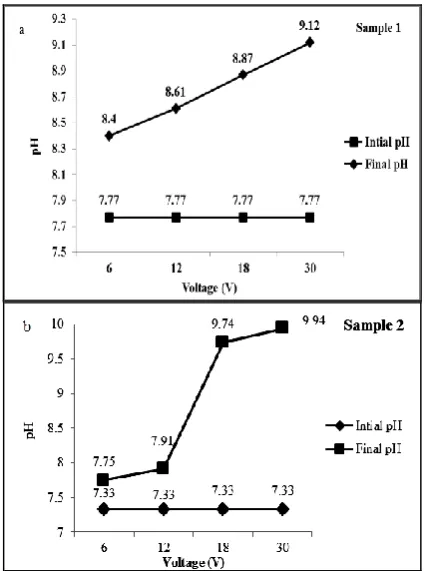
3. 4. Effect of Applied Voltage on Final Water pH In the present study, all the experiments were performed in the natural pH of the samples. The results of the pH increase during the electrocoagulation process are shown in Figures 5. The pH variation of solution after electrocoagulation process in various voltages showed that the final pH for all of experiments with iron electrode is higher than initial pH, which is in agreement with results obtained in the literature [15]. Furthermore, with increase in electrical potential, the final pH value was found to be higher due to release of CO2 during H2 evolution at cathode at low pH values (pH<7). However, electrode consumption would be higher in higher voltages which further affect electrical energy consumption [27, 28].
The change of pH during electrocoagulation process depends on the type of electrode and initial solution pH. The formation of H2 gas in the cathode electrode and OH¯ accumulation in the medium are known to increase in pH during EC process [20].
In a study conducted by Mansoorian et al. [24], pH changed during copper removal and the highest pH changes were observed for the iron electrode while a slight change in pH was observed using steel electrode. In another study reported by Bazrafshan et al. [28] on cadmium removal from synthetic wastewater in variable voltages, the final pH for iron electrodes was always higher than initial pH.
Figure 5. Effect of applied voltage on final water pH for
sample 1 (initial turbidity of 391 NTU (a) and sample 2 (initial turbidity of 175 NTU) turbidity removal (b) for Fe electrode
3. 5. Effect of Secondary Mixing The nature of produced coagulants during electrocoagulation process and the mechanism of coagulation are the keys to the success of mixing [29]. The mixing is significant if adsorption and charge neutralization are the principal mechanism of the coagulation [30]. However, mixing was reported to be critical when colloid bridging was considered as the main mechanism [31].
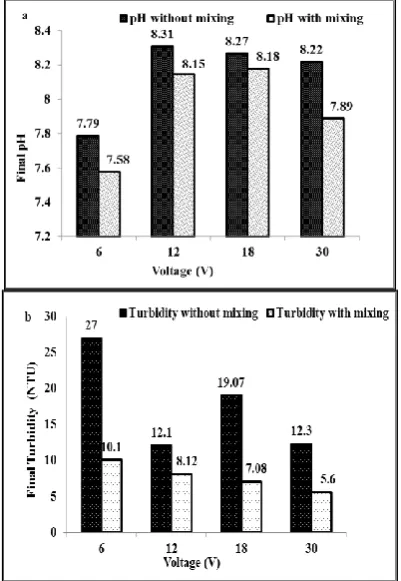
In the present work, the final pH of the treated water was in the standard range for drinking water (i.e., 7-8.5) [32]. But, to infer the effect of further secondary mixing on effluent characteristics, the treated samples were subjected to mixing and the results of final pH and turbidity are presented in Figure 6. As it is shown, the final pH slightly dropped in all applied voltages (6-40 V) (Figure 6a) while, its effect was more evident on turbidity removal (turbidity removal improved more than 50% for 6, 18 and 30 V) (Figure 6b). The difference in residual turbidity can be attributed to the characteristics of microflocs [29].
3. 6. Evaluation of Operating Costs Cost estimation of continuous electrocoagulation process is also a new approach, which is essential for economic feasibility studies. In any electrical processes, the amount of energy used is an important economic parameter affecting the operating cost. For EC process, electrode and electrical energy costs, have been taken into account as major cost items in the calculation of the operating cost [20]. The electrical energy consumption for the electrocoagulation process is expressed by Equation 5 [33]:
(5)
Where U is the voltage (V), I is the electrical current (A), t is the electrocoagulation time (h), and V is the volume of treated volume in (m3). The amount of electrode consumption is also calculated according to Equation 4.
Table 3 presents the calculation of total operating costs for the present work (the unit prices in Iranian Rial “IRR” were estimated according to the Iranian market in May 2019).
4. CONCLUSIONS
In the present study, we tried to evaluate the efficiency of turbidity removal by electrocoagulation process and
TABLE 3. Operating cost per unit volume (m3) of treated water
Total operating cost (IRR.m-3)
Electrode Consumption (gr.m-3)
Energy Consumption
(kWh.m-3) current (A) voltage (V)
Current density (mA.cm-2)
452 5.7 0.12 0.1 6 0.47
1642 17.36 0.72 0.3 12 1.4
3780 34.72 2.1 0.6 18 2.8
7985 54.87 6 1 30 4.7
The calculations are made only for iron electrode and initial turbidity of 175 NTU (residence time of 5 min).
the effect of operating conditions such as voltage, inter-electrode distance and inter-electrode material was analyzed. The highest turbidity removal for samples 1 and 2 at 1 cm inter-electrode distance and applying iron electrode were found to be 98.4 and 91.6%, respectively. Since, pH is an effective parameter in the electrocoagulation process, it was important to monitor the final pH value. At 30 V, the final pH value was higher than 9 so, in order to adjust the pH to the standard values for drinking water, the effect of secondary mixing process on the treated samples was further investigated. According to the results, turbidity efficiency increased 62, 33, 60 and 56% for voltages of 6, 12, 18, and 30 V, respectively while, the final values of pH decreased
slightly. The least operation cost from the viewpoint of energy consumption and electrode requirement was also achieved at 6 V.
5. ACKNOWLEDGEMENT
The authors would like to acknowledgr Alborz Province Water and Wastewater Company for the financial support of this research (Grant No. 963353) and are also grateful to the authorities of Materials and Energy Research Center (MERC) for providing the laboratory facilities.
Figure 6. Effect of secondary mixing on final water pH (a)
6. REFERENCES
1. Ramavandi, B., "Treatment of water turbidity and bacteria by
using a coagulant extracted from Plantago ovata", Water
Resources and Industry, Vol. 6, (2014), 36–50.
2. Derayat, J., Pirsaheb, M., Motlagh, Z.J. and Zinatizadeh, A.A., "Performance of Electrocoagulation Process in the Removal of Total Coliform and Hetrotrophic Bacteria from Surface Water",
[in persian]. Water and Wastewater, Vol. 26, (2013), 37–45.
3. Ray S.K,, Majumdera C. and Saha P., "Removal of turbidity and
E. coli from surface water by electrocoagulation and study of its
economic feasibility", Journal of the Indian Chemical Society,
Vol. 95, (2018), 1-6.
4. Rahmani, A.R., "Removal of water turbidity by the
electrocoagulation method", Journal of Research in Health Sciences, Vol. 8, (2008), 18–24.
5. Paul, A.B., "Electrolytic treatment of turbid water in package plant",In: 22 nd WEDC conference New dehli., (1996).
6. Isanloo, H., Mohseni, S.M., Nazari, S., Sarkhosh, M. and
Alizadeh Matboo, S., "Efficiency of electrical coagulation process in reduction of water turbidity", Journal of Health, Vol. 5, (2014), 67–743.
7. Panikulam P. J., Yasri N. and Roberts Edward P.L.,
"Electrocoagulation using an oscillating anode for kaolin
removal", Journal of Environmental Chemical Engineering,
Vol. 6 (2), (2018), 2785-2793.
8. Gobbi, L.C., Nascimento, I.L., Eduardo, P.M., Rocha S.M.S.
and Porto, P.S.S., "Electrocoagulatio n with polarity switch for fast oil removal from oil in water emulsions", Journal of Environmental Management, Vol. 213, (2018), 119–25.
9. Mollah, M.Y.A., Morkovsky, P., Gomes, J.A.G., Kesmez, M.,
Parga, J. and Cocke, D.L,. "Fundamentals, present and future
perspectives of electrocoagulation", Journal of Hazardous
Materials, Vol. 114, (2004), 199–210.
10. Devlin, T.R., Kowalski, M.S., Pagaduan, E., Zhang, X., Wei, V. and Oleszkiewicz, J.A., "Electrocoagulation of wastewater using
aluminum, iron, and magnesium electrodes", Journal of
Hazardous Materials, Vol. 368, (2018), 862-868.
11. Derayat, J., Jafari motlagh, Z., Pirsaheb, M., Zinatizadeh, A.A. and Bazrafshan, E., "Function of electrocoagulation process in surface water treatment by aluminum electrode", Water and Wastewater, Vol. 26, (2012), 50–4.
12. Adapureddy, S.M. and Goel, S., "Optimizing electrocoagulation of drinking water for turbidity removal in a batch reactor", International Conference on Environmental Science and
Technology IPCBEE, (2012), 97–102.
13. Sadeddin, K., Naser, A. and Firas, A., "Removal of turbidity and suspended solids by electro-coagulation to improve feed water quality of reverse osmosis plant". Desalination, Vol. 268, (2011), 204–7.
14. Ahangarnokolaei, M.A., Ganjidoust, H. and Ayati, B., "Optimization of parameters of electrocoagulation/flotation process for removal of Acid Red 14 with mesh stainless steel electrodes", Journal of Water Reuse and Desalination, Vol.8, (2018), 278–92.
15. Kobya, M. and Delipinar, S., "Treatment of the baker’s yeast
wastewater by electrocoagulation". Journal of Hazardous
Materials, Vol. 154, (2008), 1133–40.
16. Aziz, M.H.M. and Joshi, R.A., "Turbidity Removal from Water by Electrical Method".
17. Seid-Mohammadi, A., Sharifi, Z., Shabanlo, A. and Asgari, G., "Simultaneous removal of turbidity and humic acid using electrocoagulation/flotation process in aqua solution', Avicenna Journal of Environmental Health Engineering, Vol. 2, (2015).
18. Janpoor F., Torabian A. and Khatibikamal V., "Treatment of
laundry waste-water by electrocoagulation", Journal of
Chemical Technology and Biotechnology, Vol. 86 (8), (2011), 1113–1120.
19. Garcia-segura, S., Eiband, M.M.S.G., De, J.V. and
Martínez-huitle, C.A,. "Electrocoagulation and advanced
electrocoagulation processes: A general review about the fundamentals, emerging applications and its association with other technologies". Journal of Electroanalytical Chemistry, Vol. 801, (2017),267-299.
20. Ghosh, D., Solanki, H. and Purkait, M.K., "Removal of Fe (II) from tap water by electrocoagulation technique" Journal of Hazardous Materials, Vol. 155, (2008)135–43.
21. Nasrullah M., Nurul Islam Siddique M. and Zularisam A.W., "Effect of high current density in electrocoagulation process for sewage treatment", Asian Journal of Chemistry, Vol. 26 (14 ), (2014), 4281-4285.
22. Xu, X. and Zhu, X., "Treatment of refectory oily wastewater by electro-coagulation process", Chemosphere, Vol. 56, (2004), 889–94.
23. Kushwaha, J.P., Srivastava, V.C. and Mall, I.D., "Organics removal from dairy wastewater by electrochemical treatment and residue disposal". Separation and Purification Technology, Vol. 76, (2010), 198–205.
24. Mansoorian, H.J., Mahvi, A.H. and Jafari. A.J., "Removal of lead and zinc from battery industry wastewater using electrocoagulation process: influence of direct and alternating current by using iron and stainless steel rod electrodes" Separation and Purification Technology, Vol. 135, (2014), 165–75.
25. Gunukulayt, S., "Electrocoagulation/flotation treatment of synthetic surface water [dissertation]. College of Graduate Studies" Jawaharlal Nehru Technological University, (2011);
26. Akanksha, Roopashree, G.B. and Lokesh, K.S., "Comparative
study of electrode material (iron, aluminium and stainless steel) for treatment of textile industry wastewater. International" Journal of Environmental Sciences, vol. 5, (2014),519.
27. Bazrafshan, E. and Ownagh, K.A.,"Application of
electrocoagulation process using iron and aluminum electrodes for fluoride removal from aqueous environment" E-Journal of Chemistry, Vol. 9, (2012), 2297–308.
28. Bazrafshan, E., Mahvi, A.H., Naseri, S., Mesdaghinia, A.R., Vaezi, F. and Nazmara, S., "Removal of cadmium from industrial effluents by electrocoagulation process using iron
electrodes" Iranian Journal of Environment Health Science
Engineering, Vol. 6, (2006), 261-266.
29. Kan. C., Huang, C. and Pan, J.R., "Time requirement for rapid-mixing in coagulation", Colloids and Surfaces, Vol. 203, (2002), 1–9.
30. Amirtharajah, A. and Mills, K.M., "Rapid‐mix design for
mechanisms of alum coagulation". Journal‐American Water
Works Association, Vol. 74, (1982), 210–6.
31. Hahn, H.H., Hoffmann, E. and Odegaard, H., "Chemical water and wastewater treatment IV: Proceedings of the 7th Gothenburg Symposium 1996, September 23–25, 1996, Edinburgh, Scotland. Springer Science & Business Media; (2012).
32. WHO., "Guidelines for Drinking-water Quality: Surveillance
and control of community supplies", World Health
Organization, Vol. 3, (1997), 104–8.
33. Thakur, L.S., Goyal, H. and Mondal, P., "Simultaneous removal of arsenic and fluoride from synthetic solution through continuous electrocoagulation: Operating cost and sludge
utilization", Journal of Environmental Chemical Engineering,
Performance of Continuous Electrocoagulation Process for Turbidity Removal from
Sand Filter Backwash Water
L. Davarpanah, E. Abdollahzadeh Sharghi
Materials and Energy Research Center, Meshkindasht, Karaj, Iran
P A P E R I N F O
Paper history: Received 16 May 2019
Received in revised form 04 November 2019 Accepted 08 November 2019
Keywords:
Electrocoagulation Energy Consumption Sand Filter Backwash Water Turbidity Removal Voltage
هدیکچ
ذ روضح تار ی سر کاخ ،کبلج دننام تابیکرت ،
داجیا ببس بلغا بآ رد لولحم داوم و یلآ ترودک
یم گنر ای وش ن د رد .
هکییاجنآ زا .تسا هدرک بلج دوخ هب ار یدایز تاهجوت دراد هک ییایازم لیلدب یکیرتکلا داقعنا دنیآرف ،ریخا یاهلاس
آ و دنراد یعیسو دربراک بآ هیفصت عیانص رد ینش یاهرتلیف صاصتخا دوخ هب ار یدایز مجح اهنآ سوکعم یوشتسش ب
هب نآ زا ترودک فذح نیاربانب ،دهدیم رد .درک دهاوخ ینایاش کمک بآ تفایزاب و فرصم رد ییوج هفرص ناکما روظنم
هنومن شهوژپ نیا یروآ عمج زربلا ناتسا رد بآ هیفصت دحاو کی زا ینش یاهرتلیف سوکعم یوشتسش بآ یعقاو یاه
سپس .دش یاهژاتلو یتایلمع طیارش رد ترودک فذح 6
، 12 ، 18 و V 30 هلصاف ، یاه 1 و cm 5 / 1 ترودک ، هیلوا یاه
( فلتخم NTU 391 هب هنومن ناونع 1
و NTU 175 هب هنومن ناونع 2
) دورتکلا ناونع هب لیتسا و نهآ یاهدورتکلا و
قبط .دش یسررب یکیرتکلا داقعنا هتسویپ روتکار کی رد هدنوشادف داصتقا یریگرظن رد نودب هنیهب طیارش لصاح جیاتن
ژاتلو یتایلمع طیارش رد دنیآرف 30
هلصاف و نهآ دورتکلا ،تلو 1
یتناس هنومن ود ترودک فذح هدزاب و تسا رتم 1
و 2 هب
بیترت 4 / 98 % و 60 / 91 .دوب